Introduction
Most experimental studies of interactions between trematodes and hosts focus on adult parasites and their final hosts (humans and other vertebrates) and on parthenitae (usually called asexual stages) and their first intermediate hosts (molluscs). Host–parasite associations between trematode larvae (cercariae and metacercariae) and their second intermediate hosts are much less well understood, especially when the latter are represented by molluscs. This situation is largely due to the fact that, although molluscs are the second intermediate hosts of many trematodes, in the life cycles of the most widespread trematode species pathogenic for humans and domestic animals, the second intermediate hosts are either lacking (e.g. Schistosoma, Fasciola) or represented by fishes (e.g. Opisthorchis, Diplostomum) or crustaceans (Paragonimus). Schistosoma mansoni and its first intermediate hosts, molluscs in the genus Biomphalaria (particularly B. glabrata) are the subject of much laboratory attention and the Biomphalaria/Schistosoma host–parasite system is one of the best studied (for reviews see Webster & Davies, Reference Webster and Davies2001; Toledo & Fried, Reference Toledo and Fried2011).
Biomphalaria/Schistosoma studies have shown that both snail resistance/susceptibility and schistosome infectivity are governed by heritable, strain-specific factors (Richards, Reference Richards1975; Richards et al., Reference Richards, Knight and Lewis1992; Morand et al., Reference Morand, Manning and Woolhouse1996; Webster & Woolhouse, Reference Webster and Woolhouse1998; Webster & Davies, Reference Webster and Davies2001; Webster et al., Reference Webster, Gower and Blair2004; Théron & Coustau, Reference Théron and Coustau2005). Similar results have been obtained from studies on first intermediate hosts/trematode associations, such as B. glabrata/Echinostoma sp. and Pseudosuccinea columella/Fasciola hepatica (DeGaffé & Loker, Reference DeGaffé and Loker1998; Humbert & Coustau, Reference Humbert and Coustau2001; Gutiérrez et al., Reference Gutiérrez, Pointier, Fraga, Jobet, Modat, Perez, Yong, Sanchez, Loker and Théron2003). The main determinant of infection success is the parasite's ability to withstand the response of the internal defence or immune system of the molluscan host (for reviews see Adema & Loker, Reference Adema, Loker, Fried and Graczyk1997; Yoshino & Coustau, Reference Yoshino, Coustau, Toledo and Fried2011). It should be noted, however, that molluscan strains resistant to certain schistosome strains may be susceptible to other strains of these parasites (Richards & Shade, Reference Richards and Shade1987; Webster & Woolhouse, Reference Webster and Woolhouse1998; Webster et al., Reference Webster, Gower and Blair2004). Therefore, the concepts of molluscan resistance and trematode infectivity are relative rather than absolute. The likelihood is that there will always be a parasitic genotype able to infect a seemingly resistant molluscan strain. Conversely, a susceptible molluscan strain might well be resistant to an otherwise demonstrably infective parasite strain. In natural populations of B. glabrata, virtually all the molluscs are susceptible to infection by the local strain of the parasite (Shiff, Reference Shiff1994; Manning et al., Reference Manning, Woolhouse and Ndamba1995).
The research outlined above dealt with infectivity by miracidiae which give rise to mother sporocysts in molluscan first intermediate hosts. It remains unclear to what extent the features of their interactions might apply to associations where molluscs play the role of the second intermediate hosts. Grosholz (Reference Grosholz1994) demonstrated that intra-population genetic variability played a role in the resistance of the bivalves Transennella tantilla to infection with cercariae of the gymnophallid Parvatrema borealis. Same-species cercariae produced by sporocysts/rediae groups in different individuals of molluscan hosts have been shown to be variable as to morphometric parameters, life span and the expression of some behavioural reactions (Koehler et al., Reference Koehler, Springer, Keeney and Poulin2011; Prokofiev et al., Reference Prokofiev, Levakin, Losev, Zavirsky and Galaktionov2011). However, no studies analysing intra-population variability of cercarial infectivity of second intermediate hosts, or determinations of proportions between incompatible and compatible combinations in associations between molluscan second intermediate hosts and trematode larvae, have been located. In an attempt to fill this gap, the present study to analyse the host–parasite association between the blue mussel, Mytilus edulis (Bivalvia: Mytilidae) and the cercariae/metacercariae of the echinostome Himasthla elongata was carried out. The ability of cercariae to encyst in vitro in the haemolymph of mussels was chosen as the criterion for the assessment of incompatible/compatible host–parasite combinations. The results of this test were checked against the actual indices of cercarial infectivity and mussel resistance in in vivo experiments.
Materials and methods
Himasthla elongata and Mytilus edulis
The echinostome H. elongata (Mehlis, 1831) Dietz, 1909 is common in the coastal ecosystems of northern European seas. The first intermediate hosts of this parasite are intertidal snails of the genus Littorina (Gastropoda, Prosobranchia) and the second intermediate hosts are mostly intertidal bivalves M. edulis and Cerastoderma edule; its final hosts are gulls (Loos-Frank, Reference Loos-Frank1967; Werding, Reference Werding1969). At the White Sea, where our research was carried out, the role of the second intermediate host of H. elongata is virtually always played by the mussels, as the cockles C. edule are rare there. Himasthla elongata cercariae enter the mantle cavity of mussels passively in water currents via the inhalant siphon and penetrate into the mollusc's foot. Following a short migration in the foot tissues they encyst to become metacercariae some 15 min to 1 h after penetration (Zaytszeva, Reference Zaytszeva2006; our unpublished observations). Infection with H. elongata metacercariae decreases the locomotor activity of mussels as well as their byssus formation rate (Lauckner, Reference Lauckner and Kinne1983; Nikolaev, Reference Nikolaev2012). The latter, in turn, weakens the mussel attachment to the substrate, so that heavily infected individuals are more likely to be washed away by the surf.
Collection and maintenance of H. elongata in molluscan hosts
The research was carried out at the White Sea Biological Station of the Zoological Institute of the Russian Academy of Sciences. Periwinkles Littorina littorea (Linnaeus, 1758) infected with H. elongata rediae were collected in the intertidal zone of the Chupa Inlet of Kandalaksha Bay (the White Sea) in July–August of 2009–2010. The periwinkles were placed in 100 ml plastic jars filled with seawater (one periwinkle per jar) and left in sunlight for 1 h. The jars containing the molluscs were then examined under a stereomicroscope and individuals that had shed H. elongata cercariae were selected. These periwinkles were used as the source of cercariae for our experiments.
Mytilus edulis individuals free from infection with H. elongata metacercariae were collected from the substrates of the experimental aquaculture farm near the biological station. Two size-age groups of mussels were selected for the experiments: ‘small’ 2- to 3-year-old individuals with shell length 15–20 mm (average length 16.7 ± 0.3 mm) and ‘large’ 6-year-old individuals with shell length 60–70 mm (average length 63.9 ± 1.1 mm). Small mussels were used only for experimental infection by H. elongata cercariae. Large mussels were used both for experimental infection by H. elongata larvae and as a source of haemolymph.
Shells of large mussels and periwinkles used in the experiments were marked with identification numbers. When not undergoing laboratory manipulations, the periwinkles and the mussels were kept in net cages suspended in the upper subtidal zone near the station. The cages containing the mussels were placed at a distance of about 100 m from the shore and from the cages containing the periwinkles, to exclude the possibility of chance infection of experimental molluscs with H. elongata cercariae. Periwinkles were fed on thallus fragments of green algae (Enteromorpha sp.) and brown algae (dead thalli of Laminaria saccharina which had been washed ashore).
Assessment of encystment success of H. elongata cercariae in M. edulis haemolymph
Himasthla elongata cercariae shed by a single infected L. littorea snail were considered as a clone produced by the rediae parasitic in this individual host. These rediae reproduce by apomictic parthenogenesis (Dobrovolskij & Ataev, Reference Dobrovolskij, Ataev, Combes and Jourdane2003) and originate from a single miracidium that has infected a particular mollusc. This means that they have the same genotype, which is also repeated in cercariae. The assumption that the periwinkles used in our experiments had monomiracidial infection was based on the following. First, the snails were collected from the population where the H. elongata prevalence did not exceed 1.4% (our data). Second, this assumption was supported by the results of the genetic study of rediae isolated from 200 infected L. littorea individuals collected in 2008–2010 from the same population. Amplified fragment length polymorphism (AFLP) analysis of H. elongata genomic DNA demonstrated that the level of differences between the rediae from a single individual was always considerably lower than between the rediae from different individuals (Galaktionov et al., Reference Galaktionov, Solovieva, Fedorov and Podgornaya2010; N. Galaktionov, unpubl. obs.).
In vitro encystment success of H. elongata cercariae in M. edulis haemolymph was considered as the universal index, the values of which reflect the degree of expression of defence reactions in different mussel individuals (host resistance) as well as the ability of cercariae from different clones to overcome the defence reactions of the host (infectivity of each parasite clone). This parameter, expressed as a percentage, was determined as the ratio of encysted cercariae (REC) in the mussel haemolymph in vitro. REC of one clone of H. elongata cercariae in the haemolymph of a single mussel served to show the effectiveness with which the cercariae of this clone overcame the defence reactions of this mussel; that is, it characterized the interaction success in this particular ‘H. elongata clone–M. edulis individual’ combination. Infectivity of each clone of H. elongata cercariae was assessed in vitro using the average REC (H. elongata average REC, HAREC) of that clone in the haemolymph of different M. edulis individuals. The resistance of a M. edulis individual was assessed in vitro using the average REC (M. edulis average REC, MAREC) of different H. elongata clones in the haemolymph of that individual.
To obtain H. elongata cercariae, the infected L. littorea individuals previously selected were placed for 2 h into separate jars (100 ml) with filtered seawater (FSW) with the natural White Sea salinity (24‰) at a temperature of 18–20°C. The water with the shed cercariae was poured into Falcon conical tubes (50 ml) and cooled down to 2–4°C by placing the tubes in an ice-bath. Short-term (1–2 min) cooling resulted in a reversible decrease of motility of H. elongata cercariae so that they concentrated at the bottom of the tube; in this way 30–200 cercariae could be sampled easily in a small amount of water (10 μl). This sampling method made it possible to obtain cercariae free from L. littorea faeces, mucus and soluble products. This was important since, as with other echinostomes studied by Fried & LaTerra (Reference Fried and LaTerra2002), H. elongata cercariae may spontaneously encyst in water conditioned by the molluscan host (our data).
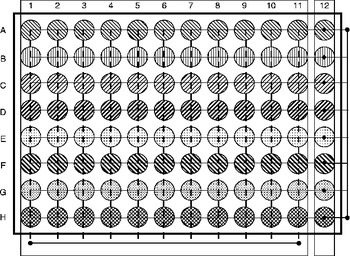
To assess the encystment success of H. elongata cercariae in the haemolymph of M. edulis in vitro, the technique devised by Gorbushin & Levakin (Reference Gorbushin and Levakin2005) was used. Into each well of a 96-well flat-bottom plate, 10 μl of FSW with 30–70 H. elongata larvae were placed. Cercariae of the same clone were placed into each of the 12 wells of one horizontal row of the plate (nos 1–12). As the result, one plate contained eight larval clones (fig. 1). Then into each of the eight wells of one vertical row (A–H) 100 μl of haemolymph obtained from one M. edulis individual was added. The haemolymph (850–900 μl) was sampled with a sterile syringe (needle diameter 0.8 mm) from the posterior abductor sinus of a single M. edulis individual. The haemolymph was added to the cercariae immediately after sampling; the time of its addition was recorded separately for each vertical row of the wells. After the first 11 vertical rows of the plate were filled with the mussel haemolymph, 100 μl of FSW was added to cercariae-containing wells of the last vertical row. In this way, in each well of the plate one combination ‘parasite clone–haemolymph of an individual mussel’ was tested (altogether 88 combinations per plate). Wells filled with FSW were used to control the viability of cercariae of the tested clones.
The plate for testing infectivity of Himasthla elongata cercarial clones and mussel resistance (explanations in the text). Vertical rows (A–H): cercarial clones (wells with cercariae from the same clone (8) are highlighted by the same shading and shown by a solid horizontal line). Horizontal rows: (1–11) haemolymph from 11 mussel individuals (wells with haemolymph from the same mussel individual are shown by a broken vertical line); (12) filtered seawater.

After 12 h incubation at 15–17°C, actively swimming larvae, dead (immobile deformed) larvae and successfully encysted larvae (metacercaraie) were counted. To assess the temporal stability of the differences in HAREC revealed during the experiment, for ten clones of H. elongata cercariae this experimental procedure was repeated 2 weeks later, this time in the haemolymph of M. edulis individuals not involved in the first experiments. Altogether, in the course of the experiment 764 ‘cercarial clone–mussel individual’ combinations were examined, with 51 H. elongata clones (51 infected L. littorea individuals) and 161 M. edulis individuals being involved. Immediately following the procurement of cercariae from the periwinkles and haemolymph from the mussels, both species of mollusc were returned to their net cages.
Secondary testing of the given cercarial clone in the haemolymph of the given mussel individual in vitro was constrained by the time (about 3 weeks) necessary for the recovery of the mussel after haemolymph sampling. Therefore the combination ‘cercarial clone–haemolymph of an individual mussel’ was tested only once in a single well of the plate. This could influence the variation of the average REC both for the cercarial clone (HAREC) and for the mussel (MAREC). The greatest variation could be expected at intermediate values of these parameters, that is, at average REC values around 50%. This is determined by the scatter of REC values in each well. To avoid errors, we selected for further experiments only those cercarial clones and those mussel individuals that demonstrated extreme values of, respectively, HAREC and MAREC in the in vitro test. In other words, the experiments involved the cercarial clones whose representatives had either totally perished or totally encysted during the tests in the haemolymph of 11 randomly selected mussels (11 vertical wells of the plate). Correspondingly, large mussels used in further experiments were represented by the individuals in whose haemolymph the majority of cercariae from eight randomly selected clones (eight horizontal wells of the plate) had either completely perished or completely encysted.
Experimental infection of mussels with H. elongata cercariae
For experimental infection of the mussels we used cercariae from the H. elongata clones that differed considerably in terms of their HAREC. The experiments were conducted at 18–20°C. After measuring their shell length, the mussels were placed in separate (100 ml) jars with fresh seawater with a salinity of 24‰. After the molluscs started filtering the water, a certain number of cercariae belonging to one clone were introduced in the proximity of the inhalant siphon. Twenty-four hours after the experimental infection the mussels were dissected and H. elongata metacercariae in their tissues were counted. The success of the experimental infection was rated by the ratio between the number of H. elongata metacercariae found during dissection and the number of cercariae with which this mussel had been infected. Two series of experiments were performed, one on large mussels and one on small mussels.
Experiments with large mussels were made on the same individuals that had served as the source of haemolymph in the studies of H. elongata cercariae encystment in vitro. After the haemolymph samples had been taken, these mussels were kept in subtidal net cages for 3 weeks before being infected experimentally. Identified from their results in the cercarial encystment in mussel haemolymph experiments, 39 parasite/host combinations with contrasting in vitro REC values were selected for infection (19 ‘incompatible’ combinations with REC close to 0% and 20 ‘compatible’ combinations with REC approaching 100%). Each M. edulis individual was infected with 50 H. elongata cercariae from the clone whose representatives had earlier been incubated in vitro in the haemolymph of this mussel. Altogether in this experiment, 39 M. edulis individuals infected with 1950 H. elongata cercariae from 12 clones were dissected.
Small mussels were infected using three clones of ‘effective’ cercariae (HAREC in vitro over 95%) and three clones of ‘ineffective’ cercariae (HAREC in vitro not exceeding 40%). The mussels used in this experiment were intact, since it is impossible to sample haemolymph from small individuals without severely damaging them. Each M. edulis individual was infected with ten cercariae belonging to the same clone. In this experiment, 72 mussels were infected with ‘ineffective’ cercariae and 71 mussels were infected with ‘effective’ ones. Altogether, 143 mussels infected with 1430 H. elongata cercariae obtained from six L. littorea individuals were dissected.
Data analysis
The data were treated statistically according to the standard recommendations (Sokal & Rohlf, 1995). For testing homogeneity during multiple comparison of ratios, χ2-test was used. During pairwise comparison of ratios, the significance of differences was determined with the help of the two-tailed Fisher's exact test. Confidence intervals of ratios were calculated according to the exact Fisher's formula. The significance of differences between average values was assessed using the two-tailed Student's t-test for independent samples. The presence of correlation between REC and the time of application of the mussel haemolymph was studied with the help of Pearson correlation (r) and Spearman rank correlations (r S). The significance of correlation was determined by comparing the ratios of correlation coefficients to their errors (z/s z for z-transformed r and r S/s rS for r S) with the critical values of the t-distribution. Before using parametric statistics (the calculation of the average values and their confidence intervals, Pearson correlation) and also before applying the t-test, the ratios were subjected to Fisher's normalizing transformation ( $$\varphi = 2\hairsp arcsin\,\sqrt { p } $$, where p is ratio). After the calculation, the average ratios and the limits of their confidence intervals were subjected to the inverse transformation. All confidence intervals are given with a 95% significance level. The limits of asymmetrical confidence intervals are given in the graphs and in parentheses after the value of the ratio or of the ratio's average.
Results
Himasthla elongata cercariae continued to swim actively in control wells containing seawater throughout the 12 h of incubation. Sometimes they briefly attached to the bottom or (more rarely) the sides of the well with their suckers. Having made several body contractions characteristic of crawling, such cercariae detached and began swimming again.
Addition of M. edulis haemolymph into the experimental wells enhanced the locomotor activity of H. elongata cercariae. The larvae spent less time swimming and instead crawled on the bottom and sides of the well for longer periods. Crawling cercariae probed the substrate surface with the anterior body end. After some time, the attached larvae stopped crawling and started to form cysts, rounding and rotating their ‘jack-knifed’ bodies.
Eventually, H. elongata cercariae placed in the M. edulis haemolymph either perished or successfully finished encystment, becoming metacercariae. All the cercariae that failed to produce a cyst wall after 1 h spent in the M. edulis haemolymph perished. Some larvae failed to complete their encystment and perished later, the cercarial body falling out of the partially formed cyst. In contrast to the cercariae that perished in the water (LT50 of H. elongata cercariae at 24‰ and 20°C is 26–30 h (Prokofiev, Reference Prokofiev2006)), cercariae that perished in mussel haemolymph quickly became opaque, lost their shape and increased in size two- to threefold. After 12 h incubation, only encysted metacercariae or dead cercariae could be observed in the wells.
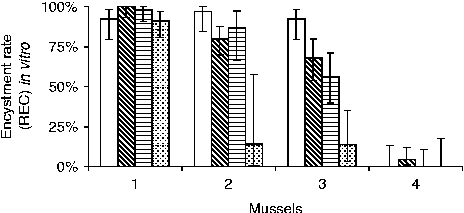
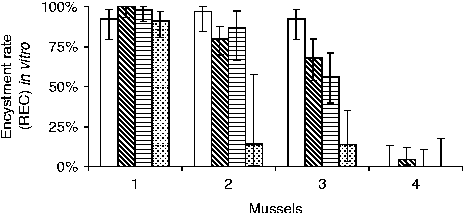
During in vitro incubation in the mussel haemolymph, REC in various combinations ‘H. elongata cercarial clone–M. edulis individual’ varied from 0 to 100%. No dead or encysted cercariae were found in FSW (control) after 12 h of incubation. In most cases (67%), RECs of individual clones of the parasite differed significantly (P< 0.05) in the haemolymph of single mussels (fig. 2). When encysting in vitro in haemolymph of different mussels, cercariae of each clone also demonstrated considerable (P< 0.01) differences in REC (fig. 2). REC in vitro and the time of addition of the mussel haemolymph were not correlated for any of the H. elongata clones used in the experiment ( − 0.5 < r< 0.49, P>0.05, average r= 0.006 ± 0.091; − 0.53 < r S< 0.54, P>0.05, average r S= 0.008 ± 0.09). MAREC were not correlated (r= 0.151, r S= 0.148, P>0.05) with the time of the haemolymph addition and showed no tendency towards either increasing or decreasing in the course of the experiment.
The ratio of successfully encysted cercariae (REC) of Himasthla elongata in the Mytilus edulis haemolymph in vitro (an example of 16 combinations ‘parasite clone–host individual’). Columns with the same shading represent the same cercarial clones.
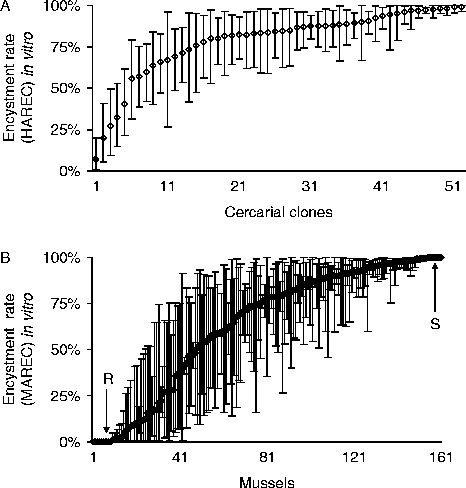
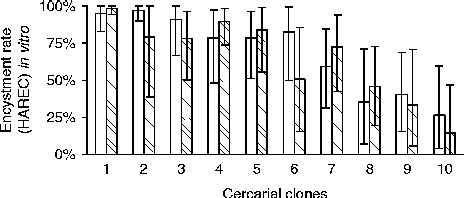
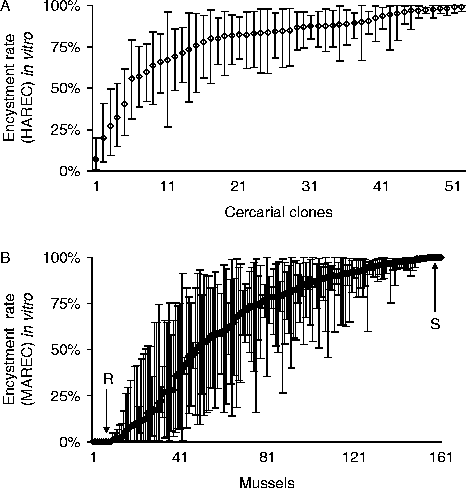
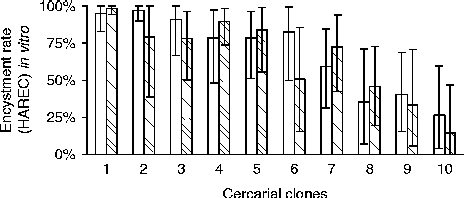
In vitro HAREC for individual H. elongata clones varied from 18 to 100% (fig. 3A), the average being 80% (74.3–85.2%). Most of the clones of H. elongata cercariae effectively encysted (HAREC over 60%) in the mussel haemolymph in vitro. Less than 10% of the cercarial clones had a HAREC greater than 95%, with the same percentage of clones failing to encyst, effectively having a HAREC below 40% (fig. 3A). MAREC in different samples of the mussel haemolymph varied from 0 to 100% (fig. 3B), the average being 65.2% (57.6–72.4%). All the H. elongata cercariae died in the haemolymph of 6% of the mussels in vitro. No instances of larval death were observed in the haemolymph of only 4% of the mussels (fig. 3B). The results of the second assessment of HAREC in mussel haemolymph in vitro, were statistically indistinguishable (P>0.05, t-test for dependent samples and Fisher exact test for each of clones) from those obtained for the ten H. elongata clones used 2 weeks earlier (fig. 4).
Average encystment rate of Himasthla elongata cercariae in vitro in the haemolymph of 6-year-old Mytilus edulis individuals. (A) Average encystment rate of cercarial clones (HAREC) (each dot on the plot stands for average encystment rate of cercariae of one clone in the haemolymph of different mussel individuals); (B) average assessment of the degree of expression of defence reactions in samples of mussel haemolymph (MAREC) (each dot on the plot stands for average encystment rate of cercariae of different clones in the haemolymph of the same mussel individual); R, fully resistant mussels; S, fully susceptible mussels.
Average encystment rate of ten Himasthla elongata clones in Mytilus edulis haemolymph in vitro. White column, first experiment; shaded column, second experiment made 2 weeks after the first experiment.
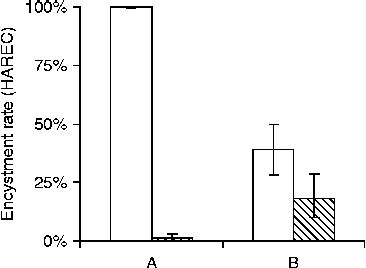
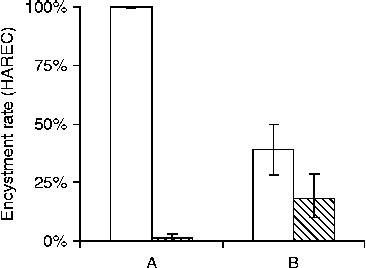
The success of experimental infection of large mussels with H. elongata cercariae varied from 10 to 74%, with an average of 28.3% (21.0–36.1%), and it showed no correlation with mussel shell length (r= − 0.12, P>0.05; r S= − 0.09, P>0.05). The average success of experimental infection of mussels in combinations ‘clone of H. elongata cercariae/M. edulis individual’ for compatible combinations selected beforehand on the basis of the in vitro test was significantly (P< 0.01) higher than for incompatible combinations (fig. 5). At the same time, the average REC derived from experimental infection of mussels for incompatible combinations turned out to be much higher (P< 0.01) than the REC derived from in vitro testing, whereas the average REC for compatible combinations was, in contrast, much lower (P< 0.05) (fig. 5).
Average encystment rate of Himasthla elongata cercariae in mussel haemolymph (in vitro test) (A) and in the same mussel individuals that had served as the source of haemolymph (experimental infection) (B). Compatible (white column) and incompatible (shaded column) host–parasite associations ‘Mytilus edulis individual/Himasthla elongata clone’ were selected on the basis of the in vitro test (see text for details).
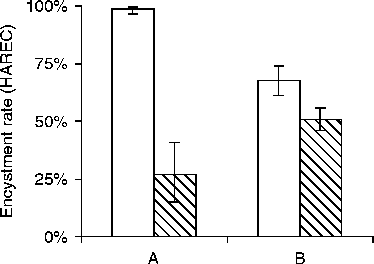
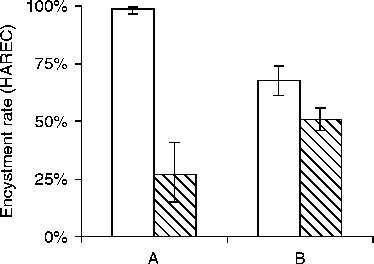
The success of experimental infection of small mussels with H. elongata cercariae varied from 10 to 100%, the average being 59.4% (55.1–63.6%), and no correlation with mussel shell length was displayed (r= − 0.04, r S= − 0.06, P>0.05). ‘Effective’ cercariae encysted more successfully than ‘ineffective’ ones both in vitro in the haemolymph of large mussels (P≪0.01), and in experimentally infected small mussels (P< 0.01) (fig. 6). At the same time, ‘ineffective’ cercariae demonstrated a higher (P< 0.01) average success (average REC) during experimental infection than during in vitro encystment (fig. 6). ‘Effective’ cercariae encysted much more (P≪0.01) successfully in vitro in mussel haemolymph than during experimental infection (fig. 6). Experimental infection was less successful in large mussels than in small ones (P< 0.01).
Average encystment rate of Himasthla elongata cercariae in the haemolymph of large (5- to 7-year-old) mussels (A) (in vitro test) and small (2- to 3-year-old) mussels (B) (experimental infection). Cercarial clones (‘effective’ (white column) and ‘ineffective’ (shaded column) cercariae) are grouped according to their encystment success in vitro.
Discussion
Our results, like those of Gorbushin & Levakin (Reference Gorbushin and Levakin2005), demonstrated a twofold impact of mussel haemolymph on H. elongata cercariae during in vitro incubation. On the one hand, the haemolymph triggered the process of cercarial encystment, but, on the other, it had a toxic impact on the cercariae, causing the death of some or all of them. The factors triggering encystment in echinostome cercariae remain poorly understood (Keeler & Huffman, Reference Keeler, Huffman, Fried and Toledo2009). Fried & LaTerra (Reference Fried and LaTerra2002) tested 15 contrasting media for in vitro encystment of Echinostoma caproni cercariae and observed effective encystment in only two: Locke's-ASW medium yielded 67% encystment, and a B. glabrata embryonic cell line (BgE) medium yielded 23% encystment. Fried & LaTerra (Reference Fried and LaTerra2002) attributed the high effectiveness of encystment in the Locke's-ASW medium to the fact that its physiochemical make-up may have simulated the gastropod pericardial-kidney region, the site where metacercariae are located in naturally infected molluscs.
It seems likely that the haemolymph of mussels – the specific second intermediate host of H. elongata – contains some molecular factors serving as specific triggers of larval encystment. It is possible that, as with E. caproni, cercarial encystment in H. elongata is triggered by specific physiochemical conditions in mussel haemolymph. In vitro encystment of H. elongata cercariae in mussel haemolymph is very unlikely to be merely a defence reaction of the larva to an aggressive medium. If this were so, the larvae would encyst in the haemolymph of non-specific hosts as well. However, it has been shown that during experimental incubation of H. elongata cercariae in the haemolymph of White Sea bivalves Mya arenaria, which are not among the second intermediate hosts of H. elongata, cercariae died after 1–2 h without demonstrating any features of attempted encystment (Levakin, unpubl. obs.).
The in vitro encystment success of H. elongata cercariae in M. edulis haemolymph is heavily dependent on both the toxicity of the haemolymph of a given mussel and on the ability of a given cercarial clone to resist its toxic impact (fig. 2). However, the defence reactions of the host, which determine the haemolymph toxicity, are just one (though a very important one) of the several barriers the cercariae have to overcome in order to encyst successfully in the second intermediate host. Equally as crucial is the chemoreceptive power of a cercaria to recognize the host, its ability to attach to it, to penetrate its epithelium, to migrate towards the final settlement site, etc. Failure to overcome any of these hurdles could result in the death of the cercariae. Importantly, larvae with high resistance to the haemolymph toxic factors could be less successful at overcoming some of the aforementioned migratory hurdles than those with a lesser resistance to the defence reactions of the host. It is noteworthy that other experiments demonstrated that H. elongata cercariae from clones that died in the mussel haemolymph in vitro (incompatible associations) were relatively successful during experimental infection of the same mussels (fig. 5). That would lead us to conclude that the mussel haemolymph, in which the cercariae were placed in vitro, is a much more aggressive medium for them than the host tissues. In the experimental plates the cercariae would have encountered haemocytes activated during haemolymph sampling from the mollusc and these would have been adhering to the plastic on which the cercariae were attempting to encyst. This circumstance may have contributed to the lack of success for the larval clones that had a low resistance to the factors of the mussel internal defence system.
In our opinion, it was the combined impact of all the above factors that resulted in the lesser infection success of mussels by cercarial clones in the compatible combinations determined by the in vitro tests and, conversely, in the greater success by the incompatible combinations (fig. 5). The same phenomenon was apparent in the infection success of large and small mussels by ‘effective’ and ‘ineffective’ cercarial clones (fig. 6). Cercariae had already been shown to have less infection success in large mussels than in small ones by Nikolaev et al. (Reference Nikolaev, Sukhotin and Galaktionov2006), Zaytszeva (2006) and Nikolaev (Reference Nikolaev2012). This may be associated with the higher pumping rate of large mussels, which could hinder cercarial attachment, or the fact that larger and older mussels may have thicker epithelia which are more difficult for cercariae to penetrate.
It should be emphasized that, despite the differences discussed above, the results of the in vitro testing and those of the experimental infections were, in general, highly similar. During experimental infection of mussels with H. elongata cercariae in compatible host–parasite associations determined by the in vitro test, a tendency towards a higher average encystment success of the larvae in molluscs could be clearly seen, as compared with the incompatible host–parasite associations. Also, a higher average success of experimental infection was revealed when a random set of large and small mussels was infected by cercarial clones effectively encysting in vitro (fig. 6). All these considerations draw us to the conclusion that the results of in vitro testing reflect actual relationships in the host–parasite associations under study. This means cercarial clones differing as to their infectivity and mussel individuals differing as to their resistance to the infection can be indentified without conducting experimental infections. This places at our disposal a reliable tool for the study of intra-populational variability of trematode larvae and their relationships with the second intermediate hosts with the use of the ‘mussel/H. elongata cercaria’ model system.
The possibility that our technique could be extrapolated to other ‘echinostome cercariae/molluscan second intermediate host’ associations remains an open question. For the experiments to be successful, the model association would need to comply with several basic requirements, which are fulfilled in the model ‘mussels/H. elongata cercariae’. The main requirements are as follows:
● the molluscan first intermediate host sheds cercariae in sufficiently large numbers to provide at one shedding episode enough individuals of the same clone to be used in experiments;
● the molluscan second intermediate host is large enough to survive provision of sufficient haemolymph (about 900 μl in our experiments) in one sample;
● the mollusc can completely recover from the haemolymph sampling procedure in the required time;
● the haemolymph of the molluscan second intermediate host contains inductors triggering cercarial encystment.
The agreement between the results of the in vitro tests and those of the experimental infections, as well the similarity of HAREC values obtained from the primary and secondary testing of the cercarial clones conducted after a two-week interval with the use of haemolymph from a different set of mussels (fig. 4), indicate that the infectivity levels of cercarial clones and the resistance levels of mussels are stable. This may point to a genetic basis of the revealed intra-population differences in the effectiveness of cercarial interactions with the second intermediate host. Most cercarial clones have a high effectiveness ( = infectivity) of infecting their second intermediate hosts. This said, a small fraction of cercariae exhibits an extremely high effectiveness, and approximately the same fraction, a decreased effectiveness. A similar situation is observed with the resistance to cercarial infection by their specific second intermediate hosts, the mussels. The vast majority of the molluscs tested are susceptible to some level of cercarial infection, but a small number (less than 10%) are either highly susceptible or highly resistant to infection.
The pattern of parasite/host compatibility outlined above mirrors associations described for miracidia (mother sporocysts) and their first intermediate hosts, molluscs (see Lively, Reference Lively1989; Shiff, Reference Shiff1994; Manning et al., Reference Manning, Woolhouse and Ndamba1995; Lively & Dybdahl, Reference Lively and Dybdahl2000). In both cases most potential hosts in the natural populations are susceptible to infection, while most infective agents (miracidia and cercariae) have a high infectivity. The data obtained from both our in vitro and in vivo experiments are reflected in the pattern of infection in mussel settlements in the Chupa inlet. In places where there is natural infection of periwinkles with H. elongata, the prevalence of metacercariae of these trematodes in mussels reaches 98%, with the infection intensity being 1–54 individuals (Nikolaev, Reference Nikolaev2012).
The results of our experimental infections demonstrate that no mussels are totally resistant to infection and no clones of H. elongata cercariae are totally effective. The mussels were infected to some extent in all combinations of resistance/infectivity, but the infection success varied. Thus, mussel resistance to infection by H. elongata cercariae is relative. This conclusion agrees with the observations made on Biomphalaria/schistosome associations (Richards & Shade, Reference Richards and Shade1987; Webster & Woolhouse, Reference Webster and Woolhouse1998; Webster et al., Reference Webster, Gower and Blair2004). Moreover, Théron & Coustau (Reference Théron and Coustau2005) and Théron et al. (Reference Théron, Coustau, Rognon, Gourbiere and Blouin2008) showed that, while resistant and susceptible strains of Biomphalaria can be distinctly differentiated in cases of infection by a few miracidia, infection success turns out to be similar when the dose of miracidia is increased. This may be associated with the inability of the molluscan defence systems to resist parasites during mass infections. It is possible that a similar effect was seen in the case of the experimental infection of mussels with H. elongata cercariae.
Acknowledgements
We are grateful to Dr S.W.B. Irwin for his helpful comments and improvement of the English version of the manuscript. This work was supported by the Russian Foundation for Basic Research (grant number 10-04-00430) and St. Petersburg State University (grant number 1.37.80.2011).