Introduction
The magnetocaloric effect (MCE) is the reversible temperature change of a magnetic material upon application and removal of a magnetic field, as illustrated in Figure 1. The phenomenon was discovered in 1917 in nickel by Weiss and Picard.Reference Weiss and Piccard1 Its potential for room-temperature refrigeration utilizing a regenerative cycleReference Brown2 was demonstrated with elemental gadolinium in 1976. Today, industrial prototypes for different cooling applications exist,Reference Belusa3–5 some of them utilizing materials with a “giant” MCE. In these materials, a first-order magnetic phase transition occurs jointly with a change in the structure, which was first observed in Gd5Si2Ge2.Reference Pecharsky and Gschneidner6 This finding triggered research that soon led to the discovery of other giant magnetocaloric materials, such as La-Fe-Si-basedReference Hu, Shen, Sun and Cheng7 and Mn-Fe-P-based alloys,Reference Tegus, Brück, Buschow and de Boer8 and NiMn-based Heusler alloys.Reference Krenke, Duman, Acet, Wassermann, Moya, Mañosa and Planes9
Illustration of magnetocaloric effect. When the magnet is removed from the (magnetized) magnetocaloric material adiabatically, the material cools down.

Contributions of magnetism and structure to the MCE
Magnetocaloric materials release heat when an externally applied magnetic field induces a transition from a disordered to an ordered phase. This is expressed by an (isothermal) entropy change ∆S T. In an adiabatic process, a corresponding temperature change, ∆T ad, is observed. In a first approximation, the total entropy change, ∆S T, may be decomposed into contributions arising from the relevant degrees of freedom—occupation of electronic bands, magnetic order, and lattice vibrations.Reference Tishin and Spichkin10 Apart from their high sensitivity to the magnetic field at the first-order transition, giant magnetocaloric materials may also benefit from the concomitant changes in the entropy contributions not directly related to magnetism.
The electronic entropy, S el, usually provides the smallest contribution, and its change, ∆S el, is also small in absolute number. S el is essentially proportional to the electronic density of states (DOS) at the Fermi energy, E F. The highest occupied electronic energy levels at E F are subject to thermal disorder. S el can be determined by low-temperature calorimetry or photoemission spectroscopy, or alternatively, from first-principles calculations in the framework of density functional theory (DFT).Reference Fujita, Fukamichi, Wang and Kawazoe11,Reference Lovell, Ghivelder, Nicotina, Turcaud, Bratko, Caplin, Basso, Barcza, Katter and Cohen12 In magnetic materials, the electronic bands cease to be spin-degenerate, which leads to a spin-dependent occupation of the electronic orbitals and thus the appearance of magnetic moments. The sizes and orientations of the moments may differ from one atomic site to another and form ordered or disordered magnetic configurations in the crystal lattice. These determine the magnetic contribution to the entropy change.
In giant magnetocaloric materials, the coupling between magnetism and structure usually inhibits the direct determination of ∆S mag from calorimetry, which yields ∆S T instead.Reference Gschneidner, Pecharsky and Tsokol13 However, ∆S mag can be assessed indirectly by subtracting the electronic and lattice contributions from ∆S T, or from theory, for instance, by employing a statistical model description of magnetism such as the Heisenberg model with parameters obtained from DFT calculations.Reference Buchelnikov, Entel and Taskaev14 The third contribution—the change in lattice entropy ∆S lat—can be large for magnetostructural phase transitions. It depends on the change in atomic volume as well as on the change in the elastic properties at the phase transition. ∆S lat can be derived from the vibrational density of states (VDOS), which can be measured by inelastic neutron scattering or nuclear resonant inelastic x-ray scattering, and has also been calculated from first-principles.Reference Fultz15–Reference Wolloch, Gruner, Keune, Mohn, Redinger, Hofer, Suess, Podloucky, Landers, Salamon, Scheibel, Spoddig, Witte, Roldan Cuenya, Gutfleisch, Hu, Zhao, Toellner, Alp, Siewert, Entel, Pentcheva and Wende18
For La(Fe1–xSix)13, the three contributions to ∆S T have the same sign,Reference Gruner, Keune, Roldán Cuenya, Weis, Landers, Makarov, Klar, Hu, Alp, Zhao, Krautz, Gutfleisch and Wende17 whereas for NiMn-based Heusler alloys, the contributions from lattice and magnetism often compete.Reference Gottschall, Skokov, Benke, Gruner and Gutfleisch19 However, the three contributions are not entirely independent. The itinerant electron metamagnet La(Fe1-xSix)13 is characterized by a competition of electronic states of Fe with different magnetic moments. Due to this, magnetic disorder leads to an increased DOS at E F, which improves the electronic screening of atomic displacements.Reference Fujita, Fujieda, Fukamichi, Mitamura and Goto20 This results in a softer latticeReference Gruner, Keune, Roldán Cuenya, Weis, Landers, Makarov, Klar, Hu, Alp, Zhao, Krautz, Gutfleisch and Wende17 and a favorable ∆S lat. The itinerant magnetism of Fe is also at the heart of the caloric properties of Fe2P-type materials, such as MnxFe1.95–xP1–ySiy.Reference Dung, Ou, Caron, Zhang, Cam Thanh, de Wijs, de Groot, Buschow and Brück21
In the following, we compare adiabatic temperature and entropy changes of different first-order materials with elemental polycrystalline gadolinium as a reference material.Reference Dan’kov, Tishin, Pecharsky and Gschneidner22,Reference Waske, Hermann, Mattern, Skokov, Gutfleisch and Eckert23 Gadolinium undergoes a second-order magnetic ordering transition at a Curie temperature (T C = 294 K) close to room temperature. Hence, we will compare it to first-order materials with similar magnetic transition temperatures (T t = 269–297 K).
Finding a substitute material for gadolinium
The MCE in response to a magnetic field of certain strength is characterized by two quantities, the adiabatic temperature change ΔT ad and the entropy change ΔS T. No commercially available equipment exists currently for measuring the adiabatic temperature change, and it is usually measured using purpose-built devices.Reference Smith, Bahl, Bjørk, Engelbrecht, Nielsen and Pryds24 Furthermore, a general problem in determining ΔT ad in giant magnetocaloric materials is potential mechanical failure and sample history dependence during the measurements, leading to lower repeatability of values observed after the first cycle.Reference Skokov, Khovaylo, Müller, Moore, Liu and Gutfleisch25,Reference Waske, Giebeler, Weise, Funk, Hinterstein, Herklotz, Skokov, Fähler, Gutfleisch and Eckert26 Here, we will present values that have been measured with the same device and under field cycling.
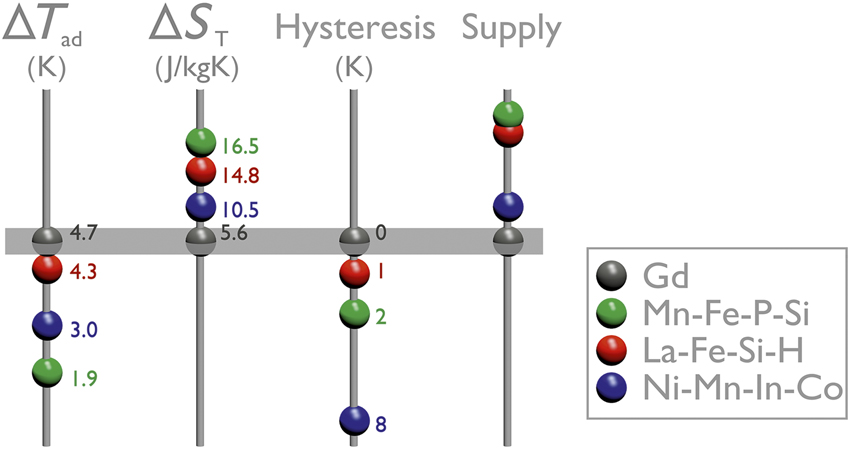
Figure 2 shows the properties of the most important magnetocaloric materials along with gadolinium as the benchmark for a field change of about 2 T. Gadolinium yields a large cyclic adiabatic temperature change of 4.7 K.Reference Waske, Hermann, Mattern, Skokov, Gutfleisch and Eckert23 La(Fe, Mn, Si)13Hx with T t = 297 delivers 4.3 K,Reference Radulov, Karpenkov, Skokov, Karpenkov, Braun, Brabänder, Gottschall, Pabst, Stoll and Gutfleisch27 while Ni45.7Mn36.6In13.5Co4.2 reaches 3.0 K and is to date the Heusler alloyReference Gottschall, Stern-Taulats, Mañosa, Planes, Skokov and Gutfleisch28 with the largest cyclic ΔT ad. For Mn-Fe-P-based materials, with T t close to room temperature, ΔT ad values around 5 K have been reported from indirect measurements.Reference Trung, Klaasse, Tegus, Cam Thanh, Buschow and Brück29 However, for a fair comparison, we use the cyclically obtained value of 1.9 K of a direct measurementReference Fries, Pfeuffer, Bruder, Gottschall, Ener, Diop, Gröb, Skokov and Gutfleisch30 for a stoichiometry with T t = 269 K.
Comparison of the magnetocaloric properties of the three most relevant first-order-type magnetocaloric materials along with those of benchmark gadolinium. The values are given for the chemical compositions in the legend, with transition temperatures close to room temperature.

The entropy change ΔS T of the transition is proportional to the amount of heat that can be transferred by the material. ΔS T is determined indirectly by magnetometry using adequate measurement protocols and calculations using the Maxwell relations.Reference Reif31 Using the same stoichiometries and literature references as for ΔT ad, entropy change values between 5.6 J kg–1 K–1 (gadolinium) and 17 J kg–1 K–1 (Mn-Fe-P-based) are reached. For first-order magnetocaloric materials, the existence of thermal hysteresis of different intrinsic and extrinsic originReference Gutfleisch, Gottschall, Fries, Benke, Radulov, Skokov, Wende, Gruner, Acet, Entel and Farle32,Reference Cohen33 is known to have a detrimental effect on the available cooling power. For second-order gadolinium, no hysteresis exists, while for Heusler alloys with an austenite to martensite transition, thermal hysteresis on the order of 8 K is observed.Reference Gottschall, Stern-Taulats, Mañosa, Planes, Skokov and Gutfleisch28 For Mn-Fe-P- and La-Fe-Si-based alloys, only a moderate hysteresis of 1–2 K is found.Reference Brück, Trung, Ou and Buschow34,Reference Basso, Kuepferling, Curcio, Bennati, Barzca, Katter, Bratko, Lovell, Turcaud and Cohen35
In addition to the physical properties of materials for magnetic refrigeration, it is crucial for this new technology to be based on abundant raw materials in order to decrease cost and be competitive on the refrigeration market. We discuss elements relevant for magnetocaloric cooling that are critical in terms of their demand-supply balance, which has a direct impact on short-term prices and long-term price stability of an emerging technology. Resource criticality is determined by several factors such as geological availability, environmental footprint, substitution and recycling potential, to name a few.Reference Graedel, Barr, Chandler, Chase, Choi, Christoffersen, Friedlander, Henly, Jun, Nassar, Schechner, Warren, Yang and Zhu36,Reference Achzet, Reller, Zepf, Rennie, Ashfield and Simmons37 The most promising materials are based on La-Fe-Si and Mn-Fe-P, while Gd serves as the best reference material to date and finds efficient utilization in current prototypes. Additionally, Heusler compounds have emerged as a likely contender for magnetocaloric applications.
Finally, one should not forget the Nd-Fe-B permanent magnets when assessing the raw materials basis for MCE, which efficiently provide the strong external magnetic field necessary to drive the cooling cycle, and which for the time being have no alternatives. The global production of Gd is unlikely to be able to meet the demand forecasted for potential mass-market application in the mid- and long term.Reference Gauss, Homm and Gutfleisch38 Lanthanum is not critical in the context of the rare-earth balance,39 and the same holds for Mn, Fe, and P. Nd in Nd-Fe-B magnets could be a bottleneck for magnetic cooling innovations as Nd price volatility and uncertainty in supply might be conceived as a risk for larger mass-market penetration of magnetic refrigeration technology. This risk, however, could be circumvented by, for example, a concerted approach securing a rare-earth supply chain outside China,Reference Gauss, Homm and Gutfleisch38 which is—with about 90–95% of global rare-earth oxide production—the main source for rare earths currently.
From materials to devices: The art of making a regenerator
We have seen that the adiabatic temperature change is actually small, generally less than 5 K in moderate magnetic fields of 2 T and below in magnetocaloric materials. For practical applications, it is necessary to increase the temperature difference between the hot and cold reservoirs by using active magnetic regeneration.Reference Barclay and Steyert40 For this, the porous magnetocaloric regenerator is periodically cycled in and out of the magnetic field, while at the same time appropriate fluid flow through the regenerator collects the synchronously released heat and cold. Active magnetic regeneration can be further improved by using a combination of materials with different operation temperatures.Reference Kitanovski, Tušek, Tomc, Plaznik, Ožbolt and Poredoš41 For gadolinium, this is achieved using binary Gd-based alloysReference Balli, Jandl, Fournier and Kedous-Lebouc42 to shift T C, such as Gd1–xRx (R = Y, Dy, Tb). For first-order magnetocaloric materials, the transition temperature T t can be adjustedReference Lyubina43 by doping or hydrogenation. With this set of materials, a porous body (regenerator) has to be formed, which allows the water reciprocating for heat transfer to be exposed to and removed from the magnetic field. This places stringent requirements on the design of the regenerator, such as maximizing the fraction of volume occupied by the magnetocaloric material, while simultaneously yielding a low pressure drop for the water flow. Due to the limited machinability of first-order magnetocaloric materials, which tend to be brittle, there are three types of geometry that are mainly used:Reference Tishin and Spichkin10,Reference Lei, Engelbrecht, Nielsen and Veje44 packed bed, parallel plate arrays—either of fully dense or composite material—and microchannel structures,Reference Moore, Klemm, Lindackers, Grasemann, Träger, Eckert, Löber, Scudino, Katter, Barcza, Skokov and Gutfleisch45,Reference Wieland and Petzoldt46 as shown in Figure 3.
Typical magnetocaloric regenerator structures (top), their microstructures (middle), and important properties (bottom). A compromise is necessary between a low void fraction, which maximizes the amount of heat/cold supplied by the material, low pressure drop, which maximizes the flow of heat-transfer liquid, and manufacturing cost.
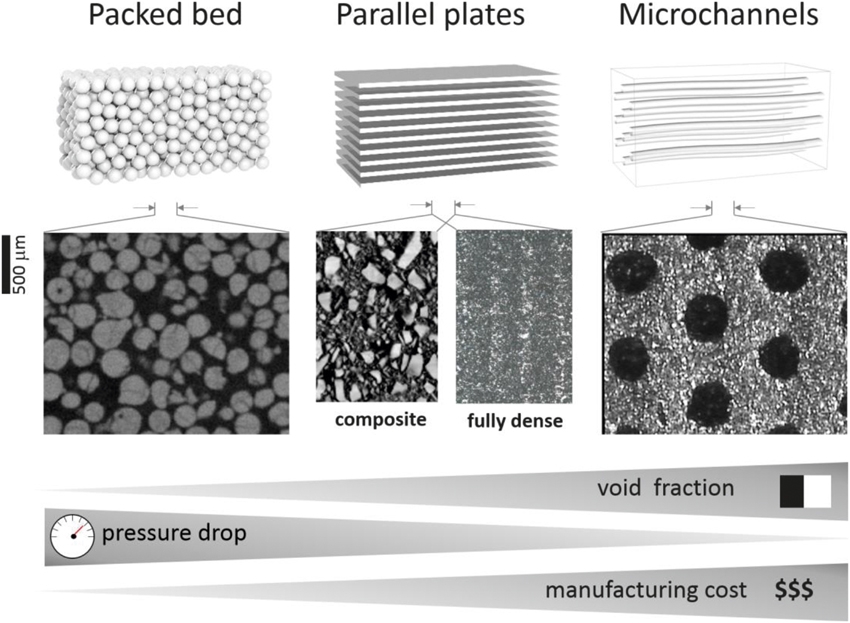
Packed beds are composed of either irregularly shaped powder or spherical particles made of magnetocaloric materials. While the former can be produced by milling, the latter requires more elaborate techniques such as gas-atomization,Reference Mayer, Dubrez, Pierronnet and Vikner47 extrusion spheronization (which involves breaking or cutting an extruded powder mixture and then rounding it into spheres),Reference Barcza, Vieyra and Katter48 the rotating electrode process,Reference Saito, Kobayashi and Tsuji49 or drop-tube solidification.Reference Liu, Zhang, Dai and Yan50 Typical sizes for both particle types used in packed-bed regeneratorsReference Balli, Jandl, Fournier and Kedous-Lebouc42 are in the range of d = 100–500 μm. Mechanical failure leading to cracking and subsequent washout of particle fragments can be counteracted by covering the particles with a thin layer of polymer, which holds the particles in position even after fragmentation.Reference Funk, Zeilinger, Dötz, Soldatov, Schäfer and Waske51 Typical void fractions of packed-bed regenerators are 35–42 vol% for spheres, and 45–55 vol% for irregular particles, which together with the turbulent flow in packed beds leads to a large pressure drop.Reference Balli, Jandl, Fournier and Kedous-Lebouc42
Parallel plate arrays are very well-defined geometries for regenerators. Typical plate thicknesses are around d plate = 200–500 μm, with gap distances between the platesReference Balli, Jandl, Fournier and Kedous-Lebouc42 in the range of d dist = 200 μm, leading to void fractionsReference Lei, Engelbrecht, Nielsen and Veje44 on the order of 0.36–0.64. The lower limit for the plate thickness is again set by the mechanical stability of the material, particularly for fully dense plates. One way out of this constraint is to form magnetocaloric composites of the active phase and a matrix of polymer,Reference Pulko, Tušek, Moore, Weise, Skokov, Mityashkin, Kitanovski, Favero, Fajfar, Gutfleisch, Waske and Poredoš52 amorphous,Reference Krautz, Funk, Skokov, Gottschall, Eckert, Gutfleisch and Waske53 or low melting temperature eutectic alloys.Reference Radulov, Karpenkov, Skokov, Karpenkov, Braun, Brabänder, Gottschall, Pabst, Stoll and Gutfleisch27
Microchannel geometries along the fluid flow direction with different cross-sectional shapes (circular, square) are another option to form a regenerator, offering a wide range of possible void fractions. Instead of drilling the channels, which wastes material, more sophisticated methods to produce this type of geometry are applied, such as three-dimensional selective laser meltingReference Moore, Klemm, Lindackers, Grasemann, Träger, Eckert, Löber, Scudino, Katter, Barcza, Skokov and Gutfleisch45 and extrusion.Reference Wieland and Petzoldt46 Both methods require a heat-treatment procedure after shaping, either to retain the active magnetocaloric phase or to sinter the green body to yield a fully dense structure, respectively. In both cases, the mechanical properties of the finished regenerator are far from ideal. Economic considerations and easy up-scalability are likely to play an important role for a potential mass production of magnetocaloric regenerators.
Conclusion
Competitive magnetocaloric materials must score high in a large number of properties in order for this new technology to become commercially viable. One of the key challenges from a materials research standpoint is shaping the mostly brittle magnetocaloric materials into porous regenerators that allow for fast heat exchange. Solving this problem is likely to accelerate not only the field of magnetocaloric refrigeration, but also other applications of magnetocaloric materials, like thermomagnetic motors and power generation.
Acknowledgments
We gratefully acknowledge funding by the DFG priority program SPP 1599 “Ferroic Cooling” (www.ferroiccooling.de). T.G. gratefully acknowledges support of Dresden High Magnetic Field Laboratory at Helmholtz-Zentrum Dresden-Rossendorf, member of the European Magnetic Field Laboratory.

Anja Waske is a group leader at the Leibniz Institute for Solid State and Materials Research (IFW) Dresden, Germany. She studied physics at the Technische Universität Dresden, Germany, followed by a PhD degree in the field of x-ray tomographic characterization of granular matter. Her research interests include magnetic composites and magnetocaloric materials for cooling and energy-harvesting applications. She develops three-dimensional image-analysis methods for understanding the properties of functional and additively manufactured materials. Waske can be reached by phone at +49-351-4659-846 or by email at a.waske@ifw-dresden.de. Photo by Alisa Chirkova.

Markus Ernst Gruner is privatdozent with the Faculty of Physics at the Universität Duisburg-Essen, Germany. He received his PhD degree in physics in 2003, and his venia legendi in theoretical physics in 2013 from the same institution. His research is mainly concerned with first-principles calculations in the framework of density functional theory covering the magnetic, electronic, and vibrational properties of functional materials with magnetostructural instabilities, such as magnetic nanoparticles, magnetic shape-memory alloys, and magnetocaloric materials. Gruner can be reached by phone at +49-203-379-2247 or by email at markus.gruner@uni-due.de. Photo by Vladimir Unkovich.

Tino Gottschall is a postdoctoral researcher in the High Magnetic Field Laboratory at Helmholtz-Zentrum Dresden-Rossendorf, Germany. He studied physics at the Technische Universität Dresden, Germany, and finished his Diploma in 2012. He received his PhD degree from the Technische Universität Darmstadt, Germany, in 2016. His research focuses on the magnetic and magnetocaloric properties of functional materials. Gottschall can be reached by email at t.gottschall@hzdr.de.

Oliver Gutfleisch is a full professor of functional materials at Technische Universität Darmstadt and a scientific manager at Fraunhofer IWKS Materials Recycling and Resource Strategies Hanau, Germany. His interests span from new permanent magnets for power applications to energy-efficient magnetic cooling, ferromagnetic shape-memory alloys, and magnetic nanoparticles for biomedical applications, with particular emphasis on tailoring structural and chemical properties on the nanoscale. Resource efficiency on element, process, and product levels, as well as recycling of strategic metals, are also in the focus of his work. He was awarded an ERC Advanced Grant on caloric cooling in 2017. Gutfleisch can be reached by email at gutfleisch@fm.tu-darmstadt.de.