Introduction
The Assisted Decision-Making (Capacity) Act 2015, amended by the Assisted Decision-Making (Capacity) (Amendment) Act 2022, was fully commenced in April 2023. A ‘relevant person’ in ADMCA means a person whose capacity is in question or may shortly be in question, or who lacks capacity, in respect of one or more matters (ADMCA, s. 2(1)) (All section references are to ADMCA unless specified). A person lacks capacity to make a decision if unable to understand the relevant information; to retain that information long enough to make a voluntary choice; to use or weigh that information as part of the process of making the decision; or to communicate the decision by any means (s. 3(2)).
ADMCA replaced the Wards of Court system, a form of plenary guardianship, with three new decision support arrangements, and ‘decision supporters’, based on the level of support that a person requires to make decisions on personal welfare, property, and affairs or both at a specific time:
-
Assisted decision-making (Part 3 of ADMCA) is the least formal tier. A person can appoint a decision-making assistant (DMA) to support them in making and expressing decisions, but decision-making authority remains with the person.
-
Co-decision-making (Part 4) is the middle tier. The person (‘the appointer’) appoints someone they trust as a co-decision-maker (CDM) to make specified decisions jointly with them under a co-decision-making agreement (CDMA). Decision-making authority is shared jointly between the person and their CDM. The director of the new regulator called the Decision Support Service (DSS) supervises this arrangement.
-
Decision-making representation (part 5) is the most formal tier of support. Following an application to the Circuit Court, the court may appoint a decision-making representative (DMR) under a decision-making representation order (DMRO). A DMR can make specified decisions on behalf of the person and will also be supervised by the director of the DSS.
Registered medical doctors and other registered prescribed professionals (nurses, midwives; speech and language therapists, occupational therapists, and social workers) will be responsible for providing capacity statements for CDMAs and DMRO applications. All of the decision supporters must abide by the guiding principles set out in s. 8 of ADMCA, which include giving effect, in so far as is practicable, to the past and present will and preferences of the relevant person, if ascertainable, and acting at all times in good faith and for the benefit of the relevant person.
Use of the new formal support arrangements: general comments
The new tiers of support in ADMCA are options to assist the person – problem-solving tools – rather than mandatory interventions when someone is having difficulty making decisions. It may be, although practice is likely to evolve with time and experience, that the formal support arrangements will only be required in limited circumstances, for example, for a major financial decision or when there are safeguarding concerns.
This is supported by the experience to date which is that formal supports are most often used for property and affairs decisions. The most recent data from the DSS (30th April 2025) shows that there are 115 DMAs notified, and 97 CDMAs and 1,221 DMROs registered. The vast majority of DMROs have been to allow an application for ancillary state support (a mortgage against property) under the post-ADMCA ‘Fair Deal’ scheme (Nursing Home Support Scheme, as amended).
In other circumstances, a level of informal support, having regard to the guiding principles of ADMCA, may suffice. For example, while ‘healthcare’ decisions are among the personal welfare decisions potentially covered by the new support arrangements, anecdotal evidence suggests that this is rarely the trigger for seeking a new support arrangement. Indeed, the revision of the HSE National Consent Policy (V1.2 January 2024) notes the value of the ADMCA guiding principles – rather than any need for a formal support arrangement – to determine the appropriate action in most cases when a healthcare decision is needed for someone who may lack capacity to decide.
Aim of paper
The aim of this paper is to explore co-decision-making, the most novel of the new tiers of support, with particular focus on the challenges this will pose for healthcare professionals. They will be responsible for making the often-fine-grained judgements about capacity for co-decision-making. I offer some personal views as to how such assessments can be performed. Healthcare professionals will have a role in considering where co-decision-making fits in the spectrum of supports and when to recommend co-decision-making for their patients.
Purpose of co-decision-making
ADMCA is meant to make Ireland compliant with its obligations under Article 12 of the UN Convention on the Rights of Persons with Disabilities (CRPD) (United Nations, 2006), the text of which states that Ireland recognises that persons with disabilities enjoy legal capacity on an equal basis with others in all aspects of life.
The first General Comment (GC1) of the Committee on the Rights of Persons with Disabilities (2014) (the body charged with monitoring implementation of the CRPD) rejected all capacity-based distinctions as inconsistent with the equal right to legal capacity (para 15) and interpretated Art. 12 as requiring that all substitute decision-making regimes should be abolished (para 28).
This interpretation has been controversial, and Ireland, like other states, ratified the CRPD subject to the declaration and reservation that: ‘…the Convention permits supported and substitute decision-making arrangements which provide for decisions to be made on behalf of a person, where such arrangements are necessary…’
In ADMCA, assisted decision-making is clearly a legal framework for supported decision-making and decision-making representation a framework for substitute decision-making. Co-decision-making, the middle and effectively the ‘hinge’ tier of support, is sometimes accepted as a form of supported decision-making (Ordinaire, Reference Ordinaire2017). However, it is more restrictive than assisted decision-making as the person (voluntarily) loses, or dilutes, some of their autonomy because they must make certain decisions jointly with a CDM. On the other hand, it extends out the autonomy of those who otherwise would lack decision-making capacity and ensures that they still participate in decision-making. Arguably, any claim that ADMCA is compliant with CRPD rests on co-decision-making being used as extensively as possible.
Co-decision-making in ADMCA compared with other legal frameworks
The Canadian provinces have been to the fore in developing supported decision-making frameworks, beginning with British Columbia’s landmark Representation Agreement Act 1996. Saskatchewan and Alberta have both introduced co-decision-making frameworks. The Law Commission of Ontario (2017) considered this but noting the complexity, practically and theoretically, and the limited support during consultation, did not take this approach.
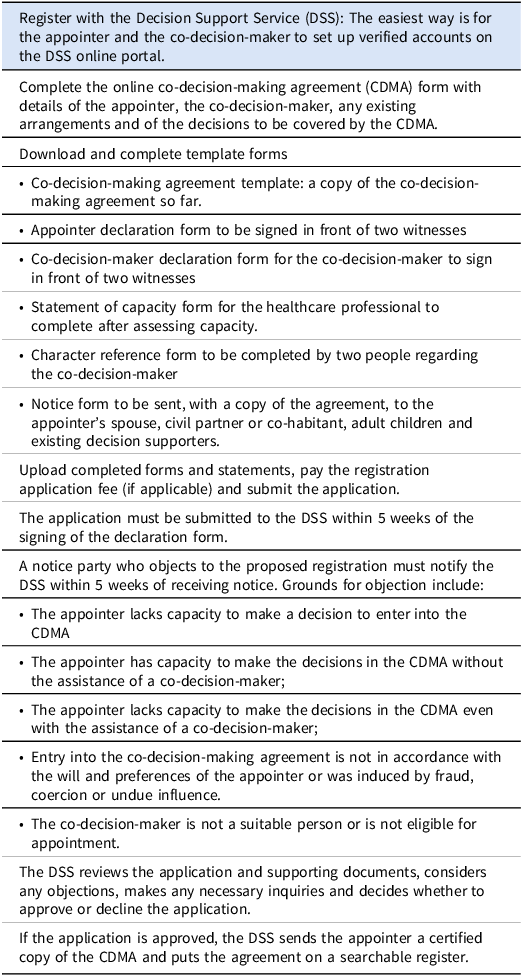
In Canada, Saskatchewan’s Adult Guardianship and Co-decision-Making Act (2001) and Alberta’s Adult Guardianship and Trusteeship Act (2008) include provisions for co-decision-making. However, co-decision-making in Ireland’s ADMCA seems more consistent with supported decision-making than these laws (although, perhaps inevitably as a result, the procedural requirements are more complex in Ireland (Table 1)):
Practical aspects of making a CDMA

Table 1 Long description
A table detailing the process to register with the Decision Support Service (DSS) for co-decision-making agreements. The table has 10 rows and 1 column. Row 1: Register with the Decision Support Service (DSS): The easiest way is for the appointer and the co-decision-maker to set up verified accounts on the DSS online portal. Row 2: Complete the online co-decision-making agreement (CDMA) form with details of the appointer, the co-decision-maker, any existing arrangements and of the decisions to be covered by the CDMA. Row 3: Download and complete template forms. Row 4: Co-decision-making agreement template: a copy of the co-decision-making agreement so far. Row 5: Appointer declaration form to be signed in front of two witnesses. Row 6: Co-decision-maker declaration form for the co-decision-maker to sign in front of two witnesses. Row 7: Statement of capacity form for the healthcare professional to complete after assessing capacity. Row 8: Character reference form to be completed by two people regarding the co-decision-maker. Row 9: Notice form to be sent, with a copy of the agreement, to the appointer’s spouse, civil partner or co-habitant, adult children and existing decision supporters. Row 10: Upload completed forms and statements, pay the registration application fee (if applicable) and submit the application. The application must be submitted to the DSS within 5 weeks of the signing of the declaration form. A notice party who objects to the proposed registration must notify the DSS within 5 weeks of receiving notice. Grounds for objection include: The appointer lacks capacity to make a decision to enter into the CDMA. The appointer has capacity to make the decisions in the CDMA without the assistance of a co-decision-maker. The appointer lacks capacity to make the decisions in the CDMA even with the assistance of a co-decision-maker. Entry into the co-decision-making agreement is not in accordance with the will and preferences of the appointer or was induced by fraud, coercion or undue influence. The co-decision-maker is not a suitable person or is not eligible for appointment. The DSS reviews the application and supporting documents, considers any objections, makes any necessary inquiries and decides whether to approve or decline the application. If the application is approved, the DSS sends the appointer a certified copy of the CDMA and puts the agreement on a searchable register.
• In ADMCA, a CDM is appointed by the person themselves rather by the courts as in Saskatchewan and Alberta.
• In Saskatchewan, a CDM can block a decision that isn’t one ‘that a reasonable person would make in the circumstances and the outcome is likely to be harmful to the adult” (s. 17(2)). In Alberta the CDM needs to consider ‘if a reasonable person could have made the decision and the decision is not likely to result in harm…’ (s. 18(5)). In contrast, in ADMCA, a CDM must ‘acquiesce’ – a word suggesting a supported decision-making approach – with the wishes of the appointer unless this would result in ‘serious harm’. An Irish CDM has a more limited ‘veto power’ than those in Saskatchewan and Alberta, as ‘serious harm’ is a much higher bar than an unqualified ‘harm’, and there is no veto just because a decision is not one a reasonable person would make.
Co-decision-making in ADMCA
Co-decision-making, as a concept, is relevant to both Part 4 and Part 5 of ADMCA. If a relevant person wants to enter a CDMA, and there is someone willing and able to act as a CDM, an application to register a CDMA is governed by Part 4 (the procedures are summarised in Table 1) and a capacity assessment and statement will be required from a qualified professional. The complexities of the capacity test will be discussed later, but the assessment is based on having a ‘flesh and blood’ potential CDM to interact with.
In contrast, co-decision-making in Part 5 involves a court determination of whether or not the person would lack capacity even if a hypothetical CDM were available. In such cases there won’t be any capacity test to consider whether the person has capacity to make the decisions jointly with a specific CDM.
Co-decision-making and Part 4 applications
An adult ‘who considers that his or her capacity is in question or may shortly be in question’ may appoint ‘a relative or friend… who has had such personal contact with [them]… over such period of time that a relationship of trust exists between them” as a CDM (s. 17). A registered CDMA is a formal and legally binding decision support arrangement. All decisions specified in the CDMA must be made jointly. This means the CDM must ‘acquiesce with the wishes of the appointer… unless it is reasonably foreseeable that [this] will result in serious harm to the appointer or to another” (s. 19(5)). A decision made within the scope of a registered CDMA cannot be challenged on the grounds that the appointer did not have the capacity to make the decision (s. 23(1)). Conversely, such a decision made other than jointly is null and void.
The CDM must understand and act within the scope of the CDMA, must apply the guiding principles of ADMCA and must submit an annual report to the DSS, including a record of any important decisions made jointly. The CDM is asked to ‘be aware of and record” any gain or diminution of the appointer’s capacity in areas covered by the CDMA; however, the DSS need only be notified of this when a decision included in the CDMA needs to be made (DSS Code of Practice for CDMs 5.1.1).
The DSS will formally review the CDMA after it has been in place for at least nine months, and then every three years. This includes consulting with the appointer and CDM and seeking a fresh capacity statement, ideally from the same healthcare professional (s. 26(3)), to determine if the appointer still requires assistance in exercising decision-making and still has capacity to make the relevant decisions specified in the CDMA with the assistance of the CDM.
Co-decision-making and Part 5 applications
When a Part 5 application for a DMRO is made to the Circuit Court, the court may make one or both of the following declarations (s. 37 (1)):
(a) …the relevant person…lacks capacity, unless the assistance of a suitable person as a CDM is made available to him or her…
(b) …the relevant person… lacks capacity, even if the assistance of a suitable person as a CDM were made available to him or her …
If s. 37(1)(a) applies and there is no suitable person to act as CDM or if there is a suitable person but a CDMA is not registered in a reasonable (court-determined) period, the court (s. 41(3)) may decide that the DMR must ‘ensure, in so far as is practicable, that he or she jointly makes decisions with the relevant person’. That is, the DMR is required to act to the greatest extent possible as a CDM would, by making decisions jointly with the person.
It is unclear as yet how the court will decide that s. 37(1)(a) applies. Under s. 139, Part 5 applications must, with some exceptions, be heard in the presence – which in practice includes virtual attendance – of the relevant person. The court may form its own view based on talking to the person. The court may also consider the views of the capacity applicant and the capacity assessor.
In the Statement of Particulars (Form 55B) to be submitted for a Part 5 application under the Circuit Court rules, the applicant is required to explain why a less intrusive approach such as co-decision-making was not taken instead. However, the ‘capacity applicant’ is distinct from the healthcare professional ‘capacity assessor’ – about one fifth at present are ‘lay’ people such as family members – and may not have any great understanding of the complexities, daunting even for professionals, of co-decision-making.
The template developed by the HSE for healthcare professionals providing a capacity statement for Part 5 applications asks the assessor to comment on whether the person would have capacity if a CDM were made available to him or her. (This is not an explicit requirement in the Circuit Court rules regarding capacity reports. However, the assessor for Part 5 applications should have sufficient understanding of co-decision-making (1) to be of assistance to the court in deciding between options (a) and (b) in s. 37(1) and (2) to be of assistance to a capacity applicant completing Section G of Form 55B).
How might a capacity assessor decide to recommend to the court that the person would have had capacity with a hypothetical CDM? The concept of co-decision-making, discussed in the next section, seems particularly relevant. If the person has at least some understanding of the decisions they face and the options that exist, if they know at least broadly, and can communicate, what outcomes they desire, and if they would like to participate in decision-making then, in my view, co-decision-making might have been an option with a theoretical, indeed idealised, CDM. In such cases, I suggest that the capacity statement should report this, with sufficient supportive detail, to the court, and the court will ultimately decide regarding s. 37(1)(a) and s. 41(3)). In contrast to the concrete capacity test for making a CDMA with a specific CDM that the assessor must consider, this requires in part a degree of imagination and empathy on the part of the assessor.
The concept of co-decision-making
The biggest – and oddest – conceptual change introduced by co-decision-making is that capacity to make a decision no longer rests with a single person, whether the person themselves (even with support) or a substitute decision-maker. Co-decision-making is counter to the traditional binary bioethical concepts of capacity as something one has or hasn’t and of decision-making as either independent or dependent.
What does it mean to make decisions jointly?
Irrespective of decision-making capacity, many people rely on interpersonal relationships with those they trust when making decisions. Considering what it means to make decisions jointly – and the minimum requirements for a joint decision – may be helpful. For example, I share a bank account with my brother, and I need to buy a car. However, I have little interest in cars and their workings. I am happy for my brother, who is more knowledgeable, to take the lead in checking out what’s available. He presents me with, and explains, his recommendation, and we decide together to proceed with the purchase.
This is a joint decision. I understand what the decision is, why it needs to be made, and what I hope to achieve. I know I am voluntarily ceding some of the decision-making to someone I trust, but my brother won’t decide for me but with me. He will go along with my final choice unless it is ludicrous, such as choosing to buy an expensive sports car that we can’t afford. The joint nature of decision-making here is independent of whether I could (but didn’t) or wasn‘t able to do it myself because of limitations in my understanding and in using or weighing information. One way or another, my brother has compensated for my failure to understand and weigh up all of the different options: he has done the ‘heavy lifting’ in sifting through and simplifying the choices for me.
Making decisions jointly in such circumstances reflects the reality, emphasised by the concept of relational autonomy (Westlund, Reference Westlund2009), that most people are not isolated individuals but exist in, and often rely on and are supported by, a social network including family and friends.
Decision-making capacity as a continuum
The functional test of capacity in ADMCA, taken on its own, results in a binary outcome where decision-making capacity is either present or absent. However, the idea of co-decision-making implies that a richer, more nuanced view of decision-making capacity is required. Instead of ‘capacity’ as something one either possesses or doesn’t, decision-making capacity, as the DSS Code of Practice for Supporting Decision-Making and Assessing Capacity (4.0) notes, ‘… is best understood as a spectrum ranging from full capacity to those lacking all capacity and those in between who may have some or partial capacity [my emphasis]’.
The binary approach to capacity has the virtue of simplicity, at least in its legal effect (although it can create difficulties for assessors when capacity is marginal). However, just as making decisions jointly challenges the bioethical assumption that decisions are either fully independent or fully dependent, the dimensional approach to capacity recognises that there is a continuum, rather than a stark division, between clearly having and clearly lacking capacity to make a decision (Largent et al. Reference Largent, Clapp, Blumenthal-Barby, Grady, McGuire, Karlawish, Grill, Stites and Peterson2022). It gives people ‘credit’ for the abilities they have or retain rather than focussing solely on what abilities they lack.
Partial capacity and CDM
There has been helpful empirical Irish work exploring the concept of partial capacity, using the MacArthur Competence Assessment Tool for Treatment (MacCAT-T) (Grisso & Applebaum, Reference Grisso and Applebaum1998). This tool generates scores on four scales: (1) Understanding a disorder and its treatment; (2) Appreciation of a disorder and its treatment; (3) Reasoning about treatment options; and (4) Ability to communicate a choice. Curley et al (Reference Curley, Murphy, Plunkett and Kelly2019a) used the MacCAT-T to assess mental capacity for treatment decisions in 215 psychiatry inpatients in Ireland and re-coded scores to categorise subjects as following: 2% lacked mental capacity for treatment decisions; 51% had partial mental capacity and 47% had full mental capacity.
Of those with partial capacity, 17% lacked the ability to understand, 53% lacked the ability to appreciate, and 63% lacked the ability to reason with the information. None were unable to express a choice. ‘Reasoning’ in McCAT-T seems similar to ‘use or weigh’ in ADMCA. ‘Appreciation’, however, is not a criterion for capacity in ADMCA, and in some cases may not fit comfortably into either ‘understand’ or ‘use or weigh’ in ADMCA. It was reassuring, however, that another paper from the same group found that those assessed as lacking capacity using the ADMCA test scored significantly lower on all four subscales of the MacCAT-T (Curley et al. Reference Curley, Murphy, Plunkett and Kelly2019b).
Conclusion
Curley et al (Reference Curley, Murphy, Plunkett and Kelly2019a) concluded, and I agree, that those with partial mental capacity are most likely to benefit from decision-making assistance or co-decision-making. The areas where support from a CDM is most likely to be useful are, both from the perspective of partial capacity and considering what joint decision-making means, are in understanding and using or weighing information.
The capacity test for making a CDMA
There are three elements to capacity assessment where a person wishes to enter into a CDMA (s. 21(4)(f)). The statement by the assessor must note that, in their opinion:
-
1. The appointer has capacity to make a decision to enter into the CDMA
-
2. The appointer requires assistance in exercising his or her decision-making in respect of the relevant decisions contained in the CDMA and
-
3. The appointer has capacity to make the decisions with the assistance of the CDM
The capacity statement submitted to the DSS will only note the outcome of the assessment. However, it is important that the assessor makes and retains as adequate record to show what questions were asked and how they reached their conclusions for all three elements. Capacity assessment involves having one or more conversations with a relevant person. It doesn’t have to follow a rigid structure, taking each element in turn.
1. The appointer has capacity to make a decision to enter into the co-decision-making agreement
This is distinct from whether the appointer has capacity to make the decisions specified in the CDMA. The assessment of capacity to enter a CDMA must be carried out in accordance with ADMCA s. 3(1), follow the process set out in the DSS Code of Practice on Supporting Decision-Making and Assessing Capacity and start, as always, with the presumption that the appointer does have capacity to enter a CDMA. The assessor may also have an educational role of taking the person through the nature and consequences of a CDMA.
Although not required to understand all of the technicalities of a CDMA, the appointer will need to understand the essential attributes of a CDMA:
-
All decisions covered by the CDMA must be made jointly with the CDM: the person will no longer be able to decide by themselves regarding these matters.
-
There is an override mechanism and the CDM may not agree to comply with the appointer’s wishes if they would cause serious harm to the appointer or others.
-
The CDMA can be varied, but only with the consent of the CDM, and can be revoked by either party at any time.
2. The appointer requires assistance in exercising his or her decision-making in respect of the relevant decisions
The need for assistance will depend on the circumstances and on the nature and difficulty level of the relevant decisions. The assessor will need to record any evidence to suggest a need for assistance; it is not enough to record labels, diagnoses or cognitive test results. What problems have occurred or are likely to occur? Why does the appointer consider that their capacity is or may shortly be in question and want to enter a support arrangement (and is willing to dilute their own decision-making authority with a CDMA)?
It is noteworthy that the capacity test for making a CDMA doesn’t require a statement regarding the capacity of the appointer to make the relevant decisions on their own (or with a DMA). In contrast, co-decision-making in Alberta requires the assessor and the court to conclude that the adult’s decision-making is ‘significantly impaired’, while in Saskatchewan, the assessor – and the court – must agree that the person’s ‘capacity is impaired to the extent that he or she requires assistance in decision-making in order to make reasonable decisions’.
‘Requires assistance in exercising his or her decision-making” is vaguer. It may serve as a lower barrier to the making of CDMAs. For example, there may be people who feel overwhelmed by specific particularly complex or stressful decisions and want the formal support of a CDM and where an assessor would readily agree they require assistance but would struggle to agree that they lack capacity otherwise.
One difficulty with this approach is that the grounds for objections to registration include that the appointer has capacity to make the relevant decisions without a CDM, or that the appointer lacks such capacity even with a CDM. Even without the formality of assessing the appointer’s capacity to make decisions alone (or with a DMA), it may be useful to record any evidence to suggest that the appointer has partial capacity such as difficulty in understanding or in using or weighing relevant information. In circumstances where an objection seems likely, or where the assessor themselves is in doubt, an assessment of the appointer’s capacity to make the decisions specified in the CDMA may be prudent.
3. The appointer has capacity to make decisions specified with the assistance of the CDM
An appointer is unlikely to have capacity to make decisions jointly with any CDM without at least ‘partial capacity’, and a basic understanding of the decisions to be made and an ability to express their own views and preferred outcomes.
Importantly, this is not ‘any CDM’: it is a named person chosen by the appointer because of a relationship of trust. Arguably, the only way an assessor can reach a conclusion that the appointer has capacity to make decisions with the assistance of this particular CDM is if they have seen how the CDM and appointer interact and have some idea of how they would work together in making decisions. This would require a meeting between the assessor, appointer and CDM as part of the assessment (except in cases where the assessor is already familiar with the appointer and CDM).
The potential CDM has important responsibilities. He or she must also understand the implications of a CDMA, act in accordance with their functions and in accordance with the guiding principles. The DSS Code of Practice for Co-Decision Makers guidance on how to interact with the appointer (2.2.1) emphasises the need for ‘respect for the appointer’s privacy, dignity and autonomy. This means that you must recognise the appointer’s right to have control over decisions that affect their life”.
An assessor who sees how the CDM interacts with the appointer might conclude that the CDM, even with education about the role, doesn’t understand their obligations such as the necessity to make decisions jointly and, as a result, the appointer would not have the capacity to make decisions specified with the assistance of this particular CDM. (Rarely, he or she might have concerns about the CDM’s own ability to make or contribute to the relevant decisions). Such a conclusion (with the implication in many cases that substituted decision-making will be needed) is not to be made lightly. In particular, it must not be influenced by the assessor’s opinion regarding what final decision they will make jointly or by the assessor’s view of the CDM’s ‘general’ suitability.
Blurred lines and blurred transitions between support arrangements
The boundaries and thresholds to determine when different arrangements are appropriate and to guide when it is necessary to transition from, for example, a CDMA to a DMRO are very unclear from the text of ADMCA.
This is particularly true for deciding between decision-making assistance and co-decision-making. As Mary Donnelly (Reference Donnelly2019: 13) has noted ‘Although the ADMCA seems to presume that a CDM will be more involved [than a DMA] in the decision-making process, there is no clear legislative statement in this regard…” and Brendan Kelly (Reference Kelly2017:355) has described the differences between a DMA and a CDM as ‘chiefly quantitative rather than qualitative”.
As a general rule, the necessity of adopting the least restrictive intervention means that when there is uncertainty, decision-making assistance is to be preferred to co-decision-making and co-decision-making to decision-making representation. However, one significant difference between a DMA and a CDM is that only the latter has a potential veto if a decision would lead to serious harm. This (rather than any fine-grained cognitive or capacity distinctions) may in practice be the main point of a CDMA and the main attraction for the appointer.
If, for example, an appointer is prone to impulsive decision-making, has made financially damaging decisions as a result, and is concerned about this occurring again, he or she may be willing to accept the immediate dilution of their decision-making authority by appointing a CDM who can act as a brake on impulse purchases. Thus, a carefully and narrowly crafted CDMA could be useful as a form of advance planning as well as of support (in a manner similar to how some advance mental health directives might work (Morrissey, Reference Morrissey2010)).
Although a CDMA can stretch out a person’s autonomy, there may come a time when substituted decision-making in the form of a DMR is more appropriate (although given that all decision supporters are bound by the same principles, this may have little practical effect). This is likely to correspond with a shift from having partial capacity to having effectively none.
Implementing co-decision-making – will it work?
Surtees’s (2012) evaluation of the operation of the law in Saskatchewan more than a decade after enactment found that only 7% of applications were for co-decision-making. At present in Ireland registered DMROs outnumber registered CDMAs about tenfold.
The stringent nature of the formalities for Part 4 applications may be – and early anecdotal reports suggest have been – a barrier in other cases. A potential CDM may, having looked at the requirements, not be willing to enter a CDMA, even if willing to assist the person in other ways. This may mean that a Part 5 application is needed instead (and there are no data available on how often the courts have applied s. 41(3)).
Surtees (Reference Surtees2012) also surveyed 34 lawyers involved in applications in Saskatchewan: only three (9%) agreed that ‘An applicant should only ask for powers which they need as of the date of the application’ with most – to reduce the need for further applications – wanting either powers they would likely, or would possibly, need in the future. As he pointed out, such responses were clearly contrary to the ‘least restrictive’ principles of the Saskatchewan legislation.
One might suspect that similar attitudes, although contrary to the least restrictive principles of ADMCA, may exist among legal and healthcare professionals and family members in Ireland. This is most likely to be a concern when further cognitive decline is very predictable and if there are considerable delays and expense associated with ‘conversion’ to a DMRO. In contrast, co-decision-making may be a more practical and useful option when decision-making difficulties are relatively static, as in many with intellectual disabilities.
Conclusions
Co-decision-making is new and challenging for professionals and for potential appointers and their CDMs. The capacity test to be applied by assessors is complex. I suggest that thinking about the minimum requirements for joint decision-making and about the idea of partial capacity are helpful in determining where co-decision-making fits on a capacity spectrum. Whatever the difficulties, co-decision-making is a core support arrangement in ADMCA and there is a responsibility on all seeking to support a relevant person to work to keep it a viable and useful option.
Funding statement
This research received no specific grant from any funding agency, commercial, or not-for-profit sectors.
Competing interests
None.
Ethical standards
The author asserts that all procedures contributing to this work comply with the ethical standards of the relevant national and institutional committee on human experimentation and with the Helsinki Declaration of 1975, as revised in 2008. The author asserts that ethical approval for the publication of this paper was not required by their local ethics committee.