Introduction
Management researchers underscore the important role of employees' positive efforts to assist other organizational members with their work, even when such efforts are not part of their formal job descriptions (Deckop, Cirka, & Andersson, Reference Deckop, Cirka and Andersson2003; Imer, Kabasakal, & Dastmalchian, Reference Imer, Kabasakal and Dastmalchian2014; Liang, Shih, & Chiang, Reference Liang, Shih and Chiang2015; Peng & Zeng, Reference Peng and Zeng2017; Wei, Reference Wei2012). Such helping behaviour reflects a critical component of the broader notion of organizational citizenship behaviour, whereby employees reach out to individual colleagues and spend time helping them with their job tasks (De Clercq, Rahman, & Haq, Reference De Clercq, Rahman and Haq2019; Kyei-Poku, Reference Kyei-Poku2014; Organ, Reference Organ1988). Helping behaviour generally benefits its targets but also aids the organization overall and enhances the helpers' own personal well-being, by contributing to coworker performance (Podsakoff, Ahearne, & MacKenzie, Reference Podsakoff, Ahearne and MacKenzie1997), enhancing the organization's competitive advantage (Borman & Motowidlo, Reference Borman, Motowidlo, Schmitt and Borman1993), and generating a sense of personal fulfilment (Hoption, Reference Hoption2016; Lemoine, Parsons, & Kansara, Reference Lemoine, Parsons and Kansara2015).
Accordingly, there is consistent interest in determining which factors might stimulate or inhibit employees' decisions to devote significant time to voluntary helping behaviours. Positive factors that enable employees' helping behaviour include pro-social motives (Choi & Moon, Reference Choi and Moon2016), a sense of belonging (Kyei-Poku, Reference Kyei-Poku2014), religion-based work values (De Clercq, Rahman, & Haq, Reference De Clercq, Rahman and Haq2019), team cohesion (Liang, Shih, & Chiang, Reference Liang, Shih and Chiang2015), coworker support (Deckop, Cirka, & Andersson, Reference Deckop, Cirka and Andersson2003), and authentic leadership (Hirst, Walumbwa, Aryee, Butarbutar, & Chen, Reference Hirst, Walumbwa, Aryee, Butarbutar and Chen2016). Negative factors that inhibit helping behaviours instead include self-centred monetary motives (Tang, Sutarso, Wu Davis, Dolinski, Ibrahim, & Wagner, Reference Tang, Sutarso, Wu Davis, Dolinski, Ibrahim and Wagner2008), coworker ostracism (Peng & Zeng, Reference Peng and Zeng2017), and open conflict norms (Rispens, Reference Rispens2009). Little research has been devoted to the specific question of how employees' lack of enthusiasm or excitement about their job situation might keep them from helping others though.
This oversight is somewhat surprising, because unhappy feelings about work tend to deplete employees' energy and prevent them from fulfilling their job duties (Jiang, Baker, & Frazier, Reference Jiang, Baker and Frazier2009; Rayton & Yalabik, Reference Rayton and Yalabik2014). Accordingly, this study proposes that the energy resource depletion that stems from feelings of unhappiness about their job situation may be so strong that it steers employees away from allocating discretionary energy towards helping activities that are not formally required. In addition to creating a deeper understanding of how employees respond to feelings of unhappiness, in the form of reduced helping behaviour, the study seeks to investigate useful ways in which organizations can contain this harmful effect, with a particular focus on the potential buffering effect of psychological capital. This critical personal resource captures the extent to which employees are confident in their own abilities, are hopeful about work goals, envision the future in a positive way, and are able to overcome workplace challenges (Luthans, Avolio, Avey, & Norman, Reference Luthans, Avolio, Avey and Norman2007).
To anchor the theoretical arguments about the combined effects of job dissatisfaction and psychological capital on helping behaviour, this study draws on the conservation of resources (COR) theory (Hobfoll, Reference Hobfoll1989, Reference Hobfoll2001). Accordingly, it postulates that the experience of negative feelings about their organization steers employees away from positive work behaviours, due to emotional resource depletion associated with these feelings (Hobfoll & Shirom, Reference Hobfoll, Shirom and Golembiewski2000; van Gelderen, Konijn, & Bakker, Reference van Gelderen, Konijn and Bakker2017). When employees lack enthusiasm about their job situation, for example, the frustration that they experience may limit the energy they have left to perform voluntary behaviours that could contribute to the well-being of other organizational members (De Clercq, Rahman, & Haq, Reference De Clercq, Rahman and Haq2019; Quinn, Spreitzer, & Lam, Reference Quinn, Spreitzer and Lam2012), even if those behaviours also might benefit the organization or themselves (Borman & Motowidlo, Reference Borman, Motowidlo, Schmitt and Borman1993; Lemoine, Parsons, & Kansara, Reference Lemoine, Parsons and Kansara2015). But employees' access to relevant personal resources should tend to relate positively to their positive work behaviours, due to their energy-enhancing effect and the associated resource gains expected from such behaviours (Hobfoll, Reference Hobfoll2001; Mazzetti, Guglielmi, Chiesa, & Mariani, Reference Mazzetti, Guglielmi, Chiesa and Mariani2016). Employees' psychological capital thus is a potentially critical personal resource with a direct positive relationship with helping behaviour. Finally, in line with COR theory, this study predicts an important buffering role of employees' personal resources, such that they help employees cope with adverse work conditions and mitigate energy depletion that arises in these conditions (Abbas, Raja, Darr, & Bouckenooghe, Reference Abbas, Raja, Darr and Bouckenooghe2014; Hobfoll, Reference Hobfoll2001). That is, drained emotional energy resources due to an unhappy job situation might be countered by access to energy-enhancing psychological capital.
In short, this study contributes to extant research by examining an underexplored driver of employees' helping behaviour, namely, the lack of enthusiasm or excitement that they feel about their jobs (Jiang, Baker, & Frazier, Reference Jiang, Baker and Frazier2009). Little research considers the possibility that the unhappy feelings employees might experience during the execution of their job tasks also can spill over to a reduced propensity to help their colleagues voluntarily, nor does extant literature offer predictions of how such challenges might be contained. Without such considerations, organizations lack a complete view of how negative behavioural reactions to dissatisfactory work situations might be countered by energy-enhancing resources that fuel people's ability to cope with workplace adversity (Hobfoll, Reference Hobfoll2001; Quinn, Spreitzer, & Lam, Reference Quinn, Spreitzer and Lam2012). The current study thus offers managers important insights into (1) the challenges employees experience when they feel unhappy about their job situation, particularly in terms of their hesitance to reach out to colleagues and assist them voluntarily, as well as (2) how the possession of psychological capital among employees might mitigate this challenge.
Research hypotheses
Recent research highlights the need for more studies into how negative work situations may turn employees away from performing positive behaviours that are not strictly required by their job descriptions and for which they do not receive direct rewards (Cheung & Cheung, Reference Cheung and Cheung2013; De Clercq & Belausteguigoitia, Reference De Clercq and Belausteguigoitia2017; Peng & Zeng, Reference Peng and Zeng2017). These discretionary behaviours can be manifest in different shapes; they are not restricted to activities that directly improve organizational performance (Podsakoff, Whiting, Podsakoff, & Blume, Reference Podsakoff, Whiting, Podsakoff and Blume2009). For example, helping activities aid organizations indirectly if employees reach out to individual peers and help them fulfil their job duties (Chou & Stauffer, Reference Chou and Stauffer2016). This focus on individual-oriented helping behaviour acknowledges the important roles of collegial collaborations and social relationship building for the achievement of organizational effectiveness (Nahapiet & Ghoshal, Reference Nahapiet and Ghoshal1998; Payne, Moore, Griffis, & Autry, Reference Payne, Moore, Griffis and Autry2011).
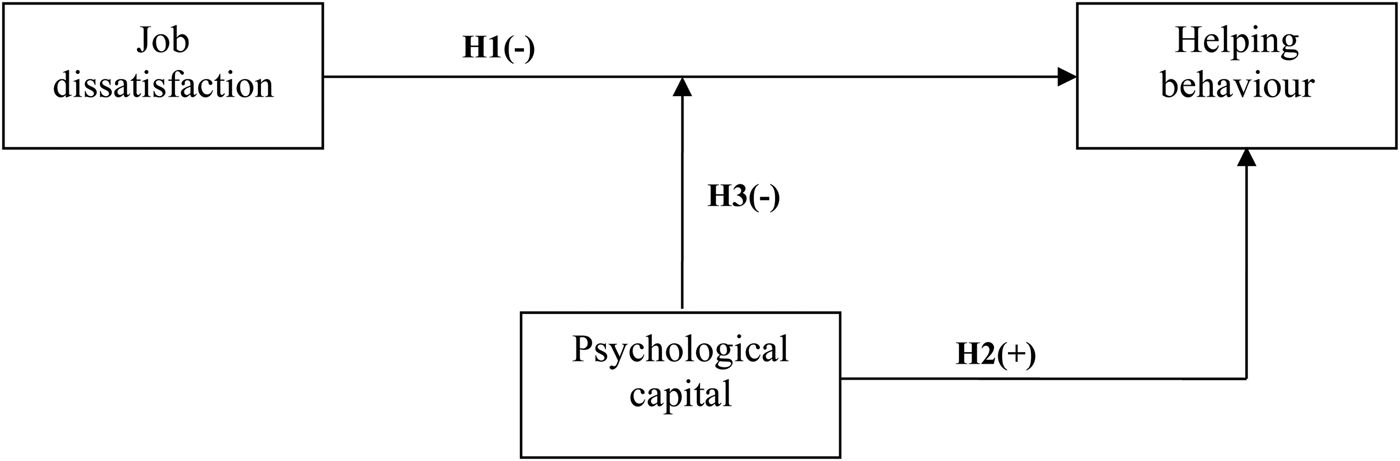
Figure 1 presents the conceptual framework and hypotheses for the current study. First, it relates employees' job dissatisfaction and psychological capital to the likelihood that they undertake helping behaviour. Second, the relationship between job dissatisfaction and helping behaviour should be moderated by psychological capital. In particular, and following COR theory (Hobfoll, Reference Hobfoll2001; Hobfoll & Shirom, Reference Hobfoll, Shirom and Golembiewski2000), job dissatisfaction likely diminishes and psychological capital enhances helping behaviour, but the former effect may be mitigated when employees can rely on high levels of psychological capital. Thus, psychological capital exerts not only a direct positive impact, in terms of fuelling helping behaviour, but also serves as a buffer against the harmful effects of job dissatisfaction, as detailed in the following sections.
Conceptual model

Job dissatisfaction and helping behaviour
Many studies that predict helping behaviour focus on positive workplace factors such as enablers (e.g., Hirst et al., Reference Hirst, Walumbwa, Aryee, Butarbutar and Chen2016; Liang, Shih, & Chiang, Reference Liang, Shih and Chiang2015; Zhu & Akhtar, Reference Zhu and Akhtar2014); less attention has centred on the harmful effects of negative, resource-draining situations (Peng & Zeng, Reference Peng and Zeng2017; Pooja, De Clercq, & Belausteguigoitia, Reference Pooja, De Clercq and Belausteguigoitia2016), including feelings of boredom or limited enthusiasm about the job. When employees are dissatisfied with or feel little enthusiasm about their jobs, it might constitute an important source of energy depletion that inhibits their helping behaviour, despite the various potential benefits of such behaviour (Jiang, Baker, & Frazier, Reference Jiang, Baker and Frazier2009). Job dissatisfaction drains employees' positive emotional resources, so they feel frustrated and unhappy when they come to work (Little, Nelson, Quade, & Ward, Reference Little, Nelson, Quade and Ward2011; Sun & Pan, Reference Sun and Pan2008) and experience a diminished ability to meet job expectations (Rayton & Yalabik, Reference Rayton and Yalabik2014). Based on the logic of COR theory, this resource drainage should lead to a reduced propensity to undertake helping behaviours, reflecting a motivation to avoid further resource losses by conserving work-related energy, including energy that otherwise could be allocated to discretionary helping efforts (Hobfoll & Shirom, Reference Hobfoll, Shirom and Golembiewski2000; Ng & Feldman, Reference Ng and Feldman2012).
Similarly, employees who feel unhappy about their job situation tend to allocate their energy towards negative behaviours, such as reduced emotional attachment to their employer (Luna-Arocas & Camps, Reference Luna-Arocas and Camps2008) or higher rates of absenteeism (Frooman, Mendelson, & Murphy, Reference Frooman, Mendelson and Murphy2012), instead of positive behaviours that could contribute to organizational effectiveness (Foote & Tang, Reference Foote and Tang2008; Lu, Shih, & Chen, Reference Lu, Shih and Chen2013). The energy-draining effect that comes with a lack of enthusiasm about work thus translates into a certain passiveness at work, such that employees refrain from voluntarily contributing to the well-being of their coworkers (Hobfoll, Reference Hobfoll2001).
Hypothesis 1
There is a negative relationship between employees' job dissatisfaction and their helping behaviour.
Psychological capital and helping behaviour
In addition, employees' psychological capital – or the extent to which they exhibit high levels of self-efficacy, hope, optimism, and resilience (Luthans et al., Reference Luthans, Avolio, Avey and Norman2007) – should influence their helping behaviours. Employees equipped with psychological capital (1) feel confident about their ability to perform their job duties, (2) have the energy to work hard towards goal attainment and the ability to see different pathways to such goal attainment, (3) expect positive outcomes for themselves in the future regardless of their personal ability, and (4) effectively bounce back from adverse situations (Avey, Luthans, & Youssef, Reference Avey, Luthans and Youssef2010; Luthans et al., Reference Luthans, Avolio, Avey and Norman2007; Newman, Ucbasaran, Zhu, & Hirst, Reference Newman, Ucbasaran, Zhu and Hirst2014). These four components constitute an overarching construct, with a stronger impact on employee outcomes than each main effect of the components individually (Avey, Reichard, Luthans, & Mhatre, Reference Avey, Reichard, Luthans and Mhatre2011; Dawkins, Martin, Scott, & Sanderson, Reference Dawkins, Martin, Scott and Sanderson2013; Newman et al., Reference Newman, Ucbasaran, Zhu and Hirst2014). For example, psychological capital as a whole has been shown to be a better predictor of job performance than its underlying components of self-efficacy, hope, optimism, or resilience (Luthans et al., Reference Luthans, Avolio, Avey and Norman2007).
Employees' psychological capital may serve as an energy-enhancing personal resource, from which they can draw to engage in positive work behaviours (Luthans et al., Reference Luthans, Avolio, Avey and Norman2007; Gupta, Shaheen, & Reddy, Reference Gupta, Shaheen and Reddy2017), including voluntarily helping their colleagues. Discretionary helping efforts that assist colleagues with their job tasks require significant energy that might prevent employees from successfully fulfilling their regular job tasks (Bolino, Hsiung, Harvey, & LePine, Reference Bolino, Hsiung, Harvey and LePine2015; Podsakoff et al., Reference Podsakoff, Whiting, Podsakoff and Blume2009), but employees who can rely on positive personal resource reservoirs are better able to persevere while undertaking work activities that consume significant energy but are not guaranteed to produce immediate rewards (Chen & Kao, Reference Chen and Kao2011; Choi & Moon, Reference Choi and Moon2016). Similarly, employees with high levels of psychological capital have greater confidence that the potential resource gains of their voluntary helping efforts – such as higher quality peer relationships or useful peer feedback (Korsgaard, Meglino, Lester, & Jeong, Reference Korsgaard, Meglino, Lester and Jeong2010) – are within reach (Newman et al., Reference Newman, Ucbasaran, Zhu and Hirst2014), which should stimulate them to undertake such efforts, according to COR theory (Hobfoll, Reference Hobfoll2001). If employees instead cannot rely on high levels of psychological capital, they are less able to perform voluntary helping behaviours and more likely to allocate their energy solely to their regular job tasks (Avey et al., Reference Avey, Reichard, Luthans and Mhatre2011; Gupta, Shaheen, & Reddy, Reference Gupta, Shaheen and Reddy2017). Thus, psychological capital provides employees with the energy they need to help their colleagues on a voluntary basis and to persist in these efforts.
According to COR theory, possessing an energy-enhancing personal resource such as psychological capital also should motivate helping behaviours, which contribute to the generation of further resource gains in the form of personal fulfilment (Hobfoll & Shirom, Reference Hobfoll, Shirom and Golembiewski2000). For example, psychological capital creates a sense of personal meaningfulness if employees reach out to others and help them overcome work challenges (Avey, Wernsing, & Luthans, Reference Avey, Wernsing and Luthans2008). Employees who voluntarily help organizational colleagues with their job tasks thus may experience strong positive emotions when they are equipped with high psychological capital, such that they become particularly motivated to engage in discretionary helping behaviours (Hobfoll, Reference Hobfoll2001). Conversely, employees with less psychological capital tend to derive less personal fulfilment from undertaking activities that contribute to others' well-being (Avey, Wernsing, & Luthans, Reference Avey, Wernsing and Luthans2008). In this scenario, they have less to gain from undertaking voluntary helping activities; consistent with COR theory, their motivation to invest substantial energy in these helping activities thus should diminish (Hobfoll, Reference Hobfoll2001). Similarly, employees marked by low psychological capital tend to exhibit less commitment to their organization (Avey et al., Reference Avey, Reichard, Luthans and Mhatre2011) and lower levels of work engagement (Joo, Lim, & Kim, Reference Joo, Lim and Kim2016), such that they would be less prone to help colleagues with their job tasks – activities that otherwise would benefit the employer (Podsakoff et al., Reference Podsakoff, Whiting, Podsakoff and Blume2009).
Hypothesis 2
There is a positive relationship between employees' psychological capital and their helping behaviour.
Moderating role of psychological capital
Job dissatisfaction and psychological capital also might exert an interactive effect on helping behaviour, such that the negative link between job dissatisfaction and helping behaviour might be buffered or mitigated by psychological capital. According to COR theory, the harmful effect of resource-draining work conditions on positive work behaviours diminishes to the extent that employees have access to personal resources that compensate for their resource losses (Hobfoll, Reference Hobfoll2001; Hobfoll & Shirom, Reference Hobfoll, Shirom and Golembiewski2000). Psychological capital is one such personal resource that enables employees to find ways to cope with their unhappy feelings about their job situation (Abbas et al., Reference Abbas, Raja, Darr and Bouckenooghe2014; Roberts, Scherer, & Bowyer, Reference Roberts, Scherer and Bowyer2011). All four components may generate positive energy from which employees can draw to deal with their sense of dissatisfaction about their work situation (Gooty, Gavin, Johnson, Frazier, & Snow, Reference Gooty, Gavin, Johnson, Frazier and Snow2009; Luthans, Avey, Avolio, & Peterson, Reference Luthans, Avey, Avolio and Peterson2010): Self-efficacy may fuel confidence in their abilities to overcome the source of their dissatisfaction (Bandura, Reference Bandura1997); their hope may function as a motivational driver to do well in their job tasks, even if confronted with a disappointing work situation (Snyder, Reference Snyder2002); optimism helps employees maintain a positive approach to their work (Seligman, Reference Seligman1998); and resilience enables employees to bounce back more easily from negative feelings about their job situation (Luthans, Reference Luthans2002).
Employees equipped with psychological capital also tend to feel motivated to seek solutions to adverse work situations (Avey et al., Reference Avey, Reichard, Luthans and Mhatre2011; Newman et al., Reference Newman, Ucbasaran, Zhu and Hirst2014), so undertaking extraordinary helping behaviours in the presence of negative feelings about their job may provide some personal fulfilment. The personal resource of psychological capital therefore could enhance not only employees' ability to cope with negative feelings about their job situation but also the personal joy they experience in this process (Hobfoll & Shirom, Reference Hobfoll, Shirom and Golembiewski2000). In a similar vein, employees marked by high psychological capital are strongly goal driven and exhibit high levels of goal commitment, particularly if the goals are challenging (Avey, Wernsing, & Luthans, Reference Avey, Wernsing and Luthans2008; Gupta, Shaheen, & Reddy, Reference Gupta, Shaheen and Reddy2017). Their psychological capital thus may motivate employees to invest some energy in voluntary helping activities, even if such efforts cannot be taken for granted, because of how they feel about their own situation. Conversely, employees equipped with low psychological capital generally are less motivated to undertake challenging work activities, so they may devote less energy to discretionary helping efforts that are not formally required if they already must deal with their lack of excitement or enthusiasm for their own work situation (Luthans et al., Reference Luthans, Avolio, Avey and Norman2007).
Hypothesis 3
The negative relationship between employees' job dissatisfaction and their helping behaviour is moderated by their psychological capital, such that the relationship is weaker at higher levels of psychological capital.
Research Method
Data collection
The data for this study came from several organizations in Pakistan that operate in different sectors, including textiles, food, telecom, finance, and education. The data collection process included two paper-and-pencil surveys: one administered with employees and another with the employees' supervisors. For both surveys, cover letters explained the purpose of the study and ensured complete confidentiality. In particular, participants were informed that the responses would be accessible only to the research team, that no employee-level information would ever be made available, and that any report or article generated from the study would be based on aggregated data only. Furthermore, the surveys emphasized that there were no right or wrong answers and urged participants to respond to the questions as honestly as possible – two measures that reduce concerns about social desirability or acquiescence biases (Spector, Reference Spector2006).
After they completed the surveys, the participants placed them in sealed envelopes and returned them directly to one of the authors. The participants were informed that the insights generated from the research would benefit their organization, but they did not receive any monetary or other incentives to participate. Furthermore, they were told that their participation was completely voluntary, and they could withdraw from the study at any time. Of the 500 surveys distributed, the 394 completed pairs reflect a response rate of 79%. Among the respondents, 26% were women, and their average age was 28 years.
Measures
The measures of the three focal constructs used items derived from previous research.
Helping behaviour
To assess the likelihood that employees go out of their way to help their coworkers with their job, this study relied on a 7-item scale of helping behaviour, with 7-point Likert anchors, as developed by Williams and Anderson (Reference Williams and Anderson1991) and applied in previous studies (e.g., Naseer, Raja, Syed, Donia, & Darr, Reference Naseer, Raja, Syed, Donia and Darr2016; Raja & Johns, Reference Raja and Johns2010). To avoid concerns about common method bias, supervisors provided the scores of employees' helping behaviours, on items such as, ‘This employee assists other employees with their work, even when not asked’, ‘This employee takes time to listen to coworkers’ problems and worries’, and ‘This employee passes along information to coworkers’ (Cronbach's α = .88).
Job dissatisfaction
The job dissatisfaction measure was a reverse-coded, 6-item scale of job satisfaction, using 5-point Likert anchors (Abbas et al., Reference Abbas, Raja, Darr and Bouckenooghe2014; Agho, Price, & Mueller, Reference Agho, Price and Mueller1992). Consistent with prior research (e.g., Jiang, Baker, & Frazier, Reference Jiang, Baker and Frazier2009), this reverse-coded scale assesses the extent to which employees are unhappy with their job situation. One item in the original scale (‘I am often bored with my job’) already was worded to signal high levels of dissatisfaction. It combined with reverse-coded versions of items such as ‘I find real enjoyment in my work’, and ‘Most days I am enthusiastic about my work’ (Cronbach's α = .83).
Psychological capital
For the measure of employees' self-assessed psychological capital, this study adopted the 24-item Psychological Capital Questionnaire (PCQ; Luthans et al., Reference Luthans, Avolio, Avey and Norman2007), with 6-point Likert anchors, as has been validated in previous studies (e.g., Avey, Patera, & West, Reference Avey, Patera and West2006; Gooty et al., Reference Gooty, Gavin, Johnson, Frazier and Snow2009; Luthans, Avey, & Patera, Reference Luthans, Avey and Patera2008; Luthans, Norman, Avolio, & Avey, Reference Luthans, Norman, Avolio and Avey2008; Roberts, Scherer, & Bowyer, Reference Roberts, Scherer and Bowyer2011). The scale includes questions pertaining to self-efficacy (e.g., ‘I feel confident discussing my work area with the management’), hope (e.g., ‘I can think of many ways to reach my current work goals’), optimism (e.g., ‘I always look on the bright side of things regarding my job’), and resilience (e.g., ‘I usually manage difficulties one way or another at work’). A second-order confirmatory factor analysis confirmed that the four dimensions loaded on the psychological capital construct as a second-order factor. The paths between the second-order factor and each of the first-order factors were strongly significant (p < .001), and the second-order model exhibited a good fit (confirmatory fit index = .91; Tucker–Lewis index = .90; incremental fit index = .92; root mean square error of approximation = .05). The internal consistency of the 24-item measure was high (Cronbach's α = .87), and the treatment of psychological capital as an overarching construct is consistent with previous empirical studies (e.g., Avey, Wernsing, & Luthans, Reference Avey, Wernsing and Luthans2008; Roberts, Scherer, & Bowyer, Reference Roberts, Scherer and Bowyer2011).
Control variables
The regression analyses included two control variables, gender (1 = female) and age (in years).
Results
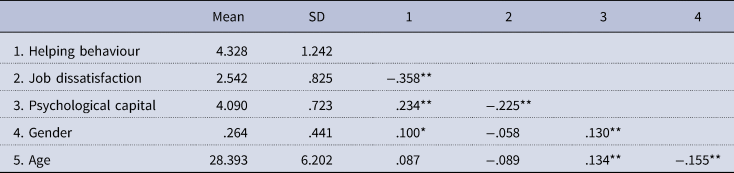
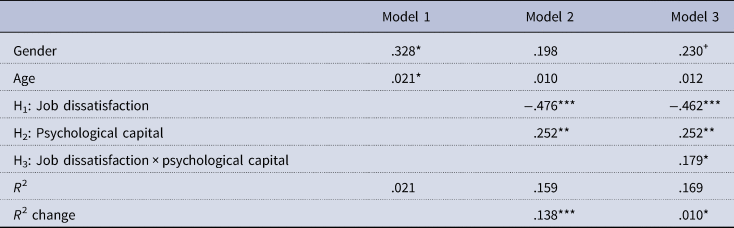
Table 1 contains the zero-order correlations and descriptive statistics, and Table 2 reports the regression results. Model 1 included the control variables, Model 2 added job dissatisfaction and psychological capital, and Model 3 added the job dissatisfaction × psychological capital interaction term, after mean-centring its constitutive components (Aiken & West, Reference Aiken and West1991).
Correlation table and descriptive statistics

Note: N = 394.
**p < .01; *p < .05.
Regression results (dependent variable: helping behaviour)

Note: N = 394.
***p < .001; **p < .01; *p < .05; +p < .10.
Model 1 revealed that helping behaviours were higher among female than male employees (β = .328, p < .05) and among older employees (β = .021, p < .05). In support of the theoretical prediction that employees who feel unhappy about their job situations are less likely to assist their coworkers voluntarily, Model 2 indicated a negative relationship between job dissatisfaction and helping behaviour (β = −.476, p < .001, Hypothesis 1). Model 2 also showed support for a beneficial role of psychological capital, in that employees equipped with higher levels of psychological capital were more likely to undertake helping behaviour (β = .252, p < .01), in support of Hypothesis 2.
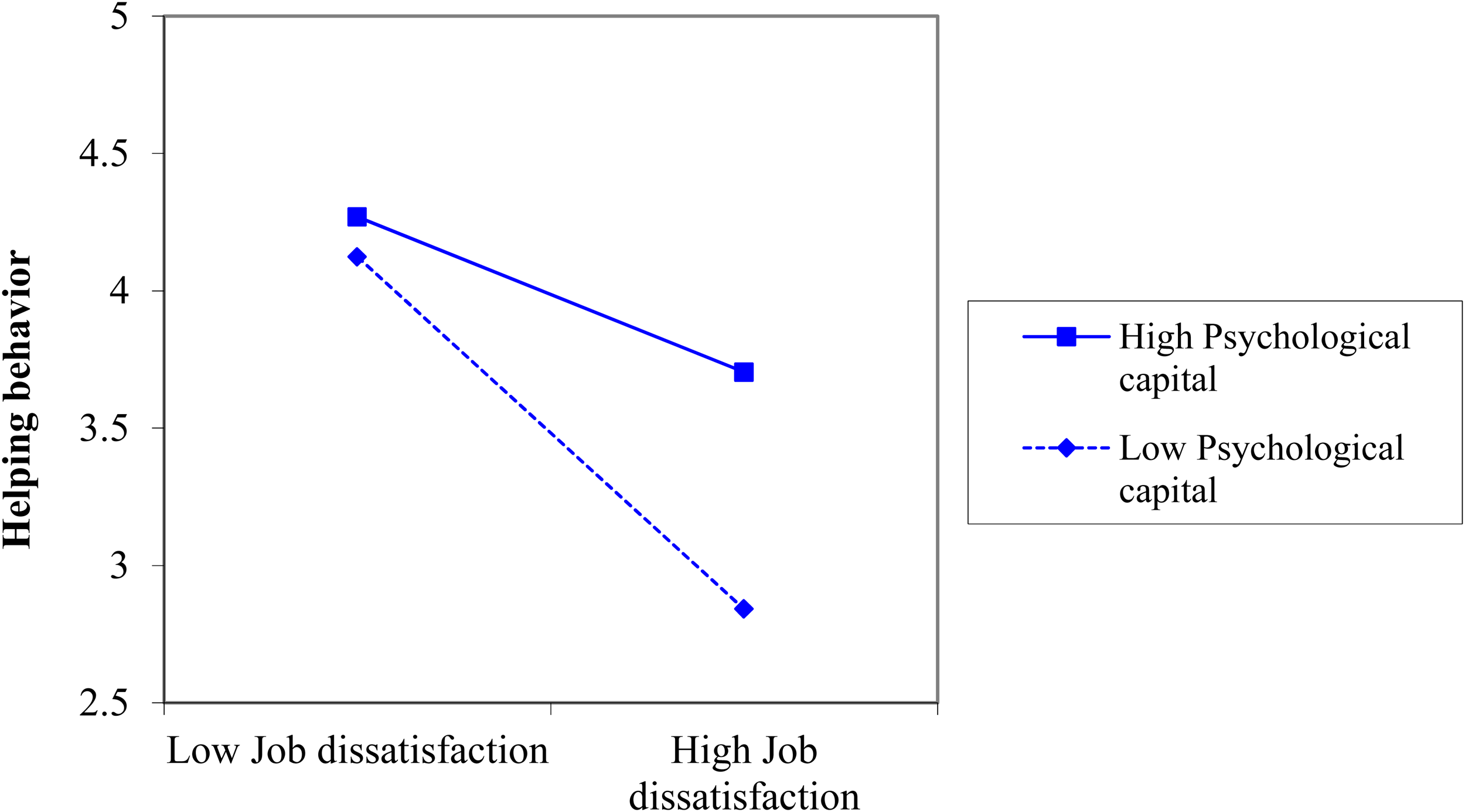
Model 3 indicated support for the theorized buffering effect of psychological capital on the negative relationship between job dissatisfaction and helping behaviour (β = .179, p < .05). The extent to which job dissatisfaction diminished helping behaviour was mitigated among employees with higher levels of psychological capital, in support of Hypothesis 3. To depict the nature of this moderating effect, Figure 2 contains a plot of the effects of job dissatisfaction on helping behaviour at high and low levels of psychological capital, combined with a simple slope analysis (Aiken & West, Reference Aiken and West1991). The relationship between job dissatisfaction and helping behaviour was strongly significant when psychological capital was low (β = −.641, p < .001) but only weakly significant when it was high (β = −.283, p < .10), in further support of Hypothesis 3.
Moderating effect of psychological capital on the relationship between job dissatisfaction and helping behaviour

Discussion
Prior research points to the importance of investigating how employees' positive energy can be channelled into discretionary work behaviours that contribute to organizational effectiveness but that are not formally required (e.g., Choi & Moon, Reference Choi and Moon2016; Lin & Peng, Reference Lin and Peng2010). These extra-role behaviours are not restricted to activities that directly add to organizational performance but also can manifest indirectly through employees' efforts to reach out to individual colleagues and facilitate the successful completion of their job tasks (Chou & Stauffer, Reference Chou and Stauffer2016). Our focus on such helping behaviour, instead of organizational citizenship in general, acknowledges the critical role of productive positive interpersonal interactions for organizational well-being (Bachrach, Powell, Collins, & Richey, Reference Bachrach, Powell, Collins and Richey2006). Yet allocating substantial time to voluntary work activities also has a negative side; it might be distracting for employees and prevent them from fulfilling their formal job duties (Bolino et al., Reference Bolino, Hsiung, Harvey and LePine2015). Thus, this study addresses the pertinent issue of how a negative, resource-draining job situation might steer employees away from helping behaviour – behaviour that already is inherently challenging.
In particular, and drawing from COR theory (Hobfoll, Reference Hobfoll1989, Reference Hobfoll2001), this research has investigated the roles of job dissatisfaction and psychological capital in predicting helping behaviour. The central predictions assert that employees' negative feelings about their job, as manifest in a lack of enthusiasm or excitement, may undermine their propensity to reach out to their coworkers and assist them in their work, yet this effect may be mitigated by the extent to which employees are equipped with psychological capital. In particular, this personal resource may fuel helping behaviour directly, and it also may make employees more immune to the emotional resource drainage that stems from unhappy work feelings, thereby reducing the likelihood that employees become reluctant to help their peers (Abbas et al., Reference Abbas, Raja, Darr and Bouckenooghe2014). The empirical findings confirm these theoretical predictions.
The direct positive relationship between job dissatisfaction and helping behaviour, as found herein, is consistent with the argument that employees' experience of negative job-related feelings compromises their extra-role helping behaviours, from which the employer and its members otherwise could benefit (Ng & Van Dyne, Reference Ng and Van Dyne2005; Rispens, Reference Rispens2009). A critical mechanism that explains this process, based on COR theory, is the desire to conserve positive work-related energy (Hobfoll, Reference Hobfoll2001). That is, employees who do not feel enthusiastic about their current job situation may prefer to save their personal energy resources for behaviours that generate immediate returns (i.e., meeting their job requirements), instead of going out of their way to perform extra-role helping activities that are not formally rewarded (Jiang, Baker, & Frazier, Reference Jiang, Baker and Frazier2009).
In turn, the direct positive relationship between psychological capital and helping behaviour shows that employees who are equipped with positive, energy-enhancing personal resources tend to be more supportive of their coworkers. This personal resource entails four psychological capacities – self-efficacy, hope, optimism, and resiliency – which infuse employees with positive energy that steers them towards activities that support organizational success and improvement (Luthans et al., Reference Luthans, Avolio, Avey and Norman2007; Newman et al., Reference Newman, Ucbasaran, Zhu and Hirst2014). From a conceptual perspective, the positive relationship between psychological capital and helping behaviour is also consistent with COR theory (Hobfoll, Reference Hobfoll1989; Hobfoll & Shirom, Reference Hobfoll, Shirom and Golembiewski2000), in that employees equipped with this personal resource have greater confidence that they can be effective in their helping efforts and anticipate possible resource gains in the form of useful peer feedback and reciprocity, for example (Hui, Lam, & Law, Reference Hui, Lam and Law2000; Korsgaard et al., Reference Korsgaard, Meglino, Lester and Jeong2010). Moreover, psychological capital may spur helping behaviour, due to the feelings of personal fulfilment it can generate (Avey et al., Reference Avey, Reichard, Luthans and Mhatre2011).
The core insight that arises from this study though is that psychological capital also has a more covert beneficial role: It serves as a buffer against the negative effects of employees' job dissatisfaction on helping behaviour. The likelihood that employees avoid assisting coworkers because they hold negative emotions about their job situation diminishes, to the extent that the associated resource depletion can be countered by their psychological capital (Hobfoll, Reference Hobfoll2001). Psychological capital fuels employees' energy levels, so they can better cope with the frustration that arises in unfavourable work situations (Abbas et al., Reference Abbas, Raja, Darr and Bouckenooghe2014; Rehman, Qingren, Latif, & Iqbal, Reference Rehman, Qingren, Latif and Iqbal2017), as well as reserve some of their resources to support discretionary helping activities that are not formally required (De Clercq & Belausteguigoitia, Reference De Clercq and Belausteguigoitia2017). Moreover, employees with high psychological capital experience personal joy from undertaking helping behaviours in the presence of adverse work situations, which thwarts the likelihood that they withhold such positive behaviours because of their own frustration (Newman et al., Reference Newman, Ucbasaran, Zhu and Hirst2014). When they can draw on their psychological capital, employees are better equipped to undertake voluntary behaviours that contribute to the success of their colleagues, even if they are not completely happy about their own job situation.
Notably, our conceptual focus on the mitigating role of employees' psychological capital touches on the incremental role of job dissatisfaction, such that the study's central contribution pertains to the relative usefulness of employees' possession of valuable personal resources for preventing their unhappy job feelings from halting their helping activities. From an empirical standpoint, this issue manifests in slope differences at different levels of psychological capital. As the interaction plot in Figure 2 and the associated simple slope analysis reveal, increasing levels of job dissatisfaction diminish helping behaviours only minimally when employees are equipped with high levels of this personal resource. Alternatively, employees' lack of enthusiasm represents an important inhibitor of their voluntary assistance of coworkers, in the absence of sufficient psychological capital.
Even though the study's theoretical arguments are not country-specific, cultural factors may be relevant, in light of the specific empirical setting of Pakistan, which entails two key opposing forces. On the one hand, the high level of collectivism that marks Pakistani culture, with its focus on maintaining group harmony (Hofstede, Hofstede, & Minkov, Reference Hofstede, Hofstede and Minkov2010), may cause employees to feel somewhat ‘forced’ to go out of their way to assist peers who ask for help, even when those employees face a negative job situation themselves. From this perspective, the roles of job dissatisfaction and psychological capital for explaining helping behaviour would be relatively weak or absent. On the other hand, the uncertainty avoidance that is inherent to Pakistani culture (Hofstede, Hofstede, & Minkov, Reference Hofstede, Hofstede and Minkov2010) might mean that employees feel strongly and negatively affected by the uncertainties that come with an unhappy job situation. Following this logic, the experience of resource-draining job dissatisfaction should be an important inhibitor of their helping behaviour, and the value of their psychological capital in mitigating this process should be salient. This post hoc reasoning about the possible role of different cultural factors clearly warrants caution, but the empirical support for the hypotheses indicates that the role of uncertainty avoidance might prevail over that of collectivism.
Overall, the study's findings extend management research by elaborating on the interplay of sources of energy depletion (job dissatisfaction) and energy creation (psychological capital) that informs employees' propensity to help their colleagues with their jobs. The scope of the tested model is somewhat narrow, reflecting the research goal of achieving depth, rather than breadth, by focusing on how resource depletion due to unhappy feelings about one's job situation might be contained by the critical personal resource of psychological capital. Consistent with COR theory (Hobfoll & Shirom, Reference Hobfoll, Shirom and Golembiewski2000), employees' reliance on psychological capital mitigates the likelihood that they choose not to assist their coworkers in response to the emotional resource drainage caused by job dissatisfaction – a positive role that has not been investigated in previous studies. In so doing, this study adds the important insight that the harmful role of an unhappy job situation in curtailing helping behaviours can be contained by an energy-enhancing personal resource, such as psychological capital, that counters the hardships of such a situation. To the extent that employees can draw from enhanced levels of self-efficacy, hope, optimism, and resilience, they are better positioned to manage the frustration that comes with their limited job-related enthusiasm, so they retain sufficient energy to help their coworkers with their job duties.
Limitations and future research
Despite its merits, this study also has some limitations, which suggest avenues for further research. First, we theorized that employees' desire to conserve positive work energy is an important mechanism that underpins the negative relationship between their job dissatisfaction and helping behaviour, but we do not empirically assess this mechanism. Further research could do so. In a related vein, we measured helping behaviour with supervisor ratings to avoid concerns about common method bias. Nonetheless, it would be useful to check for agreement among employees, peers, and supervisors in terms of how much, or little, effort employees dedicate to helping activities, as well as whether any differences in these ratings reflect how employees feel about their job situation.
Second, the focus on a specific, important, contingency factor excludes alternative potential buffers of the harmful effect of job dissatisfaction on helping behaviours. Other personal factors could function as buffers, including employees' passion for work (Baum & Locke, Reference Baum and Locke2004) or learning orientation (VandeWalle, Brown, Cron, & Slocum, Reference VandeWalle, Brown, Cron and Slocum1999) – factors that each may compensate for the emotional resource drainage that employees experience when they feel bored and lack enthusiasm about their job situation. Moreover, positive organizational factors might counter the resource depletion that arises with job dissatisfaction, such as perceived organizational support (Wayne, Shore, & Liden, Reference Wayne, Shore and Liden1997), transformational leadership (Zhu & Akhtar, Reference Zhu and Akhtar2014), or perceptions of organizational fairness (Colquitt, Conlon, Wesson, Porter, & Ng, Reference Colquitt, Conlon, Wesson, Porter and Ng2001). Another related extension might investigate alternative theoretical models, such as a model that conceives of psychological capital as a mediator between job dissatisfaction and helping behaviours or else a moderated mediation model that assesses whether the interactive effect of job dissatisfaction and psychological capital on helping behaviour might be mediated by emotional exhaustion or organizational commitment.
Third, and as mentioned, the arguments leading to the research hypotheses are country neutral, yet the country context of Pakistan is interesting in that its collectivism and uncertainty avoidance dimensions might have opposing influences on the predicted relationships. The empirical results suggest a more prominent role of uncertainty avoidance – employees' psychological capital serves as a buffer that enables employees to retain some energy for their helping behaviours in the presence of uncertainty-inducing job dissatisfaction (Hobfoll & Shirom, Reference Hobfoll, Shirom and Golembiewski2000) – but it also would be useful to undertake multicountry comparisons to explicate the relative importance of job dissatisfaction for thwarting helping behaviours, as well as the potency of various underlying moderators to buffer this process, across different cultural contexts. Yet another extension might examine the role of pertinent cultural values at the individual level, such as employees' collectivistic orientation (Triandis & Gelfand, Reference Triandis and Gelfand1998) or risk aversion (Allen, Weeks, & Moffitt, Reference Allen, Weeks and Moffitt2005).
Practical implications
This research has important implications for managerial practice. In particular, the study's results underscore the challenge that managers interested in spurring voluntary helping efforts face when they count unhappy employees within their ranks, as well as the useful role that the personal resource of psychological capital can have in this case. When they lack enthusiasm or excitement about their job situation, employees feel unhappy; managers should seek to mitigate this situation. Notable in this regard is that some employees may be hesitant to admit that they feel unhappy about their job situation, to avoid appearing overly complaining or ungrateful. Managers therefore should be proactive in identifying employees who suffer from job dissatisfaction and pinpoint the reasons (e.g., unmet expectations, excessive workloads, destructive leadership). They also could help employees recognize feelings of unhappiness in others and devise open knowledge sharing routines about such issues. By organizing customized training initiatives that stimulate open communication, they could encourage employees to express their disappointment with specific elements of their job situation (Cabrera & Cabrera, Reference Cabrera and Cabrera2005). Such initiatives could feature formalized programs that take place outside the workplace, as well as informal, on-the-job learning methods, each of which represents useful pathways for professional development (Enos, Kehrhahn, & Bell, Reference Enos, Kehrhahn and Bell2003). Ultimately, the initiatives may contribute to maintaining a helping culture in organizations, to the extent that they facilitate in-depth discussions about possible sources of employee unhappiness and solutions for dealing with the negative feelings that result.
Yet some level of unhappiness within employee ranks may be unavoidable. The current study indicates that employees who can rely on higher levels of psychological capital – feel confident about their own abilities, are hopeful about achieving work goals, are optimistic about their future, and are resilient when bouncing back from failure (Luthans et al., Reference Luthans, Avolio, Avey and Norman2007) – are better prepared to cope with the hardship that comes with an unsatisfactory job situation. That is, employees' psychological capital is a useful personal resource that managers can leverage to mitigate resource depletion due to job dissatisfaction, thereby freeing residual energy for voluntary helping behaviours, even in an unfavourable situation. A specific recommendation arising from this research thus highlights the value of recruiting and retaining employees who are equipped with high levels of psychological capital.
In addition to recruiting and retaining employees with high psychological capital, organizations can develop this personal resource among their employee bases (Luthans, Reference Luthans2002). To spur employees' psychological capital, they could explain, for example, which specific skills and mind sets are most needed to cope effectively with difficult work situations. They also might feature successful role models who have exhibited their ability to help coworkers in need, even when they do not operate in ideal work circumstances. Because the personal resource of psychological capital is malleable and open to development, it can be promoted in relatively short training sessions (Luthans et al., Reference Luthans, Avey, Avolio and Peterson2010) or even online programs (Luthans, Avey, & Patera, Reference Luthans, Avey and Patera2008; Luthans et al., Reference Luthans, Norman, Avolio and Avey2008). Despite the great value of treating psychological capital as an overarching construct (Newman et al., Reference Newman, Ucbasaran, Zhu and Hirst2014), it also may be useful to assess explicitly how employees score on each of its underlying dimensions, then develop targeted approaches to address any deficiencies (Dawkins et al., Reference Dawkins, Martin, Scott and Sanderson2013). Ultimately, employees may become more confident about their ability to cope with imperfect work situations to the extent that they develop adequate personal capacities that fuel their energy levels, as manifest in increases in the different components that underpin their psychological capital.
Conclusion
This study contributes to extant research by investigating the unexplored, combined effects of job dissatisfaction and psychological capital for predicting helping behaviour. The paucity of research on this topic is somewhat surprising, especially in light of the recognition that allocating time to voluntary helping activities usurps significant energy (Podsakoff et al., Reference Podsakoff, Whiting, Podsakoff and Blume2009) and can be a challenge for employees who face unfavourable work conditions or are deprived of adequate personal resources (Choi & Moon, Reference Choi and Moon2016; Peng & Zeng, Reference Peng and Zeng2017). Using COR theory as a conceptual framework, this study reveals that job dissatisfaction inhibits helping behaviour, and psychological capital stimulates such behaviour. Moreover, withholding helping behaviour, as a response to the emotional resource depletion that comes with job dissatisfaction, is mitigated to the extent that employees can draw from their psychological capital. For organizations, this study thus establishes a revised, expanded understanding of the occurrence of extra-role helping behaviours within their ranks. For scholars, these findings can serve as catalysts for further studies into how organizational leaders might stimulate voluntary helping behaviours among employees, even in the presence of resource-draining feelings or frustration.
Author ORCIDs
Dirk De Clercq, 0000-0003-1476-2965