Introduction
The Bubog-1 rockshelter on Ilin Island, in the Occidental Mindoro province of the Philippines, has yielded evidence of a thick shell midden and human habitation, dating from c. 33 000 cal BP onwards (Pawlik et al. Reference Pawlik, Piper, Faylona, Padilla, Carlos, Mijares, Vallejo, Ingicco, Reyes, Amano and Porr2014, Reference Pawlik, Piper, Wood, Lim, Faylona, Mijares and Porr2015; Neri et al. Reference Neri, Pawlik, Reepmeyer, Mijares and Paz2015; Piper Reference Piper, Oxenham and Buckley2016; Pawlik & Piper Reference Pawlik and Piper2019). The site contributes significantly to our understanding of the regional diversification of human economic strategies, concurrent with the warming global climate at the end of the Pleistocene, adaptation to maritime environments, technological innovation and community connectivity (Bulbeck Reference Bulbeck2008; Reepmeyer et al. Reference Reepmeyer, Spriggs, Anggraeni, Lape, Neri, Simanjuntak, Summerhayes, Tanudirjo and Tiauzon.2011; Rabett & Piper Reference Rabett and Piper2012; Pawlik et al. Reference Pawlik, Piper, Faylona, Padilla, Carlos, Mijares, Vallejo, Ingicco, Reyes, Amano and Porr2014, Reference Pawlik, Piper, Wood, Lim, Faylona, Mijares and Porr2015; Piper Reference Piper, Oxenham and Buckley2016). Less well understood is the potential socio-cultural milieu that was transmitted across Southeast Asia along with material culture and technological knowledge during this period. Here, we report on a burial found at Bubog-1 in 2013. The burial comprises a single adult inhumation interred in a secluded location under a rock overhang. Radiocarbon dating of the skeleton and associated material indicate that the individual was buried around 5000 years ago (see the online supplementary material (OSM)).
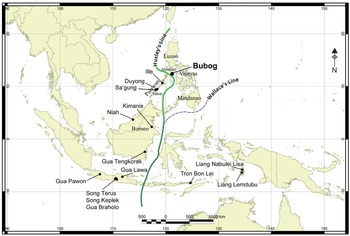
The Bubog-1 individual is the first burial to be securely dated to before 4000 years ago and to provide evidence of methods of treating the dead, east of Huxley's modification of Wallace's Line in the Philippines (Figure 1). The flexed burial position represents one of several Terminal Pleistocene burial practices associated with forager communities recorded across Island Southeast Asia, including seated burials, cremations and dismemberments. The emergence of these complex mortuary practices provides insights into the social and cultural ideas and technological innovations transmitted across Island Southeast Asia during the Early Holocene. These included the geographic spread of new technologies in bone and shell working (Pawlik & Piper Reference Pawlik and Piper2019). At c. 5000 BP, the Bubog-1 flexed burial represents a late manifestation of these diverse burial traditions. After c. 4000 cal BP, new mortuary practices emerged that—for the first time—contained a variety of grave goods.
Geographic situation of the Philippines and relevant burial sites in Island Southeast Asia (figure by the authors).

The archaeology of Bubog-1
Bubog-1 rockshelter is located on the small island of Ilin to the south-west of Mindoro Island (Figure 1). The rockshelter is approximately 45m in length, faces predominantly north-east, and is today around 31m above mean sea level. Its main floor consists of a broad, well-lit and spacious area approximately 20m in length, with a maximum height of around 10m and a depth of around 4m from the lip of the overhang to the rear limestone wall. This area is where most of the Late Pleistocene to Holocene human activity has been recorded. The archaeological record consists primarily of nine layers of well-stratified shell midden approximately 1.5m deep (Figure 2). The stratigraphy is anchored to an absolute chronology by several radiocarbon dates, ranging from 4240–4081 cal BP in layer 4 (S-ANU 32037) to 33.3–31.8 cal kBP (S-ANU 53626) in layer 9 (Pawlik & Piper Reference Pawlik and Piper2019). Chronological variation in the frequency and abundance of different molluscs collected by the human inhabitants provide a record of Terminal Pleistocene to Mid-Holocene sea-level and landscape change between the islands of Ilin and Mindoro (Pawlik et al. Reference Pawlik, Piper, Faylona, Padilla, Carlos, Mijares, Vallejo, Ingicco, Reyes, Amano and Porr2014).
The conjoined south profile of trenches 1–2 at Bubog-1 (illustration by A. Pawlik).

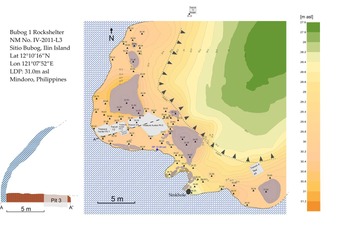
Beneath the shell midden, layers 10–12 were comprised of silty, homogeneous sediments, and the lowest—layer 13—comprised volcanic ash. They contain chert and obsidian flakes, the remains of an endemic terrestrial fauna and marine fishes. Absolute dating of these layers has so far been unsuccessful, but their stratigraphic position below layer 9 suggests a Late Pleistocene age—and before c. 33–30 kya (Pawlik & Piper Reference Pawlik and Piper2019). South-west of the rockshelter is a sinkhole that forms the entrance to a deep cave (Figure 3). On the eastern side of the sink hole—approximately 10m from the south-eastern end of the Pleistocene to Holocene shell midden—is another small rock overhang approximately 15m in length, with a breadth from the dripline to rear wall of around 6m. In 2013, a small 1m2 test pit (trench 4) was excavated to evaluate the archaeological deposits in this location.
Plan of the treasure-hunter pits and excavation trenches at Bubog-1. The profile of the west wall above the excavation trenches is shown on the left (illustration by A. Pawlik).

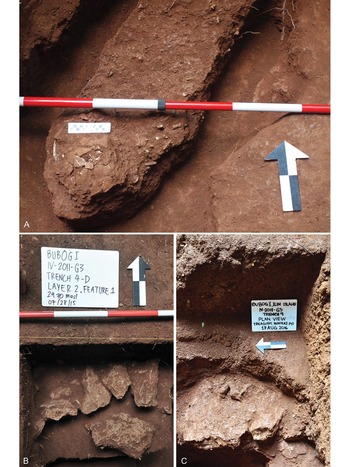
At approximately 0.35m below the modern ground's surface, fragments of a human skull were uncovered. Further excavation revealed more skeletal elements (Figure 4A). Due to the poor preservation of the bones, the skeleton was removed en bloc through an enlargement to the test pit to 2m2. The removal of the burial revealed concentrations of flat limestone blocks that may have lined the grave above and below the inhumation (Figure 4B–C).
A) The burial with fragmented cranium prepared for ‘en bloc’ removal; B) concentration of larger flat limestones above; C) below the burial (photographs by R. Fuentes & A. Pawlik).

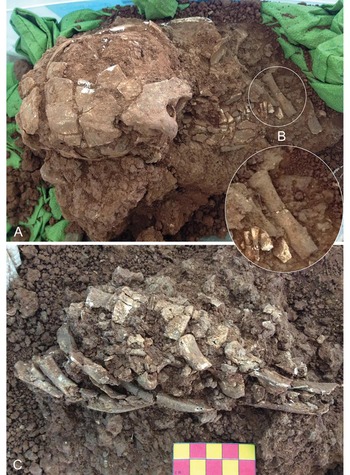
The skeletal remains are highly fragmented due to the crushing and compression by the flat limestone blocks. The facial bones, including the zygoma, maxilla and mandible, were especially poorly preserved and had become separated from the rest of the skull (Figure 5A). The isolated nature of the individual, and the scarcity of comparative, contemporaneous skeletal material in the region makes the assessment of sex based on poorly preserved features, particularly problematic. While gracile, the only potentially diagnostic features of skeletal sex (see Figure 5A) are the moderately expressed external occipital protuberance and mastoid processes (see Walrath et al. Reference Walrath, Turner and Bruzek2004). Neither, however, clearly support an estimation of male or female sex. In terms of age estimation, the presence of fully erupted third molars and fusion of the medial epiphysis of the clavicle suggest a skeletally mature individual. Average first and second molar occlusal wear scores of approximately 20–25 and 15–20 years (after Scott Reference Scott1979), respectively, are also consistent with a middle-aged adult. We acknowledge, however, that without a correlation between wear and age within the relevant population, age-at-death estimation is problematic. Aside from occasional calculus, no other evidence for skeletal or dental pathology was observed.
A) Extensively fragmented skull; B) detail of a finger phalanx adjacent to the facial bones; C) ribs found in anatomical position (photographs by R. Crozier).

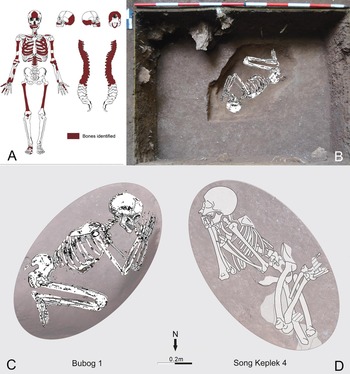
Although the facial elements were separated from the skull, the extant dentition and a fragment of left mandible remained in situ, indicating the original positioning of the head. The distal third of the right ulna was oriented just in front of, and parallel to, the face. The proximal third of the right humerus indicated flexion at the shoulder, and a hand phalanx was visible in the approximate area of the facial bones (Figure 5B). Essentially, therefore, the individual had been placed in the ground on their left side, with the arms flexed at the shoulder and elbow, and the hands placed just in front of the face. The thoracic region comprised very friable vertebrae and ribs, the latter of which were in an anatomical position consistent with primary inhumation and decomposition in situ (Figure 5C). The foot bones were located behind the pelvis, indicating tight flexion of the leg at the knee. Despite the extensive fragmentation, it was possible to reconstruct a significant portion of the skeletal remains (Figure 6A). Tight flexion, and possible wrapping of the body, is further supported by the small size of the oval-shaped burial pit, which measured approximately 0.8 × 0.4m (Figure 6B). The reconstructed position of the burial suggests that the individual was placed with the head facing roughly to the north, towards the sea (Figure 6C). This resembles the reconstructed position of Early Holocene burial SK4 from the cave site of Song Keplek in Java (Figure 6D; Détroit Reference Détroit, Simanjuntak, Pojoh and Hisyam2006). No material culture or objects were found in association with the Bubog-1 burial.
A) Identified bones from the burial (marked in red); B) burial pit with the reconstructed position of the flexed skeleton; C) reconstructed position of the burial with the head facing northwards and towards the sea; D) reconstructed position of the burial SK4 at Song Keplek (A–C: skeleton illustrations by Annie Valera; D: courtesy of Florent Détroit, Truman Simanjuntak and Pusat Penelitian Arkeologi Nasional).

Bubog-1 and Early to Mid-Holocene burial traditions in Island Southeast Asia
With a date of approximately 5000 BP, the Bubog-1 burial is contemporaneous with some of the shell midden deposition under the rock overhang to the west. Conceivably, this individual was a member of a community that inhabited the rockshelter intermittently, c. 5000 years ago. The deliberate placement of the burial in a secluded location, away from the main focus of activity, perhaps suggests the intentional creation of ‘space’ between the living and the dead. Although no material culture was found in association with the burial, the grave appears to have been deliberately lined and covered with limestone slabs.
The Bubog-1 burial shares many characteristics with other Early to Mid-Holocene burials recorded in Island Southeast Asia, some of which are more securely dated than others (Table S2 in the OSM). At Niah Cave in Borneo, for example, 25 individuals have been excavated (Rabett et al. Reference Rabett, Barker, Barton, Hunt, Lloyd-Smith, Paz, Piper, Premathilake, Rushworth, Stephens, Szabó and Barker2013). Burial positions and funerary rites include tight flexion, with the individual buried on their left or right side; or supine on the back, with the feet drawn up to the pelvis, and arms towards the face; and flexed individuals that had been decapitated (Lloyd-Smith Reference Lloyd-Smith2012). There were also secondary inhumations, cremations and a complex rite involving the seating of the corpse on a fire. Clear spatial organisation of the layout of burials was also evident, suggesting group or familial segregation (Lloyd-Smith Reference Lloyd-Smith2012). There are three reliable direct radiocarbon dates on bone collagen (Rabett et al. Reference Rabett, Barker, Barton, Hunt, Lloyd-Smith, Paz, Piper, Premathilake, Rushworth, Stephens, Szabó and Barker2013: 238–39; Table S2). B155, one of a pair of bound, flexed and decapitated individuals buried contemporaneously, gives a date of 9137–8336 cal BP. The seated burial B147 has yielded a date of 8154–7594 cal BP, and the non-burnt secondary inhumation B92 has produced a date of 8313–7670 cal BP. No material culture was found in association with any of the individuals (Rabett et al. Reference Rabett, Barker, Barton, Hunt, Lloyd-Smith, Paz, Piper, Premathilake, Rushworth, Stephens, Szabó and Barker2013: 236). At Kimansi Cave in Borneo, two partially preserved, flexed burials—probably dating to the Terminal Pleistocene or Early Holocene—have been excavated. One of these individuals appears to have been buried on the left side with the left or right arm placed between the legs (Arifin Reference Arifin2004: 82, fig. 5.3). An isolated, flexed burial was also recorded at Gua Tenkgorak, Borneo, and is dated by stratigraphic association to c. 6000 cal BP (Piper Reference Piper, Oxenham and Buckley2016).
In eastern Java, several sites have produced burials exhibiting diverse mortuary traditions (Simanjuntak & Asikin Reference Simanjuntak and Asikin2004). At Song Terus, a single individual was interred in a natural alcove in the north wall of the cave, and several limestone blocks were used to delineate the burial. The individual was flexed, on the right side, with the right hand on the face (Détroit Reference Détroit, Simanjuntak, Pojoh and Hisyam2006: 188–90). A shell recovered from just above the burial has been radiocarbon-dated to 10 405–9881 cal BP. At Song Keplek, an individual (SK4) was buried in a flexed position, on the right side. The arms were folded across the body, with the left hand placed on the chest and the right hand under the chin or in front of the face (Détroit Reference Détroit, Simanjuntak, Pojoh and Hisyam2006: 191–92; Figure 6D). An associated radiocarbon date on charcoal from the grave fill provides a tentative date of 5326–4870 cal BP (Table S2; Noerwidi Reference Noerwidi, Piper, Matsumura and Bulbeck2017).
Seven or eight inhumations from Gua Braholo in east Java show unusual funerary practices that appear to have included disarticulation and deliberate bone breakage. Of the two inhumations reported in detail, BHL-1 was buried with the upper body in a supine position. The right hand was placed on the knees, and the left hand over the right side of the abdomen; the feet were tightly flexed under the pelvis. Two large stones had been placed on top of the right side of the torso. Charcoal recovered from close to the skeleton produced a date of 12 036–10 554 cal BP. BHL-2 was a secondary burial, whereby select disassociated parts of the disarticulated skull, mandible, maxillae and pelvis were collected, possibly within a container and placed on top of a fire as part of the burial ritual. Charcoal found in the burial returned a date of 10 224–9492 cal BP (Détroit Reference Détroit, Simanjuntak, Pojoh and Hisyam2006: 193–96). Similarly, at Gua Lawa in west Java, an undated, potentially Early Holocene cremation seems to have included the deliberate selection of body parts, including the skull, mandible, ribs and long bones (Détroit Reference Détroit, Simanjuntak, Pojoh and Hisyam2006: 197–98).
Gua Pawon in Bandung, west Java, yielded partial burials PAW1 and PAW2, both of which were stained red—possibly with haematite. Charcoal recovered from the same stratigraphic layer tentatively dates the remains to 6859–6173 cal BP. PAW3 was a tightly flexed individual lying on the right side, with a rock placed on the chest (Yondri Reference Yondri2005). A direct radiocarbon assay on bone gives a date of 8454–7784 cal BP. PAW3 overlaid PAW4 (Yondri Reference Yondri2005: 197, photograph 27), a highly weathered, flexed burial with the skull—directly dated to 11 262–10 251 cal BP—supported by a sandstone block (Noerwidi Reference Noerwidi, Piper, Matsumura and Bulbeck2017).
Several cremation burials have been uncovered at Ille Cave in northern Palawan. The treatment of Burial 758 seems to have consisted of the systematic disarticulation at the joints, removal of skin and breakage of long bones, such as the femora and humeri. This was followed by cremation and subsequent placement within a container before burial. Radiocarbon assays on the bone provide dates of 9260–9006 cal BP and 9425–9280 cal BP (Lara et al. Reference Lara, Paz, Lewis and Solheim2013; Table S2).
Fewer burials have been identified to the east of Wallace's Line. A primary inhumation at Tron Bon Lei Cave in Alor, however, is dated—through radiocarbon analysis of a rotating fishhook, found around the deceased's neck and charcoal recovered from the eye socket—to 10 665–10 432 and 11 730–11 332 cal BP, respectively (O'Connor et al. Reference O'Connor, Mahirta, Samper Carro, Hawkins, Kealy, Louys and Wood2017). Commingled burnt and unburnt secondary burials of juveniles and adults from Liang Nabulei Lisa on Aru Island are dated through radiocarbon assays on several different organic samples to c. 12 000–10 000 cal BP (Bulbeck Reference Bulbeck, O'Connor, Spriggs and Veth2006a: 163–70; O'Connor et al. Reference O'Connor, Aplin, Pasveer, Hope, O'Connor, Spriggs and Veth2006: 129–32).
Later Holocene burial in Island Southeast Asia
A notable change in burial traditions occurred in the later Holocene. The initial phase of this can be recognised in the deliberate inclusion of material culture into graves, the clearest examples of which are from Palawan Island in the Philippines. At Duyong Cave, an individual was buried in a typical flexed position, but was placed face down (prone), with arms and legs doubled beneath the body. The individual, however, had been interred along with locally made, edge-ground Tridacna adzes arranged along the sides of the body (Fox Reference Fox1970: 60–64), and a fully polished stone adze. This latter artefact represents a new technology, probably introduced to Island Southeast Asia after the mid fifth millennium BP (Pawlik et al. Reference Pawlik, Piper, Wood, Lim, Faylona, Mijares and Porr2015). Dating by stratigraphy and association places this burial at c. 4500–4000 cal BP (Pawlik & Piper Reference Pawlik and Piper2019). Two perforated Conus (marine gastropod) shell discs were recovered from close to the temporal bones, and were possibly part of a necklace or earrings. These are almost identical to some of the numerous Conus discs recovered from two burials at Ille Cave in northern Palawan (Paz Reference Paz, Rountree, Morris and Peatfield2012: 144) and directly dated to 4800–4100 years ago (Pawlik & Piper Reference Pawlik and Piper2019). As far as the authors are aware, the Ille discs are the earliest, directly dated, perforated Conus-shell discs, a form of ornamentation that would become more widespread throughout Island Southeast Asia and the Pacific after c. 3500 cal BP (Szabó Reference Szabó2010).
At Sa'gung in central Palawan, and Kress (Reference Kress and Paz2004: 239–75) reports 11 burials, four of which were interred in flexed positions. Three individuals—burials 1, 6 and 8—were buried with crocodile tooth and Conus-shell disc necklaces, ground adzes and lime plugs; burial 11 lacked grave goods. While none of the burials are directly dated, based on the burial position and inclusion of grave goods, they are possibly of a similar age to the Duyong burial, or slightly later. None of these mid to late fifth-millennium BP burials in the Philippines contain pottery, a technology that first appears in this area—initially in northern Luzon—after c. 4200–4000 cal BP (Pawlik & Piper Reference Pawlik and Piper2019).
The West Mouth at Niah Cave experienced a hiatus in burials of c. 3500 years, after which several individuals were interred in flexed positions around 3500–3300 cal BP. Unlike the Early Holocene burials described above, burial B205 contained an exotic polished stone adze (Lloyd-Smith et al. Reference Lloyd-Smith, Barker, Barton, Cameron, Cole, Doherty, Hunt, Krigbaum, Lewis, Manser, Paz, Piper, Rushworth, Szabó and Barker2013: 264). After 3000 cal BP, a completely new method of burial—fully extended supine—emerges at Niah, and across Southeast Asia. A formalised cemetery with rows of graves was also established at Niah, with the deceased interred in wooden coffins and/or wrapped in shrouds, and, for the first time, accompanied by a variety of material culture, such as pots, stone adzes and basketry (Lloyd-Smith et al. Reference Lloyd-Smith, Barker, Barton, Cameron, Cole, Doherty, Hunt, Krigbaum, Lewis, Manser, Paz, Piper, Rushworth, Szabó and Barker2013: 265–66). A similar sequence of Late Holocene (c. 2700 cal BP) flexed burial traditions giving way to extended supine burials is recorded in Gua Harimau Cave on Sumatra (Matsumura et al. Reference Matsumura, Hung, Nguyen, Zhao, Ya-Feng, He, Chi, Piper, Matsumura and Bulbeck2017). While a variety of mortuary practices were employed at Pain Haka on Flores c. 3000–2100 years ago, including flexion, dismemberment and seated burials, over 50 of the inhumations were supine with limbs extended (Galipaud et al. Reference Galipaud, Kinaston, Halcrow, Foster, Harris, Simanjuntak, Havelle and Buckley2016).
The significance of burial traditions in Island Southeast Asia
Although anatomically modern humans have been present in Southeast Asia for at least c. 65 000 years (Westaway et al. Reference Westaway2017), there is no clear evidence for deliberate burial before c. 20 000 cal BP. Currently, the oldest-known burial in Island Southeast Asia is from Liang Lemdubu, on the Aru Islands. This adult female had probably been left to decompose before being wrapped and buried beneath a large limestone slab (Bulbeck Reference Bulbeck, O'Connor, Spriggs and Veth2006b: 259). An electron spin resonance (ESR) assay on a tooth and associated radiocarbon dates on shell and Cassuarius eggshell from the same stratigraphic layers date the burial to between 19 000 and 22 000 cal BP (O'Connor et al. Reference O'Connor, Aplin, Pasveer, Hope, O'Connor, Spriggs and Veth2006).
After 12 000 years ago, diverse burial traditions emerged across Mainland and Island Southeast Asia (Piper Reference Piper, Oxenham and Buckley2016), probably the most common being primary, flexed burials (Table S1). In general, the body appears to be placed on the left or right side—or less commonly on the back—often with the hands placed close to the face, or between the knees. Other prescribed mortuary practices include flexed and decapitated, secondary burials comprising partial or complete skeletons, seated burials and cremations. In some cases, treatment of the dead appears to have been even more elaborate and included disarticulation, skinning and/or partial or complete cremation before being placed in a container and buried.
Lloyd-Smith et al. (2013: 264) discuss the importance of arm-positioning in ‘social signalling’ in Neolithic burials at Niah (c. 3500–2200 BP). It is possible that subtle positioning of the body, such as differences in leg or arm positions in the flexed burials observed in Java, may also have had significant embedded meaning. Fire appears to have played an important role (Lloyd-Smith Reference Lloyd-Smith2012) in the preparation of the deceased for burial—both in terms of the deliberate burning of the body, or, in the case of the seated burials recorded at Niah and the secondary inhumation at Gua Braholo, the burning of the ground in preparation for receiving the dead. Based on the macrobotanical remains recovered from the Ille Cave cremations, Paz (Reference Paz, Rountree, Morris and Peatfield2012: 143) has argued that smoke and incense probably also played a role in creating a ‘spiritual’ effect. The intentional use of stone also seems to have been important in burial, being either placed on top, around the sides or beneath a burial. Such practice was observed at Bubog-1, Liang Lemdubu and Pawon; at Gua Braholo, stones were placed on an individual's chest and feet.
The inclusion of material culture in graves before 4500 cal BP is rare (e.g. Tron Bon Lei, Alor). There does seem, however, to be a strong, contemporaneous association with animal body parts. At Song Terus, for example, a partially burnt fragment of bovid vertebral column and the complete skull of a Javan Lutung (Trachipithecus auratus) were placed in the grave (Détroit Reference Détroit, Simanjuntak, Pojoh and Hisyam2006: 190; Piper Reference Piper, Oxenham and Buckley2016). At Niah, flexed burial B27 contained a rhinoceros right radius that was used as a ‘pillow’ (Rabett et al. Reference Rabett, Barker, Barton, Hunt, Lloyd-Smith, Paz, Piper, Premathilake, Rushworth, Stephens, Szabó and Barker2013: 236, fig. 6.21). In Bubog-1, pig and fish remains may have been incorporated into the burial. Clearly, the Early Holocene foragers of Island Southeast Asia had sophisticated relationships with the natural world. Animals were not only captured to satisfy calorific and technological requirements, but also for a variety of social and cultural purposes, such as personal adornment and group status (Piper & Rabett Reference Piper, Rabett, Dennell and Porr2014). It is conceivable that some animals had ideological significance that included associations with death, burial and the afterlife.
The emergence of complex burial traditions across Island Southeast Asia strongly implies maritime mobility between communities inhabiting the mainland and various islands of the region (Bulbeck Reference Bulbeck2008; Lloyd-Smith Reference Lloyd-Smith2012; Lloyd-Smith et al. Reference Lloyd-Smith, Barker, Barton, Cameron, Cole, Doherty, Hunt, Krigbaum, Lewis, Manser, Paz, Piper, Rushworth, Szabó and Barker2013; Piper Reference Piper, Oxenham and Buckley2016). Connectivity between populations is also evident in the dissemination of information and ideas that are manifested in numerous innovations, including technologies in bone and stone, and shell ornaments, and the distribution of obsidian (Bulbeck Reference Bulbeck2008; Reepmeyer et al. Reference Reepmeyer, Spriggs, Anggraeni, Lape, Neri, Simanjuntak, Summerhayes, Tanudirjo and Tiauzon.2011; Neri et al. Reference Neri, Pawlik, Reepmeyer, Mijares and Paz2015; Piper Reference Piper, Oxenham and Buckley2016; Pawlik & Piper Reference Pawlik and Piper2019). The restricted geographic distribution of some types of material culture suggests that not all interactions were regionally ubiquitous, or that all communities adopted innovations as and when they appeared. Examples of such include the distribution of edge-ground shell adzes, found from the Philippines across northern Wallacea as far as Island Melanesia, and fish hooks made of shell in the eastern Lesser Sundas (Pawlik et al. Reference Pawlik, Piper, Wood, Lim, Faylona, Mijares and Porr2015; O'Connor et al. Reference O'Connor, Mahirta, Samper Carro, Hawkins, Kealy, Louys and Wood2017; Pawlik & Piper Reference Pawlik and Piper2019). Different inter-connected communities developed their own unique identities and ways of perceiving the world (Lloyd-Smith Reference Lloyd-Smith2012). This is reflected in the diversity of Early and Mid-Holocene mortuary practices observed across Island Southeast Asia.
Significant changes in the treatment of the dead occurred around 4500–4000 years ago and are initially reflected in the material culture included within burials. Retention of the flexed burial position suggests an emphasis on continuity in well-established, culturally accepted modes of burial, while the appearance of a range of local and exotic material culture within graves may represent locally emergent practices with non-local influences on traditional practice.
After 4000–3500 cal BP, graves containing supine extended burials and a range of material culture appear across Island Southeast Asia. The transition from flexed burial in Island Southeast Asia mirrors similar changes observed in Mainland Southeast Asia. Here, after 4500 cal BP, burial practices changed dramatically and the dead were interred predominantly in extended supine positions, accompanied by a wealth of material culture that includes pottery, ground stone implements and shell artefacts (Hung Reference Hung2019). In Mainland Southeast Asia, the Late Holocene transformation in burial practice is a clear reflection of human population history. Late Pleistocene/Early Holocene flexed burial and dismemberment is associated with local Southeast Asian foraging communities, whereas the appearance of supine burial and the inclusion of grave goods reflects the arrival of agricultural communities migrating from southern China. These populations brought with them a broad range of exotic material culture, agriculture, domestic animals and new modes of socio-cultural interaction, ideologies and belief systems (Matsumura et al. Reference Matsumura, Hung, Nguyen, Zhao, Ya-Feng, He, Chi, Piper, Matsumura and Bulbeck2017). This hypothesis is supported by ancient DNA, craniometric data and dental non-metric traits, all of which show that the Mainland Southeast Asia hunter-gatherer communities have a deep ancestry that can be traced back to the original Australo-melanesian/Australo-papuan human populations, who entered the region in the Late Pleistocene. Conversely, the farming communities are immigrant East Asian populations, albeit admixed with a smaller number of individuals of Australo-papuan ancestry (Matsumura et al. Reference Matsumura, Hung, Nguyen, Zhao, Ya-Feng, He, Chi, Piper, Matsumura and Bulbeck2017, Reference Matsumura2019).
Craniometric reconstruction of the poorly preserved skulls of the Niah Cave prompted Barker et al. (Reference Barker, Barton, Cole, Doherty, Gilbertson, Hunt, Lloyd-Smith, Piper, Rabett, Reynolds and Szabó2013: 344–56) to argue that the Island Southeast Asia population continued from the Early into the Late Holocene, and that both populations at Niah were morphologically most similar to modern East Asians. In light of the accumulating evidence from Mainland Southeast Asia and Island Southeast Asia, Barker et al.’s (Reference O'Connor, Aplin, Pasveer, Hope, O'Connor, Spriggs and Veth2013) population continuity model seems improbable. Indeed, the isotopic work on the West Mouth and Lobang Jerangan cemeteries of the Niah Cave complex proposes a mixing of immigrant and local populations (Lloyd-Smith et al. Reference Lloyd-Smith, Krigbaum, Valentine, Oxenham and Buckley2016), while a recent craniometric study of the Gua Harimau human remains suggests that all burials before 3000 cal BP are of Australo-papuan ancestry. After 3000 cal BP, there is a mixture of local indigenous community members and new arrivals with East Asian ancestry (Matsumura et al. Reference Matsumura, Hung, Nguyen, Zhao, Ya-Feng, He, Chi, Piper, Matsumura and Bulbeck2017), possibly originating either from Mainland Southeast Asia or Taiwan, as predicted by the Austronesian migration hypothesis (see Bellwood Reference Bellwood2017).
Conclusion
Around 5000 years ago at Bubog-1, a solitary adult was possibly wrapped and buried in a flexed position in a secluded location, away from the main focus of contemporaneous occupation and shell midden accumulation. The burial appears to have been lined above and below with flat limestone slabs. The Bubog-1 burial represents one of a diverse range of burial rites that emerged across Island Southeast Asia from the Terminal Pleistocene to Mid-Holocene. Although the earliest burials in Island Southeast Asia date to c. 21–16 000 BP, it is after c. 12 000 BP that various burial practices became relatively common across the region, with the majority probably dating from 9000–8000 cal BP onwards.
The most widespread burial traditions during the Early to Mid-Holocene appear to involve various forms of flexion, with individuals buried either on their left or right sides, or on their back. Other forms of primary inhumation include flexed and decapitated, and seated burials. A variety of secondary burial practices have also been recorded, including interment of selected body parts or isolated skulls, and cremation burials. Where multiple burials are recovered from the same cave or rockshelter, there seems to be no obvious chronological sequencing in burial practice. This suggests that portions of the same forager groups, or different groups using the same location to bury their dead, applied a number of different burial rites. Occasionally, there appears to have been a deliberate segregation of liminal space from daily activities and/or the lining of the grave with stone. The addition of material culture within Early to Mid-Holocene burial contexts appears to have been rare. The inclusion of animal body parts in graves perhaps indicates that some taxa had socio-ideological significance.
The regional emergence of burial practices across Island Southeast Asia coincides with the appearance and geographic spread of technological innovations that suggest increasing maritime mobility and interaction between island populations. The ideology embedded in mortuary practice implies that new socio-cultural, ideological and cosmological perspectives and ways of perceiving the world were also transmitted across Island Southeast Asia during the Early to Mid-Holocene.
In the Late Holocene, after 4500 cal BP, new prescribed burial practices start to emerge in Island Southeast Asia. Initially, there was continuity in the Terminal Pleistocene and Early Holocene tradition of flexed inhumation, but with the incorporation of a variety of local and exotic grave goods into burials for the first time. A relatively abrupt change in funerary practice occurred after c. 4000–3500 cal BP, with the appearance of formal cemeteries and supine extended burials—loosely associated with the initial appearance of pottery. The sequence of change in mortuary techniques perhaps reflects the diffusion of ideas—prior to the eventual arrival of new populations—probably from Mainland Southeast Asia, where the transition to Late Holocene burial practice and associated material culture, and the emergence of new social and ideological practices occurs somewhat earlier than in Island Southeast Asia.
Acknowledgements
Many thanks to the Bubog excavation team, especially Fabio Buccheri, Patricia Cabrera, Jane Carlos, Alessia Droesse, Pamela Faylona, Rebecca Ferreras, Ronald Pagulayan, Trishia Palconit, Marian Reyes, Jana Santos, Irene Vigiola, Sarah Agatha Villaluz, Amellia Jade Villamiel, and the Deyta and Ledo families. We are grateful to Annie Valera for the Bubog burial illustrations and Vida Kusmartono for translating Indonesian reports. Research from 2013–2016 was supported by the National Geographic Global Exploration Fund (GEFNE 62-12 and 129-14) and the University of the Philippines Emerging Interdisciplinary Research Grant EIDR-2-002-1111212. Fieldwork from 2016–2019 was funded by grants from the University of the Philippines, UPD-OVCRD Outright Research Grant 151513 PNSE, OVPAA Enhanced Creative Work and Research Grant ECWRG 2016-2-032 and Emerging Interdisciplinary Research Grant EIDR-C08-001. Philip Piper was funded through the Australian Research Council Grant DP140100384. Rebecca Crozier was funded through the University of the Philippines OVPAA Balik Research Grant OVPAA-BPhD-2012-10. We thank the National Museum of the Philippines for permission to excavate on Ilin Island and analyse the skeletal remains. Special thanks go to Mayor Romulo D. Festin, Michelle Festin-Rivera, Roxanne de Vera and the Municipality of San Jose and Barangay Pawikan for their continuous support of our fieldwork on Ilin Island.
Supplementary material
To view supplementary material for this article, please visit https://doi.org/10.15184/aqy.2018.190