Implications
The capacity to estimate daily methane production (DMP) or relative methane production of ruminants on the basis of short-term emission measurements will enable verification of enteric emission budgets and the development and verification of abatement techniques. This will enable more rapid deployment of abatement strategies and verify the emissions data used in carbon accounting transactions. Short-term emissions measurements are uniquely placed to accelerate methane abatement by genetic selection of livestock, which requires emission data for a large number of animals.
Introduction
The majority of understanding of animal energetics and daily methane production (DMP) has been obtained from indirect calorimetry using open or closed circuit respiration chambers (RC) (Blaxter, Reference Blaxter1962; Blaxter and Clapperton, Reference Blaxter and Clapperton1965). Increasingly, however, there is a demand to measure ruminant methane emissions in animals within their natural production environment. This demand arises from the need to verify inventories, verify mitigation claims on-farm and measure large numbers of animals to determine the genetic parameters of methane output (Chagunda et al., Reference Chagunda, Ross and Roberts2009; McEwan et al., Reference McEwan, Hickey, Young, Dodds, MacLean, Molano, Sandoval and Pinares-Patiño2012). Although mobile respiration hood systems exist for on-farm use (Kelly et al., 1994), and RC studies using thousands of animals are now being conducted (Arthur et al., Reference Arthur, Herd, Donoghue, Bird and Hegarty2012), this is extremely slow and expensive. Robinson et al. (Reference Robinson, Goopy, Hegarty and Vercoe2010) identified that short-term measures of methane production were strongly correlated with DMP and can be used to obtain short-term on-farm emission data without need for an RC. This paper summarises and evaluates the use of current short-term emission measurement methods for on-farm quantification of enteric emissions from ruminants.
Variation in methane production and release from ruminants over time
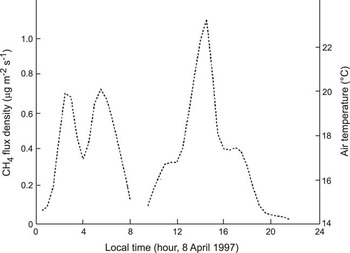
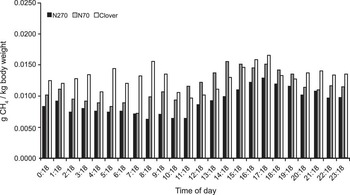
Enteric methane production has traditionally been expressed as a daily rate, although the measurement period from which this rate is derived ranges from 13.5 h to 7 days (Wright et al., Reference Wright, Kennedy, O'Neill, Toovey, Popovski, Rea, Pimm and Klein2004; Garnsworthy et al., Reference Garnsworthy, Craigon, Hernandez-Medrano and Saunders2012a), with 3 days being recommended and often used for RC studies (Lines et al., Reference Lines, Goopy and Nolan2010; Xue et al., Reference Xue, Yan, Ferris and Mayne2011). Correlation between emission rates on consecutive days is high, the correlation (in DMP or methane yield; g/kg DM) between measures made weeks or months apart is far lower, which in part reflects seasonal diet changes (Münger and Kreuzer, Reference Münger and Kreuzer2008), but also occurs when a uniform feed source is maintained (Pinares-Patiño et al., Reference Pinares-Patiño, Hickey, Young, Dodds, MacLean, Molano, Sandoval, Kjestrup, Harland, Pickering and McEwan2013). Although RC measures of <21 h are sometimes used (e.g. Wright et al., Reference Wright, Kennedy, O'Neill, Toovey, Popovski, Rea, Pimm and Klein2004), briefer emission measures made over minutes instead of hours are at risk of bias associated with changing fermentation pattern, and short-term fluctuations in emission rate that need to be understood. In groups of grazing ruminants, methane release rate follows a diurnal biphasic pattern with peak emission rates in mid-morning and again in late afternoon (Figure 1a and b). These emission peaks probably coincide with bouts of more intensive grazing known to occur in the morning and at night (Champion et al., Reference Champion, Rutter, Penning and Rook1994).
Diurnal changes in net methane flux (μg CH4/m2 per s; 30 min averages) from wether sheep (20/ha) grazing abundant pasture in New Zealand (Judd et al., Reference Judd, Kellier, Ulyatt, Lassey, Tate, Shelton, Harvey and Walker1999).

Diurnal changes in rate of flux of methane from sheep grazing within a polytunnel (Murray et al., Reference Murray, Gill, Balsdon and Jarvis2001).

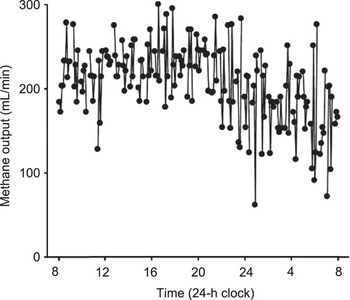
Emission rate rises and falls after eating (Mathers and Walters, Reference Mathers and Walters1982; Nolan et al., Reference Nolan, Hegarty, Hegarty, Godwin and Woodgate2010) in response to substrate supply. Eating changes the ruminal contraction frequency in sheep and (less so) in cattle (Waghorn and Reid, Reference Waghorn and Reid1983). It appears that eructation frequency is not absolutely linked to ruminal contraction frequency, but rather to the accumulation of headspace gas in the dorsal sac of the rumen (McCauley and Dziuk, Reference McCauley and Dziuk1965). Headspace gas accumulation is known to be affected by substrate supply as well as rumination and animal movement (McCauley and Dziuk, Reference McCauley and Dziuk1965), with these authors calculating that approximately 2l of gas could be accumulated in the goat rumen, when goats were resting and not ruminating. These transient gas accumulations in rumen spaces other than in the dorsal ruminal sac could explain Mathers and Walters’ (Reference Mathers and Walters1982) report that ‘violent short-term variations were evident in the plots of the observations’ of methane production, and also explain the episodic nature of methane emission (if not production) by cattle in confinement chambers (Figure 2; McCrabb and Hunter, Reference McCrabb and Hunter1999).
Short-term variation in cattle-emission rate of steers fed a high roughage diet once daily in a static confinement chamber (McCrabb and Hunter, Reference McCrabb and Hunter1999).

If methane emission rate at any given moment is dependent on (1) methanogenesis rate being closely associated with time and level of feeding, (2) type of feed and (3), short-term sporadic variation in gas release from the rumen, then great care is needed in using emissions measured over short periods as an indicator of daily emissions. The two challenges in using short-term breath measures as a proxy for full-day RC measures of emissions are (1) collecting data for an adequate period to provide a repeatable estimate of emission rate and (2) scaling up from a short-term emission rate to DMP. Developing coefficients and collecting additional information that will allow short-term emission rate to be scaled up to DMP will be especially important, if the measures are all made at the same time of the day and do not include the diurnal fluctuations in the emission rate previously described.
The importance of standardised protocols and multiple measurements when using short-term measures to characterise methane emission rates of individual ruminants are discussed below, in relation to techniques currently being developed.
An overview of direct short-term measures of methane flux
Although RC are not used for determining DMP on-farm, long-term emission measures on-farm have been made using the polytunnel system (Lockyer and Jarvis, Reference Lockyer and Jarvis1995) and the sulphur hexafluoride (SF6) tracer method (Johnson et al., Reference Johnson, Huyler, Westberg, Lamb and Zimmerman1994), both of which allow animals to demonstrate diurnal grazing pattern and diet choice. Because these methods monitor emissions continuously for extended periods, they are not considered short-term emission methods and are not discussed further. Current emission measurement procedures reliant on short-term breath sampling are described and evaluated below.
GreenFeed emission monitoring unit
The GreenFeed emission monitoring unit (Zimmerman, Reference Zimmerman2013) is a patented device manufactured by C-lock Inc. (Rapid City, South Dakota, USA), which measures emissions from individual cattle repeatedly over 3 to 6 min periods whenever they visit the unit to consume a delivered supplement. Air is continuously drawn into the shroud where cattle are supplemented, and methane and carbon dioxide (CO2) flux are calculated continuously by multiplying the methane or CO2 concentration by the flow rate of air exiting the shroud. Completeness of trapping of gases released in the shroud is tested manually by determining the change in CO2 flux associated with release of a known (gravimetric) release of CO2 into the shroud, typically showing 99.6% recovery (s.d. = 1.2%). Propane gas is released automatically at irregular intervals (when no animals are present at the unit) to check for drift of the hydrocarbon sensor, and gas sensor units are manually calibrated at approximately weekly intervals. During testing, the units have been primarily used with cattle in dairy and beef research facilities offering high-feed availability, but they could be used in remote rangeland locations. The unit does not determine emissions lost in flatus. The GreenFeed unit is designed to be accessible to cattle at all times, and thus the prospect for emission measures being made at all times of day or night exists and this could minimise the risk of biasing estimation of DMP by sampling at only one stage of the feeding cycle.
Recent comparisons by Hammond et al. (Reference Hammond, Humphries, Crompton, Kirton, Green and Reynolds2013) show a high correlation between DMP measured in RC and estimated by a GreenFeed unit. Waghorn et al. (Reference Waghorn, Garnett, Pinares-Patiño and Zimmerman2013) also found GreenFeed estimates of DMP for dairy cattle closely matched DMP estimated from animal productivity and live weight change.
The GreenFeed unit has shown itself able to detect differences in emissions resulting from mitigation technologies (dietary nitrate; Velazco et al., Reference Velazco, Bremner, Li, Luijben, Hegarty and Perdok2013). A significant constraint is the requirement for the GreenFeed unit to deliver a ‘bait’ to attract the animal into the unit and retain them there for the 3 to 6 min required for the estimation of emission rate. This may require 1 kg of bait (usually pelleted feed) to be delivered per day over four to six visits and this could be expected to affect total energy intake and intake of the basal diet or pasture, thus changing the DMP of the animal by the measurement process itself. The use of energy-free baits such as water or salt warrants investigation.
Portable accumulation chambers (PAC)
Owing to the extensive nature of sheep production and the fact that sheep are not regularly brought into contact with humans as dairy or feedlot beef cattle are, the PAC was developed to determine comparative emission rates of sheep, measuring populations of animals taken directly from the paddock (Goopy et al., Reference Goopy, Woodgate, Donaldson, Robinson and Hegarty2011). The PAC is a clear polycarbonate booth of ∼0.8 m3 volume with no permanent floor. A rubber mat is placed on the ground beneath the sheep and the PAC is lowered over the sheep forming an airtight seal onto the rubber mat beneath. Sheep are sealed in the chamber for up to 2 h, and the increase in methane concentration in the known air volume of the PAC is used to calculate methane emission (including flatus) over that period. Sheep placed in PACs do not exhibit any behavioural oddities and will usually stand in the PAC throughout the measurement period but do not jump around or attempt to escape, as they are in close proximity to and in visual contact with other sheep in adjoining PACs. After 1 h of confinement of sheep taken directly from pasture, gas concentrations in PACs were 17.2% O2 (CV = 3.1%), 3.2% CO2 (CV 16.4%) and 2180 ppm methane (CV = 25.2%) based on 96 sheep measured twice (V.H. Oddy personal communication).
The PAC approach was pursued because assessment of possible predictors of DMP by Goopy et al. (Reference Goopy, Hegarty and Robinson2009) showed that a 2-h measurement of methane emission rate was the best predictor of DMP, explaining 50% to 82% of variation in DMP, depending on when the 2-h measurement was made relative to the time of feeding. A shorter 1-h methane emission measure was shown to have a repeatability of 46.8% and a heritability of 29.5% (Robinson et al., Reference Robinson, Goopy, Hegarty and Vercoe2010). Subsequently, repeatability of the 1-h emission determined over a longer interval with 4 weeks between measurements was found to be 24%, being approximately half of the repeatability of RC over the same interval (0.49) but correlating well with DMP determined by RC (r = 0.56 to 0.66; Bickell et al. (Reference Bickell, Robinson, Toovey, Goopy, Hegarty, Revell and Vercoe2011)). These authors reported that three independent 1-h PAC measures would be as repeatable as a 1-day RC measurement of DMP. Numerous (13 to 17) PAC units are used simultaneously with individual sheep being enclosed for 1 h. This enables five measurement sessions and >60 sheep to be assessed in an 8-h working day, with some repeated measurements within and between days.
Breath spot samples during supplementation
Recently, measurements of methane concentration in the air around the mouth of cattle have been used to provide short-term estimates of methane flux, with these being scaled up to estimate DMP (Chagunda et al., Reference Chagunda, Ross and Roberts2009; Lassen et al., Reference Lassen, Lovendahl and Madsen2010; Garnsworthy et al., Reference Garnsworthy, Craigon, Hernandez-Medrano and Saunders2012a). In the method of Chagunda et al. (Reference Chagunda, Ross and Roberts2009), a hand-held laser is used to make repeated manual measurements of (background corrected) methane concentration over 15 to 25 s in the air column out to 3 m from the nose of the cows. This concentration is coupled with an assumed tidal volume to calculate methane volume released from the cow, with tidal volume being dependent on animal position (lying v. standing). Average emission rates are determined for each activity (ruminating, feeding and just standing), and DMP is able to be calculated as the sum of emission rate in each activity multiplied by the time spent in that activity each day.
The method makes substantial assumptions on the uniformity of animal behaviour and physiology (time spent lying v. standing, tidal volumes and the proportion of the day spent ruminating, feeding or just standing) for which individual animal data are rarely available. Despite these numerous assumptions, a solid correlation was apparent between DMP estimated from the laser-based short-term emission and RC emission measures in dairy cows (r = 0.7; Chagunda and Yan, Reference Chagunda and Yan2011).
Garnsworthy et al. (Reference Garnsworthy, Craigon, Hernandez-Medrano and Saunders2012a) have used an alternative approach to estimating DMP from cows, relying on short-term measurements made at milking. Their method relies on monitoring methane concentration in the feed bin, while cows are ingesting supplement during milking. From these data for individual cows, an initial estimate of methane-production rate during a milking session (MEIm) is calculated from the sum of emissions per eructation and the number of eructations while they are eating, where emission per eructation is derived by integrating the area under each individual eructation peak. A scaling coefficient is then applied to MEIm to correct for dilution of eructated methane between the mouth and the sampling tube to provide an estimate of methane emission rate during the measurement period (MERm). Because MERm is a measure of emission rate while cattle are eating, it is not representative of the average emission rate over the entire day. This episodic emission is probably due to both increased rumen fermentation after feeding and the more frequent eructation throughout feeding as noted by Garnsworthy et al. (Reference Garnsworthy, Craigon, Hernandez-Medrano and Saunders2012a). An equation based on 12 cows whose emissions were measured over the short term while milking (MERm), and subsequently in a prolonged respiratory chamber study, was created to convert MERm values to DMP (g/d) values. When applied in a robotic milking unit, the technique has been used to document diurnal variation in emission rate and association between emission rate and milk yield, stage of pregnancy or lactation and diet type (Garnsworthy, Reference Garnsworthy, Craigon, Hernandez-Medrano and Saunders2012a and Reference Garnsworthy, Craigon, Hernandez-Medrano and Saundersb).
As not all the air in the feed bin is collected (as occurs in the GreenFeed unit), there is a risk that the position of the animal's head could affect measured methane concentration, although initial tests using controlled gas release indicated that this was not the case (Garnsworthy et al., Reference Garnsworthy, Craigon, Hernandez-Medrano and Saunders2012a). As with the GreenFeed unit, the animal's head position is considered (indirectly) in choosing whether to accept data; small emission peaks are discarded as they may have arisen when the head was away from the feed bin when the eructation occurred. The use of CO2 concentration as an indicator of animal proximity could be advantageous if head position is found to affect measured concentration in the sample as claimed by Lassen et al. (Reference Lassen, Lovendahl and Madsen2012). These authors used this argument to support use of the CO2 : CH4 ratio as a proxy for DMP, with these authors claiming ‘this ratio describes the methane production of each cow’.
Application of the CO2 : CH4 ratio
CO2 is produced by both ruminal fermentation and mammalian oxidation of substrates. As mammalian CO2 production is proportional to energy expenditure, a field measurement of CO2 production would be a valuable tool for nutritional research and field measures have been made using SF6 (Boadi et al., Reference Boadi, Wittenberg and Kennedy2002; Pinares-Patiño et al., Reference Pinares-Patiño, D'Hour, Jouany and Martin2007), isotope dilution (Corbett et al., Reference Corbett, Farrell, Leng, McClymont and Young1971) and cardiac output (Brosh et al., Reference Brosh, Aharoni, Degen, Wright and Young1998). At any given ME intake, CO2 output for most of the days is much less variable than enteric methane production, and therefore CO2 has been evaluated as an internal marker to upscale short-term methane emission rates to DMP in free-ranging animals. Pinares-Patiño et al. (Reference Pinares-Patiño, D'Hour, Jouany and Martin2007) found a positive association between CO2 and CH4 emission for cattle because both are correlated with feed intake, and therefore the level of intake needs to be allowed for in predicting CO2 output. As the majority of CO2 production arises from mammalian oxidation of energy substrates, Lassen et al. (Reference Lassen, Lovendahl and Madsen2010) sought to allow for the effects of feed intake (roughage and concentrate intakes) as well as body weight on CO2 : CH4 ratio; they found this ratio to have a repeatability of 0.35 to 0.37 and proposed its use as a methane trait for genetic evaluation, without a requirement to scale up to DMP. Subsequently, Lassen et al. (Reference Lassen, Lovendahl and Madsen2012) made a 3-day study of the CO2:CH4 ratio of 93 cows sampled during milking, finding a mean repeatability of the ratio from Holstein and Jersey cows of 0.37 and 0.33, respectively. Madsen et al. (Reference Madsen, Bjerg, Hvelplund, Weisbjerg and Lund2010) used body weight and milk production as predictors of CO2 production for housed cows and used the CO2 : CH4 ratio in exhaust gases from the barn to calculate a mean DMP. In a recent study, Waghorn et al. (Reference Waghorn, Garnett, Pinares-Patiño and Zimmerman2013) found a close association between DMP estimated from predictive equations on the basis of milk production and body weight change, with emissions measured by the GreenFeed system but no measures of CO2 were reported. A low apparent CO2 production (noted as a low CO2 accumulation over 1 h) has been used as an indication of leaks in the PAC system, and CO2 production is now being considered as a potential proxy for recent feed intake in sheep entering the PAC system (V.H. Oddy, personal communication).
Although CO2 production is less episodic than methane release, CO2 production is not constant, increasing with animal activity (Corbett et al., Reference Corbett, Farrell, Leng, McClymont and Young1971), which would have an impact on the estimates of DMP reliant on a CO2 : CH4 ratio on the basis of short-term measurements. Abatement strategies themselves may affect feed intake (e.g. Landau et al., Reference Landau, Silanikove, Nitsan, Barkai, Baram, Provenza and Perevolotsky2000), or affect CO2 production without affecting intake (Bayaru et al., Reference Bayaru, Kanda, Kamada, Itabashi, Andoh, Nishida, Ishida, Itoh, Nagara and Isobe2001).
Variability in emission rates measured by RC and short-term breath sampling
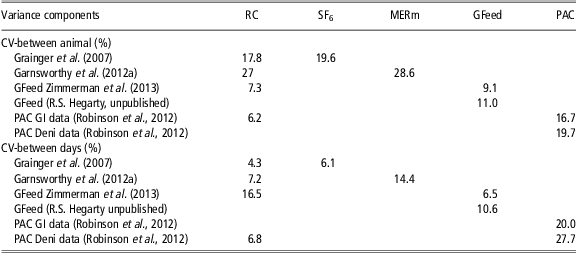
Grainger et al. (Reference Grainger, Clarke, McGinn, Auldist, Beauchemin, Hannah, Waghorn, Clark and Eckard2007) compared the variability of DMP determined by the SF6 procedure with DMP measured by RC, partitioning variation between days and between animals. Garnsworthy et al. (Reference Garnsworthy, Craigon, Hernandez-Medrano and Saunders2012a) also used this partitioning, and therefore this structure has been used to compare the sources of variation to understand limits to repeatability of emission measurement systems where available (Table 1). Variances for GreenFeed measures were based on the results of Zimmerman et al. (Reference Zimmerman, Michal, White, Johnson, Guerouali and Zimmerman2013) and an unpublished GreenFeed study of four cattle measured over 6 × 2-day periods; variances for PAC measures were based on the study by Robinson et al. (Reference Robinson, Goopy, Woodgate, Donaldson, Hegarty and Oddy2012) for 708 ewes, including repeat measurements made on a subset of ewes.
Variation in methane production rate partitioned into coefficient of variation (%) for between-animal and between-days components for RC and methods relying on breath sampling
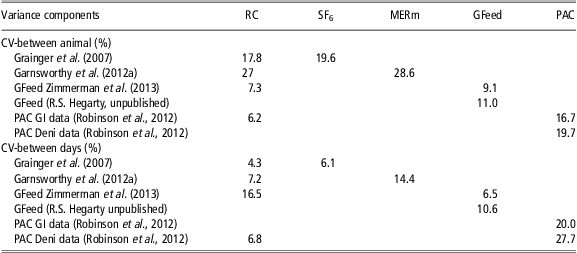
RC = respiration chambers; SF6 = sulphur hexafluoride.
These include SF6 tracer (Grainger et al., Reference Grainger, Clarke, McGinn, Auldist, Beauchemin, Hannah, Waghorn, Clark and Eckard2007), sampling of breath in feeding boxes during milking (MERm; Garnsworthy et al., Reference Garnsworthy, Craigon, Hernandez-Medrano and Saunders2012a), GreenFeed system (GFeed; Zimmerman et al., Reference Zimmerman, Michal, White, Johnson, Guerouali and Zimmerman2013) and portable accumulation chambers (PAC) (Robinson et al., Reference Robinson, Goopy, Woodgate, Donaldson, Hegarty and Oddy2012; Goopy et al., Reference Goopy, Woodgate, Donaldson, Robinson and Hegarty2011).
In most cases, short-term emission measures showed greater between-animal and between-day variances than do emissions measured with RC (Table 1), reflecting the larger number of sources of variation that may affect enteric emission rate by short-term measurement systems.
RCs provide a very high repeatability day to day, but repeatability of methane yield (g/kg DM) declines as the period between measures increases (Pinares-Patiño et al., Reference Pinares-Patiño, Hickey, Young, Dodds, MacLean, Molano, Sandoval, Kjestrup, Harland, Pickering and McEwan2013). This is consistent with seasonal variations in daily emissions and methane yield of individual dairy cattle (Münger and Kreuzer, Reference Münger and Kreuzer2008). By creating such a constrained environment to minimise day-to-day variation, RCs eliminate many of the variables that may affect DMP in grazing ruminants. In an RC, animals do not have the opportunity for diet selection that may enable individuals to choose a higher-digestibility diet than that of the average offered to them (SCA, 1990). The individuals preclude animals walking further to access a sward of different composition, and they constrain the time of feed delivery, which means that the diurnal pattern of consumption is unlikely to match the grazing animals. This will affect substrate pressure that regulates the balance of fermentation products (Sutherland, Reference Sutherland1977). In summary, RCs have eliminated most opportunities for animal behaviour to moderate DMP or methane yield (gCH4/kg DMI), only allowing differences in these to occur though changes in DMI and ruminal fermentation processes.
Applicability of short-term emission measures
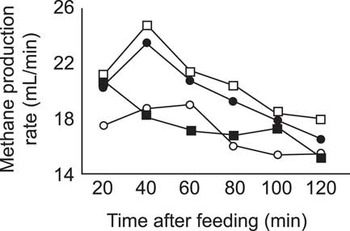
The quantity of feed consumed is the primary regulator of enteric methane production rate, but methane/kg DMI is also moderated by composition of the feed and inclusion of fermentation modifiers (Beauchemin et al., Reference Beauchemin, Kreuzer, O'Mara and McAllister2008). Methane-emission rate rises and falls quite sharply after feed ingestion (Figure 3); therefore, when short-term emission measures are made, there may be a need to account for the time of measurement in relation to the feeding cycle to estimate DMP. If frequent short-term measurements are distributed throughout the 24 h day, then the mean raw emission rate should reflect DMP. If samples are not collected continuously or at multiple random points each day, then the mean emission rate should not be expected to reflect DMP (e.g. if spot sampling breath at twice-daily milking). In such situations where the raw emissions rate is biased because of being made only at a fixed point in the feeding cycle, a fixed protocol and scaling-up factor will be required. This approach is being used by Garnsworthy et al. (Reference Garnsworthy, Craigon, Hernandez-Medrano and Saunders2012a), and a scaling-up coefficient will need to be derived uniquely for each specific diet and feeding schedule to accurately estimate DMP.
Post-feeding decline in methane emission rate of four sheep (□●○▪) fed at 2-hour intervals (Mathers and Walters, Reference Mathers and Walters1982).

PAC studies have typically made one measure of emissions per sheep over 1h in one of five to six measurement sessions per day (Bickell et al., Reference Bickell, Robinson, Toovey, Goopy, Hegarty, Revell and Vercoe2011; Goopy et al., Reference Goopy, Woodgate, Donaldson, Robinson and Hegarty2011); time-off feed has been accounted for by including measurement session as a factor in the analysis model. Emission rates derived from PACs have not been scaled to provide estimates of DMP, as relative emission rates are considered adequate for demonstrating effectiveness of mitigation strategies and for estimating genetic parameters of enteric methane production by sheep (Robinson et al., Reference Robinson, Goopy, Hegarty and Vercoe2010). Robinson (Reference Robinson2009) sought to optimise the measurement programme for genetic improvement in sheep methane production. Robinson showed that making 1000 PAC measurements in a two-stage selection programme by measuring 800 individuals, and then retesting the highest- and lowest (200)-emitting animals, identified greater divergence than did selecting animals on the basis of unrepeated measurements on 1000 animals.
Conversion of PAC-derived emission rates to DMP would require a standard protocol of measurement around feeding. Protocols using overnight fasting and no feeding, and overnight fast and 1-h feeding and bringing animals straight from the paddock to be measured, have been used (Robinson et al., Reference Robinson, Goopy, Woodgate, Donaldson, Hegarty and Oddy2012). The principal challenges have been (1) that sheep offered feed in yards cannot be relied on to consume a fixed amount of feed in an allocated period, nor an amount in proportion to their ad libitum daily intake; (2) measurement of intake of individual animals before entry to PACs requires individual animal feeding yards; and (3) no data on grazing intake before yarding of sheep are available, but intake for at least 24 h prior is known to affect DMP (Bickell et al., Reference Bickell, Robinson, Toovey, Goopy, Hegarty, Revell and Vercoe2011).
These challenges in nutrition before entry to the PAC make direct measurement of methane/kg DMI by PACs impossible, but other approaches may be tried as proxies for feed consumption before PAC entry. Rather than standardising or measuring intake before emission measurement, an alternative approach to normalising PAC emissions would be to account for the total fermentation rate by estimation of enteric CO2 production, or of ruminal volatile fatty acids (VFA) production or a combination of both. This would require measurement of CO2 and methane concentration in the PAC and/or sampling of ruminal VFA by rumen intubation after the animals are removed from the PAC. Initial investigations into combining rumen stoichiometry and methane emission to calculate energy expenditure showed the benefit of including VFA data (McPhee and Hegarty, Reference McPhee and Hegarty2008).
Conclusion
In summary, research on short-term measurements of enteric methane emission is only recent, but is expanding the capability to measure emissions from ruminants in their production environment. Different approaches have found application in specific environments, such as GreenFeed units for beef cattle, dairy cows being breath-sampled while being milked and sheep being measured in PACs immediately off-paddock. All data must be assessed with the awareness that emission rate changes over momentary, diurnal and longer seasonal patterns, requiring sampling to be representative of this. If the sampling protocol does not incorporate sampling of emissions at least over the diurnal feeding and activity cycle, a scaling-up coefficient factor (as used by Garnsworthy et al., Reference Garnsworthy, Craigon, Hernandez-Medrano and Saunders2012a) or adjustment factors (such as for animal activity and time spent in each activity as used by Chagunda et al., Reference Chagunda, Ross and Roberts2009) may be required to avoid bias in estimating DMP. Raw short-term emission estimates can be used for some purposes such as selective animal breeding, where the requirement is for relative emission data but not necessarily DMP. Determining the genetic parameters for enteric methane, with a view to making genetic improvement by direct selection for emission traits (Wall et al., Reference Wall, Simm and Moran2010), is an emerging application of short-term emission measures. The speed and simplicity of their application makes them suitable for defining the methane phenotype of the many individual animals required for genetic and genomic improvement of methane traits in ruminants.
Acknowledgements
The assistance of Dr Dorothy Robinson and Dr David Mayer in preparing Table 1 is acknowledged, as is the help from Prof. John Nolan for insightful comments and graphics and Mr Jose Velazco for input. Dr V.H. Oddy and Mr Alistair Donaldson and Reg Woodgate provided data on gas concentrations in PAC units. PAC research was funded by Meat and Livestock Australia and the Australian Government Department of Agriculture, Fisheries and Forestry Carbon Farming Futures Filling the Research Gap Program.
This paper was published as part of a supplement to animal, publication of which was supported by the Greenhouse Gases & Animal Agriculture Conference 2013. The papers included in this supplement were invited by the Guest Editors and have undergone the standard journal formal review process. They may be cited. The Guest Editors appointed to this supplement are R. J. Dewhurst, D. R. Chadwick, E. Charmley, N. M. Holden, D. A. Kenny, G. Lanigan, D. Moran, C. J. Newbold, P. O'Kiely, and T. Yan. The Guest Editors declare no conflict of interest.