This tiny Roman period copper-alloy figurine was found on an arable field at Middle Farm in the parish of Hinxworth, north Hertfordshire, in 2004 by Andrew Phillips with the aid of a metal detector.Footnote 1 The findspot, which has been recorded, is within a Romano-British settlement known from aerial photographic evidence. The site has produced numerous recorded finds made by Mr Phillips and other local detectorists. The finds comprise mainly Roman and a few Iron Age coins, several dress fittings, Roman pottery and building materials. In about 1911, a damaged marble statue of Venus was discovered during ploughing on the same farm and is probably from this site. It is now on display in the Ashwell Village Museum.Footnote 2
The settlement (centred at tl 247400) lies on the west bank of a small stream that flows north into the River Rhee, which rises in the nearby village of Ashwell and which, in turn, feeds the River Cam. As revealed by the aerial photographs, the settlement consists of rectilinear ditched enclosures (at least 220 × 190m) at the south end, the plough-damaged remains of a range of masonry buildings (160 × 140m) in the centre and, in an adjacent field to the north, a curious configuration of three rectangular ditched enclosures, one inside the next (the outermost at least 130 × 110m, the innermost 90 × 65m), an arrangement with similarities to the Late Iron Age enclosure at Fison Way, Thetford.Footnote 3
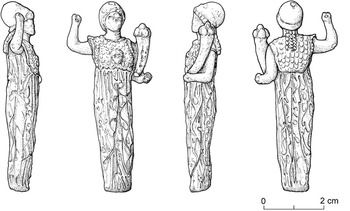
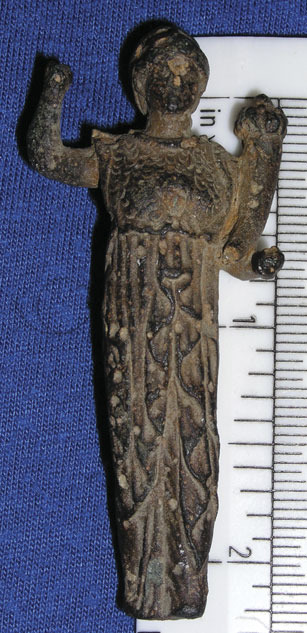
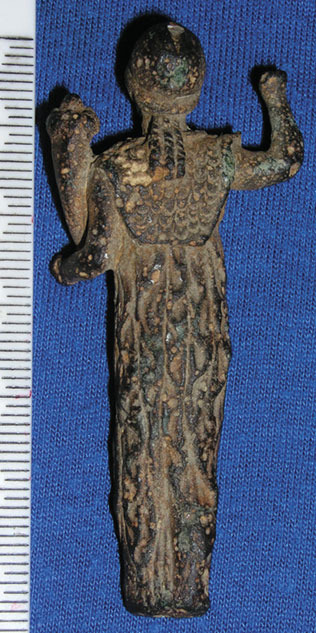
The figurine (figs 1 to 3), which has been generously donated to the British Museum by the finder and landowner, is 63mm in height and weighs 41.35g. It was finely modelled and painstakingly finished but its burial conditions have resulted in many soil-filled corrosion pits. The face, in particular, does not retain its features clearly, owing to the presence of a large corrosion pit on the forehead merging with a smaller one where the nose should be. Nevertheless, the figurine depicts with great clarity a standing female deity in Graeco-Roman dress, her left leg very lightly flexed. On her head she wears a Corinthian helmet, pushed back to reveal her face. The top of the helmet has a tiny hole and slot, apparently to attach a decorative crest. At the back, the goddess’s hair extends from under the helmet in three locks, which fall to the base of her shoulder blades.
Minerva-Fortuna figurine, Hinxworth, Herts. Drawing: Craig Williams; © The British Museum, 2008

Minerva-Fortuna figurine, Hinxworth, Herts: front view. Photograph: © Gilbert Burleigh

Minerva-Fortuna figurine, Hinxworth, Herts: rear view. Photograph: © Gilbert Burleigh

Over her upper torso she wears a stiff, ‘scaly’, bib-like aegis with the Gorgon head displayed on her breast. Beneath the aegis is a full-length garment, a peplos, its folded drapery minutely rendered, centrally parted, but otherwise completely covering her torso, legs and feet. Both her arms are bare. The right arm is bent upwards from the elbow at about ninety degrees. The angle of a minute soil-filled hole in the clenched hand suggests that she once held a spear in a throwing or flourishing gesture (as on a first-century ad bronze figurine of Athena in the British Museum, said to be from Athens,Footnote 4 with which, also, the treatment of drapery and hair may be compared). The crook of the bent left arm supports a cornucopia, its tapered end broken, while her left hand is also clenched into a fist with a soil-filled hole through it, implying a further held attribute, perhaps an ear of corn. A further soil-filled hole in the underside of the figurine probably indicates a means to attach it to a base stand.
The figure’s armour – helmet, aegis and predicted spear – are attributes of the goddess Athena-Minerva, while the cornucopia and suggested ear or ears of corn were attributes of Tyche-Fortuna. So the figurine would appear to have been made as an amalgamation of all these deities. Parallels from Roman Britain have proved elusive, but an unprovenanced second-century ad Roman bronze figurine representing Athena-Isis-Tyche in the Greek and Roman collections of the British Museum shows the deity wearing a ‘scaly’ aegis with Gorgon head and holding a cornucopia in her left hand.Footnote 5 Missing from the right hand – but re-constructible because of the hand’s position – is a steering oar and, in place of Athena’s helmet, the goddess wears an Isis-Tyche headdress. In size, pillar-like posture and craftsmanship the Hinxworth figurine is also comparable with a tiny bronze figurine of Jupiter Heliopolitanus, the Roman assimilation of the Syrian sun and thunder god Hadad, worshipped at Heliopolis (Baalbek).Footnote 6 Said to be from one of the Vesuvian cities, the figurine is dated to the first century ad, and we may cautiously advance a date of first or second century ad for the Hinxworth figurine.
Such amalgamations of deities are not uncommon in the classical world and Tyche and Fortuna were often assimilated with other deities, including Athena and Minerva, especially on gems but also on bronzes. A first- to third-century ad red jasper gem in the British MuseumFootnote 7 depicts a helmeted Athena wearing a long chitôn and peplos and holding the attributes of Fortuna – cornucopia, steering oar and ears of corn – while the Lexicon Iconographicum Mythologiae Classicae includes a statue of Minerva as Tyche with cornucopia and crownFootnote 8 and a gem from Cyrene showing Athena with a cornucopia.Footnote 9 In addition, a coin of Antoninus depicts Athena-Tyche with oar, ear of corn and cornucopia, and in Delos many terracotta figurines of Alexandrian origin depict Athena-Nike-Tyche-Demeter.Footnote 10
The archaizing nature of the figurine is notable and exceptional for Roman Britain and, indeed, for the north-west provinces in general. This raises the question of its origin. If not from the Hellenized regions of southern Italy, southern France or Spain, it may be from as far afield as North Africa or the eastern Mediterranean. Notwithstanding the unusual form of the figurine, there is no reason to doubt the veracity of the findspot: it was discovered on a known Romano-British settlement by a responsible detectorist who has been reporting his finds and findspots to archaeologists for very many years, and its condition (as yet unconserved) appears consistent with its having been buried in the place where it was found, while the unearthing of the figurine was observed by an independent archaeologist who was working with the detectorists at the time.
In 2002 the same group of detectorists discovered a hoard of Roman temple treasure in the neighbouring Hertfordshire parish of Ashwell.Footnote 11 The findspot lies within an extensive Late Iron Age and Romano-British settlement situated between two branches of the River Rhee, the western branch being the same stream on whose west bank lies the Hinxworth settlement. Excavation of the findspot has revealed a site associated with ritual feasting connected to funerals.Footnote 12 Together with gold jewellery and a silver statuette of a goddess, seven gold and thirteen silver, leaf-shaped, votive plaques (some with inscriptions) were found in the hoard. Several of these plaques have images of Minerva but, surprisingly, none of the inscriptions refers to Minerva, but instead to a hitherto unknown Romano-Celtic goddess, Senuna.Footnote 13 This suggests that the votaries equated Senuna with Minerva (as with Sulis-Minerva at Bath, for instance), presumably because they were considered to share some powers and attributes.
The findspots of the Ashwell temple treasure and the Hinxworth figurine are only about 1km apart and both the contemporary settlements with which they are associated lie on the banks of the same water course. It is conceivable, then, that this very unusual figurine was intended not only to represent Athena-Tyche but also (or instead) Minerva-Fortuna-Senuna. In the context of a conflation of Senuna and Minerva, as apparently indicated by the Ashwell votive plaques, we might perhaps hazard a guess that the Hinxworth figurine found its way into the ground as a dedication to Senuna, by a votary from the eastern or southern Mediterranean, and that it was, perhaps, intended as a multiple assimilation of Senuna and her powers to the bounty of Fortuna and the wisdom (and more) of Athena-Minerva.
It is perhaps no coincidence that the silver female figurine from the Ashwell hoard was probably a representation of the goddess Fortuna, but dedicated to Senuna, as testified by its inscribed base, and that one of the two votive silver model arms in the hoard held two ears of corn in its hand, an attribute of Fortuna.
Acknowledgements
Our thanks must be extended first to Andrew Phillips, the finder, for immediately bringing his discovery to our attention in 2004. He subsequently donated his find to the British Museum, jointly with the landowner, Mrs Bridget Sheldrick, who, with her son Christopher, made the donation in memory of her late husband, John Sheldrick, who had a considerable interest in the history and antiquities of the area. Our thanks are extended to each of them for their most generous donation of this significant find. Julian Watters (Finds Liaison Officer for Bedfordshire and Hertfordshire, Verulamium Museum, St Albans) helpfully discussed the find at various stages. Garth Denning and Donna Watters produced line drawings for earlier notes of the discovery, while Craig Williams of the British Museum has redrawn the figurine for this report.