


Introduction
Although supervision is recognized as essential to the provision of high quality cognitive behavioural therapy (CBT) services, we are only gradually clarifying the nature of effective supervision practice. The research literature on supervision has been slow to develop (Watkins, Reference Watkins1997) and we cannot yet talk of evidence-based practice as confidently as we might within therapy. We rely mainly on recommendations for best practice and emerging models of the CBT supervision process.
Early work stressed basic principles such as the working alliance (Bordin, Reference Bordin1983, see also Safran & Muran, Reference Safran and Muran2001) and discussed the parallels between therapy and supervision activities (Liese & Beck, Reference Liese, Beck and Watkins1997; Newman, Reference Newman1998). Many authors have also referred to the ways that supervision reflects the learning process articulated by Kolb (Reference Kolb1984) with its cycle from concrete experience, through observation and reflection, to abstract conceptualization, and on to testing of those ideas in new situations. The purpose of supervision has been usefully summarized as a balance of normative, formative and restorative functions (Inskipp & Proctor, Reference Inskipp and Proctor1993). More recently and within the CBT literature, the Newcastle ‘Cake Stand’ model (Armstrong & Freeston, Reference Armstrong, Freeston and Tarrier2006) gives an overview of supervision aims and activities, while Bennett-Levy & Thwaites (Reference Bennett-Levy, Thwaites, Gilbert and Leahy2007) suggest six stages through which supervision should pass.
Guidelines for practice have begun to emerge. Falender et al. (Reference Falender, Cornish, Goodyear, Hatcher, Kaslow, Leventhal, Shafranske and Sigmon2004) offered an expert consensus from US psychologists which describes the competencies required for supervisors across a range of therapy modalities. Recommendations for best practice in CBT supervision have been summarized by Pretorius (Reference Pretorius2006). Friedberg et al. (Reference Friedberg, Gorman and Beidel2009) discussed ways that supervision could most effectively foster empirically supported treatment methods. A more ambitious competence-based supervision framework, based on a literature review, was produced by Roth & Pilling (Reference Roth and Pilling2008) to support the ‘Increasing Access to Psychological Therapy’ (IAPT) programme (Department of Health, 2007). While covering generic and meta-competencies, the guidelines also began to clarify CBT-specific skills. Milne and colleagues have begun to address the evidence base for supervision via systematic literature reviews (Milne & James, Reference Milne and James2000; Milne et al. Reference Milne, Reiser, Aylott, Dunkerley, Fitzpatrick and Wharton2010, Reference Milne, Sheikh, Pattison and Wilkinson2011). While noting the limitations of some research in terms of its design and strength, they have been able to develop several recommendations for practice, covering the major areas of supervision: relationship, contracting, learning methods and evaluation (Milne, Reference Milne2009; Milne & Dunkerley, Reference Milne and Dunkerley2010).
In summary, we are at a transitional stage where there is a range of guidance available to supervisors in a conceptual and descriptive form, and an emerging consensus on best practice and the supervisor competencies required, although the supporting research evidence remains limited. Training for supervision is gradually becoming more available, and with some early indications of its impact (Milne et al. Reference Milne, Sheikh, Pattison and Wilkinson2011). This is important, as the recent expansion of CBT services has produced a high demand for therapists to undertake supervision.
The present paper stems from several years of experience in delivering supervisor training, both in health service settings and in relation to postgraduate CBT courses within the CBT Centre at the University of Southampton. It became clear that supervisors need a bridge to link the complexities of guidelines and models of supervision to their moment-by-moment facilitation of the supervision meeting. The structure described below was developed to specify the actions and processes to be followed during case supervision, and to offer this in a clear and accessible format. It is in the form of ten crucial steps to be taken during CBT supervision. With their focus on process rather than content, these steps can be followed by supervisors of varying experience and at all levels of work with trainees and qualified therapists.
The ten steps
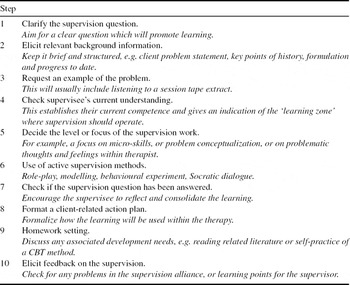
Table 1 summarizes the steps which are proposed as a basis for effective, structured work within CBT supervision. Each step is discussed in turn.
Ten steps for supervision

Step 1. Clarify the supervision question
Liese & Beck (Reference Liese, Beck and Watkins1997) talk of the need for a specific, negotiated agenda in supervision, just as in therapy. Formulating this as a question rather than simply a subject brings several advantages: it gives clarity about the goal of the ensuing discussion, it ensures the work stays on track (with the implied test of ‘Have we answered the question?’), and as Bordin (Reference Bordin1983) has pointed out, it promotes an active stance in the supervisee and strengthens the working alliance. Agreeing a supervision question at the start ensures that the discussion will be collaborative, and built around the supervisee's perceived learning needs. It also allows the supervisor to judge what information they are going to need to best understand and best respond to the issue.
One important caveat expressed by Padesky (Reference Padesky and Salkovskis1996) should be noted. As she says, ‘While important to address a supervisee's questions and concerns, it is also crucial to note what is not discussed in supervision’ (p. 287). Clearly then, the supervisor must be aware of blind spots, and be prepared to take an active role in shaping up the topic to be addressed. Supervision questions should, ideally, link back to the agreed (and contracted) goals for supervision and not become merely reactive to ‘this week's problem’. The supervisor should bear this in mind in judging the value of the questions brought to him/her.
Supervision questions will tend to fall into three broad categories and from the start, the supervisor should be considering their options for responding to each of these opening questions.
(a) Information questions (of the ‘who, what, why and when?’ type) are frequent. The supervisee may want to check, ‘Is this a suitable case?’ or they may request specific information, as in ‘Which questionnaires could I use to measure self-esteem?’ or they could be checking their therapy format, asking ‘When should I switch to working on schema-level material?’.
The supervisor has a number of options here. They may simply give the expert advice requested, especially with trainees, where supervision needs to be more didactic during the early stages (Liese & Beck, Reference Liese, Beck and Watkins1997). A factual answer may, however, be less appropriate for more experienced supervisees and the supervisor must not let information-giving become an easy option, which can serve to prevent the supervisee's development through active learning. Alternative strategies for information questions may therefore include setting homework (e.g. appropriate background reading on the topic of the question), or in a group supervision format, the supervisor may draw on other members’ ideas and knowledge of the subject.
Most usefully, the supervisor will seek to convert the information question into a learning question (described below). This may be facilitated by asking about the processes or problems which underlie the question. For example, discussion of a question on client suitability may reveal uncertainties about how to individualize therapy beyond standard protocols. Working on this will be more productive that just rehearsing client criteria for brief CBT.
(b) A second form of question which we often hear is the request for feedback. Examples include ‘Did I reassure the client too much?’, ‘How skilfully did I introduce this theoretical concept to the client?’ and ‘Was I too passive – should I lead the session more?’ Feedback questions are frequent among trainee therapists. In more experienced therapists they tend to be brought up at any time that the supervisee feels under-confident or anxious.
Requests for feedback are entirely legitimate. Corrective feedback is an essential component of all learning and feedback is used explicitly within CBT supervision. For example, whole session tapes, assessed on measures such as the Revised Cognitive Therapy Scale (CTS-R; Blackburn et al. Reference Blackburn, James, Milne, Reichelt, Garland, Baker, Standart and Claydon2000, Reference Blackburn, James, Milne, Baker, Standart, Garland and Reichelt2001) form a common basis for giving feedback on client-related skills. The first option in response to these questions is therefore to give direct, constructive and formative feedback, as requested. The aim is to both recognize and reinforce what the supervisee is doing well, alongside giving ideas to improve their practice, and to do so in ways which allow the supervisee to ‘hear’ the advice and be able to use it. Thus, according to Scaife (Reference Scaife2009), feedback must be genuine, specific and relevant, given as an opinion rather than a fact, set in the context of a supportive approach, and with regard to any areas of supervisee vulnerability where it could trigger unhelpful defensive reactions.
We also need to consider why the supervisee is concerned about their performance. Does it suggest a lack of understanding or preparation by the therapist or anxiety or low self-confidence about their task? Are there specific therapist cognitions that might be interfering with effective performance, and which could be challenged (Liese & Beck, Reference Liese, Beck and Watkins1997). For example, the therapist who asks ‘Was I too passive’ may turn out to have an underlying, unhelpful assumption that ‘I mustn't upset my clients’ which needs to be reviewed within supervision.
(c) The third type of supervision question is a more open enquiry about therapy processes and skills. The supervisee may be seeking a clearer formulation of the client's problem, trying to improve aspects of their assessment or intervention technique, or understanding their personal reactions to the client. The supervisee may enquire about actions, feelings, knowledge or understanding. The common factor is that their question indicates a willingness to explore and test new ideas. We might therefore categorize them as ‘learning questions’. Examples might range from the technical, ‘How can I help this client to set herself more meaningful goals?’, to the more conceptual, ‘Why do I find myself feeling so inadequate with this client?’. The common factor is that they open up a range of possible approaches to supervision which are likely to promote a deeper level of learning than simple sharing of information or feedback. We will deal with these supervision methods below, as part of step 6.
To reiterate, the first step is to settle on a useful, relevant, and stimulating question which the supervision can then seek to answer.
Step 2. Elicit relevant background information
For efficient supervision, and to avoid distraction from the task, the information-giving part of any supervision has to be succinct. Butler (Reference Butler2005) stressed the need for supervisees to prepare so as to give essential information for their question, rather than just the ‘next instalment’ of their client's story. This was also seen as a way to foster their development of an internal supervisor by making the supervisee think through the problem and be an active participant (G. Butler, personal communication). Padesky (Reference Padesky2002) similarly talked of a ‘Three Minute Rule’ for information, setting this time limit to ensure that the supervision session is used mainly for active learning, rather than extended case description. This idea has also emerged within the IAPT initiative, where time management is a particularly pressing issue. A checklist of client information which is needed in supervision is provided by Richards et al. (Reference Richards, Chellingsworth, Hope, Turpin and Whyte2010, p. 14), and may be very helpful as a model for all supervisees in preparation for a meeting. The list includes results of standardized measures, which form one succinct and useful indicator of the client's status and/or progress.
While focused and clear information will aid subsequent discussion, it should be noted that working in this way also places demands on the supervisor. Supervisors must restrain their curiosity and use the ‘need to know’ principle, gathering only the information which puts the question in its clinical context and is therefore relevant to their task.
Step 3. Request an example of the problem
In therapy, we gain more from working on concrete instances of client difficulties than by intellectually discussing broad concepts and ideas. So it is with supervision. The example or problem being brought to supervision will usually be best illustrated by a video or audio recording of the point in therapy when it arose. Bordin (Reference Bordin1983) describes the value of live material of this type, a point echoed by many other authors (e.g. Aveline, Reference Aveline and Shipton1997; Ricketts & Donohoe, Reference Ricketts, Donohoe, Lawton and Feltham2000; Pretorius, Reference Pretorius2006). Where such recorded material is available, the supervisor should normally listen to a fairly brief extract of around 5 minutes. This provides rich information about the client and about the therapist's skills and approach, while also illustrating the therapist–client interaction. It opens an opportunity for constructive feedback, as noted above. Prior to any analysis or discussion of the supervision question itself, it is therefore recommended that the supervisor gives a brief summary of good points or strengths heard on the recorded extract.
Establishing the regular use of recordings can, however, be problematical and only the minority of supervision sessions (6–20%) appear to use such material (Milne, Reference Milne2008). There can be practical issues, but these are rarely insurmountable. Where the problem is attitudinal, in that the supervisee feels self-conscious during recorded sessions, or is reluctant to be directly observed by their supervisor, their anxiety about the process can be reduced by fostering an atmosphere of trust and positive working alliance and if necessary, by using a CBT approach. The latter might involve attention to task-related negative thinking, or the use of a hierarchical approach to reduce anxiety. The issue of client consent is also an important one, which must be addressed at an early stage. Ideally, recording should be set up as a regular part of therapy with benefits for both parties, with resulting recordings available for use by the client (to listen again to important sessions) and the therapist, for supervision or self-reflection.
In the absence of recordings, other means to illustrate the problem must be found. Joint sessions, observation through a one-way screen or CCTV are all possibilities. Even without these options, we still do not have to rely only on verbal descriptions by the supervisee. Supplementary sources of information might include review of the therapist's personal reactions, reading their written notes, or the use of role-play, with the therapist adopting the role of their client.
Step 4. Check the supervisee's current understanding
The aim of this step is to understand how the supervisee conceptualizes the problem or difficulty prior to supervision, and in the context of what they already know about the client. This may sometimes be in the form of a mini-formulation of the situation using CBT concepts. Knowing how the supervisee currently sees the issue will ensure that the supervisor does not try to tell them what they already know. At the same time, it prevents gaps in the supervisee's knowledge or skills from being overlooked. In conceptual terms, the supervisor is trying to work within Vygotsky's Zone of Proximal Development (ZPD; Vygotsky, Reference Vygotsky1978). The ZPD is defined as a range where the lower limit is formed by the supervisee's current skill level, and the upper limit comprises the skills they might attain with suitable support. Maximum learning takes place within this range (James et al. Reference James, Milne, Blackburn and Armstrong2006). In step 4, we therefore invite the supervisee to briefly describe their thinking on the issue so far. Padesky has developed a ‘Supervisory Road Map’ of questions which can help in prompting the supervisee to clarify their current understanding of the problem (Padesky, Reference Padesky and Salkovskis1996).
In training settings, or situations where the supervisor is required to evaluate the competence of the supervisee against external standards, step 4 can also be helpful in providing an opportunity to assess the person's knowledge base, and their skill in applying CBT models and ideas.
Step 5. Decide the level or focus of the supervision work
Now we know what needs to be tackled, and the sort of learning we should target. We still need to consider how to achieve this, as any supervision question may potentially be addressed at a number of levels. For example, a question about how to engage a client might be covered by reviewing the technicalities of motivational interviewing, or we could focus on the quality of the therapeutic relationship, or instead address therapist beliefs and feelings about working with unmotivated or ambivalent clients. How do we decide which is the most effective use of supervision time?
The decision about the most productive level of work has to be overt and deliberate, in order to safeguard against any blind spots or avoidance on the part of either supervisor or supervisee. Thus, in the example above, the options would be reviewed with the supervisee. In other situations, the supervisee might be asked to consider the list of supervision components provided by Lewis (Reference Lewis2012) in order to decide which might be of most relevance to the current problem. This list covers: the client's problems, the effect of the client's problems on the therapist and vice versa, case conceptualization and clinical techniques, professional role and context, therapist's wellbeing, self-evaluation and reflection, context of therapeutic activity, and ethical issues. The decision should also model the therapy process by being negotiated (i.e. collaborative) and will need to balance the supervisee's suggested focus against the supervisor's assessment of the supervisee's current development needs, and a judgement about the best interests of the client.
Step 6. Use of active supervision methods
Most writers on CBT supervision stress the importance of using methods which parallel the active, problem-solving therapy stance. Padesky (Reference Padesky and Salkovskis1996, Reference Padesky2002) provided an overview of modes of supervision which includes live and recorded observation, role-play and demonstrations, co-therapy and personal change strategies such as behavioural experiments.
Case discussion will often be part of the supervision process, particularly where Socratic dialogue (Overholser, Reference Overholser1991) can be used to aid reflection by the supervisee, to help make theory/practice links and to generate new ideas for action. However, it is too easy to slip into using discussion as the default method. There is perhaps a parallel with the phenomenon of therapist drift described by Waller (Reference Waller2009), in which clinicians shift from ‘doing therapies’ to ‘talking therapies’. He sees their avoidance as a consequence of the stressful nature of effective CBT, with its focus on cognitive challenges and behavioural changes. The same avoidance of challenge and collusion to ensure safety may arise in supervision.
Research has suggested that role-play is rarely used in routine supervision (Townend et al. Reference Townend, Iannetta and Freeston2002; Waite & Gordon, Reference Waite and Gordon2003; Milne, Reference Milne2008). We can probably extrapolate from this evidence and state that all active methods of supervision are relatively neglected.
How can we alter this situation? First, the methods to be used in supervision should form part of a signed supervision agreement or contract. Supervision records should always note the method used, as well as the topic discussed. This is in line with professional standards (e.g. BABCP practitioner re-accreditation records) and allows ongoing audit and review of the supervision. Week by week, there should be an explicit discussion with the supervisee about the method which will be used to address their question (probably in conjunction with step 5, above), which balances the use of behavioural and verbal working methods.
It is worth stressing here that a single method such as role-play can be used in varying ways and with different ends in mind (Stopa, Reference Stopa2012). A role-play where the supervisee plays the part of their client may serve to illustrate the problem, or to help the supervisee gain new understanding of the client's perspective, as in awareness-oriented role-play (Safran & Muran, Reference Safran and Muran2000, Reference Safran and Muran2001). It may also allow modelling of skills by the supervisor. Where the supervisee plays the role of therapist, they will be able to practice new skills, and to receive consultation and feedback from the supervisor. Role-play can also be more open ended, used to simply explore the consequences of adopting a particular style or intervention.
There are two key points here. First, effective supervisors will make a commitment to use active methods. Second, they will aim to fine-tune the activity so that it will answer the supervisee's question and meet the learning needs which have been identified.
Step 7. Check if the supervision question has been answered
After the active part of supervision has concluded, we need to check what has been learned, very much in the way that we might ask a client to summarize the session during therapy. We encourage the supervisee to draw out learning from the discussion, and allow or encourage reflection as part of this process. We might ask ‘Have you gained any new ideas from our work just now?’ and then return to the starting question by asking ‘How do you see the problem now?’ In doing so, we are aiming to follow Kolb's cycle of adult learning (Kolb, Reference Kolb1984), by moving from concrete experience to observation and reflection. A further question such as ‘What can you learn from this to help with future clients?’ will help move the supervisee on to Kolb's next stage, namely the formation of more abstract conceptualizations and generalizations.
Step 8. Form a client-related action plan
Kolb's model proposes a final stage in the cycle, namely testing the implications of concepts in new situations. In other words, new insights have to be translated into new behaviours, which can themselves be evaluated. In the supervision context, this testing of new behaviour will centre on changes in therapist's activity within therapy. To facilitate this sort of experiment and change, the supervisor should ask ‘How do you think you can now put these ideas into practice with your client?’ A specific action plan, rather than woolly ‘good intentions’ will ideally be the outcome at this stage.
Step 9. Homework setting
Any action plan should aim to go further than specifying steps to take within one client's therapy. It should also foster or consolidate more generalized learning by the therapist. Therefore, as in therapy, homework setting is used in supervision to extend learning beyond the session. Here, it will often have the educational aim of filling gaps that have been discovered in the therapist's knowledge or skill. So, the supervisor may suggest homework such as reading which can be undertaken, or experiments which might challenge any unhelpful assumptions uncovered within the therapist.
To ensure it has been carried through, and to judge any benefits from it, the homework will need to be followed up at the next supervision through a brief review or ‘bridge to the last session’ (Liese & Beck, Reference Liese, Beck and Watkins1997).
Step 10. Elicit feedback on the supervision
As supervision comes to a close, the final step involves checking on the usefulness of the session and/or any problems arising within the supervision itself. While this may seem obvious, in fact feedback seems to be neglected in the published studies of supervision activity reviewed by Milne (Reference Milne2008). He looked at feedback to the supervisee, but it is probably safe to extrapolate that two-way feedback will be limited if one-way feedback is absent. As for each of the 10 steps, this is therefore a step which needs to become explicit and routine. Eliciting feedback is partly for the supervisor's benefit in guiding future work. It also helps us to check that the supervisee is completing the session with a sense of engagement and positivity, and that the supervision bond is intact at the close of the meeting. If not, a repair may be needed (Lombardo et al. Reference Lombardo, Milne and Procter2009).
Discussion
We have discussed ten simple steps which are consistent with key learning principles (Vygotsky, Reference Vygotsky1978; Kolb Reference Kolb1984) and currently available guidelines (Roth & Pilling, Reference Roth and Pilling2008; Milne, Reference Milne2009). Carried out regularly, these will ensure a positive and helpful structure to supervision activity. The clear and explicit format helps avoid some of the common pitfalls of novice supervisors (and others!) such as the drift towards case description and inefficient use of supervision time. The 10-step sequence allows flexibility over content and method, while ensuring adherence to good practice for CBT supervision.
It should be noted that the model focuses on actions to take within single supervision sessions. It refers only indirectly to the development and maintenance of the supervisory alliance. This is not to downplay its importance, as reviewed by Safran & Muran (Reference Safran and Muran2001) and Milne (Reference Milne2009). A supportive atmosphere is crucial to both encourage openness and to allow the sharing and resolution of therapist self-doubt and stress. In practice, the rule about formulating a clear supervision question might need to be relaxed on occasions where a supervisee arrives in distress and the supervision has to take a more supportive or ‘restorative’ tack. The supervisor also needs to be alert to the sense of de-skilling which can arise during intense discussion of a therapist's work, and must allow space for emotional processing to take place as the cognitive and behavioural aspects of competence are developed (Lombardo et al. Reference Lombardo, Milne and Procter2009).
The 10-step process was originally designed as a guide to supervisors who are new to the role, or are still developing their supervisory skills and confidence. As such, it was seen as a teaching tool and a self-study aid. It may, however, also be used as an audit tool for more experienced supervisors who wish to review their practice, and as a basis for supervisor consultation (supervision of supervision). For example, the steps can be used as a check-list during review of audio recordings of a supervision session. Improvement plans can then be developed for any steps which are absent, or which seem to be dealt with in too cursory a fashion. In group supervision, small modifications to the steps may be required to ensure that questions and learning points are made relevant to all group members, and to ensure they are drawn in to the active phase of supervision and review.
The model presented here requires empirical testing and will continue to be refined. Projects are currently underway in two key areas. First, the effectiveness of supervision training using the model is being evaluated. A second study aims to assess the type and content of questions brought to supervision, and relate this to a number of variables including stage of training. Additional feedback on the content and use of the 10 steps will be welcomed by the author.
Main points and further reading
CBT supervision should be structured, active, and mirror aspects of CBT practice with clients (Liese & Beck, Reference Liese, Beck and Watkins1997). It should incorporate current best practice (Milne, Reference Milne2009). In practice, it is particularly important to agree a supervision question to provide a focus for discussion. This should be in a form which stimulates active participation and learning by the supervisee, rather than didactic teaching by the supervisor. Topics may range over a number of levels (Lewis, Reference Lewis2012). The principles of adult learning must be incorporated (James et al. Reference James, Milne, Blackburn and Armstrong2006). Active methods including role-play should be prominent and monitored (Townend et al. Reference Townend, Iannetta and Freeston2002). Supervision should close with a review of learning and an agreement on action points, so as to complete the learning cycle (Kolb, Reference Kolb1984).
Acknowledgements
Thanks are due to Katherine Newman-Taylor for her helpful comments on the draft manuscript.
Declaration of Interest
None.
After reading this paper, you should:
(1) Be able to describe the key tasks to be completed within CBT supervision sessions.
(2) Know how to shape up effective supervision questions.
(3) Describe the process of choosing appropriate supervision method(s) within a session.
(4) Be better able to critique the supervision you receive or deliver.



Comments
No Comments have been published for this article.