

Switzerland introduced the Swiss Solvency Test (SST) as a regulatory requirement in 2006. Since 2011, the capital requirements are in force and insurers have to have their internal models approved by the regulatory authority.
While the SST is not identical to Solvency II, there are many commonalities and Switzerland is likely to obtain equivalency from Solvency II.
The SST differs from Solvency II in that many insurers and reinsurers have to use an internal model to determine their regulatory capital requirements. In contrast to Solvency II, using an internal model is the norm, rather than the exception. All reinsurers, insurance groups and all insurers for which the standard model is not applicable have to develop an internal model. Overall, close to 100 insurers use partial or full internal models, among them most life insurers.
We present our experiences with the SST, in particular relating to internal models and their validation and supervisory approval. We also present the Swiss experience with smaller companies, many of which also use at least partial internal models.
Model validation has become an important topic for the Swiss industry. We present the experiences and challenges of model validation. Model validation is complex, requiring many different specialities. Model validation is at the (sometimes uneasy) intersection of philosophy, mathematics, natural sciences, actuarial science, audit, forensic science, psychology and much more.
The process of model validation has to be well defined and well planned. Validations can be done for different components of the models and for different levels of depth.
Validations have to be done against clearly defined standards. While both the SST and Solvency II have a list of requirements relating to models, they nevertheless are often open to interpretation. It is then important that the interpretation of a (subjective) requirement is clearly formulated.
We present our understanding on what constitutes a model and the different elements of models and how they can be validated. We discuss some of the challenges we encountered and pitfalls to avoid. Some of the challenges relate to model documentation, which is very rarely sufficient to allow for a model validation without further discussions with the modellers. Another area relates to parameterization. The way a model quantifies risks can depend very sensitively on the data that is used, the way data is transformed and then used to parameterize the model. Sometimes very small and seemingly insignificant changes to data can lead to a completely changed SCR. Model validation has to take into account these sensitivities.
During the presentation, we will relate the more theoretical aspects of model validation with our actual experiences of the Swiss Re model review. We will also point out the changing model landscape in Switzerland, especially the convergence of valuation and risk quantification that we can observe. This already has implications in how insurers and reinsurers run their business, set their strategy and make investment decisions. Another aspect of internal models is the quantification of group effects. We will discuss also how this had implication in group structures, the web of intra-group transactions and recovery and resolution planning.
Discussion follows:
The Chairman (Dr D. J. P. Hare, F.I.A.): Within the Life Practice Executive Committee we are very excited about this evening. We were thinking about what could we do, as a profession, to help our colleagues prepare for Solvency II, and what could be better than to learn from other people's mistakes and successes? We thought that Philipp Keller and Mike Eves would be good choices to tell us about the Swiss Solvency Test (SST).
Mr Keller is going to give us an introduction on the SST. There will be a sessional paper that will go into the British Actuarial Journal in due course. Rather than wait for the paper to be finished, we wanted to hear the presentation now.
Mr Keller is a well-known name in actuarial circles. He described himself as the midwife of the SST. From further discussion, I think he is probably one of the parents as well. Before joining the regulator, Mr Keller was with Swiss Re, and then Arthur Andersen. He was with the regulator all through the critical period of the development of the SST. He left the regulator a few years ago, and, after a brief foray with one consultancy, he ended up with another one where he has been since 2009.
Mr Eves embarked on his career with the Prudential in the United Kingdom, and then moved to Swiss Re in the mid-80s. He has held a variety of roles here in the UK, nine years in life assurance, five years in property and casualty insurance (P & C) and then moved to Switzerland at the end of 1999. He was in P & C for another five years and then became the Group Chief Actuary, a post he has held since 2005.
I cannot think of two people who are better qualified to talk to us about this. I will now hand the floor over to Mr Keller.
Mr P. L. Keller (Deloitte): I will first give a short introduction about the SST. Then I will make some comments on the main issues in Switzerland, which are internal models, model validation and current Swiss group modelling followed by some other topics that are being discussed in Switzerland, which often revolve around the current financial crisis. At the end there will be some conclusions which are not really conclusions, but problems and questions. The problems at the moment are too big to be solved easily.
The SST started development in 2004. The standard model was developed over a period of about two years and it was implemented in 2006 by law. We did three field tests between 2004 and 2006. Our group solvency approach was developed a bit later between the end of 2004 and early 2006.
Since 2006, the SST has been in force and since 2011 the capital requirements have to be satisfied. So there was a transition period of about five years where firms could develop models and build up capital if necessary.
The standard model, in contrast to the Solvency II standard formula, is recalibrated every year. It is mostly the financial market parameters that are calibrated every year. Models have been developed since, say, early 2006 by the companies, and since 2011 we have been in an approval phase.
The SST is very close to Solvency II – perhaps Solvency II for a small country. It is a bit simpler. It does not have a standard formula that is factor-based, but it is a stochastic standard model that has to be used by companies that do not use internal models.
One big difference from Solvency II is the use of internal models. In Switzerland, companies have to argue why they use the standard model and do not develop an internal model. It is mandatory for all the reinsurers and all the insurance groups. And I would say 90% of all life companies do have an internal model.
In contrast to the group requirement of Solvency II, which is essentially based on the consolidated balance sheet, in Switzerland each legal entity must be modelled separately, taking into account the ownership relations and all the intra-group transactions. Each legal entity has to be economically solvent to satisfy the solvency requirement.
We do not consider operational risk, a difference from Solvency II, because, when I was consulting with Arthur Andersen, I developed an operational risk model and I thought it was not stable enough, or based on any science at that time.
The risk measurement is a 99% T-VaR in contrast to a 99.5% value at risk. The valuation is market consistent, as in Solvency II, but with a risk-free discount rate for all liabilities. There is no equity dampener, and Eurobonds have a credit risk assigned in the SST.
Currently, 75 insurers and reinsurers have applied for model approval. More than half of the companies use an internal model. These consist of groups, reinsurers, life insurers and P & C insurers. I would say about 30% are P & C insurers; we have about 100 P & C insurers. Small insurers tend to use the standard model.
The supervisory authority has approved about a fifth of the models. Models approved with conditions form about a half. About a third or a quarter of models are rejected. Those rejected by the supervisory authority have to be rebuilt or much improved.
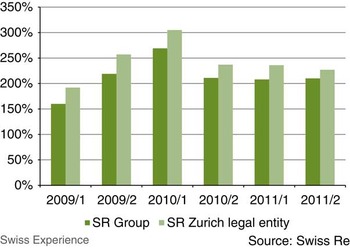
Mr M. J. Eves, F.I.A.: I will just show you a practical example, see figure 1. Swiss Re has been calculating SST numbers for a few years. We published these numbers going back to 2009 on our website in January.
Swiss Solvency Test: Swiss Re's Solvency Ratios

This gives you a flavour of how our company solvency has changed over the three years. You have to do the SST calculations every six months, by the way. That is probably different from Solvency II. You can see from the progression that we have been solvent throughout. There are two bars. One is the solvency ratio of Swiss Re Group as a whole; that is, when you take all the risks of Swiss Re Group worldwide together. The other bar relates to Swiss Re Zurich legal entity, which is the main writer in the group. For this, you look at the legal entity and all the legal commitments of that legal entity. We will explain why there are differences later, when we are dealing with groups.
The numbers are after an unstable period in the financial markets. You could say that, with financial markets and various other factors affecting our ratio, it has been pretty stable now for the last 18 months.
But what should this number be? It is roughly 200% now, but what should it be? The Swiss Re Group certainly wants to be around after a “shortfall” event – the one-in-200- years event. We are targeting somewhere around that.
Mr Keller: The biggest topic in Switzerland is currently the internal model, and internal model approval. I will not talk too much about this here but we have seen the convergence of valuation and risk, which has been happening over a few years. Historically, in Switzerland, when I was a regulator, the life companies tended to be sophisticated at valuations but did not have a risk model, whereas the P & C companies had catastrophe models and many risk models, but valuations were not formalised. What is happening now is that, together with the financial market models, we have life companies, P & C companies, reinsurers and groups, with all-risk models that are consistent with the valuation framework, which, in Switzerland, tends to be market-consistent.
In a market-consistent valuation, due to the risk margin, which is the expected cost of capital for non-hedgeable risk, the risk model enters. Valuation drives the risk via the change of value over a one year time horizon and the risk models drive the valuation via the impact on the risk margin. Currently, the models for risk and valuation are all converging.
Mr Eves is going to talk about the development of Swiss Re's internal model.
Mr Eves: It has taken since 1994 to get to where we are today. That is 17 years to have a model approved and to be using it in a regulatory environment. At the same time, we have internally been developing an economic framework, what we call economic value management (EVM), similar to market-consistent embedded value (MCEV). The two run in parallel; the underlying concepts are very similar. The way we create economic value is consistent with the way that we would create value or risk within the SST. We use the risk from the SST calculations as a fundamental basis of the risk capital in our economic framework. So we have developed the two in line with each other.
We use market-consistent valuations for assets and liabilities and a one year time horizon. A one year time horizon is similar to Solvency II. Obviously, we need to model dependencies and the correlations between the different factors. We have been analysing these for a long time.
What we want to do is to distinguish between risk and exposure to risk, and keep the two separate.
Mr Keller: Model validation is a big topic. Supervisors started having discussions about large companies’ models in 2006, and, since last year, there has been a formalised process of model validation. Model validation is also being done both internally by special functions within the larger companies, and by external consultants.
Models are very complex. You can have different perspectives on a particular model. You can look at it from the perspective of a philosopher thinking about what is knowable and what is not knowable within it. How do we know the model captures the proper risk? You can look at the model as a mathematician and go through the creations that define it. You also need to look at it from the point of view of a natural scientist, especially in respect of P & C models. Natural catastrophes and man-made catastrophes are hence captured.
You can look at the model with the eye of an actuary or an accountant or an economist. I have been involved in modelling and model validation, especially now, because the major risks of the companies in Switzerland are financial market risks.
Psychologists are sometimes involved to assess the incentives that models give management to write business or to hide things. The perspective of the regulator is to try to approve a model or find its shortcomings. Sometimes you need to look at a model from the viewpoint of the criminologist, as some companies sometimes try to play around with the numbers.
Investors are interested in the results of the models. Managers are interested in using the models to calculate, or sometimes reduce, capital requirements calculated by the model. Politicians lately have become interested in what investment incentives models and risk-based solvency systems give in the market.
Model validation has quite a long history. A regulatory framework was developed in Switzerland. Because we were mostly actuaries, mathematicians and scientists, we thought about models and model validation scientifically.
The history started around 1500–1600 with Giordano Bruno being burnt at the stake, and Galileo Galilei having to recant his theories. Charles Darwin caused a lot of controversy, but the model of Albert Einstein's relativity theory has been generally accepted. You can therefore see a general improvement from being killed if people disagreed with your models, to at least not being killed.
What it also shows is that the scientific method, that is, looking at theories and models, is not for the faint-hearted. It is complex. It is often difficult to find the shortcomings of a model, and sometimes it is difficult to agree or to disagree with a certain approach taken by a model.
Some shortcomings are simple to find. Supervisors in Switzerland are said to complain about a lack of tail dependency in aggregation – not using an appropriate copula. This has a large impact but is easy to find. Another model shortcoming would be to not use a spread risk for reinsurance receivable, which can also have a large impact, but is much more difficult to find.
I remember a case where a company had used a time series of spread volatilities over a 10 year time horizon using monthly data. There was one data point that was bigger than the others. The company thought that this was an outlier and took it away. By doing so, it reduced the solvency capital requirement by 30%. That was a sizeable subsidiary of a large insurance group.
Afterwards the actuaries involved asked Bloomberg to check whether it was really an outlier. It was not, so it was put back in. If you do not have control over the data series, it can have a huge impact. If you validate the model to find such a shortcoming, it is difficult because you do not see the risk any more.
You can never really say that a model is true because all models are wrong. What you can say is that it is useful for the purpose for which it is used.
Validating models is a big concern to the supervisors and to companies that support insurers and reinsurers with model validation, and also the insurance companies themselves. How do you assess whether an assumption's underlying methodology is appropriate? How do you assess that expert judgement is appropriate? In the end, model validation is expert judgement on the expert judgement done by the company. Then the regulator makes an expert judgement on the expert judgement on the expert judgement of the company.
Therefore, it is an infinite assessment of expert judgement, which can be quite difficult and tedious. This is what is awaiting companies doing internal model validation.
Another major topic in Switzerland was group modelling. The Swiss approach to group modelling is different because of Bruce Porteous, who wrote a book about how to model groups and conglomerates. Also, discussions we had with insurance groups concluded that, in normal situations, insurance groups are like consolidated entities – if one entity has a loss, the parent company will see to it that the loss will be made good. So capital flows freely in normal situations, but once the financial situation deteriorates, and there is a catastrophic situation, groups become legalistic. Those companies will only be supported if there is a legally binding instrument in place that forces the parent company to transfer capital or risk. Because the SST is focusing more on the one–in-200-years event, we thought to model a group not as a consolidated entity but as a set of legal entities that are connected by ownership, and with a set of intra-group transactions between those legal entities, is a more appropriate approach. However, it is more complex to model.
Large groups, for instance AIG, may consist of 8,000 legal entities. The intra-group transactions are probably into six figures, hundreds of thousands, and are not really knowable anymore. Swiss groups tend to consist of around 100 to perhaps 500 legal entities and the number of intra-group transactions before we started the SST was 20,000. But, based on our approach, it has been streamlined to a few hundred intra-group transactions that are set up to optimise the capital and risk position of each legal entity in the group.
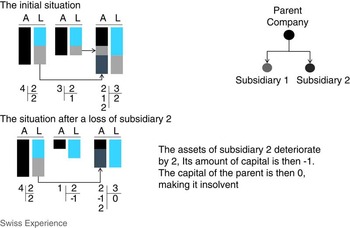
To model a group appropriately is quite tricky. This example (see figure 2) is a simple group consisting of a parent and two subsidiaries.
Example of a Group

Subsidiary two has a loss. Depending on how you look at the group and how you model it, and the guarantees that are in place between the parent and subsidiary two, the situation of the group looks completely different.
If you look at the consolidated approach, there is no information available on how the legal entities behave. If you have no intra-group transactions in place, no guarantees, the parent and subsidiary one stay solvent, but subsidiary two has a huge loss and is insolvent because the parent company will exercise the limited liability put option to let the subsidiary go insolvent.
If there is a guarantee in place between subsidiary one and two, subsidiary two survives, but both the parent and subsidiary one are insolvent and vice versa. If the parent gives the guarantee to subsidiary two, only subsidiary one survives.
If you look at changing the group structure, for example, if it is not the parent directly owning both subsidiaries but the parent owning subsidiary one which in turn owns subsidiary two, again the situation looks different. Hence the ownership relationship is crucial to understanding how a group will fail, and also the intra-group transactions in place are crucial to understanding how, and in which sequence, a group will default.
Taking such an approach is quite useful for modelling and analysing the risks of these complex groups.
We can now consider the real-life example of Swiss Re.
Mr Eves: From a Swiss Re viewpoint, we have to model our relationships with the parent company and daughter companies, which is fairly complex. Then we have to model the intra-group transactions between the legal entities, that is, – all the re-insurance and the retrocessions between the different companies. We map this out within the internal model so that we know where any impacts are going to appear.
We have a direct retrocession arrangement from one of our American companies, Swiss Re America, straight into Swiss Re Zurich, but there is also an ownership connection, not direct, but through another holding company, which we also have to model.
If you have a one-in-200-years event for Swiss Re America that could potentially cause a large claim, within our model we can see how that will flow through the group, both in terms of the retrocession and the reinsurance to Swiss Re Zurich, and in terms of the ownership or the value of the participation that also flows through into the Swiss Re Zurich balance sheet.
This is why I said earlier that we have two numbers for Swiss Re Group. One number assumes that all capital and claims flow freely from one company to another through the group. The other one is when you look legalistically and you have had such a big claim you just let that particular company go. Then, obviously, not all claims will flow up to the parent company; and you are not going to push capital down from the parent company because the group is now stressed.
The second number comes out a bit higher in terms of the solvency ratio because you are not going to pay every claim throughout the group. All large companies with subsidiaries all over the globe should model this in their internal model, so that where you have an impact somewhere, you know how it is going to flow through the group.
Mr Keller: There is a simplified equation that you have to solve. The capital you have available is a participation matrix times the capital. The capital is a vector of the capital amounts of all the legal entities of which the group consists, plus assets, minus liabilities, plus the intra-group transactions, which is the matrix times the unity vector with the requirement that capital always has to be larger than zero. This leads in the end to a linear optimisation equation.
In reality, it is more difficult because the intra-group transactions have different subordinations, which also have to be modelled. These models are quite complex to implement. You can gain a lot of insight into the risks that different legal entities have within the group.
Now, I shall go through a selection of discussions that we have had in Switzerland about the SST, often fuelled by the financial crisis. The first is really a question: what is market-consistent valuation? For us, the basis of a market-consistent valuation is the replication of the insurance liability cash-flows with financial instruments. We have chosen financial instruments that are traded in a deep and liquid market because they have reliable market prices.
You can choose alternatives – illiquid bonds, for instance. These have less reliable market prices, and you will have a market-consistent valuation that probably includes a liquidity premium. Or you can replicate your cash-flows formally, using the actual assets that are held backing the liabilities. This will add matching premium to the risk-free discount rate.
How can you choose replicating financial instruments that you still consider to be market-consistent? These are discussions relating to market consistency.
We see that there are certain choices that you have to make for a valuation, and that other things are given. You have to choose your risk measurement and your time horizon for capital. You have to choose your replicating instruments for valuation, whether they are deep and liquid, or whether they are corporate bonds or your own assets. Once you have chosen them, everything follows; you do not have choices anymore because replicating instruments uniquely determine the discount rate of a portfolio. The discount rate determines the best estimate. Replicating instruments tell you how well you can replicate, which in turn tells you what the non-hedgeable risk is; and the non-hedgeable risk determines the risk margin. The risk margin and the best estimate together determine the market-consistent value of liabilities. The solvency capital requirement is simply the change in economic value over a one year time horizon. The required capital is then also determined. Therefore, with these choices of risk measure, time horizon and replicating instruments, you have defined your internal model or your solvency capital framework.
This leads to another discussion. If you change your replicating instruments or your time horizon for capital, how can you arrive at a solvency framework that is still consistent? Consistency is important. As an actuary, I would rather be consistent than right. If you are inconsistent it is easy to arbitrage against it. As a company, you can arbitrage against a solvency framework; but within a company, investors or business people can arbitrage against an internal model, which is also sometimes an issue.
The risk margin is much more complex than we thought when we defined it in 2004. The equation that Solvency II uses, which is the sum of the Solvency Capital Requirement (SCR) times 6%, is already a simplification. You have to integrate all the possible paths that an insurance company's future SCR can take over the lifetime of the insurance liabilities.
Some companies in Switzerland started to use more sophisticated approaches to calculating the risk margin than would be implied by the equation that Solvency II prescribes. It can have a big impact.
The risk margin often used underestimates long-term risks that move slowly or that move from time to time in a big way, such as longevity risk. This is an issue that we are dealing with in Switzerland.
Another problem that we have in Switzerland relates to interest rates, which are probably below even those in the euro zone. We have very low interest rates so that the banks can recapitalise. They receive free money so that they can lend and therefore replenish their balance sheets. The banks in many countries in Europe have an implicit or explicit government guarantee which leads to competitive distortions against the insurance industry because insurers do not have this government guarantee.
The financial market does not really have the proper price finding mechanism anymore because of government intervention; central banks and governments buy up government bonds, which changes the price or puts pressure on rating agencies not to downgrade certain failing countries.
This makes it difficult for insurers to compete. First, the very low interest rates, – the government guarantees, reduces the cost of capital for banks. A slow-moving train wreck will probably come to the insurance industry if something does not happen in the coming years. Basically, insurers and pensioners pay for the recapitalisation of the banks in Switzerland, which, of course, can bring financial stability, but I find it a bit questionable, as a future pensioner, or somebody who prefers insurers to banks.
Another problem is the sovereign risk that we are observing in Europe. In Switzerland, we do not consider ourselves as part of Europe. When we developed the SST we completely disregarded sovereign risk. This was a major failing. If you look back in history, there are many examples of European countries defaulting.
The historical solutions to sovereign debt have been quite drastic. But you can also see a slippery slope now in Europe. It started with protectionist measures being put in place, then a disregard of the law, which I think the UK did when they used anti-terror laws against Icelandic corporations to freeze the money. There has been inter-generational default. For example, France used pension assets to cover other liabilities and Ireland used pension assets for bailout. Brazil and Switzerland have engaged in currency wars and, last year, Hungary forced private pensioners to put money into government pensions. We are now talking about the outright default of Greece and probably other countries.
Hence, sovereign risk is important in Europe. Our companies are also involved. It can always be worse, so we develop scenarios. Most companies in Switzerland are formulating scenarios of how a euro collapse might develop. It is quite tricky to do because it depends how the euro zone would potentially collapse. For example, the collapse of a centre leaf or a periphery leaf would lead to completely different situations.
Mr Eves: A risk model has a use test in a SST, it also has a use test under Solvency II. It must be the basis of your company. This is the case for the Swiss Re Group. But you need to understand the use test.
First of all, you must not have any white spots. That is, know where you stand. Make sure you are covering everything. Also, understand your profit and loss. If you are achieving a great risk-adjusted return, is there something wrong with the way that you are assessing that risk? You need to look at this very carefully.
Having EVM, which I mentioned earlier, and the SST on the same basis, we can assess risk-adjusted returns, and we can see exactly what risk-adjusted returns we are making in our different businesses, in our various geographies, all the way down throughout the companies, even down to the P & C contract level or a life reinsurance treaty. We can see what risk-adjusted returns we are receiving. If you are receiving big returns in a portfolio, you need to be asking yourself: “Are you assessing the risk correctly?”
In these models, which are the same under the SST, or Solvency II, diversification is important. You diversify your risk as it reduces the average capital requirement. You also need to understand the sources of risk and you need to know which risks correlate highly. For example, in the early days, we thought pandemic risk was just a mortality risk, but if we have our one-in-200-years event pandemic, it is going to hit the financial markets and so there is a correlation. You also have to make sure that you are not surprised when the big event comes or that you do not suddenly find you have losses in places that you did not expect. So, understand the sources of risk and then diversify.
Then think the unthinkable, which is difficult. It is worth spending your time looking ahead. We have a group of people called emerging risk specialists who are seeing what potentially could happen. Also, do some scenario testing, perhaps not as extreme as Mr Keller just suggested, but at least go in that direction and see what each scenario would mean and what management would do.
Risk management is important in a company. At Swiss Re, we have a chief risk officer on the executive board of our company, that is, at the highest level. If the company understands the risks that it is taking then it is hoped that it will be able to survive better.
Also, point the carrot in the right direction. One of the most dangerous aspects of any company is that people are human and act in their own best interests. Hence be careful of incentive systems, as they may have unintended consequences. Make sure that your people are aligned in the right direction, so you get the right returns on your risk capital and ensure that you maintain your solvency ratios. That is important in performance measurement.
Consistently throughout the company, everyone is measured on EVM. EVM also links to our capital requirements.
If you put all these “rules” together, it is hoped that you can reduce some of the risks and sins of the past that we have seen. We have seen problems ourselves and we have, we hope, learnt from them. Always make sure that when something happens, you learn from it.
Swiss Re has much natural catastrophe exposure. We do not know every earthquake that is going to happen so when one happens we make sure that we model it, understand it and, if necessary, introduce it into our group risk model. For good risk management, you need to learn from events.
Also, look at a potential crisis. Turn the equation around and ask, “This is our capital. What could make us go under? What crisis would give us serious problems?”
We hope that with Solvency II and with the SST we are learning to turn the question around the other way to see what crisis could happen and, if it did happen, how we would manage it.
Mr Keller: The problems that we face in Switzerland are many and some of them seem unsolvable. The insurance industry, especially the life industry, is struggling with the effects of the financial crisis, mainly due to the low interest rate environment, but also due to losses incurred when investing in certain assets before the crisis. But because of this crisis a number of fundamental questions are being asked. For instance, what is the foundation of valuation? What is value? What is cost? What is price? How do they connect together? How do you quantify risk?
The challenges are becoming more interdisciplinary, requiring expertise not only in mathematics and actuarial science, but also in finance, law, science, macro-economics, and so on. This is a great time to be an actuary, I think. We live in a great time for trying to solve problems.
The Chairman: Thank you, the audience is now welcome to ask questions.
Mr D. Gott, F.F.A.: Given your comments that there is no new explicit government guarantee to life offices in Switzerland, to what extent is there a possibility of a default of a life office being systemically catastrophic?
If there is such a possibility, what is being done from a supervisory perspective to ensure that you do not only know the chance of default of a life office but given that it does default, it does so in a way that causes as little a ripple effect across the financial system as possible?
Mr Keller: First, I do not believe that the insurance industry is systemically relevant because of the technical provisions. If a life company failed, the technical provision would still be there, although policy-holders might take a small hit.
What is being done? The basis of everything is sound technical provisions, in my opinion. That is the core of any risk-based solvency framework. There are other elements: contingency planning, recovery and resolution schemes, which are being implemented more for banks, but also for insurers.
It was always a requirement in the SST to evaluate scenarios. There are about 20 specified scenarios and each company has to evaluate 3 to 5 company-specific ones. We assess what would happen if that event occurred and how companies can fail in a safe way. Insurers are more long-term and have sound technical provisions. It might hit their reputation, however.
Some companies try to become seemingly systemically relevant, by growing certain types of business and putting in additions. But in reality, I cannot imagine insurers to be systemically relevant.
Mr Eves: I would add a point or two to that. Mr Keller and I have been in many discussions recently in International Actuarial Association (IAA) meetings about systemic risk and insurers, because the IAA wants to produce a paper about the actuary and systemic risk. We concluded that insurance risk is not systemic for some of the reasons that Philipp has stated.
If you take on a risk as an insurance company, and then as a risk-taker, does it amplify the risk, or does it dampen it? These risks flow through the company. As they pass through, does the risk expand or reduce?
Insurance risk is about reducing risk by diversifying it. Insurance companies are a bit of a buffer, partly because, with insurance risk, you normally do not pay claims the next day. Even on the largest claim, such as from earthquakes, you do not pay for six or 12 months, so the liquidity risk is relatively small.
The real risk is when insurance companies write banking-type risk. Then it is much more likely to be systemic, and we have not really seen that as yet. The AIG issue was in one of their non-insurance subsidiaries, rather than an insurance subsidiary, because that is where they were writing that type of risk.
If insurance companies are getting into financial-type risk covers, yes, it could be systemic, but not for normal insurance risk.
Mr M. C. Ledlie, F.F.A.: I was looking at the chart of firms that had failed to obtain internal model approval, and I was wondering if you could say anything more about the reasons why firms had had their models rejected; whether any particular types of firms had been rejected; whether big firms or small firms were more prone to not having model approval; and whether you have any lessons for either firms or regulators in internal model approval from the Swiss experience.
Mr Keller: All sizes of company have had models not approved. The reason sometimes was just that they were very bad models. That is, they were bad for supervisors, especially if there is a model approval with additional requirements. Sometimes it is difficult for a supervisor to focus on the key risks.
When I started at Swiss Re I did a PhD in functional analysis. I applied functional analysis to everything I saw. Many supervisors, coming straight from university, do not really know where the real risks lie, or they sometimes need to make an approximation. It is all right to be pragmatic.
A model takes time to develop. We saw so in the Swiss Re example. It has developed over nearly 20 years and it is still being developed. All the internal models that we see in Switzerland are continuously being improved. It is better to start with sound methodology that is consistent. It does not need to be very complex.
You obtain model approval and the supervisors say, “Now you have to improve.” That is so all the time. What does not work is if you try to do everything in one year. That just leads to hysteria, and there are not enough people to do it. One of the bottlenecks that we have in Switzerland is the number of specialists doing modelling. Especially in mid-sized companies, you have one or two people who do modelling and model development. They also have to do all the model documentation. After they have written about 500 pages they tend to resign and join a consulting company. We then support companies in doing model documentation.
Another reason why models have not been approved is the lack of model documentation. If there are no words, it does not exist, in a sense. A supervisor cannot approve a model if there is no documentation. The biggest shortcoming of some models is the lack of documentation. Modellers often tend to write badly, as they do not want to do it. Proper model documentation is huge. In mid-sized companies, model documentation is, say, 1,000 pages. If you are a large company, like Swiss Re, you easily end up in four digits if you describe in detail what a model is doing.
It also takes a lot of time. You cannot do it in half a year. It takes one, two or three years. So it is better to start simple, develop over time and improve, and risks that are not covered at the beginning you deal with in other ways, perhaps with a limit system or with risk avoidance.
The Chairman: Mr Eves, do you want to say anything about your documentation?
Mr Eves: I cannot tell you how many pages it is in total but I know it takes 50-100 pages for each part of the model. You must have documentation for each natural catastrophe. Lethal pandemic, longevity trend, and financial market risk are all models in themselves. The models come together with an enormous correlation matrix. But the regulator needs to see the documentation. Models are complex and if you look at any model, you cannot just take the mathematical code and work out what it is doing. You have to have the documentation and to have someone guide you through it, so that you can understand the thinking behind the model and how it is programmed. Then you can test it. It is important to get the documentation right and it is not something I have always known actuaries to be good at.
Mr Keller: What is also sometimes missing is the back testing validation that is being done. Sometimes the model is documented, but the parameters that flow into the model are not appropriately documented. What back testing is being done? What statistics on the primary data are being dealt with? This is a huge amount of work.
Mr R. Austin, F.F.A.: I have a question on documentation. I am familiar with what is required under Solvency II in terms of the legislative framework, and in particular the principles around documentation. However, I know nothing about the documentation requirements of the SST. It would therefore be helpful to understand more about this.
Mr Keller: Generally, because we are a small country, we are more principles-based. The SST can be described in 14 principles, and the entire documentation of the regulator probably fits in under 100 pages. This is in contrast to the standard formula in Solvency II, which is already 1,000 pages. Being more principles-based makes it more difficult. There is not much guidance given for documentation. It should be sufficient that a knowledgeable third party is able to understand the model and ask proper questions. Later the regulator gave a small guideline of about five pages of what it wanted to see in it: methodology, processes, back testing, and so on, but much less prescribed than in Solvency II.
What sometimes happens is that, because they like rules and not principles, some firms use Solvency II guidelines and regulation. They just apply it to the SST. That also works.
If you document appropriately for Solvency II, you definitely document appropriately for the Swiss approach.
Mr Eves: In Swiss Re, we have the group model that we use for the SST. We are basically using this group model to work out the solvency in all our subsidiaries, and we did this under the SST principles and assumptions. We want to use that same model because we want it to meet the use test for our European subsidiaries. For Europe, that means the FSA and the CAA, the Luxembourg regulator. Regulators come to Zurich to understand our model. They are clearly looking for more documentation and definitely at a more granular level.
Also, I sit on the board of our UK direct writing company. The responsibilities of the board under Solvency II are much greater than they would be in Switzerland. I would say it is more detailed as there is more documentation to go through, and more people are involved. On the Swiss side, there is a lot of documentation for the SST. But it is lightweight compared to Solvency II, mainly because, as Mr Keller said, it concentrates on the main principles, rather than documenting and validating everything. It could be that the regulators are learning quite quickly, but I do not know how they are going to read all the documentation. What I see is enormous.
Mr Keller: The worst example was a company that had to send in a financial market risk model to the French authority. The documentation was 10,000 pages long. I do not know who reads it, but some supervisors do.
Dr B. T. Porteous, F.F.A.: One area where we are struggling in Solvency II is on third country equivalence. This has become high profile recently with some firms even threatening to move their headquarters outside of the EU. It looks like the European Commission is not going to budge on the fairly strong requirements needed to achieve third country equivalence and this means that it could be hard for EU insurers with businesses in non-equivalent third countries to compete locally.
This is because they will have to run their businesses according to, essentially, two sets of rules: local rules in the third country, and Solvency II rules at the level of the group. It will not be possible for EU insurers to optimise their businesses under both sets of rules, as these often conflict, putting EU insurers at a competitive disadvantage in such non-equivalent third countries.
I am quite interested to hear about what the SST experience is with this issue. You did not mention it, but I am guessing that there is no such concept under the SST. I would also be interested to know how this equivalence issue is working out for the Swiss insurers who operate in third countries and, in particular, for life insurance companies. How are they managing to run their businesses according to two sets of rules that may often be in conflict?
Mr Eves: First of all, for Swiss Re, the SST is perhaps a bit conservative because it is risk-free. We do not have a matching premium or liquidity premium.
We measure the whole group on a risk-free basis. If you have a liquidity premium then those ratios would look even higher from our perspective. We apply the SST to all our subsidiary companies. We have to show the Swiss regulator the SST ratio for our largest subsidiaries. We calculate the ratios and we occasionally have companies under 100% from a SST point of view. It is okay because in aggregate they are okay. Yet they are going to be subsidiaries that have a higher proportion of assets in corporate bonds, or a higher proportion than perhaps other subsidiaries have.
So we see those differences quite clearly. For us as a group that is okay as we use a consistent economic performance indicator. In the United States, on life contracts, our competitors are using some other economic measure, either internal rate of return, or assuming a higher return than risk-free. We have the debate. Is this something we want to follow or do we want to keep our framework? Do we need to change our targets?
We are based in Switzerland; the companies based in the UK or in Germany may have a different perspective. They have not had to start from the SST as we have done.
Mr Keller: It is a problem. Switzerland is too small to ask for equivalence with other countries, so we cannot do so. Generally, the SST has slightly fewer requirements for P & C companies but more requirements for life companies. In the life companies, perhaps there are 50% to 100% more capital requirements than under Solvency II. Then, of course, you have the Swiss Group, which has subsidiaries in the EU. Do you accept these numbers even though they are quite far away from what Switzerland would require? If you want equivalence in Switzerland, you have to accept the Solvency II numbers, and vice versa. With Solvency II, if it grants equivalence to Switzerland, we have to accept the SST numbers. There will probably be some convergence over time towards Solvency II, but perhaps not in everything. For example, the ultimate forward rate has already been implemented in Switzerland; I think it takes 30 years, but a shorter time with Solvency II.
As of next year we will also use the swap rate rather than the pure risk-free rate. There is a convergence of approaches. That will also alleviate the problems that companies have. It will not make them go away completely. Not looking at the credit risk for Greek bonds would be a step too far for Switzerland.
The Chairman: May I ask a question about the cost of implementing this? We have heard some quite frightening numbers across Europe for the costs of implementing Solvency II. Roughly, how much did it cost a medium-sized company in Switzerland or a larger one to implement the SST?
Mr Eves: The SST was a continuation of what we were already doing. Whilst we were in the right direction, it was still a big project. The cost to implement the SST was in the low tens of millions of Swiss francs, given that we were already in a good position. It is costing us much more than that to implement Solvency II in our European subsidiaries.
Mr Keller: For small companies it was really not a big problem. It was sometimes 100,000 Swiss francs or pounds – more or less the same amount. For really small companies it was lower. For them it was much simpler because it was principles-based and you had one actuary who knew everything. For large companies, like Swiss Re, Zurich, and others, they already did economic capital modelling so it was basically an adjustment. For some of the mid-sized ones, it was most onerous because they had a complex business and complex risks, and sometimes not the models. Today you talk about the low millions. Issues around data are expensive. But it is not because of Solvency II or the SST, but International Financial Reporting Standards (IFRS), or the requirement to have proper data. As soon as you do the IT and data projects, it is sometimes in the tens of millions.
Mrs I. M. Paterson, F.F.A.: Sharing information from other countries is always helpful. Indeed one of the benefits of the International Association of Actuaries is learning from actuaries around the world.
I thought that you made a very important point about risk management: that it is important to learn from new events. I wondered if you could share any new events that you thought were particularly illuminating and what you learnt from them. Also, and this is perhaps more tricky, how can these lessons be shared with regulators so that the industry benefits in general? In summary, what are your most illuminating lessons, and how might they be shared more generally?
Mr Eves: I think that the most illuminating thing at Swiss Re is that we are a major natural catastrophe writer, but natural catastrophe risk is not the main driver of our results. Our five biggest risks are credit spread, equity, lethal pandemic, mortality trend and credit underwriting, not natural catastrophe. When a natural catastrophe happens you will read in the press that Swiss Re has paid out an extremely large claim for it. But this natural catastrophe risk actually diversifies well because, for example, the Japanese earthquake is not correlated, as far as we are aware, with European windstorm or American hurricanes.
But we learn when something big happens. In 2005, when Hurricane Katrina banged into New Orleans, we used our models in the first few days, and our estimate ended up under the final cost by a considerable amount for two reasons. First of all, our risk model for that event did not sufficiently take into account the storm surge of the sea coming over the top of the levees. I think that there was some allowance, but it was mainly a wind damage model rather than a storm surge model. The second one was that we found out that when you reinsure large hotel chains, you end up with an accumulation of risk because they all have large hotel casino boats at the end of the Mississippi. You suddenly realise that you have not asked for your data to be as granular as you need.
Thailand is possibly another example. The insurance industry or the reinsurance company has not collected enough premiums out of Thailand to cover the losses that have occurred in the last six months. Again, models may not be fully picking up that Japanese manufacturers have concentrations of factories in Thailand.
We learnt even more from the financial crisis and the way that we model that. This exceeded our risk models in terms of frequency. At the time this was probably a one in 10,000 year event. I do not think that it was. The risk, particularly credit spread and in equity markets, has been clearly amplified, probably throughout the industry.
Mr Keller: What I learnt was mostly from the financial crisis, which is still ongoing. I learnt that it is really hard to think about these events because if I do not like something, I find it difficult to think about it. We had 20 financial market risk scenarios in the SST calibrated before the credit crisis, and only one was comparable in effect to the financial crisis. In 2004, when we formulated the scenarios, we were thinking “Should we put in something like the Great Depression?” But we thought that cannot happen again. It is psychologically very difficult sometimes to think about certain risks because it is just too unpleasant to do so.
Fukushima is another example. We had a nerve-breaking Tokyo scenario. There was a half page description. I never thought about what would happen with nuclear reactors. Thinking about risks should not be done by one person, but by a team of people with different opinions to arrive at a consensus.
This urge to not talk about risk was evident during the euro crisis. Two years ago, we started to talk about what would happen if the euro collapses. If you talked about it then with European regulators it was not well received. When I gave a speech, one lady stood up and formally declared that her government does not intend to default currently. She nearly left the room!
You could also misuse scenario testing by just glossing over the real risks. That has been done in some of the banking stress tests by the Federal Reserve in Europe. Thinking about risk has much to do with psychology and having an environment where it is possible to discuss freely, and to have a contrary opinion without being laughed at. When we formulated the pandemic scenario in 2004 I remember some actuaries leaving the room laughing saying, “A pandemic. It will never happen again. And if it happens, the government will help us.” Then we had the swine flu, and now it is being accepted. The euro collapse is being accepted slowly. An Iran-Iraq war, a nuclear exchange, is still seen as something that one should not really talk about, even though I would consider it as a one-in-200-years event.
Mr G. C. Wood, F.F.A.: I am always interested in the intersection between the mathematics and the people element. I would like a clarification on a couple of your points. You mentioned earlier, in response to a question, the reasons for the rejection of models. Most of them you said were just down to bad models. I would be interested in your thoughts about, for example, management actions, and embedding the use test, and how well that is going in Switzerland. That is one aspect.
The second aspect is annual calibrations. In the EU we have seen, for example, the so-called Hungarian compromise, where the Germans got their extrapolation of risk-free curves, the Spanish and the British got their matching premium, and the French got their equity dampeners. I would be interested in how the calibration process works in Switzerland. Do you have any examples of that type of compromise?
Mr Keller: I am also not blameless. Life is a sequence of compromises. Good regulation is about knowing where to do the compromises. I think I compromised on group pension business, which is something very Swiss. The requirements are probably not very lenient but allow the companies over the years to make a transition to a more appropriate framework. There is no point in implementing a regulatory framework that makes half of the industry insolvent.
Otherwise, we did not do much. But it was easier because, firstly, we are a very small country. Everybody knows each other. We developed it before the credit crisis. That was a much easier environment in which to act without too many compromises. It is principles-based, which also makes it easier. But, obviously, we now face regulatory contagion. Certain other elements are also now being introduced in Switzerland, although it is not too bad at the moment.
With the use test we have seen a positive development. Swiss Re has used a model for 20 years. Other companies have had it for 10 or 15 years. When we introduced the SST, many companies never really used economic capital models. Now more or less all do. We have seen a change in risk awareness, in hedging, especially, and an improvement in asset-liability matching is being observed. You always have companies that do not want it. It is normal that, if you have 200 companies, there will always be very good ones and certainly below average ones. Not all can be above average.
Mr S. J. Makin, F.F.A.: I have a slightly technical question. The high-impact, easy-to-spot modelling limitation that you mentioned earlier was lack of tail dependence in the dependency structures used by firms for aggregating risks. However, it strikes me that for a model with any reasonable and realistic number of risks there will be relatively few, if indeed any, possible copulas which could be used to model tail dependence in any sensible, targeted way. Indeed, even if there were any such copulas, they would be incredibly difficult, in fact impossible, to parameterise.
My question is, given these difficulties, what did SST firms do in practice to accommodate lack of tail dependence in the modelling?
Mr Keller: You are right. I think it is impossible to calibrate a copula, but it is equally impossible to calibrate a correlation matrix.
I saw a company that, I think, had a 30,000 times 30,000 correlation matrix, which I would have found challenging to calibrate. In the end, what you do is use a framework. It does not necessarily need to be a copula. It can be another kind of dependency structure that gives you the right direction.
You have the gut feeling that if this item moves like this, then that item should move like that, and you calibrate it as such. In a one-in-200-years environment you have no data. It is all expert judgement. It is essential that you have tail dependency, but it must be an appropriate tail dependency. That can be different for different risk factors.
What does not work, in my opinion, is having a copula or correlation on the risk types, like the standard formula, where you have market, credit, and insurance risk and a correlation matrix or a cupola for them. It does not work because it is portfolio-dependent and you would have to change this correlation matrix copula all the time.
An appropriate way of modelling is to model the underlying risk factors which are exogenous to the company. Each realisation of the risk factor gives you a scenario. For each scenario you would have to do a proper valuation of all assets and liabilities.
As Mr Eves said, that is what Swiss Re does. You simulate it, say, one million times or 10 million times, and then you have an empirical distribution. The modelling of dependency is done on the lowest level of risk factors. The dependency on the higher risk classes then follows naturally from those dependencies. For a one-in-200-years event, even in financial market crashes, you do not have so many. So it requires expert judgement in the end, which makes it difficult for the supervisors to decide whether an approach is appropriate or not.
I know, for instance, for the FSA, for an operational risk, it is essential that it is a copula. Our supervisors sometimes find it essential that it is a T copula for certain types of financial market risks. Also, it is an expert judgement by the supervisors, which cannot be evidenced by any data. Ideally, you have a theory where you could arrive at the copula, but also that does not exist.
Mr J. Taylor, F.F.A.: I was intrigued by the legalistic behaviour of groups in stress situations and how that compares with legal work currently being undertaken by UK companies to liberalise the intra-group legal agreements so that capital can be held at the highest level, thereby realising diversification benefits.
From a regulatory perspective, how much contractual commitment would you look for on a subsidiary's behalf from the parent to ensure the subsidiary will remain solvent in a stress scenario? Similarly, when you have many subsidiaries within a group, how do you ensure that the various agreements are simultaneously achievable?
Mr Eves: The moment that we do not support a subsidiary when something happens, we might as well write ourselves off. That is our brand gone. Clearly, you are looking at only an extremely stressed situation. Ultimately, if you have that one-in-10,000-years event, and your group is under, what do you have to do legally?
I think you saw with some of the investment banks, when things went wrong, the way that money suddenly disappeared from one country into another and then did not go back. That to me is not a real scenario, but it is the legal scenario.
It is interesting to see the difference in numbers. At the moment Swiss Re Zurich is the holding company, although we are changing our structure. There is not a big difference in the numbers, so it does show that Swiss Re is organised such that it tends to have a free flow of capital and risk through the company.
The Swiss regulator wanted to see what would happen if it was legal. That was why we started assuming that, in the case of certain events, it is legally possible that we would not have to support a subsidiary. We would rather say, “We are a group. We have free flow of money everywhere. This is not a situation we will contemplate.”
Mr Keller: The Swiss framework was based on Confederation Life of Canada and the United States. That could be observed in the early 1990s. In my experience, when I was at Arthur Andersen, I was sitting in the Swiss firm but everybody was talking in English. But once the US company had problems, suddenly somebody said, “We are a Swiss firm. We shall speak only in Swiss-German”.
I had this experience first-hand. Once a group has problems, it starts to decompose. AIG is a perfect example with the credit crisis. Even if the group does not want to decompose, local regulators tend to freeze the capital which then leads to immediate liquidity strains in certain groups. Capital was not risk-bearing any more. Supervisors asked for liquid high-quality assets to be transferred to their territories. That led to a very fast downfall of the companies.
With the Swiss approach all this has to be modelled, and you also have to model how the group is in the financial stress situation. In many jurisdictions, regulation and insolvency law need to be analysed. You gain a lot of insight by modelling, but I do not say that it is the right model. The truth is probably in between the consultative approach and the pure legalistic one. The fact that you have to analyse it means that you gain a lot of knowledge.
We have seen groups starting to change their structure. It is not always the case, as was suggested, that you go into a branch structure, because a branch's capital is fungible and gives the lowest capital requirement. If you move to a branch structure, you lose your limited liability put option. You cannot let subsidiaries go insolvent. In a financial stress case the limited liability put option, the assets that the parent has, can be very valuable. So there is an optimal group structure, which, I think, would not be a pure branch structure.
The Chairman: Thank you very much to our speakers for their preparation. We look forward to seeing their final paper in due course. I invite you to join me in thanking Mr Eves and Mr Keller in the usual way.