Introduction
It is now well accepted that in the future in most industrialised countries, the labour force will become smaller and older. To counteract the shrinkage of the working-age population and to reduce the number of social security beneficiaries, increasing employment at older ages is called for. Senior workers' productivity levels are important in determining whether policies to extend the length of the working life will be successful. Strategies for encouraging older workers to remain longer in the workforce need to be evaluated in tandem with the development of the productivity profile of older workers. It is well known that workers of different ages have different levels of productivity (as well as learning abilities), although the size of the age effect is still highly disputed and strongly dependent on the occupation, technological progress and possible cohort effects that derive from the rising level of education. Studies of the influence of age on individual productivity use different measures, including supervisors' evaluations, piece-rate studies, analyses of employer–employee datasets, age–earnings profiles and entrepreneurial activity (cf. McEvoy and Cascio Reference McEvoy and Cascio1989; Prskawetz, Mahlberg and Skirbekk Reference Prskawetz, Mahlberg, Skirbekk, Clark, Ogawa and Mason2007; Prskawetz et al. Reference Prskawetz, Mahlberg, Skirbekk, Freund, Winkler-Dworak, Lindh, Malmberg, Jans, Nordström and Andersson2005; Skirbekk Reference Skirbekk2008; Warr Reference Warr, Triandis, Dunnette and Hough1994). An important cause of variability in productivity at higher ages is likely to be the variation in the age-related decline of cognitive abilities. Some abilities, such as perceptual speed, show relatively large decrements from young ages, while others, like verbal abilities, exhibit only small changes throughout the working life. Older individuals learn at a slower pace and have reductions in their memory and reasoning abilities. In particular, senior workers are likely to have difficulties in adjusting to new ways of working (McEvoy and Cascio Reference McEvoy and Cascio1989; Schaie Reference Schaie1996; Skirbekk Reference Skirbekk2008; Verhaegen and Salthouse Reference Verhaegen and Salthouse1997).
Previous studies have indicated the plasticity of ageing by focusing on the role of behavioural risk factors and social involvement on individuals' cognitive reserves in old age (for a survey seeLe Carret et al. Reference Le Carret, Lafont, Mayo and Fabrigoule2003). Based on the Survey on Health, Ageing and Retirement in Europe (SHARE), we study the role of these intervening factors on cognitive functioning in old age, and focus on the fluid abilities that are more likely to deteriorate with age. Our approach is to model cognitive abilities as a function of age and education, and to study the loss in efficiency depending on behavioural risk factors (like smoking and obesity) as well as social involvement at old age. Unlike the study by Adam et al. (Reference Adam, Bay, Bonsang, Germain and Perelman2006), we study the cognitive decline of a single indicator of fluid abilities that shows clear decline in old age. Moreover, we model the best possible cognitive performance as a function of age and education, and perform country-specific analysis to test the generality of the results.
The paper has been organised as follows. Theories of cognitive ageing are reviewed in the next section, and the data, methods and variables are discussed in the next. The descriptive univariate and multivariate results based on the stochastic frontier concept are presented in the fourth section, and the fifth sets out our conclusions.
Cognitive ageing and cognitive reserve
During the last three decades, a great deal of evidence has accumulated that increased age is accompanied by ‘cognitive ageing’ – the term describes a pattern of age-related changes in cognitive functioning including reasoning, spatial orientation, numerical capabilities, verbal abilities, memory and problem solving. These cognitive abilities are closely correlated with performance in several areas of life, not least job performance (Schmidt and Hunter Reference Schmidt and Hunter1998; Skirbekk Reference Skirbekk2008; Warr Reference Warr, Triandis, Dunnette and Hough1994). Different mental abilities follow different paths across the lifecycle. Crystallised abilities tend to increase or remain at a high functional level until late in life, while fluid abilities tend to decline substantially over the adult lifespan (Blum, Jarvik and Clark Reference Blum, Jarvik and Clark1970; Horn and Cattell Reference Horn and Cattell1966, Reference Horn and Cattell1967; Schaie Reference Schaie1994; Schwartzman et al. Reference Schwartzman, Gold, Andres, Arbuckle and Chaikelson1987; Verhaegen and Salthouse Reference Verhaegen and Salthouse1997). Crystallised abilities include accumulated knowledge and skills, such as the meaning of words and size of vocabulary, while fluid abilities concern performance in learning and processing new material – and also comprise perceptual speed and reasoning abilities.
A longitudinal study by Schwartzman et al. (Reference Schwartzman, Gold, Andres, Arbuckle and Chaikelson1987) found that verbal skills remain virtually unchanged across the lifecycle, while reasoning and speed decline with age. The study of twins by Blum, Jarvik and Clark (Reference Blum, Jarvik and Clark1970) provided similar findings: the size of vocabulary remained constant from youth to old age, despite a general reduction in other cognitive abilities. Verhaegen and Salthouse (Reference Verhaegen and Salthouse1997) analysed 91 different studies and concluded that important fluid abilities, such as reasoning and speed, decline significantly by the age of 50 years. The decline with age in fluid abilities has been shown across countries, for both men and women, and for individuals with different levels of ability (Deary et al. Reference Deary, Whalley, Lemmon, Crawford and Starr2000; Park, Nisbett and Hedden Reference Park, Nisbett and Hedden1999; Maitland et al. Reference Maitland, Intrieri, Schaie and Willis2000). It is important to stress that intra-individual variations increase with age – following the long-term impact of different lifestyles and health behaviour over the lifecycle. Educational, family and occupational choices in addition to behavioural factors such as eating, smoking and drinking habits imply that mental health is increasingly variable at older ages, as exemplified by the greater variation in depression, dementia or activities of daily life in the latter half of life, implying a greater overall variation in mental health at older ages (Christensen et al. Reference Christensen, Mackinnon, Korten, Jorm, Henderson and Jacomb1999; Wilson et al. Reference Wilson, Mendes De Leon, Barnes, Schneider, Bienias, Evans and Bennett2002b).
The decline in cognitive functioning is associated with structural changes in the brain (Raz Reference Raz, Dixon, Bäckman and Nilsson2004). Even early in the ageing process, cerebral atrophy, ventricular enlargement and hippocampal atrophy may be evident in many individuals (Coffey et al. Reference Coffey, Wilkinson, Parashos, Soady, Sullivan, Patterson, Figiel, Webb, Spritzer and Djang1992; Meyer et al. Reference Meyer, Rauch, Crawford, Rauch, Konno, Akiyama, Terayama and Haque1999). In addition, the underlying pathologic basis of cognitive decline would be the loss of synapses, neurons, neurochemical inputs and neuronal networks (Honig and Rosenberg Reference Honig and Rosenberg2000). The large variation in cognitive decline implies that many people experience strong declines in cognitive functioning, often related to poor health. Fillit et al. (Reference Fillit, Butler, O'Connell, Albert, Birren, Cotman, Greenough, Gold, Kramer, Kuller, Perls, Sahagan and Tully2002) suggested that many individuals have a high functional reserve and therefore the potential to keep learning and adapting in spite of age-related declines in health and mental capacities (Baltes and Baltes Reference Baltes, Baltes, Baltes and Baltes1990). Scarmeas and Stern (Reference Scarmeas and Stern2003) developed this view with the concept of cognitive reserve, the notion that innate intelligence or life experience, as evinced by educational or occupational attainment, creates a cognitive reserve that to some extent counteracts the cognitive decline associated with normal ageing. Hence, as age development is similar for those with high and low abilities, those with higher initial ability levels may simply have ‘more left’ – greater cognitive reserve (Baltes and Mayer Reference Baltes and Mayer1999; Park, Nisbett and Hedden Reference Park, Nisbett and Hedden1999).
Scarmeas and Stern (Reference Scarmeas and Stern2003) explored what constituted cognitive reserve and proposed that there are both active and passive components. Active components include the experience acquired from a high level of education, from complex occupations that require continuing education and sustained intellectual involvement. Passive components are the brain structures (synaptic density and number of neurons) that are associated with an enhanced capacity to process information, retrieve memories and solve problems. Recent studies have tried to identify the parameters that contribute to the development of cognitive reserve and influence the cognitive performance of elderly people. Epidemiological studies have established low educational attainment and low occupational status as important risk factors for reduced cognitive functioning and Alzheimer's disease (Cullum et al. Reference Cullum, Huppert, McGee, Dening, Ahmed, Paykel and Brayne2000; Launer et al. Reference Launer, Andersen, Dewey, Letenneur, Ott, Amaducci, Brayne, Copeland, Dartigues, Kragh-Sorensen, Lobo, Martinez-Lage, Stijnen and Hofman1999). Le Carret et al. (Reference Le Carret, Lafont, Mayo and Fabrigoule2003) reported that education protected psychological performance in late life and they related the effect to occupational complexity and the acquisition of a lifelong ability to sustain attention and conceptualise problems. Bennett et al. (Reference Bennett, Wilson, Schneider, Evans, Mendes de Leon, Arnold, Barnes and Bienias2003) found that (more) education modified the deleterious effect of senile plaque density on cognitive performance. Similarly, lower childhood intelligence (Richards et al. Reference Richards, Shipley, Fuhrer and Wadsworth2004; Whalley et al. Reference Whalley, Starr, Athawes, Hunter, Pattie and Deary2000) and lower linguistic ability in early life (Snowdon et al. Reference Snowdon, Kemper, Mortimer, Greiner, Wekstein and Markesbery1996) appear to be a reliable proxy for lower cognitive reserves. Moreover, cognitive training has frequently been found to improve cognitive functioning among older people (Ball et al. Reference Ball, Berch, Helmers, Jobe, Leveck, Marsiske, Morris, Rebok, Smith, Tennstedt, Unverzagt and Willis2002; Schaie and Willis Reference Schaie and Willis1986). Katzman (Reference Katzman1993) suggested that educational courses can increase the synaptic density in the neocortical association cortex and therefore delay the onset of dementia by up to five years.
A positive association between cognition and participation in intellectual, social and physical activities has been reported by several studies. Low-skilled occupations have been identified as risk factors for age-related cognitive decline (Capurso et al. Reference Capurso, Panza, Solfrizzi, Capurso, Mastroianni and Del Parigi2000). On the other hand, individuals who are/were involved in complex work, with freedom to decide how to organise their working days, could be expected to experience less cognitive decline (Schooler, Mulatu and Oates Reference Schooler, Mulatu and Oates1999). Salokangas and Joukamaa (Reference Salokangas and Joukamaa1991), Bosse et al. (Reference Bosse, Aldwin, Levenson and Ekerdt1987) and Dave, Rashad and Spasojevic (Reference Dave, Rashad and Spasojevic2006) found that working longer associated with better cognitive functioning, but because those who experience health impairments retire early (Belgrave, Haug and Gomez-Bellenge Reference Belgrave, Haug and Gomez-Bellenge1987; McGarry Reference McGarry2004), it is uncertain to what extent later retirement actually improves health levels. Moreover, a follow-up study by Sugisawa et al. (Reference Sugisawa, Sugisawa, Nakatani and Shibata1997) found that cognitive functions among those who retired early did not differ significantly from their age peers in work, while Mein et al. (Reference Mein, Martikainen, Hemingway, Stansfeld and Marmot2003) found that among British civil servants in high employment grades, an extended career actually worsened the cognitive functions relative to those who had retired. Adam et al. (Reference Adam, Bay, Bonsang, Germain and Perelman2006) studied the relationship between cognitive performance and occupational activities, defined in a broad sense that included professional, leisure, physical and other activities. Their results confirmed the positive impact of occupational activities on the cognitive functioning of older people.
Several studies have found that a more active lifestyle is protective of late-life cognitive function (Dik et al. Reference Dik, Deeg, Visser and Jonker2003; Elwood et al. Reference Elwood, Gallacher, Hopkinson, Pickering, Rabbitt, Stollery, Brayne, Huppert and Bayer1999; Newson and Kemps Reference Newson and Kemps2005), consistent with a report that cognitive function in mid-life is associated with greater physical activity in childhood (Richards, Hardy and Wadsworth Reference Richards, Hardy and Wadsworth2003). Leisure pursuits are often chosen because they require mental effort and are cognitively stimulating. In a study of a religious order (Wilson et al. Reference Wilson, Barnes, Mendes de Leon, Aggarwal, Schneider, Bach, Pilat, Beckett, Arnold, Evans and Bennett2002a), longitudinal data were collected from 801 elderly Catholic nuns, priests and brothers without dementia. On recruitment, their cognitive activities were rated and subsequently shown to be associated with retention of cognitive function and reduced risk of dementia after controlling for age, sex and education. The effect sizes in the sub-analysis of cognitive ageing were sufficient to suggest that continued demanding cognitive activity in later life might reduce the decline in global cognition.
Leisure activities, irrespective of the extent of cognitive effort involved, surveyed in a non-demented general population sample were also found to have a cumulative effect on the risk of incident dementia (Scarmeas et al. Reference Scarmeas, Levy, Tang, Manly and Stern2001). Among the members of the British 1946 birth cohort study (Richards, Hardy and Wadsworth Reference Richards, Hardy and Wadsworth2003), leisure activities associated with better cognitive performance at age 43 years, and physical exercise at age 36 years linked to a significantly slower rate of memory decline from 43 to 53 years of age. In a Swedish twin study, Crowe et al. (Reference Crowe, Andel, Pedersen, Johansson and Gatz2003) compared leisure activities between same-sex twin pairs discordant for dementia. Factor analyses of activity reports obtained 20 years earlier identified three activity factors: intellectual/cultural, self-improvement and domestic. The authors concluded that greater participation in intellectual-cultural leisure activities was associated with a lower risk of Alzheimer's disease in women, but not men. Studies of physical activity find that regular exercise improves the working memory function among older men (Elias et al. Reference Elias, Elias, Sullivan, Wolf and D'Agostino2003; James and Coyle Reference James and Coyle1998).
Other risk factors have also been shown to affect cognitive performance among older adults. In a follow-up of Irish smokers and non-smokers, where initial intelligence levels were controlled for, a negative effect of smoking was found (Deary et al. Reference Deary, Pattie, Taylor, Whiteman, Starr and Whalley2003). Excessive alcohol consumption is related to higher morbidity and mortality, but moderate consumption may be weakly positively related to longevity and mental functioning at older ages (Bond et al. Reference Bond, Burr, McCurry, Borenstein Graves and Larson2001; McDougall, Becker and Areheart Reference McDougall, Becker and Areheart2006). Obesity has been found to have negative effects on cognitive performance, net of education, occupation, cigarette smoking, alcohol consumption, total cholesterol and a diagnosis of type II diabetes (Elias et al. Reference Elias, Elias, Sullivan, Wolf and D'Agostino2003).
Living arrangements are another factor that might influence cognition, because social isolation is related to more rapid decline in cognitive abilities (Wilson et al. Reference Wilson, Krueger, Arnold, Schneider, Kelly, Barnes, Tang and Bennett2007). In more developed countries, the percentage of older people living alone generally rose rapidly between 1960 and the late 1970s, and in some North American and European countries the trend continued through the 1990s, but in others it slowed or halted around 1980 (Tomassini et al. Reference Tomassini, Glaser, Wolf, Broese van Groenou and Grundy2004; United Nations Organisation 2007). From a study of 550 Scots whose IQ was tested in 1932 and retested in 1999–2001, Gow et al. (Reference Gow, Pattie, Whiteman and Deary2005) found that those living with more people in later life, and thus experiencing less loneliness, had higher cognitive performance. Loneliness accounted for three per cent of the variance in later-life cognition (once prior abilities and sex were controlled for), such that those experiencing increased levels of loneliness displayed poorer cognitive performance in later life. A lack of social interaction, as follows retirement for some people, sets off cognitive function problems (Cohen Reference Cohen2004; Cole, Schaninger and Harris Reference Cole, Schaninger and Harris2002; Glass et al. Reference Glass, Mendes de Leon, Marottoli and Berkman1999; Melchior et al. Reference Melchior, Berkman, Niedhammer, Chea and Goldberg2003). Cognitive decline as a result of reduced socialisation after retirement is most evident among men (Sugisawa et al. Reference Sugisawa, Sugisawa, Nakatani and Shibata1997). Maier and Klumb (Reference Maier and Klumb2005) found that in Germany spending time with friends improved health and survival at older ages. Bassuk, Glass and Berkman (Reference Bassuk, Glass and Berkman1999) used longitudinal United States data from 1982 to 1994 and found that those who had no social contacts suffered from more severe cognitive decline than the rest of the population. A weakening of the degree of activity is related to stronger decline relative to older individuals who manage to uphold their level of cognitive functioning (Mackinnon et al. Reference Mackinnon, Christensen, Hofer, Korten and Jorm2003).
Beland et al. (Reference Beland, Zunzunegui, Alvarado, Otero and del Ser2005) found that participation in community activities mattered for women in a study of community-dwelling older people and that its effects were more significant at advanced ages. Barnes et al. (Reference Barnes, Mendes de Leon, Wilson, Bienias and Evans2004) showed that the level of social involvement and social network size were positively correlated with initial level of cognitive functions and associated with a reduced rate of cognitive decline. A high number of people in a person's social network reduced the rate of decline by 39 per cent when compared to a low number, and high social involvement reduced decline by 91 per cent. These relationships remained after controlling for socio-economic status, cognitive activity, physical activity, depressive symptoms and chronic medical conditions. Zhang (Reference Zhang2006) looked at cognitive impairment over two years, and after controlling for age, activities of daily living, disability and rural residence, found that women's disadvantages in social networks and participation in leisure activities partially accounted for gender differentials in impairment. In a longitudinal study of 4,603 Taiwanese from 1989 to 2000, Glei et al. (Reference Glei, Landau, Goldman, Chuang, Rodríguez and Weinstein2005) found that older people who participated in one or two social activities failed 13 per cent fewer cognitive tasks than those with no social activities; while those who engaged in three or more activities failed 33 per cent fewer cognitive tasks.
The findings for the effect of social involvement on cognition are nevertheless contradictory. McGue and Christensen (Reference McGue and Christensen2007) found in a study of Danish twins that social activity was significantly and moderately heritable, raising the possibility that late-life cognition functioning might reflect selection processes. Aside from this, social activity did not predict changes in functioning, and in monozygotic twins discordant for their levels of social activity, the more socially-active twin was no less susceptible to age decreases in physical and cognitive functioning and increases in depression symptoms. To summarise, the findings on cognitive reserve may have important implications for the role of continued education, social involvement and structure of retirement at older ages. These factors may indeed help to sustain cognitive abilities at older ages, thus increasing the feasibility and practicability of increased labour-force participation. This literature review has revealed that studies have identified numerous factors that contribute to the development of cognitive reserve and to reduced cognitive decline with increasing age. If this is the case, the impact should be the same in all countries, or at least the sign of the effect should be the same. Using large samples from 12 different countries, we proceed to test the hypothesis that the association between cognition, on the one hand, and social involvement and behavioural risks, on the other, was the same in every country.
Data, method and variables
The empirical analysis is of data from SHARE, the overall aim of which is to increase understanding of ageing processes and their implications in Europe. SHARE includes detailed cross-national information, among other things on health, wellbeing, economic circumstances and social networks for 11 European countries: Austria, Belgium, Denmark, France, Germany, Greece, Italy, The Netherlands, Sweden, Switzerland and Spain; and Israel. The data were collected between 2004 and 2006. SHARE covers the non-institutional population aged 50 or more years. Since the spouses of the respondents were also interviewed, some were younger than 50. Release 2.0.1 of the data was for 31,115 individuals in 21,176 households. The weighted-average response rate was 61.6 per cent (Börsch-Supan and Jürges Reference Börsch-Supan and Jürges2005).
In order to exclude greater declines in cognitive functioning as a result of poor health, the analysis was restricted to ‘healthy’ respondents aged 50–79 years, and we excluded those who reported a stroke or cerebral vascular disease, Parkinson's disease or cancer. Anti-cancer drugs decrease cognitive ability levels (Falleti et al. Reference Falleti, Sanfilippo, Maruff, Weih and Phillips2006; Winocur et al. Reference Winocur, Vardy, Binns, Kerr and Tannock2006), and Parkinson's disease (Norman et al. Reference Norman, Tröster, Fields and Brooks2002; Rasquin et al. Reference Rasquin, Lodder, Ponds, Winkens, Jolles and Verhey2004), stroke and cerebral vascular disease may severely reduce cognitive functioning (Schatz and Buzan Reference Schatz and Buzan2006; Schmidt et al. Reference Schmidt, Mechtler, Kinkel, Fazekas, Kinkel and Freidl1993). We also excluded respondents who were taking drugs for anxiety or depression or who had been treated in a mental hospital or psychiatric ward. These selection criteria are similar to those of Adam et al. (Reference Adam, Bay, Bonsang, Germain and Perelman2006), but whereas that team excluded only people with brain cancer, we excluded all persons diagnosed with any kind of cancer, because cancer medication is very likely to affect cognitive functioning. Missing or unreliable data for one of the variables retained in the analysis was another criterion for exclusion. The final analysis sample had 22,949 people (10,902 men and 12,047 women), with a mean age for men of 62 years and of 63 years for women.
Methods
The multivariate analysis used the ‘stochastic frontier approach’, which emanates from econometric studies of production functions. A short account of the method will be helpful to many readers. There are two ways to estimate a fully efficient production function: (a) Data Envelopment Analysis (DEA), a non-parametric technique that assumes all deviations from the efficient frontier to be a realisation of inefficiency, and (b) Stochastic Frontier Analysis (SFA), a parametric technique which assumes that deviations from the efficient frontier can be either a realisation of inefficiency or a random shock. Aigner, Lovell and Schmidt (Reference Aigner, Lovell and Schmidt1977) and Meeusen and van den Broeck (Reference Meeusen and van den Broeck1977) simultaneously introduced stochastic production frontier models. Their models allow for technical inefficiency but also acknowledge the fact that random shocks outside the control of producers can affect output. The great virtue of stochastic production frontier models is that the impact of shocks on output can, at least in principle, be separated from the influence of variation in technical efficiency.
The application of this terminology to the association between age and cognitive functioning has the implication that a stochastic frontier function represents an ‘optimal’ curve (or age relationship) that depends on several factors. The underlying assumption is that age and educational level are the main explanatory factors of an individual's cognitive functions, so these are the main ‘input factors’ or predictors. Not all individuals attain the optimal cognitive abilities for their age and educational level, however, for some are ‘inefficient’ in that their cognitive functioning is sub-optimal. Moreover, we also consider measurement errors (statistical noise and random shocks) such as the daily constitution of a person. Adam et al. (Reference Adam, Bay, Bonsang, Germain and Perelman2006) studied the relationship between cognitive performances and occupational activities using the stochastic frontier approach. They assumed age to be the driving factor (input) and the cognitive test score to be the output. We follow their approach but have specified a different model, and we have run the models for each country separately.
Let us consider a production function for the cognitive functioning of an individual i:

where x i is a vector of inputs (e.g. age and education), q i is the output (e.g. cognitive test score such as ‘number of words recalled’), and β is a [k×1] vector of parameters to be estimated. We can think of efficiency being measured as ςi multiplied by a theoretical norm where ςi∊[0, 1] such that:

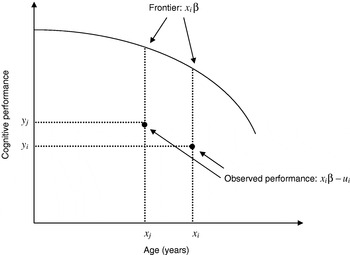
If ςi=1, individuals are fully efficient and ‘produce’ or recall (for example) the highest number of words they can (according to their age and educational level). In this case, their cognitive performance lies exactly on the optimal or frontier curve f(x i;β). If ςi<1 then individuals are not fully efficient; that is, their cognitive performance is below the optimal curve. Figure 1 graphically represents the mathematical reasoning. Imagine individual A who is ‘fully efficient’ according to his/her age and educational level. His/her cognitive performance will lie on the optimal or frontier curve f(x i;β). Then imagine individual B who is not ‘fully efficient’. His/her cognitive performance will lie below the curve. Put differently, in the stochastic frontier conception, the distance to the optimal or frontier curve is modelled as a function of various explanatory factors. Adding a two-sided error term following Aigner, Lovell and Schmidt (Reference Aigner, Lovell and Schmidt1977) yields:

which is equivalent to:

Defining u i=−ln(ςi) yields:

with  , u i⩾0 and cov(v i, u i)=0, where v i is the two-sided measurement error (random factors like the daily constitution of a person), and u i is the one-sided technical inefficiency. The last is a key term in the frontier analysis method, for it corresponds to the distance to best practice as represented by the stochastic frontier ln (f(x i;β))+v i. Hence u i requires an assumption about the distribution of u. For this analysis, we assumed for the inefficiency component a truncated-normal distribution u∼iidN +(μ;σu2). Alternatively, the non-negative disturbance was specified to be half-normally distributed with u∼N +(0;σu2). The estimated coefficients slightly differed but remained stable and comparable to the truncated-normally distributed inefficiency.
The stochastic frontier function.

The inefficiency term can be modelled as a function of other covariates. This idea was first introduced by Battese and Coelli (Reference Battese and Coelli1995).Footnote 1 According to their specification, we modelled the inefficiency term u i as u i=Z iδ where Z i is a set of variables thought to influence inefficiency. The applied software provided an extension to the truncated normal model by allowing the mean of the inefficiency term to be modelled as a linear function of a set of covariates. Summing up, the mathematical model that is used in the current paper is:

where q i represents the cognitive performance measured by the number of words recalled, x i represents age, the square of age, and educational level, and Z i incorporates the measures of social participation, behavioural risks, economic situation and chronic diseases. The analysis software estimates the coefficients β (effect of age and education) as well as δ (effect of social participation and control variables).
The variables
SHARE includes five different measures for cognitive functions: orientation, memory, verbal fluency, numeracy and recall. Orientation for time (date, month, year and day of the week) is a basic cognitive functioning indicator, and was not included in the analysis because it shows little variation by age (it is most appropriate for detecting very severe cognitive deficits). Memory indicates the number of words the interviewee can recall from a list of ten items: butter, arm, letter, queen, ticket, grass, corner, stone, book, stick. Recall is the number of words from this list that the interviewee can recall after a certain delay, which depends on the time to answer another seven questions, but generally about five minutes. The scales for memory and recall both range from ‘0’ to ‘10’. Verbal fluency is the number of different animals that the interviewee can name within one minute, with the values ranging from ‘0’ to ‘80’ in the current sample. Numeracy measures the performance in calculating percentages.Footnote 2 The respondents achieved scores from ‘1’ to ‘5’ – the higher the score, the better the numerical ability.
These measures of cognitive functioning are an assessment more of fluid than crystallised intelligence. A measure of crystallised intelligence would not involve any processing of new information, only recall or the performance of learned information and skills. A vocabulary test or a general knowledge test would be more appropriate. Fluency is commonly used as a measure of the efficiency of the central executive of working memory, since it uses the ability to sustain attention on a given task (goal) and to thwart intrusions. The variables memory and recall involve a timing aspect and a processing speed component. We report briefly the descriptive evidence from SHARE on the decline with age of the four measures memory, recall, verbal fluency and numeracy, and then concentrate on recall, as verbal skills might remain unchanged across the life course (Schwartzman et al. Reference Schwartzman, Gold, Andres, Arbuckle and Chaikelson1987). For all four dimensions, the decline with age was almost linear, which allows the application of linear regression. The mean number of words remembered declined from 5.5 words at age 50 years to 4.0 words at age 80, and the mean number of words recalled dropped from 4.0 to 2.0. Respondents aged 50 years named on average 21 animals, while those aged 80 named about 15 animals. Finally, the numerical ability score decreased from 3.8 to 3.0. Using standardised scores for memory, recall, verbal fluency and numeracy our results clearly demonstrate that memory and recall decreased more strongly than verbal fluency and numeracy (for more details seeEngelhardt et al. Reference Engelhardt, Buber, Skirbekk and Prskawetz2008). Because the decline of cognitive functioning was most pronounced for memory and recall, further analysis was concentrated on those two aspects of cognitive ability. The decline of the standardised scores was almost identical for both and we chose to examine only recall.
Because only ten words were read out and available for recall, it might be argued that this index is distorted by a ceiling effect (Rasmussen et al. Reference Rasmussen, Larsen, Houx, Skovgaard, Hanning and Moller2001). A respondent able to remember more words is unable to show their superior cognitive ability. It was found, however, that 97.8 per cent of the respondents recalled up to seven words, and only 1.5 per cent eight, 0.5 per cent nine, and only 0.2 per cent all ten. The distribution of recall scores therefore indicates that the distribution was not distorted by a ceiling effect.
We selected several indicators that are potential sources of plasticity in cognitive reserve, namely social participation and behavioural risks. The activities of social participation captured in SHARE include voluntary and charity work, care provided for sick or disabled adults, help provided to family, friends and neighbours, educational training, participation in a sports, social or other kind of club, participation in a religious organisation, and participation in a political or community organisation. The corresponding questions referred to activities undertaken within only the previous month and did not elicit how long a person had engaged in these activities. Additionally, SHARE collected information on frequency and on the motivation for taking part in the various activities. Our analysis did not consider those frequencies which are restricted to the preceding month only but might vary during a year. This restriction of activities to the last month before time of interview is certainly a limitation of the analysis. For instance, those who had been involved in certain activities for many years except for the preceding month would not be detected.
Additionally, the following behavioural risks were included in the analyses: being employed, carrying out moderate or vigorous physical activities, being overweight or obese, as well as smoking and drinking habits. If respondents said they engaged in vigorous activity (such as sports, heavy housework or a job that involves physical labour) at least one to three times a month, then we coded them as engaged in vigorous activities. If a respondent answered ‘less than once a month’, he/she was coded as not being engaged in vigorous activities. The same definition was applied for moderate activities: persons who engaged in activities that require a low or moderate level of energy (such as gardening, cleaning the car, or doing a walk) at least one to three times a month were categorised as being engaged in moderate activities. Persons were coded as overweight or obese if their body-mass index (BMI) was greater than 25. They were coded as smoking if they had ever smoked cigarettes, cigars, cigarillos or pipes daily for at least one year, and as drinking if they had more than two glasses of any alcohol almost every day of five to six days a week during the last six months. Alternatively, we distinguished people who never smoked, former smokers and current smokers.
Moreover, we controlled for economic situation and health – specifically, for chronic diseases. As an economic indicator, a measure generated at the household level and adjusted for purchasing power parity (ppp) was included, which is especially appropriate for comparisons of countries with different levels of income. The ppp-adjusted total gross income (i.e. the nominal gross income at the household level divided by the purchasing power parity) was included as a control to quantify the association between economic wealth and cognitive ability. In order to be able to distinguish countries with different income levels, each country's quartiles of ppp-adjusted total gross income were calculated. Imputations for Israel were not available, so Israel was not included in the final pooled model, but only at the country level, where the final model excluding the income variable was estimated. In order to control for various chronic diseases, a three-level variable was included that distinguished: (a) no chronic diseases, (b) mild chronic diseases (i.e. high blood pressure, high blood cholesterol, diabetes, asthma, osteoporosis, stomach, duodenal or peptic ulcer, cataracts or hip fracture), and (c) severe chronic diseases (heart attack and chronic lung disease). These categories of ill health might affect cognitive performance and central executive function.
Age in years and education were input factors for the stochastic frontier function. The educational level of each respondent was measured by the International Standard Classification of Education (ISCED-97) of the amount received (United Nations Educational, Scientific and Cultural Organization 1997). The ISCED-97 classification has seven levels (0–6), ranging from pre-primary level of education (e.g. kindergarten) to the second stage of tertiary education (PhD). We recoded the ISCED codes into four broader education levels: ‘low’ (pre-primary education, ISCED 0 and 1), ‘medium’ (lower secondary education, ISCED 2), ‘high’ (upper secondary or post-secondary non-tertiary education, ISCED 3 and 4) and ‘very high’ (first and second stage of tertiary education, ISCED 5 and 6).
Results
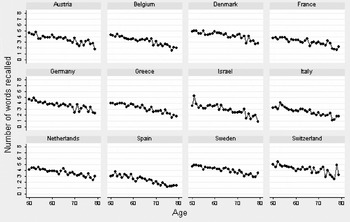
The descriptive results for number of words recalled clearly indicate a decline of cognitive functioning with increasing age (see Engelhardt et al. Reference Engelhardt, Buber, Skirbekk and Prskawetz2008). To see whether the association between age and recall was similar in all countries, the mean numbers of words recalled for all countries were plotted separately. Figure 2 depicts the decline with age and shows that the decline was observed in all countries but that the level at age 50 years and the magnitude of the decline varied. The recall score was especially low in Italy, Spain and Greece, which might reflect the relatively low educational level among older people in those countries. Figure 2 shows the greater variation with increasing age in cognitive performance in Austria, Denmark, Sweden and Italy, as well as generally large variation in Switzerland and Denmark. The larger variation is partly explained by the small number of respondents in the corresponding age groups and countries. For example, the Swiss sample was the smallest with 713 respondents, followed by Denmark with 1,171. The country with the largest analysed sample was Belgium, with 2,713 men and women aged 50–79 years.
Mean number of words recalled by age and country.

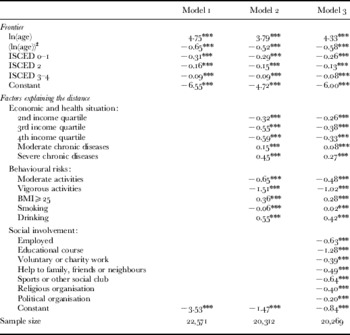
To estimate the basic stochastic frontier function for recall, at the first step we included age-squared and the level of education. The estimated coefficients of this first model (Model 1) are shown in Table 1. Both age and education had a significant effect on the frontier function. As expected, education was an important factor for cognitive performance among the aged. The estimated coefficients were highly significant and indicated that the better the cognitive functioning, the higher the educational level. Summing up, the cognitive reserve frontier estimated as a function of age and educational level can be considered as a good benchmark with respect to which individual cognitive performance can be assessed. The one-sided test for the presence of an inefficiency term detected a statistically significant effect, so inefficiency was modelled as a function of behavioural risks, social participation and control variables for economic circumstances and health, as described above.
Estimated coefficients of a stochastic frontier model including behavioural risks and social involvement

Notes: Reference categories: ISCED 5–6 (see text); 1st income quartile; no chronic diseases; hardly ever or never vigorous or moderate activities; body mass index (BMI) <25; never smoking over a period of one year at least one cigarette, cigar or pipe a day; drinking less than two glasses of alcohol almost every day or five or six days a week; not employed; not attending an educational course; not engaged in voluntary or charity work; no provision of help to family, friends or neighbours; no involvement in sports or other social club; no participation in a religious organisation; no participation in a political organisation. Since income at the household level is not yet available for Israel, Models 2 and 3 do not include Israel, explaining the lower number of absolute records in Models 2 and 3.
Significance level: *** p<0.01.
Data source: SHARE 2004 Release 2.0.1 (see text), weighted data, own calculations.
Model 2 of Table 1 includes a relative income measure and chronic diseases as well as the following four aspects of behavioural risks: physical activities, BMI, smoking and drinking. The additionally included coefficients for relative economic situation and chronic diseases as well as those for behavioural risks were significant. It has to be stressed that estimated negative coefficients can be interpreted as the actual cognitive performance being closer to the stochastic frontier and therefore indicating a better cognitive performance. Conversely, positive coefficients indicate a greater distance to the optimal curve, i.e. to the best practice curve, and thus indicate inferior cognitive performance. Contrary to the notation in regression models, the coefficients of the factors explaining the distance to the optimal curve have different signs. This is because the term Z iδ is subtracted in Equation 6.
Income was significantly associated with cognitive functioning: the higher the income quartile of a respondent, the better their cognitive ability and the lower the distance to the optimal performance given age and education. As described earlier, the quartiles refer to the ppp-adjusted total gross income within a country and not to quartiles for the total sample of 12 countries. Chronic diseases, especially severe chronic disease, were also significantly correlated with lower cognitive performance. Physical activities were associated with better cognitive functioning as individuals who kept up some moderate or even vigorous activities were also closer to the frontier function compared to those with no physical activities. The estimated coefficients for a BMI of 25 or higher and for drinking more than the recommended levels of alcohol (i.e. drinking more than two glasses of any alcohol almost every day or five to six days a week) indicated that being overweight or obese as well as elevated alcohol consumption increased the distance to the frontier function of optimal cognitive functioning. Surprisingly, smoking had a slight positive and even highly significant effect on cognition. This result may be due to selection bias in the cross-sectional dataset. Selection could be caused by an increasingly higher mortality of smokers with age and a positive selection of the smokers in the survey with respect to cognitive ability. With the additional control of social involvement (Model 3), the effect of smoking turned in the expected direction. A different measurement for smoking that distinguished between: (a) people who never smoked over a period of one year at least one cigarette, cigar or pipe, (b) former smokers, and (c) current smokers revealed similar results.
Finally, different dimensions of social involvement were added. More exactly, we included indicators for being employed, attending educational courses, doing voluntary or charity work, providing help to family, friends or neighbours, participating in a sports, social or other club, participating in a religious organisation, and participating in a political or community organisation. The estimated coefficients of the seven dimensions of social involvement were significantly negative and therefore indicated that individuals who engaged in social activities were closer to the optimal frontier curve as compared to those not engaged (Table 1, Model 3). In addition, the estimates for the standard deviations of the two error components σv2 and σu2 indicated that most of the variation was through technical inefficiency u, not measurement error v, as the corresponding standard deviation σu2=1.54 was higher than σv2=0.04. In other words, most of the variation was through systematic inefficiency and not from measurement errors.
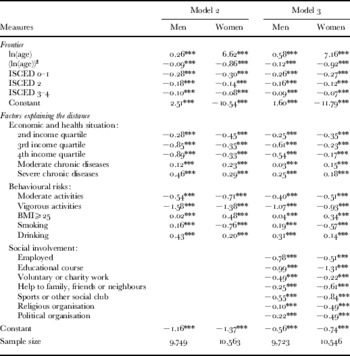
In order to detect possible gender differences in the association between behavioural risks as well as social involvement and the variable recall, models for men and women were run separately (Table 2). For both sexes, all coefficients for the social involvement indicators were negative, thus indicating that social involvement associated with better cognitive performance. Except for being employed and doing voluntary work, the association between social involvement and cognition was stronger among women than men, the corresponding coefficients having higher absolute values. Turning to behavioural risks, the estimates indicate that the association between cognitive ability and being overweight was stronger among women, whereas the association with excessive consumption of alcohol was more pronounced among men. Moreover, the surprisingly positive association between smoking and cognitive ability was partly neutralised by the findings that it applied only to women. For men, the association between smoking or having smoked over a period of at least one year at least one cigarette, cigar or pipe daily, on the one hand, and the number of words recalled, on the other, was negative in the sense that smoking associated with worse cognitive performance. The estimated coefficient was positive, indicating a greater distance to the optimal frontier for smokers. Interestingly, smoking decreased the distance to the frontier among women.
Estimated coefficients of a stochastic frontier model, by gender

Notes: Reference categories: ISCED 5–6 (see text); 1st income quartile; no chronic diseases; hardly ever or never vigorous or moderate activities; body mass index (BMI) <25; never smoking over a period of one year at least one cigarette, cigar or pipe a day; drinking less than two glasses of alcohol almost every day or five or six days a week; not employed; not attending an educational course; not engaged in voluntary or charity work; no provision of help to family, friends or neighbours; no involvement in sports or other social club; no participation in a religious organisation; no participation in a political organisation. Income at the household level was not available for Israel, which explains the lower number of absolute records in Models 2 and 3.
Significance level: *** p<0.01.
Data source: SHARE 2004 Release 2.0.1 (see text), weighted data, own calculations.
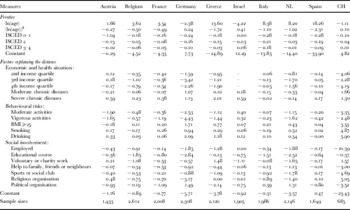
Turning to the control variables for health, mild chronic diseases seemed to have a stronger impact among women than men. The diseases included in this category are: high blood pressure, high blood cholesterol, diabetes, asthma, osteoporosis, stomach, duodenal or peptic ulcer, cataracts or hip fracture. The descriptive results show that mild chronic diseases were more frequent among women than men (55 compared to 45 per cent). Severe chronic diseases (heart attack and chronic lung disease) were more frequent among men than women (16 compared to 11 per cent) and more strongly associated with low cognitive performance. The association between income and cognitive performance was evident among men with a ppp-adjusted total gross income above the median. The stepwise inclusion of the variables showed that part of the effect of income was absorbed by social involvement among men, indicating an interaction between income, social involvement and cognition. Among women, the association between income and cognition was less pronounced in size and direction. Finally, the stochastic frontier approach was run for all countries separately (Table 3). Unfortunately, the models did not converge for Denmark and Sweden. Nevertheless, the graphs representing the mean number of words recalled show for Denmark and Sweden a pattern similar to the other countries (Figure 2). Despite the different signs of the coefficients for age and education, we found a decline in cognitive performance with age in all countries. The estimated effects were significant for all countries. Moreover, we found the expected higher cognitive performance with higher educational levels, except in Israel and Switzerland, for people in the ISCED 3–4 group. In all countries these coefficients were highly significant.
Concerning the potential factors affecting individuals' sub-optimal performance, or distances to the estimated frontier, we found for all countries with the exception of Israel significant negative effects for being employed. Thus, in almost all countries, being employed reduced the individual distance from the best possible performance given a certain age and educational level. Also participating in physical activities, whether vigorously or moderately, had a positive effect on cognitive reserve, again with Israel being the only exception. As regards being overweight or obese, smoking and drinking, the country-specific results were generally consistent with the general expectation. In Austria, a high BMI appeared significantly to favour cognitive performance. For smokers, cognitive performance seemed to be closer to the optimal level in Belgium and Italy, while it appeared significantly reduced in all other countries.
In accordance with our expectations, the employed and those with further training showed cognitive performances closer to the optimal level than those who were not employed (with the exception of Israel for employment, for which no significant effect was found). The other forms of social involvement had more disparate effects on cognitive performance. Voluntary or charity work did not bring about the expected results in Austria, Greece and Switzerland. Giving help to family, friends or neighbours had no positive effect on cognitive reserve in Spain. Taking part in a sports or social club did not seem to help in Spain or Switzerland, and being active in a religious organisation associated with significantly sub-optimal performance in Austria, Spain and Switzerland. Finally, being active in a political organisation increased the distance to the cognitive frontier in Germany, Italy and The Netherlands. Thus although we obtained the expected signs for the pooled sample, the country-specific results differed and require further consideration.
Discussion
Recent research has increased our understanding of the potentially modifiable factors that associate with cognitive decline in later life, and several interventions for preventing cognitive decline and dementia in old age are being evaluated: early detection, lifestyle factors, the management of medical morbidities and pharmaceutical approaches (Fillit et al. Reference Fillit, Butler, O'Connell, Albert, Birren, Cotman, Greenough, Gold, Kramer, Kuller, Perls, Sahagan and Tully2002). The idea of lifestyle management is to promote brain reserve through lifelong learning, social involvement and occupational complexity. Social detachment is an independent risk factor for cognitive decline among cognitively-intact older people (Bassuk, Glass and Berkman Reference Bassuk, Glass and Berkman1999). Berkman et al. (Reference Berkman, Glass, Brissette and Seeman2000) suggested that social involvement most likely challenges individuals to communicate and participate in exchanges that stimulate cognitive capacities. Maintenance of social involvement and avoidance of social isolation may be important in maintaining cognitive vitality in old age.
Estimated coefficients of a stochastic frontier approach by country

Notes: NL: Netherlands. CH: Switzerland. Reference categories: ISCED 5–6 (see text); 1st income quartile; no chronic diseases; hardly ever or never vigorous or moderate activities; body mass index (BMI) <25; never smoking over a period of one year at least one cigarette, cigar or pipe a day; drinking less than two glasses of alcohol almost every day or five or six days a week; not employed; not attending an educational course; not engaged in voluntary or charity work; no provision of help to family, friends or neighbours; no involvement in sports or other social club; no participation in a religious organisation; no participation in a political organisation. Since income at the household level was not available for Israel, that analysis did not include an economic variable.
Significance levels: All non-zero coefficients are significant at p<0.01, except one: the frontier constant for Austria (−0.29) is not significant.
Data source: SHARE 2004 Release 2.0.1 (see text and Acknowledgements), weighted data, own calculations.
In this paper, we have used a parametric stochastic frontier approach to estimate the impact of social involvement as well as behavioural risk factors on cognitive reserve and vitality in ageing among people aged 50 or more years in 11 European countries and Israel. For this purpose we used the individual data collected during the first wave of SHARE in 2004. Using large samples, we have tested the hypothesis that the association between cognitive ability, on the one hand, and social involvement and behavioural risks, on the other hand, is the same in different countries. Using comparable data for the 12 different countries, the results support this hypothesis. In this respect, this comparative study adds significantly to the literature.
In the pooled sample, the results clearly show that individuals' cognitive reserve is mainly a function of age and educational level. At the same time, all different forms of social involvement increase cognitive functioning, in particular the continuation of work. Moreover, behavioural risks such as physical inactivity, being overweight or obese, smoking or drinking clearly do not promote cognitive performance. The results for individual countries vary, however, with respect to the signs for most indicators of social involvement and behavioural risks. Cultural differences are clearly important in any international and cross-cultural analysis. Although cross-cultural surveys allow comparative ageing research, problems of the comparability of behavioural and psychological phenomena may arise (Tesch-Römer and von Kondratowitz Reference Tesch-Römer and von Kondratowitz2006). People from different cultural backgrounds likely understand and interpret terms and concepts differently, which might cause variation across the participating countries (Bardage et al. Reference Bardage, Pluijm, Pedersen, Deeg, Jylhä, Noale, Blumstein and Otero2005). This study has taken into account various aspects, however, so the differences in cognitive functioning might arise from methodological or cultural biases, but of course they could also indicate true differences between countries. In the context of cross-cultural analysis, Börsch-Supan, Hank and Jürges (Reference Börsch-Supan, Hank and Jürges2005), and in more detail Jürges (Reference Jürges2007), have addressed the role of reporting styles, their impact on cross-country differences in self-assessed health and comparability of health measures. Using a standardised health index, they found that Scandinavians (Danes and Swedes in particular) have a more positive attitude towards their health and tend systematically to overrate their health as compared to the SHARE average.
In the current study, not only the explanatory variable (cognition) but also the control variables (behavioural risks, health) might be distorted by cultural biases. Tesch-Römer and Kondratowitz (Reference Tesch-Römer and von Kondratowitz2006) referred to the translation problem and the feasibility of exact transfers of meaning in cross-cultural analyses. Our study focused on cognitive functioning, or more exactly on the number of words recalled from a list of ten items: butter, arm, letter, queen, ticket, grass, corner, stone, book and stick. Although these items are common place, they might be perceived differently in the various countries. It is conceivable that the connotation, occurrence and frequencies, and the associations among these words vary by country (and language). For example, the word ‘queen’ might have different connotations in The Netherlands, Spain and Sweden where monarchs still have constitutional functions and living exemplars. The association with a living person might make it easier to remember the word ‘queen’. Another example is that in Spain, butter is little used and therefore the word might be more difficult to recall than elsewhere. Then again, it might have been that when the SHARE data were collected, the price of butter was in the news more in some countries than others, making ‘butter’ easier to remember. Ideally, the test conditions should be identical at each session at the same time of day in the same setting (Rasmussen et al. Reference Rasmussen, Larsen, Houx, Skovgaard, Hanning and Moller2001), but in an international project involving over 30,000 respondents, this cannot be achieved. There may also have been variation among the interviewers, as through different accents, reading tempos and audibility. Although the interviewers had strict instructions in SHARE, the total eradication of personal traits and characteristics was impossible. To sum up, distortions and biases may have occurred at the levels of the respondent, the interviewer and the country.
There is also a possibility that the findings include cohort effects, especially with regard to education. Older cohorts might have lower cognition scores because a higher percentage had low education or, put another way, the increasing access over time, to higher education might have led to better cognitive performance among the younger cohorts. It must therefore be emphasised that the study has used cross-sectional not longitudinal data, and that the association between age and cognitive performance might partly be explained by cohort effects. Given the cross-sectional framework, we must be cautious when making causal inferences. For example, we cannot say whether socially more active people have better cognitive performance or whether those with better cognitive performance are socially more active. Longitudinal studies, however, clearly indicate that the relationship between social participation and cognitive capabilities works in the former way. SHARE is a longitudinal project and further waves will enable us to produce causal conclusions regarding social participation and cognitive ageing. Further longitudinal analysis may also help us to disentangle some of the puzzling country-specific results.
Despite these caveats, the results of the presented analyses clearly indicate that increased variation of cognitive decline at older ages may not be an argument against encouraging older workers to remain longer in the workforce. Our results suggest that social involvement – in particular occupational activities – positively correlate with cognitive ability. Though we cannot discern any causality from the cross-sectional results, the findings encourage a focus on the underlying correlates of cognitive variability in old age. The variation of social involvement and behavioural risk factors will in the end determine the feasibility of more people working to older ages.
The reported results indicate that all kinds of social involvement increase cognitive functions. In particular, the beneficial effect of continued occupational engagement illustrates the potential effect of the reforms in most European countries that seek to prolong being economically-active. It has also been shown that behavioural risks, such as physical inactivity, obesity, smoking or drinking, are clearly detrimental to cognitive performance. A tentative conclusion is that investing in continued education and fostering social involvement at older ages may indeed help to sustain cognitive abilities at older ages, thus increasing the feasibility and practicability of increasing labour-force participation into old age.
Acknowledgements
SHARE data collection was funded primarily by the European Commission through the 5th Framework Research and Development Programme (project QLK6-CT-2001-00360 in the thematic programme Quality of Life). Additional funding came from the United States National Institute on Aging (NIA) (U01 AG09740-13S2, P01 AG005842, P01 AG08291, P30 AG12815, Y1-AG-4553-01 and OGHA 04-064). Data collection in Austria (through the Austrian Science Foundation, FWF, grant number P-15422), Belgium (through the Belgian Science Policy Office) and Switzerland (through BBW/OFES/UFES) was nationally funded. The SHARE data collection in Israel was funded by NIA (R21 AG025169), by the German-Israeli Foundation for Scientific Research and Development (G.I.F) and by the National Insurance Institute of Israel. Further support by the European Commission through the 6th Framework Programme (projects SHARE-I3, RII-CT-2006-062193 and COMPARE, 028857) is gratefully acknowledged.