INTRODUCTION
Conventional flooded rice cultivation in Asia provides more than 0·75 of the world rice supply (Cabangon et al. Reference Cabangon, Tuong and Abdullah2002; Qin et al. Reference Qin, Hu, Zhang, Wei and Li2006). Rice is also the greatest consumer of water among all crops and consumes about 0·80 of the total irrigated fresh water resources in Asia (Bouman & Tuong Reference Bouman and Tuong2001; Bouman et al. Reference Bouman, Humphreys, Tuong and Barker2007). Fresh water, however, is becoming increasingly scarce because of population growth, increasing urban and industrial development, and the decreasing availability resulting from pollution and resource depletion (Belder et al. Reference Belder, Bouman, Cabangon, Guoan, Quilang, Li, Spiertz and Tuong2004; Bouman Reference Bouman2007). Decreasing water availability for agriculture is threatening the productivity of irrigated rice (Belder et al. Reference Belder, Bouman, Cabangon, Guoan, Quilang, Li, Spiertz and Tuong2004; Bouman Reference Bouman2007; Bouman et al. Reference Bouman2007). To reduce water use in irrigated rice, plastic film mulching cultivation (PM), which is considered as a novel water-saving technique, has been developed and practiced in many areas in China since the 1990s (Peng et al. Reference Peng, Shen, Wang, Liu, Luo and Wu1999; Liu et al. Reference Liu, Ai, Zhang, Lu, Zeng and Fan2005). This technique is employed under non-flooded conditions with limited irrigation and it is substantially different from both traditional flooded rice cultivation and rain-fed rice cultivation (Li et al. Reference Li, Wu, Lu, Zhao, Fan and Zhang2006). There are reports that this new technique, characterized by its striking efficiency in the maintenance of soil moisture, increase of soil temperature in the early season and inhibition of weed growth, has led to improvements in water use efficiency (WUE) (Fan et al. Reference Fan, Liu, Jiang, Zhang, Lu, Zeng and Christie2005; Liu et al. Reference Fan, Liu, Jiang, Zhang, Lu, Zeng and Christie2005; Tao et al. Reference Tao, Brueck, Dittert, Kreye, Lin and Sattelmacher2006). However, a major problem associated with this cultivation is poor grain filling, with reduced grain filling rate leading to low grain weight, when compared with traditional flooded cultivation (TF) (Xu et al. Reference Xu, Zhang, Zhang and Yang2007). The biochemical mechanism responsible for poor grain filling under PM is not understood.
Apart from PM, wheat or rice straw mulching cultivation (SM) has subsequently developed in rice production, especially in the Yangtze River Basin in China where rice–wheat rotations are the main cropping system (Fan et al. Reference Fan, Liu, Jiang, Zhang, Lu, Zeng and Christie2005; Liu et al. Reference Fan, Liu, Jiang, Zhang, Lu, Zeng and Christie2005; Qin et al. Reference Qin, Hu, Zhang, Wei and Li2006). A major challenge in the rice–wheat cropping system is the disposal of the wheat residue preceding a rice crop. Farmers always burn the crop residue, particularly when they want to establish the rice crop rapidly when labour is limited. This leads to the loss of most of the organic C and up to 0·80 of nitrogen (N) (Raison Reference Raison1979), 0·25 of phosphorus (P) and 0·21 of potassium (K) can be lost (Ponnamperuma Reference Ponnamperuma, Banta and Mendoza1984), as well as significant air pollution and death of beneficial soil fauna and microorganisms. One of the best solutions would be to use crop straw as a soil mulch material in non-flooded rice cultivation in the rice–wheat rotation system. Although several experiments have been conducted to test non-flooded straw mulching cultivation in rice (Fan et al. Reference Fan, Liu, Jiang, Zhang, Lu, Zeng and Christie2005; Liu et al. Reference Fan, Liu, Jiang, Zhang, Lu, Zeng and Christie2005; Xu et al. Reference Xu, Zhang, Zhang and Yang2007; Zhang et al. Reference Zhang, Zhang, Yang and Zhang2008), no information is available with regard to the effects of straw mulching cultivation on the grain filling process and underlying biochemical mechanism.
It has been proposed that the seed development may be mediated through endogenous hormones (Yang et al. Reference Yang, Peng, Visperas, Sanico, Zhu and Gu2000, Reference Yang, Zhang, Wang, Liu and Wang2006b; Brenner & Cheikh Reference Brenner, Cheikh and Davies1995). Among phytohormones, both ethylene and abscisic acid (ABA) are generally regarded as inhibitory growth regulators (Trewavas & Jones Reference Trewavas, Jones, Davies and Jones1991; Cheng & Lur Reference Cheng and Lur1996; Mohapatra et al. Reference Mohapatra, Naik and Patel2000; Davies Reference Davies and Davies2004). A high ethylene evolution rate has frequently been related to abortion in maize (Zea Mays) (Cheng & Lur Reference Cheng and Lur1996) and reduction in grain weight in wheat (Triticum aestivum) (Xu et al. Reference Xu, Yu, Qi and Yu1995; Beltrano et al. Reference Beltrano, Ronco and Montaldi1999; Yang et al. Reference Yang, Zhang, Liu, Wang and Liu2006a). Application of ethylene inhibitors improves dry matter partitioning and development of later-flowered spikelets on rice panicles (Mohapatra et al. Reference Mohapatra, Naik and Patel2000). However, the cause and effect relationship between ethylene emission from rice grains and the development of the grain has not been investigated.
There is a report that the anthers located on the distal floret positions of a wheat spikelet contain more ABA than those on the proximal positions, and the high ABA concentration is linked to the reduced grain set (Lee et al. Reference Lee, Martin and Bangerth1988). Under water stress, the reduction in grain set and kernel growth in wheat (Morgan Reference Morgan1980; Saini & Aspinall Reference Saini and Aspinall1982; Ahmadi & Baker Reference Ahmadi and Baker1999), and a decreased rate of endosperm cell division rate in maize (Myers et al. Reference Myers, Setter, Madison and Thompson1990; Ober et al. Reference Ober, Setter, Madison, Thompson and Shapiro1991) have been observed to be associated with elevated levels of ABA. There are many observations, however, that ABA can promote dry matter accumulation in the sink organ and its level is correlated with the growth rate of fruits or seeds (Eeuwens & Schwabe Reference Eeuwens and Schwabe1975; Browning Reference Browning1980; Berüter Reference Berüter1983; Wang et al. Reference Wang, Cook, Francis, Ambrose and Hedley1987, Reference Wang, Yang, Zhu, Zhang, Lang and Wang1998; Ross & McWha Reference Ross and Mcwha1990; Schussler et al. Reference Schussler, Brenner and Brun1991; Kato et al. Reference Kato, Sakurai and Kuraishi1993; Yang et al. Reference Yang, Zhang, Wang, Zhu and Wang2001, Reference Yang, Zhang, Wang, Xu and Zhu2004).
The purpose of the present study was to investigate the changes in ethylene evolution rates and ABA concentrations in the grains of rice under non-flooded plastic film mulching and wheat straw mulching cultivations, and determine how these hormonal changes correlate with the grain filling process. The effects of chemical regulators on ABA and ethylene in the grains were also studied to verify the roles of the two hormones.
MATERIALS AND METHODS
Plant materials and site description
The experiment was conducted at a farm belonging to the Yangzhou University, Jiangsu Province, China (32°30′N, 119°25′E, 21 m asl), during the rice growing season (May–October) of 2006, and was repeated in 2007. The soil was a sandy loam (Typic fluvaquents, Etisols (US taxonomy)) with 24·6 g organic matter/kg, 1·27 g total N/kg, 34·3 mg Olsen-P/kg and 68·5 mg exchangeable K/kg. The field capacity soil moisture content, measured after constant drainage rate and made gravimetrically, was 0·189 g/g and the bulk density of the soil was 1·34 g/cm3. Weather variables were measured at a weather station close to the experimental site: in 2006 average air temperature was 24·6°C, precipitation 96·8 mm/month and sunshine hours 181 h/month; in 2007 these were 24·8°C, 95·2 mm/month and 183 h/month, respectively.
Two high-yielding rice (Oryza sativa L.) cultivars currently used in local production, Zhendao 88 (ZD 88, a japonica cultivar) and Shanyou 63 (SY 63, an indica F1 hybrid cultivar), were grown in the paddy field. Across the 2 years, seedlings were raised in the seedbed, sown on 10–11 May and transplanted on 9–10 June at a hill spacing of 0·20×0·20 m with two seedlings per hill. The heading date for both cultivars was on 18–21 August, and plants were harvested on 8–10 October.
Treatments
The experiment comprised four treatments in a complete randomized block design with four replicates and a plot size of 3×8 m. The four treatments were traditional flooding (TF) as control and plastic film mulching (PM), wheat straw mulching (SM) and no mulching (NM) as non-flooded cultivation systems. The TF treatment was continuously flooded with 20–30 mm water level in the plot until 1 week before rice harvest, in line with traditional farming practice. In non-flooded cultivation treatments, the field was ploughed and 1·5 m wide beds were prepared; then the field was flooded and puddled. Plastic film, 0·005 mm thick and 1·8 m wide, was used to cover the soil before transplanting in the PM treatment. Wheat straw harvested from the same field in the wheat season was used to cover the soil before transplanting in the SM treatment. The amount of wheat straw used was c. 7·5 t DM/ha, containing an average of 37 kg N/ha, 7 kg P/ha and 83 kg K/ha. In all the non-flooded treatments, plots were flooded for 6–8 d only, after transplanting, for the re-greening of seedlings. After that, the amount of water applied to PM, SM and NM plots was controlled at 360–420 m3/ha at each stage of mid-tillering, booting, flowering and early grain filling, respectively, when soil water potential had reached −25 kPa (soil moisture content 0·161 g/g at 150–200 mm depth) and if there had been no precipitation at this time. Soil water potential of −25 kPa was chosen because the work done by Yang et al. (Reference Yang, Liu, Wang, Du and Zhang2007) has shown that such soil moisture would not seriously reduce grain yield. The soil water potential in non-flooded plots was monitored with tension metres (Soil Science Research Institute, Nanjing, China) buried at a depth of 150–200 mm in the soil. Traditional flooding and non-flooded plots were separated by a 2 m wide alley using plastic film inserted into soil to a depth of 0·6 m. The other plots were separated by a 0·5 m wide irrigation furrow and two 0·3 m levees. The irrigation water was applied via pipelines and the amount of irrigation water was monitored with a flow metre installed in the irrigation pipelines and used for the calculation of WUE for irrigation. In all treatments, N (150 kg/ha as urea), P (30 kg/ha as single superphosphate) and K (45 kg/ha as KCl) were applied and incorporated into the soil before transplanting or film/straw mulching.
Sampling
Three hundred panicles that headed on the same day were chosen and tagged from each plot. Twenty tagged panicles from each plot were sampled at 4-d intervals from heading to maturity. All fertilized spikelets that developed into grains were removed. One half of the sampled grains were used for measurements of ABA, ethylene and 1-aminocyclopropane-1-carboxylic acid (ACC). The other half of the grains was dried at 70°C to constant weight and weighed. The grain filling process was modelled by the Richards (Reference Richards1959) growth equation as described by Zhu et al. (Reference Zhu, Cao and Luo1988) :

Grain filling rate (G) was calculated as the derivative of Eqn (1):

where W is the grain weight (mg), A is the final grain weight (mg), t is the time after heading and B, k and N are coefficients determined by regression. The active grain filling period was defined as the days when W was from 0·05 (t 1) to 0·95 (t 2) of A. An average grain-filling rate during this period was therefore calculated from t 1 to t 2.
ABA extraction, purification and quantification
The methods for extraction and purification of ABA [(+)-ABA] were modified from those described by Bollmark et al. (Reference Bollmark, Kubat and Eliasson1988) and He (Reference He and He1993). Samples of 20–30 grains were ground in a mortar (at 0°C) in 10 ml 0·75 g/g methanol extraction medium containing 1 mM butylated hydroxytoluene as an antioxidant. The extract was incubated at 4°C for 4 h and centrifuged at 4800 g for 15 min at the same temperature. The supernatants were passed through Chromosep C18 columns (C18 Sep-Park Cartridge, Waters Corp, Millford, MA, USA), pre-washed with 10 ml 1·00 g/g and 5 ml 0·75 g/g methanol, respectively. The hormone fractions were dried under N2 and dissolved in 2 ml phosphate buffer saline containing 1·1 mg/g Tween 20 and 1·0 mg/ml gelatin (pH 7·5) for analysis by an enzyme-linked immunosorbent assay (ELISA).
The mouse monoclonal antigen and antibody against ABA, and immunoglobulin G-horseradish peroxidase (Ig G-HRP) used in ELISA were produced at the Phytohormones Research Institute, China Agricultural University, China (He Reference He and He1993). The methods for quantification of ABA by ELISA and recovery test have been described previously (Yang et al. Reference Yang, Zhang, Wang, Zhu and Wang2001, Reference Yang, Zhang, Huang, Wang, Zhu and Liu2002). The recovery proportion of ABA in grains was 0·84±0·054. The specificity of the monoclonal antibody and the other possible nonspecific immunoreactive interference have been checked previously (He Reference He and He1993; Yang et al. Reference Yang, Zhang, Huang, Wang, Zhu and Liu2002) and the method proved reliable.
Ethylene and ACC analysis
Ethylene evolved from grains was determined according to Beltrano et al. (Reference Beltrano, Carbone, Montaldi and Guiamet1994), with modifications. Briefly, sampled grains were placed between two sheets of moist paper for 1 h at 27°C in darkness, to allow wound ethylene to subside. Each sample contained 100–120 grains. Grains were then transferred into 15 ml glass vials containing moist filter paper, immediately sealed with airtight subaseal stoppers and incubated in the dark for 8 h at 27°C. A 1 ml gas sample was withdrawn through the subaseal with a gastight syringe and ethylene was assayed using a gas chromatograph (HP5890 Series II, Hewlett Packard Com, Palo Alto, CA, USA) equipped with a Porapak Q column (3×2000 mm, 50–80 mesh) and flame ionization detector (FID). Temperatures for the injection port, column and detector were kept constant at 140, 100 and 200°C, respectively. Nitrogen was used as the carrier at a flow rate 30 ml/min and hydrogen and air were used for FID at the rate of 30 and 300 ml/min, respectively.
The concentration of ACC in the grains was determined according to Cheng & Lur (Reference Cheng and Lur1996). Ethylene evolved from ACC was assayed using gas chromatography as described above. The transformation proportion from ACC to ethylene was 0·87±0·045, 0·91±0·052 and 0·82±0·043 at early, mid and late grain filling stages, respectively. ABA and ACC concentrations and ethylene evolution rate were expressed on a dry weight (DW) basis.
Final harvesting
All plants were harvested by hand on 8–10 October in both years. Grain yield was determined from all plants within a 5 m2 site (except border plants) in each plot and adjusted to a moisture content of 0·14 g H2O/g fresh weight (FW). The yield components, i.e. number of panicles/m2, proportion of filled grains and grain weight, were determined from 50 plants (excluding the border ones) sampled randomly from each plot. The proportion of filled grains was defined as the filled grains (specific gravity ⩾1·06 g/ml) as a proportion of total number of spikelets. The number of spikelets per panicle was calculated from the grain yield, grain weight (0·14 g H2O/g FW) and proportion of filled grains, i.e. number of spikelets per panicle=grain yield/m2/(number of panicles per square metre×1000-grain weight×proportion of filled grains).
Chemical applications
The cultivar (cv.) SY 63 was used for chemical application. Plants were grown in a paddy field with the same growth conditions as described earlier. Three treatments, TF, PM and NM, were conducted. The treatment methods were the same as described earlier.
Synthetic (±)-ABA, amino-ethoxyvinylglycine (AVG, ACC synthase inhibitor, restrains the synthesis of ethylene by inhibiting ACC synthase), ethephon (an ethylene-releasing agent) (all from Sigma, St Louis, MO, USA) and fluridone (Fluka, Riedel-de Haën, New Jersey, Germany), an inhibitor of carotenoid biosynthesis leading to reduction of ABA synthesis, were applied to the panicles. Preparation of the chemical solutions has been described elsewhere (Cheng & Lur Reference Cheng and Lur1996; Yang et al. Reference Yang, Zhang, Liu, Wang and Liu2006a). Starting at 7 d after heading (DAH), 50 mM ethephon, 50 μM AVG, 20 μM ABA, 20 μM fluridone or 20 μM fluridone+20 μM ABA was applied to panicles by using a writing brush that had been dipped in the solution. The chemicals were applied daily for 4 d at the rate of 5 ml per panicle at each application. All the solutions contained ethanol and Tween 20 at final concentrations of 0·9 and 1·1 mg/g, respectively. The same volume of deionized water containing the same concentrations of ethanol and Tween 20 was applied to the control plants. Each chemical treatment was carried out in an area of 2·7 m2 with four replications.
Ethylene evolution rate and ACC and ABA concentrations in grains were determined 6 and 14 d (16 and 24 DAH), respectively, after the chemical treatments. Grain weight was measured at 6-d intervals from heading to maturity. Measurement methods were the same as described above. Activities of three key enzymes involved in sucrose to starch conversion in rice grains, sucrose synthase (SuSase, EC 2.4.1.13), ADP glucose pyrophosphorylase (AGPase, EC 2.7.7.27) and soluble starch synthase (SSSase, EC 2.4.1.21), were also determined 16 and 24 DAH as described previously (Yang et al. Reference Yang, Zhang, Wang, Zhu and Liu2003). Forty to fifty panicles for each treatment were harvested at maturity for the determination of final grain weight.
Statistical analysis
Analysis of variance was conducted using the SAS/STAT statistical analysis package (version 6.12, SAS Institute, Cary, NC, USA). Data from each sampling date were analysed separately. Where significant differences were found, mean differences were indicated through standard error of the difference (s.e.d.). Regressions were used to evaluate the relationship between ethylene evolution rate or ACC and ABA concentrations in grains and the grain filling rate. The differences in data across the 2 years and in the interaction between the year and cultivar were not significant (P>0·05). Therefore, data from both years were averaged.
RESULTS
Grain yield, grain filling rate and WUE
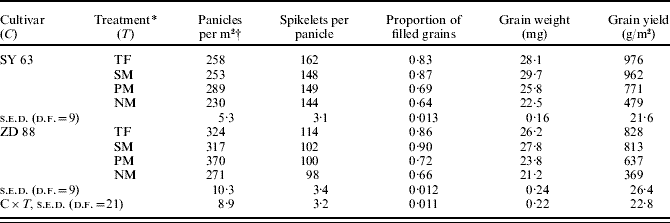
Table 1 shows the grain yield and its components under different cultivation methods. Compared with that under the continuous flooding system (TF), the grain yield showed some reduction under the non-flooded systems but differed greatly among the treatments (Table 1). Due to the significant decreases in the proportion of filled grains and grain weight, the grain yield under the PM decreased by 21·0% for SY 63 and 23·1% for ZD 88. The reduction was significant (P<0·05). The difference in the sink size (total number of spikelets, i.e. panicles/m2×spikelets/panicle) was not significant (P>0·05) between the TF and PM treatments (data not presented). In contrast with PM, SM significantly increased the proportion of filled grains and grain weight (Table 1), but significantly reduced sink size as a result of decreased spikelet number per panicle. Grain yield under SM was not significantly (P>0·05) affected compared with that under TF. The NM treatment showed the lowest grain yield among the treatments where it was reduced by 50·9–55·4%, due to significant (P<0·05) decreases in sink size, proportion of filled grains and grain weight (Table 1).
Grain yield and its components of two rice cultivars SY 63 (indica hybrid cultivar) and ZD 88 (japonica cultivar) under non-flooded mulching cultivation
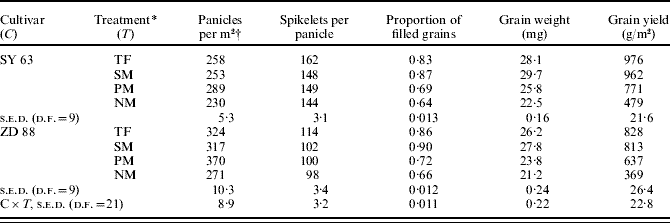
* TF indicates traditional flooding cultivation, and SM, PM and NM are wheat straw mulching, plastic film mulching and no mulching under non-flooded conditions.
† Data are averages observed for the 2 study years.
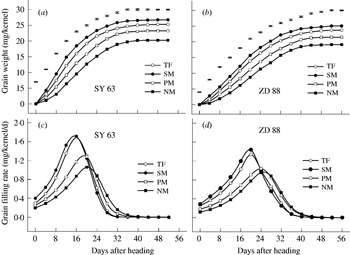
As shown in Fig. 1, grain weight was closely associated with the grain filling rate. Both the maximum grain filling rate and mean grain filling rate during the active grain filling period (4–28 DAH for SY 63 and 4–32 DAH for ZD 88) were markedly decreased under PM and NM, while they were increased under SM when compared with those under TF (Fig. 1), indicating that the low proportion of filled grains and grain weight under PM and NM are mainly attributable to the small grain filling rate.
Grain weight (a and b) and grain filling rate (c and d) of two rice cultivars SY 63 (indica hybrid cultivar) (a and c) and ZD 88 (japonica cultivar) (b and d). TF: traditional flooding cultivation, SM: wheat straw mulching, PM: plastic film mulching and NM: no mulching under non-flooded conditions. Data are averages observed for the 2 study years. The grain filling rate was calculated according to Richards’ (Reference Richards1959) equation. Vertical bars in (a) and (b) indicate one s.e.d. (d.f.=9).

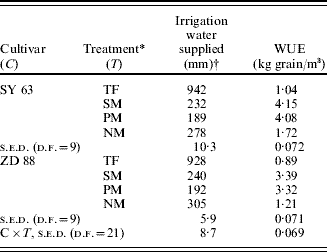
Water application during the growing season across the 2 study years, on average, was 191 mm to PM, 236 mm to SM, and 292 mm to NM, which was only 20·4, 25·2 and 31·2%, respectively, of that applied to TF (935 mm, Table 2). Compared with that under TF, WUE for irrigation was markedly increased under all the non-flooded treatments: by 273–292% under PM, 221–299% under SM and 36–65% under NM (Table 2). Under the same treatment, the hybrid cv. SY 63 showed a higher WUE than cv. ZD 88.
WUE for irrigation in two rice cultivars SY 63 (indica hybrid cultivar) and ZD 88 (japonica cultivar) under non-flooded mulching cultivation
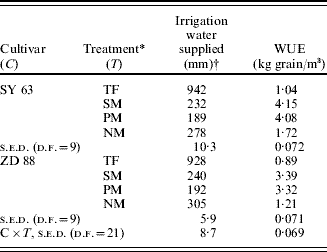
* TF indicates traditional flooding cultivation, and SM, PM and NM are wheat straw mulching, plastic film mulching and no mulching under non-flooded conditions.
† Data are averages observed for the 2 study years.
Changes in ABA, ethylene and ACC in grains and relationships with grain filling
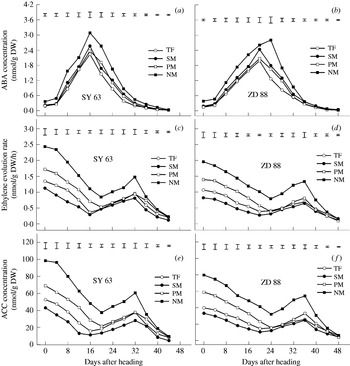
The concentration of ABA in grains on a DW basis was very low at the start of grain filling (Fig. 2a, b). It increased quickly from 4 DAH and reached a peak at 16–24 DAH, after which it sharply declined. The time at which peak ABA concentration occurred almost coincided with the maximum grain filling rate (Fig. 1b, d). Among the four treatments, NM showed the highest ABA concentration in grains during the filling. There was no significant difference (P>0·05) in ABA concentration among the TF, PM and SM treatments from 4 DAH to 16 or 24 DAH. Both SM and PM enhanced ABA accumulation in grains from 20 or 24 DAH to 28 DAH when compared with the TF treatment.
Changes in ABA concentration (a and b), ethylene evolution rate (c and d) and ACC concentration (e and f) in the grains of two rice cultivars SY 63 (indica hybrid cultivar) (a, c and e) and ZD 88 (japonica cultivar) (b, d and f). TF: traditional flooding cultivation, SM: wheat straw mulching, PM: plastic film mulching and NM: no mulching under non-flooded conditions. Data are averages observed for the 2 study years and vertical bars indicate one s.e.d. (d.f.=9).

In contrast to ABA, ethylene evolution from the grain was very high at initial grain filling and rapidly decreased with the grain filling process until 16–24 DAH. Thereafter, it increased until 32 or 36 DAH, when it sharply decreased (Fig. 2c, d). NM had the highest ethylene evolution rate among all the treatments during the grain filling period. PM markedly increased the ethylene evolution from grains at 16–20 DAH, while it was substantially reduced under SM. A very similar pattern was observed for the ACC concentration in grains (Fig. 2e, f). The ACC concentration was significantly correlated with the ethylene evolution rate (r=0·99, P<0. 01), suggesting that the increase in ethylene evolution may be attributable to the increased ACC concentration in grains under the PM and NM.
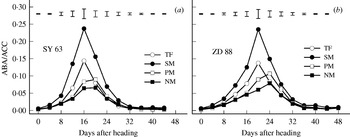
As shown in Fig. 2a, b, e and f, accumulation of both ABA and ACC in grains was increased in the NM treatment. The increase in ACC concentration relative to the increase in ABA concentration was greater under NM than under TF. The ratio of ABA to ACC (ABA:ACC) in the grains during the active grain filling period, on average, was increased under SM, and decreased under NM and PM when compared with that under the TF (Fig. 3a, b), suggesting that ethylene was more enhanced than ABA when plants were grown under the NM and PM treatments.
Changes in the ratio of ABA to ACC in the grains of two rice cultivars SY 63 (indica hybrid cultivar) (a) and ZD 88 (japonica cultivar) (b). TF: traditional flooding cultivation, SM: wheat straw mulching, PM: plastic film mulching and NM: no mulching under non-flooded conditions. Data are averages observed for the 2 study years and vertical bars indicate one s.e.d. (d.f.=9).

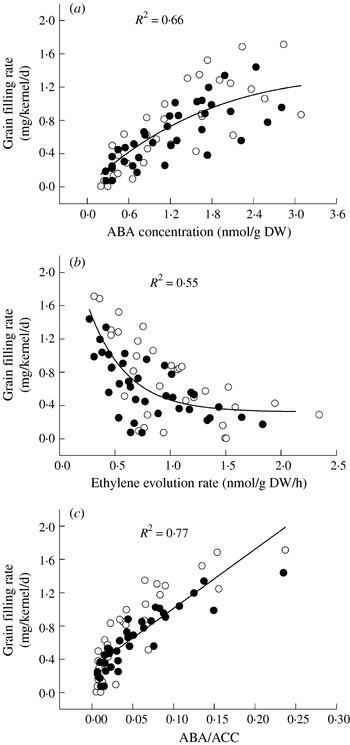
Figure 4a shows that the concentration of ABA correlated with the grain filling rate in a hyperbolic relationship, whereas the ethylene evolution rate correlated with the grain filling rate in an exponential decay equation (Fig. 4b). The ratio of ABA to ACC significantly correlated with the grain filling rate with a linear relationship (Fig. 4c).
Relationships of grain filling rate with ABA concentration (a), ethylene evolution rate (b) and the ratio of ABA to ACC (c) in the grains of two rice cultivars SY 63 (indica hybrid cultivar) (open circles) and ZD 88 (japonica cultivar) (closed circles). Data are from Figs 1–3 and represent averages observed for the 2 study years. Regression equations are G=9·29X 1/(6·52+X 1)−0·61X 1,  and G=0·31+7·11X 3, respectively, for (a), (b) and (c) (G is the grain filing rate, and X 1, X 2 and X 3 represent ABA concentration, ethylene evolution rate and the ratio of ABA to ACC in grains, respectively). The coefficient of determination R 2 is calculated (P<0·01, n=68).

Effects of chemical regulators
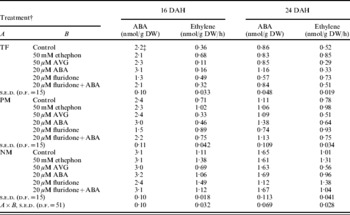
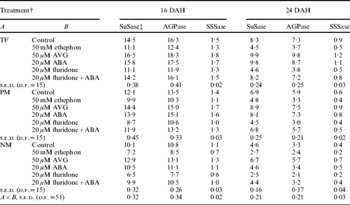
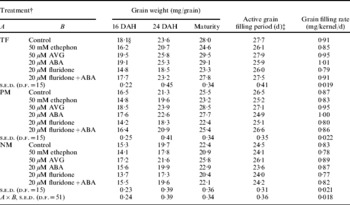
To verify the roles of ABA and ethylene in grain filling, chemicals involved in promoting or inhibiting both hormones were applied at the early grain filling stage (7–10 DAH). When AVG, an inhibitor of ethylene synthesis, was applied to the panicles, ethylene evolution rate of grains was significantly (P<0·05) reduced (Table 3), and activities of SuSase, AGPase and SSSase in grains, grain filling rate and grain weight were significantly (P<0·05) increased when compared with respective controls under the TF, PM and NM treatments (Tables 4 and 5). Application of fluridone, an inhibitor of ABA biosynthesis, produced the opposite effect for all the three treatments. Application of ethephon, an ethylene-releasing substance, to panicles significantly (P<0·05) increased the ethylene evolution rate, decreased activities of SuSase, AGPase and SSSase and reduced grain filling rate and grain weight. The opposite results were obtained when ABA was applied to the panicles under both the TF and PM treatments. No detectable effects on grains were found when ABA was applied to panicles under the NM (Tables 3–5). When plants were treated with both fluridone and ABA, the differences in all the measurements were not significant (P>0·05) relative to the control (Tables 3–5), indicating that there are no indirect effects of fluridone on grain filling.
Effects of applied ethephon, AVG, ABA, fluridone and fluridone+ABA on ABA and ethylene in the grains of riceFootnote *

* The cultivar SY 63 (indica hybrid) was used.
† TF indicates traditional flooding cultivation, and PM and NM represent plastic film mulching and no mulching under non-flooded conditions. The chemicals were applied to panicles daily for 4 d starting at 7 DAH. Control plants were applied with deionized water.
‡ Data are averages observed for the 2 study years.
Effects of applied ethephon, AVG, ABA, fluridone and fluridone+ABA on enzymatic activities in the grains of riceFootnote *

* The cultivar SY 63 (indica hybrid) was used.
† TF indicates traditional flooding cultivation, and PM and NM represent plastic film mulching and no mulching under non-flooded conditions. The chemicals were applied to panicles daily for 4 d starting at 7 DAH. Control plants were applied with deionized water.
‡ Activities of SuSase, AGPase and SSSase in grains were expressed as mmol/g DW per min, and are averages observed for the 2 study years.
Effects of applied ethephon, AVG, ABA, fluridone and fluridone+ABA on the grain filling rate and grain weight of riceFootnote *

* The cultivar SY 63 (indica hybrid) was used.
† TF indicates traditional flooding cultivation, and PM and NM represent plastic film mulching and no mulching under non-flooded conditions. The chemicals were applied to panicles daily for 4 d starting at 7 DAH. Control plants were applied with deionized water.
‡ Active grain filling period and grain filling rate were calculated according to Richards’ (Reference Richards1959) equation.
§ Data are averages observed for the 2 study years.
DISCUSSION
To achieve the dual goal of increasing food production and saving water, non-flooded mulching cultivation has been adopted and developed as a new rice production technique in recent years (Fan et al. Reference Fan, Liu, Jiang, Zhang, Lu, Zeng and Christie2005; Liu et al. Reference Fan, Liu, Jiang, Zhang, Lu, Zeng and Christie2005; Lu et al. Reference Lu, Wu, Pang, Li, Wu, Shi and Zhang2007). The present results showed that both PM and SM treatments significantly increased WUE of irrigation (Table 2), but grain yield differed significantly between the two treatments (Table 1). PM significantly decreased the yield, while SM did not, when compared with TF, in agreement with previous studies (Qin et al. Reference Qin, Hu, Zhang, Wei and Li2006; Xu et al. Reference Xu, Zhang, Zhang and Yang2007; Zhang et al. Reference Zhang, Zhang, Yang and Zhang2008). The difference in grain yield between PM and SM was mainly due to the differences in grain filling, i.e. PM significantly decreased the grain filling rate, proportion of filled grains and grain weight, whereas these were significantly increased under SM (Fig. 1, Table 1). The early senescence caused by high temperature in both surface soil and canopy during the grain filling period and heavy lodging at the late grain filling stage may account for poor grain filling under PM (Liu et al. Reference Liu, Yuan, Wang, Xu and Cheng2002; Zhang et al. Reference Zhang, Zhang, Yang and Zhang2008). However, the high photosynthetic rate of leaves and root activity due to more nutrient supply from soil and more oxygen supply to the root system during grain filling would contribute to the increased grain filling rate and grain weight under SM (Qin et al. Reference Qin, Hu, Zhang, Wei and Li2006; Zhang et al. Reference Zhang, Zhang, Yang and Zhang2008). Few previous studies, however, have described the biochemical mechanism in which grain filling differs among the cultivation methods under the non-flooded system. The present data, for the first time, showed a close association between changes of ethylene production and ABA concentration in grains and the grain filling rate (Figs 1 and 2). The grains under PM or NM treatments had much greater ethylene evolution rate and higher ACC concentration than those under TF or SM treatments (Fig. 2c–f). Ethylene evolution rate was significantly and negatively correlated with the grain filling rate, the relationship being one of exponential decay (Fig. 4b). Application of an inhibitor of ethylene synthesis (AVG) increased the grain filling rate and grain weight, while application of ethylene-releasing agent (ethephon) reduced these (Table 5). These results suggest that ethylene plays a role in inhibiting grain filling and high ethylene production under PM and NM contributes to the low proportion of filled grains and grain weight as a result of a small grain filling rate.
Little is known about how ethylene affects grain filling. It is reported that ethylene can act as a signal to induce the expression of alpha-amylase genes and thereby reduce starch accumulation in the storage organs (Rook et al. Reference Rook, Corke, Card, Munz, Smith and Bevan2001). The present results showed that the activities of three enzymes involved in the sucrose-to-starch pathway in the grains, SuSase, AGPase and SSSase (Hawker & Jenner Reference Hawker and Jenner1993; Ahmadi & Baker Reference Ahmadi and Baker2001; Hurkman et al. Reference Hurkman, McCue, Altenbach, Korn, Tanaka, Kothari, Johnson, Bechtel, Wilson, Anderson and Dupont2003), were significantly reduced by application of ethephon, but substantially enhanced by application of AVG, to the panicles at the early grain filling stage (Table 4). These results suggest that ethylene reduces the grain filling rate through inhibiting the key enzymes involved in sucrose-to-starch pathway in rice grains.
The results herein demonstrated that the change in ABA concentration in the grains followed a similar pattern to the grain-filling rate (Figs 1 and 2). Application of ABA to the panicles under both TF and PM treatments significantly increased the grain filling rate and grain weight, whereas application of fluridone, an inhibitor of ABA synthesis, had the opposite effect (Table 5), indicating that, opposite to ethylene, ABA plays a role in enhancing grain filling, consistent with the report that normal levels of endogenous ABA are required to maintain appropriate shoot and root growth in well-watered and water-stressed tomato plants (Sharp et al. Reference Sharp, Lenoble, Else, Thorne and Gherardi2000; LeNoble et al. Reference Lenoble, Spollen and Sharp2004).
The mechanism by which ABA facilitates grain filling is not understood. It has been proposed that ABA has a major role in relation to sugar-signalling pathways and enhances the ability of plant tissues to respond to subsequent sugar signals (Rook et al. Reference Rook, Corke, Card, Munz, Smith and Bevan2001; Davies Reference Davies and Davies2004). There are many reports that ABA can enhance the movement of photosynthetic assimilates towards developing seeds (Dewdney & McWha Reference Dewdney and McWha1979; Ackerson Reference Ackerson, Ackerson and Ackerson1985; Brenner & Cheikh Reference Brenner, Cheikh and Davies1995). The present data showed that activities of SuSase, AGPase and SSSase in the grains were significantly enhanced by application of ABA, but substantially reduced by application of fluridone, to the panicles at the early grain filling stage under TF and PM (Table 4). This result suggests that ABA may promote grain filling through an increase of sink activity by regulation of key enzymes involved.
It is noteworthy that ABA concentration was greatly increased, whereas the grain filling rate and grain weight were significantly decreased, under NM (Figs 1 and 2). The present results showed that, under the NM, both ABA concentration and ethylene evolution rate were increased in the grains (Fig. 2). However, the ratio of ABA to ACC was greatly reduced (Fig. 4), suggesting that the NM treatment had a greater effect on ethylene release than ABA accumulation in these grains. When these panicles were treated with AVG, ethylene production was reduced and grain filling and grain weight were increased. In contrast, the grain filling rate and grain weight were decreased when application of fluridone resulted in a reduction in ABA and an increase in ethylene production (Tables 3 and 5). These results indicate that the reduction in the grain filling rate and grain weight under NM is mainly attributed to the increase in ethylene production.
There is a proposal that plant hormones can act either synergistically or antagonistically and it is the balance between promoting and inhibiting agents that ultimately determines the path of plant growth and development (Davies Reference Davies and Davies1995). Data in the present study also showed that the grain filling rate was not only correlated with the ABA concentration and ethylene evolution rate, but also more correlated with the ratio of ABA to ACC (Fig. 4c), suggesting that antagonistic interactions between ABA and ethylene would regulate the grain filling rate and a high ABA concentration or a high ratio of ABA to ACC is beneficial to grain filling. It is notable, however, that the correlation between ABA concentration and grain filling rate showed a hyperbolic relationship (Fig. 4a). Such a curve indicates that a maximum grain filling rate (1·21 mg/kernel/d) may be achieved only when the ABA concentration in grains is 3·44 nmol/g DW. The result suggests that an appropriate higher ABA concentration and a higher ratio of ABA to ACC are necessary to enhance the grain filling rate. However, too much ABA may have an adverse effect on grain filling as results of inhibited photosynthesis and phloem translocation and a shortened grain filling period (Brenner & Cheikh Reference Brenner, Cheikh and Davies1995; Ahmadi & Baker Reference Ahmadi and Baker1999).
The present results showed that the number of spikelets per panicle was significantly reduced under the SM, PM and NM treatments (Table 1). The mechanism in which the non-flooded system reduces spikelet numbers was not investigated in the present study. Further research is needed to clarify the effect of altered ABA and ethylene status on spikelet numbers.
In conclusion, the grain filling rate is closely associated with the changes in ethylene evolution rate and ABA concentration in rice grains under non-flooded mulching cultivations. The decreased ethylene production or a high ratio of ABA to ACC contributes to a fast grain filling rate and high grain weight under the SM. However, a greater increase in ethylene production than in ABA accumulation under the PM and NM results in poor grain filling, which leads to low grain weight. A high ratio of ABA to ethylene in rice grains would maintain a fast grain filling rate.
The authors gratefully acknowledge the grants from the National Basic Research Program (973 Program, 2009CB118603), National Natural Science Foundation of China (30671225, 30771274), the State Key Project of China (2006BAD02A13-3–2) and the Doctoral Foundation of Ministry of Education, China (200811170002), Hong Kong Research Grants Council (HKBU 2465/05 M) and University Grants Committee (AoE/B-07/99).