Introduction
In the summer of 1947, four animal hide scrolls were offered for sale to the Syriac Orthodox archbishop in Jerusalem. In November and December of 1947, three more scrolls were bought by a professor for the Hebrew University in Jerusalem.Footnote 1 These “Jerusalem Scrolls,” as they were called in 1948, would eventually come to be known as the first of the Dead Sea Scrolls.Footnote 2 These seven scrolls are among the best preserved of all the manuscripts that emerged from the Judean desert in the 1940s and 1950s. Their importance was recognized and famously summed up by William Foxwell Albright already in 1948: “unquestionably the greatest manuscript find of modern times.”Footnote 3 Many would still agree with that assessment today, but with regard to these first scrolls, a more accurate summary might have been “the greatest manuscript purchase of modern times.”
The fact that these scrolls were bought from antiquities dealers is well known, and the story of their vicissitudes on the market has been narrated on more than one occasion.Footnote 4 Yet, in spite of this knowledge, scholars often treat these seven scrolls as if they were artifacts recovered from a documented professional archaeological excavation. It is also seldom noted that several other more fragmentary scrolls attributed to Cave 1 were bought rather than excavated by archaeologists. Furthermore, the connection of all of these pieces to a particular alleged site of “discovery,” the space we now call Cave 1 or 1Q, is problematized by the fact that Cave 1 was a thoroughly disturbed context when archaeologists finally excavated it in 1949.5 In short, the transition from “Jerusalem Scrolls” to “Dead Sea Scrolls from Cave 1 at Qumran” is not quite as simple as it seems.
Until quite recently, issues of provenance and the Dead Sea Scrolls appeared relatively straightforward.6 The exceptional case would be Cave 4, where the Bedouin uncovered thousands of fragments, and archaeologists quickly followed to recover thousands more.7 For about a decade, at least some scholars of the scrolls have been raising the possibility that a considerable portion of “Cave 4 fragments” may have originated in other caves.8 The materials attributed to Cave 1 have so far escaped a similar level of scrutiny. The goal of this article is to provide such scrutiny: What can actually be known about the purchased scrolls that have been attributed to Cave 1? Which of them can confidently be associated with fragments from the documented excavation of Cave 1?9
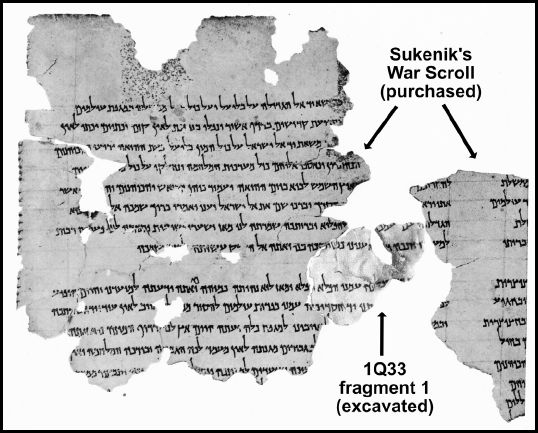
Before we can answer these questions, it will be helpful to dwell a moment on what is meant by saying that purchased scrolls and fragments are “connected to” or “associated with” fragments excavated by archaeologists. We generally say that particular scrolls bought from the market can be materially associated with or connected to a particular cave when they can be shown to be part of a manuscript actually found by the archaeologists who conducted controlled excavations in the caves.Footnote 10 At Cave 1, the clearest instance of this situation is the case of “the War Scroll” (a purchase made by Eleazar Sukenik, discussed below) and the fragments published as 1Q33, which were excavated by archaeologists.Footnote 11 The fragments of 1Q33 match the writing surface, script, and textual character of Sukenik’s scroll and in fact can be fitted neatly into the gaps of columns 18 and 19 of Sukenik’s scroll. Figure 1 illustrates the placement of 1Q33 fragment 1.
Column 18 of Sukenik’s War Scroll with fragment 1 of 1Q33 set in place; images adapted from Eleazar L. Sukenik, The Dead Sea Scrolls of the Hebrew University (Jerusalem: Magnes, 1955) plate 33 (courtesy of Magnes Press and © The Israel Museum, Jerusalem) and PAM negative M40.531 (courtesy of The Leon Levy Dead Sea Scrolls Digital Library; Israel Antiquities Authority, photo: Najib Anton Albina).

While a similar situation obtains in some cases of Cave 1 scrolls that I will discuss below, it does not appear to be as common as sometimes suggested.Footnote 12 Many of the purchased scrolls and fragments have no such connection to material archaeologists excavated from Cave 1. The complicated history of purchases of scrolls said to come from Cave 1 and the inclusion of purchased material alongside excavated material in the first volume of Discoveries in the Judaean Desert (DJD) have obscured these relationships to the degree that even specialists can disagree about the status of certain pieces. For instance, in their 2010 re-edition of the Cave 1 Isaiah scrolls in the DJD series, Eugene Ulrich and Peter W. Flint state that parts of 1QIsab, specifically the fragments published as 1Q8, were found in situ by excavators.Footnote 13 The editors of DJD I, however, clearly say that although these pieces were published with the material excavated by archaeologists, the particular fragments that make up 1Q8 were not excavated. They were purchased: “Among the fragments published here, sets number 8 (Isaiah), 20 (Apocalypse of Lamech), and 28 (annexes to the Rule of the Community) were bought from an antiquities dealer in Bethlehem.”Footnote 14 The misunderstandings have even made their way into standard reference works. As the preceding quotation indicates, 1Q20, a set of fragments of a work now generally known as the Genesis Apocryphon, was also part of a purchase. Yet, the Society of Biblical Literature’s Handbook of Style describes 1Q20 as “excavated frags. from cave.”Footnote 15
Identifications of scrolls and fragments are also subject to change. This seems to be the case with the claim by Weston Fields in 2009 that fragments of the Thanksgiving Scroll purchased by Eleazar Sukenik (1QHa) were found in Cave 1 by de Vaux’s team.Footnote 16 This was indeed the conclusion of scholars in the 1950s, but subsequent scholarship overturned that identification decades ago.Footnote 17 According to the best current knowledge, then, there is no material connection between Sukenik’s Thanksgiving Scroll and Cave 1.
It is these kinds of problems that have prompted the present investigation. What this essay seeks to provide is an organized discussion of the different purchases of scrolls attributed to Cave 1 and an examination of how the status of Cave 1 as a contaminated archaeological context complicates the assignment of some purchased scrolls to this cave. For at least some of these items, this transformation from “Jerusalem Scrolls” to “Qumran Cave 1 Scrolls” seems more than a little problematic.
The Story of the Discovery
Despite the variants in its many retellings, the tale of the discovery of the first seven Dead Sea Scrolls is very well known, at least in its broad outlines. Nevertheless, it is worth repeating a version of the story here to set the stage for the discussion to follow. Here is a summary from the classic overview of Qumran and the Dead Sea Scrolls by Frank Moore Cross:
In the spring of the year 1947 two shepherd lads were grazing their mixed flocks of sheep and goats along the foot of the crumbling cliffs that line the Dead Sea in the vicinity of Qumrân….
According to their account, one of their animals strayed. In searching for it, one of the shepherds, Muhammed ed-Dîb by name, casually threw a stone into a small circular opening in the cliff face. Instead of the expected smack of rock against rock, he heard a shattering sound. He was frightened and fled. Later, presumably when the fear of jinn or hyenas finally gave way to the lure of buried gold, he and his companion Ahmed Muhammed returned and crept into the cave and found decaying rolls of leather in one of a number of strange elongated jars embedded in the floor of the cave. These were the original “Dead Sea Scrolls.”
In the year between the Bedouin discovery and the first press releases announcing the discovery to the world, there was confusion, blundering, and intrigue, as is associated often, unfortunately, with spectacular, chance finds. At least one, and probably several clandestine excavations ravaged the cave site; additional materials came to light; there is evidence that a considerable amount of precious material was destroyed in the process. The details of this phase of the vicissitudes of the scrolls of Cave I are most difficult to establish. In any case, after some of the scrolls (three, according to Ta‘âmireh claims) had been passed about in the tents of clansmen, they were brought to Bethlehem for sale and fell into the hands of antiquities dealers. At some point they were joined with a portion of the manuscript materials from clandestine excavations. Ultimately one lot came into the possession of the Syrian Orthodox Metropolitan of Jerusalem, a Syrian cobbler of Bethlehem acting as broker; another was purchased by the late E.L. Sukenik for the Hebrew University.Footnote 18
The focus here, as in the majority of such accounts, is the moment of discovery. Yet, Cross is more circumspect than most in mentioning both the subsequent “clandestine excavations” after the initial discovery and the story of the purchase of these first scrolls in two separate lots. And it is the details of these transactions that will be our first area of investigation.
Four Major Purchases: Two Batches of Scrolls and Two Batches of Fragments
It is well known that the first seven scrolls to be offered for sale in 1947 ended up in the hands of two buyers. One group of scrolls was purchased in July of 1947 by Athanasius Yeshue Samuel, better known as Mar Samuel, the Syriac Orthodox archbishop in Jerusalem. This group was purchased from Khalil Iskander Shahin (“Kando” in most scholarly discussions, or occasionally “Quando”) and consisted of the Community Rule (1QS), the Habakkuk Pesher (1QpHab), the Great Isaiah Scroll (1QIsaa), and the Genesis Apocryphon (1QapGen).Footnote 19 A second group of scrolls was bought from the dealer Faidi Salahi (sometimes anglicized as Feidi Salahi and sometimes identified as Faidi-al-Alami) by Eleazar Sukenik for the Hebrew University in November and December of 1947. This second group included three scrolls: a second copy of Isaiah (1QIsab), the Thanksgiving Scroll (1QHa), and the War Scroll (1QM).Footnote 20
While none of these basic facts is in dispute, detective work carried out by scholars in the 1950s determined that the story of these sales was a little more complicated.Footnote 21 On the basis of interviews with the sellers and alleged finders of the scrolls, John C. Trever concluded that a first group of scrolls was found in a cave by Muhammad ed-Dhib in late 1946 or early 1947.Footnote 22 This group consisted of three scrolls: 1QS, 1QIsaa, and 1QpHab. Two fellow tribesmen of Muhammad ed-Dhib, Jum‘a Muhammad and Khalil Musa, brought the three scrolls to Bethlehem in March 1947 and deposited them “for several weeks” with a carpenter and antiquities trader named Ibrahim Tjha.Footnote 23 Having not been sold, the scrolls were then entrusted to Kando, probably at some point in April 1947.Footnote 24 The Syriac Christian George Isha’ya Shamoun (a.k.a. George Isaiah or George Shaya), a mutual acquaintance of Kando and Mar Samuel, informed the latter about the scrolls and aroused his interest in purchasing them. In May or June of 1947, George Isha’ya and Khalil Musa brought four more scrolls, said to have come from the same cave as the first three scrolls, to Kando’s shop in Bethlehem.Footnote 25 At that moment, it seems that for a brief time all seven of the first scrolls were in the possession of Kando.Footnote 26 Kando kept only one of the four scrolls brought by Isha’ya and Khalil Musa (apparently the Genesis Apocryphon) as payment for funding he had provided for Isha’ya’s expeditions to the cave. Isha’ya and Khalil Musa sold the other three scrolls they had brought (a second copy of Isaiah, the War Scroll, and the Thanksgiving Scroll) to another dealer, Faidi Salahi. Thus it was that in July 1947, Mar Samuel bought four scrolls from Kando: the Community Rule, the Habakkuk Pesher, the Great Isaiah Scroll (all allegedly found by Muhammad ed-Dhib), and the Genesis Apocryphon (allegedly found by Isha’ya and Khalil Musa). Mar Samuel eventually took these scrolls to the United States and there sold them (unknowingly) to Yigael Yadin, who saw to their return to Jerusalem in 1954.Footnote 27 Thus, according to this reconstruction of events, the Genesis Apocryphon was actually part of the second group of manuscripts that appeared on the Bethlehem antiquities market, the rest of which were eventually sold to Sukenik by Faidi Salahi through a negotiation mediated by Levon Nasri Ohan.Footnote 28
In addition to these two groups of well-preserved scrolls, there were also two groups of fragments that were purchased and that are generally associated with Cave 1. One of these batches was a cigarette box containing fragments that came into the possession of Mar Samuel at some point before September 1948.Footnote 29 These pieces consisted mostly of a “mass of leather” said to have been illicitly removed from Cave 1 by Isha’ya around August 1948.Footnote 30 This material was also brought to the United States by Mar Samuel. When taken apart by John Trever at Yale University in April 1949, the clump of leather was found to consist of fragments of two copies of the book of Daniel (1Q71 and 1Q72) and a fragment of a liturgical prayer (1Q34bis). The other pieces in the box were “a ragged piece of coarse leather” preserving a portion of the so-called Book of Noah (1Q19bis), and a fragment of papyrus containing several letters of an unidentified text (1Q70bis). To the best of my knowledge, nearly all of this material remains in New Jersey under the care of the Syriac Orthodox Church.Footnote 31
When DJD I was published in 1955, the volume was said to include all the scrolls from Cave 1 excavated by de Vaux and his team. But more material than this was published in the volume. In addition to these excavated pieces, an appendix included editions of the fragments Trever had sorted from the cigarette box in the possession of Mar Samuel. Yet, another subset of scrolls in DJD I are singled out as part of a purchase made by the Palestine Archaeological Museum (PAM) from “the Bethlehem dealer” in the spring of 1950.Footnote 32 This purchase included the sets of fragments designated 1Q8 (fragments of Sukenik’s Isaiah scroll), 1Q20 (a fragment of the Genesis Apocryphon), and 1Q28 (a set of fragments belonging to the Community Rule scroll).Footnote 33 A set of PAM photographs of these items dated 4 March 1950 provides a probable rough date of acquisition.Footnote 34
Lingering Questions Connected to Purchased Fragments Associated with Cave 1
Conflicting evidence or missing data prevents firm conclusions with regard to some purchases. This is the case with a fragment from column 2 of 1QSb (1Q28b), a set of scraps containing text from Deuteronomy (1Q5, fragment 13), and a record of a purchase for “fragments” apparently from Cave 1 in 1951.
That 1QSa (1Q28a) and 1QSb (1Q28b) were originally part of the same scroll as 1QS is highly probable.Footnote 35 To judge from the statement of the editors of DJD I, it would seem even more certain that 1QSa and 1QSb were purchased: “All the fragments that we group under the number 28 definitely belong to the same set (ensemble) as 1QS. In fact, they were sold to the Palestine Archaeological Museum in 1950 by the Bethlehem antiquities dealer.”Footnote 36 Yet, Trever makes a curiously specific claim regarding one fragment of this text: “A small piece of 1QSb (Col. II) also was sifted from the debris” during the excavation of Cave 1.Footnote 37 I can find no corroboration of Trever’s statement, but if it were correct, this fragment would constitute a material connection between Cave 1 and the three scrolls associated with Muhammad ed-Dhib. Thus, it would be very useful to see if Trever’s statement can be somehow confirmed or disconfirmed.Footnote 38
The story of one of the fragments of 1Q5 (1QDeutb) is also somewhat confusing. The set 1Q5 consists of dozens of small fragments assembled into about 50 relatively larger fragments.Footnote 39 One of these composite pieces is fragment 13. At first glance, the editors of DJD I appear to have associated the purchase of a part of fragment 13 with Batch 3 above (the fragments in the cigarette box that Mar Samuel had obtained from Isha’ya): “The fragments published in the appendix as well as the central part of frag. 13 of 1Q5 are the remains of the clandestine explorations of the Syrians.”Footnote 40 The editors’ association of the Deuteronomy fragment with “the Syrians” cannot, however, mean that the Deuteronomy fragment was part of the same acquisition as Batch 3. The Batch 3 items that appear as an appendix to DJD I were published without photographs, as those fragments had been brought to the United States by Mar Samuel.Footnote 41 In a footnote, the editors add that pieces of fragment 13 were actually found by de Vaux’s team as well: “The fact that frag. 13 of 1Q5 could be supplemented by two small fragments found during the excavations that took place during February and March 1949 provides a further argument that these different lots share an identical origin.”Footnote 42 Trever twice mentions the source of a purchased portion of 1Q5, giving different, though not incompatible, stories. At one point in his narrative, he associates the Deuteronomy fragment with what I am calling Batch 4, the 1950 purchase by the Palestine Archaeological Museum:
The story of Saad’s efforts to make the acquaintance of Kando, and finally (in 1950) to secure the mass of fragments which the cobbler and his associates had dug from the cave, reads like a Sherlock Holmes detective adventure. It was then that fragments of the Hebrew University Isaiah Scroll (1QIsb), some from the “Genesis Apocryphon” (1Q20, now 1QApoc), several large pieces (including two almost-complete columns) from the Manual of Discipline (1QS) and some fragments of a scroll of Deuteronomy (1QDeutb) were secured for the Department of Antiquities, but only after payment of the large sum of £Pl,000 ($2,800).Footnote 43
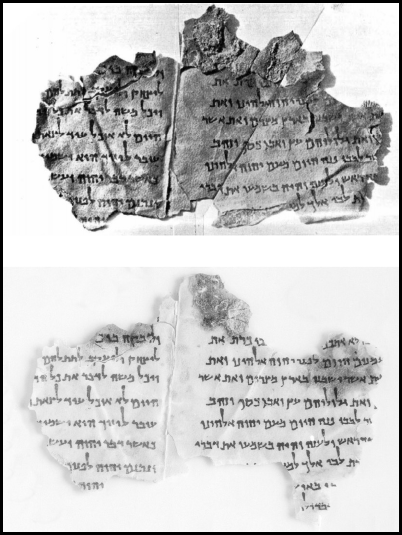
Trever reiterates what the editors of DJD I had also made clear, namely, that the purchase of Batch 4 took place in 1950. But this date would seem to raise a problem, for the museum had purchased the main part of the Deuteronomy fragment already in 1949. In that year Harding mentioned the fragment in one of his first publications about the discovery and excavation of Cave 1, noting that, in addition to the excavated fragments, “some other fragments in the square script, which have been acquired from an outside source, are of the book of Deuteronomy.”Footnote 44 That this statement refers to fragment 13 of 1Q5 is made clear by a photograph that accompanies the article (the upper image in fig. 2).
Top: Photograph of 1Q5, fragment 13 taken in 1949; Bottom: Photograph of 1Q5 with additional fragments taken in 1961; images adapted from Gerald Lankester Harding, “The Dead Sea Scrolls,” PEQ 81 (1949) 112-16 and plates XVII-XXI, at plate XX, fig. 3 and PAM negative 43.751 (courtesy of The Leon Levy Dead Sea Scrolls Digital Library; Israel Antiquities Authority, photo: Najib Anton Albina).

Trever’s second statement on the origin of the Deuteronomy fragment offers a possible solution: “[The archaeologists] also found small pieces of the larger Deuteronomy fragment, part of which was reported to have come from Isha’ya and part from Kando.”Footnote 45 Trever thus suggests the fragment came from three sources: a portion bought from Isha’ya (one of “the Syrians”), a portion bought from Kando (the 1950 purchase), and a portion recovered by the archaeologists in 1949. If this interpretation is correct, it must be the portion purchased from Isha’ya that was already in Harding’s possession in 1949. Comparison of the 1949 photograph with an infrared photograph taken in 1961 (PAM 43.751) suggests that the bits recovered by archaeological excavation—and the 1950 purchase, if it did indeed include parts of this fragment—were not very large (the fragment as a whole is about 12 cm wide by 8 cm high; see fig. 2).Footnote 46
Finally, in 2009, Weston Fields published a ledger that includes purchases made by the Palestine Archaeological Museum. One column in the ledger records the alleged source of each purchase. For one item purchased on 12 May 1951, the source is listed as “Q1,” presumably a reference to Cave 1 at Qumran. The only description of the purchase is “fragments,” and the name of the seller is “Haj Taher Marakshy.”Footnote 47 It is unclear to me whether the expenditure in this ledger entry represents an actual purchase of scroll fragments or if it refers to non-scroll material said to come from Cave 1.Footnote 48 The numbered designation “Q1” also suggests that the ledger was retrospectively filled out, as no other “manuscript caves” were known to museum officials until the 1952 regional survey, a point to which I will return.
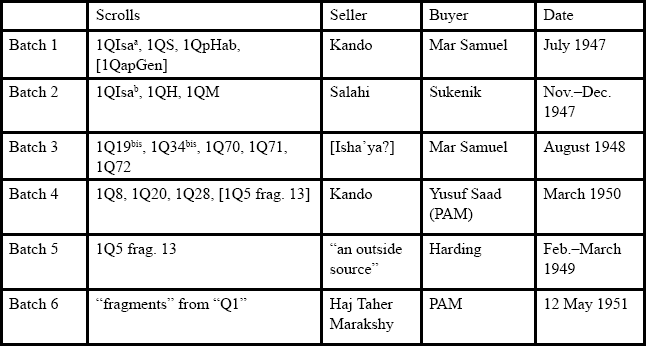
We thus have evidence for five discrete purchases of material attributed to Cave 1 (or perhaps six, if the 1951 purchase contained scroll fragments). Figure 3 summarizes the data. Because these groups represent purchases and not alleged “discoveries,” I have placed the Genesis Apocryphon in Batch 1 (scrolls sold by Kando to Mar Samuel in July 1947), even though Trever has established that the Genesis Apocryphon probably came to the market with Sukenik’s scrolls rather than with the other three bought by Mar Samuel.
Purchases attributed to Cave 1.

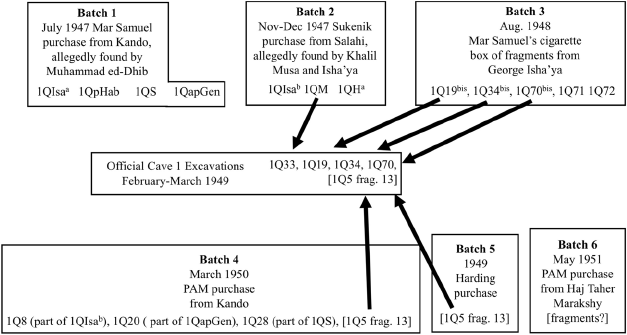
The tabular format makes it easier to see connections among the various purchases. For instance, we can see that Batch 4, the museum purchase from Kando in 1950, contains materials connected to both the Mar Samuel purchase (Batch 1) and the Sukenik purchase (Batch 2), which can be explained by Kando having been in possession of all seven of the scrolls in 1947. He would have had the opportunity to keep any fragments that detached from the main scrolls. We are also now in a better position to see connections between the purchased material and pieces that were excavated under controlled conditions by archaeologists (see fig. 4).
Connections between the manuscript purchases and the manuscripts excavated by archaeologists from Qumran Cave 1.

What is most striking about the diagram is the fact that Batch 1 is completely unconnected to Cave 1. That is to say, none of the material said to have been found by Muhammad ed-Dhib (Mar Samuel’s July 1947 purchase, with the exception of the Genesis Apocryphon) can be connected to the material excavated from Cave 1 by archaeologists.Footnote 49 Further exploration of this problem will require turning to the details of the identification and excavation of Cave 1 itself.
The Identification of Cave 1 by Archaeologists
In the late 1940s, the scrolls we have been discussing were said to come from “a cave” or “the cave.”Footnote 50 Today, they are described as coming from “Cave 1,” a cave first identified and excavated by scholars in early 1949. But that identification was apparently made without assistance from anyone who had actually visited the cave before 1949.Footnote 51 Here is how Harding described the identification of the cave in DJD I:
Then a Belgian observer on the United Nations staff, Captain Lippens, who had become interested in the story of the find, raised the question with Major-General Lash of the Arab Legion. Lash offered, subject to the approval of the Department of Antiquities, to send a small contingent of men to the area where the cave was believed to be located in order to try to rediscover it. This was done at the end of January 1949, and the cave was actually found by Captain Akkash el Zebn after only two or three days’ search. The discovery was duly reported back to headquarters, and I went down to examine the place. At first I was sceptical whether it could really be the right cave, but the presence of many potsherds and fragments of linen showed that it had at least been occupied and must be investigated. Accordingly on 15 February the Jordan Department of Antiquities in collaboration with the École Biblique et Archéologique Française and the Palestine Archaeological Museum started work there and continued until 5 March 1949.Footnote 52
So, what the archaeologists found and excavated was a cave that showed signs of both ancient activity and modern pillaging. Other accounts of the arrival of the archaeologists at the cave provide a more vivid description of the condition of the site. Ovid R. Sellers, who visited the cave twice during the 1949 excavations, described the scene as follows in a note dated 21 March 1949:
The operation was complicated by previous clandestine excavators, who last November dug up the surface of the cave to a depth of several inches in the vain hope that the Bedouin had missed some scrolls. So in the debris were cigarette stubs, a little modern cloth, and scraps of newspaper which had been used to wrap food…. No complete new scrolls were found, but there was part of one scroll (which has not been unrolled) and there were hundreds of bits of manuscripts as well as a large quantity of sherds. Undoubtedly the cave was the correct one; for some of the manuscript fragments clearly belong to the scrolls which are known. Apparently the Bedouin broke open all the jars and removed the manuscripts, ignoring the pieces which broke off and fell on the floor. These pieces were mixed with débris in the unauthorized excavation.Footnote 53
In his own descriptions, de Vaux is more precise about the degree of disturbance. In one of his first detailed accounts, he made the following remarks as he described the features of Cave 1:
The ceiling was 2.5 to 3 m above the “archaeological layer.” This represents in fact only the surface of the cave disturbed by the most recent looters in search of manuscripts and of a “treasure”; it is in this layer and in the rubble tossed out in front of the entrance that we found all the potsherds, the remains of linen, and the fragments of manuscripts. Its thickness varied from 25 to 50 cm.Footnote 54
We thus learn that the scroll fragments all came from the thoroughly disturbed interior surface context or from the debris of illicit digging left outside the cave itself. Harding goes further, noting a total lack of stratigraphy: “In view of the earlier clearance no stratification could be observed.”Footnote 55
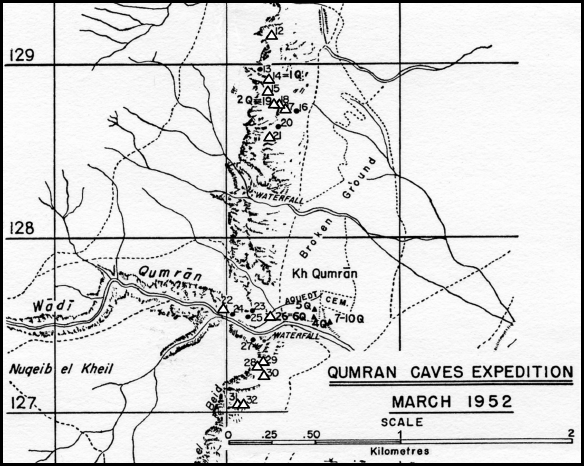
There are two points to take away from these descriptions. First, Cave 1 was highly contaminated when professional archaeologists finally reached it. Second, the excavators operated under the impression that there was only one cave with manuscripts. When they found a disturbed cave with ancient remains and identified what they believed were small pieces of the scrolls already known, they were satisfied they had found the single source from which all of the first seven scrolls and fragments had emerged.Footnote 56 Yet, when archaeologists conducted a wider search of the area in 1952, they found many such disturbed areas, some in very close proximity to Cave 1. The space we call “Cave 2,” for instance, sits fewer than 200 meters south of Cave 1. It was first visited by archaeologists in March 1952 and was found to be thoroughly disturbed. In the words of one of the excavators, “signs of illicit digging were very much in evidence.”Footnote 57 In his discussion of the excavation of Cave 2, de Vaux put matters more starkly: “The cave had been completely emptied” by clandestine diggers.Footnote 58 Elsewhere, de Vaux mentions that only two small fragments were found by archaeologists in the spoils left behind by the Bedouin.Footnote 59 The fact that another plundered cave that (seems to have) contained scrolls was found quite close to Cave 1 should give us pause.Footnote 60 I do not mean to suggest that the purchased scrolls generally linked to Cave 1 actually came from Cave 2 specifically, just that plausible alternative locations exist. Indeed, the plausible alternatives are more numerous than typical maps of the “scroll caves” indicate. Most maps of the Qumran region label only those caves in which manuscripts were found. On such maps, Cave 1 can appear fairly isolated, except for the presence of Cave 2. This picture is somewhat misleading.
The survey of caves carried out in the spring of1952 revealed several other areas both in the immediate vicinity of Cave 1 and slightly further afield that de Vaux identified (on the basis of material remains) as having been, in his words, “utilized by the community at Qumran.”Footnote 61 These sites are marked with white triangles in fig. 5:
Plan of the caves in the Qumran area; white triangles mark sites identified by de Vaux as having been “utilized by the community at Qumran”; image adapted from Roland de Vaux, Archaeology and the Dead Sea Scrolls (trans. David Bourke; The Schweich Lectures of the British Academy 1959; London: The British Academy, 1973) plate XL, by permission of the British Academy.

It would thus appear that there are several additional locations in the vicinity of Cave 1 that could have potentially been the source of some of the well-preserved scrolls generally associated with Cave 1. For instance, the survey’s “Cave 12” was found to contain at least one cylindrical “scroll jar” but no scrolls or fragments of scrolls.Footnote 62 Subsequent surveys of the region have located even more caves in the area with Roman-era remains.Footnote 63
Before leaving the topic of the 1952 survey, I should note that it is only at this point—in 1952—that the conventions for designating the caves with numerals were established. “Scroll Cave 1” or “1Q” is thus a retrospective designation for the provenance of all the “texts from the Judean desert” that came to the knowledge of scholars between 1947 and early 1952. Or to put it another way: As of 1952, “the Jerusalem Scrolls” and all material purchased between 1947 and 1952 came to be called material from “Qumran Cave 1.”
There is one final complication to consider: The alleged finder of the first scrolls was not always consistent in his identification of Cave 1. It seems that Muhammad ed-Dhib told multiple conflicting versions of his story. Harding’s published versions of the discovery story seem to rely on interviews with Bedouin sources.Footnote 64 These stories are somewhat vague but not incompatible with the identification of Cave 1 as the place of discovery. In 1957, however, William Brownlee published an account said to have been transcribed from an interview with Muhammad ed-Dhib in 1956, in which several details about the discovery of the scrolls differed substantially from the traditional story.Footnote 65 Although the main discrepancy that drew attention in the 1950s was the different date that Muhammad ed-Dhib gave for the discovery, the key difference for our purposes is that his 1956 account problematized the location where the first three scrolls were found. In this later statement, Muhammad ed-Dhib described the find spot as “a cave with its entrance open at the top like a cistern.”Footnote 66 As Trever noted in a response article, this description is “clearly not that of Qumrân Cave 1.”Footnote 67 Trever pointed out this and other inconsistencies with earlier accounts and concluded that Muhammad ed-Dhib’s 1956 version of events deserved no credence (Treverjudged the earlier oral accounts attributed to Muhammad ed-Dhib to be more reliable). At the same time, de Vaux asserted that the story published by Brownlee could not be correct because de Vaux had himself employed Muhammad ed-Dhib in 1952 and had heard him identify the cave excavated by Harding as the site of the initial discovery.Footnote 68 Brownlee replied with a fairly tepid defense, noting only that Harding’s own early accounts also had discrepancies.Footnote 69 There the matter rested, with variations of Harding’s version of events going on to become canonical.
Nevertheless, it should be recalled that, as noted above, none of the material that was said to be found by Muhammad ed-Dhib (1QIsaa, 1QS, and 1QpHab) can actually be connected to the material excavated by archaeologists from the cave we call “Cave 1.” The balance of evidence suggests that we should at least be open to the possibility that 1QIsaa, 1QS, and 1QpHab may very well have come from a different cave or caves.Footnote 70 It is indeed true that some of the other early purchased materials can be connected with confidence to material excavated from Cave 1 under controlled conditions. Yet, the contaminated nature of Cave 1 as an archaeological context, the fact that other disturbed areas nearby yielded scroll fragments, and the fact that still other caves contained empty cylindrical “scroll jars” all indicate that we should perhaps be more cautious about assuming that all of the “Jerusalem Scrolls” originated at Cave 1.
Conclusions
This investigation has gone some way toward clarifying the history of purchases of scrolls attributed to Cave 1. Some questions remain unanswered (such as the identity of the “fragments” said to have been purchased in 1951, according to the ledger Fields published), but on the whole, the picture of which fragments were bought and which were excavated seems clearer. The question of whether all seven of the well-preserved scrolls on the market in 1947 came from the same cave is less clear. But we are now in a better position to ask: Does this point really matter? Are we not reasonably confident that all these scrolls came from the same general area? Does the particular cave really make a difference? At one level, these kinds of uncertainties do in fact complicate those studies that invoke the contents of particular caves as distinct corpora.Footnote 71 Those of us who work on ancient book collections and libraries more broadly would very much like to know exactly which manuscripts were found together.
But this desire may be asking too much. It tempts us to reconstruct beyond what the evidence allows. It also raises the question of how we perceive our jobs as scholars. Is our task to attempt to reconstruct lost archaeological contexts? To determine which of the “Jerusalem Scrolls” really are scrolls from “Qumran Cave 1”? Or does undertaking that kind of exercise serve to gloss over the many unknowns and fail to face up to the fact that the site was disturbed and the archaeological context has been irretrievably lost? Is it instead the job of scholars to remind each other and the public about the fragility of much of what passes as knowledge? From my own experience working with dispersed Christian materials, I am well aware of how important it is to gather as much evidence as possible to try to reconstruct what we can know with confidence about manuscript discoveries. But the trap of overconfidence, into which I have fallen more frequently than I would like to admit, seems to be ever present in the world of Qumran scholarship. It is easy to forget just how messy and anecdotal our evidence is. Fundamentally, the kinds of gaps and fissures I highlight here serve to remind us that a significant portion of these scrolls are plundered antiquities. We generally use bucolic and romantic euphemisms to discuss the discovery of the Dead Sea Scrolls—“found by Bedouin shepherd lads” and so forth, but the reality is distinctly unromantic: many of the Dead Sea Scrolls, including some of the most famous ones, are decontextualized products of the antiquities market.Footnote 72 Our knowledge of them has been compromised from the beginning.