Introduction
Tobacco smoking is the single largest risk factor for disease, directly accounting for about 7 million deaths worldwide each year (World Health Organization, 2013). The World Health Organization currently estimates that smoking causes US$500 billion in global economic damage annually (World Health Organization, 2013). Tobacco smokers also die younger than non-smokers. For example, a study following nearly 35 000 British doctors from 1951 until 2001 found that smokers had a three-fold higher likelihood of dying in middle age relative to non-smokers, with the risk of death increasing with heavier smoking (Doll et al. Reference Doll, Peto, Boreham and Sutherland2004). Importantly, the same study also showed that while there was a significant health benefit to quitting at any age, stopping smoking before the age of 30 offset the trajectory towards tobacco-related disease, leading to the same outcomes observed in non-smokers.
Smoking has been the target of prolonged, large-scale public health campaigns in Westernised countries which have successfully reduced rates of smoking. For example, in Australia, the rate of smoking in adults has fallen from a high of 72% of males in the 1940s and 33% of females in the 1970s to less than 20% of adults in 2008 (Scollo & Winstanley, Reference Scollo and Winstanley2008). This rate is lower still for young people aged 15–24, with current statistics finding that 12% of males and 10% of females reported regularly smoking (Australian Institute of Health and Welfare, 2017; Guerin & White, Reference Guerin and White2018). Unfortunately, the benefits of these campaigns have largely bypassed priority populations including people with mental ill-health (Thornton et al. Reference Thornton, Baker, Johnson and Kay-Lambkin2011), who smoke at significantly higher rates than the general population (Scollo & Winstanley, Reference Scollo and Winstanley2008). In the Australian National Survey of Mental Health and Wellbeing (Australian Bureau of Statistics, 2007; Slade et al. Reference Slade, Johnston, Oakley Browne, Andrews and Whiteford2009), the rates of current daily smoking among people with affective, anxiety and substance use disorders varied by specific disorder between 33% and 73%, with the rate for ‘any mental disorder’ being 36%. This rate was almost double the prevalence of smoking in individuals who did not report having a mental illness (18.8%) (Lawrence et al. Reference Lawrence, Mitrou and Zubrick2009). Among those with psychotic illnesses specifically, the smoking rate is substantially higher, with the 2010 Survey of High Impact Psychosis revealing that the prevalence of current tobacco smoking was 67%: 72% for males and 59% for females (Cooper et al. Reference Cooper, Mancuso, Borland, Slade, Galletly and Castle2012; Morgan et al. Reference Morgan, Jablensky, McGrath, Bush, Cohen, Gelletly, Neil and Hocking2011). Within the 18–24 age group, 70.6% of 199 participants reported being current daily smokers (Cooper et al. Reference Cooper, Mancuso, Borland, Slade, Galletly and Castle2012).
In addition to higher rates of smoking than the general population, there is evidence that people with mental ill-health are also heavier smokers (Lawrence et al. Reference Lawrence, Mitrou and Zubrick2009). In one American population-based study, the average number of cigarettes smoked per day by current smokers was found to increase with the level of psychological distress, from 12 per day among smokers with no distress to 19 daily cigarettes in smokers with serious psychological distress (Lawrence et al. Reference Lawrence, Mitrou and Zubrick2009), a mean difference of 2555 cigarettes per year. Consistent with this, smokers with mental ill-health have poorer physical health, as well as a higher rate of death from tobacco-related cancer relative to other smokers (Prochaska et al. Reference Prochaska, Das and Young-Wolff2017). Moreover, people with mental ill-health are less likely to quit than smokers in the general population, despite making as many attempts (Lasser et al. Reference Lasser, Boyd, Woolhandler, Himmelstein, McCormick and Bor2000).
It is estimated that persons with mental illness comprise 34–44% of the US tobacco market (Grant et al. Reference Grant, Hasin, Chou, Stinson and Dawson2004; Lasser et al. Reference Lasser, Boyd, Woolhandler, Himmelstein, McCormick and Bor2000), with similar numbers in the UK (McManus et al. Reference McManus, Meltzer and Campion2010). This can have a significant economic impact on populations with low incomes, given that smoking is expensive in many high-income countries. Indeed, smokers with a mental illness have been found to spend up to 40% of their income on cigarettes (Kisely & Campbell, Reference Kisely and Campbell2008), leaving little money for food, clothes and other necessities. Despite these statistics, comparatively little attention has been paid to developing and testing targeted smoking cessation interventions for people with mental ill-health compared to the general population. For example, of 8700 studies reviewed for the US Clinical Practice Guidelines for treating tobacco dependence, less than 25 focused on populations with mental ill-health (Prochaska, Reference Prochaska2010).
One potential approach to successfully reducing the marked negative impact of tobacco smoking in individuals with mental ill-health is to focus on understanding smoking behaviour and testing cessation interventions in this population in the early stages of mental illness, that is, taking an early intervention approach. Despite the many advantages of early intervention to prevent the lifelong impacts of smoking, to-date, research examining smoking in mental ill-health has concentrated on populations of adults with established mental illness. This is despite the divergence in smoking rates between the general population and those with mental ill-health being likely to have started earlier in the course-of-illness. Indeed, depressive symptoms have been associated with very early cigarette initiation among youths aged 12–14 (Mayfield Arnold et al. Reference Mayfield Arnold, Greco, Desmond and Rotheram-Borus2014).
In recent years, researchers have begun to assess smoking in young people with mental ill-health. For example, Hermens and colleagues (Reference Hermens, Scott, White, Lynch, Lagopoulos, Whitwell, Naismith and Hickie2013) reported prevalence rates of cigarette use in young people presenting for primary mental healthcare in Australia. Examining rates across the age bands of 12–17, 18–19 and 20–30, they reported that 23%, 36% and 41% of these groups, respectively, reported daily tobacco smoking. While this study provides an overview of smoking rates in young people accessing primary mental healthcare services, it highlighted that considerable work is still required to understand smoking behaviours, attitudes and knowledge at the earlier stages of mental ill-health. More recently, Brunette and colleagues (Reference Brunette, Feiron, Aschbrenner, Colctti, Devitt, Greene, Harrington, MoHugo, Pratt and Robinson2017) reported secondary analyses from a trial of an online computer program tailored to smokers with serious mental illness (SMI). A sub-analysis of 43 young adult (18–30 years) smokers with schizophrenia found limited interest in engaging in smoking cessation programs: only 23.3% reported being ready to quit this month, with 39.5% not thinking of quitting at all. Of those who did want to quit, only 1.8% intended to use nicotine replacement therapy (NRT) and 2.0% smoking cessation medications (i.e. bupropion or varenicline). While providing further evidence in this domain, this sample did not include people under 18, thus missing the opportunity to intervene earlier in the illness and developmental trajectory. The population also only included those with schizophrenia, limiting the generalisability of findings. A Canadian survey of 97 young people with concurrent mental health and substance use disorders reported extremely high current rates of daily cigarette smoking, with 64.9% of 12–18 year olds and 72.7% of 19–24 reporting smoking (Catchpole et al. Reference Catchpole, McLeod, Brownlie, Allison and Grewal2017). The sample reported ‘modest interest’ in quitting, with few interested in attending formal smoking cessation treatment programs. The co-occurrence of substance use disorders within this study, however, limits generalisability to young people presenting with mental ill-health alone.
Thus, initial research indicates that consistent with findings in older individuals, mental ill-health in young people confers a markedly increased risk for tobacco smoking. However, further information about smoking behaviour and attitudes towards treatment in 15–25 year olds with emerging mental illness – the peak period of onset for both smoking and mental illness – is needed to guide targeted cessation support and early intervention efforts. The aims of the current study were therefore to assess (i) the proportion of current and past tobacco smoking in a sample of young people affected by mental ill-health accessing primary and specialist mental health services in Australia; (ii) the proportion of smokers in this population who reported wanting to quit and (iii) the knowledge, attitudes and self-reported behaviours in regard to quitting tobacco smoking in this population.
Methods
Setting
This study was undertaken at a youth mental health centre in Melbourne, Australia. A specific centre located in the suburb of Sunshine was chosen because at this site, primary and specialist mental health service are co-located, facilitating the inclusion of young people with mental health disorders ranging from mild and moderate to severe. Sunshine is an area of north-west Melbourne that has high levels of socio-economic deprivation according to the Socio-Economic Indexes for Areas used by the Australian Bureau of Statistics (see Reynolds et al. Reference Reynolds, Brown, Geros, Sizer, Eaton, Tindall, McGorry and O’Donoghue2019).
The primary care service was headspace, which aims to provide support for young people experiencing mild to moderate mental health problems, that is, predominantly anxiety or depressive disorder. To access these services, young people must present with a mental health problem that is assessed to be manageable within the community, that is, not at high risk of harm to self or others or needing support from specialist mental healthcare services due to severity or specificity of presentation. Headspace Sunshine provides care for approximately 350 young people each month.
Co-located with headspace Sunshine is a specialist youth mental health service for young people with severe mental health disorders residing in north-west and western metropolitan Melbourne, provided by Orygen specialist services. Services are provided across four streams: First episode psychosis [Early Psychosis Prevention and Intervention Centre (EPPIC)] (McGorry et al. Reference McGorry, Edwards, Mihalopoulos, Harrigan and Jackson1996), ultra-high risk for psychosis [Personal Assessment and Crisis Evaluation (PACE)] (Yung et al. Reference Yung, McGorry, Francey, Nelson, Baker, Phillips, Berger and Amminger2007), borderline/severe personality disorder [Helping Young People Early (HYPE)] (Chanen et al. Reference Chanen, McCutcheon, Kerr, Sharp and Tackett2014) and mood disorders [Youth Mood Clinic (YMC)] (Rice et al. Reference Rice, Halperin, Cahill, Cranston, Phelan, Hetrick, Blaikie, Edwards, Koutsogiannis and Davey2017). To access EPPIC services, young people must be experiencing a first episode of psychosis (defined as experiencing at least one positive psychotic symptom daily for at least 1 week). For PACE services, the young person might be at risk of developing psychosis, that is, attenuated positive psychotic symptoms at subthreshold symptom intensity or frequency, present within the last year for at least a week, or brief limited intermittent psychotic symptoms, which are full-threshold psychotic symptoms that have lasted no more than 1 week and remitted without intervention, or trait vulnerability, defined as either schizotypal personality disorder in that individual or a first-degree relative with a psychotic disorder diagnosis. To access the HYPE clinic, a young person must be assessed as meeting 3 out of the 9 DSM-5 criteria of borderline personality disorder. Finally, for the YMC, a young person must be experiencing significant depression, bipolar II disorder (non-psychotic bipolar disorder) or severe anxiety disorders.
Participants
All young people aged 15–25 attending youth mental health services at the Sunshine clinic as an outpatient were eligible to participate. As the survey required the ability to read and respond to questions in English, a lack of fluency in English was an exclusion criterion.
Design and procedure
This was a cross-sectional survey of young people attending government-funded specialist and primary youth mental health services, which enquired about tobacco smoking behaviours, attitudes and knowledge. In August 2017, potential participants were approached by trained youth peer researchers in the service waiting room and asked if they would be interested in participating in a survey examining tobacco behaviours, attitudes and knowledge. If they agreed to participate and subsequently completed the survey, consent was implied. The participants independently completed the survey on an iPad with the peer researcher available to provide technical assistance or clarify any questions. Recruitment occurred over a 2-week period with peer researchers available for 4 hours/day. This period was chosen based on estimates that it would allow a recruitment target of 100 to be reached, facilitating an estimate of the baseline smoking rate in this population.
Instruments and measures
Given the lack of previous surveys utilised in this population, a novel survey was developed collaboratively with stakeholders. Stakeholders included Quit Victoria – a tobacco control peak body that provides smoking cessation services as well as health promotion resources – as well as young people with lived experience of mental ill-health. The aim of the survey developed was to broadly measure the attitudes, knowledge and behaviours towards tobacco smoking of young people with mental ill-health. The survey is available upon request from the authors.
Behaviours
Questions on tobacco-related behaviour included current and past frequency of tobacco use. For those reporting that they had ever smoked, the survey asked about previous attempts to quit. For those who reported having smoked in the past week, they were asked about the number of cigarettes smoked over the week. These questions were based on the 2011 Australian Secondary Students’ Alcohol and Drug Survey.
Attitudes
If participants reported that they had smoked in the past 4 weeks, their attitudes towards potential attempts to quit in the future were assessed. This included if they thought they should quit sometime in the future or if they were happy to smoke for the rest of their life, if they were seriously considering quitting in the next 6 months and how confident they felt about being able to quit if they tried. If they responded that they did plan to quit, they were asked if they are planning to quit in the next 30 days.
Knowledge
Knowledge of the interaction between tobacco smoking and health was explored by asking participants to indicate if they believed a number of statements were true, false or if they were ‘unsure’ if the statement was true or not. These questions were developed based on academic literature in the area of smoking and mental illness.
Statistical analysis
Data are presented using descriptive statistics. Differences between behaviours, knowledge and attitudes of young people accessing primary and specialist services are explored using Pearson chi-square tests.
Results
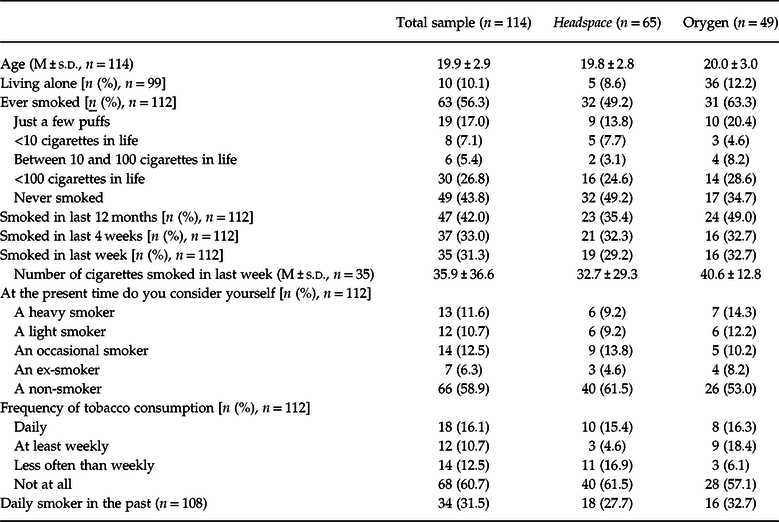
In total, 114 young people completed the survey, of which 57.0% (n = 65) were attending primary services, and 43.0% (n = 49) were attending specialist services. The average age of the sample was 19.9 (s.d. 2.9) with a minority (10.1%) living by themselves (Table 1).
Demographics and self-reported smoking

Smoking behaviours
A total of 56.3% (n = 63) of the young people reported ever smoking, with 17.0% (n = 19) smoking ‘just a few puffs’ and 26.8% (n = 30) reported smoking over 100 cigarettes in their lifetime. In the last 12 months, 42.0% reported smoking tobacco, with 28.6% of the sample reportedly smoking tobacco in the last 7 days. About 16.1% of young people reported being current daily smokers of tobacco, and 31.5% were previous daily smokers. There was no difference in the prevalence of past or current tobacco smoking in the sample of young people attending the primary care and specialist mental health services. These data are presented in Table 1.
Attitudes and behaviours towards quitting
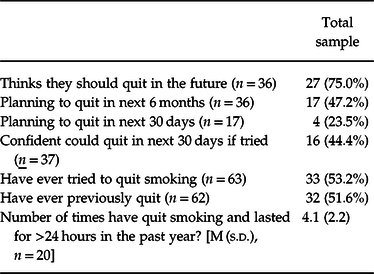
Of the current, regular smokers (n = 36), 75.0% thought they should quit in the future; however, only 23.5% reported planning to do so in the next 30 days, with 44.4% of those confident that they could successfully stop smoking. These data are presented in Table 2. Of the 63 participants who reported ‘ever smoking’, 53.2% (n = 33) reported that they had tried to quit, and 51.6% (n = 32) had previously quit. Of the 20 participants who responded to the question ‘how many times have you quit smoking and lasted for >24 hours in the past year’, the mean was 4.05 (s.d . = 2.24).
Attitudes and behaviours towards quitting

Knowledge about smoking and mental well-being
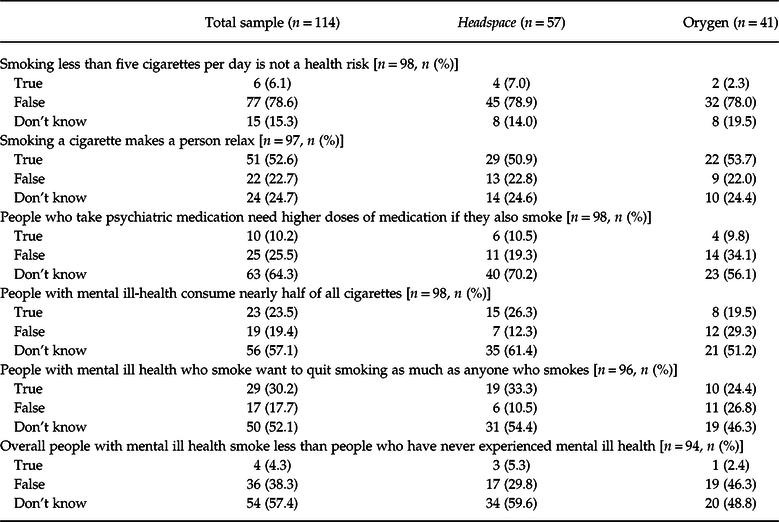
Current knowledge was addressed by asking participants whether they felt the statements presented in Table 3 were true or false, or whether they were unsure. Of the survey respondents, 78.6% were aware that smoking less than five cigarettes was a health risk, while only 22.7% correctly identified that smoking a cigarette did not make a person relax. Only 10.2% correctly identified that people who take particular psychiatric medication need higher doses of medication if they also smoke, and 23.5% correctly agreed that ‘people with mental ill-health consume nearly half of all cigarettes’. The statement ‘people with mental ill-health who smoke want to quit smoking as much as anyone who smokes’ was correctly endorsed by only 30.2%, while 38.3% correctly stated that following was false: ‘overall people with mental ill-health smoke less than people who have never experienced mental ill-health’. There were no significant differences between the responses of young people attending headspace (primary care) and those attending Orygen (specialist mental healthcare).
Knowledge of the interaction between tobacco smoking and health

Discussion
Comparison to previous literature
Rates of tobacco smoking in this sample of young people presenting for care for mental ill-health were 56.3% for those who had ever smoked, 42.0% who had smoked in the last 12 months and 28.6% who had smoked in the last week. These rates are higher than rates currently reported in Australian secondary school pupils, with latest data finding that by the age of 17, 12% of males and 9% of females had smoked in the past week (Guerin & White, Reference Guerin and White2018). This rate rises slightly for those aged 18–24 years, with 15% of males and 13% of females reporting smoking at least weekly (Australian Institute of Health and Welfare, 2017), but this is still markedly lower than rates endorsed by the young people in the current survey. Another important comparison is contrasting the rates found in this study to rates in adult populations with mental ill-health. The current rate of smoking in the last week (28.6%) was lower than that reported in the 2007 Australian National Survey of Mental Health and Wellbeing (Australian Bureau of Statistics, 2007; Slade et al. Reference Slade, Johnston, Oakley Browne, Andrews and Whiteford2009), where the past week smoking rate for individuals reporting ‘any mental disorder’ was 36% (Lawrence et al. Reference Lawrence, Mitrou and Zubrick2009). A total of 16.1% of the current sample reported smoking daily. This rate is lower than that reported by Hermens and colleagues (Reference Hermens, Scott, White, Lynch, Lagopoulos, Whitwell, Naismith and Hickie2013), who found that between 23% (12–17 year olds) and 34.6% (20–30 year olds) of young people with mental ill-health reported smoking ‘daily or almost daily’ but only between 4.2% (12–17 year olds) and 5.6% (20–30 year olds) reported smoking weekly. This suggests that smoking frequency may have reduced in youth with mental ill-health since the Hermens et al. study (Reference Hermens, Scott, White, Lynch, Lagopoulos, Whitwell, Naismith and Hickie2013), with more young people reportedly smoking weekly and fewer smoking daily.
While 75.0% of current smoking participants acknowledged a need to quit, only 23.5% had plans to quit in the next 30 days. This observation was similar to that in a sample of American 18–30 year smokers with schizophrenia (Brunette et al. Reference Brunette, Feiron, Aschbrenner, Colctti, Devitt, Greene, Harrington, MoHugo, Pratt and Robinson2017), which found that 23.3% of participants endorsed plans to quit in the next month. Older participants in that study (over 30 years) were not statistically more likely to report being ready to quit that month, suggesting that age may not substantially influence attitudes towards quitting in people with SMI. Motivation to quit smoking in adult smokers with mental health problems was previously explored by Siru and colleagues (Reference Siru, Hulse and Tait2009), who suggested that these individuals are as motivated to quit smoking as those who smoke in the general population. The authors concluded that this should be leveraged and smoking cessation promoted within the population, as it is within the general population. The current finding of our study that only 30.2% of respondents correctly identified that ‘people with mental ill-health who smoke want to quit smoking as much as anyone who smokes’ supports the need to challenge the commonly held false belief that people with mental ill-health are not motivated to quit tobacco smoking.
Notably, this study demonstrates that young people accessing mental health services, in general, have limited knowledge about smoking and mental ill-health. For instance, they do not appear to be aware of the high prevalence of smoking among people with mental ill-health, nor do they know that smoking does not make someone relaxed. These findings warrant further exploration to inform the development of smoking cessation and prevention campaigns targeting young people with mental ill-health, and the health professionals working with them. Countering low levels of knowledge of harms and misconceptions of benefit may be particularly pertinent given evidence that people with psychotic disorders have historically been the target of tobacco industry marketing that promoted smoking as beneficial self-medication while normalising the behaviour among clinicians (Prochaska et al. Reference Prochaska, Hall and Bero2007). Messages about the effect of smoking on mental health and well-being may also be salient for young people without mental ill-health, but this would require additional testing.
Clinical implications
This study has a number of important findings that may assist mental health services in addressing tobacco smoking in young people. First, the proportion of young people who were smokers of tobacco did not differ between those accessing primary- or specialist-based services. This suggests that at this stage of adolescence/emerging adulthood, smoking behaviours potentially do not vary with the severity of illness, at least on the domains examined in this survey. Second, despite the majority endorsing a need to quit, only a small proportion of those young people who smoked planned to do so within an immediate time frame of 28 days.
Furthermore, respondents were generally not confident in their ability to quit. This emphasises the need to use techniques, such as motivational interviewing, to assist young people with mental ill-health to consider and to change their smoking behaviours (Mendelsohn et al. Reference Mendelsohn, Kirby and Castle2015). Third, findings from the knowledge of smoking and mental well-being questions highlight that the majority of young people who smoke cigarettes experiencing mental health problems lack awareness of issues specifically relating to them that could potentially be used as motivators for change. Critically, these inaccurate beliefs about smoking are often held by clinicians as well (Mendelsohn & Montebello, Reference Mendelsohn and Montebello2013; Ratschen et al. Reference Ratschen, Britton, Doody, Leonardi-Bee and McNeill2009). Psycho-education about tobacco and mental health should be incorporated into standard youth mental healthcare, as well as ensuring that all clinicians working with those with mental ill-health are aware of these myths and misconceptions, and are equipped with the tools needed to encourage young people to quit smoking.
Interventions for tobacco smoking
Adults with mental ill-health
The evidence base for interventions to help support adults with mental ill-health to quit tobacco smoking is growing. Pharmacotherapies such as varenicline and bupropion have been found to be safe for use in individuals with mental illnesses, with varenicline more effective than placebo, nicotine patches (i.e. NRT) and bupropion in helping adult smokers with mental ill-health to achieve abstinence (Anthenelli et al. Reference Anthenelli, Benowitz, West, St Aubin, McRae, Lawrence, Ascher, Russ, Krishen and Evins2016). These prescriptions were recommended for use alongside cessation counselling sessions, which focus on elements such as tobacco use education, behavioural skills for quitting smoking and setting a quit date. These sessions can be provided either by specialist smoking cessation services (e.g. Quitline in Australia, Stop Smoking Services in the UK and HSE Quit clinics in Ireland) or by appropriately trained mental health clinicians (Mendelsohn et al. Reference Mendelsohn, Kirby and Castle2015). While safe to offer, provision of pharmacological treatments for smoking cessation to people with severe mental illness is still often neglected by clinical services and quit rates remain low, perhaps because of myths surrounding smoking in this population, such as smoking helping manage the side effects of antipsychotic medications (Mendelsohn & Montebello, Reference Mendelsohn and Montebello2013). Lifestyle interventions, combined with telephone support, have shown efficacious in significantly reducing the number of cigarettes smoked at 36 months among people with mental ill-health, but not in promoting ongoing abstinence (Baker et al. Reference Baker, Kay-Lambkin, Richmond, Filia, Castle, Williams and Lewin2011, Reference Baker, Richmond, Kay-Lambkin, Filia, Castle, Williams, Lewin, Clark, Callister and Palazzi2018). In a similar UK-based trial, a bespoke smoking cessation intervention consisting of behavioural support from a mental health smoking cessation practitioner and pharmacological aids for smoking cessation was successful at increasing the incidence of quitting at 6 months, but the effect waned by 12 months, suggesting that alternative approaches are needed to promote sustained abstinence (Gilbody et al. Reference Gilbody, Peckham, Bailey, Arundel, Heron and Crosland2019). Notably, few participants in this trial were prescribed the most effective form of pharmacotherapy, varenicline, despite this medication having now been shown to be safe and efficacious in this population. This again highlights the need for education around smoking and mental illness for service providers.
Young people
In young people, a 2017 Cochrane systematic review of smoking cessation studies specifically targeting young people aged under 20 years concluded that there remains limited evidence that either behavioural support or smoking cessation medication increases the proportion of young people who stop smoking in the long‐term (Fanshawe et al. Reference Fanshawe, Halliwell, Lindson, Aveyard, Livingstone‐Banks and Hartmann‐Boyce2017). It found that group‐based behavioural interventions held the most promise, but evidence remains limited for all intervention types. The review concluded that there continues to be a need for well‐designed, adequately powered, randomised controlled trials of interventions for this population of smokers.
Young people with mental ill-health
To date, there have been limited interventions trialled for use with young people in the early stages of their mental illness. A trial of the effects of motivational interviewing on smoking cessation in 191 adolescents with psychiatric disorders in the USA found there to be no effect of the intervention on smoking outcomes (Brown et al. Reference Brown, Ramsey, Strong, Myers, Kahler, Lejuez, Niaura, Pallonen, Kazura and Goldstein2003). On the other hand, a recent trial in Australia (Curtis et al. Reference Curtis, Zhang, McGuigan, Pavel-Wood, Morell, Ward, Watkins and Lappin2018) piloted a 12-week tailored smoking cessation intervention program that included pharmacological treatment, motivational interviewing and behavioural change techniques, concluding that it was feasible, acceptable and effective to offer such treatments in youth mental health services. Further testing of this combination of interventions is urgently required. One further novel way of providing smoking cessation interventions to young people might be to utilise mental health peer workers to support referrals to a smoking cessation service-delivered intervention, as is currently being investigated in an adult population (Baker et al. Reference Baker, Borland, Bonevski, Segan, Turner, Brophy, McCarter, Kelly, Williams, Baird, Attia, Sweeney, White, Filia and Castle2019). Further research in the early intervention field is warranted and should become a priority to ensure smoking habits are addressed at this critical early stage. This is particularly important given emerging evidence shows that young adulthood represents a critical time to intervene to alter health trajectories (Spring et al. Reference Spring, Moller, Colangelo, Siddique, Roehrig, Daviglus, Polak, Reis, Sidney and Liu2014). It may also represent a time to provide salient messages about smoking and mental health to deter young people who do not smoke from taking it up.
Limitations
As a cross-sectional study of a self-selected sample, there are several limitations. First, it is unclear whether the findings from this study are generalisable beyond individuals who undertook this survey, as this might not have been a representative sample. For example, the study was conducted in a centre based in an area of high socio-economic deprivation where levels of tobacco smoking may be higher and willingness to quit lower than in other less deprived areas (Rejineveld, Reference Rejineveld1998; Giskes et al. Reference Giskes, van Lenthe, Turrell, Brug and Mackenbach2006). Second, there was a lack of a community sample comparison group with which to compare this sample. While the findings can be compared with national surveys, collecting data from a community sample of peers using the same methods would have allowed for more direct comparisons to be made. Third, self-reported rates of smoking are typically less reliable than data collected using objective measures such as a carbon monoxide breath test; however, use of biochemical verification of smoking status was beyond the scope of the present study. Fourth, following the advice of the youth stakeholder group, participants were not required to report either their gender or diagnosis, given that those currently seeking treatment might not have been given an official diagnosis. Finally, broader questions around ethnicity, socio-economic status, level of education and migration status were also not asked as this was designed to be a waiting room survey and participant burden needed to be limited to ensure completion.
Conclusions
This study found that young people affected by mental ill-health have a high prevalence of current smoking relative to population rates. Moreover, while the majority were aware of the harms associated with smoking tobacco, only a minority had immediate intentions to attempt to quit. Considering that individuals with enduring mental illness have a reduced life expectancy compared to the general population and that smoking is a strong contributor to this early mortality, novel interventions to support smoking cessation in this group are urgently needed.
Conflict of interest
The authors have no conflict of interest to declare.
Ethical standards
The authors assert that all procedures contributing to this work comply with the ethical standards of the relevant national and institutional committee on human experimentation with the Helsinki Declaration of 1975, as revised in 2008. The study received ethical approval from the Melbourne Health Human Ethics Research Committee (QA2017049).
Financial support
This research received partial funding from Quit Victoria, an independent, not-for-profit organisation based in Melbourne, Victoria, Australia.