Introduction
Evidence has accumulated over the past 15 years showing that exposure to childhood adversity (CA) – in the form of abuse, neglect and bullying – is associated with increased risk of psychosis across the spectrum, from low-level experiences to disorder (Varese et al., Reference Varese, Smeets, Drukker, Lieverse, Lataster, Viechtbauer and Bentall2012b). This has led to substantial research trying to understand possible underlying psychological and biological mechanisms, thus a systematic review in the topic is needed.
In terms of biological mechanisms, evidence covers dysfunction in pathways such as the stress response system (Ruby et al., Reference Ruby, Polito, McMahon, Gorovitz, Corcoran and Malaspina2014), dopaminergic neurotransmission (Howes, McCutcheon, Owen, & Murray, Reference Howes, McCutcheon, Owen and Murray2017), inflammation and redox dysregulation (Steullet et al., Reference Steullet, Cabungcal, Monin, Dwir, O'Donnell, Cuenod and Do2016), and changes in stress-related brain structures such as the amygdala or the hippocampus (Van Winkel, Van Nierop, Myin-Germeys, & Van Os, Reference Van Winkel, Van Nierop, Myin-Germeys and Van Os2013). For example, it has been suggested that excessive exposure to stress might lead to an overactivation of the hypothalamic–pituitary–adrenal axis. This could be toxic for hippocampal functioning (Aas et al., Reference Aas, Haukvik, Djurovic, Tesli, Athanasiu, Bjella and Melle2014; Teicher, Anderson, & Polcari, Reference Teicher, Anderson and Polcari2012), which might in turn contribute to the emergence of psychosis. Furthermore, acute social stress has also been found to increase striatal dopamine release in individuals with a psychotic disorder, and in individuals with CA (Howes et al., Reference Howes, McCutcheon, Owen and Murray2017). In addition, inflammatory dysfunctions as well as redox dysregulation conditions (Alameda et al., Reference Alameda, Fournier, Khadimallah, Griffa, Cleusix, Jenni and Do2018; Steullet et al., Reference Steullet, Cabungcal, Monin, Dwir, O'Donnell, Cuenod and Do2016) have been found among individuals exposed to CA and among patients with psychosis.
Several psychological models have also been proposed to explain the relationship between CA and psychosis. These models look at the same epiphenomena from different angles and can be complementary, thus they should not be considered necessarily as competing explanations. One theory postulates that CA may lead to psychosis through a pathway of heightened emotional distress, characterised by hypersensitivity to daily-life stressors, leading to anxiety and depression (Bebbington, Reference Bebbington2015; Myin-Germeys & van Os, Reference Myin-Germeys and van Os2007) and it is often called ‘affective pathway to psychosis’. Another model proposes that severe forms of CA might lead to cognitive biases, such as negative schema about the self and the world, and others (NS) which, in addition to a heightened tendency to attribute experiences to external causes, might give rise to paranoia, ideas of reference (Garety, Bebbington, Fowler, Freeman, & Kuipers, Reference Garety, Bebbington, Fowler, Freeman and Kuipers2007; Morrison, Frame, & Larkin, Reference Morrison, Frame and Larkin2003). Another putative pathway emphasises the mediating role of post-traumatic stress disorder (PTSD)-related symptoms, such as dissociation and intrusive memories (Hardy, Reference Hardy2017). It is suggested that flash-backs could be interpreted as being externally generated, leading to hallucinatory experiences and hampering reality testing (Allen, Coyne, & Console, Reference Allen, Coyne and Console1997; Morrison et al., Reference Morrison, Frame and Larkin2003). Other possible mediators have been proposed such as dysfunctional attachment (Gumley, Taylor, Schwannauer, & MacBeth, Reference Gumley, Taylor, Schwannauer and MacBeth2014; Read & Gumley, Reference Read, Gumley and Benamer2010).
Despite the fact that several narrative reviews on the topic exist (Bebbington, Reference Bebbington2015; Bentall et al., Reference Bentall, De Sousa, Varese, Wickham, Sitko, Haarmans and Read2014; Freeman & Garety, Reference Freeman and Garety2014; Gibson, Alloy, & Ellman, Reference Gibson, Alloy and Ellman2016; Misiak et al., Reference Misiak, Krefft, Bielawski, Moustafa, Sąsiadek and Frydecka2017; Morgan & Gayer-Anderson, Reference Morgan and Gayer-Anderson2016; Read, Fosse, Moskowitz, & Perry, Reference Read, Fosse, Moskowitz and Perry2014; Van Winkel et al., Reference Van Winkel, Van Nierop, Myin-Germeys and Van Os2013), to date only a single systematic review has been conducted (Williams, Bucci, Berry, & Varese, Reference Williams, Bucci, Berry and Varese2018). Williams et al. (Reference Williams, Bucci, Berry and Varese2018) examined psychological mediators between CA and psychosis including papers up to September 2017, which consisted of a total of 37 studies. They found evidence for a mediation by cognitive bias, by symptoms of PTSD, and by affective processes. However, this review is limited by the fact that (i) they did not analyse and discuss the evidence of all the mediation pathways tested within each study and limited to the summary of the main conclusions provided by each author; (ii) no information on the percentage of total effect mediated was systematically extracted and summarised; (iii) did not include biological mediators. The present study overcomes these limitations and includes additional papers published up to July 2019, providing an additional period of 22 months of research in the field.
Our aim is to systematically review the evidence on psychological and biological mediators between CA and psychosis across the spectrum from low-level experiences in general populations (GP) to disorder. Based on the concept of psychosis as a continuum (Van Os, Linscott, Myin-Germeys, Delespaul, & Krabbendam, Reference Van Os, Linscott, Myin-Germeys, Delespaul and Krabbendam2009), covering all the spectrum may allow a better understanding of the mediational processes operating at different stages. Results will be grouped based on existing proposed theoretical mechanisms and discussed in terms of potential treatment interventions.
Methods
Search strategy
A systematic review of the literature was conducted following Preferred Reporting Items for Systematic Reviews and Meta-Analyses (PRISMA) (Moher et al., Reference Moher, Liberati, Tetzlaff, Altman, Altman, Antes and Tugwell2009) guidelines and was registered in PROSPERO (Moher, Booth, & Stewart, Reference Moher, Booth and Stewart2014) in July 2018 (registration number: CRD42018100846). The main search was conducted on MEDLINE, EMBASE and PsycINFO, through Ovid provider, and in Cochrane Libraries in June 2018 and it was updated in July 2019. We searched Medical Subjects Headings (MeSH) and keywords related to: (1) CA, (2) mediation and (3) psychosis, using the Boolean operator ‘AND’ (full list of search terms as well as details on the screening procedure are provided in online Supplementary Material.
Inclusion and exclusion criteria
Included studies were those that (1) examined psychological or biological mediators of the relationship between CA and (i) psychosis onset (these include case-control studies), (ii) severity of positive symptoms in patients with a psychotic disorder, in subjects at risk for psychosis [as described by the Yung et al. (Reference Yung, Yung, Pan Yuen, Mcgorry, Phillips, Kelly and Buckby2005)] or (iii) severity of attenuated psychotic symptoms (these include also studies measuring psychosis proneness and psychotic-like experiences) in the GP; (2) for clinical studies only (not for GP), psychotic disorder was defined according to Diagnostic and Statistical Manual of Mental Disorders [DSM-III, DSM-III-R, DSM-IV, DSM IV-TR (American Psychiatric Association, 1994)], or International Classification of Diseases, Ninth or Ten Revision (ICD-9, ICD-10) (World Health Organization, 1992); and (3) were performed in humans; (4) included CA occurring before age 18 and involving exposure to sexual, physical and emotional abuse, physical and emotional neglect or bullying (or equivalent experiences); (5) assessed both mediators and outcomes using validated methods and scales; (6) employed a robust method for testing mediation in the analyses and fulfilling the Baron and Kenny criteria (Hayes, Reference Hayes2009); used pathways analyses or structural equation models; (7) had been published as original research.
Exclusion criteria were: (1) including more than 20% of participants aged 65 years or over, in accord with others (Van Os et al., Reference Van Os, Linscott, Myin-Germeys, Delespaul and Krabbendam2009); (2) being performed in homogeneous samples of specific populations (such as pregnant women or samples from forensic settings); (3) including non-psychological mediators (e.g. being exposed to later life hassles or level of education); (4) not being published in the English language.
Quality assessment and data extraction methodology
Quality assessment was carried out using the Newcastle–Ottawa Scale (Stang, Reference Stang2010) for cohort studies by two independent reviewers (LA and PM). Details on the instrument items and quality assessment procedures can be found in online Supplementary Material.
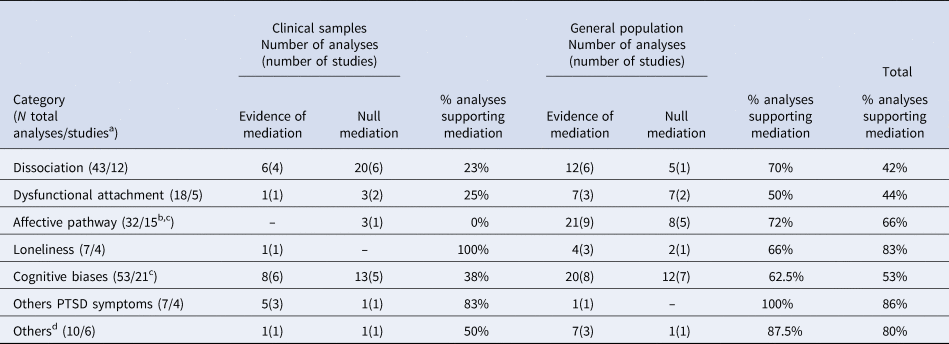
The agreed quality grades of each study are presented in online Supplementary Table S1a–S1c. To summarise the evidence, we constructed Tables 1–3 and online Supplementary Table S2. We enumerated the number of studies and analyses indicating whether there was evidence for mediation or lack of mediation in clinical samples and in GP studies.
Summary of evidence for mediators between adversity and psychosis in clinical samples (subjects at risk for psychosis and with psychotic disorder) and in general population
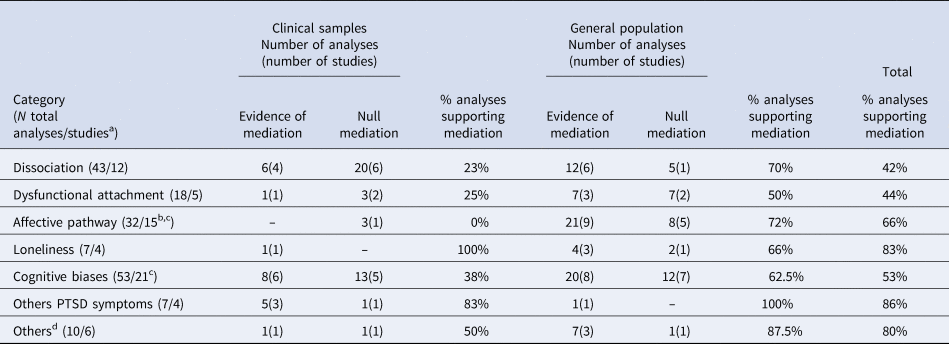
a We considered one analysis as ‘supportive of mediation’ when a significant mediation (partial, total or ‘suggested’) was found, and negative when null mediation was found.
b Isvoranu et al. was only included in the articles count within but not in the analyses count.
c Ashford et al. was only included in the articles count but not in the analyses count.
d Others included anomalous self-experiences; mania; time-perspective capabilities and compulsions as mediators.
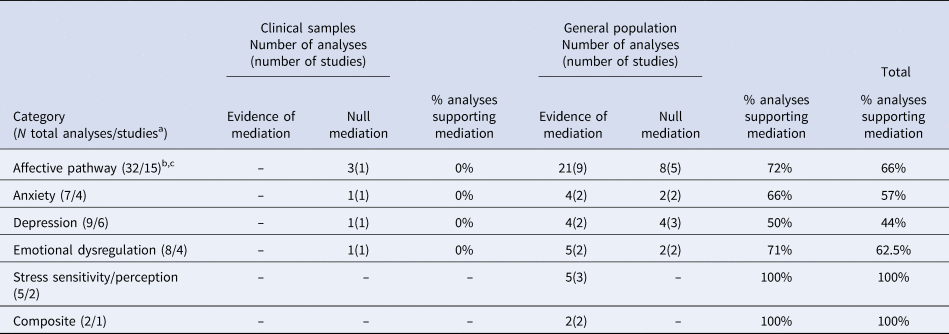
Summary of evidence for mediators within the affective pathway category between adversity and psychosis in clinical samples (subjects at risk for psychosis and with psychotic disorder) and in general population
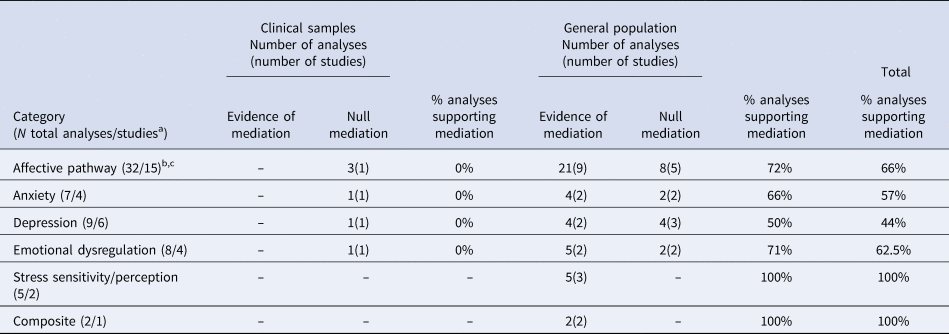
a We considered one analysis as ‘supportive of mediation’ when a significant mediation (partial, total or ‘suggested’) was found, and negative when null mediation was found.
b Isvoranu et al. was only included in the articles count within but not in the analyses count.
c Ashford et al. was only included in the articles count but not in the analyses count.
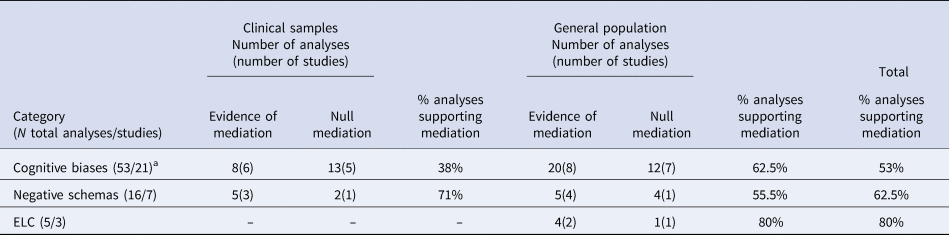
Summary of evidence for mediators within the cognitive biases category between adversity and psychosis in clinical samples (subjects at risk for psychosis and with psychotic disorder) and in general population
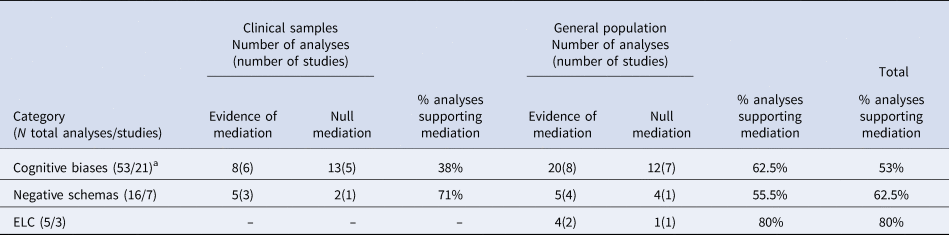
a We considered one analysis as ‘supportive of mediation’ when a significant mediation (partial, total or ‘suggested’) was found, and negative when null mediation was found.
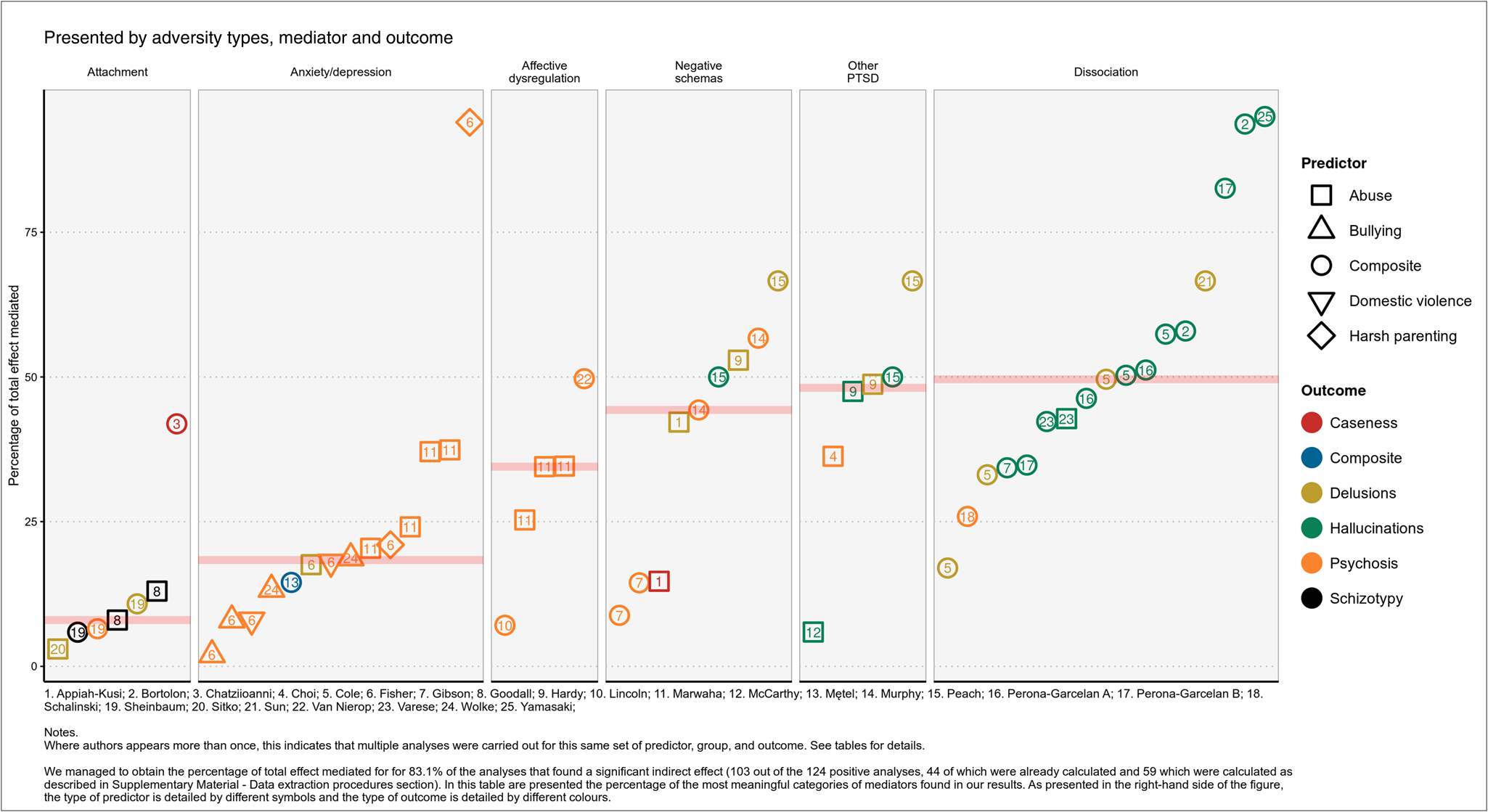
These results were extracted from the text or tables of each paper. We included all mediation analyses (i.e. distinct pathways tested) from each paper, meaning the total number of analyses was greater than the number of papers. In Tables 1–3 and online Supplementary Table S2, as well as in the text we provided the ‘percentage of analyses showing evidence of mediation’, across all categories of mediators (see online Supplementary Material for more details). We also collected information on the percentage of total effect that was mediated, which is equivalent to the amount of mediation in each pathway tested. Figure 1 represents the percentage of the total effect mediated by each analysis for which information was available across the most meaningful categories described in the Results section. The type of adversity and outcome are also shown to have a visual representation of the pathway. As an indicative measure, the median value of all the analyses per category is also highlighted in the figure and presented in the text.
Percentage of total effect mediated by each mediator. Presented by adversity types, mediator and outcome.

Further details on data extraction procedures can be found in online Supplementary Material and in Fig. 1 footnote. In online Supplementary Tables S1a–S1c, we also provide details on the significance of the indirect and direct effects as well as the proportion of total effect mediated in each study.
Results
We identified 48 studies that met our inclusion criteria from the 2310 studies found in the initial searches (2018 and 2019 combined) (online Supplementary Fig. S1).
Twenty-one studies were conducted in clinical samples [four in First Episode of Psychosis (FEP) or early psychosis patients (Evans, Reid, Preston, Palmier-Claus, & Sellwood, Reference Evans, Reid, Preston, Palmier-Claus and Sellwood2015; Morgan et al., Reference Morgan, Reininghaus, Fearon, Hutchinson, Morgan, Dazzan and Craig2014; Peach, Alvarez-Jimenez, Cropper, Sun, & Bendall, Reference Peach, Alvarez-Jimenez, Cropper, Sun and Bendall2019; Sun et al., Reference Sun, Alvarez-Jimenez, Simpson, Lawrence, Peach and Bendall2018), three in Ultra High Risk (UHR) patients (Appiah-Kusi et al., Reference Appiah-Kusi, Fisher, Petros, Wilson, Mondelli, Garety and Bhattacharyya2017; McDonnell, Stahl, Day, McGuire, & Valmaggia, Reference McDonnell, Stahl, Day, McGuire and Valmaggia2018; Thompson et al., Reference Thompson, Marwaha, Nelson, Wood, McGorry, Yung and Lin2016), 14 in non-FEP patients (Cancel et al., Reference Cancel, Comte, Truillet, Boukezzi, Rousseau, Zendjidjian and Fakra2015; Chatziioannidis et al., Reference Chatziioannidis, Andreou, Agorastos, Kaprinis, Malliaris, Garyfallos and Bozikas2019; Choi et al., Reference Choi, Choi, Kim, Lee, Gim and Park2015; Hardy et al., Reference Hardy, Emsley, Freeman, Bebbington, Garety, Kuipers and Fowler2016; Isvoranu et al., Reference Isvoranu, Van Borkulo, Lou, Wigman, Vinkers, Borsboom and Myin-Germeys2017; Perona-Garcelán et al., Reference Perona-Garcelán, Carrascoso- López, García-Montes, Ductor-Recuerda, López Jiménez, Vallina-Fernández and Gómez-Gómez2012; Quidé, O'Reilly, Watkeys, Carr, & Green, Reference Quidé, O'Reilly, Watkeys, Carr and Green2018; Schalinski et al., Reference Schalinski, Breinlinger, Hirt, Teicher, Odenwald and Rockstroh2019; Steenkamp, Weijers, Gerrmann, Eurelings-Bontekoe, & Selten, Reference Steenkamp, Weijers, Gerrmann, Eurelings-Bontekoe and Selten2019; Styła, Stolarski, & Szymanowska, Reference Styła, Stolarski and Szymanowska2019; Van Dam, Korver-Nieberg, Velthorst, Meijer, & de Haan, Reference Van Dam, Korver-Nieberg, Velthorst, Meijer and de Haan2014; Varese, Barkus, & Bentall, Reference Varese, Barkus and Bentall2012a; Weijers et al., Reference Weijers, Fonagy, Eurelings-Bontekoe, Termorshuizen, Viechtbauer and Selten2018; Wickham & Bentall, Reference Wickham and Bentall2016) 27 in GP (Ashford, Ashcroft, & Maguire, Reference Ashford, Ashcroft and Maguire2012; Bortolon & Raffard, Reference Bortolon and Raffard2018; Bortolon, Seillé, & Raffard, Reference Bortolon, Seillé and Raffard2017; Boyda & McFeeters, Reference Boyda and McFeeters2015; Boyda, McFeeters, Dhingra, & Rhoden, Reference Boyda, McFeeters, Dhingra and Rhoden2018; Cole, Newman-Taylor, & Kennedy, Reference Cole, Newman-Taylor and Kennedy2016; Fisher, Appiah-Kusi, & Grant, Reference Fisher, Appiah-Kusi and Grant2012, Reference Fisher, Schreier, Zammit, Maughan, Munafò, Lewis and Wolke2013; Gawęda, Göritz, & Moritz, Reference Gawęda, Göritz and Moritz2019; Gibson, Reeves, Cooper, Olino, & Ellman, Reference Gibson, Reeves, Cooper, Olino and Ellman2019; Goodall, Rush, Grünwald, Darling, & Tiliopoulos, Reference Goodall, Rush, Grünwald, Darling and Tiliopoulos2015; Jaya, Ascone, & Lincoln, Reference Jaya, Ascone and Lincoln2017; Lincoln, Marin, & Jaya, Reference Lincoln, Marin and Jaya2017; Marwaha & Bebbington, Reference Marwaha and Bebbington2015; Marwaha, Broome, Bebbington, Kuipers, & Freeman, Reference Marwaha, Broome, Bebbington, Kuipers and Freeman2014; McCarthy-Jones, Reference McCarthy-Jones2018; Mętel et al., Reference Mętel, Arciszewska, Daren, Pionke, Cechnicki, Frydecka and Gawęda2020; Murphy, Murphy, & Shevlin, Reference Murphy, Murphy and Shevlin2015; Perona-Garcelán et al., Reference Perona-Garcelán, García-Montes, Rodríguez-Testal, López-Jiménez, Ruiz-Veguilla, Ductor-Recuerda and Pérez-Álvarez2014; Pinto-Gouveia, Matos, Castilho, & Xavier, Reference Pinto-Gouveia, Matos, Castilho and Xavier2014; Rössler, Ajdacic-Gross, Rodgers, Haker, & Müller, Reference Rössler, Ajdacic-Gross, Rodgers, Haker and Müller2016; Sheinbaum, Kwapil, & Barrantes-Vidal, Reference Sheinbaum, Kwapil and Barrantes-Vidal2014; Shevlin, McElroy, & Murphy, Reference Shevlin, McElroy and Murphy2015; Sitko, Bentall, Shevlin, O'Sullivan, & Sellwood, Reference Sitko, Bentall, Shevlin, O'Sullivan and Sellwood2014; van Nierop et al., Reference van Nierop, van Os, Gunther, van Zelst, de Graaf, ten Have and Van Winkel2014; Wolke, Lereya, Fisher, Lewis, & Zammit, Reference Wolke, Lereya, Fisher, Lewis and Zammit2014; Yamasaki et al., Reference Yamasaki, Ando, Koike, Usami, Endo, French and Nishida2016)]. Our review included 82 352 subjects from the GP and 3189 subjects from clinical studies. Participant ages ranged from 18.5 to 44.6 years old in clinical samples (30.4 on average) and between 9.8 and 51.7 in the GP (34.3 on average). In clinical samples, 35% of the participants were women, compared with 37% of the volunteers.
This total number of analyses excludes two studies with an extremely high number of analyses [one used a network-based approach exploring multiple connections between adversity and symptoms (Isvoranu et al., Reference Isvoranu, Van Borkulo, Lou, Wigman, Vinkers, Borsboom and Myin-Germeys2017), the other included up to 28 (Ashford et al., Reference Ashford, Ashcroft and Maguire2012)]. These studies would have distorted the numerical summaries and therefore are described narratively but are not considered in the summary tables. Overall, 170 analyses were included in this review (ranging between 1 and 12 analysis per paper).
The quality check agreement between the two raters was 81.8%. Overall, the quality was graded as ‘fair’ (between 4 and 7) for all studies except one, where quality was judged as ‘good’ (Fisher et al., Reference Fisher, Schreier, Zammit, Maughan, Munafò, Lewis and Wolke2013). Studies of biological mediators tended to be graded with lower scores failing to provide estimates of the indirect effects, relying on small samples, and/or cross-sectional data (Cancel et al., Reference Cancel, Comte, Truillet, Boukezzi, Rousseau, Zendjidjian and Fakra2015; Quidé et al., Reference Quidé, O'Reilly, Watkeys, Carr and Green2018). Overall, only 4/47 studies (Fisher et al., Reference Fisher, Schreier, Zammit, Maughan, Munafò, Lewis and Wolke2013; Lincoln et al., Reference Lincoln, Marin and Jaya2017; Thompson et al., Reference Thompson, Marwaha, Nelson, Wood, McGorry, Yung and Lin2016; Wolke et al., Reference Wolke, Lereya, Fisher, Lewis and Zammit2014) used a prospective design. Eight (Ashford et al., Reference Ashford, Ashcroft and Maguire2012; Bortolon et al., Reference Bortolon, Seillé and Raffard2017; Boyda et al., Reference Boyda, McFeeters, Dhingra and Rhoden2018; Boyda & McFeeters, Reference Boyda and McFeeters2015; Cancel et al., Reference Cancel, Comte, Truillet, Boukezzi, Rousseau, Zendjidjian and Fakra2015; Isvoranu et al., Reference Isvoranu, Van Borkulo, Lou, Wigman, Vinkers, Borsboom and Myin-Germeys2017; Jaya et al., Reference Jaya, Ascone and Lincoln2017; Marwaha et al., Reference Marwaha, Broome, Bebbington, Kuipers and Freeman2014) of the 47 studies reported a mediating effect but failed to provide estimates of the indirect and direct effects and thus were classified as ‘suggested mediation’, as described above and in online Supplementary. Table 1 summarises the evidence for each analysis by mediator category. Given the high number of analyses and the heterogeneity found for the affective pathway, cognitive schema pathway and dissociation, three detailed tables were constructed for these groups (see Tables 2 and 3 and online Supplementary Table S2, respectively) presenting the evidence for each subcategory.
Figure 1 summarises the percentage of total effect mediated for 58 analyses included in 25 papers across the most relevant category of mediators found in our review (only categories being explored in at least three papers are shown in Fig. 1, the percentage of total effect mediated of the remaining analyses is shown in online Supplementary Tables S1a–S1c).
The most relevant categories of mediators found in our review were: dissociation, dysfunctional attachment, affective pathway to psychosis, loneliness, cognitive biases, other PTSD symptoms, other psychological mediators and biological mediators.
Dissociation
Despite only 42% of analyses showing evidence of mediation, 10/12 studies (Bortolon et al., Reference Bortolon, Seillé and Raffard2017; Bortolon & Raffard, Reference Bortolon and Raffard2018; Cole et al., Reference Cole, Newman-Taylor and Kennedy2016; Gibson et al., Reference Gibson, Reeves, Cooper, Olino and Ellman2019; Perona-Garcelán et al., Reference Perona-Garcelán, Carrascoso- López, García-Montes, Ductor-Recuerda, López Jiménez, Vallina-Fernández and Gómez-Gómez2012, Reference Perona-Garcelán, García-Montes, Rodríguez-Testal, López-Jiménez, Ruiz-Veguilla, Ductor-Recuerda and Pérez-Álvarez2014; Schalinski et al., Reference Schalinski, Breinlinger, Hirt, Teicher, Odenwald and Rockstroh2019; Sun et al., Reference Sun, Alvarez-Jimenez, Simpson, Lawrence, Peach and Bendall2018; Varese et al., Reference Varese, Barkus and Bentall2012a; Yamasaki et al., Reference Yamasaki, Ando, Koike, Usami, Endo, French and Nishida2016) were supportive of mediation, against 2/12 that were not (Evans et al., Reference Evans, Reid, Preston, Palmier-Claus and Sellwood2015; Thompson et al., Reference Thompson, Sullivan, Lewis, Zammit, Heron, Horwood and Harrison2011). The percentage of total effect mediated was consistently high across analyses within this category, with a median of around 50% of total effect explained (Fig. 1). As illustrated in Fig. 1, most of the studies showing evidence of mediating effects used hallucinations as an outcome and explored trauma as a composite score (Bortolon et al., Reference Bortolon, Seillé and Raffard2017; Cole et al., Reference Cole, Newman-Taylor and Kennedy2016; Gibson et al., Reference Gibson, Reeves, Cooper, Olino and Ellman2019; Perona-Garcelán et al., Reference Perona-Garcelán, Carrascoso- López, García-Montes, Ductor-Recuerda, López Jiménez, Vallina-Fernández and Gómez-Gómez2012, Reference Perona-Garcelán, García-Montes, Rodríguez-Testal, López-Jiménez, Ruiz-Veguilla, Ductor-Recuerda and Pérez-Álvarez2014; Varese et al., Reference Varese, Barkus and Bentall2012a; Yamasaki et al., Reference Yamasaki, Ando, Koike, Usami, Endo, French and Nishida2016), while only two (Cole et al., Reference Cole, Newman-Taylor and Kennedy2016; Sun et al., Reference Sun, Alvarez-Jimenez, Simpson, Lawrence, Peach and Bendall2018) studies found positive effects with delusions as an outcome . As shown in online Supplementary Table S2, it was not possible to draw conclusions about which dissociative symptoms were more likely to mediate the adversity–psychosis association.
Dysfunctional attachment
Despite overall 44% of analyses showing evidence of mediation, 3/5 (Chatziioannidis et al., Reference Chatziioannidis, Andreou, Agorastos, Kaprinis, Malliaris, Garyfallos and Bozikas2019; Sheinbaum et al., Reference Sheinbaum, Kwapil and Barrantes-Vidal2014; Sitko et al., Reference Sitko, Bentall, Shevlin, O'Sullivan and Sellwood2014) papers showed mixed findings, 1/5 (Van Dam et al., Reference Van Dam, Korver-Nieberg, Velthorst, Meijer and de Haan2014) showed no evidence of mediation and just 1/5 (Goodall et al., Reference Goodall, Rush, Grünwald, Darling and Tiliopoulos2015) showed consistent evidence of mediation across all its analyses. As seen in Fig. 1, the percentages of total effect mediated showed a small median value of around 12%.
Affective pathway
Only one paper explored this pathway in clinical samples (Thompson et al., Reference Thompson, Marwaha, Nelson, Wood, McGorry, Yung and Lin2016) showing no evidence of mediation. The remaining 14 (Ashford et al., Reference Ashford, Ashcroft and Maguire2012; Fisher et al., Reference Fisher, Appiah-Kusi and Grant2012, Reference Fisher, Schreier, Zammit, Maughan, Munafò, Lewis and Wolke2013; Gibson et al., Reference Gibson, Reeves, Cooper, Olino and Ellman2019; Isvoranu et al., Reference Isvoranu, Van Borkulo, Lou, Wigman, Vinkers, Borsboom and Myin-Germeys2017; Lincoln et al., Reference Lincoln, Marin and Jaya2017; Marwaha et al., Reference Marwaha, Broome, Bebbington, Kuipers and Freeman2014; Marwaha & Bebbington, Reference Marwaha and Bebbington2015; McCarthy-Jones, Reference McCarthy-Jones2018; Mętel et al., Reference Mętel, Arciszewska, Daren, Pionke, Cechnicki, Frydecka and Gawęda2020; Rössler et al., Reference Rössler, Ajdacic-Gross, Rodgers, Haker and Müller2016; van Nierop et al., Reference van Nierop, van Os, Gunther, van Zelst, de Graaf, ten Have and Van Winkel2014; Wolke et al., Reference Wolke, Lereya, Fisher, Lewis and Zammit2014; Yamasaki et al., Reference Yamasaki, Ando, Koike, Usami, Endo, French and Nishida2016) papers (including 29 analyses) were conducted in GP samples, with 66% of analyses supporting mediation. In total, 12/14 (Ashford et al., Reference Ashford, Ashcroft and Maguire2012; Fisher et al., Reference Fisher, Appiah-Kusi and Grant2012, Reference Fisher, Schreier, Zammit, Maughan, Munafò, Lewis and Wolke2013; Gibson et al., Reference Gibson, Reeves, Cooper, Olino and Ellman2019; Isvoranu et al., Reference Isvoranu, Van Borkulo, Lou, Wigman, Vinkers, Borsboom and Myin-Germeys2017; Lincoln et al., Reference Lincoln, Marin and Jaya2017; Marwaha et al., Reference Marwaha, Broome, Bebbington, Kuipers and Freeman2014; Marwaha & Bebbington, Reference Marwaha and Bebbington2015; Mętel et al., Reference Mętel, Arciszewska, Daren, Pionke, Cechnicki, Frydecka and Gawęda2020; Rössler et al., Reference Rössler, Ajdacic-Gross, Rodgers, Haker and Müller2016; van Nierop et al., Reference van Nierop, van Os, Gunther, van Zelst, de Graaf, ten Have and Van Winkel2014; Wolke et al., Reference Wolke, Lereya, Fisher, Lewis and Zammit2014) of the GP studies found evidence of mediation and three of them were prospectively graded high in quality assessment (Fisher et al., Reference Fisher, Schreier, Zammit, Maughan, Munafò, Lewis and Wolke2013; Lincoln et al., Reference Lincoln, Marin and Jaya2017; Wolke et al., Reference Wolke, Lereya, Fisher, Lewis and Zammit2014) (online Supplementary Table S1b).
We divided the affective pathway into these subcategories: anxiety, depression, affective dysregulation and stress sensitivity (Table 2), results per subcategories showed an overall high proportion of analyses supporting mediation (Table 2). As seen in Fig. 1, the median percentages of total effect mediated for anxiety and depression were at around 20% while that of affective dysregulation was at around 35%.
Feeling of loneliness
In total, 83% of analyses showed evidence of mediation. Only one study (Steenkamp et al., Reference Steenkamp, Weijers, Gerrmann, Eurelings-Bontekoe and Selten2019) was conducted in clinical samples and showed evidence for mediation. In GP, two studies showed evidence of mediation (Boyda & McFeeters, Reference Boyda and McFeeters2015; Jaya et al., Reference Jaya, Ascone and Lincoln2017) and another showed mixed findings (Shevlin et al., Reference Shevlin, McElroy and Murphy2015). The low number of analyses did not allow us to draw consistent conclusions in terms of specific pathways between adversity–psychosis (see online Supplementary Tables S1a, S1b for details).
Cognitive biases
In total, 53% of analyses overall showed evidence of mediation in this category. In terms of papers, 17/22 were supportive of mediation (Appiah-Kusi et al., Reference Appiah-Kusi, Fisher, Petros, Wilson, Mondelli, Garety and Bhattacharyya2017; Ashford et al., Reference Ashford, Ashcroft and Maguire2012; Bortolon et al., Reference Bortolon, Seillé and Raffard2017; Boyda et al., Reference Boyda, McFeeters, Dhingra and Rhoden2018; Evans et al., Reference Evans, Reid, Preston, Palmier-Claus and Sellwood2015; Fisher et al., Reference Fisher, Schreier, Zammit, Maughan, Munafò, Lewis and Wolke2013; Gawęda et al., Reference Gawęda, Göritz and Moritz2019; Gibson et al., Reference Gibson, Reeves, Cooper, Olino and Ellman2019; Hardy et al., Reference Hardy, Emsley, Freeman, Bebbington, Garety, Kuipers and Fowler2016; Jaya et al., Reference Jaya, Ascone and Lincoln2017; McDonnell et al., Reference McDonnell, Stahl, Day, McGuire and Valmaggia2018; Mętel et al., Reference Mętel, Arciszewska, Daren, Pionke, Cechnicki, Frydecka and Gawęda2020; Murphy et al., Reference Murphy, Murphy and Shevlin2015; Peach et al., Reference Peach, Alvarez-Jimenez, Cropper, Sun and Bendall2019; Pinto-Gouveia et al., Reference Pinto-Gouveia, Matos, Castilho and Xavier2014; van Nierop et al., Reference van Nierop, van Os, Gunther, van Zelst, de Graaf, ten Have and Van Winkel2014; Wickham & Bentall, Reference Wickham and Bentall2016), 5/20 were not (Fisher et al., Reference Fisher, Appiah-Kusi and Grant2012; Morgan et al., Reference Morgan, Reininghaus, Fearon, Hutchinson, Morgan, Dazzan and Craig2014; Perona-Garcelán et al., Reference Perona-Garcelán, García-Montes, Rodríguez-Testal, López-Jiménez, Ruiz-Veguilla, Ductor-Recuerda and Pérez-Álvarez2014; Weijers et al., Reference Weijers, Fonagy, Eurelings-Bontekoe, Termorshuizen, Viechtbauer and Selten2018; Yamasaki et al., Reference Yamasaki, Ando, Koike, Usami, Endo, French and Nishida2016). Results were more likely to show evidence of mediation when conducted in the GP, compared with clinical samples (62.5% v. 38% of analyses were supportive of mediation, respectively, Table 1).
In order to explore specific domains within the category, we divided this category into: negative schemas about self, others and the world (NS) and external locus of control (ELC) as they were the most represented subdomains. Briefly, the evidence for the former showed that 62.5% of analyses were supportive of mediation with a proportion of total effect mediated of around 47% of median value (Fig. 1). No studies in clinical samples explored the ELC and 2/3 studies in general GP showed evidence of mediation (Fisher et al., Reference Fisher, Schreier, Zammit, Maughan, Munafò, Lewis and Wolke2013; Gibson et al., Reference Gibson, Reeves, Cooper, Olino and Ellman2019). Other biases such as maladaptive schemas (Bortolon et al., Reference Bortolon, Seillé and Raffard2017; Boyda et al., Reference Boyda, McFeeters, Dhingra and Rhoden2018), low self-esteem (Fisher et al., Reference Fisher, Schreier, Zammit, Maughan, Munafò, Lewis and Wolke2013), aberrant salience (Gawęda et al., Reference Gawęda, Göritz and Moritz2019) were insufficient in numbers of studies to draw conclusions. No specific pathways could be highlighted between some types of adversities and outcomes.
Other PTSD symptoms, time perspective, mania, compulsions and psychological resilience
Other PTSD symptoms not described in the other categories included post-traumatic intrusions, avoidance and numbing, or a general measure of post-traumatic symptoms. Overall, the results suggested evidence of mediation (Choi et al., Reference Choi, Choi, Kim, Lee, Gim and Park2015; Hardy et al., Reference Hardy, Emsley, Freeman, Bebbington, Garety, Kuipers and Fowler2016; McCarthy-Jones, Reference McCarthy-Jones2018; Peach et al., Reference Peach, Alvarez-Jimenez, Cropper, Sun and Bendall2019). The percentage of total effect mediated was also high, with a median value just below 50% (see Fig. 1). Other mediators including five studies that did not fit into the aforementioned categories are presented in online Supplementary Table S1a, S1b and include time perspective (Styła et al., Reference Styła, Stolarski and Szymanowska2019), mania (Thompson et al., Reference Thompson, Marwaha, Nelson, Wood, McGorry, Yung and Lin2016), compulsions (McCarthy-Jones, Reference McCarthy-Jones2018), a measure of psychological resilience (Mętel et al., Reference Mętel, Arciszewska, Daren, Pionke, Cechnicki, Frydecka and Gawęda2020) and self-disturbances (Gawęda et al., Reference Gawęda, Göritz and Moritz2019). Particularly, strong mediating effects were found through anomalous self-experiences (Gawęda et al., Reference Gawęda, Göritz and Moritz2019).
Biological mediators
Surprisingly, only two studies examining biological mechanism as potential mediators between CA and psychosis were included (online Supplementary Table S1c). One found no evidence for a mediation of the inferior frontal gyrus activation between CA and positive symptoms (Quidé et al., Reference Quidé, O'Reilly, Watkeys, Carr and Green2018); another showed that the grey matter density in the dorsolateral prefrontal cortex was mediating the link between emotional neglect and disorganised symptoms in patients (Cancel et al., Reference Cancel, Comte, Truillet, Boukezzi, Rousseau, Zendjidjian and Fakra2015).
Discussion
From this systematic review of 47 papers, we found evidence of partial mediation between adversity and psychosis through various overlapping and not competing psychological mechanisms. The link between adversity and psychosis was particularly driven by NS, by dissociation and other PTSD symptoms. For GP samples there was good evidence for mediation through an affective pathway (affective dysregulation, anxiety and depression), but there were insufficient studies looking at this in individuals at risk for psychosis and in patients suffering from the disorder to allow conclusions to be drawn about its mediating role in clinical settings. We found no evidence supporting the mediating role of dysfunctional attachment styles in the GP; there were too few studies addressing this mediator in clinical samples to permit conclusions. Other mediators showing interesting findings included loneliness, stress sensitivity, anomalous self-disturbances and ELC, but generalisation of findings is limited due to the low number of studies. Contrary to our expectations, only two papers (Cancel et al., Reference Cancel, Comte, Truillet, Boukezzi, Rousseau, Zendjidjian and Fakra2015; Quidé et al., Reference Quidé, O'Reilly, Watkeys, Carr and Green2018) fulfilled our inclusion criteria examining biological mediators. There is evidence that potential biological mediators are associated with adversity and with psychosis, but very few considering mediation effects directly, using psychosis as an outcome in the pathway. So, the speculation on biological mediators is currently mostly conjecture showing an urgent need for more research in this field.
Strengths and limitations
The findings of this review should be interpreted in the context of various strengths and limitations. A major strength is the large scale of this review including 47 studies, 82 352 subjects from the GP and 3189 from clinical studies. This has allowed us to cover multiple mediator groups with a sufficient number of participants and show new pathways that did not appear in William et al., systematic review (Williams et al., Reference Williams, Bucci, Berry and Varese2018), such as the role of loneliness. Second, we have not limited our analysis to the description of the main finding of each study and to report whether the mediation was present or absent, but we have also examined the amount of mediation of each pathway by providing the percentage of total effect mediated (when this was possible). We believe this is an important point given that just limiting to the significance of the p value of the indirect effects is highly dependent on the sample size and thus totally limited. Calculating the proportion of the effect that is mediated provides a more accurate understanding of the mediational processes. Moreover, we believe that our concrete clinical implications (see below) may be useful and could contribute to a better knowledge of trauma-informed care in services treating individuals with psychosis.
Some limitations must be mentioned. First, only four studies used a prospective design to estimate the indirect effects, while in the remaining studies, it cannot be excluded that the mediator resulted as a consequence of psychosis. Second, CA was measured retrospectively in all studies except two (Fisher et al., Reference Fisher, Schreier, Zammit, Maughan, Munafò, Lewis and Wolke2013; Wolke et al., Reference Wolke, Lereya, Fisher, Lewis and Zammit2014) which were conducted in GP. In patients, this can constitute a risk of bias given the difficulties of patients to recall their experiences and to disclose these openly in assessment by research assistants. Third, the percentage of total effect could not be obtained nor calculated in 17% of the analyses that were supportive of mediation (authors did not provide details on the indirect, direct and total effects), thus our Fig. 1 is not totally representative of the total number of analyses included in this review. In addition, some mediators (i.e. attachment styles, anxiety and depression) were found to be highly explored in the GP but very little in clinical samples, which is an important limitation of current literature in the field and which limits the extent to which we can extrapolate our conclusions to clinical intervention in clinical settings. Furthermore, papers in this review considered that null mediation occurred when the indirect or mediating effects did not reach a significant p value of <0.05. Considering the p value to test the null hypothesis is limited by the fact that is highly dependent on the sample size. Thus, it is likely that in our review, studies conducted in small samples are underestimating potential mediating effects, and this should be taken into consideration when interpreting our conclusions. The age range of studies in the GP was quite wide (9.8–51.7 years), and thus the population included in these studies is quite heterogeneous as different confounding factors may operate at different ages; this should be considered as a limitation when interpreting our results. Furthermore, only three papers took into account different mediating effects based on the timing of adversity (McDonnell et al., Reference McDonnell, Stahl, Day, McGuire and Valmaggia2018; Schalinski et al., Reference Schalinski, Breinlinger, Hirt, Teicher, Odenwald and Rockstroh2019; Wolke et al., Reference Wolke, Lereya, Fisher, Lewis and Zammit2014) which is an important limitation of current research as different mediating mechanisms may operate differently based on the developmental period (McGrath et al., Reference McGrath, Saha, Lim, Aguilar-Gaxiola, Alonso, Andrade and Wojtyniak2017). Lastly, there was a time lag between the systematic literature search, in July 2019, and the submission date in February 2020, which means newer studies were not included in the current work.
Evidence for mediational pathways between childhood adversity and psychosis
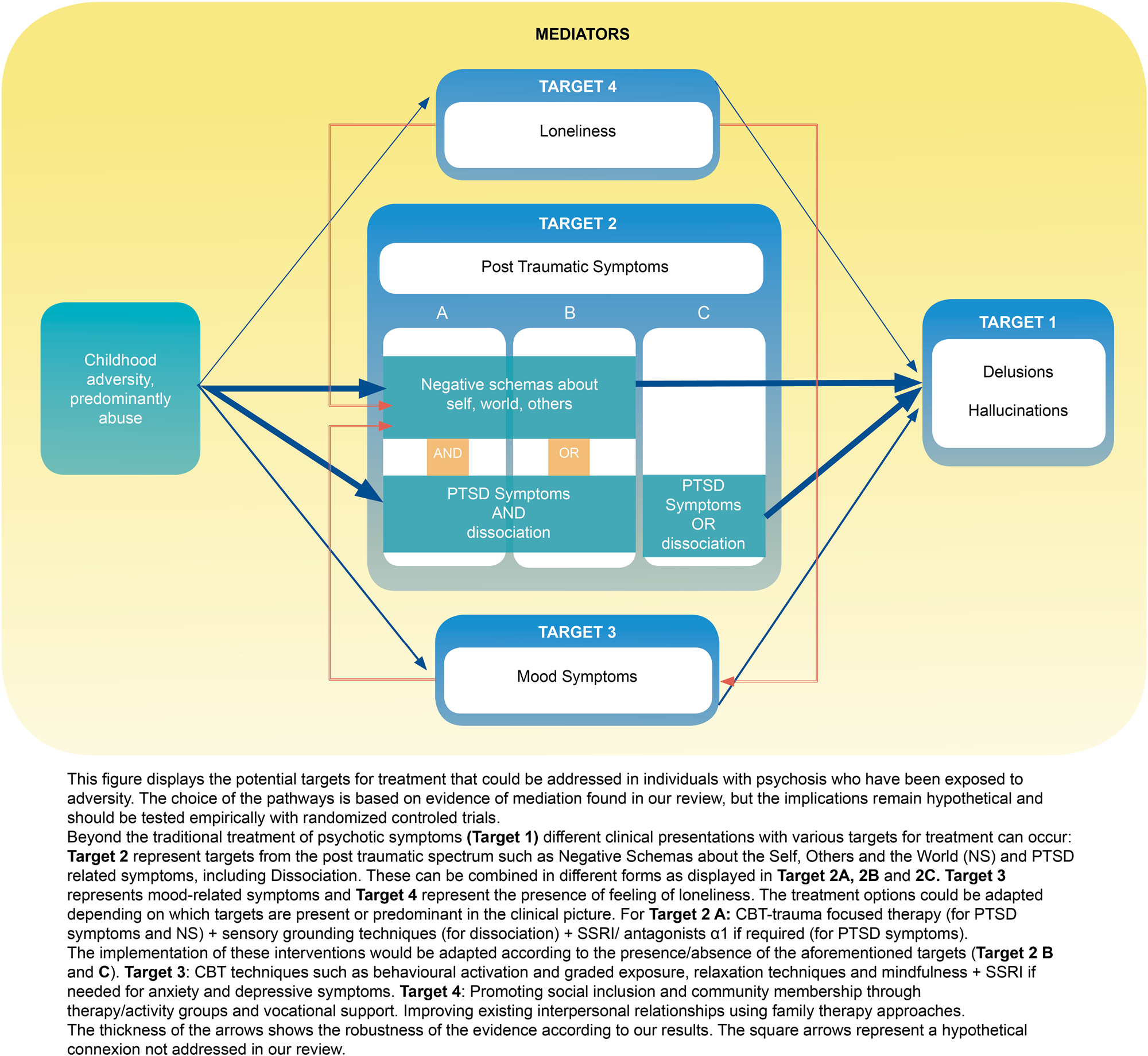
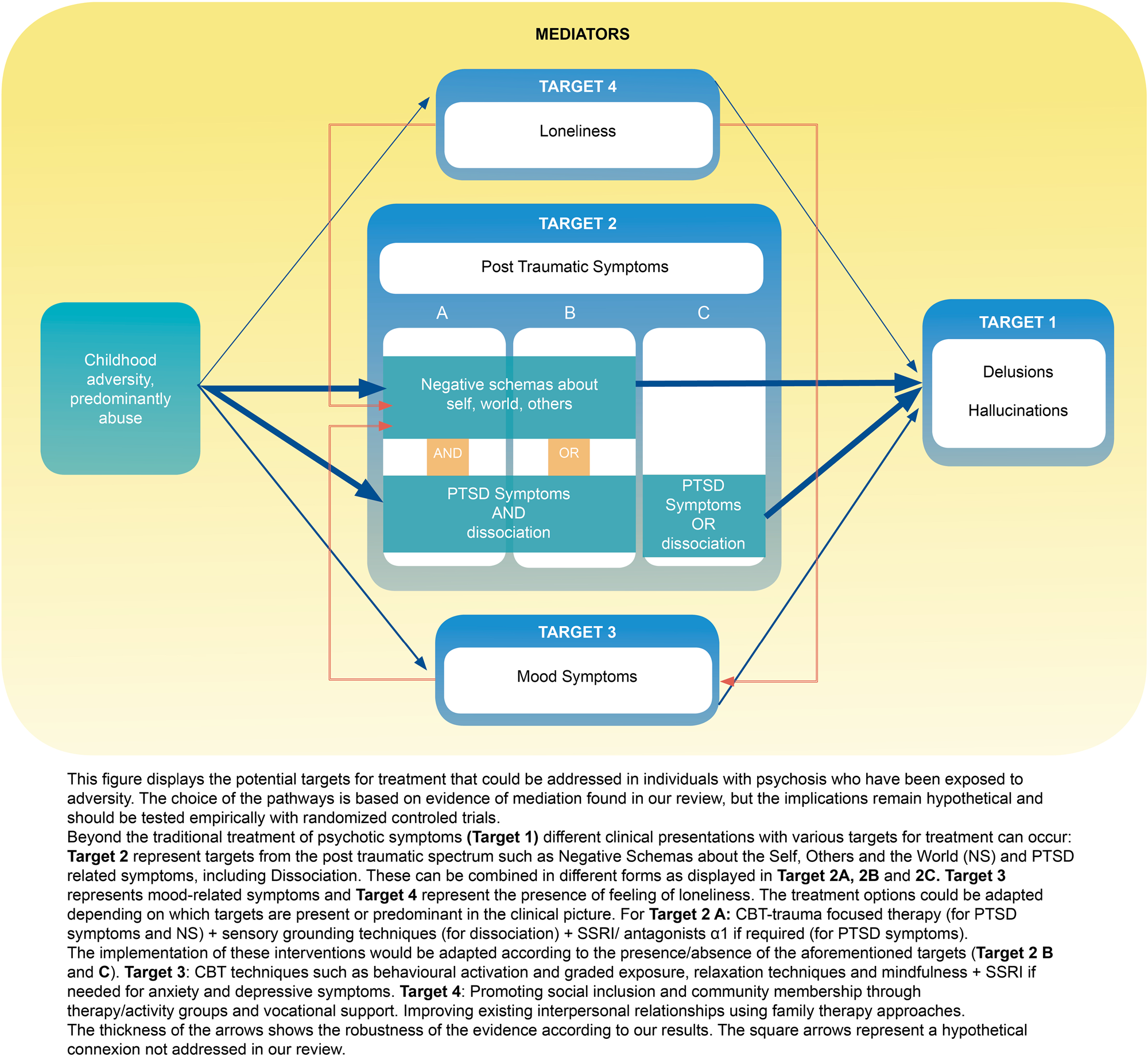
Here we will discuss each pathway separately, but as it will be further developed in the clinical implications (Fig. 2) and the conclusions, we believe that the mediating mechanism between CA and psychosis is complex, possibly involving an interplay between these different complementary, con-competing pathways.
Potential targets for treatment based on the evidence of mediational pathways between adversity and psychosis.
Pathway 1: dissociation and PTSD symptoms
Mediation through this pathway was more common when hallucinations were used as an outcome. These two categories, intimately related, showed the highest percentages of total effect mediated (Fig. 1).
The role of post-traumatic dissociation in psychosis was already the focus of research at the end of the eighteenth century, when Janet, among others, defined hysterical psychosis as characterised by its dissociative and stress-related nature (Moskowitz, Schäfer, & Dorahy, Reference Moskowitz, Schäfer and Dorahy2009). Current international classifications do not include dissociation among the diagnostic criteria for any form of psychosis. However, contemporary authors such as Ross (Reference Ross, Johannessen, Martindale and Cullberg2006) and Moskowitz et al. (Reference Moskowitz, Schäfer and Dorahy2009) suggest the existence of a dissociative type of psychosis that could potentially be responsive to psychotherapy focused on trauma.
Accordingly, our findings showing mediation by PTSD symptoms in clinical samples (Choi et al., Reference Choi, Choi, Kim, Lee, Gim and Park2015; Hardy et al., Reference Hardy, Emsley, Freeman, Bebbington, Garety, Kuipers and Fowler2016; Peach et al., Reference Peach, Alvarez-Jimenez, Cropper, Sun and Bendall2019) are consistent with reports suggesting that similar mechanisms could be involved in psychotic experiences and symptoms of PTSD. For instance, it has been suggested that some hallucinations represent a dissociated type of post-traumatic intrusion, which may not be recognised as such by people with psychosis (Allen et al., Reference Allen, Coyne and Console1997; Moskowitz et al., Reference Moskowitz, Schäfer and Dorahy2009). Our results therefore support the possibility of applying specific psychological interventions, such as cognitive behavioural therapy (CBT), for patients with psychosis, dissociation and PTSD symptoms and with a history of clear-cut traumatic episode. In this regard, two recent systematic reviews exploring the safety and efficacy of trauma-focused therapies in individuals with comorbid PTSD symptoms and psychosis have shown that trauma-focused CBT is safe (Sin & Spain, Reference Sin and Spain2017), can reduce PTSD symptoms (Swan, Keen, Reynolds, & Onwumere, Reference Swan, Keen, Reynolds and Onwumere2017) and can lead to small improvements in positive symptoms after treatment (Brand, McEnery, Rossell, Bendall, & Thomas, Reference Brand, McEnery, Rossell, Bendall and Thomas2018).
Pathway 2: cognitive biases
Cognitive schemas about the self, the world and others were the most consistent mediator between CA and psychosis in both clinical samples and GP. Moreover, this category contributed highly to the total effect between CA and psychosis, with a median percentage mediated of around 46% across all analyses (Fig. 1).
This evidence supports previous cognitive models of the development of positive symptoms (Garety, Kuipers, Fowler, Freeman, & Bebbington, Reference Garety, Kuipers, Fowler, Freeman and Bebbington2001; Morrison et al., Reference Morrison, Frame and Larkin2003) which suggest that exposure to severe trauma might contribute to the development of cognitive bias such as NS. Further exposure to stressors or to subtle perceptual abnormalities that are common in the GP (Van Os et al., Reference Van Os, Linscott, Myin-Germeys, Delespaul and Krabbendam2009), and even more common in genetically predisposed individuals, will lead to anomalous conscious self-experiences which will trigger the search for an explanation. The biased schemas, in combination with anomalous self-experience, disrupt the appraisal process leading to a misinterpretation of reality, and subsequently delusional ideas (Garety et al., Reference Garety, Kuipers, Fowler, Freeman and Bebbington2001; Howes & Murray, Reference Howes and Murray2014; Morrison et al., Reference Morrison, Frame and Larkin2003). Other factors are important in this process, such as the ELC (Thompson et al., Reference Thompson, Sullivan, Lewis, Zammit, Heron, Horwood and Harrison2011), which has shown evidence for mediation, especially in GP (Fisher et al., Reference Fisher, Schreier, Zammit, Maughan, Munafò, Lewis and Wolke2013; Gibson et al., Reference Gibson, Reeves, Cooper, Olino and Ellman2019). It would be interesting for future research to explore if other cognitive biases such as jumping to conclusions and meta-cognitive deficits can moderate or mediate the connections between CA and psychosis in combination with NS and ELC.
Pathway 3: affective pathway
We found consistent evidence suggesting that anxiety, depression and affective dysregulation might partially mediate the link between CA and low-level psychotic experiences in the GP. The affective component could be a mediational partner along with other mechanisms such as cognitive bias or PTSD-related symptoms. For example, Fisher et al. (Reference Fisher, Schreier, Zammit, Maughan, Munafò, Lewis and Wolke2013) report on a large prospective study, where 100% of the total effect was mediated only when anxiety and depression were added to the model in combination with cognitive bias and low self-esteem. Unfortunately, our interpretation is restricted to GP (and thus to attenuated positive symptoms) due to the lack of studies performed in clinical settings. Nevertheless, these results support previous claims that the association between CA and psychosis might be mediated by non-psychotic symptoms [otherwise the so-called ‘ancillary symptoms of psychosis’ (Bebbington, Reference Bebbington2015) such as anxiety and depression and affective dysregulation]. These symptoms might be determinants of paranoid thinking; for example, anxiety might lead to anticipation of threat, and low mood might drive negatively biased interpretations of ongoing experience and impact self-esteem and negative schemas about the self, which in turn are precursors of psychotic symptoms, as illustrated in Fig. 2.
Pathway 4: feeling of loneliness
Although only explored in four studies (Boyda & McFeeters, Reference Boyda and McFeeters2015; Jaya et al., Reference Jaya, Ascone and Lincoln2017; Shevlin et al., Reference Shevlin, McElroy and Murphy2015; Steenkamp et al., Reference Steenkamp, Weijers, Gerrmann, Eurelings-Bontekoe and Selten2019), we found good evidence suggesting that a feeling of loneliness might mediate the CA–psychosis relationship. We could hypothesise that social withdrawal and loneliness may increase an individual's sensitivity to potential stressors in daily life restrict access to balanced information from the environment, maintaining biased cognitive biases. This could, in turn, predispose an individual to lower mood and anxiety, which would constitute a favourable ground for the emergence of psychotic symptoms. Thus, the feeling of loneliness and isolation must be taken very seriously as it might operate as a potential condition allowing other mediators to operate.
Pathway 5: biological measures
Despite the high emphasis put on the search for biomarkers during the last 20 years of psychiatric research, we could identify just two eligible papers exploring biological mechanisms using psychosis as an outcome (Cancel et al., Reference Cancel, Comte, Truillet, Boukezzi, Rousseau, Zendjidjian and Fakra2015; Quidé et al., Reference Quidé, O'Reilly, Watkeys, Carr and Green2018). This highlights the limited evidence in this field and the need for future studies testing mediation in longitudinal samples.
Clinical implications for clinical settings
Our results provide evidence to support some potential treatment implications for traumatised individuals with psychosis, in addition to the treatment of positive symptoms, which often remain high in this vulnerable group (Ajnakina et al., Reference Ajnakina, Trotta, Oakley-Hannibal, Di Forti, Stilo, Kolliakou and Fisher2016; Alameda et al., Reference Alameda, Golay, Baumann, Ferrari, Do and Conus2016). Figure 2 displays a model with the different potential treatment targets derived from the pathways mentioned above. Beyond the traditional treatment of psychotic symptoms (Target 1 in Fig. 2), we propose targeting the relevant mediators found in our review, hypothesizing that an improvement in such targets would then have an indirect beneficial effect on positive symptoms.
A common clinical picture corresponds to a situation where a traumatised patient with psychosis suffers from NS and PTSD symptoms, including dissociation. If these are present (Target 2A in Fig. 2), a trauma-focused therapy, such as trauma-focused CBT could be appropriate, integrating treatment of negative schemas and traumatic intrusions, in addition to dissociative symptoms. Briefly, this could include grounding techniques, imaginal exposure, memory updating and cognitive restructuring, alongside more general CBT elements such as the use of behavioural experiments to gather new information about current safety (Hardy, Reference Hardy2017). In some cases, dissociative symptoms may be very disruptive and prevent access to the other targets; in this case, they can be prioritised and targeted using sensory grounding techniques to help the individual reliably regain contact with present external stimuli (Keen, Hunter, & Peters, Reference Keen, Hunter and Peters2017; Steel et al., Reference Steel, Hardy, Smith, Wykes, Rose, Enright and Mueser2017).
In addition to psychological interventions, some patients with highly distressing PTSD symptoms might respond to adjunctive pharmacological treatments such as selective serotonin reuptake inhibitors or other antidepressants blocking α1 adrenoceptors commonly used in patients with PTSD (Steckler & Risbrough, Reference Steckler and Risbrough2012). This integrated approach could be adapted depending on which mediators are present or predominant, as described in Fig. 2.
Anxiety and depressive symptoms could be, in isolation or in combination with other mediators (such as cognitive bias and post-traumatic symptoms), another target for treatment (Target 3, Fig. 2) that could indirectly ameliorate positive symptoms as suggested in previous reviews (Bebbington, Reference Bebbington2015). The use of antidepressants and CBT techniques such as behavioural activation and graded exposure (Waller et al., Reference Waller, Garety, Jolley, Fornells-Ambrojo, Kuipers, Onwumere and Craig2013), as well as relaxation techniques and mindfulness, could then be useful, targeting low mood and anxiety, respectively (Waller et al., Reference Waller, Garety, Jolley, Fornells-Ambrojo, Kuipers, Onwumere and Craig2013).
Lastly, it is important to highlight the possible role of loneliness as another mediator that could be targeted for treatment. Promoting social inclusion and community membership through group interventions and vocational support could be beneficial, as well as improving existing interpersonal relationships using family therapy approaches. Also, as previously mentioned, loneliness might co-occur with other mediators.
Our review indicates that routine assessment of trauma history should be necessary in clinical settings treating individuals with psychosis. Furthermore, given the possible importance of mediators, it is also important to carry out a careful assessment of the cognitive biases, PTSD, dissociative symptoms, anxiety, mood and feelings of loneliness.
Conclusions
Our review suggests that the association between adversity and psychosis is mediated by various overlapping non-competing mechanisms. Cognitive schemas about the self and the world and post-traumatic symptoms (particularly dissociation) seem to play an important role in the association, while other factors such as mood and feeling of loneliness seem to contribute partially to this link and interact mutually in contributing to the effect. Our findings support the routine assessment of experiences of CA in clinical settings, alongside with all the potential mediators. More evidence testing the efficacy of interventions targeting such mediators through cognitive behavioural approaches using trauma-focused therapy and/or pharmacological means is needed in future.
Supplementary material
The supplementary material for this article can be found at https://doi.org/10.1017/S0033291720002421.
Acknowledgements
We thank our funding bodies (Swiss National Science Foundation, the National Institute for Health Research, NARSAD, ESRC Centre for Society and Mental Health) for their support.
Financial support
This work was supported by the Swiss National Science Foundation (Grant P2LAP3_171804 to L.A.). This paper represents independent research part funded by the National Institute for Health Research (NIHR) Biomedical Research Centre at South London and Maudsley NHS Foundation Trust and King's College London, South-Eastern Norway Health Authority (#2017060) and the NARSAD Young Investigator Award to Monica Aas (#22388). This paper represents an independent research part supported by the ESRC Centre for Society and Mental Health at King's College London (ESRC Reference: ES/S012567/1). The views expressed are those of the author(s) and not necessarily those of the ESRC, the NIHR, the NHS, the Department of Health and Social Care or King's College London.
Conflict of interest
None.