INTRODUCTION
Marine macrophytes (seaweed and seagrass) are of vital importance in coastal marine ecosystems because besides being primary producers, they also transport various epiphytic organisms which contribute towards the increase in productivity of coastal zones in all oceans (Booth, Reference Booth1986).
Among the epiphytic organisms in macrophytes, the diatoms stand out because they are responsible for nearly 40% of primary production processed in coastal ecosystems, representing a much higher production speed than that found in the plants to which they are adhered (Moncreiff et al., Reference Moncreiff, Sullivan and Daehnick1992; Mann, Reference Mann1999).
By virtue of its ecological importance, the community of epiphytic diatoms has been studied in different macrophytes, such as seaweeds (Bergey et al., Reference Bergey, Boettiger and Resh1995; Ruesink, Reference Ruesink1998; Hernándes-Almeida & Siqueiros-Beltrones, Reference Hernándes-Almeida and Siqueiros-Beltrones2008), seagrass (Jewett-Smith, Reference Jewett-Smith1991; Frankovich et al., Reference Frankovich, Gaiser, Zieman and Wachnicka2006; Chung & Lee, Reference Chung and Lee2008) and mangrove (Wah & Wee, Reference Wah and Wee1988; Siqueiros-Beltrones & López-Fuerte, Reference Siqueiros-Beltrones and López-Fuerte2006; Chen et al., Reference Chen, Ya-Hui and Ling2010). However, most of these studies address the qualitative aspects of flora and highlight the great diversity of epiphytic diatoms, their variations among hosts and existing relations with environmental variables.
Despite the existence of a broad list of studies about epiphytic diatoms flora, the quantitative structure of their populations is still poorly characterized, hampering more in-depth knowledge about the function of this epiphytic community in productive marine cycles (Frankovich & Zieman, Reference Frankovich and Zieman1994).
The fault of quantitative studies resides in the difficulty in establishing a quantitative method for evaluating epiphytic diatoms in marine macrophytes. This difficulty is related to the texture and architectural complexity of macrophytes, as well as to the difficulty in removing epiphytes from their hosts due to the diverse forms of adherence (Tanaka, Reference Tanaka1986; Totti et al., Reference Totti, Poulin, Romagnoli, Perrone, Pennesi and De Stefano2009). Most of the methods used for removing epiphytic organisms are mechanical, underscoring the shaking of the host (Tanaka, Reference Tanaka1986), spraying with jets of water and brushing and sonication (Cattaneo & Kalff, Reference Cattaneo and Kalff1978), acid hydrolysis (Gough & Woelkerling, Reference Gough and Woelkerling1976) and fragmentation of hosts (Borum & Wium-Andersen, Reference Borum and Wium-Andersen1980).
In the case of epiphytic diatoms, cell removal using mechanical methods is not effective because many cells, characterized by their direct adherence to the host through valves, are very difficult to remove (Chung & Lee, Reference Chung and Lee2008).
One of the methods that address quantitative analyses of epiphytic diatoms was proposed by Tanaka (Reference Tanaka1986), who developed a methodology capable of evaluating the quantity of diatoms in diverse species of seaweeds through the quantification of cell per gram dry weight. This method enabled the total evaluation of populations, favouring a more precise characterization about the vertical distribution of epiphytic flora along the thallus, spatial and seasonal variations and a list of those environmental factors that act in the water column.
Thus, considering the lack of quantitative studies on epiphytic diatoms, this study aimed at describing the variations in density of epiphytic diatoms in the thallus in Galaxaura rugosa (J. Ellis and Solander) J.V. Lamouroux, collected at the Fernando de Noronha archipelago (north-eastern Brazil) as a means to contribute towards knowledge about this micro-vegetation's participation in the trophic chain of an insular ecosystem located in the Tropical Atlantic.
MATERIALS AND METHODS
Study area
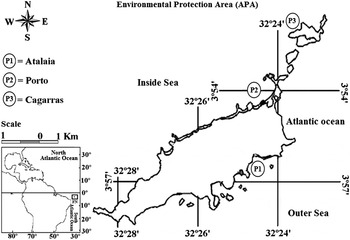
The Fernando de Noronha archipelago is of volcanic origin, located in the equatorial South Atlantic (3°51′03″–3°58′55″S 32°22′29″–32°29′40″W), 545 km from the city of Recife (north-eastern Brazil) (Figure 1). Since 1988, the archipelago has been politically tied to the State of Pernambuco, when the National Marine Park of Fernando de Noronha was created. It comprises a main island, measuring approximately 16.4 km2, which represents 91% of the archipelago's area, and it is surrounded by 20 islets. The climate is Alfred Wegener Institute tropical according to the Köppen system. The average annual temperature of the air is around 27°C, of the water 24°C, with a salinity of 36 and annual precipitation is about 1300 mm. There are two well-defined seasons during the year: rainy (February to July); and dry (August to January). Relative humidity ranges between 81% (dry) and 85% (rainy). Trade winds have direct impact on the south side of the archipelago facing the African continent. It is called the ‘outside sea’, characterized by rough waters all year long. The north side, facing the North Atlantic, more protected from winds and currents, is called the ‘inside sea’ (Villaça et al., Reference Villaça, Pedrini, Pereira, Figueiredo, Alves and Castro2006).
Location of points: P1, Atalaia; P2, Porto; a P3, Cagarras in the Fernando de Noronha archipelago (FN), Pernambuco, north-eastern Brazil (modified from Costa et al., Reference Costa, Eskinazi-Leça, Pereira and Bandeira-Pedrosa2009).

Data analysis
Samples of Galaxaura rugosa were collected during two campaigns (June 2006 and June 2007), in the intertidal zone and subtidal to the Fernando de Noronha archipelago in the following locations: Atalaia (Point 1, (P1)); Porto (Point 2, (P2)); and Cagarras (Point 3, (P3)), during the spring tides (Figure 1). On the Cagarras, only those samples collected in June 2006 were examined due to the lack of seaweed during the June 2007 collection period.
Galaxaura rugosa (J. Ellis and Solander) J.V. Lamouroux (Nemaliales: Rhodophyta) are a red, macroscopic seaweed with an erect, cylindrical thallus and a cell wall slightly impregnated with calcium carbonate. They have a rocky habitat, measuring 3 cm to 8 cm in height, with sub-dichotomous ramifications along the thallus (Littler & Littler, Reference Littler and Littler2000). They are covered by long, assimilating filaments arranged in defined whorls from the median portion to the apex. Their distribution stretches from the south-east coast to the north-east coast of Brazil, including the Fernando de Noronha archipelago.
Samples of G. rugosa were collected with the help of spatulas for removing the plants in their entirety. After the collection, the material was fixed in a formaldehyde solution at 4%, neutralized with borax at 1%. Samples of G. rugosa were randomly selected from each collection. They were divided into three symmetrically equal portions (apical, middle and basal). The fragments were dried on absorbent paper, weighed on an analytic scale and submitted to direct oxidation with sodium hypochlorite at 1% for 24 hours to remove diatoms from the host. The oxidized material underwent successive washings with distilled water in a centrifuge at 1000 rpm for approximately two minutes (Costa et al., Reference Costa, Eskinazi-Leça, Pereira and Bandeira-Pedrosa2009). The supernatant was removed until the sample reached 15 ml, and the sediment was preserved with 1 ml of formaldehyde at 4%. In order to quantify the diatom cells, the oxidized materials were placed in 10 ml chambers and left to sediment for 24 hours. An inverted Zeiss binocular microscope was used for the count, employing the method described by Hasle & Fryxell (Reference Hasle and Fryxell1970), with 30 random fields quantified. Abundance was expressed in the number of cells per grams of wet weight seaweed and the results represent the average of the analysed rejoinders. The identification of diatoms was made following the methods of Hustedt (Reference Hustedt1961), Ricard (Reference Ricard1987) and Moreno et al. (Reference Moreno, Licea and Santoyo1996). The system of Round et al. (Reference Round, Crawford and Mann1990) was used for the classification of taxa.
Statistical analysis
Differences in the abundance between the three symmetrically equal portions (apical, middle and basal) were assessed through a one-way analysis of variance for the data obtained. When significant differences were observed, a post hoc Student–Newman–Keuls test was also performed at a significance level of P < 0.05 and using PAST software (Hammer et al., Reference Hammer, Harper and Ryan2001).
RESULTS
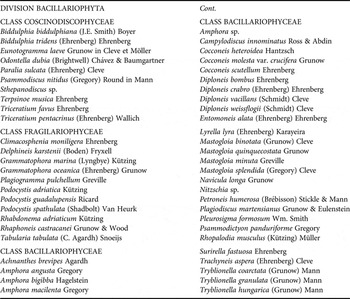
We identified 52 taxa of the epiphytic diatom in the thallus of the G. rugosa collected in the Fernando de Noronha archipelago, distributed among the Coscinodiscophyceae (19.2%), Fragilariophyceae (21.2%) and Bacillariophyceae (59.6%), confirming a dominance of monoraphid and biraphid taxa. Eleven species were considered very frequent and characterize the floristic structure of diatoms, since they were present in more than 70% of the samples analysed: Amphora sp.; Cocconeis scutellum Ehrenberg; Diploneis bombus Ehrenberg; Grammatophora marina (Lyngbye) Kutzing; Mastogloia binotata (Grunow) Cleve; Navicula longa Grunow; Nitzschia sp.; Psammodiscus nitidus (Gregory) Round in Mann; Rhabdonema adriaticum Kutzing; Trachyneis aspera (Ehrenberg) Cleve; and Tryblionella coarctata (Grunow) Mann. Taxa of the epiphytic diatom observed in the thallus of the Galaxaura rugosa are reported in Table 1.
Epiphytic diatom taxa recorded in Galaxaura rugosa, collected in the Fernando de Noronha archipelago, Pernambuco, north-eastern Brazil, in the months of June 2006 and June 2007.

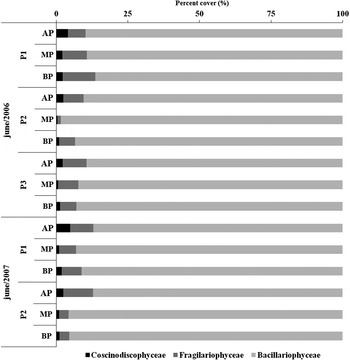
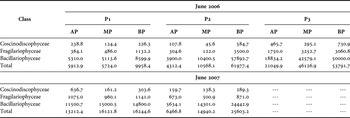
The epiphytic diatoms occurred throughout the thallus in G. rugosa, with a greater abundance (cells per gram wet weight of seaweed) of individuals belonging to the Bacillariophyceae than the Coscinodiscophyceae and Fragilariophyceae, confirming that the flora is characterized by individuals with pennate morphology with raphe, with nearly 92% of total coverage of the thallus in G. rugosa (Figure 2; Table 2).
Percentage cover (%) of the classes of epiphytic diatoms in Galaxaura rugosa, collected in the Fernando de Noronha archipelago, Pernambuco, north-eastern Brazil, in the months of June 2006 and June 2007: P1, Atalaia; P2, Porto; P3, Cagarras; AP, apical portion of the seaweed; MP, middle portion of the seaweed; BP, basal portion of the seaweed.

Quantitative variation of epiphytic diatoms (cells per gram wet weight of seaweed) in Galaxaura rugosa, collected in the Fernando de Noronha archipelago, Pernambuco, north-eastern Brazil, in the months of June 2006 and June 2007: P1, Atalaia; P2, Porto; P3, Cagarras; AP, apical portion of the seaweed; MP, middle portion of the seaweed; BP, basal portion of the seaweed. ---, data not available.

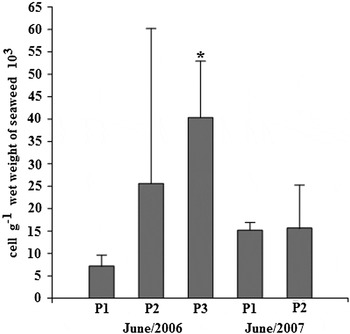
In general, the abundance of epiphytic diatom cells ranged between 7198.4 cells per gram wet weight of seaweed and 61977.4 cells per gram wet weight of seaweed, in the samples collected on Porto beach (P2) (June 2006), with significant differences between the collection points in the June 2006 period (F = 174.98, P = 0.01) (Figure 3).
Mean ± standard deviation of density of epiphytic diatoms (cell per gram wet weight of seaweed 0.103), in Galaxaura rugosa, collected in the Fernando de Noronha archipelago, Pernambuco, north-eastern Brazil, in the months of June 2006 and June 2007: P1, Atalaia; P2, Porto; P3, Cagarras. *, significant differences P < 0.05.

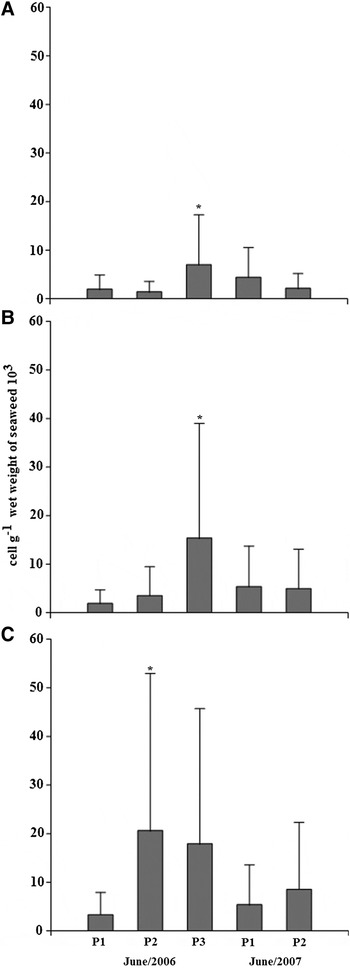
On Atalaia (P1), the average density of the diatoms was smaller, ranging between 5724.0 cells per gram wet weight of seaweed, in the middle portion (June 2006) to 16244.6 cells per gram wet weight of seaweed, in the basal part (June 2007). In general, in this season, the highest abundance values were obtained in June 2007, regardless of the part of seaweed analysed (Figure 4).
Mean ± standard deviation of density of epiphytic diatoms (cell per gram wet weight of seaweed 0.103), in different portion of Galaxaura rugosa, collected in the Fernando de Noronha archipelago, Pernambuco, north-eastern Brazil, in the months of June 2006 and June 2007: (A) apical portion of the seaweed; (B) middle portion of the seaweed; (C) basal portion of the seaweed; P1, Atalaia; P2, Porto; P3, Cagarras. *, significant differences P < 0.05.

At Porto (P2) the average density ranged between 16244.6 cells per gram wet weight of seaweed, in the apical part, and 25603.2 cells per gram wet weight of seaweed, in the basal portion, both in June 2006. At this collection point, the highest abundance values were always found in the basal portion of the host (Figure 4).
The samples of G. rugosa collected on Cagarras (P3) revealed the highest average densities for diatoms, ranging from 7017 cells per gram wet weight of seaweed, on the apical portion, to 53791.7 cells per gram wet weight of seaweed, in the basal portion (June 2006) (Figure 4).
Thus, considering the quantitative attributes of the epiphytic community, an increase was verified in the abundance of the plant's apical parts heading towards the basal parts, regardless of collection sites and the two annual periods. There were significant differences (F = 1.22, P < 0.05) along the thallus of Galaxaura rugosa, with greater concentration in the basal portions of the host.
DISCUSSION
The maximum number of epiphytic diatoms recorded in this study is comparable to those reported on macrophytes from various areas and depths (Siqueiros-Beltrones et al., Reference Siqueiros-Beltrones, Serviere-Zaragoza and Argumedo-Hernández2002; Siqueiros-Beltrones & Hernández-Almeida, Reference Siqueiros-Beltrones and Hernández-Almeida2006; Siqueiros Beltrones & López-Fuerte, Reference Siqueiros-Beltrones and López-Fuerte2006; Totti et al., Reference Totti, Poulin, Romagnoli, Perrone, Pennesi and De Stefano2009). However, quantitative data are reported only in a few studies and using different metrics, such as chlorophyll-a biomass (Pinckney & Micheli, Reference Pinckney and Micheli1998), biovolume (Snoeijs, Reference Snoeijs1994), weight (Worm & Sommer, Reference Worm and Sommer2000), cells cm−2 (Coleman & Burkholder, Reference Coleman and Burkholder1994), cells mm−2 (Totti et al., Reference Totti, Poulin, Romagnoli, Perrone, Pennesi and De Stefano2009), cells mg−1 dry weight (Snoeijs, Reference Snoeijs1995) or relative abundance (Siqueiros-Beltrones et al., Reference Siqueiros-Beltrones, López-Fuerte and Gárate-Lizárragua2005; Sutherland, Reference Sutherland2008).
The greatest wealth of diatoms was found in individuals collected at sites that suffer less influence from wind and ocean current actions, whereas less wealth was detected in samples collected on Atalaia, located on the east section of the archipelago, subject to greater water movement. This fact is in agreement with Navarro et al. (Reference Navarro, Perez, Arce and Arroyo1989), who revealed, on beaches of Puerto Rico, greater wealth of species on hosts at sites with moderate water movement and less diversity in hosts located at sites with strong action by currents.
The quantitative distribution of epiphytic diatoms varied in the diverse sections of the thallus in the G. rugosa, with greater concentrations in the basal part of the seaweed, with an important occurrence of individuals with biraphid symmetry, belonging to the Bacillariophyceae class.
Differences in structure of epiphytic diatom communities can occur when the hosts grow in different sites of light exposure and also because they are subject to differences in ocean current directions and speeds. Furthermore, the differences in colonization in hosts can also vary in accordance with the form of adherence, mobility, ability of the species to form a colony and produce mucous (Wetherbee et al., Reference Wetherbee, Lind, Burke and Quatrano1998).
Tanaka (Reference Tanaka1986) classified the epiphytic diatoms in four groups according to the adhesive strength: Group I, plankton species without power of adherence, like Thalassiosira sp., and Skeletonema costatum; Group II, species with active movement like Amphora, Nitzschia and Navicula; Group III, comprising species with a small area of adherence, attached to the host with peduncles, like species of Licmophora and Synedra; and Group IV, oval-shaped species of diatoms that adhere directly to the host through valves, produce mucous and have a large adhesive strength like Achnanthes, Cocconeis and Mastogloia.
Species belonging to Group IV, with pennate symmetry, especially those belonging to the Bacillariophyceae class have been considered really epiphytic because they are strongly adhered and are more difficult to remove from the host. For this reason, they are frequently cited in marine macrophytes that inhabit environments subject to the action of currents or areas with great movement (Navarro, Reference Navarro, Perez, Arce and Arroyo1989) or that have leafy morphology (Chung & Lee, Reference Chung and Lee2008).
Siqueiros-Beltrones et al. (Reference Siqueiros-Beltrones, Serviere-Zaragoza and Argumedo-Hernández2002) comparing the epiphytic diatom flora in the Phaeophyceae Macrocystis pyrifera (L.) C. Agardh in the Bay of California in Mexico, observed that the most abundant species was the Cocconeis cf. britannica, which formed a large mosaic covering the entire surface of the macro-algae stalk, remaining constant in different times of the year (May to November).
In this study, the quantitative aspects of epiphytic diatoms in G. rugosa, from the Fernando de Noronha archipelago, followed the same qualitative pattern, since nearly 80% of the quantified cells were from individuals belonging to the Bacillariophyceae. This fact confirms that in the qualitative as well as the quantitative aspect, epiphytic flora in seaweed from the Fernando de Noronha archipelago need strong elements of adherence.
Thus, in marine ecosystems with strong hydrodynamics, epiphytic flora tends to comprise species with a large adhesive strength to the host, as occurred in the area being studied.
On the other hand, the quantitative results obtained confirmed that the methodology applied to the counting of epiphytic diatoms in G. rugosa was valid, because it enabled the quantification of all individuals adhered to each part of the seaweed. As a result, it was possible to identify a quantitative variation/zoning along the thallus of the analysed host, with greater abundance for diatoms at the basal portion.
According to Chung & Lee (Reference Chung and Lee2008), the occurrence of a variation/zoning in the distribution of the composition and abundance of epiphytic flora results from action by different environmental factors, most especially sunlight, wind action, currents and host morphology.
The greatest abundance of diatoms in the basal parts of plants, regardless of the collection site, suggest that ocean current movement on the water surface may affect the fixation of species along the seaweed thalli, favouring the installation of a greater number of individuals with the largest adhesive strength like the representatives of the Bacillariophyceae.
The results confirm that Galaxaura rugosa can be regarded as good hosts for the adhesion of diatoms.
ACKNOWLEDGEMENT
This work was supported by Conselho Nacional de Desenvolvimento Científico e Tecnológico (CNPq) (Proc. 477354/2004-1).