Spectators and critics acknowledge the arrestingly beautiful and seamless fluidity of media and performance in Robert Lepage's The Blue Dragon, but opinion is divided over the appearance of the archetypal love story at the heart of the piece. The story – a cross-cultural romance between a French Canadian and a Chinese set in contemporary Shanghai – is variously described as ‘bafflingly trite and pure soap opera’Footnote 1 and as ‘predictable even clichéd’.Footnote 2 Michael Billington, on the other hand, suggests that the love story works as ‘a metaphor for a critique of two cultures’.Footnote 3
In this article, we take up Billington's suggestion of story as metaphor to suggest that as a cross-cultural romance, The Blue Dragon offers a compelling vision of the new China and the West's relation to it. We argue that the wider global context frames the story and seeps into its representational apparatus. Taking our cue from the Chinese word for river –  (chuan) – which recurs as a visual and thematic motif throughout the performance, we suggest that the new paradigm of mobilities sees the love story adapting to more transient human relations. Far from collapsing into ‘soap opera’, The Blue Dragon transforms the archetypal love story into a drama that takes place in the space of flows between two cultures, where love and intimacy are implicated in the transience and mobility of human life in the twenty-first century.
The idea of contemporary modernity as used throughout our analysis draws extensively on Zygmunt Bauman's distinction between an older European modernity and the global era of ‘liquid modernity’.Footnote 4 Liquid modernity is an updating of Marx's account of nineteenth-century social and economic systems, in which: ‘All that is solid melts into air, all that is holy is profaned, and man is at last compelled to face with sober senses, his real conditions of life, and his relations with his kind.’Footnote 5 Stripped of metaphysical concerns, Marx saw that modern ‘man’ would be forced into a sober and realistic view of capitalism. For the current era, no such insights will lead to radical consciousness or revolution. Bauman argues that a further ‘redistribution and reallocation’ of melting powers is under way, but the resultant emancipation from the chains that bind is no panacea. He writes grimly that ‘liquidizing powers have moved from the “system” to “society”, from “politics” to “life-policies” – or have descended from the “macro” to the “micro” level of social cohabitation’.Footnote 6 In our era's ‘individualized, privatized version of modernity’, the ‘real conditions of life’, as in personal relationships and intimacy, ‘patterns of dependency and interaction’, are more unstable than ever.Footnote 7 In a later volume, Liquid Love, ‘the man with no bonds’ is an ironic update of Robert Musil's The Man without Qualities. The novel's hero, Ulrich, is an unmarried man in his thirties who, lacking inherent qualities, composes them by his own wit and effort. The ‘man with no bonds’ is the ‘denizen of our liquid modern society’ who, according to Bauman:
Must tie together whatever bonds they want to use as a link to engage with the rest of the human world by their own efforts with the help of their own skills and dedication. Unbound, they must connect . . . None of the connections that come to fill the gap left by the absent or mouldy bonds are, however, guaranteed to last.Footnote 8
In The Blue Dragon, as will become clear, the divorced, exilic, solitary Pierre is a version of ‘the man without bonds’, while the women, Claire and Xiao Ling, experience a relatively stronger connectivity with each other, suggesting that life in liquid modernity will continue to be inflected by gendered experience. Importantly, the context for the love story is the condition of being unbound and disconnected in a liquid world that recalls not only Bauman's idea of the ‘permanence of transience’ but also his discussion of ‘togetherness dismantled’.Footnote 9
The following section offers a descriptive commentary on the performance as an aide memoir for readers who have seen the work and a guide for those who have not. Thereafter, we move on to examine Lepage's theatre in terms of globalization and intermediality, The Blue Dragon's figuration of the ‘man with no bonds’ and ‘the Shanghai Girl’, the spatial representation of Shanghai as a mobile space in modern China and, finally, the conditions of possibility for a love story among mobile identities. We conclude by tracing the way in which the performance imagines forms of connectivity between China and the West.
The Blue Dragon
The Blue Dragon is a sequel to Lepage's The Dragon Trilogy (1985) that introduces fictional French Canadian artist, Pierre La Montagne, whose restless search for meaning throughout the performance culminates in a decision to emigrate to China. The Blue Dragon is set in Shanghai some twenty years later, where we see that Pierre's failure to connect to Canada as home is a pattern repeated in his adopted city. Pierre (played by Henri Chassé in the Melbourne production) runs a small art gallery in one of Shanghai's newly regenerated industrial precincts, but his time in Shanghai is coming to an end. The story opens at Pudong Airport. Pierre is waiting in the arrivals hall for his ex-wife Claire (played by co-writer Marie Michaud in Melbourne), who is ostensibly visiting him. When Xiao Ling (played by Tei Wei Foo) arrives at Pierre's apartment, a brief comedy of errors ensues in which ex-wives and lovers meet. The final scene, played out as three alternative endings, also takes place at the airport.
Framed by arrivals and departures, the love story is given a modern twist in which the three characters are loosely connected rather than bound together. The relationship between Pierre and Xiao Ling has few interpersonal exchanges: their encounters are brief, strangely dispassionate and characterized by an unwillingness to ‘tie together whatever bonds they want to use as a link’.Footnote 10 Pierre is closer to his ex-wife yet he does not at first know that she intends, with some amount of shame, to adopt a Chinese orphan. When the adoption falls through he comforts Claire without knowing that Xiao Ling is pregnant with his child. In a rapid succession of sliding screens and rising and lowering panels, the story unfolds in Pierre's sparsely furnished bachelor apartment, the art gallery where an exhibition of Xiao Ling's self-portraits is opening, a bar where Claire and Xiao Ling get to know each other, a tea-shop where they discuss the unwanted pregnancy, and street scenes of ingenious design depicting contemporary Shanghai and Beijing. When Xiao Ling leaves for Beijing to have the baby alone, and Claire returns to Canada, the relationships appear to ‘melt into air’. Pierre delivers a monologue about his years in China, demonstrates his mastery of calligraphy and re-enacts as a piece of memory theatre his first meeting with Xiao Ling. Claire, still ready to demonstrate the power of Western money, returns to ‘rescue’ Xiao Ling and her baby. In this way, the Chinese Canadian baby girl becomes part of the ‘love triangle’. Her primal needs and fundamental vulnerability help to reforge lost ‘patterns of dependency’ in the liquid modern society represented by the performance. It is Xiao Ling – with her baby perhaps the symbol of connection that both Claire and Pierre are searching for in China – who becomes the figure that interrupts the ‘permanence of transience’. As friend to Claire and former lover of Pierre, she binds the characters in future patterns of dependency and emotional engagement. The new relations of affinity, based on effort over kinship and dedication over family imperatives, function as a new mode of connectivity that diminishes the tyranny of geographical distance to create a new family assemblage that is decidedly liquid and modern.
To remind us of the significance of the geographical dimension of life, the resolution of the love story unfolds in the mobile space of Pudong Airport. The liquid randomness of human lives is reiterated when the final scene is played out three times as prefigured by the three strokes of the Chinese character signifying ‘river’. When the alternative scenarios interrupt the foreclosure of the narrative, the spectator is left slightly bewildered, but authorized to imagine his or her own ending. In the final and most radical version, Pierre, ‘the man with no bonds’, remains in Shanghai with the baby, while Xiao Ling accompanies Claire to a new life in Quebec. The irony of the inversion of the orientalist romance, the unsettling of the stereotype of the ‘passport’ wife and rich husband, and the revision of the bourgeois family is not lost on an audience.
To summarize: our account of The Blue Dragon highlights instances of the ‘permanence of transience’ as a feature of social life in contemporary Shanghai. The effects of globalization and liquid modernity flow through to the micro level of human connectivity, personal relationships and intimacy. Experience is inflected with class and gender differences. For the affluent Western subjects, transience confounds meaning; for Xiao Ling, transience lived as supported mobility offers the freedom to travel, to study in the West and to experience the occidental Other. As unwitting agents in our discussion of the West's relationship with China, the three characters represent the humanist dimension within the technology of intermedial performance that they do not generate but which happens around them. Co-writers Lepage and Michaud offer a love triangle recoded for the modern age with three points of connectivity, each with its own version of redemption. Middle-aged Claire and Pierre find kinship in caring for Xiao Ling and the baby. Youthful Xiao Ling relinquishes the burden of motherhood and, we must add, the conditions of statehood and a command economy, and enters the world of mobilities. The story resonates, we argue, with an emerging vision of the new China and the West's relation to it.
Lepage's theatre: globalization and intermediality
Lepage's epic theatre productions are critically acclaimed for the ‘virtuosic originality as well as the technical sophistication of their transformative mise-en-scène’.Footnote 11 The Dragon Trilogy led the field in transnational and intercultural theatre. Other major works, such as the hauntingly beautiful The Seven Streams of the River Ota, first seen at the Edinburgh International Festival in 1994, offer treatments of mid- to late twentieth-century history, from the Holocaust and Hiroshima to the AIDS epidemic. Seven Streams has toured extensively, introducing audiences around the world to a mode of performance that mediates world and human histories through exquisite politically inflected images and soundscapes.
Lepage's work speaks to the dilemmas of spatiality, affect, mobilities and performativity, and his production company, Robert Lepage Inc. and Ex Machina, is frequently discussed within the context of globalization. While categorization of Lepage as a global performance artist situates his work within the cultural flows of late capitalism, other specific elements of his productions tend to be lost, neglected or synthesized into a totalizing narrative of globalization. Content, narrative and meaning receive less attention and close analysis, overshadowed as they are by Lepage's reputation as an exponent of intercultural theatre and multimedia shows made for the international arts festival circuit.
Aleksandar Dundjerovic and Ilva Navarro Bateman argue that the international festival circuit is crucial to the development of the work, that Lepage typically ‘devises performances for an international audience based in metropolitan urban centres and whose experiences reflect the sameness of global transnational cultures’.Footnote 12 More than merely providing product for what Dan Rebellato and Jen Harvie refer to as ‘a United Nations of theatre’,Footnote 13 Dundjerovic and Bateman suggest that Lepage's work is more interactive – that is, it responds to the cultural groups for which it is made – and that the work evolves on the road as it seeks to escape the ‘small market’ and the ‘obstacle of isolation’ that characterize Lepage's native Quebec.Footnote 14 These debates about the materialist considerations of Lepage's work, though important, tend to deflect questions about aesthetics and the meanings generated in the performances. The prominence given to story in The Blue Dragon invites us to refocus on meaning and message.
Lepage's work is also discussed in the context of the avant-garde, where, contrary to his representation as a global performance maker, he is viewed in more individualistic terms. Christopher Innes considers his body of work ‘a unique theatrical phenomenon’, and that Lepage, viewed as an auteur, has created a ‘radically non-traditional form of theatre’.Footnote 15 Moreover, Innes finds modernist influences in the work, citing, for instance, how mime, dance and visual image take precedence over realist character and dialogue in ways that owe much to European surrealism and the Symbolists, especially Gordon Craig. The use of multiple screens in Lepage's mises en scène is linked to Craig's concept of mobile screens that reflected the new technologies of theatrical lighting in the theatre of the early twentieth century. Further, Innes ascribes to Lepage's multimedia works – despite the fragmentation of montage and cinematic elements – a ‘holistic unity’ that arises from the ‘journeys’ the protagonists and spectators take through them.Footnote 16 This observation is based on Innes's view that Lepage addresses contemporary modes of communication that are lateral and non-linear; that is, not vertical in the sense of depth models where the surface reflects inner truths. Multimedia performance is thus the ‘realist’ form of the contemporary era ‘designed specifically to mirror a contemporary mindset’.Footnote 17
In The Blue Dragon a rapidly changing Shanghai is stunningly created through image projection and mobile installation that include the city skyline at night, the cityscape by day and live maps of the Huangpu River projected onto screens. It is characterized, on the one hand, by a turbo-mobility, and, on the other, by the constraints of geography. Indeed, the use of multimedia platforms suggests something more: the juxtaposition of dimensions that these techniques evoke is reminiscent of globalization itself, a process through which media technologies, shared images and icons and an expanded imaginary which simultaneously encompasses the global and the local allow citizens of global cities such as Shanghai to experience multiple realities.
Mobile identities: ‘the man with no bonds’
At first, China is ‘an all-consuming passion’ for Pierre.Footnote 18 He practises calligraphy, photographs the landscape and speaks Mandarin. His apartment is decorated with screens, lamps, silk bathrobes and porcelain teacups (see Fig. 1). Yet, as might be expected of his mobile identity, his apartment is a hybrid space, neither Western nor Chinese, floating somewhere in the space of flows, objects, language and desire. While Pierre appears somewhat detached, the performance nevertheless represents him as a social rather than solitary figure in acknowledgement that, in the inherent instability of the space of flows, to connect is paramount for emotional survival. In this sense he appears more a paradigmatic character than an individual figure – a stereotypical Westerner and inheritor of the orientalist paradigm – seeking his own ontological security in the Other.
Henri Chassé as Pierre and Marie Michaud as Claire in Pierre's Shanghai apartment. The Blue Dragon. Image courtesy of Ex Machina. Photographer Yannick Macdonald.

Status for many Western men as cosmopolitans and members of the globally mobile elite is affirmed by intercultural romance and even marriage. James Farrer argues that sexual relationships or marriage between foreigner men and Chinese women produce elitist forms of cosmopolitan identity and membership of the transnational capitalist elite.Footnote 19 Throughout the reform era, foreign husbands were labelled ‘airplane tickets’ or ‘passports’, so pervasive was the assumption that Chinese women married to foreigners would leave China for their husband's country of origin.Footnote 20 For Pierre, however, this status is not so easily achieved in the twenty-first-century world of sexual encounters with young Chinese women. The stereotyped submissive oriental female of Western fantasy is replaced by the feisty and assertive woman, no longer in awe of the Western male or looking for a ticket out. Xiao Ling refuses his offer of cohabitation and chooses when and how often to visit, refusing to play the part of the ‘love-prone’ or the ‘love-vulnerable’ person.Footnote 21 He must rely on his own efforts if China is going to confer cosmopolitan status on him.
Early in the performance, Pierre establishes an intimacy with the audience by sharing his love of and proficiency in Chinese calligraphy. He crouches on the stage floor with a paintbrush and paper and, as he writes, large-scale Chinese characters appear in graceful, sweeping movements on a screen behind him. Pierre tells us that there is nothing more exciting than seeing your name written in Chinese script for the first time, as if he has only come to recognize himself when China has somehow inscribed him. Chinese orthography is believed to be the oldest continually used writing system in the world and Pierre's love of Chinese script seems to be an attempt to hold on to at least one aspect of Chinese culture that is enduring and still able to dwarf other more transient and troubling realities. Yet the intimate fluid contact between hand and paintbrush, and between ink and paper, is interrupted by the simultaneous appearance of the mediatized spectacle, reminding the audience, at least, of the global dominance of ‘mediatized culture’.Footnote 22 The individual act is shown to be a transient and fleeting illusion in the flow of image and media. Pierre continues by writing the Chinese character signifying river – (chuan) – and explains how the character consists of three strokes, which relate to the Three Gorges region along the Yangtze River. The number three also binds the three characters into the love story and prefigures the three endings that are offered. The sequence sets the ideas of fluidity, flow and transience in motion at the same time as the calligraphic representation of the river introduces the recurring idea of three strokes, three characters and three endings. The satisfying economy of exposition and theme draws visual, corporeal and verbal signification together.
The sequence also establishes the melancholic tone that underscores the unravelling of Pierre's chosen life. The attempt to find redemption in Shanghai is exposed as a partly orientalist desire for that which is unavailable in Canada. In the present in which the performance is set, Pierre's tenure in Shanghai is unsettled as his gallery teeters on the edge of bankruptcy. The arrival of his ex-wife reminds him of a lost life and a lost identity in his former homeland. With this reminder, he has also to face the fact that despite the dynamism of Shanghai and the rise of China as an economic power to rival Western hegemony, he has not been a success financially, romantically or emotionally in Shanghai. Pierre's command of Chinese calligraphy begins to appear as a futile attempt to stabilize identity in an ancient and seemingly unchanging dimension. What Pierre cannot find in a rapidly transforming global city such as Shanghai he seeks in eternal images.
The image of Eternal China in an unstable world, and Pierre's struggle for meaning in his own life through engagement with symbols, are also reflected in his attempt to establish an identity through bodily inscription. As a screen across a small room slides open, the spectator sees Pierre lying face down on a bench with his back exposed. We see Xiao Ling, her long hair loose, tattooing a blue dragon on his back as if it were a blank canvas. His body flinches as she brings the needle down on his back and we see the blue dragon appear on a screen behind the action. The dragon now appears on the same screen as Pierre's calligraphic name and the word chuan, for river, as part of a shifting sequence of images.
The correlation between the white paper on which Pierre writes his name and the white skin on which Xiao Ling tattoos the dragon sees him indelibly inscribed with Chinese symbols. Yet the choice of the dragon, a symbol of power, strength and good fortune, suggests an increasingly desperate attempt to recode and stabilize an unsettled mobile identity. The image of the dragon is not only inevitably associated with China, but also has characteristics of strength and power that are lacking in Pierre's passive masculinity.
If the tattoo is an attempt to capture a time and place, to achieve something enduring and to recode identity, it also signals Pierre's distance from and failure to assimilate to the law of the Other. Since China itself is undergoing profound transformation, his tattoo can be understood as an attempt to reinstate Western notions of the timelessness of China. The erotics of pain evoked by the beautiful Xiao Ling as she excoriates his naked skin while gently brushing her hair across his back may be the deepest intimacy he is able to feel, and the closest he comes to possessing China and being possessed by it. Pierre's ordeal makes him feel alive and part of something bigger, something that he thinks offers more certainty of meaning. Pain is, after all, profoundly unambiguous; it provokes inescapable affect, and serves to remind us unequivocally of the frailty of the human body and the limits of human existence.
From Shanghai Girl to ba ling hou
The part of Xiao Ling is performed by Tai Wei Foo, a Singaporean-born dancer who is trained in classical Western and Chinese forms as well as in modern dance. The Blue Dragon is her first experience as an actor where she worked closely with co-writers Lepage and Michaud.Footnote 23 We see Xiao Ling as representing ba ling hou (八 零 后), the post-1980 generation that is modern, technologically savvy, globally oriented and consumption-driven; a product of Deng Xiaoping's economic reforms. As a hip young artist, she appears assertive, self-obsessed, an embodiment of the new China. Her attributes connect her to the ‘Shanghai Girl’ discourse that represents the decadence of post-Communist Chinese cities through the figure of the promiscuous young woman.Footnote 24 Representing the East as feminine has long been a feature of orientalism, as Said's study of Flaubert points out.Footnote 25 Xiao Ling's lineage is to be found in the image of the ‘modern girl’ whose lifestyle, imagined as extravagant and licentious, has the power to shock. In the 1920s and 1930s, the ‘modern girl’, sometimes known as the ‘Chinese flapper’, was a common trope that appeared in popular culture as a feminized composite of Chinese and Western culture. Like Xiao Ling, she was the symbol of ‘Shanghai Modern’.Footnote 26
The Blue Dragon updates the ‘Shanghai Girl’ stereotype and partially subverts it, but also lingers in the orientalist representation of the inscrutable Other. Xiao Ling's relationship with her Western lover is complicated and indeed compromised by his entrepreneurial role in her career: his gallery exhibits her art and he launches her onto the Shanghai art scene. But there are further issues at stake for the young woman in modern Shanghai that are inferred but not explored in the performance. Ferrar's study of intermarriage between Chinese nationals and Western expatriates residing in Shanghai notes – the ‘passport to the West’ syndrome mentioned above notwithstanding – that locals’ relationships with foreigners, especially casual dating relationships, remained politically and culturally sensitive through the mid-1990s.Footnote 27 Moreover, the gender imbalance, in which it is nearly always Chinese women who have relationships with Western men, is interpreted locally as a sign of either the ‘venality’ or the opportunism of Chinese women looking for rich husbands. Although attitudes are changing in the 2000s, the lingering ambivalence among Chinese about intercultural relationships perhaps explains why, when Xiao Ling discovers her pregnancy, her composure slips.
In further recognition of the uncertainties that inhabit the physical and emotional space of flows, in dealing with her pregnancy Xiao Ling is both assertively modern and yet surprisingly attached to premodern concepts such as shame, fate and destiny. Rather than tell Pierre (whose child it may or may not be) or have an abortion, she resigns herself to what she imagines will be her fate as an unmarriageable single mother and departs alone for Beijing (see Fig. 2). In an expression of an ambivalent relationship with the West, at her most powerless Xiao Ling is reduced to copying Vincent van Gogh self-portraits for Beijing's street stalls. Later, when she departs for Canada, her bold decision to enter the space of flows imagines a more supportive Western influence. The ambivalence is a feature of the changing conditions of survival.
Transience: Tai Wei Foo as Xiao Ling at the railway station while Pierre tries to contact her. The Blue Dragon. Image courtesy of Ex Machina. Photographer Yannick Macdonald.

The history of Sino-European relations is a complex and sometimes sordid narrative pervaded by various manifestations of orientalism: Said's ‘systematic discipline’ for ‘knowing’ the Orient.Footnote 28 The performance shows it lingering in the spaces of social cohabitation, the arts and culture. In The Blue Dragon, the three characters – Pierre, Claire and Xiao Ling – are configured within the remnants of this near-monolithic Western discourse that sees each of them doubled as both subject and object. Xiao Ling is a subject with agency but to Pierre's Western male gaze she is the oriental female object and his love interest. Pierre's gaze, in turn, ‘orients’ the spectatorial gaze onto representations that are familiar to Western notions of Chinese performance. When Xiao Ling performs the Sleeve Dance in a costume that has long, flowing ‘water sleeves’ Pierre sees a familiar image from Chinese Opera, while at the same time he admires the grace and beauty of Xiao Ling's modern version. He is moved by the iconic and the particular in equal measure, with the performance suggesting the inseparability of these elements in the Western experience of China. Later, Xiao Ling performs a Revolutionary Dance in the uniform of a Red Army soldier. The grace and beauty of the Sleeve Dance are replaced by disciplined acrobatics, and the symbol of traditional China is replaced by the image of Maoist China. As she balances on Pierre's bicycle as he rides across the stage, the assemblage is an ironic demonstration of Eastern and Western modernity, a hybrid configuration in which difference itself signifies the fissions of intercultural relations.
Mobile spaces: translocal Shanghai in the space of flows
Shanghai has been a space of global flows at least since the late eighteenth century. In the early twenty-first century, Shanghai is a global city in which the local finds new ways to accommodate and negotiate the global on a daily basis.
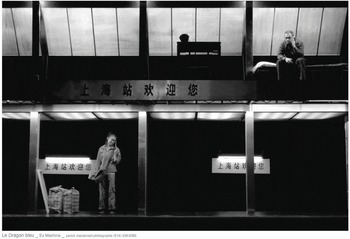
The Blue Dragon's representations of the city involve the rapid opening and closing and the raising and lowering of screens and curtains. These theatrical devices ensure that geography as a constitutive factor in social life is never far from our attention. Shanghai is represented as a series of localities, simultaneously separate and connected. The relationship between them shifts and slips. The stage is multilayered and projects simultaneous multiple realities and overlapping dimensions that implicate the temporal and the spatial in the space of flows. We see Pierre's apartment in Shanghai in the same temporal and spatial frame as Claire's flight from Canada. The multilayered stage presents geographical and temporal superimpositions of social dimensions which are not just parallel, but contiguous. Throughout the performance, shifting scenography and travelling characters emphasize the inexorability of mobilities. This is reflected in the many scenes that take place in spaces of mobility and transience. These include the airport, the departure lounge, the railway station, the river, the bicycle track and the urban landscape. The sense of movement is intensified by the characters cycling, walking, moving in and out of buildings, going up and down stairs and being carried along by conveyer belts built into the stage. The most evocative of these are the scenes in which the characters appear to cycle through the city against stunningly lit cityscapes (see Fig. 3). The geography of China and elsewhere is a pre-eminent and inescapable presence throughout the production.
Pierre and Xiao Ling cycle through Shanghai by night. The Blue Dragon. Image courtesy of Ex Machina. Photographer Yannick Macdonald.

Spaces of transient intimacy such as Pierre's bachelor apartment and a dimly lit cocktail bar are spaces where fleeting connections pass as social life. In the bar, the drinks are not placed on tables but move past potential consumers on a cocktail version of a sushi train. Despite the potential for intimate engagement, these spaces are what Marc Augé calls non-places that we pass through in the flow.Footnote 29 In these non-places where human connections are difficult, universes of shared cultural recognition replace spaces of human connection. While this means that the characters can live in the symbolic universe where everything is a sign and a collection of codes that they can understand, they have no roots in anthropological – that is, meaningful – ‘place’. Claire flies back and forth between Shanghai and Quebec, unable to decide where she should be. On one flight she evades human contact and sensory perception by abandoning herself to an amorphous and disconnected space of flows behind a pair of eyeshades, earplugs and a sleeping tablet. The spectator observes her retreating like a snail into the shell of the aeroplane, to a non-place that assigns no meaning to her presence. We see a glimpse into ‘the human existential condition’ shaped by ‘the new irrelevance of space, masquerading as the annihilation of time’,Footnote 30 and can feel at this point empathy for the woman who retreats from her own irrelevance in the new space.
The Blue Dragon renders Pierre's Shanghai life unstable as his search for a place in which to find personal and cultural meaning is overtaken by the disposable meanings and plasticity of idealities described by Bauman. Consumption patterns that change with the flow of fads, fashions and individual whim, combined with the extensive changes to urban topography generated by the Shanghai World Expo, have changed the cityscape. These forces of globalization threaten to bankrupt his gallery. The transformation of the urban landscapes of China in the twenty years he has been there has shattered his expectation of a stable, if not static, Orient in which to seek refuge from the West. Despite his attempts to anchor himself, Pierre ‘belongs’ neither to the space of global flows that constitutes his Shanghai nor to the ‘place’ of his home in Quebec.
The shifting of panels throughout the performance indicates the possibility of mobility, but a paradoxical paralysis prevents Pierre from exercising a desire for movement of his own free will. If he is looking for something in the East – like many fictional and real people before him – he is now disillusioned and confused. Where once orientalism allowed the Western subject to remake and consume the Orient, the Orient seems to have swallowed him whole and left him with no clear identity – neither Western, Asian nor even expat – and nowhere to go. Pierre cannot come to own, dominate or know the Orient, in the way of nineteenth- and twentieth-century imperialists, much less know himself through it. He cannot even be successful in business in it.
This confusion of cultures and the perplexing tendency for them to blend indiscriminately, thereby offering only indeterminate hybrids, is reflected in the multimedia displays of flickering images in which Chinese and Western modernities are fused. An advertisement for Kentucky Fried Chicken – one of the most recognizable signs in the global symbolic universe – is juxtaposed against images of Shanghai sweatshops. Scenes of Pudong Airport and the maglev are juxtaposed against other Western images such as Claire's expensive designer clothes, shoes and bags.Footnote 31 The China of myth that seduced Pierre has now been engulfed, at least in the urban setting, by an aggressive modernity in constant tension with tradition. In these important ways, the scenography supports a narrative of transience, the anxiety of mobility and the plasticity of ideality, including the idea of ‘China’. Despite this, the story offers him an alternative to the transience of flows; he is intimately and eternally bound to China through the child that is born of his relationship with Xiao Ling.
Patterns of transience and connection
In this article, we have been interested in the way in which the archetypal love story is transformed. Given an open-ended form, exemplified by the three endings, the story is a compelling metaphor for the shifting global relations of modernity. As a personal story, the love story is prone to sentiment and melodrama, but as a metaphor it mediates gendered and intercultural relations between history and its subjects. The love story draws attention to prescient themes: on the one hand, the struggle to establish and maintain meaningful human relationships within an increasingly liquefying modernity; on the other, a geo-theatrical drama of the relationship between the West and China.
The Blue Dragon coincides with the historic moment when the resurgence of China is a concern for many Western regimes – especially in the Asia–Pacific region – where there is a deep ambivalence about the rise of China as an emerging military and economic power. While it represents a vast market and energy consumer that may bring increased wealth to the West, it threatens to change the post-Cold War balance of power between the West and the East. The Beijing Olympic Games in 2010 and the Shanghai World Expo in 2011 are cultural events that demand that the world see China as a superior global force. Twenty-first-century China – with its strange social fusion of command economy and rampant capitalism – generates deep anxiety about a modern democratic, Western, way of life.
In this context, the love story at the heart of The Blue Dragon humanizes the dragon. In representing China through Shanghai, imagined as a modern space of flows where connectivity and intercultural relationships are possible, the performance deploys an attitude of engagement rather than fear. Lepage's seductive, enthralling and idealized representation of the modern city places it at the centre of the new paradigm of mobilities, whose forms are fluid rather than fixed, and where transformations of self are also possible. The seamless transformations of intermedial scenography and the ever-present flows of the Huangpu River underscore the new conditions of transience that seep into the micro level of human relationships. Along with the three strokes that make the Chinese character signifying river, the three characters and the three endings, the love story foregrounds the mobility of Western subjects and the increasing mobility of a young generation of Chinese. In doing so the performance reaffirms the place of theatre in mediating the lingering image of the monolithic or eternal Other, in this case China. Rather than the West watching China from some imagined space of stability, the performance imagines subjects who are caught in patterns of transience and connection. Lepage's scenographic construction of Shanghai does more than represent a place as theatrical spectacle; it also historicizes and unsettles spectators’ perceptions of the city. We are asked to confront spatiality and mobility as underlying paradigms for existence, and to understand them in the context of Shanghai, a key site for the renegotiation of the West's relationship with China.