Coxiella burnetii, the causative agent for Q fever in humans, is an obligate intracellular pathogen found nearly worldwide (Hilbink et al. Reference Hilbink, Penrose, Kovacova and Kazar1993). The organism is primarily found in ruminant animals including sheep, goats, and cattle. Farm and abattoir workers handling these animals are at the greatest risk for exposure, and disease is thought to occur primarily through aerosol exposure via contaminated excreta and birth products. Consumption of contaminated milk and dairy products has long been considered a potential means of transmission.
C. burnetii is the most heat resistant vegetative pathogen found in raw milk, which led to its use as the reference pathogen for establishing proper pasteurisation conditions. Pasteurisation conditions for raw fluid milk products were primarily based on studies conducted by Enright (Reference Enright1961) and Enright et al. (Reference Enright, Sadler and Thomas1957) where viability of the Coxiella in the heated samples was confirmed by their inoculation into guinea pigs and testing of second passage pigs for the presence of complement-fixing antibodies. The resulting data from these studies indicated that proper pasteurisation temperatures should be increased from those previously considered adequate, and that an additional margin of safety could be obtained for products having increased fats, solids or flavourings by the addition of 3 °C to the processing temperature. Unfortunately, this guinea pig model did not allow for thermal inactivation curves to be produced at each temperature because viable cells in the original milk sample could not be quantified. Questions regarding the experimental approach to Enright's work, including the inability to properly produce survival curves, have led researchers to question the need for such stringent pasteurisation conditions (Cerf & Condron, Reference Cerf and Condron2006; LeJune & Rajala-Schultz, Reference LeJune and Rajala-Schultz2009). New formulations of milk having higher fats and sugars content, and added flavours, may need assessment for thermal inactivation kinetics of Coxiella. In addition, a rapid and sensitive method for quantitation of Coxiella in milk products would be useful for evaluating proper pasteurisation conditions for non-thermal techniques such as high pressure and cold plasma processing.
PCR has been used for detection of Coxiella burnetii in dairy products including cheese, yogurt, cream, margarine and raw milk (Loftis et al. Reference Loftis, Priestley and Massung2010; Hirai et al. Reference Hirai, Nakama, Chiba and Kai2012; Eldin et al. Reference Eldin, Angelakis, Renvoise and Rault2013). Unfortunately, direct PCR is not able to differentiate viable cells from dead cells. In the aforementioned studies, viability was determined by culture in mice along with a secondary passage into mice or cell culture and final viability confirmation using a variety of methods including Gimenez staining, immunofluorescence, and PCR. Unfortunately, these procedures only provided a qualitative determination of viability. To study inactivation kinetics properly, the viable cells remaining after heat treatment need to be enumerated directly from the test product.
Integrated cell culture-PCR (ICC-PCR) has been used to determine the viability of obligate intracellular microorganisms such as enteric viruses in a variety of environmental samples (Lee & Jeong, Reference Lee and Jeong2004; Gallagher & Margolin, Reference Gallagher and Margolin2007; Rodriguez et al. Reference Rodriguez, Polston, Wu, Wu and Sobsey2013). This technique serves to confirm viability by allowing viruses to infect a tissue culture system with measurement of their propagation over time by using PCR to quantitate the increase. Although intact nucleic acids may be found in the system, viability is confirmed by a decrease in the cycle threshold (C t) value obtained using real-time PCR specific for the organism. A similar approach has been used to determine antibiotic minimum inhibitory concentrations (MICs) for clinical use (Brennan & Samuel, Reference Brennan and Samuel2003; Boulos et al. Reference Boulos, Rolain, Maurin and Raoult2004) and to evaluate the chlorine exposure necessary to inactivate poliovirus (Blackmer et al. Reference Blackmer, Reynolds, Gerba and Pepper2000). The goal of this work was to develop an ICC-PCR assay for detection of viable Coxiella in a variety of fluid milk products and evaluate its potential for characterising heat inactivation of Coxiella burnetii in whole milk.
Materials and methods
Organisms and reagents
Coxiella burnetii Nine Mile phase II RSA 439, a smooth-coated avirulent strain, and African green monkey kidney epithelial (Vero) cells were kindly provided by Dr. Robert Heinzen at Rocky Mountain Laboratories (National Institutes of Health, Hamilton, MT). Vero cells were routinely propagated using RPMI 1640 medium supplemented with 3% foetal bovine serum (FBS, Gibco, Grand Island, NY). Infected Vero cells were maintained using RPMI 1640 with 1% FBS. Ultra-high temperature (UHT) whole, skim and 2% milks and whipping cream were obtained from Gossner Farms (Logan UT, USA), and high-temperature short-time (HTST) half & half, cream, chocolate milk and eggnog were obtained from a local grocer and were refrigerated immediately after transport to the lab.
Development and optimisation of ICC-PCR assay for detection of viable Coxiella in milk
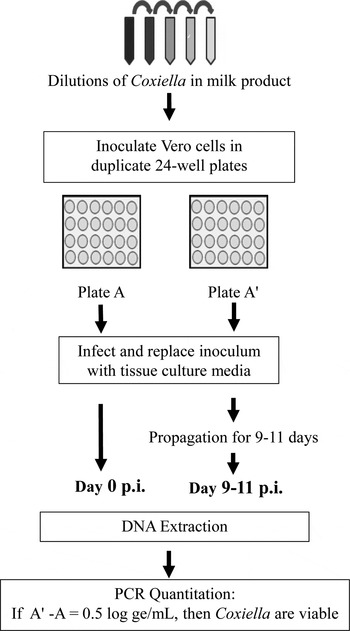
Figure 1 illustrates the ICC-PCR assay scheme that was evaluated for determining the viability of Coxiella in milk products. This method involved inoculating duplicate 24-well plates containing Vero cells with a relatively small volume of diluted Coxiella-inoculated milk and allowing infection for a short period of time. The inocula were removed and tissue culture media was added to both plates. Immediately after infection, one plate was frozen and the duplicate plate incubated to allow propagation of the Coxiella. After the propagation period, DNA in both plates was extracted and the IS111a gene content of the baseline and propagated samples was compared using quantitation by real-time PCR. In this manner, viability was determined directly from the milk sample.
Overview of Integrated Cell Culture-PCR (ICC-PCR) assay scheme. p.i.; post-infection.

For initial evaluation of the ICC-PCR scheme, a 2-h infection period was chosen. Coxiella stock was serially diluted in each matrix to result in a concentration of 7·18 log ge/ml and further diluted 1:1 with PBS. This mixture (200 µl) was layered on confluent Vero cells in duplicate wells in duplicate 24-well plates. No-matrix positive controls and un-inoculated matrix controls were included for all experiments. A 2-h incubation at room temperature with slow rocking on a wrist-action platform shaker was used to allow infection of the Vero cells, after which 800 µl fresh RPMI 1640 + 1% FBS was added and mixed gently. An equal volume of inoculum/media mix was removed and replaced with 800 µl fresh media. This resulted in a substantial dilution of the milk matrix in order to remove growth inhibitors and provide fresh growth media for cell maintenance and propagation of the Coxiella in the Vero cells. One of the duplicate plates was immediately placed at −80 °C as a Day 0 post-infection (D0 p.i.) plate and the other was incubated for 11 d at 37 °C in a 5% CO2 atmosphere to allow Coxiella propagation in the infected Vero cells. At Day 11 p.i., the duplicate plate was stored at −20 °C until the DNA was extracted, which was performed after three freeze-thaw cycles. PCR was completed on all samples from the D0 and D11 p.i. plates, and propagation of the Coxiella was evaluated by comparing the ge/ml estimated by the standard curve.
For extended infection time tests, 500 µl of 1:1 milk and PBS mixture was layered on confluent cells in duplicate 24-well plates as described previously. All plates were slowly mixed using the wrist-action shaker at room temperature for 2 h, after which one of the duplicate plates for the 2 h infection samples was frozen and the other plate was further incubated to allow propagation for an additional 9 d. The duplicate sets of plates for the 5-, 24- and 48-h infections were moved to 37 °C in 5% CO2 for an additional 3, 22 or 46 h. No-matrix positive controls were prepared by dilution of Coxiella in PBS only. At the end of each infection period (2, 5, 24, or 48 h), the inoculum in each well was removed and 1 ml fresh RPMI 1640 + 1% FBS was added prior to freezing (for D0 p.i. plates) or incubation (for D9 p.i. plates) so that well volumes were equivalent for comparison by PCR.
ICC-PCR quantitation of the thermal inactivation of Coxiella burnetii in whole milk
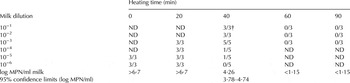
Whole milk (1·5 ml) containing 7·2 log ge/ml Coxiella was aliquoted into 2 ml crimp-top glass vials (Fisher Scientific, Pittsburgh, PA), sealed, and placed into an ice bath for 5 min to cool. Vials were simultaneously placed into a vial holder, submerged in a shaking 60 °C water bath (Thermo Scientific, West Palm Beach, FL) for heat treatment and were removed at intervals (0, 20, 40, 60, and 90 min.) to an ice bath to stop inactivation prior to the ICC-PCR assay. Thermally treated milk samples were serially diluted using RPMI 1640 + 1% FBS prior to infection of the Vero monolayers as described earlier, testing 3–5 aliquots of each dilution in the tissue culture assay depending on the expected degree of inactivation. Quantitation of the remaining viable Coxiella in each treated sample was determined by MPN method using the number of D9 p.i. wells at each dilution level showing at least a 0·5 log increase over the highest of the D0 p.i. wells assayed for each dilution level. MPN's were calculated using an MPN Excel spreadsheet (Blodgett, Reference Blodgett2010).
PCR
Nucleic acid extracts for Coxiella burnetii stocks and infected Vero cell cultures were prepared by extracting 200 µl of sample using the Quickgene Mini80 system with the QuickGene DNA tissue Kit S (AutoGen, Holliston, MA) with final elution using 200 µl of the kit supplied buffer. Extracted DNA samples were stored at −20 °C prior to PCR amplification.
The real-time PCR primers and minor groove binder (MGB) probe sequences and concentrations used for amplification of the Coxiella-specific IS1111a gene were as per Howe et al. (Reference Howe, Loveless, Norwood, Craw, Waag, England, Lowe, Courtney, Pitt and Kulesh2009) with forward primer 3′-AATTTCATCGTTCCCGGCAG-5′, reverse primer 3′-GCGGCGTTTACTAATCCCCA-5′ and MGB probe 3′-FAM-TGTCGGCGTTTATTGG-5′ manufactured by Applied Biosystems (Foster City, CA). Amplifications were run using the Quantitect PCR Probe mix (Qiagen, Valencia, CA) with 5 mm MgCl2 and 5 µl template in 20 µl volumes. Reactions were run on a Roche LightCycler 480 (Indianapolis, IN) with a cycling profile of a denaturation cycle at 96 °C for 15 min. followed by amplification using 45 cycles of 96 °C for 10 s., and 60 °C for 30 s. A standard curve was produced over a 6-log range using extracted 10-fold serial dilutions of purified Coxiella burnetii with triplicate reactions giving a slope of −3·393, with an efficiency of 97·1% and R 2 of 0·952.
Evaluation of PCR matrix inhibition from various milk products
The initial ICC-PCR assay scheme used a 2-h infection with 1:1 diluted milk followed by inoculum removal and addition of fresh media. The final amount of milk matrix in each sample may have been slightly variable due to incomplete inoculum removal and dilution with fresh media. To alleviate this variability and better evaluate the real effect of the matrix on PCR detection of the Coxiella, a mix simulating the ratios of assay components in each well at the end of the infection period was prepared. Vero cells in 24-well plates were grown to confluence and rinsed with PBS followed by addition of 875 µl fresh RPMI 1640 + 1% FBS, 25 µl of milk product and 100 µl of Coxiella burnetii serially diluted in PBS to produce test wells containing log 3·7 Coxiella genome equivalents (ge)/ml. Negative controls were prepared by adding 100 µl of PBS instead of milk. The contents of the wells were lysed via three freeze-thaw cycles, scraped, and harvested to sterile 1·5 ml microtubes which were stored at −20 °C prior to DNA extraction and PCR analysis. The degree of inhibition caused by the presence of the milk product was evaluated by determining the cycle threshold shift between triplicate test and no-matrix control wells. A shift of more than 2 cycles from the no-matrix control was considered to be inhibitory to the PCR.
Results and discussion
Optimisation of Vero cell infection directly from inoculated milk
In our initial evaluation of a 2-h Vero cell infection time, Coxiella in matrices (whole and skim milk, cream, chocolate milk, and eggnog) were tested and compared to Coxiella in PBS (a positive control with no-matrix) in duplicate trials. This infection time is based on a report from Shannon & Heinzen (Reference Shannon, Heinzen, DeLeo and Otto2008) indicating that pure cultures of Coxiella are able to infect and propagate at least 2 logs in Vero cell culture monolayers over a period of 6 d using the same 2 h infection period. The positive control samples increased 1·65 log ge/ml after 11 d propagation, which is close to the expected increase of 2 log ge/ml, however, propagation from the various milk samples was problematic. Variable growth of Coxiella was shown in skim and chocolate milk and no growth was seen in eggnog and whole milk (data not shown). Inhibition analysis indicated that the PCR was not influenced by the presence of the skim and whole milk. Therefore, it was assumed that the inability to see propagation in these samples was more likely due to reduced infection of the Vero cells and/or reduced propagation of the Coxiella once they have infected Vero cell monolayers for these samples.
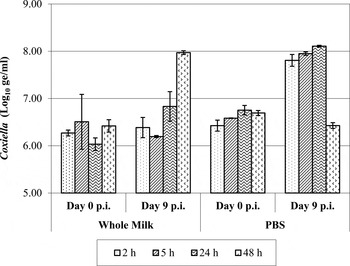
Since it was seen that the residual milk had little toxicity to the Vero cells, it was thought that extending the infection time might improve Coxiella entry from the whole milk samples into Vero cells, thus improving propagation of the Coxiella. Extended infection times of up to 48 h were tested for Coxiella in UHT whole milk and PBS (as a positive control) in duplicate trials (Fig. 2). Increased infection times for the positive control samples resulted in both slightly increased D0 p.i. infection levels and increased propagation after 9 d as quantitated by PCR, although the Coxiella did not propagate after a 48-h infection period. Microscopic inspection of these wells showed extensive cell death, presumably due to cell damage from lack of nutrients for the cells during the extended infection period. Propagation in the positive control samples also increased slightly with increased infection times, but reached a maximum of 8 log ge/ml regardless of the initial infection time tested.
Effect of increased Vero cell infection time for whole milk and control samples. Results represent averages and standard deviations Coxiella ge/ml in 6 replicate wells from two trials. No-matrix controls were completed using phosphate buffered saline (PBS). Total assay times included infection times of 2, 5, 24 and 48 h followed by an additional 9 d of incubation to allow propagation of the Coxiella.

For the whole milk samples, there was no clear increase in quantitated infection level with extended infection time, but there was a substantial increase in growth when a 48 h infection period was used, with the D9 p.i. samples reaching 8 log ge/ml, the maximum level seen in the positive control samples. This indicates that extending the infection time to 48 h overcomes the issues causing reduced propagation in the UHT whole milk samples. Additionally, the more extensive inoculum removal using the extended infection time assay scheme may have contributed slightly to the improvement in the infection and propagation from the milk, though the D0 and D9 p.i. levels were similar for both the initial and modified 2 h infection wells.
Effect of 48-h infection on propagation and viability determination of Coxiella burnetii in various milk products
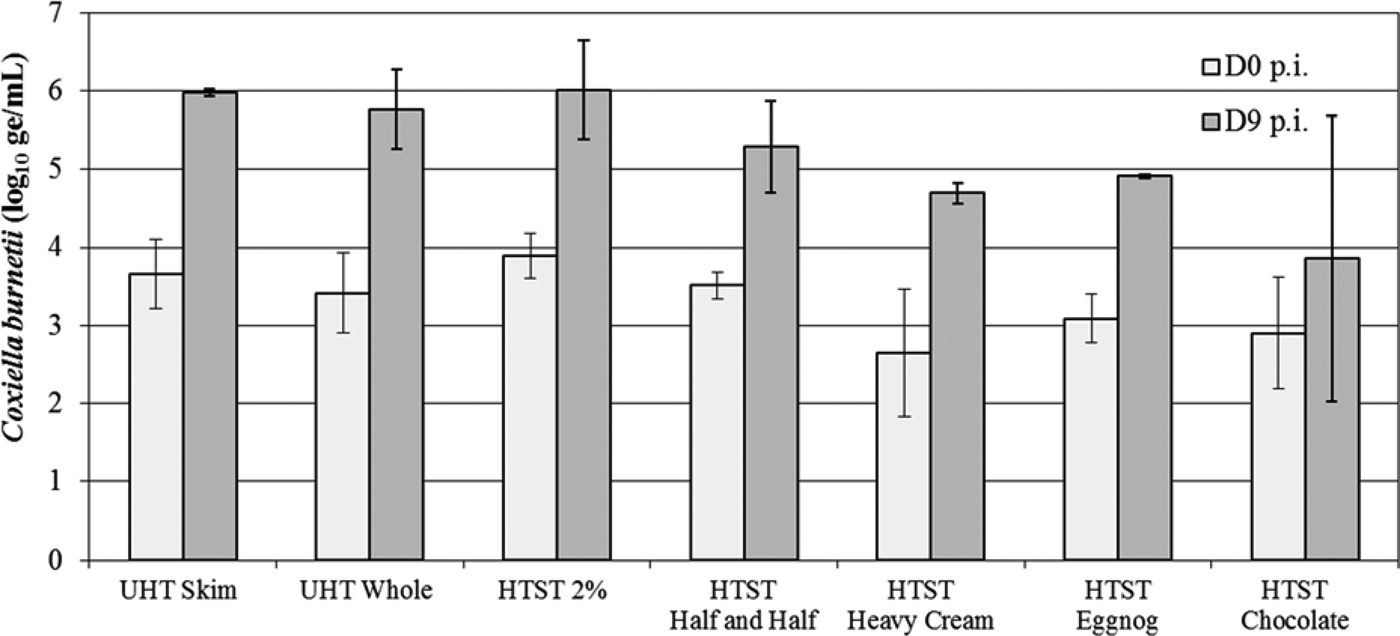
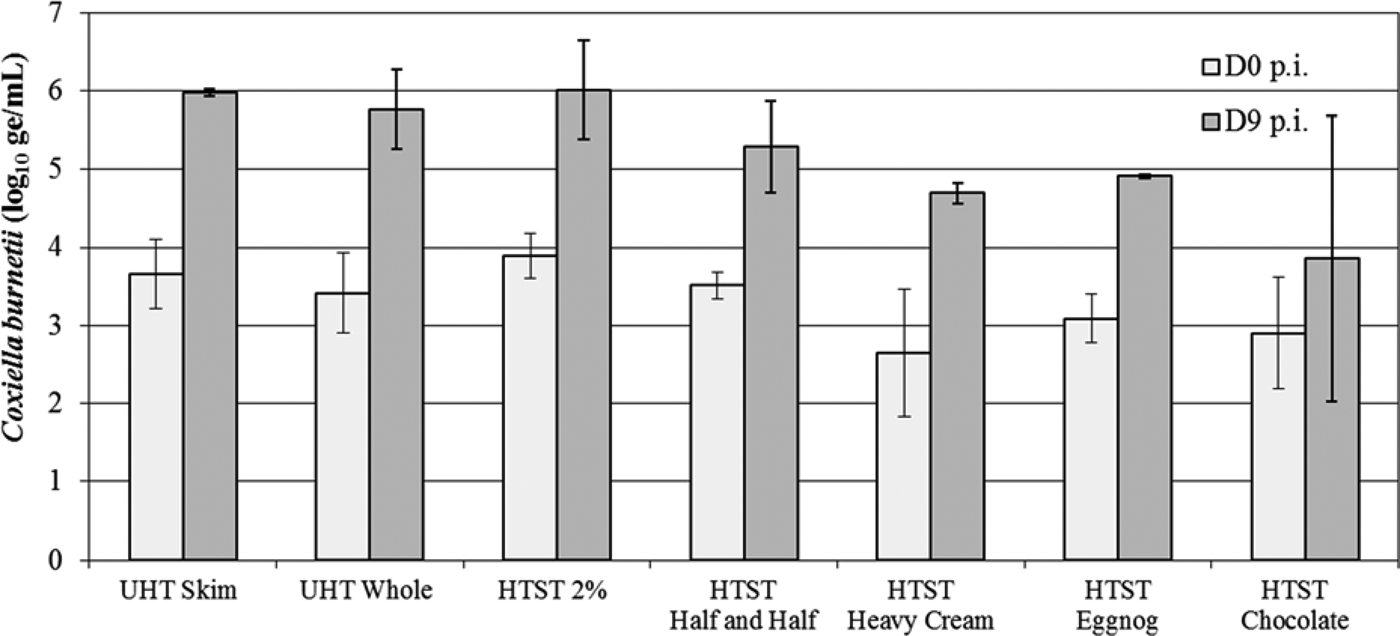
Infection and propagation of Coxiella in UHT whole milk was made possible by extending the infection time to 48 h. However, the effect of the extended infection time on detection of Coxiella in other dairy products was not known. To this end, the modified infection assay scheme was tested on an extended array of dairy products using a lower initial inoculum of Coxiella (~104 ge/ml). Inoculated RPMI + 1% FBS was used as a control because of the previously mentioned deleterious effect of PBS on the Vero cell monolayers using 48 h infection. The improved assay was tested on a variety of milk products in duplicate trials with duplicate test wells. The level of Coxiella propagation for these milk products using the 48-h infection scheme is shown in Fig. 3. Coxiella levels in the UHT whole, UHT skim, UHT 2% milk, and UHT whipping cream samples all increased at least 2 log ge/ml after 9 d of propagation. Slightly less propagation (~1·8 log ge/ml) was seen for the HTST half & half and HTST eggnog samples. Propagation from HTST chocolate milk was highly variable, with 2 of 4 trials showing no propagation. Overall, the modified 48-h Vero cell infection scheme allowed a ≥2 log increase in Coxiella ge/ml indicating that infection and propagation were possible from Coxiella present in a wide range of milk products.
Comparison of Coxiella burnetii infection and propagation from various milks using 48-h tissue culture infection. Results indicate average and standard deviation for Coxiella ge/ml for 6 replicate tissue culture wells in two trials at Day 0 (D0) and Day 9 (D9) post infection (p.i.).
PCR limits for detection of infection and propagation of Coxiella burnetii in UHT whole milk
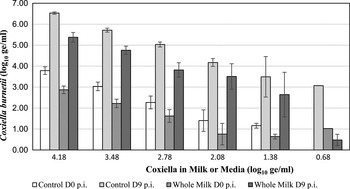
After optimising the assay infection time we aimed to determine the lowest level at which Coxiella can infect and propagate in cell culture with and without the influence of the milk. This was accomplished by infecting Vero cell monolayers with serial 5-fold dilutions of Coxiella made in either RPMI + 1% FBS (as a positive control) or whole milk at concentrations of 4·18–0·68 log ge/ml. To reduce evaporation in the test wells with the extended infection time (48 h), the volume of inoculum was increased from 200 to 500 µl. Triplicate test wells for the D0 and D9 p.i. samples for each inoculum level were averaged over two trials.
As seen in Fig. 4, the Day 0 infection levels for the positive control samples were as expected for each level down to the 0·68 ge/ml milk level, where neither sample contained detectable Coxiella. Although initial infection level could not be quantitated for the 0·68 ge/ml inoculum level, the D9 p.i. samples contained ~3 log ge/ml, indicating that the D0 p.i. levels for the 0·68 ge/ml inoculum were at the PCR limit of detection. The control samples consistently showed Coxiella propagation of greater than 2·5 logs at each inoculation level.
Limit of PCR detection for Coxiella infection and propagation from whole milk and media control samples using 48-h infection and 9-d propagation. Milk and tissue culture media (control) inoculated at 5-fold dilutions from 4·18 log ge/ml were assayed in two trials with triplicate wells. Data represent the average and standard deviation of 6 replicate wells at each initial inoculation level per ml of milk.

The presence of the whole milk in the modified ICC-PCR reduced the ability of the Coxiella to infect the Vero cell monolayers by ~ 0·5 log at each inoculation level vs. the samples prepared in media alone. It is believed that the presence of the milk and the increased volume used for the 48-h infection may have prevented complete infection of the monolayers. The lowest inoculum level at which propagation could still be detected from UHT whole milk was log 1·38 ge/ml, though propagation increases were more variable at this level. Coxiella were detected at D0 p.i. for the 0·68 ge/ml inoculation level samples, however there was no propagation seen at D9 p.i. A possible explanation for the PCR signal is the presence of non-infectious background Coxiella or Coxiella DNA fragments in the milk. Kim et al. (Reference Kim, Kim, Lafferty and Dubovi2005) indicated that Coxiella DNA is present in >90% of bulk tank milk in the U.S. In addition, we have sporadically seen false positive PCR results at C ts of ≥38 cycles where we do not observe an increase in the concentration of Coxiella over the 9 d propagation period. Overall, the results from this trial indicate that whole milk containing as few as log 2·08 Coxiella ge/ml will consistently infect Vero cell monolayers and propagate at least 2 log ge/ml in 9 d, though milk containing fewer cells (down to 1·38 ge/ml) will infect and propagate less reliably.
PCR inhibition analysis
PCR inhibition due to the presence of residual milk products in the cell culture assay was evaluated by extracting and amplifying Coxiella DNA from a mixture simulating assay well contents that are present at the end of the 11 d propagation period. The impact of the milk matrix on detection was determined by comparing the C t of the milk product samples to that of a no-matrix control. Differences between the no-matrix and test samples for each product were 0, 0·21, 0·84, 2·17, and 2·84 cycles for skim, whole, heavy cream, eggnog and chocolate milks, respectively, indicating that the only milk products which would cause significant (>2 cycle) PCR inhibition were the eggnog and chocolate milk. This is consistent with the presence of inhibitory compounds such as egg components (Woodward & Kirwan, Reference Woodward and Kirwan1996), spices, and various stabilisers in the eggnog, and the polyphenols from the chocolate in the chocolate milk (Margot et al. Reference Margot, Stephan, Guarino, Jagadeesan, Chilton, O'Mahony and Iverson2013).
Quantitation of Coxiella burnetii heat inactivation in whole milk
The potential of the ICC-PCR assay for quantitation of viable Coxiella present in milk after heat inactivation was evaluated by batch-heating log 7·2 Coxiella ge/ml UHT whole milk in submerged glass vials at 60 °C for 0, 20, 40, 60, and 90 min. The equation derived by Enright et al. (Reference Enright, Sadler and Thomas1957) for calculation of thermal death time (TCDT) for inactivation of 105 guinea pig infective doses of Coxiella in 2 ml raw milk is as follows: Log time (min) = 19·78711 – 0·128105 Temp (°F). For a 60 °C (140 °F) heat treatment, this equation gives a median thermal death time of 71·2 min. Regression lines were also produced for the heating conditions whereby surviving Coxiella would be expected. For this study, since the 60-min treatment had the potential to have viable cells, a 90-min heat treatment was included as a control for total inactivation.
In our thermal inactivation trial, heat-treated milk was serially diluted and used to infect Vero cells in 3–5 culture wells with the intent to use the qualitative propagation results to calculate a viable Coxiella MPN. To define which samples showed propagation of the Coxiella, the PCR-determined quantities of Coxiella in the D9 p.i. wells were compared to the highest ge/ml level found in the D0 p.i. test wells for each time point assayed. Although untreated Coxiella were generally able to propagate by more than 2 log ge/ml, it was apparent that the injury caused by the heat treatment necessitated redefining the increase in ge/ml which could be considered as positive for propagation (data not shown). To that end, a 0·5 log ge/ml increase from D0 p.i. to D9 p.i. (equivalent to ~1·6 doublings) was chosen as a more conservative measure of propagation than a doubling. If the Coxiella ge/ml in the D9 p.i. wells increased by ≥0·5 log ge/ml the result was scored as positive for growth. This cutoff also reduced potential error due to run-to-run amplification variation and error in the PCR standard curve.
Table 1 details the MPN results of the 60 °C thermal inactivation trial. The 0 and 20 min samples showed little inactivation with calculated MPN's greater than the upper assay detection limit of 6·7 log MPN/ml. The samples treated for 60 and 90 min had no wells showing propagation in the ICC-PCR assay, resulting in an MPN quantitation of less than 1·15 log MPN/ml, and at least a 6-log reduction in viable Coxiella. The MPN for the sample treated for 40 min was 4·26 MPN/ml with a 95% confidence range of 3·78–4·74 log MPN/ml, indicating an ~3-log reduction in viable Coxiella from the initial inoculation level. Overall the data in this study match those from the thermal death time data of Enright et al. (Reference Enright, Sadler and Thomas1957), and they indicate that the ICC-PCR assay may be more sensitive than the guinea pig model.
Inactivation of Coxiella burnetii in whole milk at various treatment times

ND, not determined
Initial inoculation level = log 7·2 ge/ml
† Number positive wells/number test wells
An interesting result of this thermal inactivation trial was that there was no measurable decrease in viability after the 20-min thermal treatment, which would indicate that the thermal inactivation of Coxiella in milk is possibly biphasic instead of linear. Unlike the guinea pig model used by Enright et al. (Reference Enright, Sadler and Thomas1957), the ICC-PCR method allows production of survival curves which should allow better characterisation of thermal inactivation. This method also has a distinct advantage in that it can be used to confirm viability of the Coxiella directly from the test sample. This method can also be implemented in a format which can allow quantitation of the remaining viable cells in the sample using a statistical probability method. Further experiments with thermal treatment times are necessary to produce survival curves for characterisation of the thermal inactivation of Coxiella in milks.
Conclusions
To our knowledge, the optimised method used in this study is the first method to allow a determination of Coxiella viability directly from inoculated milk using growth in tissue culture and quantitation via real-time PCR. Although eggnog and chocolate milk were problematic for infection, most other milk types allowed infection and propagation which suggest that the method could be used in future studies to compare inactivation in different milk products. By confirming that there was an increase in PCR ge/ml from the Day 0 to Day 9 post-infection samples, we were able to consistently prove viability of Coxiella in samples containing as few as ~25 (log 1·38) Coxiella ge/ml in UHT whole milk. In addition, the ICC-PCR assay was applied in a multiple-well format which allowed MPN calculation of the viable numbers of Coxiella in milk samples thermally treated at 60 °C for up to 90 min, and which resulted in a 6-log decrease in viable cells. Results also indicate a 3 log MPN/ml inactivation with a 40 min treatment at 60 °C. However, there are also indications that inactivation may not be linear due to a lack of measureable inactivation in samples subjected to a 20 min heat treatment. Overall, the utility of the ICC-PCR method for characterising thermal inactivation of Coxiella in milk products will need to be investigated further.
This study was supported in part by grant number 5U01FD003801 from the U.S. Food and Drug Administration to the Institute for Food Safety and Health of the Illinois Institute of Technology. The authors thank Songchuan Ma and Jiaojie Zheng for their technical assistance.