




No CrossRef data available.
Article contents
Procedural and declarative memory in obsessive-compulsive disorder
Published online by Cambridge University Press: 01 September 2004
Abstract
Obsessive-compulsive disorder (OCD) has been associated with frontostriatal abnormality. This has led to the hypothesis that the disorder is characterized by abnormality of procedural memory. However, evidence for either procedural or declarative memory disturbance has been mixed, and few studies have directly assessed both of these forms of memory in the same patient group. In the present study, we assessed encoding and retrieval in declarative memory using the Rey Auditory Verbal Learning Test (RAVLT), and procedural memory using the Pursuit Rotor Task, in 27 adults with OCD and 29 matched healthy controls. Groups did not differ with respect to salient demographic characteristics or memory on the RAVLT. In contrast, patients with OCD performed significantly better than controls during the early, but not later trial blocks of the Pursuit Rotor Task. This pattern of results indicates intact encoding and retrieval in declarative memory, but abnormally enhanced procedural memory during the early course of learning in OCD. These findings may be consistent with striatal overactivation observed in neuroimaging studies of OCD, as well as the prominent role of the striatum during early stages of procedural memory. (JINS, 2004, 10, 647–654.)
Information
- Type
- Research Article
- Information
- Journal of the International Neuropsychological Society , Volume 10 , Issue 5 , September 2004 , pp. 647 - 654
- Copyright
- 2004 The International Neuropsychological Society
INTRODUCTION
Obsessive-compulsive disorder (OCD) is a neuropsychiatric condition characterized by intrusive, repetitive, and unwanted thoughts that usually prompt repetitive overt and/or covert behaviors intended to reduce anxiety associated with the thoughts. Lifetime prevalence rates for OCD range from approximately one to three percent in the adult population (Bebbington, 1998; Horwath & Weissman, 2000). The disorder generally has its onset in childhood or adolescence, and is characterized by a chronic, waxing and waning course (Skoog & Skoog, 1999). Significantly reduced quality of life, as well as social, family and occupational problems are common in OCD (Amir et al., 2000; Bystritsky et al., 2001).
OCD has been associated with frontostriatal circuitry abnormality. Positron emission tomography (PET) studies have reported abnormally increased blood flow in several brain regions while patients were resting or during symptom provocation (Rauch et al., 2001; Saxena & Rauch, 2000). These regions have generally included the striatum (especially the caudate nucleus), orbitofrontal gyrus and other frontal lobe regions, thalamus, and cingulate gyrus. Treatment with selective serotonin reuptake inhibitors or behavioral therapy has been found to produce a normalization of regional overactivation (Saxena et al., 2001, 2002). Computerized tomography and magnetic resonance imaging studies have reported structural abnormalities in striatum and orbitofrontal gyrus, although inconsistently (Aylward et al., 1996; Robinson et al., 1995; Rosenberg et al., 1997; Szeszko et al., 1999).
The presence of frontostriatal circuitry abnormality suggests that patients with OCD may demonstrate performance deficits on procedural memory tasks. Procedural memory may be conceptualized as learning without awareness and can be observed in the improvement of speed and/or accuracy on tasks such as implicit sequence learning, mirror reading, probabilistic classification, star mirror tracing, or the Pursuit Rotor Task (Squire, 1986). It should be noted that procedural memory likely involves several processes, as demonstrated by dissociations in performance on different procedural memory tasks within the same group of patients (Gabrieli et al., 1997). Nonetheless, numerous studies using a variety of tasks have shown that aspects of procedural memory are abnormal in patients with basal ganglia dysfunction such as those with Tourette's syndrome, Parkinson's and Huntington's disease, as well as animals with damage to frontostriatal circuitry (Bylsma et al., 1990; Gomez Beldarrain et al., 1999; Heindel et al., 1988; Miyachi et al., 2002; Packard & Knowlton, 2002; Pascual-Leone et al., 1995; Sarazin et al., 2002; Stebbins et al., 1995).
In contrast to procedural memory, declarative memory involves the conscious learning and recall of information such as lists of words or images (Gabrieli, 1998). Dysfunction in the encoding and retrieval of declarative memories has been most commonly associated with damage to mesial temporal lobe structures, particularly the hippocampus (Cabeza & Nyberg, 2000; Squire & Zola, 1996). Double dissociations may be observed whereby patients with basal ganglia abnormality perform poorly on procedural memory tasks and relatively well in their encoding and retrieval of declarative memories, while patients with mesial temporal lobe abnormalities show the reverse pattern (Gabrieli, 1998; Sabe et al., 1995). To date, no consistent evidence for mesial temporal lobe abnormality has been found in OCD.
It has been hypothesized that because of a procedural memory deficit, information that would otherwise be processed without awareness must be processed with full awareness by patients with OCD, resulting in increased arousal and misallocation of attention (Rauch & Savage, 2000; Rauch et al., 1997). Declarative memory circuitry is recruited in order to compensate for abnormal procedural memory, albeit somewhat inefficiently. Functional neuroimaging studies using procedural memory tasks have observed abnormal recruitment of frontostriatal circuitry and increased hippocampal activation relative to healthy controls, supporting this hypothesis (Rauch et al., 1997; Roth et al., 2003).
Few behavioral studies have assessed procedural memory in OCD, and only a subset has evaluated both procedural and declarative memory in the same group of patients. Patients with OCD were shown to perform more poorly than healthy controls on the procedural memory component of the Tower of Hanoi (Cavedini et al., 2001), as well as on an implicit sequence learning task where the opportunity to recruit declarative memory was interfered with through dual task demands (Deckersbach et al., 2002). In contrast, one study reported poor delayed recall for a word list but intact Pursuit Rotor Task performance (Martin et al., 1993). Other investigations of declarative memory in OCD have yielded inconsistent findings (Christensen et al., 1992; Hollander et al., 1990; Savage et al., 1996). When deficits in encoding and retrieval in declarative memory are observed in OCD, evidence suggests that they are largely due to impaired use of strategic processes subserved by frontostriatal circuitry rather than processes subserved by mesial temporal lobe circuitry (Deckersbach et al., 2000; Savage et al., 1999, 2000).
The conflicting results reported with respect to procedural memory in OCD may be partly due to the use of relatively small sample sizes, the inclusion of medicated patients, and failure to exclude patients with comorbid major depressive disorder. With regard to the latter possibility, patients with primary major depressive disorder have been reported to perform poorly on procedural memory tasks (Sabe et al., 1995), and even non-clinical levels of depression have been associated with reduced procedural memory (Kalechstein et al., 1998). In the present study, we sought to evaluate the hypothesis that procedural memory is abnormal in a sample of unmedicated and non-clinically depressed patients with OCD. We hypothesized that, relative to healthy controls, the patient group would show poorer performance on the Pursuit Rotor Task, a measure of procedural memory, and normal performance on the Rey Auditory Verbal Learning Test, a task designed to assess encoding and retrieval in declarative memory.
METHODS
Research Participants
Participants were 27 adult outpatients with OCD and 29 healthy controls. All participants were right-handed by self-reported hand preference for writing, and were between the ages of 18 and 65 years. None of the participants had a history of substance abuse, neurological illness, head injury resulting in a loss of consciousness, electroconvulsive therapy or psychosurgery, or other medical illness with potential effects on cognitive functioning. Patients met diagnostic criteria for OCD as defined by the Diagnostic and Statistical Manual of Mental Disorders–Fourth Edition criteria (American Psychiatric Association, 1994). Diagnosis was established using the Anxiety Disorders Interview Schedule (ADIS), a structured diagnostic interview for anxiety disorders and exclusionary conditions based on DSM-IV criteria (Brown et al., 1994). The ADIS was administered by either a psychiatrist or psychologist with extensive experience in OCD. Patients were excluded if they had a comorbid DSM–IV diagnosis of major depressive disorder or dysthymia. Among the patients with OCD, 4 met diagnostic criteria for comorbid generalized anxiety disorder, 3 had social phobia, and 1 had panic disorder. However, in all cases OCD was clearly the primary diagnosis. OCD symptom severity was assessed using the Yale-Brown Obsessive-Compulsive Scale (YBOCS; Goodman et al., 1989). The YBOCS is a structured clinical interview specifically designed to determine the nature, extent and severity of obsessions and compulsions. Ten items pertaining to the severity of obsessions and compulsions are rated on a four point scale of severity, with higher scores reflecting greater severity of illness. Among our patients with OCD, 19 were never prescribed psychotropic medications and 8 had discontinued the use of selective serotonin reuptake inhibitors for a minimum of two weeks prior to their participation in the study. None of the patients were undergoing cognitive-behavioral therapy at the time of participation. Healthy controls were recruited from a subject pool at the Centre de Recherche Fernand Seguin (a dedicated research center affiliated with the University of Montreal and Hopital Louis H. Lafontaine) and advertisements in a local newspaper, and had no personal history of psychiatric illness based on self-report. All participants provided written informed consent after complete description of the study.
Procedure
Mood
The Beck Depression Inventory (BDI) is a 21-item self-report scale designed to assess for cognitive, emotional and somatic symptoms of depression (Beck, 1987). Scores range from 0 to 63, with higher scores indicating a greater level of depression. Situational anxiety was measured with the Spielberger State-Trait Anxiety Inventory, State subscale (STAI–S; Spielberger et al., 1970). Scores on the STAI–S range from 20 to 80, with higher scores indicating a greater degree of anxiety.
Declarative memory
On the Rey Auditory Verbal Learning Test (RAVLT; Spreen & Strauss, 1998), participants were read aloud a list of fifteen words and asked to recall as many as possible. The procedure was repeated for a total of five learning trials. Following the fifth learning trial, an interference list of fifteen new words was presented followed by free recall of the new list. Participants were subsequently asked to recall the words from the first list (short delay). Subjects were asked to recall the first list again after a 30-min delay (long delay), and then completed a yes/no recognition memory trial. Total words recalled, as well as percent retained relative to the last learning trial, are presented.
Procedural memory
On the Pursuit Rotor Task (Photoelectric Pursuit Rotor, Model 30014; Lafayette Instrument Company, Lafayette, Indiana), participants were required to hold a curved light sensor wand with their right hand and track the motion of a two centimeter light emitting disk (the target) rotating inside a 30.5 centimeter in diameter turntable. Participants initially completed a baseline of three twenty second trials at each of four different disk rotation speeds (15, 30, 45, and 60 rpm) and the time-on-target was recorded. The average time-on-target for each of the three baseline rotation speed trials was then calculated. For each participant, the rotation speed during baseline at which they were able to track the target closest to an average of 5 s was used exclusively for the test trials. This procedure was employed to minimize absolute group difference in motor coordination or speed, and is consistent with prior studies using this task (van Gorp et al., 1999). Participants next completed a total of six test blocks of four twenty second trials each. The inter-trial resting period was 20 s, while the inter-block resting period was 60 seconds. Thirty minutes of other cognitive tests (results to be reported elsewhere) were completed between Blocks two and three, and again between Blocks 4 and 5. The average percent time on target for each block was calculated by averaging the time on target for all four trials within a block.
Data Analysis
Group differences in demographic and clinical characteristics were analyzed using independent samples t tests and nonparametric statistics, as appropriate. Group × Trial and Group × Block mixed model repeated measures analysis of variance were conducted for the RAVLT learning trials and Pursuit Rotor Task, respectively. Independent sample t-tests were carried out to evaluate group differences on the individual trials of the RAVLT and blocks of the Pursuit Rotor Task. All tests used two-tailed comparisons with significance level set at p < .05.
RESULTS
Demographic and clinical characteristics of the patient and control groups are presented in Table 1. The groups did not differ significantly in terms of age, years of education, sex composition and handedness. The mean total score on the YBOCS for the patient group was in the moderate symptom severity range. Despite excluding patients with a diagnosable depressive disorder, the patient group reported significantly more symptoms of depression and anxiety than the control group.
Demographic and clinical characteristics of OCD and control groups

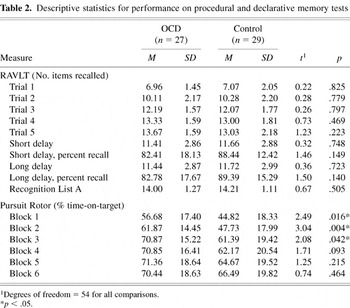
Descriptive statistics for the RAVLT and Pursuit Rotor Task are presented in Table 2. The mean number of words recalled on each learning trial of RAVLT is presented in Figure 1 for illustration. Neither the Group main effect [F(1,54) = 0.18, p = .671] nor the Group × Trial interaction [F(4,54) = 0.83, p = .510] reached statistical significance. As expected, there was a significant main effect of trial, indicating better recall with repeated exposure to the word list [F(4,54) = 231.55, p = .001]. Additional analyses showed that the patients and controls performed similarly in the number of words recalled and percent of words recalled at short and long delays, as well as on the recognition memory trial.
Descriptive statistics for performance on procedural and declarative memory tests


Mean words per trial on the Rey Auditory Verbal Learning Test by group.
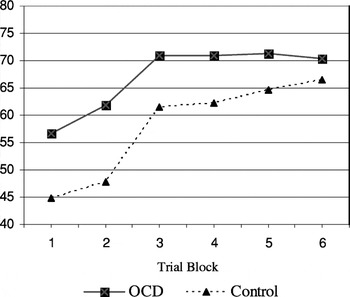
On the Pursuit Rotor Task, the groups did not differ with respect to the rotation speed used for test trials, as determined by the baseline evaluation (χ2 = 0.203, p = .299). The majority of participants in both the patient (88.9%) and control (75.9%) groups performed the test trials at the 60 rpm setting, while the remainder used the 45 rpm setting. Figure 2 shows the mean percent time on-target for the six test blocks of the Pursuit Rotor Task. A significant main effect of Group was present, indicating that, overall, the OCD group stayed on-target significantly longer than the control group [F(1,54) = 4.30, p = .043]. A main effect of block was also observed indicating better performance with increasing task experience across the groups [F(5,54) = 46.92, p = .001]. The Group × Block interaction was also significant [F(5,54) = 2.77, p = .019]. Group comparisons on the individual test block performance indicated that the OCD group stayed on-target significantly longer than controls for the first three blocks. Groups did not differ on the last three blocks.

Percent time on target on the Pursuit Rotor Task by group.
Statistical comparison of patients with (n = 8) and without (n = 19) a comorbid anxiety disorder did not reveal any significant differences on either the RAVLT or Pursuit Rotor Task (all p > .05). No significant correlation (all p > .05) was observed between percent time on target for any of the Pursuit Rotor blocks and overall OCD symptom severity (YBOCS total score), or severity of obsessions (YBOCS Obsession subscale) or compulsions (YBOCS Compulsion subscale). Finally, group differences in mood did not account for the Pursuit Rotor Task findings in analysis of covariance.
DISCUSSION
The present study revealed that unmedicated patients with OCD performed better than healthy controls on a procedural memory task, while group differences were not observed for either encoding or retrieval in declarative memory. Specifically, the OCD patients remained on-target during the Pursuit Rotor Task for a significantly greater percent of time overall than controls. This effect was largely due to significantly better performance by the patients during the early but not later trial blocks of the task. No association was found between procedural memory and mood or the severity of either obsessions or compulsions in the patient group.
That our OCD group showed better procedural memory than controls, especially during the early block of trials, was unexpected. Patients with Tourette's syndrome, a disorder hypothesized to be genetically related to OCD (Sheppard et al., 1999), have been shown to perform more poorly than healthy controls on the Pursuit Rotor Task (Stebbins et al., 1995). However, in contrast to OCD, Tourette's syndrome is associated with striatal underactivation (Braun et al., 1993; Eidelberg et al., 1997). It may be speculated that enhanced procedural memory during the early stages of learning in OCD is associated with the striatal overactivation reported in numerous functional neuroimaging studies of the disorder (Saxena & Rauch, 2000). Although caution must be exerted in linking neuropsychological performance changes to specific underlying neural circuitry, tentative support for this hypothesis may be found in research on brain regions involved in early versus later stages of procedural memory tasks. Studies with primates and healthy humans indicate that the caudate nucleus and rostral putamen tend to be most active during the early stages of novel procedural memory tasks (Krebs et al., 1998; Miyachi et al., 2002). In contrast, later stages of learning appear to involve corticocerebellar circuitry and more caudal portions of the putamen (Grafton et al., 1994; Krebs et al., 1998; Miyachi et al., 2002). However, it should be noted that neither regional overactivation nor underactivation on functional neuroimaging are consistently associated with performance differences on a variety of tasks in either healthy controls or patient populations (e.g., McAllister et al., 2001; Rauch et al., 1997).
Only two functional neuroimaging studies to date have applied procedural memory tasks to OCD, both with small sample sizes. One study used PET and an implicit sequence learning task (Rauch et al., 1997), while the other (Roth et al., 2003) employed functional MRI and a probabilistic classification task (Knowlton et al., 1994). Despite the use of different tasks, both studies reported that adults with OCD showed prominent hippocampal but little striatal activation, while healthy controls showed prominent striatal and little to no hippocampal activation. Performance differences were not observed in either study. These results were interpreted as consistent with frontostriatal dysfunction in OCD. Since neither of the studies specifically reported on temporal changes in the degree of striatal activation during the course of the tasks, the hypothesis that differential striatal activation in OCD is related to the early stage of procedural memory tasks could not be addressed.
Taken together, results from neuroimaging studies during rest, symptom provocation and procedural memory tasks suggest that the directionality of the striatal abnormality seen in OCD, whether it be overactivation or underactivation, may depend on the stage of procedural memory interrogated and/or the nature of the task employed. With respect to task requirements, both sequence learning and probabilistic classification involve “cognitive” procedural memory. In contrast, the Pursuit Rotor Task involves a more purely “motor” procedural memory. Activation of the hippocampus during cognitive procedural memory tasks in OCD has been interpreted as suggesting that these patients have abnormal frontostriatal circuitry and therefore must rely on the declarative memory system to adequately perform procedural memory tasks (Rauch & Savage, 2000). It remains unknown whether patients with OCD would also activate the hippocampus, or show differential striatal activation, during a motor procedural memory task such as that employed in the present investigation. Further functional neuroimaging studies of OCD, employing both cognitive and motor procedural memory tasks, and assessing activation both during the early and later stages of the tasks, will be necessary to evaluate these hypotheses.
The functional significance of better procedural memory in our patients is unclear. One aspect of procedural memory subserved by frontostriatal circuitry that may be relevant to OCD is the formation of stimulus-response associations (Mishkin et al., 1984; Packard & Knowlton, 2002; Poldrack et al., 2001; Saint-Cyr et al., 1995). In the case of OCD, this may be expressed as facilitated acquisition of associations between potentially threatening cognitive or environmental stimuli such as intrusive thoughts and anxiety-reducing compulsive behaviors. Exposure and response prevention, a form of behavior therapy that is highly effective for treating OCD, involves in part repeated presentation of anxiety-provoking stimuli and gradual withholding of compulsive responses (Foa et al. 2001). This treatment, which has been shown to reduce resting frontostriatal overactivation in patients with OCD on positron emission tomography scans (Schwartz, 1998), may work in part through the breaking of maladaptive stimulus-response associations.
Our OCD and control groups did not differ with respect to encoding and retrieval in declarative memory. Prior research has yielded inconsistent findings for both verbal and visual declarative memory in the disorder (Greisberg & McKay, 2003). Recent studies have indicated that lesser use of organizational strategies during encoding, rather than impaired retrieval processes, accounts for verbal and visual declarative memory deficits when observed in OCD (Deckersbach et al., 2000; Savage et al., 1999). This has been interpreted as reflecting a deficit in the use of frontostriatal circuitry mediated strategic processes rather than a mesial temporal circuitry mediated retrieval deficit (Savage et al., 1999). The lack of group difference for declarative memory in the present study may thus be due in part to the nature of the RAVLT. Unlike some other declarative memory tests such as the California Verbal Learning Test (CVLT; Delis et al., 1987), the items on the RAVLT cannot be readily organized on the basis of semantic or other relationships between items, and therefore the potential advantage in recall afforded to controls was likely limited. Even if a test such as the CVLT had been employed, previous findings (Savage et al., 2000) suggest that group differences in learning and recall would likely have been due to the patient groups lesser use of strategic processes rather than a retrieval deficit per se.
The present findings contrast with the only prior study using the Pursuit Rotor Task in OCD, which found no differences between healthy controls and patients (Martin et al., 1993). In attempting to account for their results, Martin and colleagues proposed that the high level of education of their participants (M age OCD = 15.4; M age controls = 15.9 years) may have rendered it difficult to observe group differences. However, the level of education of participants in the present study is comparable to that report. Furthermore, both studies used unmedicated patients, and treatment with selective serotonin reuptake inhibitors does not appear to have a significant impact on procedural memory in OCD (Mataix-Cols et al., 2002). Thus, education and medication status are unlikely to explain the discrepancy in findings. It is possible that the larger sample size employed in the current study may have contributed to the detection of group differences.
It may be questioned whether the better procedural memory by our patient group is an artifact of poor performance by the control group. However, the percent time-on-target for our controls during all stages of the Pursuit Rotor Task is comparable or better than that observed in several other studies using healthy controls with similar ages and education levels (Martin et al., 1993; Stebbins et al., 1995; van Gorp et al., 1999). It may also be questioned whether the comparison of tests that employ different stimulus modalities, auditory–verbal (RAVLT) versus visuomotor (Pursuit Rotor), may have impacted our findings. The methodology and results of the present study do not permit resolution of this issue. Further studies employing both auditory-verbal declarative memory tests and auditory–verbal procedural memory tests such as priming tasks would help address this issue.
Our OCD group showed greater time-on-target than controls as early as the first block of test trials on the Pursuit Rotor Task. This raises the possibility that the patients had greater skill than controls at baseline. Our groups did not differ significantly in the rpm level at which their ability to stay on target was closest to 5 s during baseline trials; this has been the standard method to establish baseline equivalence in motor abilities on the task (Heindel et al., 1989; Stebbins et al., 1995; van Gorp et al., 1999). However, significant group differences in the rate of improvement in actual time on target during the baseline trials may have resulted in the patient group starting the test blocks with an already higher level of performance. We therefore analyzed the time on target for the last baseline trial to gauge level of performance prior to the first test block. This was found to be significantly better for the patient group [t(1) = 2.18, p = .034]. It is possible that the multiple baseline trials were sufficient to permit group differences in procedural memory to manifest, which were then maintained until the fourth block when the patient group reached a plateau in their rate of improvement. Future studies would benefit from using sizably larger samples in order to permit statistical evaluation of the rate of learning during both the baseline and test phases of the task. Alternately, beginning test blocks at the same rpm rate for all subjects and eliminating pre-test block baseline trials altogether may be helpful for determining differences in procedural memory in early and late phases without extensive pre-exposure to the task (e.g., Granholm et al., 1993).
In summary, the present findings revealed significantly better procedural memory during the early stages of learning in unmedicated patients with OCD as compared to healthy controls, in the absence of group differences for encoding and retrieval in declarative memory. This pattern of findings appears to be consistent with evidence of frontostriatal circuitry abnormality in OCD. Replication in a larger sample of patients with OCD, and direct comparison with patients with Tourette's syndrome, would be informative. Finally, further functional neuroimaging studies would be helpful to directly evaluate the relationship between cognitive and motor procedural memory task performance and frontostriatal circuitry activation in OCD.
ACKNOWLEDGMENTS
This study was supported by grants from the Fonds Pour La Formation de Chercheurs et L'Aide a la Recherche (RMR), and the Fond de la Recherche en Santé Québec (KO and JB). We thank Laura Flashman and three anonymous reviewers for their helpful comments on this manuscript.
References
REFERENCES
Amir, N.,
Freshman, M., &
Foa, E.B.
(2000).
Family distress and involvement in relatives of
obsessive-compulsive disorder patients.
Journal of Anxiety Disorders,
14,
209–217.CrossRefGoogle Scholar
American Psychiatric Association.
(1994).
Diagnostic and statistical manual of mental disorders
(4th ed.).
Washington, DC:
American Psychiatric Association Press.
Aylward, E.H.,
Harris, G.J.,
Hoehn-Saric, R.,
Barta, P.E.,
Machlin, S.R., &
Pearlson, G.D.
(1996).
Normal caudate nucleus in obsessive-compulsive disorder assessed by
quantitative neuroimaging.
Archives of General Psychiatry,
53,
577–584.CrossRefGoogle Scholar
Bebbington, P.E.
(1998).
Epidemiology of obsessive-compulsive disorder.
British Journal of Psychiatry–Supplementum
(35),
2–6.Google Scholar
Beck, A.T.
(1987).
Beck Depression Inventory.
San Antonio, TX:
The Psychological Corporation.
Braun, A.R.,
Stoetter, B.,
Randolph, C.,
Hsiao, J.K.,
Vladar, K.,
Gernert, J.,
Carson, R.E.,
Herscovitch, P., &
Chase, T.N.
(1993).
The Functional Neuroanatomy of Tourette's Syndrome: An FDG-PET
Study. I: Regional changes in cerebral glucose metabolism
differentiating patients and controls.
Neuropsychopharmacology,
9,
151–168.Google Scholar
Brown, T.A.,
Di Nardo, P.A., &
Barlow, D.H.
(1994).
Anxiety disorders interview schedule for DSM–IV.
Albany, NY:
Graywind Publications.
Bylsma, F.W.,
Brandt, J., &
Strauss, M.E.
(1990).
Aspects of procedural memory are differentially impaired in
Huntington's disease.
Archives of Clinical Neuropsychology,
5,
287–297.CrossRefGoogle Scholar
Bystritsky, A.,
Liberman, R.P.,
Hwang, S.,
Wallace, C.J.,
Vapnik, T.,
Maindment, K., &
Saxena, S.
(2001).
Social functioning and quality of life comparisons between
obsessive-compulsive and schizophrenic disorders.
Depression and Anxiety,
14,
214–218.CrossRefGoogle Scholar
Cabeza, R. &
Nyberg, L.
(2000).
Imaging cognition II: An empirical review of 275 PET and fMRI
studies.
Journal of Cognitive Neuroscience,
12,
1–47.Google Scholar
Cavedini, P.,
Cisima, M.,
Riboldi, G.,
D'Annucci, A., &
Bellodi, L.
(2001).
A neuropsychological study of dissociation in cortical and subcortical
functioning in obsessive-compulsive disorder by Tower of Hanoi task.
Brain and Cognition,
46,
357–363.CrossRefGoogle Scholar
Christensen, K.J.,
Kim, S.W.,
Dysken, M.W., &
Hoover, K.M.
(1992).
Neuropsychological performance in obsessive-compulsive disorder.
Biological Psychiatry,
31,
4–18.CrossRefGoogle Scholar
Deckersbach, T.,
Otto, M.W.,
Savage, C.R.,
Baer, L., &
Jenike, M.A.
(2000).
The relationship between semantic organization and memory in
obsessive-compulsive disorder.
Psychotherapy and Psychosomatics,
69,
101–107.CrossRefGoogle Scholar
Deckersbach, T.,
Savage, C.R.,
Curran, T.,
Bohne, A.,
Wilhelm, S.,
Baer, L.,
Jenike, M.A., &
Rauch, S.L.
(2002).
A study of parallel implicit and explicit information processing in
patients with obsessive-compulsive disorder.
American Journal of Psychiatry,
159,
1780–1782.CrossRefGoogle Scholar
Delis, D.C.,
Kramer, J.H.,
Kaplan, E., &
Ober, B.A.
(1987).
California Verbal Learning Test–Adult Version.
New York:
The Psychological Corporation.
Eidelberg, D.,
Moeller, J.R.,
Antonini, A.,
Kazumata, K.,
Dhawan, V.,
Budman, C., &
Feigin, A.
(1997).
The metabolic anatomy of Tourette's syndrome.
Neurology,
48,
927–934.CrossRefGoogle Scholar
Foa, E.,
Wilson, R., &
Wilson, R.R.
(2001).
Stop obsessing!: How to overcome your obsessions and compulsions
(Rev. ed.).
New York:
Bantam Doubleday Dell Publishers.
Gabrieli, J.D.
(1998).
Cognitive neuroscience of human memory.
Annual Review of Psychology,
49,
87–115.CrossRefGoogle Scholar
Gabrieli, J.D.,
Stebbins, G.T.,
Singh, J.,
Willingham, D., &
Goetz, C.G.
(1997).
Intact mirror-tracing and impaired rotary-pursuit learning in
patients with Huntington's disease: Evidence for dissociable
memory systems in skill learning.
Neuropsychology,
11,
272–281.CrossRefGoogle Scholar
Gomez Beldarrain, M.,
Grafman, J.,
Pascual-Leone, A., &
Garcia-Monco, J.C.
(1999).
Procedural learning is impaired in patients with prefrontal
lesions.
Neurology,
52,
1853–1860.CrossRefGoogle Scholar
Goodman, W.K.,
Price, L.H.,
Rasmussen, S.A.,
Mazure, C.,
Delgado, P.,
Heninger, G.R., &
Charney, D.S.
(1989).
The Yale-Brown Obsessive-Compulsive Scale. I: Development, use, and
reliability.
Archives of General Psychiatry,
46,
1012–1016.Google Scholar
Grafton, S.T.,
Woods, R.P., &
Tyska, M.
(1994).
Functional imaging of procedural motor learning: Relating cerebral
blood flow with individual subject performance.
Human Brain Mapping,
1,
221–234.CrossRefGoogle Scholar
Granholm, E.,
Bartzokis, G.,
Asarnow, R.F., &
Marder, S.R.
(1993).
Preliminary associations between motor procedural learning, basal
ganglia T2 relaxation times, and tardive dyskinesia in
schizophrenia.
Psychiatry Research,
50,
33–44.CrossRefGoogle Scholar
Greisberg, S. &
McKay, D.
(2003).
Neuropsychology of obsessive-compulsive disorder: A review and
treatment implications.
Clinical Psychology Review,
23,
95–117.CrossRefGoogle Scholar
Heindel, W.C.,
Butters, N., &
Salmon, D.P.
(1988).
Impaired learning of a motor skill in patients with Huntington's
disease.
Behavioral Neuroscience,
102,
141–147.CrossRefGoogle Scholar
Heindel, W.C.,
Salmon, D.P.,
Shults, C.W.,
Walicke, P.A., &
Butters, N.
(1989).
Neuropsychological evidence for multiple implicit memory systems: A
comparison of Alzheimer's, Huntington's, and Parkinson's
disease patients.
Journal of Neuroscience,
9,
582–587.CrossRefGoogle Scholar
Hollander, E.,
Schiffman, E.,
Cohen, B.,
Rivera-Stein, M.A.,
Rosen, W.,
Gorman, J.M.,
Fyer, A.J.,
Papp, L., &
Liebowitz, M.R.
(1990).
Signs of central nervous system dysfunction in obsessive-compulsive
disorder.
Archives of General Psychiatry,
47,
27–32.CrossRefGoogle Scholar
Horwath, E. &
Weissman, M.M.
(2000).
The epidemiology and cross-national presentation of
obsessive-compulsive disorder.
Psychiatric Clinics of North America,
23,
493–507.CrossRefGoogle Scholar
Kalechstein, A.D.,
Hinkin, C.H.,
van Gorp, W.G.,
Castellon, S.A., &
Satz, P.
(1998).
Depression predicts procedural but not episodic memory in HIV-1
infection.
Journal of Clinical and Experimental Neuropsychology,
20,
529–535.CrossRefGoogle Scholar
Knowlton, B.J.,
Squire, L.R., &
Gluck, M.A.
(1994).
Probabilistic classification learning in amnesia.
Learning and Memory,
1,
106–120.Google Scholar
Krebs, H.I.,
Brashers-Krug, T.,
Rauch, S.L.,
Savage, C.R.,
Hogan, N.,
Rubin, R.H.,
Fischman, A.J., &
Alpert, N.M.
(1998).
Robot-aided functional imaging: Application to a motor learning
study.
Human Brain Mapping,
6,
59–72.3.0.CO;2-K>CrossRefGoogle Scholar
Martin, A.,
Pigott, T.A.,
Lalonde, F.M.,
Dalton, I.,
Dubbert, B., &
Murphy, D.L.
(1993).
Lack of evidence for Huntington's disease-like cognitive
dysfunction in obsessive-compulsive disorder.
Biological Psychiatry,
33,
345–353.CrossRefGoogle Scholar
Mataix-Cols, D.,
Alonso, P.,
Pifarre, J.,
Menchon, J.M., &
Vallejo, J.
(2002).
Neuropsychological performance in medicated vs. unmedicated
patients with obsessive-compulsive disorder.
Psychiatry Research,
109,
255–264.Google Scholar
McAllister, T.W.,
Sparling, M.B.,
Flashman, L.A.,
Guerin, S.J.,
Mamourian, A.C., &
Saykin, A.J.
(2001).
Differential working memory load effects after mild traumatic brain
injury.
Neuroimage,
14,
1004–1012.CrossRefGoogle Scholar
Mishkin, M.,
Malamut, B., &
Bachevalier, J.
(1984).
Memories and habits: Two neural systems. In
G. Lynch,
J.L. McGaugh, &
N.M. Weinberger (Eds.),
Neurobiology of learning and memory (pp.
287–296).
New York:
Guilford Press.
Miyachi, S.,
Hikosaka, O., &
Lu, X.
(2002).
Differential activation of monkey striatal neurons in the early and
late stages of procedural learning.
Experimental Brain Research,
146,
122–126.CrossRefGoogle Scholar
Packard, M.G. &
Knowlton, B.J.
(2002).
Learning and memory functions of the basal ganglia.
Annual Review of Neuroscience,
25,
563–593.CrossRefGoogle Scholar
Pascual-Leone, A.,
Grafman, J., &
Hallett, M.
(1995).
Procedural learning and prefrontal cortex.
Annals of the New York Academy of Sciences,
769,
61–70.CrossRefGoogle Scholar
Poldrack, R.A.,
Clark, J.,
Pare-Blagoev, E.J.,
Shohamy, D.,
Creso Moyano, J.,
Myers, C., &
Gluck, M.A.
(2001).
Interactive memory systems in the human brain.
Nature,
414,
546–550.CrossRefGoogle Scholar
Rauch, S.L. &
Savage, C.R.
(2000).
Investigating cortico-striatal pathophysiology in
obsessive-compulsive disorders: Procedural learning and imaging
probes. In
W.K. Goodman,
M.V. Rudorfer, &
J.D. Maser (Eds.),
Obsessive-compulsive disorder (pp.
133–154).
Mahwah, NJ:
Lawrence Erlbaum Associates, Inc.
Rauch, S.L.,
Savage, C.R.,
Alpert, N.M.,
Dougherty, D.,
Kendrick, A.,
Curran, T.,
Brown, H.D.,
Manzo, P.,
Fischman, A.J., &
Jenike, M.A.
(1997).
Probing striatal function in obsessive-compulsive disorder: A PET
study of implicit sequence learning.
Journal of Neuropsychiatry and Clinical Neurosciences,
9,
568–573.Google Scholar
Rauch, S.L.,
Whalen, P.J.,
Curran, T.,
Shin, L.M.,
Coffey, B.J.,
Savage, C.R.,
McInerney, S.C.,
Baer, L., &
Jenike, M.A.
(2001).
Probing striato-thalamic function in obsessive-compulsive disorder
and Tourette syndrome using neuroimaging methods.
Advances in Neurology,
85,
207–224.Google Scholar
Robinson, D.,
Wu, H.,
Munne, R.A.,
Ashtari, M.,
Alvir, J.M.,
Lerner, G.,
Koreen, A.,
Cole, K., &
Bogerts, B.
(1995).
Reduced caudate nucleus volume in obsessive-compulsive disorder.
Archives of General Psychiatry,
52,
393–398.CrossRefGoogle Scholar
Rosenberg, D.R.,
Keshavan, M.S.,
O'Hearn, K.M.,
Dick, E.L.,
Bagwell, W.W.,
Seymour, A.B.,
Montrose, D.M.,
Pierri, J.N., &
Birmaher, B.
(1997).
Frontostriatal measurement in treatment-naive children with
obsessive-compulsive disorder.
Archives of General Psychiatry,
54,
824–830.CrossRefGoogle Scholar
Roth, R.M.,
Saykin, A.J.,
Wishart, H.A.,
Flashman, L.A.,
Ward, J., &
Mamourian, A.C.
(2003).
An fMRI study of brain activation during implicit learning in OCD.
Journal of Neuropsychiatry and Clinical Neurosciences,
15,
262.Google Scholar
Sabe, L.,
Jason, L.,
Juejati, M.,
Leiguarda, R., &
Starkstein, S.E.
(1995).
Dissociation between declarative and procedural learning in
dementia and depression.
Journal of Clinical and Experimental Neuropsychology,
17,
841–848.CrossRefGoogle Scholar
Saint-Cyr, J.A.,
Taylor, A.E., &
Nicholson, K.
(1995).
Behavior and the basal ganglia.
Advances in Neurology,
65,
1–28.Google Scholar
Sarazin, M.,
Deweer, B.,
Merkl, A.,
Von Poser, N.,
Pillon, B., &
Dubois, B.
(2002).
Procedural learning and striatofrontal dysfunction in
Parkinson's disease.
Movement Disorders,
17,
265–273.CrossRefGoogle Scholar
Savage, C.R.,
Baer, L.,
Keuthen, N.J.,
Brown, H.D.,
Rauch, S.L., &
Jenike, M.A.
(1999).
Organizational strategies mediate nonverbal memory impairment in
obsessive-compulsive disorder.
Biological Psychiatry,
45,
905–916.CrossRefGoogle Scholar
Savage, C.R.,
Deckersbach, T.,
Wilhelm, S.,
Rauch, S.L.,
Baer, L.,
Reid, T., &
Jenike, M.A.
(2000).
Strategic processing and episodic memory impairment in obsessive
compulsive disorder.
Neuropsychology,
14,
141–151.CrossRefGoogle Scholar
Savage, C.R.,
Keuthen, N.J.,
Jenike, M.A.,
Brown, H.D.,
Baer, L.,
Kendrick, A.D.,
Miguel, E.C.,
Rauch, S.L., &
Alpert, M.S.
(1996).
Recall and recognition memory in obsessive-compulsive disorder.
Journal of Neuropsychiatry and Clinical Neurosciences,
8,
99–103.Google Scholar
Saxena, S.,
Bota, R.G., &
Brody, A.L.
(2001).
Brain-behavior relationships in obsessive-compulsive disorder.
Seminars in Clinical Neuropsychiatry,
6,
82–101.CrossRefGoogle Scholar
Saxena, S.,
Brody, A.L.,
Ho, M.L.,
Alborzian, S.,
Maidment, K.M.,
Zohrabi, N.,
Ho, M.K.,
Huang, S.C.,
Wu, H.M., &
Baxter, L.R.
(2002).
Differential cerebral metabolic changes with paroxetine treatment
of obsessive-compulsive disorder vs. major depression.
Archives of General Psychiatry,
59,
250–261.CrossRefGoogle Scholar
Saxena, S. &
Rauch, S.L.
(2000).
Functional neuroimaging and the neuroanatomy of
obsessive-compulsive disorder.
Psychiatric Clinics of North America,
23,
563–586.CrossRefGoogle Scholar
Schwartz, J.M.
(1998).
Neuroanatomical aspects of cognitive-behavioural therapy response in
obsessive-compulsive disorder. An evolving perspective on brain and
behaviour.
British Journal of Psychiatry–Supplementum
(35),
38–44.Google Scholar
Sheppard, D.M.,
Bradshaw, J.L.,
Purcell, R., &
Pantelis, C.
(1999).
Tourette's and comorbid syndromes: Obsessive compulsive and
attention deficit hyperactivity disorder. A common etiology? Clinical Psychology Review,
19,
531–552.Google Scholar
Skoog, G. &
Skoog, I.
(1999).
A 40-year follow-up of patients with obsessive-compulsive disorder.
Archives of General Psychiatry,
56,
121–127.CrossRefGoogle Scholar
Spielberger, C.,
Montouri, E., &
Luschene, R.
(1970).
State-Trait Anxiety Inventory (STAI Form C1).
Palo Alto, CA:
Consulting Psychologists Press.
Spreen, O. &
Strauss, E.
(1998).
A compendium of neuropsychological tests
(2nd ed.).
New York:
Oxford University Press.
Squire, L.R. &
Zola, S.M.
(1996).
Structure and function of declarative and nondeclarative memory
systems.
Proceedings of the National Academy of Sciences of the United
States of America,
93,
13515–13522.CrossRefGoogle Scholar
Stebbins, G.T.,
Singh, J.,
Weiner, J.,
Wilson, R.S.,
Goetz, C.G., &
Gabrieli, J.D.E.
(1995).
Selective impairments of memory functioning in unmedicated adults
with Gilles de la Tourette's syndrome.
Neuropsychology,
9,
329–337.CrossRefGoogle Scholar
Szeszko, P.R.,
Robinson, D.,
Alvir, J.M.,
Bilder, R.M.,
Lencz, T.,
Ashtari, M.,
Wu, H., &
Bogerts, B.
(1999).
Orbital frontal and amygdala volume reductions in
obsessive-compulsive disorder.
Archives of General Psychiatry,
56,
913–919.CrossRefGoogle Scholar
van Gorp, W.G.,
Altshuler, L.,
Theberge, D.C., &
Mintz, J.
(1999).
Declarative and procedural memory in bipolar disorder.
Biological Psychiatry,
46,
525–531.CrossRefGoogle Scholar

Demographic and clinical characteristics of OCD and control groups
Descriptive statistics for performance on procedural and declarative memory tests

Mean words per trial on the Rey Auditory Verbal Learning Test by group.
Percent time on target on the Pursuit Rotor Task by group.
 You have
Access
- 25
- Cited by