1. INTRODUCTION
1.1. Combinatorial problem
The manufacturers of building materials, systems, and technologies continue to create larger palettes of products and levels of accomplishment within each product. Each instance of a technology or system is considered to have effectiveness in its own right that can be ranked against others in its class. For example, the levels of accomplishment of chillers, boilers, and heat recovery units would be determined by their macrosystem efficiencies. These macro system efficiencies such as the coefficient of performance of a chiller would be the ratio of heat energy removed compared to the energy consumed by the system and could be ranked in order within its class from the highest to lowest ratio. The level of accomplishment of a certain property or technology parameter is an important distinction from the performance of the whole building. Although each accomplishment level (expressed as values of a technology parameter) can be ranked in order, its role in the resulting performance of the whole building is only comprehensible in the outcome of energy use by the whole building system.
The diversity of technologies and discrete technology solutions exponentially increase the already broad spectrum of available design alternatives. The vast array of alternatives available for buildings can be seen as a discrete combinatorial space made up of all the possible combinations of levels of accomplishment from each technology category. Surveying this combinatorial design space reveals a dizzying number of possible technology combinations. For example, given 16 technology types with between two and seven levels of accomplishment each, more than 1 billion unique combinations exist. The motivation to explore this combinatorial space of technology options is to develop a rigorous methodology for finding low-cost solutions that meet the energy-savings goals required by the national energy codes, which enforce better performing buildings.
1.2. Energy reduction policy
The American Institute of Architects was the first to adopt the 2030 challenge, which was developed by the nonprofit Architecture2030, with the goal that all new buildings designed in the year 2030 and after will use net-zero site energy. The European Union, the United Kingdom, and the Korean government are also pursuing legislation for zero-carbon buildings and expect to reach this goal in 2050, 2019, and 2025 respectively. In this instance, the net-zero building uses zero energy at the site, meaning the energy produced at the site must meet or exceed the energy consumed by the building. The pathway toward this goal requires an incremental and affordable energy-savings strategy. Many prescriptive building codes and guidelines such as LEED, the ASHRAE Advanced Energy Design Guide in the United States, and Passivhaus in the United Kingdom present a step-by-step method to reduce building energy use. These guides do not necessarily result in the selection of financially viable technology combinations, and hence do not provide a cost-effective path for owners to meet the current energy-savings goals enforced by governing energy codes.
1.3. Prescriptive-based methodologies
Passivhaus describes their methodology as “the world's leading fabric first approach to low energy buildings.” The Passivhaus ideology and rating system is interesting because it is composed of both prescriptive requirements and a performance rating. The Passivhaus Designer's Guide is a prescriptive methodology with an emphasis on selecting glazed and opaque fabric elements that meet minimum conduction criteria, airtightness, solar shading, mechanical ventilation with heat recovery, and primary energy appliances (Passivhaus, n.d.). The ASHRAE Advanced Energy Design Guidelines were developed as a prescriptive methodology for small to medium office buildings, as well as other types to achieve 30% to 50% energy savings with variations provided for each of the US climate zones. The design guide documents also include conceptual ideas about integrated design frameworks and workflow arrangements that will help facilitate the production of energy efficient buildings (ASHRAE, n.d.). These guidelines, as well as other prescriptive methodologies, are formed with requirements for specific energy-savings technologies and the level of accomplishment required to meet their minimum recommendation. The types of building envelope, ventilation, heating, cooling, and lighting technologies outlined in these guides and building codes are used as a basis, but also include others such as renewables that reduce site energy when selecting a palette of technologies used in comparison of building performance for this study.
1.4. Optimization-based methodology
Parametric studies are often used by designers to select building technologies that reduce energy use in a one factor at a time approach. In this approach, one input variable is manually updated for each simulation run while all others are kept constant. “This method is often time-consuming while it only results in partial improvement because of complex and non-linear interactions of input variables on simulated results” (Nguyen et al., Reference Nguyen, Reiter and Rigo2014). Moreover, it will fail when there exists interactions between input variables, as demonstrated in Wu and Hamada (Reference Wu and Hamada2009, p. 173).
Metaheuristic algorithms such as genetic algorithms can explore the combinatorial design space much more efficiently than parametric studies. They are effective at locating the maximum or minimum of highly nonlinear objective functions. Because executing building simulations is often computationally expensive, the number of simulations needed to search for an optimum point is also an important consideration in choosing optimization algorithms for optimizing building technologies. However, metaheuristic algorithms often require a large number of evaluations of the objective function. For example, in Salminen et al. (Reference Salminen, Palonen and Sirén2012), with a six-parameter search space, the implementation of a genetic algorithm explored a total of 27% of the combinatorial space of solutions. This is clearly not much more efficient than an exhaustive search. As the combinatorial design space expands to include more technology options and there are more alternatives to test, the efficiency of the search technique to reach an optimum point becomes more important. Some other popular optimization algorithms described in Nguyen et al. (Reference Nguyen, Reiter and Rigo2014) are not suitable for the building technology selection problem in this paper. Gradient-based methods are only applicable if all building technology decisions that need to be made can be represented by continuous variables. Note that in building design studies, BEopt (Christensen et al., Reference Christensen, Anderson, Horowitz, Courtney and Spencer2006) and GenOpt (Wetter & Wright, Reference Wetter, Wright, Augenbroe and Hensen2003) are popular optimization methods that fall in this category. The branch and bound method for solving integer programs is not only time consuming but also requires a lower bound to be generated for each node or subproblem.
The problem that this paper attempts to address is a nonconvex combinatorial optimization problem. Nonconvex combinatorial optimization problems are in general extremely difficult to solve for global optimality. No method that does not completely enumerate (explicitly or implicitly) all possible solutions can guarantee global optimality (Colorni et al., Reference Colorni, Dorigo, Maffioli, Maniezzo, Righini and Trubian1996; Blum & Roli, Reference Blum and Roli2003). This paper proposes a greedy heuristic optimization algorithm, that is, an algorithm that makes a locally optimal choice at each step (see chap. 16 of Leiserson et al., Reference Leiserson, Rivest, Stein and Cormen2001), to select energy technologies to meet a given energy target at minimal cost. It is a stepwise optimization method that changes the level of achievement of a single energy technology at each step in such a way that the energy-savings-to-cost ratio is improved by the greatest amount. For the initial study, we focused on two levels of energy savings: 30% and 50%, which are selected as the targets in the ASHRAE Energy Design Guide. It is expected that each level can be reached by applying different combinations of technology solutions. A comparison with prescriptive design guides and procedures for the same energy-savings targets is demonstrated.
2. METHODOLOGY
2.1. Case study buildings
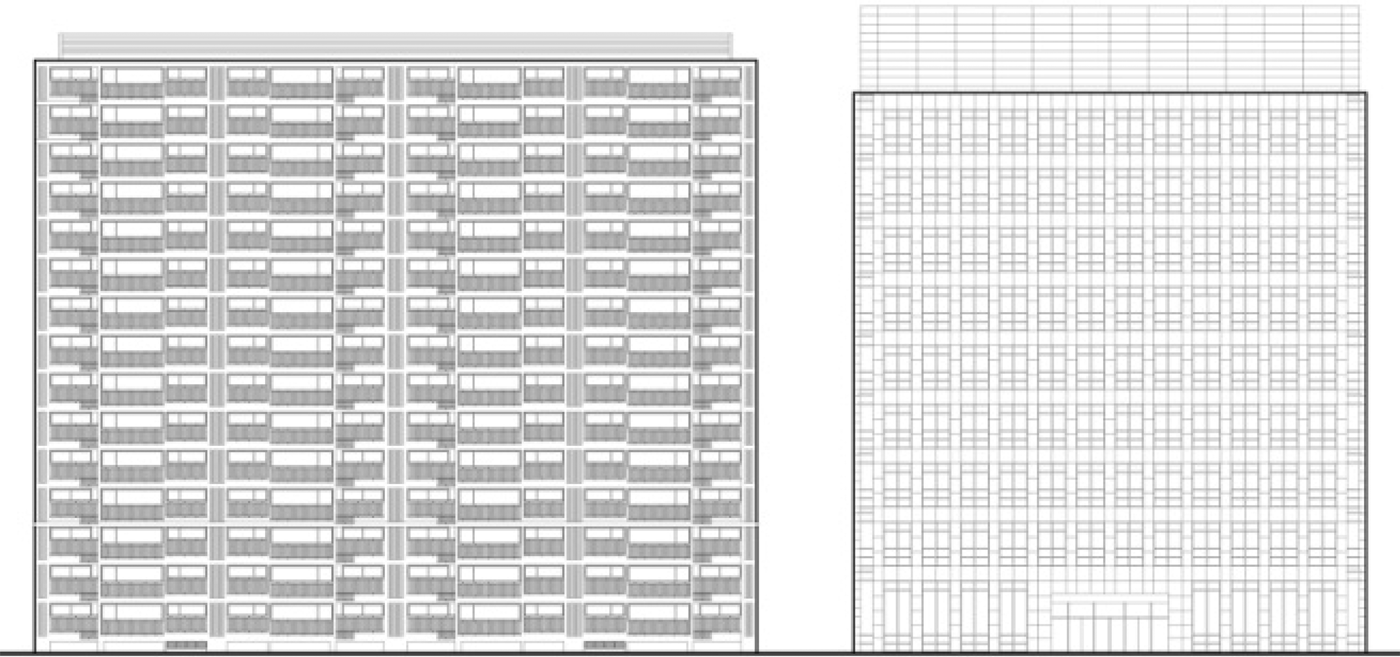
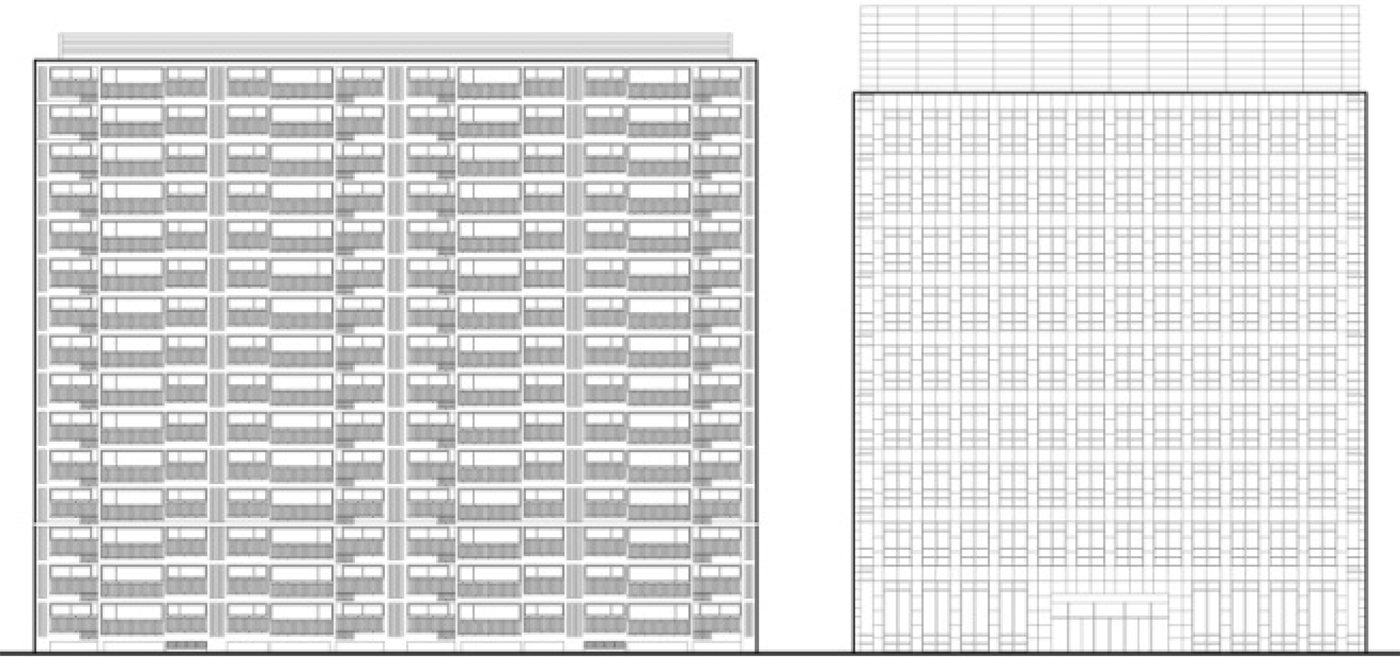
Two buildings were selected to study the application of the optimization methodology's ability to reach lowest cost technology mixes and compare with the way current existing prescriptive techniques achieve energy savings (Fig. 1). A 10-story 8467-m2 office and a 15-story 60-unit 6028-m2 apartment building have been selected as representations of prototypical Korean buildings.
Elevations of apartment and office buildings.
For this case study, the buildings are situated in the urban capital city of Seoul, Korea. The weather data used in the study is from the Incheon airport at latitude 37.48 degrees and longitude 126.55 degrees.
The two prototypical buildings are modeled with a normative energy modeling tool, the energy performance coefficient (EPC), which calculates the yearly energy use intensity (EUI) of each building with the given climate data. The following sections show the development and application of the optimization framework to meet the energy reduction targets. We then compare the resulting optima with the results we would obtain by following the procedures laid out in prescriptive design guides. Our optimization approach and the prescriptive techniques are then compared in their ability to reach the desired energy targets of 30% and 50% energy savings, whereas the monetary cost of each mix will be compared across alternative approaches as well.
2.2. Modeling approach
This study uses a normative energy calculation approach that is defined by ISO 13970 and CEN 15603. The ISO-CEN whole-building energy modeling approach has been coded into an Excel calculator that solves algebraic heat balance equations with averaged monthly weather data. The calculator's output is an EUI, that is, the yearly energy used per unit floor area in kilowatt hours per square meter per year (kWh/m2/year), and it is used mostly in benchmarking the building's performance rating as an EPC (Lee et al., Reference Lee, Fei and Augenbroe2011). This approach offers significant advantages over dynamic simulation based tools such as those promulgated by ASHRAE 90.1 and its Appendix G based LEED scoring of the EA credits. The main advantages are reduced modeling effort, increased transparency and avoidance of modeler's bias, increased model accountability and reduction or absence of computation time. The EPC approach removes modeler's bias, a set of subjective judgments and manipulations required by the modeler making decisions about how to represent input values that cannot be taken directly from observable information in the design specs, and instead uses a set of normative modeling assumptions and scenarios (Kim et al., Reference Kim, Augenbroe and Suh2012). The normative model this study utilizes is composed of algebraic heat balance equations and is therefore more transparent than a corresponding dynamic simulation model, which numerically solves partial differential equations that describe the full complexity of dynamic physical behavior. The latter requires much more computation time than the simplified calculations encoded in the standard. The normative modeling methodology has been shown to lead to the same ranking of alternatives as the detailed dynamic simulation models. The reason for this surprisingly good behavior is that simplified calculations do much better in comparative analysis than in predicting absolute outcomes. Recent work shows, for example, that a normative model produces the correct ranking and prioritization of energy conservation measures (Heo et al., Reference Heo, Augenbroe and Choudhary2011). When testing different competing technologies against each other, we are basically performing a comparative analysis. This substantiates that the underlying engine for finding the optimal mix of technologies is based on the normative model. A specially adapted version was developed for this purpose, making sure that all technologies and solutions were adequately represented in the energy performance calculation.
The resulting EPC calculation tool is used by the optimization algorithm to evaluate the combinatorial space of technology parameters in the two selected prototypical buildings. It should be stressed that the optimization problem is only well posed at the whole-building level. As a consequence, optimality can be defined only at the whole-building energy outcome level. Any attempt at a prescription of subset technology parameters will likely lead to a suboptimal building because the performance of any single technology cannot be judged on its own, but only as part of the whole-building system. Augenbroe (Reference Augenbroe, Hensen and Lamberts2011) asserts that the method of optimizing the building or a building system by simply selecting the components with the highest achievement is inadequate for many system theoretic problems. Rather, the whole building's performance must be evaluated as a function of all technology parameters. The whole-building model approach accounts for the logical fit of energy systems by calculating for the interactive affects between the energy demand of passive systems (heat transfer through windows and walls) and the efficiency of active (heating, cooling, and lighting) and generation (photovoltaic and solar thermal) systems used to satisfy those demands (Augenbroe & Park, Reference Augenbroe and Park2005).
Prescriptive energy codes and guidelines bias the technologies that the design team selects because guidelines, by definition, trail developments available in the market. Therefore, they list only a segment of the technologies available at the time of application. Any list of prescribed technologies is inherently reflective of the regulators’ bias and limits the number of acceptable strategies. Instead, a whole-building energy performance indicator such as EUI, which can account for the complexities and interactions between different technologies, should be used to benchmark buildings.
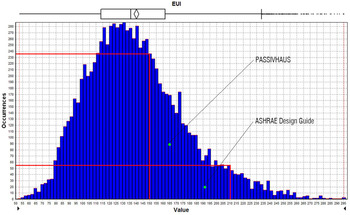
A performance-based approach allows for compliance through innovation and does not restrict the path selected to reach the energy performance requirement. For example, in a design space of 16 parameters and more than 1 billion total possible combinations, the prescriptive compliant building is just one data point in a vast array of possible solutions that meet an energy reduction target and most likely is not the monetary cost optimal one. In this instance, the 16-parameter design space is selected to capture all of the building technology categories (envelope, heating, cooling, lighting, ventilation, domestic hot water, appliances, and building controls) that typically constitute building codes, design guides, and prescriptive methodologies with the addition of solar thermal and photovoltaic energy generation technologies but at incremental levels of achievement and cost. The selected parameter set does not include thermal storage technologies, such as ice storage, because they are implemented to reduce energy demand at peak times and do not necessarily reduce the energy consumed on site. If these possible combinations are seen as a potential population of typical buildings, then a Monte-Carlo random sampling method can be used to enumerate a portion of this population. Figure 2 shows an example population of virtual realizations of Korean office buildings as a probability density function from 10,000 technology combinations. In this population, where the baseline building has an EUI of 300 kWh/m2/year, 55 of the samples meet the 30% energy-savings target and 235 meet the 50% target (each instance representing a particular mix in the considered building). The developed optimization methodology searches the combinatorial space, or potential population of instances of technology mixes applied to the considered building, for the single instance that meets the energy-savings objective at the lowest monetary cost.
Population of potential buildings.

2.3. Baseline definitions
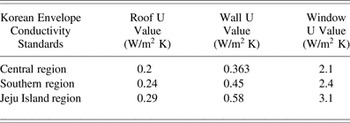
The baseline buildings in this study were created by applying the prescriptive requirements that are described in the Building Energy Saving Design Guidebook, published by the Korean Energy Management Corporation (Kemco, n.d.). Kemco outlines minimum allowable U-values for the building's envelope based on the building's location and associated climate within Korea. The Korean building code varies for each of its three regions: Central, Southern, and Jeju Island. Seoul is in the Central Region of Korea, so the building codes that apply there are used to determine the baseline buildings’ properties (Table 1).
Korean building codes

The occupancy schedule for the office building is defined as 100% occupancy for normal weekday operation: Monday to Friday, 9:00 a.m. to 6:00 p.m., with no other occupied times. The occupancy schedule for the apartment building is interpolated at hourly points from a continuous model (Richardson, Reference Richardson, Thomson and Infield2008). The occupancy schedules are held constant throughout each model and represent a normative approach to evaluating energy-savings technology alternatives. When calculated with the normative model, which includes energy consumed for heating, cooling, ventilation, lighting, plug loads, and hot water, the baseline office and apartment buildings’ yearly energy use intensities are 320 and 346 kWh/m2/year, respectively. The heating and cooling demand for the baseline office building, before efficiencies of mechanical equipment are considered, are 66 and 49 kWh/m2/year, respectively; the demands for the baseline apartment building are 69 and 35 kWh/m2/year, which demonstrates that the central region of Korea is a heating-dominated climate zone.
2.4. Cost function
The cost function this study aims to minimize is a linear sum of the premium monetary costs of 16 technologies (identified by technology parameters) at their levels of achievement. Each technology's level of achievement is also in order of increasing cost because any technology with the same or a lower level of achievement at a higher cost than the previous instance would be excluded from the selection of technologies. The premium monetary cost is defined as the cost of any technology's level of achievement cost minus baseline cost. For each technology, we define a cost evaluation function with the technology parameters and certain building-specific parameters as its arguments. For each evaluation of the cost function, the cost all of applied technologies are summed to calculate total premium cost.
For any technology that is not included in the baseline building but is added later, as in the case of renewables and heat recovery, the premium cost is just the total cost of the technology because the baseline cost of that parameter is zero. Because the baseline cost is subtracted from the cost of each added technology, the “premium” cost of the baseline building equals zero.
The cost function can be written as
 $$C\lpar {\bi x} \rpar = \sum\limits_{i = 1}^p {A_i}\lpar x_i \rpar \comma$$
where  ${x_i} \in \left\{ {0\comma\; 1\comma \ldots \comma\,{n_i}} \right\}$, x i = 0 represents the baseline, and x i = 1, 2, 3, … , n i represents the achievement levels ordered along increasing cost (i.e., if j < k, A i(j) < A i(k)). For each A i, which is the cost function for technology i, A i(0) = 0; therefore, C(0) = 0.
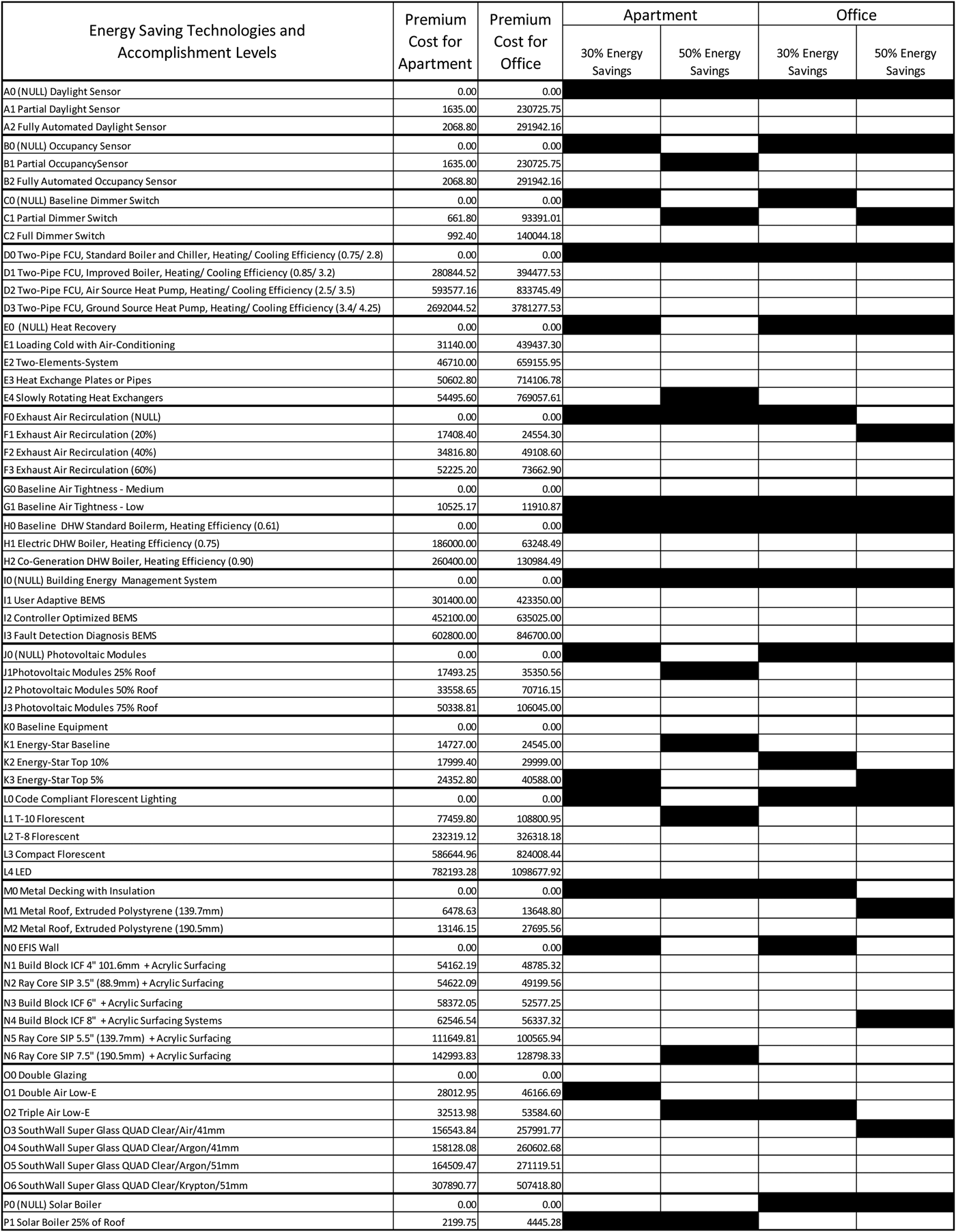
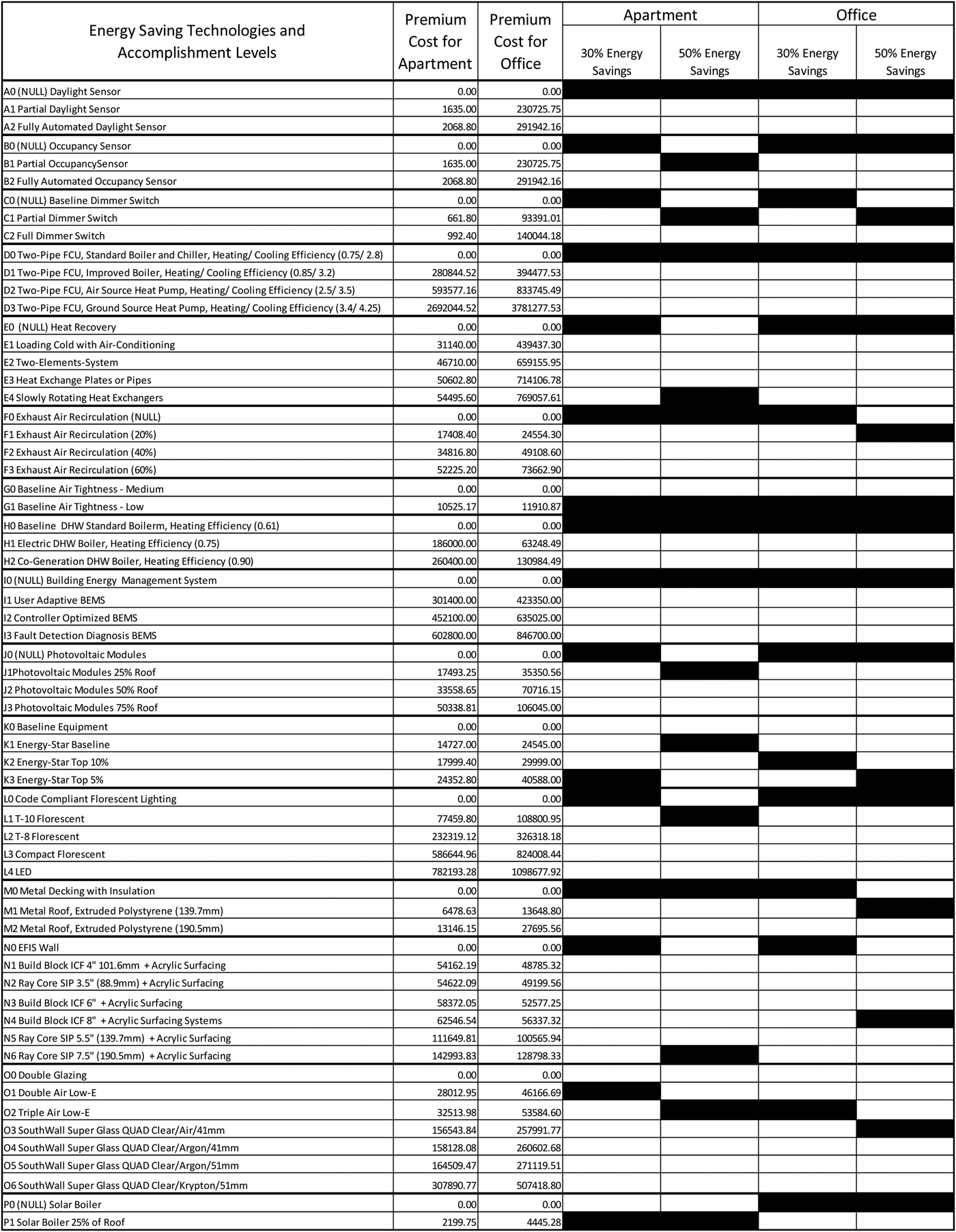
It should be noted that this method of costing removes the time sensitivity of technology cost and excludes net present value or return on investment calculation because the main goal of the optimization algorithm is to meet an instantaneous energy reduction target at the time of construction at minimum capital investment cost. The 16-technology parameters considered and their corresponding levels of accomplishment with individual premium costs based on system size are given in Figure 3.
Accomplishment levels of technology parameters, their premium costs, and technology levels selected by optimization algorithm for Korean apartment and office buildings. Selected technology levels are indicated by the shaded cells.
2.5. Optimization
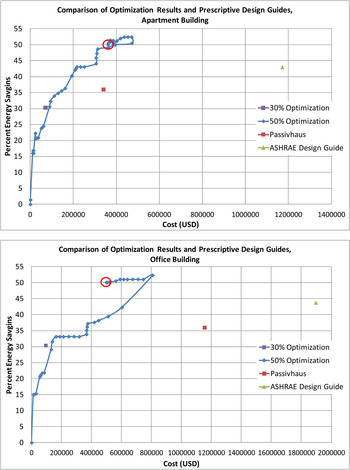
To search the large discrete combinatorial space of technology alternatives, an optimization algorithm is developed into a MATLAB code that automates the testing of combinations of technologies in a combined ascent and descent method, which can be initialized at any point, that is, at any specific set of technologies to begin the search for an optimum. In this paper, we initialize the combined ascent–descent procedure from the baseline building where all technologies are equal to the lowest or baseline level of accomplishment. The algorithm then ascends in steps by selecting the single alternative that maximizes the objective function, energy savings divided by monetary cost or E/C ratio, until the energy-savings target is reached directly or exceeded. When the energy-savings target is exceeded, the algorithm performs the procedure in reverse, by stepping down levels of accomplishment (in such a way that the E/C ratio is maximized and the energy-savings constraint is satisfied) until any further step would result in the violation of the energy-savings constraint. The algorithm is expected to find the solution with close to minimum cost because the least cost solution that meets a given target, say, T, for E will give the largest value of T/C (because C is minimized), assuming that T is exactly achievable. In this study, the switch to the descent procedure can be seen in Figure 4 at the ridge where the optimization path reverses and steps down to reach the final value of the E/C ratio.
Comparison of optimization results and prescriptive design guides for Korean apartment and office buildings. Blue lines plot the percentage energy savings versus cost for technology-level combinations visited by optimization algorithm when the energy-savings target is set to 50%. The starting point is the origin. The algorithm increases the technology level of a technology parameter at each step until the energy savings exceed the target. Then, the algorithm reduces the technology levels and terminates when further reduction causes the energy-savings target constraint to be violated (the termination point is the last point that does not violate the energy-savings target constraint, as indicated by a red circle.)

The developed combinatorial optimization approach is unlike previous optimization studies because it does not reduce the discrete nature of technology accomplishments by continualizations between minimum and maximum property values, but retains the ability to produce unique solutions from currently available discrete technology options and products. One reason to support the creation of custom MATLAB code for optimization is that even powerful off-the-shelf software such as Phoenix Integration's Model Center is unable to execute optimization algorithms with discrete input parameter values. Even with an automated process in MATLAB, enumerating the full factorial set of combinatoric options is computationally prohibitive; the main computational burden is the evaluation of the energy savings of the more than 1 billion technology achievement level combinations utilizing our Excel implementation of the normative building energy model.
2.6. Optimization algorithm
The optimization algorithm is specified below.
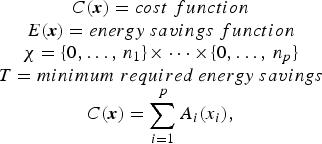 $$\matrix{ C\lpar {\bi x} \rpar = cost\; function \cr E\lpar {\bi x} \rpar = energy\; savings\; function \cr {\rm\chi} = \lcub {0\comma \ldots\comma\, {n_1}} \rcub\! \times \cdots \times \!\lcub {0\comma \ldots\comma\, {n_p}} \rcub \cr T = minimum\; required\; energy\; savings \cr C\lpar {\bi x} \rpar = \displaystyle\mathop \sum \limits_{i = 1}^p {A_i}\lpar {{x_i}} \rpar\comma}$$
where  ${x_i} \in \left\{ {0\hbox{,}\; 1\comma \ldots \comma\,{n_i}} \right\}$ and the A i's are increasing functions, that is, A i(x k) > A i(x l) if k > l. Assume that E(0) ≤ T ≤ E((n 1, … , n p)T) (i.e., the energy savings is between that achieved with the baseline technologies and that achieved with all technology parameters at their highest level of achievement) and E((n 1, … , n p)T) = max{E(x): x ∈ χ} (i.e., the maximum energy savings is achieved with all technology parameters at their highest level of achievement).
Initialize: Specify a starting solution x0. Compute E(x0). Set x = x0. If E(x0) > T, use Descent Procedure. If E(x 0) < T, use Combined Ascent and Descent Procedure
Descent Procedure:
1. Set Ω = {1, … , p}.
2. For i ∈ Ω, set xi = x. If
 $x_i^i \gt 0$, set $x_i^i = x_i^i - 1$ and compute S(xi) = E(xi)/C(xi). Otherwise, set ${\rm \Omega} = {\rm \Omega} \backslash \lcub i \rcub $.
3. If
${\rm \Omega } = \emptyset $, stop and return x. Otherwise, find $k = \hbox{argmax} \lcub {S\lpar {{{\bi x}^i}} \rpar \!\!:i \in {\rm \; \Omega}} \rcub $.4. If E(xk) ≥ T, set x = xk and return to Step 2. Otherwise, set
${\rm \Omega} = {\rm \Omega} \backslash \lcub k \rcub $ and return to Step 3.




Combined Ascent and Descent Procedure:
1. Set Ω = {1, … , p}.
2. For i ∈ Ω, set xi = x. If
$x_i^i \lt n_i$, set $x_i^i = x_i^i + 1$ and compute S(xi) = E(xi)/C(xi). Otherwise, set ${\rm \Omega} = {\rm \Omega} \backslash \lcub i \rcub $.3. Find k = argmax{S(xi): i ∈ Ω} and set x = xk.
4. If E(xk) ≥ T, find l = argmin{C(xi): i ∈ Ω, E(xi) ≥ T}, and set x = xl. Otherwise, return to Step 2.
5. Apply descent procedure with x as starting point.


3. RESULTS AND DISCUSSION
3.1. Optimization results
The energy-savings targets for the optimization are set for 30% and 50% of the EUI for the prototypical apartment and office building. The energy-savings target forms the constraint, while the objective is the minimization of the premium cost function. The ridges at the end of the optimization procedure, seen in each of the two optimization graphs in Figure 4, are sets that are very close to the optimal point but happen to be located where technology accomplishment levels can still be decreased. The optimization algorithm's descent procedure continues to step down the level of technology accomplishment until the energy-savings target as a constraint is violated.
This study assumes that given two technology achievement level combinations that achieve energy savings greater than the target, the decision maker prefers the one with the smaller cost. Thus, even though the technology combinations on the ridge of the final descent procedure are very close to the optimum, the technology levels are stepped down until any further stepping down would violate the energy-savings constraint.
To highlight the insights that can be garnered from our approach, we present a few salient results (Fig. 3). The technology parameters that the optimization algorithm selects for the 30% energy-savings target apartment building are improved sealants (ACH = 0.20), Energy Star appliances, double low-E glazing, and solar hot-water installed on 25% of the roof area. For the office building with the 30% target, the optimization algorithm selected improved sealants [air changes/h (ACH) = 0.13], Energy Star equipment, and triple low-E glazing. In the optimization process to reach the 50% energy-savings target for the apartment building, the algorithm selected occupancy sensors, dimmer switches, rotating heat exchangers, improved sealants (ACH = 0.20), photovoltaics on 25% of the roof area, Energy Star equipment, T-10 florescent lighting, SIP wall panels with 190.5-mm polystyrene insulation, triple low-E windows, and solar hot water on 25% of the roof area. In the optimization process to reach the 50% energy-savings target for the office building, the algorithm selected dimmer switches, 20% exhaust air recirculation, improved sealants (ACH = 0.13), Energy Star equipment, 139.7-mm extruded polystyrene roof insulation, 203.2-mm insulated concrete form work, and 41-mm quadruple glazing.
3.2. Prescriptive method results
To rate the outcome of the Passivhaus compliant design in this study, the impact of the Passivhaus guidelines on the office and apartment building's EUI are calculated with our normative model. For the office and apartment buildings in this case study, the Passivhaus guidelines required selecting the technologies: slowly rotating heat exchangers, improved sealing (ACH = 0.13/0.20 office/apartment), 139.7-mm polystyrene roof insulation, SIP wall panels with 139.7-mm polystyrene insulation, and 41-mm quadruple glazing. The office and apartment buildings recorded a 35.6% and 36.0% energy savings, respectively, as a reduction in EUI in our calculations.
In this case study, we assume that the prototypical Korean apartment and office buildings have been through the design development stage and are being optimized for materials, lighting, and heating and cooling systems, so the focus of the application is the specific level of achievement for each of the associated technology parameters. For this study, the recommendations are applied for US climate zone 4, Baltimore, which is a coastal city two degrees of latitude north of the Korean Capital, Seoul (Kottek et al., Reference Kottek, Grieser, Bect, Rudolph and Rubel2006).
The technologies that were required for the apartment and office buildings to meet ASHRAE Energy Design Guide standards are daylight sensors, occupancy sensors, high-efficiency boiler for heating and hot water, improved sealants (ACH = 0.13/0.20 office/apartment), Energy Star equipment, high-efficiency florescent lighting, 139.7-mm polystyrene roof insulation, and SIP wall panels with 88.5-mm polystyrene insulation. The office and apartment buildings recorded 43.75% and 43.0% reductions in EUI, respectively, as calculated by our model.
3.3. Discussion
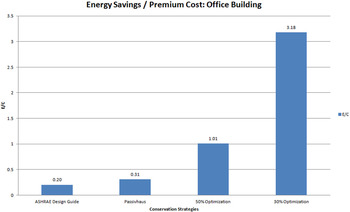
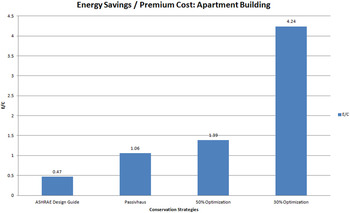
Analysis of the optimization routine to reach 50% energy savings shows that the algorithm starts by reducing energy loses by limiting infiltration into the building and in the middle steps further reduces the heating and cooling demand by decreasing the envelope conduction in the windows and walls. As the procedure climbs over 30% savings, the routine selects more solar thermal and photovoltaic energy generation technologies to reduce the overall energy consumption. The building envelope parameters are increased to the highest levels of accomplishment and the heating and cooling demand is reduced further such that the value of the solar thermal and photovoltaic panels for energy production diminishes and they are actually removed during the descent procedure. To compare the final results of how the optimization methodology performs at selecting energy-savings technologies against the prescriptive methodologies, we can compare their ability to maximize the ratio of energy savings divided by the premium cost ratio (Figs. 5 and 6).
Energy savings/premium cost for an office building.

Energy savings/premium cost for an apartment building.

3.4. Further applications
The optimization algorithm developed in this study could be extended as a tool to study hypothetical situations based on trends in technology development and price forecasting. The tool could be used to answer questions such as how much will the cost of a certain technology have to fall before its selection is advantageous over others of the same type? The optimization process could be made an integral part of performance-based energy codes, such that building owners would have more design alternatives than those listed in current (partly prescriptive) codes to develop energy-efficient buildings.
In the briefing and developing requirements stage, the optimization process could also be used to determine appropriate energy-savings targets given the owner's budget limit to spend on premium energy conservation measures.
The optimization tool could be even more powerful and widely applicable if cost data were published by manufacturers as openly as the physical characteristics of their systems. If the availability of cost data increased, then it would be possible to make more accurate longitudinal projections for cost increases such that net-present value could be transparently calculated along with the lifetime cost of operational energy use of the building. These lifetime costs could then be aggregated to transparently find total operations and maintenance costs for each technology combination. If the optimization target was shifted to minimize total energy cost expenditures rather than site energy use, then the modeling approach could be extended to include thermal storage technologies that reduce high-cost demand peaks.
The results from the optimization can also be used to make more informed general predictions about which combinations will produce cost-optimal solutions in buildings of similar size, type, function, and climate given a similar palette of technology parameters and cost information. The optimization approach could also be extended to select technologies for retrofit strategies to demonstrate a more cost-effective path to bringing existing buildings up to current levels of energy code compliance than generic prescriptive guidelines.
4. CONCLUSION
We introduced an optimization algorithm to maximize the ratio of energy savings divided by cost (E/C) of an energy-savings technology mix. The evaluation of the (E/C) ratio is applied to an apartment building and an office building located in Korea. The (E/C) ratio ranking demonstrates that existing prescriptive methodologies are much less efficient than the optimization algorithm at reducing the prototypical buildings’ EUI at the lowest premium cost (Figs. 5 and 6). The E/C ratio for 50% optimization in the office building is demonstrated to be a 3.25 times improvement over the Passivhaus Guide and a 5 times improvement over the ASHRAE Design Guide. For the apartment building, the 50% optimization demonstrates a 1.31 times improvement over the Passivhaus Guide and a 2.95 time increase over the ASHRAE Design Guide. The optimization methodology is shown to produce superior performance in terms of finding the lowest cost solutions to energy-savings targets for prototypical apartment and office buildings (Fig. 4). This result further reinforces the concept of performance-based thinking in that the performance indicator, EUI, is a function of all the building parameters and can be optimized only at the whole-building level rather than suboptimizing (or prescribing) a subset of technology components. Furthermore, this result identifies the weaknesses of prescriptive energy-savings methodologies in that they do not provide cost-efficient solutions to meet the energy-savings targets imposed by national energy codes and desired by building owners.
ACKNOWLEDGMENTS
We acknowledge the financial support of the Research Institute of Industrial Science & Technology, POSCO Global R&D Center, Korea.
Brian Simmons is an Energy Engineer with the energy analytics company Retroficiency in Boston. He holds a BArch from Southern Polytechnic and an MS from Georgia Institute of Technology. His research focuses on building design optimization, computational building simulation, and design decision making.
Matthias H.Y. Tan is an Assistant Professor in the Department of Systems Engineering and Engineering Management at the City University of Hong Kong. He holds an MEng degree from NUS and a PhD degree from Georgia Institute of Technology. His research interests include design and analysis of experiments and statistical quality improvement.
C.F. Jeff Wu is a Professor and Coca-Cola Chair in Engineering Statistics at the Stewart School of Industrial & Systems Engineering at the Georgia Institute of Technology. Dr. Wu received his BS in mathematics from National Taiwan University and his PhD in statistics from the University of California, Berkeley. He has served as editor or associate editor for several major statistical journals and has published more than 150 research articles in peer-reviewed journals.
Godfried Augenbroe is a Professor at Georgia Institute of Technology, where he directs the PhD and MS programs in High Performance Building in the School of Architecture. He has a 35-year track record in research and teaching in building performance simulation. His research covers topics in computational building simulation, performance-based design, uncertainty and risk analysis of building energy models, auditing and calibration, multiscale simulation, and normative assessment methods. Dr. Augenbroe has been the main advisor of 28 PhD theses, has chaired major international conferences, has served as associate editor of two scientific journals, and has published two books and over 200 refereed papers.