Introduction
The seeds of Anamirta cocculus, commonly known as Cocculus indicus, were already in use by Venetian sailors in the sixteenth century and by Norwegian sailors in the nineteenth century to treat seasickness.Reference Hänsel and Hänsel1 This tall, climbing shrub is indigenous to eastern India and the Malay Archipelago, where it is one of the major medicinal plants and has diverse applications as a folk remedy.Reference Morton2 Interestingly, by the nineteenth century, less scrupulous brewers added the seeds to illegally adulterate beer.Reference Drury3 Anamirta cocculus seeds contain about 1.5 per cent of an intensely bitter, crystalline principle, picrotoxin, which was first isolated in 1812 and is an easily purified equimolar mixture of readily separable toxic picrotoxinin and non-toxic picrotin.Reference Clark4 This phytopharmaceutical is a powerful convulsive substance that inhibits the effect of the neurotransmitter γ-aminobutyric acid (GABA). GABA receptors are distributed throughout the whole nervous system and vestibular organ.Reference Felix, Ehrenberger, Portmann and Aran5
Ehrenberger et al., 1982, were the first to report that even very small doses (1–5 mg) of picrotoxin slowly injected intravenously can suppress vertigo in patients with Ménière’s disease and other peripheral vestibular disorders.Reference Ehrenberger, Benkoe and Felix6 At that time, and even still today, the exact etiopathogenesis of Ménière’s disease is unclear and there is no causal therapy or universally applicable therapy concept. Current therapies aim primarily to alleviate symptoms, particularly the recurrent vertigo that massively reduces the quality of life for these patients and has secondary consequences such as social isolation, inability to work and depression. Since Ménière’s disease is a disease with great need for new therapeutic options, it is surprising that the clinical application of picrotoxin has not been examined in more depth.
The objective of this study is to systematically review and analyse the relevant literature about this phytopharmaceutical with reference to its effect on the vestibular system as well as its clinical application for vertigo control in Ménière’s disease and other peripheral vestibular disorders, thus bringing this naturally occurring chemical substance back into the spotlight and encouraging further research.
Methods
Search strategy and inclusion criteria
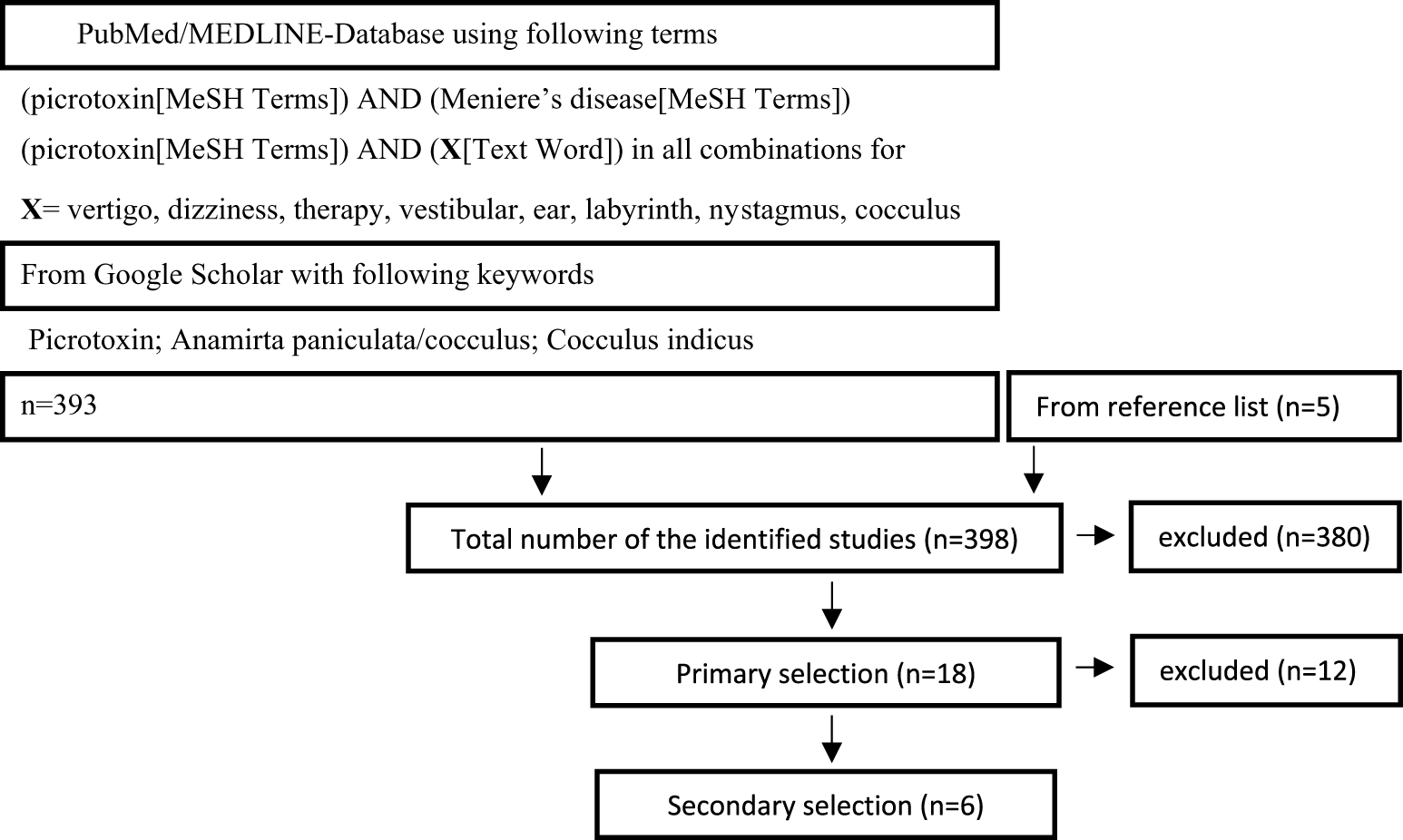
In this study, we followed the Preferred Reporting Items for Systematic Reviews and Meta-Analyses (‘PRISMA’).Reference Moher, Liberati, Tetzlaff and Altman7 The last search in PubMed/MEDLINE and Google Scholar was conducted on 1 December 2024, with a combination of relevant terms (Figure 1). In the first selection, all studies regarding the effect of picrotoxin on the vestibular system and vertigo were included. In the second selection, only studies that reported on the use of picrotoxin in humans for treatment of Ménière’s disease and other peripheral vestibular disorders were included. The data were clustered and descriptively analysed with focus on the following main outcome measures: vertigo control, pharmacological mechanism of action, administered dose and adverse reactions. In addition, case series from our clinic were retrospectively evaluated.
Flowchart of the search strategy and the study selection process.

Our own case series
A retrospective survey of all patients treated with suppositories containing 1-mg picrotoxin (hereinafter referred to as picrotoxin suppositories) at our outpatient department since January 2019 was carried out. From this point on, we implemented this therapeutic option for the treatment of Ménière’s disease. The patients were identified via the digital information system, which provided the diagnosis and the prescriptions issued in the balance clinic. The course of symptoms, duration of use and possible adverse reactions for each case were evaluated.
All patients fulfil the criteria for definite Ménière’s disease.Reference Lopez-Escamez, Carey, Chung, Goebel, Magnusson and Mandalà8 A stepwise therapeutic approach was followed.9 After betahistine and cinnarizine for at least three months and intratympanic dexamethasone (0.4 mg mixture of dexamethasone with hyaluronic acid once daily for three days) failed to control vertigo, non-destructive options such as saccotomy and picrotoxin suppositories (off-label use) together with medical and surgical ablation of the vestibular organ were discussed with the patients.
The suppositories are currently not available as an approved medical product, therefore they were prepared according to a detailed medical prescriptionReference Segel10 by the same pharmacy as for the study by Weikert et al.Reference Weikert, Rotter, Scherer and Hölzl11 Before prescription, each patient was informed in detail about the special nature of this off-label therapy and the clinical experience reported in the literature with this plant-derived natural product. Patients were asked about epilepsy, history of any unexplained seizures or family predisposition, which we considered as contraindication. Women were particularly informed that they should not use the suppositories when planning or during pregnancy.
Results
Following the above-mentioned search strategy, 398 relevant studies, published between 1931 and 2024, were identified (Figure 1).
Primary selection
Eighteen papers were identified at the end of the first screening process. Studies that investigated the effect of commercially available medications on vertigo in which Cocculus indicus is part of a combined preparation were excluded. A study in which no significant effect of Cocculus indicus compared to placebo on motion sickness symptoms was observed, also was excluded because of the high homeopathic dilution (6CH) used.Reference Lucertini, Mirante, Casagrande, Trivelloni and Lugli12
Secondary selection
The findings of the six clinical studies in the final selection are summarised in Table 1.Reference Ehrenberger, Benkoe and Felix6, Reference Weikert, Rotter, Scherer and Hölzl11, Reference Ehrenberger and Felix13–Reference Zabaneh, Majerus, Olze and Stölzel17 The excluded studies, which are basic research about the pharmacological mechanism, are summarised in Table 2.Reference Cortes, Galindo, Galicia, Cebada and Flores18–Reference Vega, Soto, Budelli and González-Estrada28 One paper was not listed in Table 1 because the authors mentioned the use of picrotoxin suppositories as a treatment option for Ménière’s disease without presenting their own results.Reference Helling and Scherer29 The authors recommended gradually reducing the initial dosage of picrotoxin suppositories from 1 mg daily to 1 mg weekly as a long-term therapy.
Treatment of vertigo with picrotoxin in patients

* Total number of patients, divided in two groups with peripheral and central spontaneous nystagmus; V↓ = reduction of vertigo; SN↓ = decreased rate of spontaneous nystagmus; supp. = suppositories; i.v. = intravenously; f = female; m = male; ≈ is no significant effect.
Pharmacological effect of picrotoxin on the vestibular system in basic research

One of the studies is prospectively randomised and reports about significantly better outcome on vertigo of picrotoxin in comparison to betahistine in patients with Ménière’s disease (p < 0.00 for attack frequency and p = 0.019 for attack intensity).Reference Weikert, Rotter, Scherer and Hölzl11 One dissertation evaluated the effect of picrotoxin on physiologic, experimental and pathological nystagmus.Reference Enke14 One conference paperReference Zabaneh, Majerus, Olze and Stölzel17 as well as our case series were also included. In total, 203 patients received picrotoxin; 85 of them were treated for vertigo with picrotoxin suppositories and a reduction of vertigo intensity and frequency was reported in 74.9 per cent. In all clinical studies the picrotoxin dose in the suppositories is reported to be 1 mg.Reference Weikert, Rotter, Scherer and Hölzl11, Reference Streinzer, Neuwirth-Riedl, Zrunek, Rasinger, Fürpass, Ehrenberger and Majer15–Reference Zabaneh, Majerus, Olze and Stölzel17 The highest total picrotoxin dose that has been continuously infused in patients with peripheral vestibular disorder was reported to be 50 mg.Reference Ehrenberger, Benkoe and Felix6
Most of the limited knowledge about the clinical experience with picrotoxin is scattered in literature sources in the German language, not only as original articles but also as book chapters, a conference paper and a dissertation, which cannot be found directly via core databases. Only two reports were published in English.Reference Ehrenberger, Benkoe and Felix6, Reference Ehrenberger and Felix13
All reports on picrotoxin application for vertigo control originate from authors affiliated with two clinical centres. The first study 40 years ago and later ones are published from a research team associated with Klaus Ehrenberger, who was head of the otolaryngology department at the Vienna University Hospital.Reference Felix, Ehrenberger, Portmann and Aran5, Reference Ehrenberger, Benkoe and Felix6, Reference Ehrenberger and Felix13, Reference Streinzer, Neuwirth-Riedl, Zrunek, Rasinger, Fürpass, Ehrenberger and Majer15, Reference Felix and Ehrenberger19, Reference Ehrenberger30–Reference Felix, Ehrenberger and Drescher32 The remaining studies were published later by physicians trained by Hans Scherer, who was the chairman of the Charité University Hospital Berlin at the time.Reference Weikert, Rotter, Scherer and Hölzl11, Reference Weikert16, Reference Zabaneh, Majerus, Olze and Stölzel17, Reference Ariel, Robinson and Knapp33, Reference Scherer34 In both clinics, picrotoxin had become an integral part of the therapy regimen for peripheral vestibular disorders.Reference Streinzer, Neuwirth-Riedl, Zrunek, Rasinger, Fürpass, Ehrenberger and Majer15, Reference Helling and Scherer29, Reference Ehrenberger, Felix and Westhofen31 In his dissertation, Enke reported adverse reactions such as momentary black-out, delayed optical and tactile hallucination and headache in one patient after a cumulative dose of 9 mg administered intravenously for approximately 2 hours.Reference Enke14 Several subjects felt increased alertness. In the study of Steinzer et al., three patients described unsteadiness as walking on clouds. There were no reports of adverse reactions associated with picrotoxin suppositories or severe or irreversible adverse reactions in long-term therapy (up to 18 years).Reference Zabaneh, Majerus, Olze and Stölzel17
Our own case series
Our case series (n = 14) is supplemented in Table 1. Mean duration of therapy is 4.2 years (0.2–15 years range). Four patients had a cochlear implant on the affected side. One patient, a dance teacher, underwent cochlear implantation on the affected ear because of profound low-frequency hearing loss. More than a year later she began to have frequent vertigo attacks (at least three times a week) accompanied by ear fullness and tinnitus exacerbation on the implanted ear. Five patients had already undergone a saccotomy prior to picrotoxin, however, the dizziness-free interval only lasted a few months or up to a year. The intensity of vertigo from 10 patients (71.4 per cent) was reported to be significantly reduced, allowing them to carry out their daily life activities. They described the picrotoxin effect on vertigo as making it bearable by reducing the intensity of the attacks. There was no subjective benefit concerning fluctuating hearing, tinnitus or fullness of the ear. The patients only noticed the effect after a few weeks. No reliable information was possible retrospectively about the change in attack frequency, as this fluctuates strongly during the course of Ménière’s disease. One patient, whose therapy was initiated in another clinic, had already received the suppositories for almost 15 years. All patients are undergoing outpatient follow-up care.
Discussion
This study is the first review that evaluates the application of picrotoxin for treatment of vertigo. It summarises the literature not only about the effect of this phytopharmaceutical on patients with Ménière’s disease and other peripheral vestibular disorders, but also provides insights into basic research findings that seek to explain its mechanism of action.
Vertigo control in Ménière’s disease
Vertigo attacks in Ménière’s disease are the result of the unstable function of the vestibular organ. Reduction of vertigo intensity and frequency of attacks are prerequisite for better social integration of these patients. The interindividual variability and unpredictability of the course of this disease, as well as the possibility for spontaneous remission, undermine the significance of control groups in the clinical research. However, without a reliable control group, it is not possible to demonstrate the success of any treatment option and an undisputed therapeutic option for Ménière’s disease is therefore yet to be established.
The common stepwise therapeutic strategy initially includes options that aim to stabilise the vestibular organ function such as intratympanic dexamethasone application or saccotomy. If these have no effect, then irreversible destructive options such as intratympanic gentamicin application, surgical labyrinth ablation or selective neurectomy come into consideration. Since no definitive distinction between Ménière’s disease and vestibular migraine is possible,Reference Murofushi, Tsubota, Kitao and Yoshimura35 destructive therapies should be used as a last resort. Moreover, in up to 78 per cent of these patients, involvement of the contralateral ear can occur metachronous over time.Reference Pérez-Carbonell, Orts-Alborch, Pla-Gil, Pérez-Guilén, Tenías-Burrillo and Marco-Algarra36 Patients with synchronous bilateral disease involvement are optimal candidates because it is often hard to determine which vestibular organ is actually involved in the vertigo attacks.
Our clinical results with picrotoxin suppositories support the findings in the literature. The subjective reduction rate of vertigo is similar in all case series with Ménière’s disease. This therapeutic option could be especially beneficial to patients with recurring Ménière’s disease after cochlear implantation because the round-window niche is obstructed by the electrode array and intratympanic treatment is not an option and surgery carries risks for implant damage, electrode dislocation or injury of the cochlear nerve.
Picrotoxin meets all the requirements as a therapeutic option in the stepwise therapy for Ménière’s disease. Its effect has been well studied in basic research. As a commercial drug, it has been in clinical use for a long time. The toxic dose is known, and no considerable irreversible adverse reactions have been reported for the recommended administration dose. Although this therapeutic option for Ménière’s disease has been mentioned in medical books,Reference Scherer34, Reference Schaaf37 its clinical application has found limited spread in the literature and the otolaryngology community. This is potentially due to the lack of a commercially available medical product that is officially approved for this application. The lack of such a medication despite the favourable picrotoxin profile is most likely due to cost considerations; not the cost of the phytopharmaceutical itself, which is easy to obtain and inexpensive with a current market price 1 mg picrotoxin costs only a few cents, but rather, as already suggested by Weikert et al., the cost for regulatory development and approval as a drug for the treatment of peripheral vestibular disorders would not be commensurate with the expected financial benefit.Reference Weikert, Rotter, Scherer and Hölzl11
Placebo (52.5 per cent) and nocebo (42.3 per cent) effects, which are huge problems for the evaluation of therapeutic options in randomised controlled trials on patients with Ménière’s disease, should also be considered.Reference Dimitriadis and Zis38, Reference Taniguchi, Sutton, Mills, Nguyen, Rizk and Meyer39 Since no such study about picrotoxin has been published, we cannot fully exclude that both effects may also play a role for subjective vertigo reduction. In all reviewed case series, symptom relief was considerably better than the above-mentioned percentage values. However, given the small number of papers and relatively small cohort of patients, we cannot draw a definitive conclusion about the effectiveness of picrotoxin.
Dose, adverse reactions, contraindications
In emergency medicine picrotoxin was the drug of first choice during the 1930s and 1950s as an antidote for massive overdose of short-, intermediate- or long-acting barbiturates.Reference Wax40 There were also commercially available products.Reference Bause41 The initial recommended dose was 25 mg intravenously followed by 15 mg every 15 minutes until there was evidence of complete awakening.Reference Koppanyi and Fazekas42 Because of the very narrow therapeutic window, picrotoxin was subsequently replaced by new synthetic analeptics and then used exclusively in basic research.
It is not clear why a dose of 1 mg for picrotoxin suppositories was chosen. This empiric dose was not adjusted for body weight in any of the studies, as in our case series, and is well below the known convulsive dose in animals. In macaques, 1 mg/kg picrotoxin subcutaneously had no noticeable motor hyperactivity and 2 mg/kg led to grand mal convulsions.Reference Gavin and Blair21 In humans no manifest convulsion was observed with infusion rate under 1 mg picrotoxin/min.Reference Ehrenberger, Benkoe and Felix6 Furthermore, it should be considered that the picrotoxin effect in humans probably has a large variation similar to that in animals, even at the same dose.Reference Munch and Ponce43
Ito et al. reported that treatment of rats with subconvulsive dose (3 mg/kg i.p. daily for 10 days) led to a delayed onset of convulsion and increased time to death after application of lethal dose compared to control animals.Reference Ito, Lim, Nabeshima and Ho44 The authors explained this response with possible down-regulation of the picrotoxin binding site. Although these experimental values cannot be directly transferred to humans, they raise questions regarding the long-term effect of the picrotoxin suppositories. The one patient in our case, who has been taking picrotoxin suppositories for 15 years, did not have any relevant attacks since receiving this medication and had no associated adverse reactions. We advised the patient to try without the medication for a time, but she refused.
There are no reports of any significant long-term sequelae such as cognitive dysfunction or spontaneous recurrent seizures after acute intoxication with picrotoxin when it was used in humans as a drug and later as a pharmacological tool in rodents.Reference Pressly, Vasylieva, Barnych, Singh, Singh and Bruun45 However, it has been reported that treatments with subconvulsive doses of picrotoxin can cause development of susceptibility to seizures in rats.Reference Cain46 Interestingly, treatment of Down syndrome and Alzheimer’s disease mice models with non-convulsant doses can help restore cognitive function.Reference Fernandez, Morishita, Zuniga, Nguyen, Blank and Malenka47, Reference Yoshiike, Kimura, Yamashita, Furudate, Mizoroki and Murayama48 Exposure to picrotoxin during the embryonic period could induce autism-like disorders with social deficits in male mice (5 mg/kg i.p.)Reference Kotajima-Murakami, Hagihara, Sato, Hagino, Tanaka and Katoh49 and aberrant sexual behaviours in male rats (0.75 mg/kg subcutaneously).Reference Teodorov, Habr-Alencar, Sider, Felicio, Varoli and Bernardi50 Even if the dose of 1 mg in the suppositories is well below the values given in laboratory animals, its prescription, especially in women of reproductive age, requires special information and due diligence.
Mechanism of action, research gaps and controversies in the literature
The number of publications with the key word picrotoxin had a relatively stable plateau for about 30 years since the beginning of the 1990s. Research interest in this substance has declined steadily in the last 10 years. A possible explanation for this is the discovery of new, even more selective substances as pharmacological tools to inhibit GABA type A (GABAA) receptor-mediated chloride currents.Reference Pressly, Vasylieva, Barnych, Singh, Singh and Bruun45
To understand the effect of picrotoxin on the vestibular system, we must identify its site of action. By antagonising the GABAA receptor picrotoxin modifies the GABA effect on the intrinsic Cl− channel.Reference Pantoja, Holt and Guth26 Flock and Lam, 1972, were the first to suggest that GABA is an afferent neurotransmitter in the peripheral vestibular organs.Reference Flock and Lam20 Felix and Ehrenberger observed an excitatory effect in cat macular afferent fibres caused by GABA.Reference Felix and Ehrenberger19 However, basic research studies in the following decades showed contradictory results; while some of them confirmed this suggestion,Reference Meza51, Reference López, Wu and Meza52 others showed opposite results.Reference Cortes, Galindo, Galicia, Cebada and Flores18, Reference Guth and Norris22, Reference Vega, Soto, Budelli and González-Estrada28 The clinical effect of picrotoxin is most likely due to modulation of the afferent transmission of the hair cells in the vestibular organ.Reference Vega, Soto, Budelli and González-Estrada28
It is not definitively clear whether picrotoxin influences vertigo solely due to its effect on the vestibular organ or whether it also affects the vestibular centres. Felix and Ehrenberger hypothesised that the reduction of peripheral spontaneous nystagmus by picrotoxin might be due to a raised excitability threshold of the labyrinths on both sides, which could decrease the absolute value of tonic difference.Reference Felix, Ehrenberger and Drescher32 In other words, the blockade of chlorine-ion current of the GABA receptors could reduce the vertigo-inducing intra-aural differences during labyrinthine excitations.Reference Ehrenberger, Felix and Westhofen31 While he counted the spontaneous nystagmus beats, Enke measured the slow phase nystagmus velocity after caloric, optokinetic and rotary chair testing in his dissertation and saw no significant nystagmus or subjective vertigo reduction in healthy individuals.Reference Enke14 The three patients with acute peripheral vestibulopathy also did not report any vertigo relief after administration of 6 mg picrotoxin intravenously. Moreover, they had increased slow phase velocity of spontaneous nystagmus compared to the other two placebo-controlled patients.
These discrepancies could be a result of the dose-dependent peripheral action of picrotoxin. Felix and Ehrenberger suggested that the prolonged peripheral vestibular effect without any central analeptic effect could be due to accumulation of picrotoxin in lower doses in the inner ear.Reference Felix, Ehrenberger and Drescher32 Similar to ototoxic antibiotics, as demonstrated from Stupp et al., picrotoxin probably achieves high concentration in the lymphatic fluid and is retained there for a long time.Reference Stupp, Küpper, Lagler, Sous and Quante53 This speculation about picrotoxin could be investigated in future studies with a similar study design. Furthermore, as picrotoxin is water-soluble,Reference Munch and Ponce43, Reference Zolkowska, Banks, Dhir, Inceoglu, Sanborn and McCoy54 it would be useful to test its effect on laboratory animals after intratympanic administration. In this way the topography of the picrotoxin action could be better investigated. A similar idea has been investigated by Ariel et al. in ophthalmic research.Reference Ariel, Robinson and Knapp33 Intravitreal picrotoxin injection in cats induced spontaneous nystagmus, which could be mediated subcortically.
Since GABA is known to be the major inhibitory neurotransmitter in the central nervous system, it is puzzling that it is supposed to act on an excitatory synapse of the peripheral vestibular system. Meza explained this finding with the possible existence of a mixed GABAA–GABAC receptor. GABAC is known as the first expressed receptor in evolution, which corresponds to the fact that the vestibular organ was the first sensory organ to evolve.Reference Meza51 Pin-pointing the role of picrotoxin on the vestibular system becomes more difficult given that it also modulates the activity of the dominant transmitter of the efferent synapses (type II hair cells) and its action on the saccule differs from that on the semicircular canals.Reference Pantoja, Holt and Guth26
Finally, this study summarises the basic research about the effect of picrotoxin on the vestibular system, highlighting the lack of knowledge and controversial results. Furthermore, it simplifies literature search and gives this topic the attention it deserves.
• Picrotoxin is a powerful convulsive substance that inhibits the effect of the neurotransmitter GABA
• In a prospectively randomised study 1 mg picrotoxin suppositories have significantly better outcome on vertigo in comparison to betahistine in patients with Ménière’s disease
• Vertigo intensity and frequency could be reduced in 74.9 per cent of patients treated with this treatment option
• There were no adverse reactions associated with picrotoxin suppositories, nor severe or irreversible adverse reactions in long-term therapy (up to 18 years)
• The small cohort of patients and controversies in the literature allow no definitive conclusion about its effectiveness
• This phytopharmaceutical has the potential for wider implementation for long-term vertigo control in Ménière’s disease
Conclusion
Available clinical data and the authors’ own experiences with picrotoxin suppositories do not correspond with the limited attention that this phytopharmaceutical substance has received in the literature. It has the potential for wider implementation for long-term vertigo control of Ménière’s disease and is particularly well suited for patients with a cochlear implant on the affected ear or bilateral involvement. The main limitation factor for its widespread adoption most likely is the fact that there is no commercially available product on the market.
Acknowledgments
The authors would like to thank Prof. Dr. Michael Schirner and Dr. Anja Lieder for their support in proofreading of the manuscript.
Funding statement
This research received no specific grant from any funding agency in the public, commercial or not-for-profit sectors.
Competing interests
The authors have no personal, financial or institutional conflict of interest.
Ethical standards
Informed consent was obtained from each patient in our case series.