


In July 1949, a national emergency was declared, and five thousand troops were sent to the border between Mexico and the United States to impede unauthorized crossings. While this might sound astonishingly familiar in today’s political context in the United States, back then it was the Mexican government taking action to try to keep its citizens from leaving their own country. At the time—and again in 1953—there was a labor shortage in Mexico’s northern agricultural fields, and the military was set in to “turn Mexican migrants into Mexican workers” (Hernández 2006, 434). These crises happened during complications regarding a binational guest worker agreement known as the Bracero Program that was established in 1942 in response to labor shortages in the United States related to World War II. It was a time when elite discussions about the benefits and pitfalls of the Mexican Revolution (1910–1920) were still happening, and there was a wealth of opinions and positions concerning the “problem” of emigration in relation to the nation. Focusing on discourses against Mexicans leaving their own country—espoused by the most relevant institutions at the time (government and Catholic Church)—this article delves into this point in history to examine how migration to the United States became politicized in Mexico.Footnote 1
After the Mexican Revolution and with it the official end of autocratic rule in Mexico, many Mexican intellectuals, artists, scholars, and politicians were discussing which path the nation should take, Mexico’s place in the world, and what it meant to be Mexican.Footnote 2 In this context, the growing flow of Mexican migrants seeking temporary agricultural jobs in the United States presented a “grave problem” that needed to be dealt with in political and ideological terms. In this article, I discuss the conservative treatment of this issue in the Jalisco newspaper El Informador, the oldest and most influential newspaper in Mexico’s mid-twentieth century West, where, in contrast to other parts of Mexico, people had been seeking temporary jobs in the United States for over half a century. I home in on the “exclusive contributions” of two prominent, ultraconservative intellectuals and writers: Jesús Guisa y Azevedo and Nemesio García Naranjo, to discern the kinds of arguments about labor migration from Mexico to the United States that were widely mobilized at the time. In the context of postrevolutionary nation building in Mexico, conservative critiques and the vilification of migration to the United States were attempts to attack the revolutionary project that was trying to dismantle structures of power that had prevailed since Porfirian times (1876–1911), threatening conservatives’ privilege and, as a result, politicizing migration.Footnote 3 The effects of such politicization (e.g., morally based suspicions of migrants, doubts about national allegiance, unequal access to state resources) continue to reverberate today (Dick Reference Dick2018; Fitzgerald Reference Fitzgerald2008).
The emphasis of this work is on migration as a political problem, not only an economic adaptive strategy, a last resort, or an inevitable flight from certain death. This perspective allows me to ask what makes migration such an “easy” political tool and target for the mobilization of nationalist discourse and sentiment, in an effort to better understand the relationship between migration, ideology, and nation building.
The emergence of an emigration “problem”
The beginnings of Mexican labor migration to the United States happened at a time of social turmoil and deep change in Mexico. The Mexican Revolution promised the end of autocracy and also social justice and well-being for all. The new government was trying to forge a country that would be radically different from the past colonial structures that concentrated wealth, land, and political power in the hands of elites and the Catholic Church. This also meant thinking about who Mexicans were and which resources—past and present—could help them think about themselves and their future as a nation. Intellectuals thought of this mainly in terms of oppositions: Spanish-colonial versus Mexican versus Indigenous versus Mestizo versus Yankee (and in various combinations).
While the elevation of a “true” and valuable Mexicanness during the postrevolutionary period (1920s–1940s) countered the Porfirian push for foreign investment to achieve national development (Lomnitz Reference Lomnitz2010), Hillary Parsons Dick (Reference Dick2018) has argued that, concerning Mexicans who were heading north of the border, there were points of “ideological resemblance” between the new government and the past autocracy: “The ‘celebration’ of lo mexicano took shape in express contrast with images of life in the United States, so that ‘being Mexican’ is about what the United States is not. The creation of this absolute difference between Mexico and the United States helped negate egalitarian, transnational imaginaries and legitimate the variegation of belonging in Mexico by construing migrants as morally flawed” (Dick Reference Dick2018, 66). Dick shows that such state-endorsed imaginaries were produced and re-created over time, turning migrants into second-class citizens by equating migration to the United States with moral failing, and resulting in a “hierarchy of belonging in which some people are citizens but not fully members of the polity” (14). This can also be described as a moralization of border crossing that assumes that migration to the United States necessarily entails a change in character and subjectivity, a point that is fundamental to understanding the conditions of possibility for migration to the United States to become politicized. Here I provide a detailed look at the arguments that were wielded against emigration at this point in time to better understand the political stakes and the interests involved in the formation of imaginaries about migration across generations.
Further, the posture described here echoes the narratives against emigration that were produced by the Catholic Church in Mexico’s postrevolutionary era. Such discourses were woven together mainly by equating migration to the United States with moral corruption, family disintegration, and loss of the “true” (meaning Catholic) faith. In the 1920s migrants were accused of “‘enhancing the decadence of the fatherland,’ of magnifying with their labor a ‘nation that has always been considered an enemy of ours [Mexico]’ and source of ‘our biggest national misfortunes.’ The archbishop [of Guadalajara] claimed that migrants disrupted the social order because they arrived spreading ‘the customs of that country [the US], its diversions, its language and even its vices’” (Espinosa Reference Espinosa1999, 391). Victor Espinosa (Reference Espinosa1999, 390) argues that parish priests working in towns with high levels of migration were the earliest to be alarmed about “their flock” leaving to the United States, since migrants were thought to return with “too much money,” “weird behavior” and “changed ideas” that challenged local values and hierarchy structures (see also Fitzgerald Reference Fitzgerald2008).Footnote 4
Furthermore, Mexicans’ migration to the north was purportedly strengthening the US economy while weakening Mexico’s. Emigration was often described in terms of a sangría—loss of blood or bloodletting—that drained the virility and viability of the Mexican nation.
During the Mexican Revolution, around 25,000 Mexicans left for the United States each year. In addition, during World War I (1917–1918), the United States government facilitated the emigration of approximately 72,862 Mexicans to fill crucial positions in the industrial and agricultural sectors (Torres Ramírez Reference Torres Ramírez1983, 249; Alanís Enciso Reference Alanís Enciso2001, 205). At the same time, attempts to curb such flows date back to the turn of the century, during the Porfiriato (1876–1910). They consisted mainly of appeals to patriotism and warnings about the mistreatment and dangers emigrants would face during the journey and later in the United States (Alanís Enciso Reference Alanís Enciso2001; Cohen Reference Cohen2001).
The first attempt to regulate such exits through legislation was in the Constitution of 1917. Alanís Enciso (Reference Alanís Enciso2001, 206) argues that the preoccupation with laying down laws about emigration is evidence of the magnitude of the phenomenon in the early twentieth century, as well as its place as “an issue of national importance” that needed to be attended to. Concerning the emigration of Mexicans to the United States, the 1917 Constitution mainly sought to establish rights and responsibilities of all parties involved in order to shield Mexicans from abuse (Torres Ramírez Reference Torres Ramírez1983; Alanís Enciso Reference Alanís Enciso2001). It prohibited their leaving Mexico without a labor contract—which effectively turned clandestine labor emigration into a violation of Mexican law—it established the employer as responsible for the expenses of repatriation, and it called for workers to be paid a minimum wage and to receive employer-provided access to medical services. Some portrayed return as a “moral and nationalist duty,” although the Mexican government did little to aid such repatriation efforts (Alanís Enciso Reference Alanís Enciso2001; Minian Reference Minian2018).
Attempts by the government to stop clandestine migration through outlawing it or refusing to expedite migratory documents proved futile, which led Alanís Enciso (Reference Alanís Enciso2001, 225) to conclude that the main characteristic of Mexican state politics concerning emigration at the time was a marked distance between legislation and reality. This rift is addressed in the pages of El Informador in the form of a harsh critique of the government’s appeals to patriotism while also denying citizens decent-paying jobs and paths for social mobility.
But the divide between the new laws and the reality of Mexican society went far beyond the issue of emigration. The schism between the direction the new government was trying to veer in and broad sections of Mexican society came to a violent outbreak in 1926 that turned into a three-year conflict known as the Cristero War. The detonator of this rebellion was the attempt by then president Plutarco Elías Calles to enforce anticlerical laws and eradicate the influence of the Catholic Church in the country. Espinosa (Reference Espinosa1999, 392) argues that the need for many Catholic priests to seek refuge in the United States during the Cristero War and ensuing social networks produced a discursive change in the church: Migrants ceased to be labeled “apátridas y facetos” (unpatriotic and presumptuous) and became “hijos ausentes” (absent sons).
However, despite widespread discussion and policies against the emigration of Mexicans to the United States in the first three decades of the twentieth century, people kept leaving—with or without the permission of church and state. The public debate increased dramatically during the breakdown of the Bracero Accord negotiations in 1949 and 1953. In the following section, I examine how Mexican labor emigration to the United States was portrayed and discussed at the time in the pages of Guadalajara’s newspaper El Informador.
The emigration “crisis” in Jalisco’s biggest newspaper
El Informador is a newspaper that was founded in Guadalajara, Jalisco in 1917 by local businessman and journalist Jesús Álvarez del Castillo Velasco (1881–1966). With the Mexican Revolution in its final stages, it was a time of social upheaval, uncertainty, and ideological disagreement concerning the country’s future. Álvarez del Castillo was chief editor of El Informador until his death, receiving the Maria Moors Cabot Prize (awarded by Columbia University’s journalism school) in 1953 for his work. The paper quickly became “by far the most influential and powerful” daily newspaper in the city, and the most important journalistic publication in Mexico’s West (Casillas Báez Reference Casillas Báez, Venegas Delgado, Hernández López, Ábregas Puig, Valdés Dávila and Casillas Báez Venegas2010, 317). As the most widely read newspaper in the region, El Informador also was an important voice in national political debates (Fregoso Centeno Reference Fregoso Centeno2009).
In the following, I look at columns published in El Informador between 1949 and 1954 to analyze debates and opinions concerning the “emigration crisis.” The topic of labor emigration was often discussed in the paper’s “Editorial” section, in “Comments of the Day,” and in opinion columns by “special contributors,” and it also came up in “Police News.” Emigration was also the subject of front-page headlines, especially when addressing the state of negotiations of the Bracero accords and the “grave,” binational “problem” of unauthorized migration.Footnote 5
In the late 1940s and early 1950s a real struggle emerges in the articles that deal with Mexican labor emigration to the US in general, and with the “Bracero problem” in particular.Footnote 6 The most prominent perspective in El Informador is Catholic, anti-emigration, and anti-government. Isidro Fabela and others protested that Mexico ought to be “a country of immigration, not of emigration,” arguing that Mexico could not afford to lose able-bodied workers in its struggle to become a modern and prosperous nation, and that its vast territory should be populated by white European immigrants to “complete the population” and “in benefit of our race” (Fabela Reference Fabela1953).Footnote 7 Such whitening, tied to demographic growth, would bring modernity within reach.Footnote 8 Labor emigration to the United States was depicted as unnecessary and thus unpatriotic. The Mexican state should not allow the emigration of laboring men, who were “abandoning land, workshop and jobs in order to join the army of Mexicans who go to implore as if it was a blessing, to be welcomed in US territory and be given a job” (Fabela Reference Fabela1953). Labor emigration to the United States, and especially clandestine border crossings, was not only harmful for the economy but also denigrating to the nation as a whole (Figure 1).
Front-page headline, El Informador, August 18, 1953: “‘Wetbacks’ Are a Grave Problem”

Figure 1. Long description
The front page of a newspaper titled ‘EL INFORMADOR’ with the subtitle ‘DIARIO INDEPENDIENTE’. The date is March 18 of August 1953. The main headline reads ‘Los “Espaldas Mojadas” son un Grave Problema’. Below the main headline, there are several subheadlines and articles. One subheadline reads ‘E. U. CREE QUE AMERICA LATINA ES FACIL PRESA DEL COMUNISMO’. Another subheadline states ‘Deben Terminar las Propuesta Huelgas en Francia que no Aceptan’. There are multiple columns with text in Spanish, including advertisements and other news articles. The layout includes various sections with different font sizes and styles, highlighting important information.
By the mid-twentieth century, a significant community of Mexicans already lived in the southwestern United States, and this began to present a “problem” concerning national belonging and allegiance. The suspicion fomented by those living outside the confines of the Mexican nation-state created a need to reaffirm belonging in different ways. On September 13, 1953, then secretary of state Ángel Carvajal traveled to Los Angeles to participate in the celebrations of Mexican independence from Spain (1821). On this occasion, he affirmed: “Mexico does not forget its sons that live outside of the national territory, … it still sees them as a part of the great organism that is the Mexican population who—directly or indirectly—fight for the exaltation of the Fatherland and for the prestige of the Mexican nation in the exterior … Mexico awaits the return of all the absentees to reincorporate themselves into the Mexican family, which is in charge of forging a firmer destiny for the Fatherland.”Footnote 9
This rather reassuring statement by a government official congeals the notion that all Mexicans are part of a single family, the Mexican nation, and that they should always bring honor to their family, never desert it. Most of the conservative intellectuals who contributed to the pages of El Informador had harsher words. In a “special collaboration” column entitled “Braceros? Children Should Not Leave Home!” Salvador Navarro Aceves (Reference Navarro Aceves1954) compares Mexican labor migrants to children who, following adventurous fantasies, foolishly abandon their parents’ home. With an abundance of pathos, he decries the anxiety such departures cause parents, after these have done their best to shield their children from suffering and pain, imbued them with tradition and family values, and tried to save them from false illusions and the attraction exerted by exotic tales they might hear from friends or strangers. He attributes the desire and act of leaving to ignorance and naive ambition: “The Mexican land is the great home of Mexicans. Its children, those who belong to the ignorant masses, possess the qualities of vigor for labor and noble aspirations, but lack the course of a firm education, of a clear concept of what life is like in foreign lands and it is they who, without previous knowledge and lack of certainty of the exact truth, leave in hopeful caravans, in search of horizons that are neither secure nor definitive: they go to earn a hypothetically abundant bread, and some clothes of a modern parvenu.”Footnote 10
According to Navarro Aceves, the price migrants pay is higher than what healthy morals permit. Even worse, coming from Mexico, a country “where they are free like the birds, they leave to be exposed to segregation by color and discrimination due to their rudimentary habits.” Migrants are portrayed in this piece as being unaware of the “extent of moral suffering [they will be exposed to]: the legal rigor with which their transgressions are met, their abandonment when sick and miserable, [and] the infinite nostalgia for their land, where everyone speaks the same language and feels with the same heart” (Navarro Aceves Reference Navarro Aceves1954). This depiction of Mexico as a benign, homogeneous, and nurturing Motherland to which not only a social debt is owed, but also the most profound and patriotic commitment, is commonplace in conservative critiques of migrants, who are seen as sole bearers of an individual responsibility for their movement across borders.Footnote 11
This assessment is closely tied to another widespread idea that we find in the pages of El Informador, namely, that Mexicans weren’t leaving their home country because of sheer necessity, miserable living conditions, or lack of employment opportunities, but in search of adventure or “because they want to save their daily wages to amass a little capital” (Fabela Reference Fabela1953). The latter is deemed as “legitimate” but ultimately “sad” for Mexico, because once migrants find themselves better dressed, better fed, and better paid, the perspective of returning to Mexico becomes grim, prompting many to stay on the US side of the border, bearing American children and thus draining the country from “blood of our blood.”Footnote 12 This situation, according to Isidro Fabela (Reference Fabela1953), will have catastrophic consequences for the Mexican economy because “every man that leaves is capital that gets lost.”
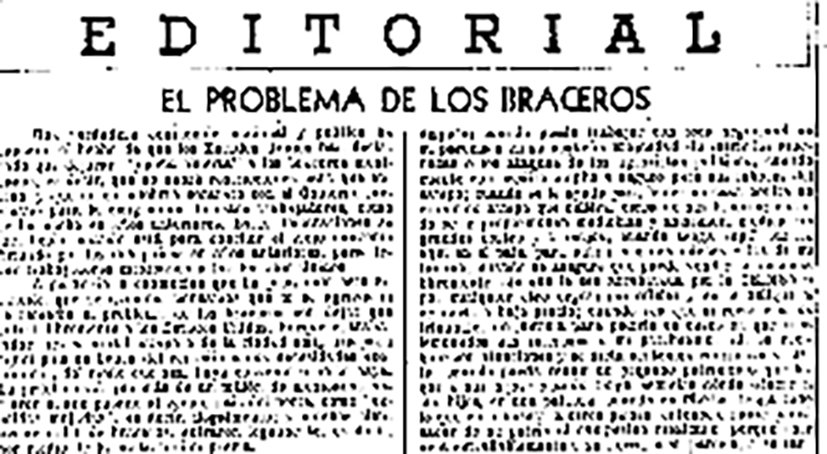
In this scenario, the Mexican government was often portrayed as “having its hands tied”—similar to what Deborah Cohen (Reference Cohen2001, 115) discusses as very low negotiating leverage of a “subaltern state”—because desperate workers were willing to cross the border clandestinely and because Mexico didn’t have enough military or employees to police the border and impede surreptitious crossings. Often, the “solution” to the “Bracero problem” is framed as an interpellation of the potential labor migrants, reminding them of their patriotic duty to remain within the limits of the burgeoning Mexican nation. Furthermore, El Informador’s conservative journalists made appeals to Catholic principles such as the integrity of the nuclear family, which had been harmed by the long absences of young men who were constantly subject to various “ungodly” temptations, such as women, drugs, and Protestantism (Figure 2).Footnote 13
Editorial, “The Bracero Problem,” January 16, 1954

In an editorial from August 27, 1953, that takes the US perspective into account, the issue is described as a matter of policing. It is reported that then attorney general Herbert Brownell had traveled along the southern border to assess the “very grave problem” of the “Wetbacks.” He seemed scandalized by the extent of illegal crossings of Mexican workers, citing 839,000 apprehensions during the 1952 fiscal year. He also asserted that “neither of the two governments is doing enough” to stop the trend, and that the problem persisted due to insufficient Border Patrol personnel. The editorial continues to report that Brownell had already formulated a “viable project” to stop the “avalanche of braceros,” which consisted of reinforcing the Border Patrol with military help. However, the editorial asserts, while this situation represented a problem for the US government because it constitutes a violation of its laws, for Mexico, the issue was much graver, since the “constant drainage [sangría] of peasants” was leaving the countryside empty, alarmingly reducing national agricultural production.Footnote 14
The weighing of costs for one country versus those for the other is a frequent discursive move in the Informador’s contributors’ analysis of the “Bracero problem.” Unsurprisingly, Mexico comes out as having the short end of the stick. In the “Comentarios al Día” of August 27, 1953, some thought it suitable to compare “invasions” when there was talk about a “Mexican invasion” of braceros on the US side:
As if our miserable invaders, that are only in search of a better remunerated job and above all a much better currency, were as dangerous as the Texan settlers that invaded our country until it lost half its territory, the [United States] government, which supported that precursory invasion, snatched it away; in the opposite direction and with completely opposed effects as that of our braceros….
The invasion from there to here was of conquest; the one from here to there is servile. The United States broke our territory in half with their invasion, and with ours they drain our blood….
There’s nothing we would like more than to have this kind of invasion, inversely in Mexico, since the one we perpetuate in the United States is composed of hard-working, long-suffering people, modest in their demands; it’s not them, but we who should lament the situation!Footnote 15
This comparison of “invasions” holds an argument about the legitimacy of Mexican labor emigration to the US, even if unauthorized, based on a vague notion that the current border arrangements were illegitimate (Mexico lost about half its territory—today’s US Southwest—to the United States at the conclusion of the Mexican-American War).Footnote 16
Two conservatives against emigration: Jesús Guisa y Azevedo and Nemesio García Naranjo
I now take a closer look at comments published between 1949 and 1953 by two “special contributors” to El Informador: Nemesio García Naranjo and Jesús Guisa y Azevedo. I focus on these two men not only for their frequent columns dealing with the “Bracero problem” but also because they were central figures in the political and intellectual conservative tradition in Mexico, which means we can assume they espouse ideas and positions about current topics that were widespread at the time (Krauze Reference Krauze2014; López P. Tostado Reference López Portillo Tostado2012). Hence, I take their approaches to be representative of a conservative stance toward the labor emigration of Mexicans to the United States in the first half of the twentieth century, which, I argue, continues to reverberate today.
Nemesio García Naranjo was born in the northern state of Nuevo León, Mexico, in 1883. He was a journalist and lawyer who became a congressman at age twenty-seven, one year before Porfirio Díaz’s ousting in the Mexican Revolution. He remained a lifelong, staunch supporter of Díaz, previously serving as head of his reelection committee and never disowning such convictions, calling himself a “castaway of Porfirismo” even after Díaz was overthrown and forced into exile (López P. Tostado Reference López Portillo Tostado2012, 67). García Naranjo came from a family involved in politics and remained a vocal figure in Mexico’s political life after the revolution, which pushed him into exile at several points in his life. As a child he lived for a few years in Texas with his family and was later exiled for his own political positions, going to the United States in 1914–1923 and 1926, and to Venezuela in 1932–1933 (López P. Tostado Reference López Portillo Tostado2012, 68).Footnote 17 He returned to Mexico in 1935, where he continued to write and participate in political life. García Naranjo is the author of the famous phrase, commonly attributed to Porfirio Díaz, “¡Pobre México! tan lejos de Dios y tan cerca de los Estados Unidos” (Poor Mexico! So far from God and so close to the United States) (González Gamio Reference González Gamio2013), which, notably, is widespread in Mexico today—over a century later—even though its interpretations have changed over time.
During the Díaz regime, the “ideal of national unity was a political obsession” (Lomnitz Reference Lomnitz2010, 215) that was guided by progressivist ideals of modernization, which needed to be autocratically imposed upon a morally inferior would-be citizenry: Mexicans were “far from God” because they were far from being morally upright and virtuous citizens (Lomnitz Reference Lomnitz2010). Díaz approached the relationship between Mexico and the US in a pragmatic way, encouraging US investment while simultaneously looking to Europe as morally superior, seeking Western European immigration to Mexico as a path to achieve the desired “moral mobility,” a form of socioeconomic progress grounded in Catholic values and communality (Dick Reference Dick2018). This imaginary of national unity was created at a time when large-scale migration to the United States was incipient, resulting in conflicting and constrained processes of national belonging, whereby “federal officials promoted a vision of national unity in which being Mexican became bound up with ethico-moral differences between the United States and Mexico, ratifying the ideal of moral mobility in economic development and citizenship policy” (Dick Reference Dick2018, 41). In this context, transnational migrants were enveloped with moral suspicion concerning not only their values and religious integrity but also their allegiance to Mexico.
In an August 1953 contribution subtitled “Advertencia” (Warning), García Naranjo decries the “exodus of Mexican workers” as harmful for Mexico’s economy and detrimental for workers themselves. Commenting on an agglomeration of aspiring braceros at the border, with the US border patrol unable to stop the “human torrent,” he warns of the consequences for Mexico: “Very grave for the United States, and worse for Mexico. The neighboring country can reject the illegal immigrants whenever it resolves to; but Mexico has endured many years of such bleeding and doesn’t manage to stop it, even as it translates into dwindling vitality” (García Naranjo Reference García Naranjo1953). Furthermore, he offers a grim vision of life in illegality: “For the wretched who leave our country in such conditions, the future couldn’t be more sinister. Clandestine entry brings with it the fatal consequence of a clandestine life, outside of law. The fugitives [or deserters] cannot protest, not even complain, but must suffer the taunting and abuses that they are subject to with slave-like resignation” (García Naranjo Reference García Naranjo1953).
García Naranjo sees the whole situation as a “tragedy” that is to be blamed on the postrevolutionary government: “For forty years, we’ve been monotonously repeating that because of the revolution the proletariat has been redeemed. Before 1910, the ‘enslaved’ Mexicans didn’t make the slightest effort to get out of Mexico, while now that they find themselves ‘redeemed’ they present us with the paradox of fleeing their own redemption. Even though they leave to be exposed to the greatest humiliations! If the gates of the United States were to be wide-open, only God knows what dramatic extremes the depopulation of Mexico would reach!” (García Naranjo Reference García Naranjo1953). We find in his piece an emphasis on the “broken promises” of the Mexican Revolution as a false redemption of the working classes. In this argument, the labor emigration of Mexican peasants and workers in general serves as evidence for the “failure” of the Revolution.
The flow of (especially clandestine) labor to the United States presented a considerable challenge for the government at the time. How to hold on to a discourse of national pride and progress, and appeal to patriotism, when your own citizens were “fleeing” the country to escape misery and death? Deborah Cohen (Reference Cohen2001, 114) explains that “symbolically and strategically, migrant laborers had provided a sign of its failure. Yet with no way of creating enough jobs to satisfy the country’s need, the Mexican government could only put a positive spin on a negative situation. It portrayed Mexico as the strategic, if not quite equally modern partner of the United States.” So, the government reconciled this situation by offering “a modernizing discourse as its public rationale for the Program” that was “intuitively anti-modern” (Cohen Reference Cohen2001, 114). The idea that Mexican labor migrants would be a modernizing force in the country through exposure to modern agricultural technology and knowledge, as well as modern values and work habits, was most famously espoused in the 1930s by Manuel Gamio (1883–1960), a student of Franz Boas and founder of disciplinary anthropology in Mexico.Footnote 18 But conservatives such as García Naranjo and Guisa y Azevedo, who opposed the government that was formed out of the revolution, felt differently and were vocal about it.
Jesús Guisa y Azevedo was born in Guanajuato in 1899. He completed doctoral studies in philosophy at the University of Leuven in 1923 and afterward lived in Spain for most of the 1920s. A staunch Catholic, he lamented the “loss of spiritual uniformity” as a pernicious effect of modernity and its “blind faith in science,” citing the thirteenth century as a model of moral and spiritual integrity, a time “when communities were homogeneous and people shared similar moral values, of immutable character; when there was an established and respected order and hierarchy” (López P. Tostado Reference López Portillo Tostado2012, 120). In contrast to such idyllic arrangements of earlier times, the twentieth century’s only valued things were money and the force of the masses: the two “primordial elements of the modern State” (López P. Tostado Reference López Portillo Tostado2012, 120). This view of a degenerate and lamentable course of history is closely tied to the “anti-Yankeeism” that was widespread among Mexico’s ultraconservative Catholic elites.Footnote 19 In this sense, Guisa y Azevedo’s thought falls into the line of what Edmundo O’Gorman (Reference O’Gorman1977) calls a perceived historical choice between “the two Americas”—Yankee America versus Spanish-colonial America. The underlying argument was that the Yankee government sought to “break with the root of Spanish culture and Latin American spirit through a renovated imperialism, a spiritual reconquest and the creation of new dependencies” (López P. Tostado Reference López Portillo Tostado2012, 121). The United States was portrayed as a hollow society, interested only in superficial, material gains and set to undermine the Mexican (Catholic) spirit through their flashy but ultimately soulless, secular modernity. Guisa y Azevedo was convinced that all Mexico’s maladies came from the government’s attempts to “imitate the Anglo-Saxon political ideas of federalism, the balance of political powers, [and] freedom of religion” (López P. Tostado Reference López Portillo Tostado2012, 124). He considered the government’s anticlerical stance an affront against “ourselves” that forced Mexicans to live “as exiles in their own home” (López P. Tostado Reference López Portillo Tostado2012, 159).
Furthermore, Guisa y Azevedo rationalized Spanish colonization as legitimate on the grounds of what he called the “civilizing force” of evangelization, and believed this legacy was being jeopardized by the (supposedly US-induced) “triumph of indigenismo” (López P. Tostado Reference López Portillo Tostado2012, 124).Footnote 20 He warned that if Mexico gave way to a recognition and appreciation of Indigenous peoples as a source of national identity and pride, it would be moving away from the Western—by which he meant civilized—world. We see that Guisa y Azevedo thought of Mexico as an offspring of Catholic Spain that was therefore superior to the United States, and he fought for it to stay like that.
Like García Naranjo, Guisa y Azevedo considered the Mexican Revolution a fraud to the nation, asserting that it brought “one social form, which is the ejido, and one family form, which is divorce” (quoted in López P. Tostado Reference López Portillo Tostado2012, 154). This phrase congeals two of his most cherished values, which come through in his newspaper contributions: Catholicism and private property. Moreover, in his pieces for El Informador, he considered the ejido property form the sole cause of Mexican peasants’ poverty and consequent emigration, calling it not a form of production, but a tool for “political subjugation of the campesinos” (quoted in López P. Tostado Reference López Portillo Tostado2012, 154).
Always critical of the postrevolutionary government, Guisa y Azevedo argued that the new leaders of the country were mere lackeys under the US government, bent on destroying the invaluable Spanish and Catholic traditions that were at the root of true Mexicanness. In August 1953, he accused Venustiano Carranza, leader of the anti-Díaz forces in 1915–1917 and first president of the new Mexican republic in 1917–1920, of having blindly followed US president Woodrow Wilson (1913–1921), of being his “disciple” and aligning with the US endeavor to “change the traditional, Spanish, Catholic national physiognomy [of Mexico],” which is why he “brought divorces” and the ejido land tenure system (Guisa y Azevedo Reference Guisa y Azevedo1953b). He sees the ejido and its eschewing of private land tenure as the core cause of Mexican labor emigration, calling it the
most practical, safe, scientific and truly rational way of further impoverishing [the countryside]…. [T]he ejido is at the root of this inhumane phenomenon of the braceros.
Today, farmers are either braceros or bracero contenders. The ejido pushes them to suffer the “unspeakable” and even some day face the American soldier’s bullet. But the ejido is the raison d’être of the Revolution…. “We must ponder the meaning of this Mexican flight. We are witnessing the dissolution of Mexico.” Are we going to blame American farmers for seeking cheap labor? No, it’s the ejido. (Guisa y Azevedo Reference Guisa y Azevedo1953a)
His argument about the direct causality between the ejido and the “abandonment of the land” revolves around the idea that rootedness is tied to owning the land, and that such attachment is needed to properly and effectively cultivate it. The only reason for the existence of the ejido, according to Guisa y Azevedo, is its use as an ideological tool of the revolution: “We refuse to see the problems that plague Mexico; our vision is clouded by the bunch of lies that the current demagogy makes us turn into idols. Among them, the ejido, we must worship with the adoration of latria. Mexico sacrifices itself to it” (Guisa y Azevedo Reference Guisa y Azevedo1953a). This rather dramatic and exasperated statement is an iteration of an idea he had expressed four years earlier in another column for El Informador: “The agrarian reform was done just for the sake of it, for demagogic reasons, for hate of the landowner, and never for love of the peasant. No wonder the ejidatario abandons the land and leaves as a bracero or comes to the cities to increase the number of vagabonds and parasites” (Guisa y Azevedo, Reference Guisa y Azevedo1949a). Thus, Guisa y Azevedo decries the ejido as a senseless political maneuver tied to the “communist impulses” of president Lázaro Cárdenas (1934–1940), which kept Mexico “backward” while producing the “inhumane” Bracero tragedy.Footnote 21 Pushing this argument, he denounces other government reasonings and explanations of labor emigration as nonsensical: How could people seek an adventure on an empty stomach, how could Mexican peasants be leaving the country due to “combatant consciousness”—such as wanting to fight for democracy in World War II—when there was so much to be done in their own country. He ridicules the idea in a column: “Since they couldn’t fight on the front, they fought the Germans in the furrows of the neighboring country. As if Mexico didn’t have furrows, and as if Mexicans liked to be ordered around in English!” (Guisa y Azevedo, Reference Guisa y Azevedo1949b).
Deborah Cohen (Reference Cohen2001) argues that, although the Mexican government had some leverage in negotiating the Bracero accords with the US because of its popularity at the time (oil nationalization under Lázaro Cárdenas in 1938, redistribution of land, and the general strengthening of the postrevolutionary national project), it still needed to justify sending Mexican laborers to strengthen its “old foe.” This became easier when Mexico entered World War II (1942) alongside the alliance against Germany: Mexico would be fighting for democracy and against the spread of authoritarianism by “saving California’s fields” (Cohen Reference Cohen2001, 112), which meant filling the labor shortages resulting from the US participation in the war. The need that emerged at the time to justify human mobility across international borders echoes what Lisa Malkki (Reference Malkki1992) has described as a “sedentarist bias”—the naturalization of immobility—that lies at the foundation of nation-states and is central to understanding how migration becomes politicized in times of crises and transformation.
Guisa y Azevedo, true to his conservative, romanticizing and backward-looking position, finds hope in an older generation of patriotic peasants who haven’t lost their devotion to the earth nor their will to work it:
An old generation of farmers exists, wise men attached to the land, who are saddened by the panorama of destruction that constitutes the countryside, however, all in all, keen to work…. Circumstances have forced them to remain inactive and they ask, they have long been asking, for guarantees
We have to go back to the land, to cultivate corn and wheat under the best conditions, that is, making use of all the advancements of modern techniques. Fortunately, there still exist old farmers that, though old, are not tired. Some have lands that they haven’t been able to cultivate for lack of guarantees and others, not having them, wish to own them. We must count on these old peasants. They are ready to offer their work, to give themselves to the thankless labors of the land and it is just and proper that we take advantage of their goodwill, their knowledge and their love of the land. (Guisa y Azevedo, Reference Guisa y Azevedo1949b)
His longing for older, prerevolutionary times when peasants were firmly tied to the land and knew their place as land cultivators of private property is evident. He attributes a “patriotic sense” to an older, nonmigrating generation of peasants, whose experience, discipline, and love of the land we can count on to “rectify” the harmful government agrarian policies that produced uprootedness.
Guisa y Azevedo speaks of national pride while attacking government appeals to patriotism as a way to make peasants stay in Mexico. Clearly shaken by the events of Operation Wetback, he called the “forcibly returned one million Mexican workers, the ones with the wet back, [a fact] not of honor, but an affront” (Guisa y Azevedo Reference Guisa y Azevedo1954). He takes this as clear evidence that ejidatarios are fleeing misery and argues, “It is easy to talk about patriotism, but if we don’t agree that the fatherland is where one eats, where life is pleasant, in a word, where man forges, naturally and through hard work, pains, and the succession of hopes, his tranquility and his happiness, we fall into nothing more than hot air” (Guisa y Azevedo Reference Guisa y Azevedo1954). He takes this conjuncture as a moment in need of serious reflection as a nation, asserting that “the truly patriotic lies in making Mexico the good and decent land it should be for all its children” (Guisa y Azevedo Reference Guisa y Azevedo1954). For him, this meant a move away from “communist policies” such as the ejido. It meant privatization of land. He claimed that Mexico’s “emptying” would not be stopped through such discourse, since “patriotism is not a magic word” and pronouncing it would not make disappear the ineptitude of Mexico’s corrupt politicians nor their inadequate policies. Here, we clearly see the mobilization of emigration as a talking point to push for a change in the political-economic system based on an ideology that posits private property as a precondition for rootedness and rootedness as a precondition for staying.Footnote 22
Mexico-US migration as a political problem, then and now
In El Informador, and especially in Guisa y Azevedo’s and García Naranjo’s contributions to it, we see various ways that labor migration of Mexicans to the United States constituted a fertile ground and central element in arguments about nationalism, patriotism, Mexicanness, religious values, and the future of the nation, that were wielded to critique the agenda of the postrevolutionary government.
Appeals to patriotism and the depiction of Mexico as a single family that shares one language, one heart, one home in the form of a nurturing and paternalistic state, and one destiny, show how emigration can be mobilized to construct a homogeneous national population that obscures social inequality, and especially the diversity of Indigenous and non-mestizo populations. In the case I examined here, looking at a “crisis” that involved an other country—the ever-present northern neighbor—contributes to blurring the differences and inequalities within the confines of the Mexican nation-state that the 1917 Constitution addressed and postrevolutionary governments in the first half of the twentieth century tried to implement.
Conspicuously absent from such deliberations are migrants themselves, a fact that points to the deep disconnect between theorizations and political discussion of migration—its causes, its consequences—and the lived experience of the whole process. In Caught in the Middle, Deborah Cohen (Reference Cohen2001) points to the contradictions between Mexican state discourse and reality in the 1940s, when government officials tried to frame circular labor migration as a modernizing force and humanistic endeavor but were confronted with workers desperate to participate in the program and “unstoppable flows” of unauthorized migrants. All this despite terrible and abusive working conditions in the United States, as well as risky journeys. Braceros never waited for the Mexican government to work out a decent deal that would benefit laborers but poured over the border regardless.
After 1954, discussions on the Bracero issue quiet down in El Informador. Some scholars have argued that the Mexican state exerted a strategic silence because it was starting to face an “excess of citizens” as a result of a “third world” demographic growth with a “first world” life expectancy (Fitzgerald Reference Fitzgerald2008; Dick Reference Dick2018; Minian Reference Minian2018). Earlier scholarship on migration also contributed to the erasing of “home countries” or “sending states” by focusing only on the “first world” countries of arrival—the experiences and mechanisms associated with illegalization, racialization, integration, and cultural resistance or resilience. Kelly Lytle Hernández (Reference Hernández2006, Reference Hernández2013) shows how border policing was an eminently binational endeavor that became discursively shaped in the 1950s as a problem solely of the United States. Parting from Herbert Brownell’s announcement in May 1954 of the success of Operation Wetback—a law enforcement campaign designed to deport illegalized Mexican migrants en masse—Hernández (Reference Hernández2006, 421–422) asserts that the official (US) “account of Operation Wetback was a decade late and a nation short.” Mexico and the United States were cocreators and thus co-responsible for the sociocultural processes that sprang from and shaped the solidification of their shared border. Both countries were following their own domestic interests and negotiating how international mobility could be regulated to benefit both nations. In Hernández’s (2006, 422) paper “The Crimes and Consequences of Illegal Immigration,” we learn that “the cross-border history of Operation Wetback reveals how Mexican officials actively participated in the imagination and implementation of policing unsanctioned migration along the U.S.-Mexico border.” This insight shifts the US-centered perspective on migration while pointing to the political character of Mexico’s absence and silence in public debates concerning migration after the 1950s. Such political moves have reinforced a border that has been historically porous and binationally co-constructed. Erasing this joint history obscures historical responsibilities, making space for the image of an unknown, dangerous, and radically different Other that is easily used as a bogeyman at the service of nationalist, right-wing ideologies.Footnote 23
In this context, it becomes relevant to acknowledge that labor migration from Mexico to the United States was portrayed as a problem and a crisis almost from its beginnings, over a century ago. What becomes evident through the articles in El Informador is that the same “crisis” means something completely different on each side of the border. A closer look at who was espousing which arguments against emigration at the time reveals a conservative anxiety about an ongoing national progressive transformation that threatened the privilege embedded in old racial and class hierarchies.
When terms such as unstoppable tide, invasion, avalanche, human torrent, crisis, or grave problem are used to describe the same phenomenon but almost one hundred years apart, we seem to be dealing with an ahistorical and faceless problem, which positions migration as a template for political exploitation.Footnote 24 This begets the question of what transformation is going on today, what is being threatened, and who is wielding this kind of language to what purpose.Footnote 25
Acknowledgments
This work was supported by COPOCYT and the Graduate Center, CUNY. The author thanks Marc Edelman for his encouragement and feedback on an early draft and the anonymous LARR reviewers for their generous comments.


 Open access

