In 2003, Michael Gielen (1927–2019), one of the key actors of musical modernity in Germany, remembered his arrival in Argentina in 1940 during an interview with Reinhard Kapp at a conference on the remigration of music and musicians:
Buenos Aires was a paradise. We got there in March 1940 … in February 1940 by boat. In January we got an Italian boat in Triest, and arrived in the summer, in the subtropical summer of Argentina, and this was an intact, corrupt democracy. That is, one could live there very well.Footnote 1
In retrospect, these highly mobile times of migration and the different perspectives they opened for the individuals involved (congealed in memories like the one quoted here) not only help us understand the complex situation behind these testimonies, but also provide an insightful contrast to the situation of motionless and confinement we lived through in spring 2020 – it reminds us to cherish this complexity of perspectives and encourages our awareness of it, even if it is temporarily not linked to mobility. Perhaps the experience of individuals such as the one discussed here becomes more relevant under our current conditions.
As a refugee, Gielen is a perfect example of the complex questions we need to discuss if we wish to understand the cultural and artistic relationships between South America and Europe since the 1930s and following the end of the Second World War.Footnote 2 Paying attention to Gielen, his fellow refugees/emigrants/immigrants – the wording is important and not always clear – and their memories make us aware of the complex layers of immigration that shaped South American representations of Europe and vice versa in those turbulent times. The case discussed in this article is particularly challenging. Personal recollections are fundamental in understanding how these representations are developed; and this is also true for the narratives advanced by professional researchers. Hence, it is worth dedicating a few words to this from the outset. I write as a music historian who focuses on contemporary music and the consequences of exile for the musical culture in Europe. In this context, I personally met with some of the exiled musicians who lived in Latin America for parts of their lives, and read numerous first-hand accounts of their experiences. However, I witnessed representations of South America as they circulated in the Federal Republic of Germany (FRG) in the period after 1968. Both perspectives are important in my approach to the questions informing the processes of cultural exchange between these regions analysed in this special issue. To further contextualize my positionality as a (West-)German scholar, I begin by offering additional personal memories that evoke the character of international cultural politics and exchange processes in the period between the 1970s and 1990.
I first came across South America as a topic in the early 1970s in elementary school. I must have been seven or eight years old. I had a classmate, Karl, whose family of German origin had returned from Paraguay. I remember mysterious hints, but never explicit stories from him. Yet, I recognized that there was a difficult history between Germany and Paraguay. My next awareness of Latin America, during my teenage years in the second half of the 1970s, was partly musical, highly political, and linked to a specific construct of indigenous identity: the omnipresence of indigenous groups with ponchos and panpipes in West German pedestrian zones, and our reception of Pablo Neruda, Víctor Jara, and others among the very politicized, Left-leaning youth groups in certain West German churches. Finally, the last experience I want to convey concerns my professional life as a musicologist between the 1980s and 2000s, when after beginning to work on avant-garde music I started to slowly recognize the particular importance and the consequences of Latin American immigration/emigration for the German musical avant-garde. At the same time, I met several musicians of Latin American origin in the university and avant-garde scenes I was a part of at that time: composers such as the Chilean Juan Allende-Blin (b. 1928), the Argentinian residing in Uruguay Graciela Paraskevaídis (1940–2017), the Uruguayan Álvaro Carlevaro (b. 1957), the Mexican Julio Estrada (b. 1943), the Ecuadorian Mesías Maiguashca (b. 1938), or the Brazilian Chico Mello (b. 1956). These composers were a regular presence and I recognized them as natural members of the international avant-garde that would gather and thrive in Germany at the time. The 2006 ISCM World Music Days Festival in Stuttgart, which featured broad discussions on postmodernity and globalization, and, in consequence, a widespread scepticism towards modernity as an aesthetic concept, made a special impression on me. There, I recognized that the young Latin American composers, unlike those from nearly all other parts of the world, showed an impressive consensus towards an explicit modernism in their musical language. I do not know if this was due to the selection of music presented in Stuttgart or not, but it helped me form a specific image of the Latin American avant-garde in the context of the world music landscape. This experience led me to ponder certain intellectual questions; perhaps I was already sensitized by my research on remigration, but for the first time I recognized these avant-garde composers as coming from unique contexts, cultural spaces that probably promoted modern ideas more persistently than elsewhere. Again, it took me some time to recognize the discrepancies between the ‘public’ and highly politicized image of Latin American music that I myself embraced in the 1970s, and this musical modernity, in which one could easily place individuals like Michael Gielen.
In between – the ideological competition for the international
In the context of the preliminary conferences towards the abovementioned World Music Days Festival in Stuttgart, the philosopher Rolf Elberfeld emphasized, well foundedly, the importance of post-war history in understanding the conditions of globalized art – linked also to the question of what we regard as modernity.Footnote 3 The end of the Cold War competition between ideological blocks in 1989 seems to stand as strong and global a turning point as the end of the Second World War, which is often regarded as the starting point for decolonialization and the beginning of a new world order in which the competing capitalist and socialist blocks had a formative influence. So, the question is how the cultural consequences of the ideological clash between these competing systems changed in this time span and what the collapse of this bipolar order meant after 1989. In searching for a model to explain this situation, Elberfeld proposed to pay attention to the perspective of the ‘block free’ countries, that is, those who were not explicitly affiliated with one block or the other, like India. Interestingly, Latin America is not represented in his perspective, perhaps because it does not provide a clear ‘other’ to the competition of the two rival blocks: most countries in Latin America were always a ‘battleground’ for the competing systems, but they were never really understood as permanent allies of any of the blocks. Latin American countries may or may not work as models for Elberfeld's interests in shaping a multicentric image of the post-Cold War world, but they remain highly interesting and instructive cases for historians willing to focus on complex transnational flows. In what follows, I will present five case studies concerning a Latin American presence in the FRG. I place my emphasis on West Germany, not because this echoes my personal experience or because I may consider it more important than the Latin American presence in the German Democratic Republic, but because my archival research so far has focused on this area.
Case studies: five moments in West Germany
The first ‘moment’ draws our attention to foreign cultural politics in the years following the end of the Second World War. The Jewish cultural diplomat Werner Louis Peiser summarized the main problem at stake in post-war German foreign relations in his report after leaving his post at the German Embassy in Rio de Janeiro in 1953:
Those who represent themselves in foreign countries, must take into account that we might be faced with lack of trust. This is especially true if one is German after the cruelties of the national-socialist regime. In this situation, no attitude could be more failing than the permanent affirmation that one is a ‘good German’, always against … [the crimes of the Second World War] etc. and against some other impositions against natural human dignity. There is no need for any affirmation if we present ourselves abroad with a certain sense of tact.Footnote 4
This was particularly important for cultural politics, since in light of both the Nazi past and the Cold War, state-sponsored cultural initiatives were often regarded with suspicion by local hosts. Sources at the German Federal Foreign Office show how the Federal Republic pushed cultural politics in Latin America through the framework of national and international non-governmental cultural organizations that had been established between the two world wars.Footnote 5 The goal was to avoid or mitigate the impression of state-directed cultural activities. As early as 1949, the German Foreign Institute (Deutsches Auslandsinstitut) in Stuttgart was re-established as the Institute for Foreign Relations (Institut für Auslandsbeziehungen), even before the cultural division of the German Federal Foreign Office was operative. The re-established German Academic Exchange Council (DAAD) began its work following the impulse of the occupying powers. I shall come back to this later.
In the early years, the re-establishment of a mutual respect in international communication was central, as we see from a report by the former head of the Department of Culture and Public Relations in the German Embassy in Brazil in the early 1950s. After the founding of the two German States, the cultural strategies of the Cold War cross-faded with the policies concerning Germany's past, which brought the cultural influence of the two ideological blocks to the foreground. Increasingly, cultural engagement in Latin America was discussed openly in terms of promotion and publicity. In the 1960s, the cultural diplomacy guidelines of the early Federal Republic lost ground in the midst of these changes. This shift led to the use of an extended concept of culture, no longer as ‘high culture’, that even stood in contrast to the idea of ‘civilization’ that was common in the early post-war years.Footnote 6 The rejection of the gap between ‘high’ and ‘low’ as a sociological critique of elitist ideas about art also opened a new perspective on the ‘popular’ that seemed to suspend old strategies of argumentation. In 1962, Gebhard Seelos, FRG's ambassador in Brazil, reported on Soviet cultural propaganda in the country and stated that Germany could not oppose these efforts if they did not have the courage to change their own cultural policy and open up to ‘low’ culture offering appeals to the masses. Seelos considered inviting the Hohner OrchestraFootnote 7 for its effective transformation of classical music by engaging modern music, folklore, and more specifically, national musical idioms. He emphasized the use of Brazilian melodies and rhythms, in the modern idiom of the Hohner instruments, in a similar way in which a Bavarian music group had successfully done in India.Footnote 8
This Cold War cultural strategy abroad also responded to developments in Latin America, activities in Soviet-influenced countries, and relationships between the FRG and the German Democratic Republic (GDR). In his 2012 dissertation about the Latin American influence on visual art in the GDR, art historian Marcus Kenzler showed that the latter actively cultivated cultural contacts in several Latin American countries such as Cuba, Mexico, Nicaragua, Uruguay, Columbia, Ecuador, Chile, and Venezuela in the 1960s and 1970s.Footnote 9 Kenzler also indicates the importance of exiled Latin Americans communities, especially Chileans, in the GDR. Since some of them belonged to exiled families from Nazi Germany that formed the German and Jewish colony in Chile, their European exile paradoxically brought them back to Europe. One example is Hanns Stein (b. 1926), the Czech-born Jewish singer who left for Chile with his family in 1940 escaping anti-Semitism. After the military coup of 11 September 1973, he went into exile to East Berlin, to return to Chile, where he still resides, in the 1980s.Footnote 10 According to Kenzler, the sources about the cultural policies of the GDR also show how politicians and diplomats discovered and used popular music for political propaganda abroad in the 1960s. So, the personal accounts from German pedestrian zones and the politicized youth groups of churches in 1970s West Germany mentioned earlier not only inform the reception of Latin American culture in the FRG, but also shed light on its reception in the GDR. Thus, it is important to recognize the triangular flows between Latin America and the two German states. Popular culture played a prominent role in the official foreign cultural policies of both states, even if used to legitimize vastly different political projects. This also allowed for the establishment of cultural spaces where Latin American popular music groups of various origins could flourish in the German cultural landscape.
The second ‘moment’ directs our attention to the Berlin Festival weeks. The official political interest behind this festival follows the general cultural policy guidelines of the FRG regarding international trade fairs. The 1950 foundation of an international festival parallel to the Industrial Fair in Berlin was officially sanctioned as a way to attract tourism.Footnote 11 The positioning in Berlin (as opposed to the industry-oriented Hannover Fair founded in 1947)Footnote 12 shows that it was, like the fair itself, not politically neutral. It was not addressed only to an almost comprehensive international public, but rather to the partners and prospective partners of the Western bloc, and as such, its location in Berlin was also intended to keep the GDR and the Soviet-influenced sphere on their toes, so to speak. This is explicitly discussed in the records from 1959: official invitations to the Festival had gone to countries with which diplomatic relationships were maintained, while informal invitations went to Israel and the Eastern countries.Footnote 13 From the beginnings of the 1960s onwards, the organizers of the festival developed a special presentation under the rubric ‘partners in progress’. This event was accompanied by cultural events especially scheduled for these participants. It was here that so-called ‘developing countries’, such as those from Latin America, could present cultural programmes.
After the building of the Berlin Wall in 1963, the composer Nicolas Nabokov – secretary of the Congress of Cultural Freedom, a CIA-based advocacy group established to counter Soviet cultural diplomacy – wrote a memorandum on the new orientation of the festival under these conditions that suggested a strategic re-focusing on non-European cultures, beginning with Africa.Footnote 14 In 1964, this was put into practice, which led to the participation of a group of Indian singers in the programme. In 1965, this initiative was continued, with a focus on East Asia, particularly Japan.Footnote 15 With regard to Latin America, it is worth mentioning that the DAAD Berlin Artists Program was founded around the same time. We will come back to this later. In 1966, documents from several individuals in Latin America reached the Festival management, including a letter from the German Embassy in Venezuela requesting the programme of the preceding festival, and a letter from a journalist writing for a German newspaper in Argentina and Uruguay. There were plans to have the 1968 festival devoted to Latin America, in an explicit gesture to the planned Latin American focus of the industrial fair. It is unclear how these plans unfolded; nevertheless, the sources indicate that this suggestion came at a time when the programme was almost set, and as a compromise it was suggested that ‘South American artists and their culture should be incorporated’ without changing the total alignment of the festival.Footnote 16 It was not until 1982 that the festival was finally devoted to Latin America. I will return to this later.
The third ‘moment’ concerns the Darmstadt summer courses. A glance at the courses’ participant statistics between 1962 and 1969 shows an increasing presence of Latin American musicians at this important European avant-garde music hotspot.Footnote 17 In the 1960s, one can observe a relatively strong participation, with an absolute peak of thirty-two participants in 1966, and a percentage peak of 15 per cent in 1967. Then, after a significant decline in the 1970s, in the 1980s the absolute numbers increase again, although the percentage participation remains in the single digits.Footnote 18 Statistics based on nationality or residence show that a substantial number of musicians from Latin American countries became European residents at least for some years.Footnote 19 Friedrich Hommel, the new director of the summer courses in 1981, emphasized their international nature and made it explicitly visible through focus themes. The abovementioned numerical increase of Latin American participants in the 1980s seemed to have caused him to look closer at this. Therefore, in August 1986 he decided to invite the Argentinian composer, musicologist, and music pedagogue Elsa Justel (b. 1944), who attended the courses in 1984 and 1986, to collaborate in a project entitled ‘Analysis of the resonance of the International Summer Courses for New Music in Latin American Countries’. Justel presented a report on the 1986 courses preserved in the papers of the summer courses held in the archive of the City of Darmstadt.Footnote 20 Remarkably, Justel does not specifically highlight the Latin American presence; instead, she takes a more ecumenical approach. After a two-page introduction on the general importance of the courses with respect to compositional, performatic, and personal aspects of intellectual and cultural exchange, she pays attention to some individual events: the lectures of Anatol Vieru (1926–98), Robert H. P. Platz (b. 1951), Kaija Saariaho (b. 1952), Bunita Marcus (b. 1952), José Evangelista (b. 1943), Mayako Kubo (b. 1947), and Jan Vriend (b. 1938); the ‘Recital Seminar’ on vocal technique by Brenda Mitchell; the recital seminar on guitar technique by Jean-Luc Mas; the seminar on vocal techniques by Trevor Wishart (b. 1946); the seminar on Giacinto Scelsi by Harry Halbreich (1931–2016); and the seminar recital on bassoon technique by Alexandre Ouzounoff (b. 1955). A letter from Wilhelm Schlüter to the Darmstadt cultural administration from the beginning of August 1987 announced the receipt of Justel's report and demonstrates the plan to include it in one of the scheduled publications of the International Music Institute. Although the idea was to publish the text in its original language, Spanish, as a nod to an increasingly large group of potential Spanish-speaking participants, in the end it did not happen since the entire publication was cancelled.
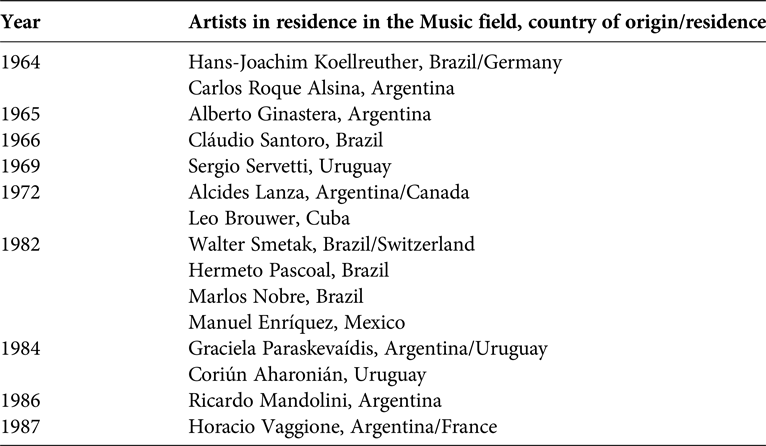
Altogether, the sources show two interesting waves of participation by Latin American artists in Darmstadt, the 1960s and the 1980s. Unsurprisingly for this context, most of these composers cultivated an unabashedly modernist and/or avant-garde aesthetic. A cursory glance at the fourth ‘moment’, the DAAD Berlin Artists Programme, founded in 1962 by the Ford Foundation, substantiates this observation (see Table 1). While in the first year Latin America was represented only by two visual artists, one from Brazil and one from Mexico, from the second to the fourth year of the programme Latin America sent only musicians, including Hans-Joachim Koellreutter, a German emigrant to Brazil who cannot be underestimated as a composition teacher in his adoptive country.Footnote 21 The 1980s witnessed an increase of Latin American presence in the programme; this is clear in 1982, with four musicians – Manuel Enríquez (1926–94) from Mexico, Marlos Nobre (b. 1939), Hermeto Pascoal (b. 1936), and Walter Smetak (1913–84) from Brazil – (and five writers as well as three visual artists),Footnote 22 and in 1984, with two composers in the programme, Coriún Aharonián (1940–2017) and Graciela Paraskevaídis, the first Latin American female composer in the programme – interestingly, the same year Elsa Justel attended the Darmstadt courses for the first time. Subsequently, only one further musician from South America is featured, Horacio Vaggione (b.1943), who was already living in Paris. Here, nationality and residence differ; this is an issue one can also observe in the Darmstadt sources since as of 1988 the chronicle of the programme indicates this with double labels. For our further discussion it is important to mention that the aesthetic orientation of most of these composers – especially the very first batch from the 1960s and those invited in 1982 – leans towards modernist avant-garde: this is also true even for the free-jazz musician Hermeto Pascoal, who has been labelled the Brazilian answer to Sun Ra. But why should there have been such a peak of Latin American interest – in all the arts – in 1982? Here, the DAAD's Arts Program seems to run parallel to the Latin American Focus of the Berlin Festival Weeks mentioned earlier.
DAAD Artist's Program – musicians from Latin America

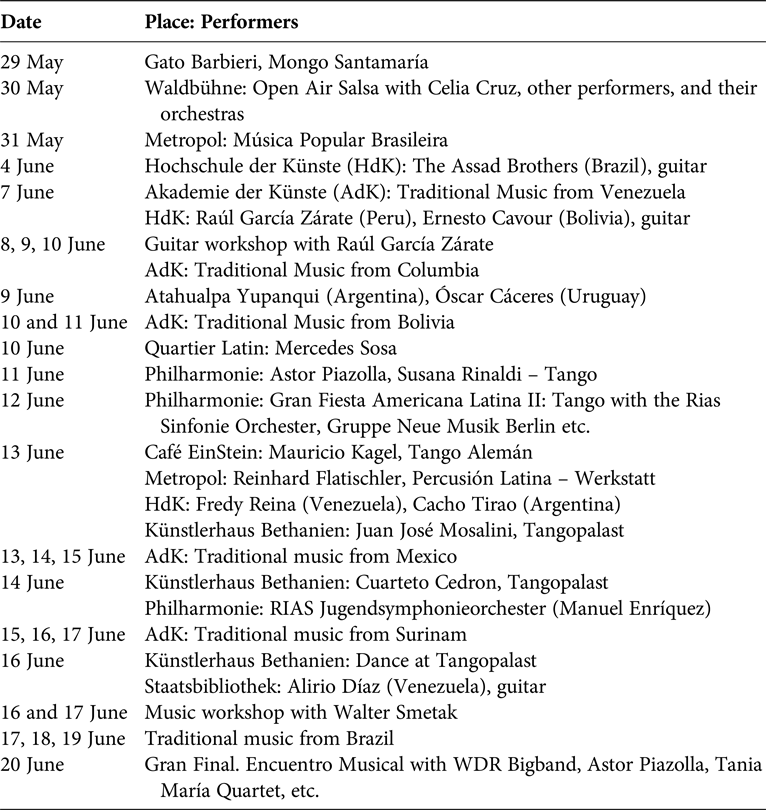
Let us return to the second ‘moment’ and look at the program of the 1982 Horizonte Festival, a festival that developed in the frame of the already mentioned Berlin Festival weeks. It is clear that Horizonte (1979–89) followed on the trajectory of the Festival weeks, developed since the 1960s as a representation of cultural diversity linked to the popular. One of the Horizonte festival's first events, a broadly advertised open-air salsa event featuring Cuban super star Celia Cruz at the Waldbühne, was intended to address a wide audience.Footnote 23 Indeed, an overview of the festival programme (see Table 2) shows classical music, tango, Latin jazz, and a series of traditional musics from Brazil, Bolivia, Colombia, Venezuela, and Surinam in the Academy for the Arts. Performers of art music from the Latin American countries were predominantly represented by classical guitarists. Avant-garde composers included Mauricio Kagel (1931–2008) – with an event conspicuously labelled Tango Alemán – regardless of the fact that Kagel had lived in West Germany since 1957 and had visited Argentina on very few occasions. Two of the fellows of the DAAD Berlin Artists Programme are featured in the programing, although not in prominent places: the Mexican avant-garde composer Manuel Enríquez had his music performed by the Rias Youth Orchestra, while the Swiss-Brazilian composer and instrument maker Walter Smetak gave a music workshop with his instruments, which were displayed during the festival.Footnote 24 So, although there are a few traces of the avant-garde musical practices supported by the DAAD, Darmstadt, and other institutions, the main programme of the festival continued the political orientation of foreign affairs and its emphasis on popular culture followed since the 1960s. This is evident in the final concert with the Big Band of the West-German Radio, Cologne, which featured the Argentinian tango legend Astor Piazzolla (1921–2002) and others.
Horizonte Festival Berlin 1982 – programme

The bilingual, Spanish-German magazine of the 1982 festival features an essay by Juan Allende-Blin, which bears the ironic title ‘Music from the other planets?’Footnote 25 In this article, Allende-Blin criticizes the cultural positioning of the festival by emphasizing the development of art music in Latin America and the formative time span between 1913 and the 1930s, linking this development on the one hand to progressive political and aesthetic ideas, and on the other hand to contemporary developments in the international art scene. In doing so, he is reacting to the 1980s situation, in which an elitist or even hegemonic musical avant-garde was played off against popular music due to very different interests. Allende-Blin presented the Latin American music scene as a confident and equal contributor to an avant-garde art, and distinguished between Latin American countries that have been culturally shaped by different layers of European immigration in the development of diverse, quite socially hierarchic but confident societies, from those entirely shaped by colonial governments subordinated to their home countries or by Christian missionaries subordinated to their mother churches. From his standpoint the cultural stratification of these societies becomes a social dimension rather than an essentialist one. So, in the end, he had sincerely answered his self-addressed question from the title with ‘no’, as he understood art as a universal and international concept, that matched – as in the case of Mauricio Kagel – his own perspective as cosmopolitan composer.
Yet, what should we read into all this? Obviously, governmental support benefits avant-garde composers through several funding sources. The funding policy of the DAAD, the German Exchange Service, opened the scientific programmes to artists with academic affiliations in the 1980s. Since its international expansion during the 1960s, the Goethe-Institut enabled several German avant-garde composers and ensembles to travel to Latin America to teach workshops. A good example is Helmut Lachenmann (b. 1935) and the Ensemble Modern's 1984 Latin American tour, which was particularly influential. For example, the Uruguayan composer Álvaro Carlevaro (b. 1957) reported in an interview with Dietrich Heißenbüttel that he attended these concerts and workshops in Montevideo and Buenos Aires, and that they made a significant impression on him.Footnote 26 In Chile, a new music association was founded after Lachenmann and the Ensemble Modern's visit as part of the same South American tour.Footnote 27 Future research could benefit from studying the personal networks between the workshops that the Goethe-Institut sponsored, especially in the 1980s, and avant-garde institutions in Germany, such as Darmstadt and the Electronic Studio in Cologne, and by studying similar interactions during the 1980s as the ones I have addressed between the DAAD Berlin Program and Darmstadt sources.
Research on the musical exchange and migration between Latin America and the GDR, and the role of the funding activities of the Communist parties, which is still missing, would help us have a better picture of this situation. As for the FRG, the focus should be on the tension between benefits for art music and official representations, and the observed connection between traditional music and the popular, which from a certain moment onwards was also connected to the needs of political representation.
Finally, some questions remain: how did government-driven cultural policy support a modernist avant-garde? How was this connected to the tacit cultural policies of the 1950s and the omnipresent influence of Nicolas Nabokov during the Cold War? At least, how was this related to the re-orientation of the Berlin Festival Weeks in the 1960s? Obviously, there is a double strategy at work, which is caused by the already discussed interactive triangle between Latin America and the two German states. The competing systems vie for different understandings of ‘the international’. While the GDR pursued the universal idea of a Socialist International, the Federal Republic countered with a liberalist cultural diversity that featured the cultural identities of its different partners in the Western hemisphere. Economical as well as political interest inform these stances.Footnote 28 In both cases, for significantly different reasons, the avant-garde seemed beyond the focus of the official political representation, because this was the battlefield of this competition for ‘the international’. And this competition is exactly what discredited the term ‘international’ after the decline of the Eastern bloc. Bloc-ideologies were followed by the implementation of a ‘neoliberal’ ideology with no counterpart. In a way the idea of the ‘global’, the trendy term of the 1990s, seems to be a neoliberal version of the competing ideas of the international, tracked by these ideological blocks. This development changed the whole landscape because there is no more ‘in-between’. The cross-currents between Latin America and Europe need to be reconsidered when assessing these transformations. And in conclusion, we might also ask if the current situation of the Humboldt-Forum in Berlin as an explicit state-driven institution is a symptom of a substantial institutional change in German cultural politics; moreover, how will this impact foreign affairs and processes of cultural exchange? This presents us with a new horizon regarding current debates on cultural heritage and restitution, since, upon preliminary consideration, it seems to be the consequence of a liberal understanding of cultural heritage. The crucial question is how this liberal idea of cultural heritage changes under post-Cold War conditions, that is, without a competing counterpart against neoliberalism.