Before the advent of modern navigational systems, such as radar and global positioning systems (GPS), the presence of a lighted landmark was vitally important because of the need for such services in bad weather conditions and in the dark, when the dangers for shippers and seamen at sea were the greatest. Such information also needed to be reliable. Human error and neglect that resulted in the malfunctioning of such an expected landmark could lead to disaster. Furthermore, lighthouses were expensive constructions, often built with considerable risk of loss of capital and lives. Lights could burn out and reflective mirrors become dirty, leaving the ships without guidance in the dark. In addition to such problems, false lights lit by wreckers could sometimes lead ships astray. Administrative structures were therefore needed to ensure that the lights were sufficient in terms of quantity and quality.
The problem with lighthouses, and the reason why they have attracted so much attention from highly respected economists, is the potential issue associated with financing such a service, for which the exclusion of nonusers is impossible. The light emitted from a lighthouse warns all ships sailing on the sea, regardless of whether they pay for its service or not. Because ships can take advantage of the information sent out by the lighthouse without coming into contact with the lighthouse operator, much less paying the operator for the service, private entrepreneurs are discouraged from building and maintaining lighthouses. Therefore, the lighthouse service fulfills the requirements of a public good: nonexclusive ability and nonrival consumption. Should a society wish to build lighthouses, conventional economic wisdom proclaimed that only the government could provide such goods in sufficient amounts. J. S. Mill explained the problem with exclusion as “[i]t is impossible that the ships at sea which are benefited by a lighthouse should be made to pay toll on the occasion of its use.”Footnote 1 For a lighthouse owner, the problem, as Paul Samuelson noted, is that “lighthouse keepers cannot reach out to collect fees from shippers.”Footnote 2 Therefore, “a businessman could not build it for profit, since he cannot claim a price from each user.”Footnote 3 Samuelson concluded that the lighthouse was an example of government provision of public goods “without which community life would be unthinkable and which by nature cannot be appropriately left to private enterprise.”Footnote 4 Ronald Coase’s (1974) paper “The Lighthouse in Economics,” which initiated the interest in the history of public lighthouse administration, is widely considered to be groundbreaking because it illustrates the feasibility of private enterprise producing public goods on a profit-making basis.Footnote 5 Such a conclusion contradicted the conventional economic wisdom of the time, which claimed that the lighthouse was a crucial example of how market failures supposedly call for government action. According to mainstream economic theory, the proper functioning of lighthouses is regarded as a public good because of difficulties associated with obtaining payment for its use.Footnote 6 Coase, however, set out to demonstrate that, for an extensive period of human history, lighthouse services were provided by private enterprises rather than by governments. He came to the following conclusion: “Contrary to the belief of many economists, a lighthouse service can be provided by private enterprise. . . . The lighthouses were built, operated, financed and owned by private individuals, who could sell the lighthouse or dispose it by bequest.”Footnote 7 Lighthouses have thus become something of an ideological battlefield for economists and historians, either for illustrating the feasibility of profitable private provision for much-needed public services, or as an example to demonstrate the necessity of regulatory policies by the state. In this article, I investigate the evolution of lighthouse services in England, from private provision to becoming part of the public sector itself, between the seventeenth and nineteenth centuries, using a unified theory of contractual relations between the government and lighthouse owners. This public-private partnership approach is used to illustrate the economic and contractual logic that underpins the public and private provision of public goods services associated with lighthouses.
The Modern Debate on the Private Lighthouses in England
Coase’s criticism against Samuelson and Mill, among others, comes down to the question of whether it is possible to charge users for lighthouse services: “As I read these writers, the difficulty of charging for the use of a lighthouse is a serious point with important consequences for lighthouse policy.”Footnote 8 Coase thus focused on the nonexcludability aspect and claimed that at least some exclusion was indeed possible, if imperfect, because the ships eventually had to leave the commons and enter a port where the lighthouse owner had the right to levy dues.Footnote 9 While in port it was possible to levy tolls on ships “presumed to have benefited from [the lighthouse].”Footnote 10 Dues were thus collected at ports and, as the routes of ships were known, the lighthouses that guided such ships were known. It was thus possible to charge each shipper according to the exact rates for each lighthouse.Footnote 11
According to Coase, lighthouses in seventeenth-century England were built as a result of voluntary action by private entrepreneurs, in response to the actions of shippers and merchants who petitioned the Crown to allow private individuals to construct lighthouses in specific locations and to charge a fee from those benefitting from this service. According to Coase, the government’s role was limited to establishing and enforcing property rights, and the problem of enforcement of the collection of charges was no different than for other suppliers of goods and services.Footnote 12 The policy implication derived from Coase’s article is that government actions are not motivated by the necessary function to provide public goods. For a long time, Coase’s revisionary conclusion regarding the nature of private provision of public goods in the form of lighthouse services remained uncontested. In 1993, however, van Zandt reexamined the evidence and found that government involvement was greater than implied by Coase’s suggestion. He concluded that lighthouses were provided by both private entrepreneurs and the government, and he maintained that a significant amount of private capital in the lighthouse business provided the English system with some administrative advantages.Footnote 13 Bertrand has recently expanded on van Zandt’s criticism of the Coasean analysis, arguing that “when examining the same historical experience, we are led to doubt Coase’s conclusions: the system was not private, and above all not efficient, as he suggests, in the sense that it was not well adapted to needs.”Footnote 14 In modern terminology, what Coase characterized as a “private” system of lighthouse provision in the seventeenth–nineteenth centuries was an example of public-private partnership, that is, where the public sector contracts out services and goods production to private enterprises.Footnote 15 Although critics of Coase agree that Coase significantly downplayed the role of the state, there is no agreement on what the role of the state actually was and what the evolution of the ownership of lighthouses tells us about the development of the public sector itself. Private interests in the service of public interest have always been controversial, because of fears of quality deterioration and the awarding of contracts to those with vested interests within state bureaucracies, thereby bypassing competitive tendering. Proponents of privatization, however, often argue that outsourcing improves efficiency because it introduces competition into the provision of public services and because private firms are relatively free of political interference, as Jensen and Stonecash summarize in a review of literature.Footnote 16 These diverging views in principle find an echo in the scholarly debate about lighthouses, as Coase and van Zandt claim that the positive effects of private capital in the lighthouse service had a net beneficial effect, while Bertrand and Taylor claim that the removal of private interests in the 1830s solved various problems with private provision. In this regard, Taylor suggests that the granting of rights to profit-seeking individuals to run private lighthouses in the seventeenth century was based on “old corruption” and against the public interest, and that the centralization of the lighthouse administration in the 1830s remedied these ancient problems.Footnote 17 Indeed, the huge profits made by the owners of the private lighthouses, a fact that became known to members of the British Parliament in the 1820s, was a major political reason for the nationalization of lighthouses and for ensuring that these were placed, in 1836, under the authority of a single governing body, Trinity House. The Bill of 1836 authorized Trinity House to buy the remaining private lighthouses of Harwich, Dungeness, Winterton, Hunstanton, Orford, Smalls, and Longships, which were held by individuals under leases from the Crown. Trinity House was also empowered to purchase several lighthouses held in perpetuity under acts of parliament: the Skerries, Spurn, and Tynemouth lights.Footnote 18 An 1845 parliamentary report on lighthouses concluded that the purchase of the lighthouses, placed under one board, “free from private claims . . . shall be considered best for the public interest.”Footnote 19
There are a number of unresolved issues concerning the provision of lighthouse services in England that were in place prior to the nationalization of 1836. If the “private” system was as advantageous as Coase claimed (relative to direct provision by the government), why was it abandoned? There is no reason why excessive dues alone would have led to nationalization: the government could simply have renegotiated the terms of the patents when these ran out.Footnote 20 In contrast, it was also in the public interest to reduce public expenditure on building and running lighthouses, whose main beneficiaries comprised a small circle with shipping interests; such public expenditure was by no means obviously in the interest of the greater public, who may have been reluctant to take on the financial burden of providing the infrastructure investments required for lighthouses. If the “private” system was dysfunctional, as Bertrand and Taylor claimed, why, then, was it not abandoned earlier, much less chosen at all? Was corruption the only reason why private entrepreneurs were willing to step in when the state failed to build lighthouses, or did the government have practical reasons for contracting out the building and running of lighthouses in the early history of the British lighthouse system? In this article, I provide a uniform framework, as well as new empirical data, based on the idea of public-private partnership, to argue that this framework could explain the transition from private to public provision of lighthouse services.
The Organization of the Lighthouse Services: A Public-Private Partnership Perspective
Lighthouse construction and maintenance have always required large sums of money, and the organizational forms of ownership and collection of dues have varied. As Fischel argues, the difficulties of excluding beneficiaries (which according to Samuelson would lead to state ownership) should not obscure the fact that lighthouses (the physical assets in the form of actual buildings) could be privately owned and a system of payment could be invented that rewarded their owners for providing such a service.Footnote 21 An analysis of the ways in which the provision of lighthouse services worked highlights the incentive structures associated with various participants. The public-private partnership perspective provides a focus on the economic rationale for different contractual solutions, since it explicitly recognizes that private parties provide a public service and assumes substantial financial, technical, and operational risk in the project, and that governmental hierarchies are far from efficient and private entrepreneurs will not always act in the interests of the principals.Footnote 22 Coase originally argued that the private provision of lighthouse services refuted Samuelson’s claim that governments were the only efficient source of such services. He did not claim that the private provision was uniformly superior; his main emphasis focused on the feasibility of private provision as a serious alternative.Footnote 23 Nevertheless, although much discussion following Coase’s original article has focused on the question of efficiency, it is empirically difficult to solve the question of whether private lighthouses delivered services of higher quality at lower costs, and this issue is not the main focus in this article. As Jensen and Stonecash note, efficiency in the public sector is generally difficult to measure because of the lack of data on operating costs and output quality.Footnote 24 This is also the conclusion contemporaries arrived at. The 1845 “Selected Commission [. . .] of Lighthouses” could not decide whether public general lights were, in economic terms, efficiently managed: “the Public general Lights are efficient in brilliancy; but it is difficult to ascertain correctly how far the several expenses for the buildings, fittings, stores, attendants, wages etc. are regulated with due economy or not.”Footnote 25 In the same vein, the 1861 commission on the management of the lighthouses had difficulty in establishing any causal relationship between the choice of lighthouse technology and shipping safety.Footnote 26
In return for the provision of lighthouse services, the government gave rights to individuals to collect light dues, which were supposed to cover the costs of running the lighthouse. The lighthouse owner thus had the right to keep any surpluses generated by the lighthouse. In the construction and running of lighthouses, several uncertainties governed the decision making. The cost of building a lighthouse was uncertain; lighthouses were sometimes located in dangerous positions, and calculating the costs of building at such locations was difficult. There were also technical uncertainties relating to the lights and the longevity of the lighthouse tower. Lighthouse technology needed to ensure that the structures were reliable and sturdy during the worst of weather conditions. There was also demand uncertainty. Future revenue streams depended on the number of ship owners passing the lighthouse, and any fluctuations and disturbances (such as frequent wars) created uncertainties. The government could transfer the risk to an agent, that is, a private entrepreneur, but risk-averse agents would charge a premium for bearing such risks.Footnote 27 For projects that represented huge capital investments (such as building a lighthouse), the terms of contracts had to be very long in order to ensure that such investments were profitable.Footnote 28
Contractual Forms in the English Lighthouse Industry, 1600–1836
The following section charts the contractual forms that were used to provide the English coast with lighthouses during the seventeenth–nineteenth centuries. This work is based on information contained in the historical “Calendar of State Papers,” parliamentary committees in the nineteenth century, supplemented with information published in the historical literature by Harris and Stevenson, who have provided much background information for later scholars engaged in the debate about the nature of the British lighthouses. In England, three basic institutional forms of lighthouse provision have existed: attempts to run the lighthouses based on royal grants but without compulsory payments; government provision from user fees; and private provision under government grants with compulsory payments. Government-based provision from the state budget was the most common method for organizing lighthouse services in many countries, including France and the United States, but this did not exist in England.
Voluntary Contributions
Those entrepreneurs willing to risk their money on lighthouse construction would arrange for the presentation of a petition to the Crown signed by shippers, merchants, and local administrators, requesting the issue of a patent for a lighthouse. In England, however, not all patents included a clause that the lighthouse keeper had the right to demand light dues from shippers. In some cases, the entrepreneur promised to erect and maintain the lighthouse with the help of voluntary contributions only. For example, in 1619 John Killigrew obtained a patent from James I to build a lighthouse and he was given permission to receive any voluntary contributions for its upkeep.Footnote 29 A year later, in 1620, when the tower was completed, Killigrew began to lament that no voluntary contributions were coming in. Claiming that he had spent £500 on the lighthouse but “yet no return,” he requested the right to levy compulsory dues from shippers.Footnote 30 In September 1621, the total amount received from voluntary contributions for the Lizard lighthouse amounted to only £18.Footnote 31 Despite some attempts to persuade the authorities that his lighthouse was a help to ship owners, Trinity House opposed the imposition of compulsory dues unless the Dutch were also willing to contribute to its costs; Killigrew was not allowed to raise light dues,Footnote 32 and he extinguished his light in 1624.Footnote 33 This demonstrates that, in this early experiment, voluntary light dues were not sufficient to finance the building of lighthouses. A further example of failed attempts to receive payments on a voluntary basis is the request from Sir John Clayton and George Blake to build a double lighthouse at St. Nicholas’ Gatt and lighthouses at Corton, Cromer, Flamborough Head, and the Farne Islands. Clayton (Blake died soon after the request) was authorized to receive payment by way of voluntary contributions. The patent lasted for sixty years at a yearly rent to the Crown of £20.Footnote 34 Clayton and Blake had spent the huge amount of £3,000 to build the lighthouses, but soon ran into financial difficulties as the said recompense was not paid according to expectations. Many users failed to pay because there was no obligation to do so, and the rates and proportions of profits to be received for each lighthouse were not mentioned in the original patent.Footnote 35 Only the lighthouse at Corton was lit, but the light was extinguished after three years when Clayton realized that he had only received £60. A system based on voluntary contributions thus led to a situation where no lighthouses were built.
Government Provision
The most important public institution that governed English lighthouse construction and the accompanying dues collection was Trinity House of Deptford Strond, a charitable organization founded in 1514 that had evolved out of a medieval Guild of Mariners. The legal status of Trinity House was, according to Taylor, a private corporation that “performed a public role which would otherwise have had to be performed by a central government agency.”Footnote 36 Regulating pilotage and providing aid to old seamen and their families were some of its chief early duties; later responsibility for seamarks was vested in the corporation. During the first half of the sixteenth century, it was the Lord High Admiral’s exclusive responsibility to supply buoys, regulate beacons and seamarks, and collect funds for the maintenance of lighthouses. In 1566, these rights of supervision, maintenance, and collection of dues were shared with Trinity House and, after 1594, all of the Lord High Admiral’s rights were gradually transferred to Trinity House. The charter of 1514, granted by Henry VIII, gave Trinity House the right to regulate pilotage and, in 1566, it gained the right to provide and regulate seamarks.Footnote 37 Trinity House first built its own lighthouses early in the seventeenth century (Caister in c. 1600 and Lowestoft in 1609). Trinity House was reluctant to propose lighthouses and objected to many, although it did occasionally approve some constructions.
The corporation was thus involved in several conflicts regarding the right to build lighthouses; for example, it opposed the construction of lighthouses at North and South Forelands in 1634. As was usually the case, shipmasters had petitioned the king to appoint someone to build a lighthouse in order to prevent shipwrecks.Footnote 38 When the Privy Council gave authority to John Meldrum to build the lighthouse, Trinity House offered to build it instead, but did not obtain approval.Footnote 39 The lighthouse was lit at Spurn Point in about 1672 without Trinity House voicing any opposition, but Trinity House opposed the ambitious project of building five lighthouses at four different sites by John Clayton in 1675.Footnote 40 In 1791, Trinity House openly explained its opposition to the construction of lighthouses: it was not its policy to propose the building of a lighthouse until shipping interests demanded it.Footnote 41 The reason for this probably related to Trinity House’s dual duties, being responsible for building lighthouses (which would increase the costs for shipping) and having a role as a charitable organization for mariners and their families. Increased costs for shipping would decrease the amount of money available for charitable purposes. As Holmstrom and Milgrom emphasize in their seminal article on “multi-tasking” in complex organizations, incentive problems must be analyzed in totality.Footnote 42 Since Trinity House was responsible for pension payments, it was also averse to risk when embarking on lighthouse projects. When incomes from the lighthouses increased during the seventeenth century, it adopted a more positive attitude toward building and financing lighthouses. It was in the context of carrying out its charitable duties toward “decayed masters and seamen” that led Trinity House to oppose any reductions in light dues in the 1850s.Footnote 43
Private Provision
Stevenson’s account of the elements of the English patents (awarded to private entrepreneurs) illustrates the core principles of delegating the lighthouse operation to private parties. Van Zandt and Bertrand build their account on Stevenson’s, and I give a short recapitulation here. Alongside Trinity House, there also existed a number of private lighthouses. The first recorded successful proposal for a private lighthouse in seventeenth-century England, that is, one not constructed by Trinity House, was probably put forward in 1615 by Edward Howard and associates, who wanted to build a lighthouse at Dungeness. The formulations in the patent of 1566 (that Trinity House had the sole authority to erect seamarks) could imply that Trinity House had a monopoly on building lighthouses. The king in 1615, James I, however, did not recognize Trinity House’s exclusive rights to build lighthouses.Footnote 44 Coase’s main argument, initially put forward by G. G. Harris in his detailed study of the early years of Trinity House, was that individuals embarked on lighthouse construction for their own financial gain, while Trinity House did not do so.Footnote 45 According to Coase, Trinity House was the rightful owner of the right to build lighthouses. Failure to do so illustrates Coase’s point relating to governmental failure. Based on previous work by Harris, Coase concluded that “with the completion of Lowestoft, [Trinity House] rested content and did no more. . . . Failure to respond to demands . . . shook confidence in the corporation; since there was a prospect of profit, it was tantamount to inviting private speculators to intervene. They soon did so.”Footnote 46 The infringement of Trinity House patents is of great importance in understanding how Coase came to the conclusion that “private” ownership of lighthouses facilitated a more efficient response to market demands than was the case for state ownership. Coase emphasized that Trinity House did not erect any lighthouses in 1610 and 1675, and that at least ten lighthouses were built by private individuals. By 1700, Trinity House had become less hostile to the erection of lighthouses because a new strategy had been adopted, which would also be of benefit to them. Applying for a grant and then leasing the rights to someone else for a fixed rent meant that some money obtained from lighthouse services reached the corporation.Footnote 47
English patents were characterized by several elements. The entrepreneur was granted the exclusive right to build and maintain a lighthouse in a specific area for a number of years;Footnote 48 in exchange for this right, the entrepreneur paid a fixed annual rent and was entitled to keep the residual amount.Footnote 49 Patents usually stipulated that competitors were forbidden to erect other lighthouses in the vicinity; the patents usually ran for a long period, for more than fifty years, although a few ran for perpetuity; if a private party would not renew a patent, it could be sold to another private party, or Trinity House might take it over.Footnote 50 The amount of money that a lighthouse operator was entitled to charge ships that passed by the lighthouse was also specified in the patent, which the following examples show. The first patent, issued in c. 1616, for Dungeness ran for fifty years;Footnote 51 the St. Nicholas Gatt patent, in 1675, ran for sixty years for a yearly rent of £20;Footnote 52 the Harwich patent, in 1665, ran for sixty-one years for a rent of £5; the Flatholm patent, in 1737, ran for ninety-nine years with a rent of £5 for fifty years and £10 thereafter.Footnote 53 Trinity House leased the Smalls lighthouse to a private individual in 1778 for ninety-nine years, and leased the Longships lighthouse to a private individual in 1795 for fifty years for an annual rent of £100.Footnote 54 Mumbles lighthouse was leased from Trinity House in 1794 for ninety-nine years at a yearly rental of £5.Footnote 55 The leases of Smalls and Longships for such long periods were criticized by the 1845 committee as “examples of improvidence and mismanagement exceeded only by the grants in perpetuity of the Tynemouth, Spurn and Skerries by the House of Commons.”Footnote 56 With hindsight, the committee was right, but, when the leasing contracts were signed for Smalls and Longships, Trinity House was still reluctant to take on the risk itself and preferred to contract out the building and maintenance to private partners.
Auctions and Negotiations in Providing Contracts to Entrepreneurs
Taylor argues that “lighthouses pose a problem for those desirous of competition at all levels of the economy as they are inherently monopolistic: the idea of competing lighthouses is plainly absurd.”Footnote 57 The idea of competition in the provision of lighthouse services is, however, not as absurd as it might appear at first. The right to erect and maintain lighthouses may be allocated on a competitive basis, in which the highest bidder, who offers the government the highest amount of money in return, could be awarded the right to collect light dues. Alternatively, the contractor who offers the lowest bid for delivering the service could win the contract. In this way governments might achieve ex ante competition (competition for the market as opposed to competition in the market),Footnote 58 whereby the entity that submitted the lowest bid would win the competitive tendering process and acquire the right to provide the service.
Nevertheless, this way of achieving competition in the market for lighthouse services was not used by the English government, which instead negotiated directly with potential contractors. These negotiations with a few individuals is the key reason why Hague and Christie claim that “it was the machinations, favours and corruptions of the seventeenth-century court which created ideal conditions for privileges which became firmly entrenched that they resisted repeated attempts at reform in the nineteenth century.”Footnote 59 There are, however, two reasons for believing that this strategy was used to increase the number of lighthouses rather than as a reward to favored people: first, negotiations with entrepreneurs were, under certain circumstances, a better way of allocating resources than competition; and, second, when new lighthouses were proposed, ship owners were always given an opportunity to express any interest in financially supporting such proposals, by means of paying light dues. If support failed, lighthouse projects did not come through. As has been observed within auction theory, auctions are not always the best way of allocating resources. It may seem that competition at an auction would be a better mechanism than negotiations with a favored contractor. However, auctions do not function well in cases where projects are complex, the contractual design is incomplete, and when there are few available bidders.Footnote 60 Complex projects that are difficult to specify in advance are less suited for auctions, in which the most relevant variable is the bid. Complexity thus encourages negotiation, especially when contractors are experienced.Footnote 61 We do not have information regarding the building costs of early lighthouses, but the 1861 Royal Commission enumerates some problems associated with comparing costs: it is difficult to compare costs between different regions in the United Kingdom and even more difficult to compare expenses incurred in different countries, such as France.Footnote 62 These difficulties arise because of varying conditions: the requisite height of the tower, the accessibility of the site, the facility of procuring material and workmen, and “many other circumstances varying with the locality.”Footnote 63 These insights, which were probably evident in both the seventeenth and nineteenth centuries, explain why there were no auctions when the English government supported the construction of lighthouses, because the terms of the auction would be very difficult to determine. Careful negotiations, in contrast, when there were few potential builders of lighthouses, which was the case in England, was a workable model for providing contracts to lighthouse entrepreneurs. Not only did private entrepreneurs have a personal stake in the costs of the lighthouse, as emphasized by Bertrand, but the only variable they could control in the presence of price fixing in order to increase net profits was to lower these costs.Footnote 64 If cost reduction became associated with a reduction in lighthouse quality, this would put ships in danger. Bertrand claims that the private construction of the Eddystone lighthouse led to insufficient quality (as a number of documented reparations might indicate) of the building because of the lack of regulations.Footnote 65
Profits
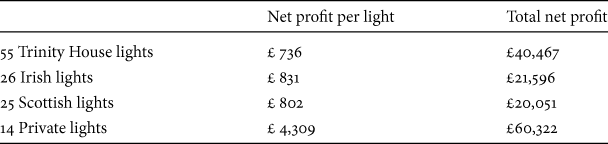
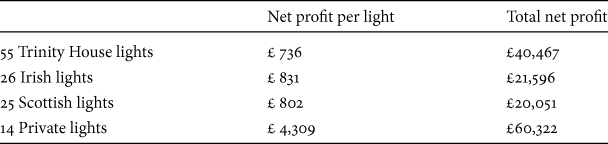
Coase, however, did not recognize the endemic problem of delegating authority to an agent with interests other than the Crown’s. Because the agent was the residual claimant in the case, private owners had an interest in collecting lighthouse dues that were as high as possible, as negotiated with the state and codified in charters. One source of conflict in the nineteenth century was the high profits made by all lighthouse owners, including Trinity House, although the private lighthouses made vastly higher profits than the government lighthouses. Table 1 shows the estimated net profits made by various lighthouses in the UK in 1832.
Net profits from all lighthouses in the UK, 1832
Source:
Selected Committee 1834, 38–39.
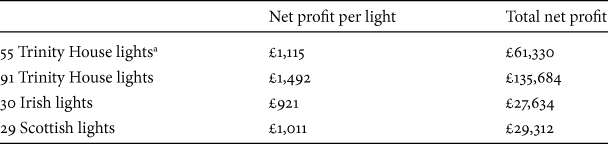
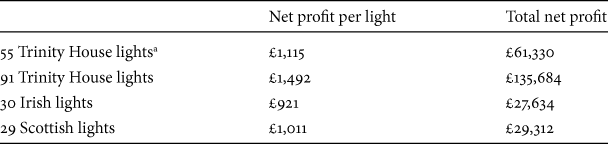
The profits remained, and the key issue is to whom did these profits fall: private entrepreneurs, the public, or Trinity House with its alms receivers? The net profits from the fifty-five lighthouses owned by Trinity House in 1832 had increased by 50 percent by 1843 (Table 2), and the profits from acquired, or newly constructed, lighthouses were even higher. The most important consideration, however, is that the high profits of private lighthouses, obtained under Trinity House’s management, in 1832 were reduced significantly (£4,309 compared with £1,492). One reason why the dues were not immediately reduced was that Trinity House was required to pay the debt incurred by the purchase of the private lighthouses for £1,200,000, and the loans were paid off in 1848.Footnote 66 A further reduction was possible in 1853 when, as a result of the discontinuation of its pension fund, Trinity House was no longer allowed to use its profits for charitable purposes, such as pensions for mariners and their families. Attempts to retain incomes from former private lighthouses, on the basis that “a grant is valid, if the dues granted are reasonable at the time of the grant, and continues so valid, notwithstanding that from a subsequent increase of shipping the dues may afford a profit.”Footnote 67
Net profits from all lighthouses in the UK, 1843
Source:
Selected Committee 1845, 22, 435–436.
a The same 55 lights as controlled in 1832, to allow direct comparison.
The importance of who controlled the residual rights is demonstrated by the reaction of the Board of Trade in 1853, who brushed aside the claims by Trinity House that the income from the lighthouses in the form of light dues was its property: “the property so vested in the Corporation . . . is held by them . . . in trust for public purposes, and liable, therefore, to be dealt with upon considerations of public policy.”Footnote 68 Being an institution that served public policy, Trinity House was also responsible to the public and government agencies to fulfill that role. The report from the Selected Committee of 1845 gathered opinions from shippers regarding the impact of centralization on the lighthouse system. The shippers seemed to be satisfied with the effect of nationalization on efficiency: no complaints by any witnesses before the committee expressed dissatisfaction with the efficiency of the lights, but high light dues remained a problem.Footnote 69 According to the report of the 1834 committee, one consequence of the decentralized lighthouse administration was the wide variation of light dues. The committee found that “there does not appear to be any rule for those rates.”Footnote 70 The 1834 committee report stresses irregularities in the lighthouse systems. According to the 1845 committee, light dues were heavier on British shipping compared with those of other countries. Evidence for this was “numerous,” but the committee quotes only two statements. The claims made by these two shippers suggested that light dues amounted to 51 percent and 68 percent a year of the profits for the respective firms.Footnote 71
The remaining private lighthouses were purchased for a total sum of almost £1,200,000 in 1836.Footnote 72 The committee points to the ineffectiveness inherent in the complex system of ownership, management, and dues that characterized the English lighthouse system. It claimed further that the dues amounted to nothing more than high taxes that benefited a few privileged individuals while damaging the competitiveness of British merchant shipping. The conclusions of the committee were interpreted by Taylor as follows: “Private ownership of lights led to inefficiency in management, high collection costs, and wide variation in charges for lights.”Footnote 73 Taylor argues that nationalization was based on an ideology in leading government circles, where “certain resources should be excluded from the realm of private property by the state, and that private profit made at the expense of the public interest was morally wrong.” Furthermore, “even in an industrializing, expanding economy, private profit was not always seen as desirable: some services, it was held, should be nonprofit making.”Footnote 74
Taylor also agrees that the lighthouse system, endorsed by Coase, was a result of “old corruption” and that “the state . . . had caused the problem by granting rights to levy light dues to individuals.”Footnote 75 It should be noted, though, that the varying dues partly reflected the difficulties in financing lighthouses in remote places and thus was a sign of the government’s public policy. Dues levied by Trinity House varied from lighthouse to lighthouse and depended on the class of ship, the tonnage of the ship, the trade in which a ship was engaged, and where it was bound. Foreign dues were double and rates differed between coastal and overseas trade.Footnote 76 As stated earlier, the dues varied between foreign and British vessels and between lighthouses. The three lighthouses at Fern demanded a due of ¾ d per ton; the lighthouse at Spurn demanded ½ d per ton; Foulness demanded ¼ d per ton; and the floating light at St. Nicholas Gatt demanded 1/8 d.Footnote 77 After nationalization, individual lighthouses had to bear their own costs, so the dues continued to vary from lighthouse to lighthouse. The system of varying dues after nationalization cannot be explained by noting that the dues rates, as well as their contractual terms, were inherited from previous owners. From 1834 onward, Trinity House established a number of lighthouses with individual toll rates payable for each establishment. The rates varied as follows: the Start light (first exhibited in 1836) demanded a toll rate of ½ d per ton; the Shipwash light (first exhibited in 1837) demanded 1/8 d per ton; and the Avon light demanded ¼ d.Footnote 78 One advantage of a centralized, rather than a decentralized, system was that it was easier to adjust rates without having to bargain with many proprietors. Between 1822 and 1832, Trinity House reduced the light dues for many of its lighthouses by 50 percent.Footnote 79
Three factors determined the returns from lighthouses: the level of the light dues (measured as a rate per ton), the number of ships passing a lighthouse, and the ships’ tonnage. The cost of constructing a lighthouse was considerable, and since they were usually built in places where the traffic was low, lighthouse owners had to receive compensation through the government’s enforced light dues and not by market exchange. For these reasons it was permissible to collect relatively higher dues. Lighthouse dues therefore varied between locations in order to induce the construction of lighthouses in remote places or places where lighthouse construction was difficult and expensive.
Conclusion
Evidence supporting the idea that private lighthouses delivered services of low quality is difficult to obtain. Although the committee of 1834 expressed its criticism of high dues and private profits made under government grants, it had few complaints about the quality of English lighthouses: “The English Lights are considered in general very good, and sufficient for the purposes they are intended for, and superior to the generality of the French Lights . . . but the difference of Expense of maintenance of the French and British Lights is so great.”Footnote 80
Before the nineteenth century, the English king and parliament did not undertake road and river improvements by levying taxes. Despite the government’s ability to borrow at low interest rates, it did not use this ability to improve infrastructure,Footnote 81 nor did the government build its own lighthouses. In the eighteenth century, the English government could borrow at interest rates between three and five percent.Footnote 82 Despite this, direct government provision of infrastructure investment in roads, canals, river improvements, and lighthouses was negligible. Instead, the king and parliament vested responsibility for undertaking particular projects in trusts or individuals. The success in vesting financial responsibility in trusts and individuals to provide an infrastructure depended on the relationship between the agent and the state. In 1836, the English semiprivate lighthouse system was reformed, private property and surplus profits were removed, and lighthouse administration was placed under one authority, Trinity House. Later on, this service was financed by user fees collected by Trinity House officials and provided for the government through Trinity House.
There were distinct advantages for the government to initiate different kinds of lighthouse systems during different time periods. Bogart suggests that road and river improvement acts in eighteenth-century England were a “second best” solution to a problem of underinvestment by central authorities, when the latter had little incentive to improve the infrastructure.Footnote 83 Coase viewed Trinity House’s activities as a sign of incompetence, whereas I suggest that such conservatism makes perfect sense if one takes into account the large amount of money needed to construct lighthouses and the variability of the rewards. In some cases, lighthouse owners could only count on voluntary contributions. Consequently, grant holders would invest in that business. In England, this selfish conservatism was in the beginning circumvented by the Crown, which allowed private individuals to risk their money; later Trinity House itself made provision for private ownership of lighthouses because it could acquire a share of the light dues in return. If compulsory dues lead to excess profits derived from a service, entrepreneurs will invest in actions to acquire those patents, and patent holders will invest in that business, whether or not that business is critical for safety at sea (which is a different issue). A vital aspect of such a system is the state’s power to enforce the levying of dues as well as applying some checks on the patentees’ rights to levy dues. Such a rental system has obvious disadvantages, and lighthouses in England were nationalized at a time when economic growth, accompanied with an increased amount of ship movement, increased revenues from lighthouses as well as the complexity of the system, in which the large number of patentees would have made the system unmanageable.