Continuing escalations
In May 2008, when Chinese President Hu Jintao visited Japan, he and Japanese Prime Minister Fukuda Takeo jointly declared that they would ‘work together so as to make East China Sea a water for sea of peace, cooperation and friendship’ (Kazankai, 2008, 613–16). Only a week after the Democratic Party of Japan (DPJ) took over office from the Liberal Democratic Party (LDP) in September 2009, the new Prime Minister, Hatoyama Yukio, also expressed his hope to turn ‘the sea of conflict into one of friendship’ upon meeting with Hu in New York (Nihon Keizai Shimbun, 23 September 2009). The leaders’ remarks testify to the fact that the East China Sea has been the main arena of confrontation between Japan and China ever since Japan's Prime Minister Koizumi Jun'ichiro retired in 2006.
The two governments have not neglected the importance of the issue. When Abe Shinzo visited Beijing in October 2006, the first official visit to China by a Japanese prime minister in seven years, both governments released a joint press announcement concerning the establishment of a ‘Strategic Partnership of Mutual Benefit’, which included a promise to develop the East China Sea in a cooperative manner (Kazankai, 2008: 553). Only a month after Hu Jintao's official visit to Japan in 2008, in June, the two governments agreed on the joint development of a natural gas field (Chunxiao/Shirakaba) in a specified area along the intermediate line in the Sea which Japan claimed as a boundary of its Exclusive Economic Zone (EEZ). Regarding the partnership agreement, Chinese enterprises would welcome Japanese companies to join their existing efforts to construct an offshore platform (Kazankai, 2008: 636–7). Reportedly, the Japanese and Chinese governments were preparing to conclude a more comprehensive treaty on joint development projects in the East China Sea. However, China, which was to cease development until the agreement became finalized, soon resumed the building of the gas-producing platform unilaterally. When Hatoyama raised the idea of establishing an ‘East Asian Community’, many Chinese welcomed it as a benign sign of his desire to improve Sino-Japanese relations, but no concrete cooperation on the East China Sea was made during his time in office.
Then the Senkaku/Diaoyu incident occurred on 7 September 2010. The confrontation began when the Japan Coast Guard (JCG) found a fishing boat operating in the ‘Japanese’ territorial waters near the Senkaku Islands. While being chased by the JCG fleet on the scene, the fishing boat dashed itself against two of the JCG vessels. The JCG first detained 15 crew members but later released all except for the captain, who was detained until 24 September. China, which also claims sovereignty over the islands, invoked a series of wide-ranging retaliation measures, including the extended imprisonment of a Japanese businessman, who had no involvement in the Senkaku/Diaoyu incident but happened to step into a ‘military control area’ in China.Footnote 1 This incident captured public attention in both Japan and China, and the political antagonism between the two nations was soon fully reignited.
China's aggressive means of handling the issue could not help but provoke a sense of deep concern in Japan concerning Chinese intentions.Footnote 2 On 16 April 2012, in Washington, DC, Tokyo Governor Ishihara Shintaro, a well-known conservative statesman, revealed his plan to purchase three privately owned islands among the Senkaku chain (Nihon Keizai Shimbun, 17 April 2012). He later also announced his idea to develop the islands by building a port and establishing a fisheries base. Many Japanese citizens, who tend to remain silent on territorial issues, responded by donating a total of more than 1.4 billion yen (about 18 million US dollars) by 10 August to help purchasing the islands.Footnote 3
Ishihara's plan posed a serious challenge to the Noda Yoshihiko administration, which was seeking to restore the relationship with its Chinese counterpart by holding a ‘Sino-Japanese Senior Officers’ Meetings on Oceanic Affairs’ in May 2012 (Nihon Keizai Shimbun, 15 and 16 May 2012).Footnote 4 Because lands may be traded freely in Japan, the only way to hinder Ishihara's provocative moves was for the government itself to purchase the islands at a higher price. The Noda government announced its intentions to do so on 7 July and went through with the purchase on 11 September. Domestically, the sale represented merely a change of ownership; Japan had been effectively controlling the Senkaku Islands since 1972, when the entire Okinawa prefecture (including the Senkakus) was returned to Japan from the United States. The Japanese government tried to explain its intentions to the Chinese side through various channels, and the Prime Minister personally wrote a letter to Chinese leaders – but Beijing refused to listen. The timing of the ‘nationalization’ of the Islands was indeed inopportune. Chinese leaders were in the middle of a political struggle fomenting around the 18th Party Congress scheduled for the coming fall, so none dared to take any measures to control the situation.
On 15 August of the same year, Hong Kong activists landed on Uotsuri/Diaoyu Island, the biggest of the five Senkakus, and were arrested by the JCG. On 19 August, anti-Japanese demonstrations took place in more than 20 cities all over China. A week later, the Japanese ambassador's car was surrounded and its national flag was stolen by some Chinese citizens on a road in Beijing. Immediately after ‘nationalization’ of the Senkaku Islands, on the weekend of 15–16 September, violent anti-Japanese demonstrations were carried out on an unprecedentedly large scale in most major cities in China. Many Japanese factories were attacked and destructed, and a number of Japanese stores were robbed and looted. Police did not make overt efforts to stop these illegal actions before 18 September, the 81st anniversary of the Manchurian incident. On 17 September, Chinese media announced that a thousand fishing boats were heading toward the Senkaku Islands (Asahi Shimbun, 18 September 2012). Sino-Japanese tensions over sovereignty in the East China Sea have escalated with each incident and seem almost impossible to ease at this moment. People in both countries have already begun to worry about the possibility of a war over the islands.
On the other hand, a rising China is causing a fundamental change not only in Sino-Japanese relations but also in the whole Asia-Pacific region. Especially in nearby waters, China is trying hard to establish its dominance by strengthening its territorial claims on small islands in the East and South China Seas, building up its navy as well as civilian forces, developing offshore oil and gas drilling facilities, and enlarging the area of its actual control. All of these belong to the range of efforts which have been undertaken to protect Chinese sovereignty – and which in turn have caused deep concerns in neighboring countries and prompted the reallocation of US military forces to the Asia-Pacific region.
What is striking, however, is that many of the international incidents that have pitted China against its neighbors in recent years are related to Chinese fishing operations. In addition to the Senkaku incident of September 2010, a Chinese fisherman who was illegally operating in South Korean waters in the Yellow Sea stabbed a member of the South Korean Coast Guard to death in December 2011. In April of the next year, Chinese and Filipino navies waged a month-long standoff over Chinese fishing boats operating in the region of the Scarborough/Huangyan Shoal near the Philippines. The following May, North Korean authorities detained four Chinese fishing boats and sought fines against them for operating across the accepted Yellow Sea maritime border between the two countries. Further, in July, one Chinese fisherman was missed in the Sea of Japan while his boat was being chased by Russian authorities for illegal operations. To say the least, Chinese fishing activity is causing frictions with neighboring countries in many parts of East Asian waters.
It is worth paying attention to the social significance of these seemingly small occurrences, because they can strongly influence public opinion in the region and deepen animosity once they are reported in a given country. Anger on one side is swiftly transmitted to the other by the mass media and to the outrage of citizens on both sides. The entire relationship between the two countries could spiral out of control for a certain period of time, and might also leave a residual and lasting negative impact beyond the immediate dispute. Even though the fishing itself is done by individual fishermen, and not by a country, the effect can be quite international.
Is there a win-win solution to the East China Sea dispute between Japan and China? To answer this question, this paper seeks to analyze the issue from the angle of the fishing industry itself, refraining from making the typical argument of sovereignty. First, the author examines the current state of Chinese as well as Japanese fisheries. Second, the content of the New Fisheries Agreement in 2000 will be studied. In the third section, the possibility for the joint management of the fishing resources in East China Sea will be raised. The next section studies fishermen–government relations in China. Finally, the author underscores the political importance of dealing with the existing issue in a cooperative manner, which works toward the achievement of joint management of the fishing resources in the East China Sea.
Overall current state of domestic fisheries in China and Japan
The motivation of Chinese fishermen to advance toward the peripheries
Maintaining the sustainability of biological resources is considered to be an urgent responsibility in China. Although there is an expanding demand for seafood, Chinese coastal waters are already highly damaged both by overexploitation and by pollution. Stricter mechanisms are necessary to control fishing hauls and to preserve the sustainability of biological resources for future generations.
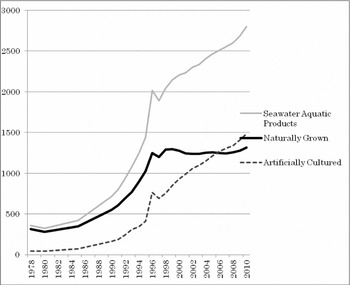
Figure 1 shows the chronological changes in the amount of seawater aquatic products in China from 1978 to 2010 by weight. Although the gross product has recorded a huge jump of 778% in a span of 32 years, it is noteworthy that the amount of naturally grown product ceased its growth once it reached the level of 12–13 million tons a year in the mid-1990s. This was about the time when the Chinese economy became more affluent, the demand for seafood expanded, and the fishing equipment used improved by great strides. The gross development after this period was made by the contribution of artificially cultured products. Detailed statistical data by location was not available in the Chinese official database.
Output of seawater aquatic products in China (1978–2010) (unit: 10,000 tons) Source: National Bureau of Statistics of China, China Statistical Yearbook 2011 (Beijing: China Statistics Press, 2011), p. 486.

As far as the numbers are concerned, the natural hauls derived from Chinese fishing efforts entered a stable stage in the mid-1990s. However, the figures did not seem to match reality. The ‘Oceanic Agendas in 21st Century in China’ report released in 1996 raised the alarm bells that excessive fishing in Chinese waters was artificially changing the biological balance and severely affecting the long-term sustainability of fishing resources.Footnote 5 The accounts made by the Chinese authorities are filled with a sense of crisis, pointing out that the fish seized from local waters are becoming significantly smaller in size and younger in age.
Yellow croaker is one of the most popular species found in the Yellow Sea and the East China Sea. To use this species as an example of the declining health of Chinese fish stocks, its average size was about 20cm in the 1970s, but had decreased to 10cm in just 30 years (Guojia Haiyangju, Reference Ketizu2011: 394). Nowadays, no matter ‘if they are 500g or only 50g each, they all get caught’ by the Chinese fishermen (Li and Zhao, Reference Li and Wei2010: 442). The number of juvenile or one-year-old fish as a fraction of the total fish catch – despite their low market value – has been admittedly increasing (Guojia Haiyangju, Reference Ketizu2011: 394).
The observed phenomena above are considered to be signs that Chinese sea-based biological resources are being put under excessive pressure by fishing and are heading towards full-scale depletion or even collapse. When a fisherman cannot find mature and economically valuable fish, in an unregulated environment, he starts trying to catch low-value juveniles with the justification that those fish would otherwise end up being caught by other fishermen if he did not do so himself. Naturally, this course of action, if taken by each individual fisherman, will effect the devastation of future fish hauls as a whole.
To make matters worse, the number of motorized fishing boats in China has expanded to 288,800 as of 2007, most of which are too small to be approved for high-sea fishing (Li and Zhao, Reference Li and Wei2010: 441). As evidence for the excessively strong pressure being exerted by fishing on the natural environment, catch per unit effort (CPUE) statistics have remained at historically low levels in the East China Sea as well as in other waters in China (Yan et al., Reference Yan, Jiansheng and Jianzhong2005: 304–305; Li and Zhao, Reference Li and Wei2010: 442). Chinese fishermen are now getting a lot less fish for the same level of efforts as in the past.
Pollution is another factor that is heavily affecting fish production in China. According to the sea water quality assessment in China in 2010, 48,700 square kilometers of seawater in the East China Sea were polluted, of which 30,400 square kilometers were ranked as heavily polluted. Similarly, 19,300 square kilometers in the Yellow Sea were likewise polluted; 6,500 square kilometers were classified as heavily polluted (National Bureau of Statistics of China, 2011: 397). Industrialization in the interior and along the shores of the Chinese continent, the operation of offshore oil and gas fields, as well as unsanitary and unsafe ways of aqua farming in the coastal areas, are all considered to be important sources of ocean contamination (Li and Zhao, Reference Li and Wei2010: 442–3; Barboza, Reference Barboza2007).
Chinese fishermen in the East China Sea are struggling with growing difficulties. To survive in the face of declining fish stocks, they pay higher prices for improved fishing vessels and equipment and bear increasing gas and labor prices, despite the poor fish catch.Footnote 6 Desperate reports are coming out from China. For example, on the very first day when the fishing ban was lifted in summer 2012, in Yantai, Shandong Province, many boats could not find any schools of fish and had to come back to the port practically empty-handed.Footnote 7
Such a deteriorating domestic environment surrounding fisheries is pushing and motivating Chinese fishermen to fish the peripheries, regardless of the financial costs and physical risks that they have to bear. As a matter of fact, 52% of what China claims as its EEZ overlaps with other countries’ claims (Ning, Reference Ning2009, 83). If many fishermen accept the challenge to cast their nets in these ambiguous areas – believing that they have the rights to do so – it is practically unavoidable that tensions will build in China's relations with neighboring countries. The owner of the trawlers detained by the North Koreans in May 2012 stated after the incident, ‘we must return there (to the North Korean side) because there are no fish left in our waters’ (Chen, Reference Chen2012).
In general, many biological resources in the ocean show a propensity for recovery, so there is hope for the restoration of East Asian waters if resources are managed properly with concerted, long-term measures. So far, the most important steps taken by the Chinese government to conserve biological resources in the ocean are simple controls as well as fishing bans in some restricted areas (especially when and where fish stocks breed and grow). A loose fishing permit system is also used to regulate boat numbers and fishing methods and acceptable gear. Many Chinese researchers have indicated that these efforts taken by the government are not effective enough to defend fish stocks from overexploitation (Tang, Zhang and Zhao, Reference Tang, Jianguo and Tiewu2009; Zhang and Bao, Reference Zhang and Teligenbaiyi2009; Ji et al., Reference Ji, Jiangshan and Chen2012). There is no evidence that a meaningful quota system has ever been implemented in China. Under the current framework, fishermen are encouraged to catch as many fish as possible when and where they are allowed, so that overexploitation cannot be avoided in total. In short, the government in China has left the excessive competition among the fishermen for a limited resource essentially uncontrolled. It can be concluded that the immature domestic system surrounding fisheries management is driving Chinese fishermen to advance toward its peripheries, and at the same time causing friction in China's relations with its neighbors.
Introducing effective haul quotas for some important fish stocks will be the next step to cope with the current situation (Zhang and Bao, Reference Zhang and Teligenbaiyi2009; Ji et al., Reference Ji, Jiangshan and Chen2012). In many countries, governments analyze the state of fishing resources and determine a total allowable catch (TAC) for each stock and for every fishing period. Once the catch numbers have reached the level of the TAC, no more fishing is allowed in the specified area for that season. However, as will be explained in the next section, TAC implementation still leaves problems for resource management.
In addition to the quantity control restricting the total fish catch, some Chinese scholars are hoping the government will introduce a fishing rights system so that the country can better control its fisheries and avoid frenzied competition among the fishermen (Tang, Zhang and Zhao, Reference Tang, Jianguo and Tiewu2009; Yi, Reference Yi2012). Besides regular government monitoring of the seawater, it will be also necessary to construct a reliable market system for seafood. For effective and comprehensive fisheries management, it is also imperative for China to eliminate illegally caught fish (for example, in relation to restrictions regarding season or size) from the market by carrying out stricter inspections on trade.
Difficulties on the Japanese side
It is not only the Chinese fishermen who face the sea differently than they once did. On the other side of the East China Sea, China's Japanese counterparts also suffer similar problems, though in different degrees. Those commonalities in experience could provide a common foundation toward future cooperation between the two nations.
Although the Japanese people are internationally well known as fish eaters, their domestic fishing industry is teetering on the edge: hunting declining stocks as exposed by the 2011 tsunami damage in the Tohoku area.Footnote 8 The average annual earnings of a Japanese fishing family operating in coastal waters in 2010 amounted to 2.2 million Japanese yen, which is far below the national average of 5.5 million yen per household.Footnote 9 Fishing is regarded as a job that is not economically viable. There were more than 202,000 fishermen in Japan in 2010, but only 1,867 people entered the industry in the same year.Footnote 10 The industry is an aging one: the average age of fishermen in Japan is climbing higher and higher as the current generation of fishermen get older.
The total fish haul by the Japanese fishermen, which peaked at 1,282 million tons in 1984, had declined to 531 million tons as of 2010. Japan has been heavily dependent on the international fish market since the mid-1990s to fulfill about a half of its domestic demands. In 2010, for example, 46% of Japan's seafood consumption was imported from other countries.Footnote 11 Major supermarket chains and the restaurant industry have tended to prefer imported fish because they are supplied in large quantities and, in many cases, are portioned into easy-to-cook sizes. Because the world demand for healthy seafood is rising, particularly in the advanced Western countries, Japanese trading companies have started to experience growing difficulties in sourcing seafood from all over the globe since the early 2000s (Katano, Reference Katano2012a; Katsukawa, Reference Katsukawa2012: 21–5).
In such an environment, domestic fish production is of much greater importance in ordinary people's lives in Japan. However, problems exist not only in terms of fish hauls, but also in the declining quality of domestic fish. Just as in China, many Japanese fishermen report that the size of fish is diminishing and that their catch cannot be sold at the same good prices they got in the past.Footnote 12
Regarding the disappearing fishing resources in the waters surrounding Japan, four factors are often pointed out as possible causes: global warming, overexploitation by Korean and Chinese fishers, damage caused by feeding habits of whales, and overexploitation by the Japanese fishermen themselves. In the East China Sea, Japanese trawling ships caught more than 370,000 tons of fish in 1961, but have only landed 20,000 tons as of the early 2000s (Katsukawa, Reference Katsukawa2012: 28–40).
Many fisheries specialists have been denouncing the Japanese fishing system and national regulations for permitting such devastating situations to unfold surrounding the fishing industry. The so-called ‘Olympic formula’, in which the fisherman who casts the net first and most is likely to catch the greatest number of fish, has been roundly criticized. After 1997, Japan started to implement TAC regulations for seven major species, such as sardines, jack mackerels, and mackerels. Under this system, each fisherman is motivated to continue fishing even when he can only find juvenile fish and even if the fish is out of season, because once the determined volume for all has been reached, he is no longer allowed to continue fishing operations. According to critics, the severe competition among fishermen produced by the TAC system is threatening the sustainability of fish stocks and also the earnings of the fishermen themselves (Yamashita, Reference Yamashita2009; Katano, Reference Katano2012b; Katsukawa, Reference Katsukawa2012: 43–4).
To overcome the difficulties inherent in the Japanese fishing industry, a possible solution might be the introduction of the individual quota (IQ) system for fishing, based on a modest estimation of the Allowable Biological Catch (ABC) of the fish schools. If the annual fishing quota is allocated to each fishing boat in advance, fishermen are motivated to catch bigger, more mature, and better-tasting fish that can be sold at higher prices on the market. Since the allowable quota will be distributed over an annual period, it also becomes easier for fishermen to control the quality of the fish landed and to adequately process the catches at port, adding greater value to the product. The IQ system has had success in controlling fishing resources as well as in improving fishermen's earnings in countries such as Norway, New Zealand, and Alaska, even without government subsidies (Katsukawa, Reference Katsukawa2012: 61–7 and 108–58; Katano, Reference Katano2012a). The Japanese government began discussions on introducing the IQ system in the late 2000s, but no actual decisions have been made thus far.Footnote 13
The New Fisheries Agreement between Japan and China in 2000
The world has enjoyed freedom of the seas for many centuries, but started to divide the waters among countries under the EEZ scheme mainly since the 1970s. The long negotiating process, which resulted in the United Nations Convention on the Law of the Sea (UNCLOS) in 1982, signaled a restructuring of the world's oceanic order.
For a long time, large parts of the East China Sea had been regarded as part of the international ‘high seas’ where anyone could fish, excepting the three to 12 nautical mile widths of territorial sea belonging to the coastal states. After UNCLOS entered into force in 1994, the East Asian states began preparations to set up their own EEZs beyond their sovereign territorial waters. However, the demarcations were too complicated to be resolved in a short time. As a simple result of the fact that the East China Sea has a width of less than 400 nautical miles wide (200 nm + 200 nm), the states’ claims overlapped. China argued for the delimitation of its EEZ according to the continental shelf argument, which in this case extends far to the east of the intermediate line between Japan and China in the East China Sea, a border suggested by Japan.Footnote 14 All the countries of the region, including Japan, China, and the Republic of Korea (ROK), had de facto territorial disputes over the small islands (and mere outcroppings of rocks) with one another. As tentative measures, before agreeing upon a more accepted framework for demarcation, the nations concluded bilateral fisheries agreements one by one around the year 2000.
The New Fisheries Agreement between Japan and China was signed in November 1997 and entered into force in June 2000. Under the old bilateral agreement concluded in 1975 (before UNCLOS), fishing boats from both countries were allowed to proceed all the way up to the border of their neighbor's territorial waters for operations, i.e. only 12 nautical miles away from land. In the late 1990s, there was a powerful current of dissatisfaction on the Japanese side, as a large number of Chinese fishing boats were operating in a careless and environmentally destructive manner right next to the Western Japanese territorial waters.Footnote 15 So the new agreement, which took three years for the Chinese side to agree upon before its ratification (Asahi Shimbun, 27 February 2000), was positively welcomed by the Japanese despite the problems it inherited. Similarly, a new fishing agreement between Japan and the ROK was effectuated in 1999, as well as the one between China and the ROK in 2001.
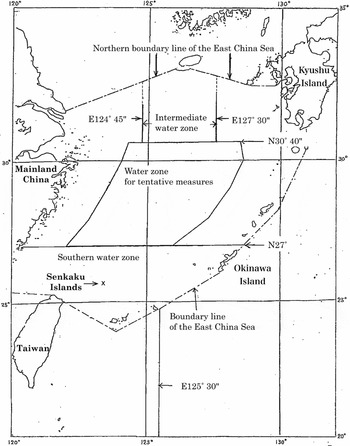
Due to the territorial disputes and competing EEZ claims among the countries concerned, plenty of blank zones were created in all of the three new frameworks.Footnote 16 In the case of Japan and China, the treatment of Taiwan, located immediately south of Okinawa, also exerted potential influence on the framework because both parties could not neglect the existence of Taiwanese fishermen operating in the East China Sea. In the New Fisheries Agreement between Japan and China, a huge ‘water zone for tentative measures (日中暫定措置水域)’ was set up in the middle of the East China Sea (Figure 2). To the north, where the ROK also claims its EEZ and where fish are traditionally abundant, another ‘intermediate water zone (中間水域)’ was also established based on the negotiations between the two countries. In these two areas, fishing boats from both countries are requested to obey the laws enforced by their own authorities while being allowed to operate under the conditions set by the Japan–China Joint Fisheries Committee annually.
Map of water zones of the New Japan–China Fisheries Agreement Source: Nitchu Gyogyo Kyodo Iinkai (Japan–China Joint Fisheries Committee), http://www.jfa.maff.go.jp/j/press/kokusai/pdf/20111031_b.pdf, modified by author (accessed on 19 May 2012).

What is more striking is that the area south from latitude 27 degrees north, the so-called ‘southern water zone (以南水域)’ which includes the southern part of the East China Sea and a small part of the South China Sea near Taiwan, was not included in the ‘water zone for tentative measures’ (Article 6, Clause (b)). Although Article 11's Clause 2(1), which specifies the responsibilities of the Japan–China Joint Fisheries Committee, also mentions that it should ‘negotiate and make recommendations to each of the governments of the signatory countries’ on issues related to the southern water zone, the area was basically left out of any public agreement. Obviously, this was owing to the difficulties related to the treatment of Taiwan, combined with the de facto territorial disputes over the Senkaku Islands. As a consequence, a majority of the Japanese water near Okinawa prefecture remained freely open to foreign fishing boats as it had been before. Additionally, the two states agreed to set the conditions annually for the fishing boats in other countries to operate in their non-disputed EEZs.
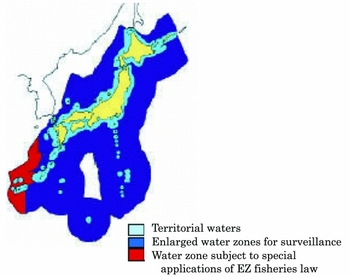
Concerning the Senkaku Islands themselves, there is further ambiguity in the New Fisheries Agreement. When the clash between the Chinese fishing vessel and the JCG occurred in 2010 in the waters off the Senkaku Islands, China denounced Japan for behaving counter to the agreement provision, stating that Japan can only regulate the behaviors of Japanese fishermen. However, as has been mentioned, there is no explicit clause related to the law enforcement in this area in the New Fisheries Agreement. In contrast, the JCG's surveillance of the 12 nautical miles near the Senkaku Islands, recognized as normal territorial waters, was indeed upheld after the New Fisheries Agreement came into effect (Figure 3). In the territorial waters marked in lightest grey (light blue online), the JCG may patrol and defend unilaterally. The area marked in lighter grey (red online) denotes where the JCG may enforce regulations only for Japanese fishing vessels.Footnote 17
The Japanese coast guard's surveillance area after the effectuation of the New Fisheries Agreement with China Source: Kaijo Hoan-cho (Japan Coast Guard), Kaijo Hoan Report, 2003 (Japan Coast Guard Annual Report, 2003), http://www.kaiho.mlit.go.jp/info/books/report2003/special01/04.html, modified by author (accessed on 20 May 2012).

Some scholars point out that there were ‘tacit understandings’ among the Chinese, accepting Japanese sovereignty over the Senkaku Islands upon concluding the New Fisheries Agreement. In his analysis of the situation, Zhao Hongwei raises the possibility that unpublicized rules were made by Japanese and Chinese authorities concerning the southern water zone: fishing boats from both countries are allowed to operate; surveillance ships from Japan and China enforce regulations only for the fishing boats belonging to their respective countries; the Chinese side respects Japan's actual control of the Senkaku Islands, but Japan permits Chinese fishing boats the right of safe passage through Japanese territorial waters, including the zone near Senkaku. Zhao speculates that – because the Chinese government was afraid to let its people know about the concessions recognizing Japanese control of the Senkaku Islands, and given that the Japanese government was also concerned about what the public would think about its administrative compromises in its own waters – the nations never mentioned the existence of such unpublicized understandings (Cho, Reference Cho and Hongwei2010: 64–7).
As a matter of fact, during the negotiation of the New Fisheries Agreement, there was a newspaper report that both parties had agreed to draw a provisional borderline in the water zone near the Senkaku Islands, and that the line would come into effect even before the New Fisheries Agreement was concluded (Asahi Shimbun, 24 June 1997). If one looks at the behavior of the surveillance vessels belonging to the Chinese Fisheries Administration Bureau (Yuzheng), they have basically stayed within the Japanese contiguous zone near Senkaku and never advanced into its territorial waters prior to the 2010 incident. It was also reported that the Chinese Fisheries Administration Bureau included the areas near the Senkaku Islands as part of its regular patrols only after 2010 (BBC Monitoring Asia Pacific, 12 July 2012). It is natural to assume that the Chinese government did recognize the de facto sovereignty of Japan over the Senkaku Islands before 2010, but with the outbreak of public nationalism against Japan, it broke the tacit agreement and began to advance into the range of the 12 nautical mile zone near the Senkakus.
Before the boat clash took place near the islands in that year, a tacit agreement between the two countries may have worked in reality. However, the absence of visible, clearly defined roles and regulations complicated the situation, especially when China advertised its all-out sovereignty over ‘Diaoyudao’ to its citizens and strengthened various administrative measures in the East China Sea. The Senkaku incident was a natural consequence of the current framework and was not mere coincidence.
Joint management of the fishing resources
The ocean, used by the many, easily invites a tragedy of the commons. While UNCLOS stipulated the rights of signatory nations, including the establishment of EEZs, it also specified their obligations pertaining to the biological and environmental preservation of the sea. Article 61 (‘Conservation of the Living Resources’) urges coastal states to determine the allowable catch of the living resources in their individual EEZs, to cooperate with related actors to prevent overexploitation, and to exchange scientific information and data related to the conservation of fish stocks with relevant international organizations (United Nations, 1982: 45-6). Especially for the stocks that migrate into several EEZs, UNCLOS further states:
Where the same stock or stocks of associated species occur within the exclusive economic zones of two or more coastal States, these States shall seek, either directly or through appropriate subregional or regional organizations, to agree upon the measures necessary to coordinate and ensure the conservation and development of such stocks without prejudice to the other provisions of this Part.Footnote 18
Therefore, international cooperation among related countries is highly desirable for related countries.
Based on these statements in UNCLOS, the New Fisheries Agreement between Japan and China included clauses on the conservation of biological resources. In deciding the species, quotas, and methods allowed for fishing in one country's EEZ for the other side, both countries have to take into account the latest status of fishing resources (Article 3). Similarly, the Japan–China Joint Fisheries Committee is responsible for enacting proper conservation measures and quantitative controls in the waters governed by tentative measures in order to ensure that the sustainability of biological resources is not endangered by overexploitation (Article 7, Clause 2). Both countries also agreed to cooperate on matters of scientific research and on the conservation of ocean's biological resources related to fisheries (Article 10).
In terms of the conservation of biological resources, Japan and China have not fulfilled the responsibilities stated in their New Fisheries Agreement. According to the press releases posted by the Japanese Fisheries Agency on its website, annual meetings of the Joint Fisheries Committee are not yielding significant results in terms of resource management, especially in the areas where Japanese and Chinese EEZ claims overlap. Not only is the treatment of the southern water zone excluded from the official agenda, but after more than a decade of implementing the agreement, both countries are still in the process of ‘preparing’ to exchange necessary materials needed for resource management measures in the intermediate zone.Footnote 19
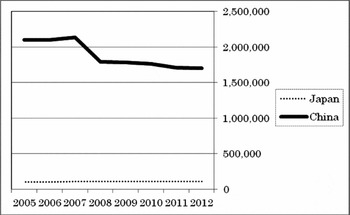
For the water zone governed by tentative measures, at least Japan and China have set non-binding quantitative targets for the annual maximum catch. Yet, there is no mention of detailed boat numbers, accepted fishing methods, and the names of stocks that may be fished. Furthermore, as shown in Figure 4, the quantity allocated to China is excessively large and unfavorable to Japan. In the year 2012, for example, the ratio between Japanese and Chinese maximum catches was as great as 1:15.6. Since there is no report that the Chinese government implements any strict quantity regulations on its domestic fishermen, in reality these annual numbers negotiated in the Joint Committee seem to be only confirming the overexploitation by Chinese fishermen in the East China Sea.Footnote 20
Japanese and Chinese non-binding quantitative targets for the annual maximum catch in the water zone governed by tentative measures (unit: tons) Notes: The annual fishing period before 2011 was set from 1 January to 31 December, whereas it was changed from 1 June to 31 May after 2012 due to negotiation delays. Source: Japanese Fisheries Agency homepage.

On the other hand, the annual quantities of Japanese and Chinese allowable catches in their respective counterpart's non-disputed EEZs are agreed upon on an almost equal basis. The stocks, fishing methods, and boat numbers are determined in detail by the Joint Fisheries Committee. However, these efforts seem to be merely token gestures by the committee, considering the fact that the group has not undertaken any meaningful cooperation for the conservation of fishing resources in the vast area that lies between the two countries.
It is already very clear that if fishermen in coastal states such as China and Japan continue fishing in the ways in which they do now, the ensuing overexploitation will occasion problems for all. However, fishermen are likely to abandon cooperative conservation efforts if they believe that others might not join in. In order to manage fishing resources in comprehensive and better ways, especially those species that are highly migratory, TAC control through an international regime is strongly recommended. The possible introduction of the IQ regulations would be a further step.
With regard to the East China Sea, transnational efforts among related countries have been desired for a long time. For example, Nagasaki prefecture along the Western edge of Kyushu Island has been urging Tokyo for several years to establish a Management Organization for Maritime Resources in the East China and Yellow Seas among Japan, China, and South Korea.Footnote 21 In fact, the intermediate zone determined by the New Fisheries Agreement between Japan and China has come to include most of the southern water zone governed by tentative measures under the agreement between Japan and ROK, as well as some of the tentative zone between China and the ROK. If international cooperation is to be achieved in the future, it is highly desirable for the Fisheries Society of Taiwan or other non-governmental organizations to be included in the framework, for the existence of free riders can threaten even the most cooperative of regimes. It is worth paying attention to the fact that fishing is essentially a private sector matter.
According to a related survey, within the many pelagic fish stocks facing exploitation pressure in the East China Sea, chub mackerel is the most highly sought among the relevant actors, and there is a possibility that bluefin tuna will be in a similar situation in the near future. The seer fish, whose haul has declined rapidly in China but risen substantially near Korea and Japan beginning around 2000, can be an interesting example for international research. Demersal fish in general are more vulnerable to high catches and need to be conserved in a cautious way. Among demersal fish, the stocks that lay eggs near the Chinese continent and move offshore as they grow, such as hairtail, yellow croaker, pike conger, and silver pomfret, have been under strong pressure from fishing competition. Although demand for an effective resource management scheme has been high, the basic scientific research among the related parties remains in a primitive stage (Tokimune, Reference Tokimura2011).
Fishermen–government relations in China
When calling for international cooperation in the field of fisheries, it is important to take into account fishermen–government relations, especially of the Chinese in this case. As a vivid report by Honda (Reference Honda and Akihiro2012) depicts, Japanese fishermen acted in direct defiance of the government when they sailed into the northern sea obtained by the Russians for operations.Footnote 22 How are the relations between Chinese fishermen and their government constructed? What kinds of implications can we see for future negotiations involving China?
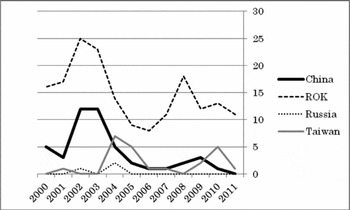
There are not many pieces of evidence available from which to assess the state of relations between the two parties. Figure 5 shows the fluctuations in the numbers of Chinese fishing boats captured by the Japanese Fisheries Agency for illegal operations in Japanese waters. Besides the Fisheries Agency, the JCG has its own body of statistics that shows a similar tendency among the concerned parties.Footnote 23 As stated above, fishermen in western Japan once had strong complaints about their Chinese counterparts. However, after the effectuation of the New Fisheries Agreement and with the passage of time, the number of Chinese fishing boats caught by the Japanese authorities has greatly reduced in number, presumably as a result of directions and education initiatives undertaken by the Chinese government on behalf of their fishermen. By contrast to the recent complaints voiced against Chinese fishermen in the countries to the south, strong opposition is not often heard in northern Japanese fishing villages nowadays. Overall, the Chinese government seems to have the capability to make its fishermen listen when it wants to.
The numbers of foreign fishing boats captured by the Japanese fisheries agency for illegal operations Source: Japanese Fisheries Agency, http://www.jfa.maff.go.jp/.

On the other hand, there is widespread doubt as to whether the Chinese government is utilizing the fishermen's operations to enlarge its actual control over the sea. According to an article published in China, the fishing boats that operate near the Spratly Islands and Scarborough Shoal are provided with government subsidies each time they go out fishing. In the year 2011, 35,000 RMB plus 82 RMB/kW of the boat's horsepower per visit was paid to the applicants.Footnote 24 Chinese authorities are encouraging domestic fishermen, including the owner of the trawlers impounded by the North Korean authorities in May 2012, to venture into North Korean waters for fishing – even providing Chinese law-enforcement vessels as protection (Chen, Reference Chen2012). Such an aggressive stance taken by the Chinese government, potentially in service of controlling a wider swath of ocean territory, is a subject of deep concern for the neighboring countries. Although relevant information is limited, for the time being it can be concluded that it is the Chinese government and not the individual fishermen that holds the power to make decisions on the borders for fishing zones.
Japanese experiences with China in ocean affairs over the last 15 years reveal that it is not an easy task to keep China engaged in negotiations (Ogura, Reference Ogura1979; Masuo, Reference Masuo and Minohara2011). As has been observed of their ‘core interest’ (hexin liyi) assertion, the ultimate sense of sovereignty on the Chinese side makes diplomatic negotiations very difficult. To persuade the Chinese government to participate in a cooperative movement, a rational line of reasoning is required that underscores how Chinese citizens could benefit practically from any proposed agreement. A proposition for the joint management of fishing resources could just fit the bill.
Beyond sovereignty
When a state claims sovereignty over islands and rocks far removed from its capital, it often bases its arguments on certain facts: that some of its nationals depend on the fisheries in the nearby waters for living, and that their ancestors have done so for generations. However, we need to take into consideration the fact that the fishermen and traders who have observed the islands from the sea for centuries do not decide the jurisdiction of the islands. In many cases, they are not the only people who have known those places.Footnote 25 No matter what dynasties emerge and fall on the shore, the sea has remained, often providing its natural benefits for peoples who have divided themselves into several nations. Modern nation-states, the latecomers, only recently invoked the notion of sovereignty for the peripheral areas of ocean territory. In the East China Sea, the new nations made small and uninhabited islands the subjects of territorial disputes, each calling the islands its own ‘indigenous land’.
Recently, serious territorial disputes over the sea are occurring all over the East Asian region. When a country claims sovereignty over islands or mere rocks, it has enough evidence at least to convince its own people, so it cannot easily back down from its assertion. China criticized the Japanese for continuing to pursue a ‘militarist’ foreign policy in their occupation of the Senkaku Islands, but ultimately it was the United Nations that decided the new boundaries of Japanese territory after World War II. The Republic of China did not claim sovereignty over the Senkaku Islands during those negotiations, and the People's Republic of China indirectly affirmed the new boundary line drawn between Taiwan and Senkaku Islands in 1953 (Renmin Ribao, 8 January 1953).Footnote 26 The two governments of China did not sign the Treaty of San Francisco because they disputed over which would represent China, but never because they had any objections to the new borderline with Japan. The story of ‘our sacred territory stolen first by Japanese militarism and then by the US ambitions toward Asia’ is totally a new myth, spun after a committee under the aegis of the UN's Economic Commission for Asia and the Far East (ECAFE) pointed out the possibility of huge petroleum reserves near the islands in its report published in 1969 (Miyoshi, Reference Miyoshi, Tadao and Masahiro2006: 259–260).Footnote 27
Resolving such disputes definitively would require time. Although territorial issues can easily become national symbols and used against other countries, one needs to take into account that nationalism often hampers diplomatic concessions essential for diverse international resolutions. Greater the attention the public pays to such issues, lesser the room governments have for maneuvering. The Japanese and Chinese administrations will find it difficult to extricate themselves from the current deadlock if each party continues to assert its sovereignty over the islands. Diplomatic negotiations are becoming more and more difficult as tensions flare. In the end, do we have to decide the jurisdiction of the islands by war?
What is probably required for us now is a different approach – not the demarcation of the sea. If we could accept the long-time reality of the sea as a shared commons for the people who are now divided amongst many countries, a new possibility might be found. For the areas that have contested maritime borders, at least for the time being, different parties could jointly bear responsibility for resource management measures by establishing especial zones for cooperation. Unlike the era in which fishing operations coincided well with nature, human beings today are potentially capable of destroying fishing resources globally. States should not provoke ocean disputes, but they should rather arbitrate the different interests of the relevant actors. For this purpose, we need to choose political agendas that are objectively desirable and according to which people can work together.
Scientific management of the sea is not a simple task at all (Kawasaki, Reference Kawasaki2005: 39–152). However, stopping the overexploitation in the East China Sea through effective international cooperation would still provide a solid, win-win solution that could confer benefits to all parties. If we can improve the ocean environment, not only will the gains of fishermen in each country increase, but we can also make contributions for future generations.
About the author
Chisako T. Masuo is an Associate Professor at the Graduate School of Social and Cultural Studies, Kyushu University located in Fukuoka, Japan. She received her Ph.D. from the University of Tokyo in 2008. Her research topics include Chinese foreign policy, international relations in East Asia, and Sino-Japanese relations. Before assuming her current position at Kyushu University, she worked for Waseda University as a lecturer, for Professor Ezra F. Vogel (Harvard University) as his research assistant, and for the Japan Institute of International Affairs (JIIA) as a research fellow. She is the author of China Looks Back: Mao's Legacy in the Open-Door Era (University of Tokyo Press, 2010 in Japanese) and co-author of some other books. Her most recent work on the development of East Asian regional cooperation appears as a chapter in A History of Japan–China Relations, 1972–2012/Politics (Akio Takahara and Ryuji Hattori (eds.), University of Tokyo Press, 2012 in Japanese; Chinese edition forthcoming).