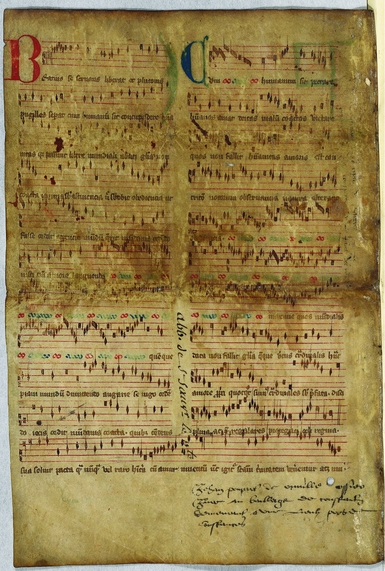
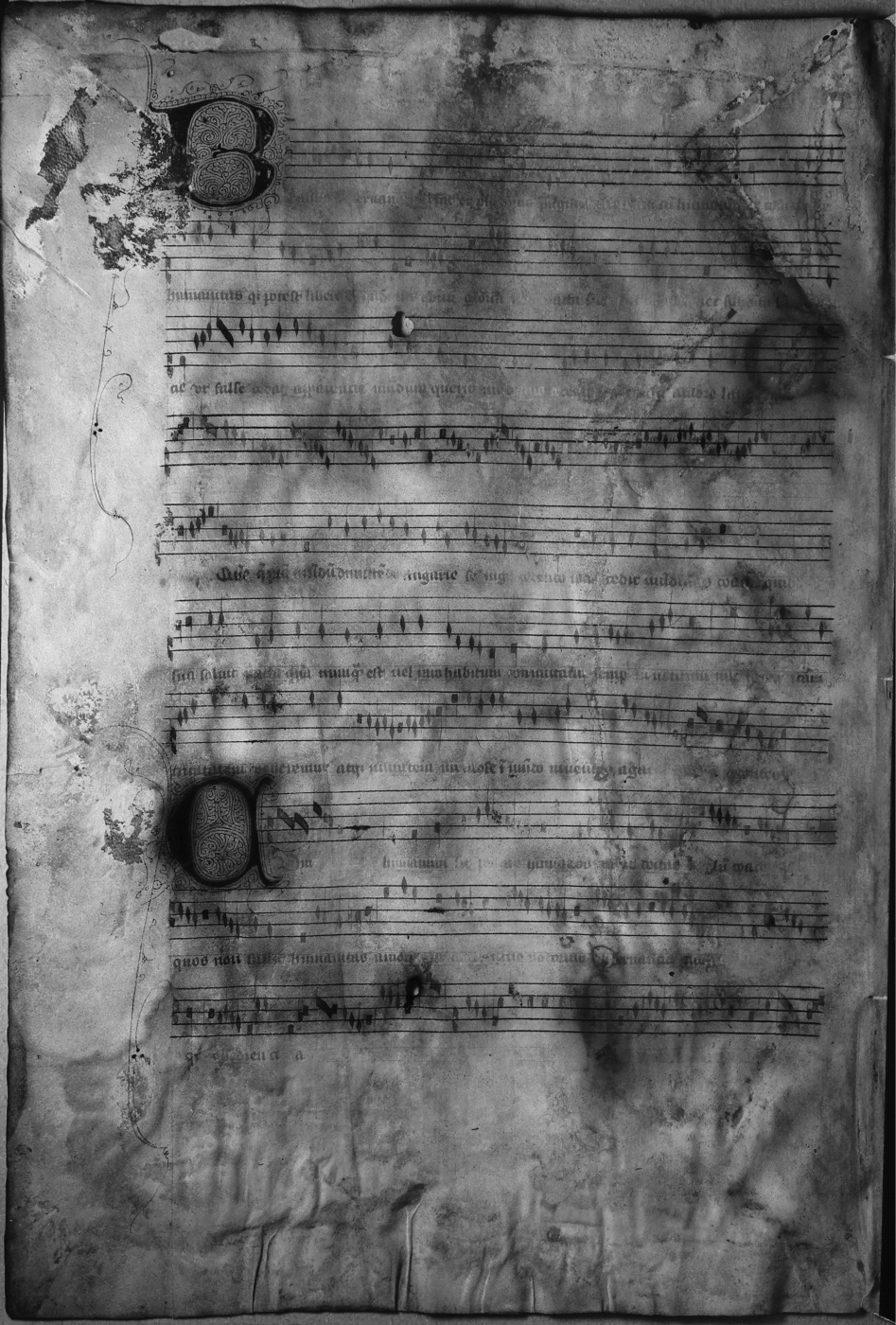
The scribe of the fourteenth-century music manuscript whose lone surviving fragment now makes up fols. 48–9 of the miscellany F-Pn 2444 had the endearing habit of drawing red and blue doodles under musical staves when there was no text to fill that space. This was his approach to the untexted lower voices of motets as well as their upper-voice melismas and hockets (motets apparently being the primary genre he copied into a manuscript that must once have comprised at least two gatherings). The doodles are especially prominent on folio 49v, which is dedicated to the motet Beatius/Cum humanum (see Fig. 2). Though the page is creased and rubbed from time served as the cover of an account book, both motet voices on this folio – the triplum on the left, and the motetus on the right – are noteworthy for the concentration of doodles in the middle of the page. The music in these sections consists of short phrases alternating with rests exchanged between voices at an increasingly breathless pace: evidently the motet has a giant untexted hocket section in its middle.
Thanks to two recently identified concordances, the upper voices of Beatius/Cum humanum can be edited for the first time. Though still fragmentary for want of a tenor, the motet reveals itself to be extraordinary in several respects. Its tripartite structure with a hocket in the centre is unique among the known Ars Nova motets.Footnote 1 And yet, Beatius/Cum humanum is firmly linked to this broader repertory through a marked intertextual relationship with the Fauvel motet Firmissime/Adesto. The latter work draws attention to the relationship between Ars Nova rhythm and theology because its praise of the Trinity is couched in duple (‘imperfect’) notes. Beatius/Cum humanum can be fruitfully situated within this same conversation: though also built up of duple longs, its striking form offers an alternate model of how music that is duple in many respects can engage with threeness and perfection.
The first two sections of the present article serve as extended commentary to the new edition of the motet in Appendix 3, exploring aspects of style and structure as well as the prominent quotation in the triplum voice. The third and fourth situate Beatius/Cum humanum and Firmissime/Adesto within two discussions of perfection – one from the early fourteenth century, the other from the late twentieth. The final section speculates on the relationship between Beatius/Cum humanum and the output of Philippe de Vitry.
Style and structure
At 226 breves, Beatius/Cum humanum is the third-longest known Ars Nova motet, out-done only by Guillaume de Machaut's Christe/Veni (Motet 21; 227 breves) and Philippe de Vitry's Petre/Lugentium (251 breves),Footnote 2 two works from northern France that can be dated to within a decade of mid-century. While length is only an indirect marker of style, it seems to be the case that longer motets were written in the middle third of the century, and based on both its sources and its notational style Beatius/Cum humanum can be comfortably placed within this geographic and chronological space.Footnote 3 More remarkable than the motet's length is its large-scale symmetrical structure. An eighty-breve hocket section with no text is framed on either side by sixty-six-breve texted sections, prefaced by a twelve-breve introitus, and concluded with a two-breve final longa.Footnote 4 This form is summarised in Figure 1d.
Polytextual writing and untexted hocket sections in four motets (unbroken texture marked in dark grey, hockets in black and introitus sections in light gray; final longs are included in the last section's count).

Three other motets combine long, untexted hocket sections with smoother polytextual writing. O canenda/Rex (attributed to Vitry) contains a twenty-four-breve hocket ninety-six breves into the motet (Fig. 1a); in Impudenter/Virtutibus (also attributed to Vitry), ninety breves of texted music are followed by forty-four untexted breves with frequent hocketing (Fig. 1b); and in the later Pictagore/O terra from the Chantilly Codex, 124 breves of polytextual writing are followed by sixty-two breves of untexted material with frequent hockets (Fig. 1c).Footnote 5 In all these works the untexed hocket section coincides with a final color in diminution.
In contrast, the hockets of Beatius/Cum humanum do not close the piece, but are followed by a third section matching the first in texture and length. Due to the loss of the tenor, it is impossible to determine what, if any, repetitive rhythmic schemes provided scaffolding for such a structure. The fact that the motet's outer sections are of identical length (sixty-six breves), while the hockets are even longer, makes it doubtful that the latter coincided with tenor diminution as they do in the other motets in Figure 1. If diminution did accompany the hockets, this section of the tenor must have been repeated before returning to the integer valor. Perhaps, then, something like a quadripartite tenor with section lengths of 60–40–40–60 or 66–44–44–66 once supported the form of the piece.Footnote 6 In any case, the form of Beatius/Cum humanum represents a marked departure from whatever conventions can be gleaned.
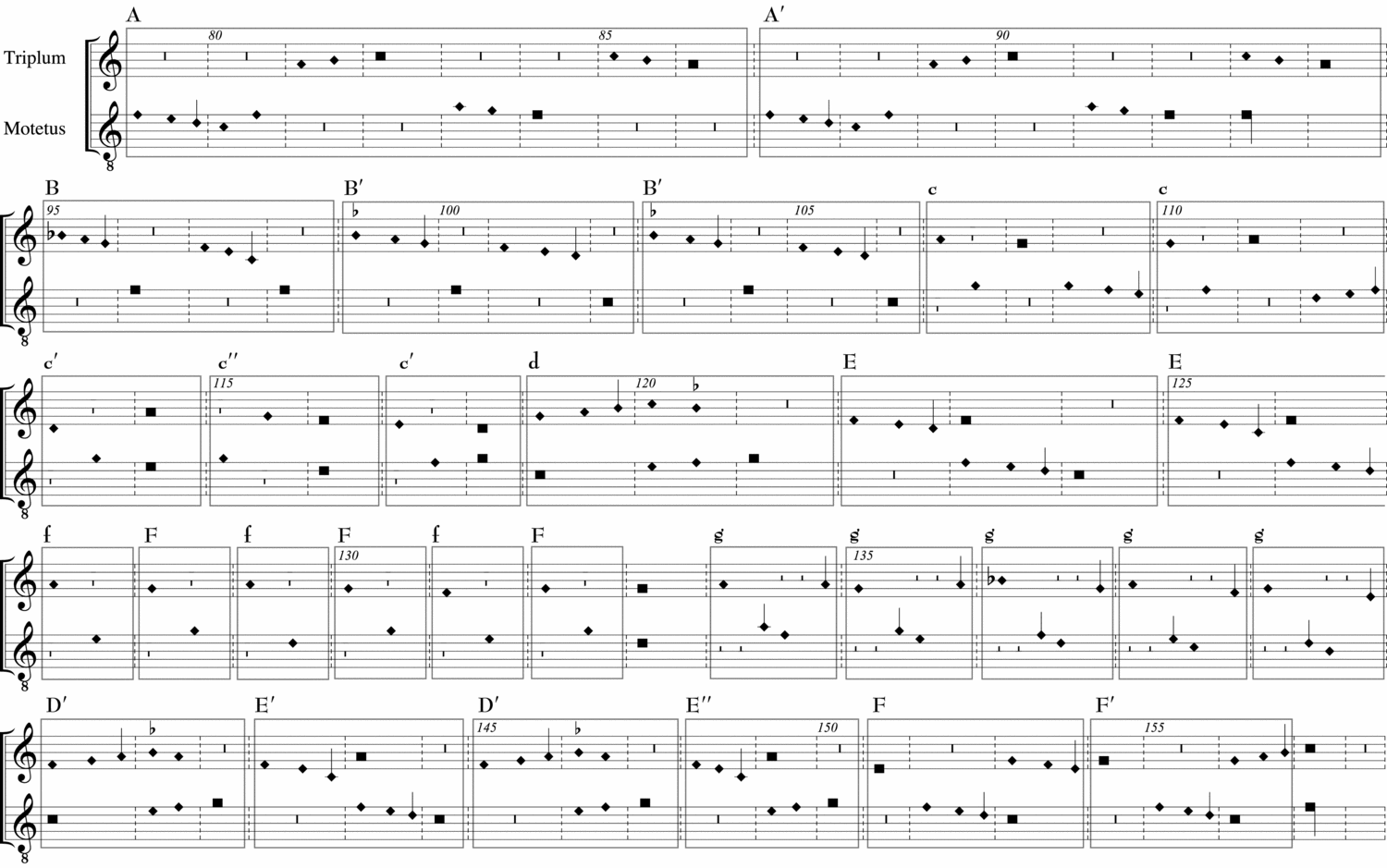
The hockets stand out stylistically as well. The motet's first and third sections restrict themselves to notational patterns prominent in the earlier stages of Ars Nova practice. Although minims are signed, the upper-voice rhythmic figures on the level of prolatio are limited to the same patterns apparently encoded by undifferentiated semibreves in Ars Antiqua sources:
 ,
 and
 . But the eighty-breve middle hocket section evokes a different set of practices. It is a methodical demonstration of what hocketing can be, moving from longer phrases exchanged by the two voices to progressively shorter ones, and recombining them in a range of ways. The rhythms
and
are still prominent, but the minim rests in bars 136–9 belong to post-Fauveline notational usage. Even more unusual are the frequent repetitions (in bb. 95–106, 122–6, and 139–50) and the sequential movement in bars 134–8.Footnote
7
Example 1 highlights some of the most prominent melodic and rhythmic blocks in the hockets, marking rhythmic correspondences with lowercase letters, and those involving both pitch and rhythm with uppercase.Footnote
8
Beatius/Cum humanum, upper voices, breves 79–158, excerpted from the edition in Appendix 3. Cells in the upper voices are marked with capital letters when their pitches and rhythms correspond, and with lowercase letters when the similarities are only rhythmic.

The very act of hocketing brings with it a different notational and sonic palette, so these stylistic differences may not amount to much. But it is nevertheless possible that the central hocket section of Beatius/Cum humanum was added at some point subsequent to its initial composition. The hockets of Vitry's Cum statua/Hugo were updated in one of its sources to employ minim rests; stylistical differences and a structural irregularity suggest that the untexted hocket section of Vitry's O canenda/Rex was a later addition.Footnote 9 The hockets of Beatius/Cum humanum might be another, more extreme case of such updating, carried out by the original composer or by someone else. The facts that these hockets result in an irregular tripartite structure, carry no text and are set off from the rest of the motet by prominent cadences all point to this scenario. Jacobus's Speculum musice testifies to this practice as well: when he complains about the paucity of genres cultivated by the moderni, he reproaches them for writing only songs and motets, ‘except for inserting hockets in their motets’ (‘nisi quod in motetis suis hoketos interserunt’).Footnote 10
The question of notational updating of Ars Nova motets is beyond the scope of the present article. Whether the central hocket section of Beatius/Cum humanum was always there, or whether it was added at a subsequent stage hardly matters to this analysis – indeed, it is hard to say which would be the stranger circumstance. In either case the work's middle section is excessive and invites interpretation.
No fragment containing the motet's tenor has come to light. That it must have had one is clear: although in its latest source the motet is accompanied by two-voice Credos, its upper voices present far too many unsupported fourths to stand on their own. The editorially supplied lower voice in the appended edition attempts to realise the contrapuntal implications of the upper voices, in line with common Ars Nova practice. The primary constraints under consideration were to support fourths between triplum and motetus, and to provide a singable line. The result is harmonically conservative, as is often the case when voices have been reconstructed. No chant emerges as an obvious match to the resulting melody. Moreover, the motet may well have had a gramatically essential contratenor as well as a tenor. Although most Ars Nova motets are in three voices, the two comparably long motets noted above are in four voices. A tenor-contratenor pair would have given the composer flexibility in the hocket section, allowing him more easily to support the melodic sequences and repetitions there. Assuming the existence of a contratenor, any substitute or reconstructed lower voice most closely approaches a solus tenor, that is, a conflation of lower voices.
Texts and intertexts
Both surviving voices of Beatius/Cum humanum treat the difficulties of living virtuously in a beguiling world (the texts, newly edited and translated by Andrew Hicks, are printed in Appendix 4). The triplum admits that coveting power and worldly goods is a part of human nature (ll. 4–6), which, when not under the constraint of the holy vows of abstinence and obedience, ‘is able to abuse worldly glory freely’ (ll. 5–6). Languishing, or seeming to languish, in Christ's love while seeking the world and yielding to worldliness leads to a conflict between the inner and outward actions which will lead to false appearance (l. 8: ‘false . . . apparencie’, comparable to the French Faus Semblans). Those who have renounced the world find it harder to turn back, once their vows are broken: ‘there is never or rarely an escape, since we strive always for the forbidden’ (ll. 15–16, echoing Ovid, Amores, 3.4.17). The best course of action is therefore to live virtuously in the world, thereby freeing oneself from Satan's reach (ll. 1–3, 19–20). But the triplum's final couplet together invokes those who live virtuously in the world and those who ‘yield to false service’. The motetus recommends contrition and the observance of vows, praising especially ‘those whom worldly glory, once bestowed, does not deceive’ (ll. 9–10). Its final lines shift from a distanced moralising tone to a personal one, asking the Virgin's protection for all holy men, from cardinals to ‘regulares’ (those living under monastic rule, ll. 15–16).
As is usual in this repertory, the two upper-voice texts are structurally differentiated. The motetus consists of sixteen octosyllabic lines arranged as four stanzas with the rhyme-scheme abab cdcd eded fgfg. The longer triplum text consists of twenty decasyllabic lines arranged in rhyming couplets. All but one of these feature a caesura after the fourth syllable, and the outlier (‘ut false ce/-dat apparencie’) may be programmatic.
Both voices are split in two by the hocket section. In both cases the split is formally unproblematic: the four motetus stanzas are syntactically independent, and the hockets fall between stanzas 2 and 3. In the triplum, the long sentence which begins in line 3 ends with line 10, making the midpoint of that text a reasonable place for interruption. The messages of the triplum's two halves run roughly in parallel, discussing first those who do not live under the constraint of vows, and then those who do. Furthermore, lines 5–9 and 11–14 contain a conspicuous return of some key words presented in the same order: ‘mundum . . . subdendo . . . cedit mundanis . . . cedens’ echoes ‘mundiali . . . subdita . . . cedat . . . mundanis cedendo’. ‘Coacta’ is also part of each of these text clusters (ll. 6 and 13).
Both the motetus and triplum conclude with a turn from moralising to prayer. The motetus's final line, ‘protegat celi regina’, evokes Marian discourse, while the triplum incorporates a Trinitarian quotation. Motet texts often invoke auctoritates in their closing lines, and these could be sacred or secular, Latin or vernacular, ancient or medieval – though not usually contemporary: older authors such as Chrétien de Troyes and Joseph of Exeter (both twelfth century) were more likely to be invoked.Footnote 11 In the triplum of Beatius/Cum humanum, however, the source quoted is not biblical, classical or legitimated by its relative antiquity. Rather, lines 17–18 (‘Nunc igitur sanctam trinitatem / Veneremur atque unitatem’) are a direct quotation from Firmissime/Adesto, a motet attributed to Philippe de Vitry and first transmitted in the Roman de Fauvel. There too these words appear as the triplum's penultimate couplet:Footnote 12

If it were restricted to text, the quotation of these lines in Beatius/Cum humanum would already be noteworthy for revealing a relationship between two motets written only several decades apart. As Margaret Bent showed in her analysis of Tribum/Quoniam, such quotations function as essential building blocks that have broad structural and interpretive consequences for the motets they cap.Footnote 13 Indeed, the lines quoted in Beatius/Cum humanum appear at the same point in Firmissime/Adesto: in both they are lines 17–18 of a twenty-line triplum.
The possibility of other structural parallels between the two motets that this coincidence raises is borne out. Though Firmissime/Adesto is shorter (192 breves as compared to 226), both are written in imperfect modus and tempus with major prolation, and with syllables declaimed on the level of prolation in the triplum voices. Both begin with a twelve-breve introitus during which the triplum voice rests. The poetic metres match and line counts are related. The eight-line motetus of Firmissime/Adesto tropes the first stanza of the hymn Adesto sancta Trinitas, alternating new lines with the first four of the hymn’s. The result is a very short text which leaves that voice with many untexted phrases. No part of Adesto sacta Trinitas makes it into the later motet, but its octosyllabic verse is preserved, while the motetus doubles in size to sixteen lines in Beatius/Cum humanum. The triplum, as noted, consists of twenty decasyllables in both works.
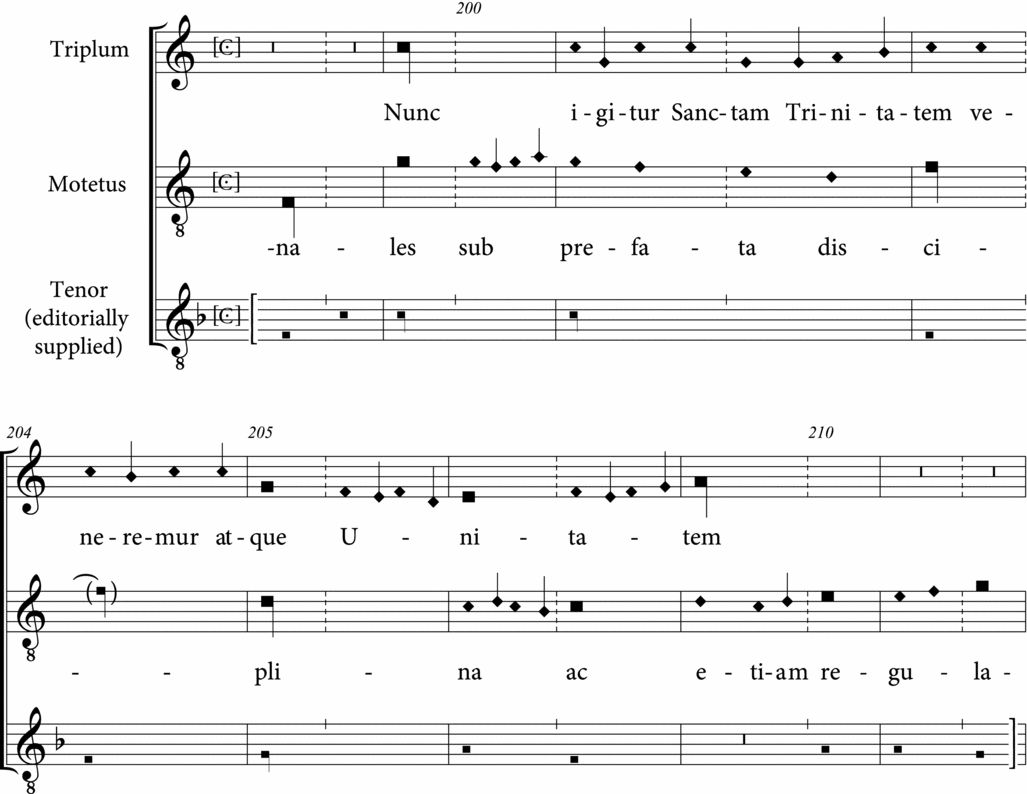
But there is more to this quotation than repeated text and borrowed metrical schemes. On the words ‘nunc igitur sanctam trinitatem veneremur, atque unitatem’, the triplum melody and rhythms of Firmissime/Adesto are also replicated in Beatius/Cum humanum (see Exx. 2 and 3).Footnote 14
Firmissime/Adesto, breves 162–77 (edited from Brussels, Bibliothèque Royale 19606, recto).

Beatius/Cum humanum, breves 197–212 (excerpted from the edition in Appendix 3).

This echo of text and music merits further consideration. It would not be strange to come upon so prominent a moment of musico-poetic intertextuality in repertory written in the so-called ‘Ars subtilior’ style, and especially in a song. Nor would it even be so surprising to find it in an Ars Nova song; as Yolanda Plumley has recently argued, citational practice is fundamental to the formes fixes.Footnote 15 But in a motet whose earliest source (F-Pn 2444) is from the mid-1300s it is unprecedented.
That an Ars Nova motet should cite another source is not in itself remarkable. Though refrain citation in motets peaked in the thirteenth century, the examples of borrowings from classical and medieval sources mentioned above are not unrepresentative, and are a well-attested practice in the works of Machaut and Vitry.Footnote 16 A different kind of borrowing is prevalent in the use of plainchant tenors, which are a mainstay of the genre: in those cases, the notes of the melody are borrowed, but the original words that accompanied them were in all probability left unsung. There are also some examples of text and melody borrowed together from what appear to be monophonic popular tunes (e.g. the tenor of Machaut's Lasse!/Se j’aim/Pour quoy me bat (Motet 16), a chanson de malmariée).Footnote 17 Thus there are several examples of Ars Nova motets borrowing texts, melodies or both from sources external to the genre.
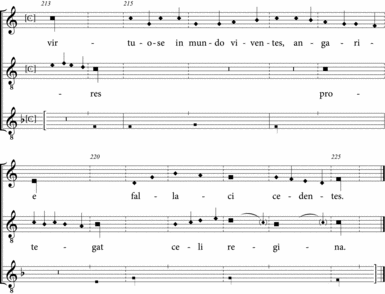
Beatius/Cum humanum sets itself apart from this practice in quoting material from within its own genre and generation of works. Bars 199–210 of Beatius/Cum humanum constitute the clearest and most extended musical quotation yet to be found of any other Ars Nova motet in any other. Other allusions between motets that have been posited involve text, pitch or rhythm, but never all three; and they never extend beyond a few breves.Footnote 18 Such borrowings lie on the continuum between coincidence and deliberate citation. But in Beatius/Cum humanum, there is no question of missing the melody from the older motet in its new context, since it appears at the top of the texture and carries the same words as it did in Firmissime/Adesto. Furthermore, the musical echo does not stop when the quoted text does. The next phrase of the triplum repeats the melody used for ‘nunc igitur sanctam trinitatem’, now set to the words ‘virtuose in mundo viventes’, thereby giving the listener another chance to hear the fanfare (Ex. 4). The sparsely texted and rhythmically inactive motetus in bars 214–17 helps foreground this moment, perhaps alluding also to the loosely texted motetus of Firmissime/Adesto. Following this melodic echo, which comes immediately after the quotation, only seven breves remain before the final cadence, which both voices accordingly head towards. The marked and unusual quotation, then, constitutes the last salient event in the long and complex Beatius/Cum humanum.
Beatius/Cum humanum, breves 213–end (excerpted from the edition in Appendix 3).

By placing two works into dialogue, this quotation hints at a dialogue between their composers (or between distinct compositional stages in the career of one composer, if they emanate from the same pen). Its specific content, paired with the place of Firmissime/Adesto on the cusp of the Ars Nova, invites speculation about the possible contributions of Beatius/Cum humanum and its model to broader dialogues about music, trinity and perfection. The written record preserves only the traces of such debates, but in doing so confirms that they did take place. Here I attempt to situate the pair of motets within two discussions that implicate Firmissime/Adesto. One of these is medieval, the other is modern; both focus on the relationship between mensural threeness and the triune Godhead. In order to listen in, it will be necessary to take a short excursion into the theoretical background of musical perfection and its link with the Trinity.
Trinity and perfection
The Latin adjective ‘perfectus’ has two related meanings pertinent to music theory. The first has to do with integrity (finished, complete); the second is qualitative (perfect, excellent). Johannes de Garlandia invoked the first meaning when he applied the term to rhythmic modes, explaining that ‘modus perfectus’ is a mode which contains full cycles of its repeating pattern.Footnote 19 This is also the meaning implied in his discussions of perfection at the ends of ligatures.Footnote 20 The application of the term to individual longs comes in Lambertus and Franco.Footnote 21 Earlier theorists (the author of Discantus positio vulgaris and Johannes de Garlandia) had called the duple longa ‘proper’ (longa recta), because at the time longs were usually accompanied by breves. Under this nomenclature, the three-beat longa was dubbed ‘longer than a long’ (longior longa) or ‘long beyond measure’ (longa ultra mensuram).Footnote 22 But in the 1270s Lambertus assigned perfection to individual notes and argued that longs and their neighbouring breves are reducible to perfect longs.Footnote 23 In the service of his broader argument about the priority of triple metre, he invoked the Trinity along with other theological and Aristotelian triplicities: wisdom, power and grace; the immobile principle, mobile principle and particular agent.Footnote 24 Insofar as most Ars Antiqua songs were in fact reducible to perfect longs, theorists did not depend on the moral weight of the Trinity to make their case. Franco's link between the longa and the Trinity, for example, seems more etymological than ideological. While he notes that ternary number derives its perfection from the Trinity, there is only an indirect link between the longa's integrity and the Trinity's threeness:
The perfect longa is called first and principal, for in it all others are included, and to it, all others are reducible. It is called perfect because it measures three tempora, and the ternary number is indeed the most perfect among numbers for the reason that it has taken its name from the most high Trinity, which is the true and pure perfection.
Longa perfecta prima dicitur et principalis. Nam in ea omnes aliae includuntur, ad eam etiam omnes aliae reducuntur. Perfecta dicitur eo quod tribus temporibus mensuratur; est enim ternarius numerus inter numeros perfectissimus pro eo quod a summa trinitate, quae vera est et pura perfectio, nomen sumpsit.Footnote 25
Duple longs, in this context, are ‘imperfect’ in the sense of being unfinished; they lack a breve and cannot stand by themselves. But they are not imperfect in a metaphysical sense, since they are reducible to perfect longs when combined with the breves that imperfect themFootnote 26 – or, as David Maw puts it, they are ‘imperfect things . . . subordinated to perfection’.Footnote 27
I suggest that Ars Nova theory and practice created conditions under which the two senses of the adjective ‘perfectus’ could be in tension, and even in danger of becoming decoupled. Under the newly theorised ‘imperfect’ modus, a duple longa was in fact complete: it was ‘perfect’ formally (i.e. no longer missing anything).Footnote 28 As this new value was worked into the system, then, the relationship between temporal threeness and theological Trinity had to be subtly renegotiated. For several writers explaining the new way, threeness retained its link with Trinity and goodness, while twoness became a qualitatively unmarked territory – not the opposite of Trinity, just the other way to count notes. The author of the Omni desideranti notitiam, for example, might seem to be following Franco when he explains that the ternary number is perfect because it is taken from the Trinity. But for Franco the perfection of the longa and of the Trinity are independent: ‘the perfect longa is called first and principal, for in it all others are included, and to it, all others are reducible’. This is no longer true in the mid-fourteenth century, and the Omni desideranti accordingly goes straight to number symbolism, no longer defending the ternary long's supremacy:
The mode is imperfect when these breves or tempora are computed through a binary number. It is said to be imperfect in the same way that the binary number is imperfect. Indeed, the ternary number is perfect having been taken from the Trinity – that is, the Father, Son and Holy Spirit – wherein there exists the highest perfection.
Modus imperfectus est, breves vel tempora per numerum binarium computare. Et dicitur imperfectus eo quod numerus binarius est imperfectus. Numerus vero ternarius est perfectus assumptus a Trinitate scilicet a patre et filio et spiritu sancto, ubi est summa perfectio.Footnote 29
While it may seem strange at first that Ars Nova theorists would continue to make an equation with Trinity that no longer served their purpose – and could even open them up to censure – I suspect they were in a sense boxed in: the older meaning of ‘completeness’ no longer held, but the word ‘perfectio’ had become entrenched in the discourse. In this context it perhaps became all the more important to stress the qualitative meaning of ‘perfectio’ because it was the only one that still applied. The Trinity's perfection was more necessary to the etymological project now than it ever had been before.
But such formulations as those in Omni desideranti create the potential for moral qualities opposite to goodness to be assigned to the category unaligned with Trinity. It stands to reason that this was the tack Jacobus took in the seventh book of Speculum musice. The titles of his two chapters dealing with the imperfect longa reveal the rhetorical progression of his argument.Footnote 30 Chapter 29 lays out the reasons why ‘imperfect longs in imperfect tempus are repugnant to this art, just as are songs that are put together from such imperfect notes’ (‘Quod longae simplices imperfectae temporum imperfectorum huic repugnant arti similiter et cantus ex talibus imperfectis compositi’). In Chapter 30 he bolsters this claim of repugnance by championing the goodness of perfect longs, arguing that ‘songs made from perfect notes are appropriately compared to the highest Trinity’ (‘cantus ex perfectis confecti convenienter in summam referuntur Trinitatem’).
Here Jacobus is not merely echoing Franco's claims, but arguing against an unnamed ‘doctor’ who ‘struggles to justify imperfect notes, and songs put together from imperfects’ (‘imperfectas notulas et cantus ex imperfectis compositos nititur approbare’). This proponent of the new art apparently made the case for the imperfect longa with three arguments (numbered here for ease of reference):
For he says that (1) before God assumed human flesh, preserving his divine essence, it was possible for song made up of imperfects to exist. (2) Also, since God is threefold in persons, in the same way as he is in one in substance, natural song must not be related to the divine Trinity more than to Unity. (3) Also, whether one sings in perfects or in imperfects, God is neither more nor less threefold and one.
Dicit enim quod, (1) antequam Deus carnem assumeret humanam salva Dei essentia, ex imperfectis cantus esse poterat. (2) Item cum similiter sic Deus trinus est in personis, sicut unus in substantia, non plus debet cantus naturalis referri in Trinitatem divinam quam in unitatem. (3) Item sive cantetur ex perfectis sive ex imperfectis, neque plus neque minus Deus est trinus et unus.
Jacobus responds to each of these objections in turn, though we will treat his second point last. The first argument, that before the incarnation there were songs made from imperfect notes, Jacobus grants as ‘only as a matter of fact’ (‘verum est sed de facto’), maintaining that the musical art is rooted in ternary perfection according to its ontological foundations (secundum fundamenta).
The last of the doctor's arguments seems to have struck Jacobus as particularly facile. He concedes that our actions do not affect God's perfection in any way, but turns to reductio ad absurdum. If God is unaffected by our actions, does it follow that it does not matter how we act? Joining the authoritative voices of Malachi, Boethius, Plato, John the Evangelist and Augustine to his own, Jacobus makes the obvious point that there is a rift between ‘good and perfect deeds’ and ‘bad and imperfect’ ones.Footnote 31
The shortest and most perfunctory of Jacobus's defences is against the second point: that the Trinity is both three and one, and its unity is as present in duple as it is in triple songs (i.e. because two is as much a multiple of one as three is). Jacobus seems to think that ‘unity’ is manifest in the harmony of songs, ‘for concord is defined as the concord of distinct pitches or distinct songs reduced into one’ (‘concordia dicitur distinctarum vocum vel distinctorum cantuum in unum concordia’).Footnote 32 But Trinity is there in the notated rhythms, ‘by reason of perfection and of the separateness which is conveyed by the ternary’ (‘in Trinitatem ratione perfectionis et distinctionis quam importat ternarius’). There is something slightly circular about this, or at least an over-dependence on the entrenched rhythmic sense of ‘perfection’.
Jacobus almost certainly knew Firmissime/Adesto, a motet frequently cited by Ars Nova treatises, and one which predated his Speculum by at least five years, but probably closer to a decade.Footnote 33 For those of his readers who knew it too, his unnamed opponent’s quoted arguments may have evoked lines from the motet's text: the doctor's ‘Deus trinus est in personis’ recalls ‘una deitas simplex in personis tribus’ (motetus ll. 3–4); his assertion that ‘non plus debet cantus naturalis referri in Trinitatem divinam quam in unitatem’ (‘natural song need not be related to the divine Trinity more than to Unity’) brings to mind the catchy ‘trinitatem veneremur atque unitatem’ from the triplum. Of course, Latin Trinitarian discourse will always resemble itself. But the related domains in this particular instance of Trinitarian reasoning – a motet in the new style and a treatise disparaging that style – serve to legitimise and amplify such resonances. More than this, Firmissime/Adesto could well have been the raison d’être for the arguments laid out by Jacobus, since it was a motet about the Trinity built solely out of imperfect longs.
Notational treatises from the mid-fourteenth century often used existing motets to help their readers call to mind particular models of rhythmic organisation, and Firmissime/Adesto was the work most frequently cited to illustrate imperfect modus and its concomitant notational details. As Maw has noted in his analysis of the Speculum passages under consideration here, Jacobus's ‘intention seems to be to equate singing in imperfect time with sin’.Footnote 34 We can imagine that he would have found it objectionable that a Trinitarian motet should have to function as the poster-child for duple longs.Footnote 35 Any perceived irony or impropriety would have been heightened by the circumstance that motets were at this time cited by their motetus incipits, so that the motet we refer to as Firmissime/Adesto would have been known as ‘Adesto sancta Trinitas’. In the treatises, this places ‘Trinity’ in proximity to ‘imperfection’.Footnote 36 For example, a passage from the mid-century Compendium totius artis motetorum presents a density of duple and triple words (in bold typeface below) that bridges the language of the treatise and the embedded incipit:
Perfectio perfecta est computanda de tribus et perfectio imperfecta de duobus. Exemplum de tribus in uno moteto Praesidentes in tronis seculi, exemplum secundi scilicet de duobus in Adesto sancta trinitas .
Perfect perfection is counted in threes, and imperfect perfection in twos. An example of [counting in] threes is in the motet Presiding in secular thrones; an example of the second kind, that is, of [counting in] twos is in Be present, holy Trinity .Footnote 37
Readers familiar with both cited motets will perceive a deeper irony. While Firmissime/Adesto praises the Trinity, Super/Presidentes describes worldly hypocrisy and greed in the dominant vein of Fauvel. Its motetus, cited by incipit in the treatise, is as follows:Footnote 38

Thus the two motets cited in the Compendium as examples of perfect and imperfect modus are inversely related to worldly perfection and imperfection. The song complaining about the world's moral decrepitude is built up of perfect longs; the one praising the Trinity, ex imperfectis.
Musical manifestos
Was some message intended in the idea of a Trinity motet in imperfect modus? And if so, to whom was it directed, and who would have considered the gesture an inappropriate one? These questions are at the heart of the two modern studies to engage deeply with Firmissime/Adesto.
Eddie Vetter's point of departure was the link between Trinity and perfection as articulated by Franco, Jacobus and the Ars Nova theorists. Looking at Firmissime/Adesto, he found duple divisions everywhere: in the imperfect modus and tempus, in the binary mechanics of diminution of the tenor, and in the 8-line motetus text. His conclusion located these binary aspects of the work within the music-theoretical debates of the time:Footnote 39 Vitry ‘incorporated binary relationships in this motet addressed to the Holy Trinity’ to make a statement – ‘to worship the Holy Trinity by other musical means than those governed by ternary divisions was a “new art”’. It is for this reason that Adesto sancta trinitas may be considered to be an early manifesto of the Ars Nova.
Reading Vetter's analysis as an argument that the work's ‘binary features are a deliberate contradiction of the expected emphasis on the Trinity’, Anne Walters Robertson responded, a decade later, with correctives to several of his claims.Footnote 40 She argued that although the modus and tempus of Firmissime/Adesto are imperfect, these should be viewed within a larger frame of triple metres: the alternation of maximas and longs in the tenor's first section suggests perfect maximodus, while the semibreves in F-Pn 146 should be interpreted in major prolation. Robertson suggested that ‘Vitry's idea of an appropriate symbolism for the Trinity in his artistic creations embraced both the number 3 and the idea of “3 in 1”’, going so far as to suggest that in this context the number four carries Trinitarian allusions as the sum of three and one.Footnote 41 In connection with this she cites resonances between a passage from Vitry's political allegory Le chapel de trois fleurs-de-lis and the triplum line ‘trinitatem veneremus atque unitatem exoremus’.Footnote 42
As a later motet that cites this very line, Beatius/Cum humanum may have something to add to discussions of Trinity and perfection, both medieval (as far as we can reconstruct them) and modern. While it is not a motet about the Trinity, its two most unusual aspects – a tripartite form and the prominent quotation of a Trinitarian passage – make it relevant to questions about musical depiction of both trinity and Trinity. If the Fauvel motet played a role in, as Vetter plausibly suggests, or even ignited the controversy about perfection and Trinity chronicled in the Speculum, then the return of its key phrase in Beatius/Cum humanum would evoke this debate and add to it.Footnote 43
I suggest that the unusual tripartite form of the motet serves not only as a depiction of Trinitarian ideas, but also as a statement about the levels on which depiction can take place in Ars Nova motets. As an exercise in uncovering this set of meanings, let us imagine the experience of a connoisseur of Ars Nova motets hearing the tripartite Beatius/Cum humanum for the first time. The setting is, perhaps, a ‘great gathering of discerning people’ (‘magna sapientium societate’) of the kind at which Jacobus reported hearing motets performed.Footnote 44
The experience might begin with the recognition that this is the kind of motet that concerns itself with dispensing advice about how to live, like Colla/Bona or Zolomina/Nazarea.Footnote 45 A listener interested in form might perhaps keep an ear out for hockets, since they tend to fall in the same part of each talea, thus providing information about repetitive schemes in the upper voices and tenor.Footnote 46 Not hearing any hockets, the listener might assume that this motet has none.Footnote 47 When hockets suddenly begin after seventy-eight breves (the introitus plus sixty-six, not that even a connoisseur would necessarily have been counting), this listener could draw the reasonable conclusion that this is the kind of motet that ends with extended untexted hockets (like O canenda/Rex or Impudener/Virtutibus).Footnote 48 By rights this should be either thirty-three or twenty-two breves long,Footnote 49 and eventually our hypothetical listener might wonder that the hockets are still going on. When, instead of ending, the motet goes back into polytextual writing, the listener would run out of comparanda. And then suddenly the motetus jumps an attention-seeking ninth, and the triplum begins to sing a familiar tune: ‘Nunc igitur sanctam Trinitatem veneremur atque unitatem’. The fanfare repeats again with new words, and heralds the final sonorities of what has been, in retrospect, an unusually long piece.
In this context the simple couplet in lines 17–18 of the triplum wields an inordinate amount of explanatory power over the motet's form. Something of a punch line, it both comments on and justifies the motet's flamboyant tripartite structure by textual and intertextual means. Beatius/Cum humanum manages ‘to worship the Holy Trinity by other musical means than those governed by ternary divisions’, but the manifesto, if manifesto it be, does not refer to the mensural scheme. Instead, the entire motet enacts a big ternary division that is unprecedented and unmissable, clearly shaping ‘trinity and unity’ through its control of text and texture.
With its intricately wrought texts, Beatius/Cum humanum has plenty of messages more subtle than a tripartite form that invokes the Trinity. But it is interesting that the motet's two most unusual features – its form and a prominent quotation of a line about Trinity and unity – are in such accord. At some point during the fourteenth century, a new way of connecting form and meaning emerged: a way that both capitalised on and propelled the extended ranges of themes treated by motets and of schemes of rhythmic repetition in their upper voices. This new kind of text–music relation, which I call ‘form-idea’ relations, is canvassed in Beatius/Cum humanum.Footnote 50 Through its remarkably salient form it depicts an important idea from one of its texts. And the story would only become more interesting if the central hocket were in fact a later addition. In that case the act of revision could be interpreted as a response in the new guise to issues raised by a work that was written before such modes of expression had gained currency.
As a response to Firmissime/Adesto, Beatius/Cum humanum strengthens aspects of both Vetter's and Robertson's readings of the older motet and its relationship to music-theoretical debates. Robertson's emphasis on larger shapes in this work is borne out.Footnote 51 On the other hand, Vetter's idea of a practical manifesto about the compatibility of duple gestures with Trinitarian import is strengthened by the motet's various duple aspects: like its older model, it is in imperfect modus and tempus (the decision to use a long quotation from Firmissime/Adesto, which must have occurred at an early stage in the compositional process, would have all but dictated this organisation of the longa). The lengths of both texts (16-line motetus, 20-line triplum) are divisible by two. There are also plenty of musical events that happen twice: the quotation itself, with its twice-stated melody; and the hocket section with its many repetitions, noted above. On a larger scale, there are the two texted sections of the motet, which are united by more than their shared length of sixty-six breves. The upper-voice rhythms exhibit similarities, especially in the placement of longs and breves, between bars 29–50 and 179–200. These ‘isorhythmic’ elements may or may not have been audible, but they strengthen the impression that parts one and three of the motet are a pair. The triplum's repetition of vocabulary, discussed above, further supports this doubling.
But then, Beatius/Cum humanum is not a motet about the Trinity. It is a motet about holiness and worldliness (in which one voice utters Trinitarian sentiments near the end). The world it describes is decidedly imperfect, and the motet, while formally Trinitarian in the largest possible sense, does not do anything counter-intuitive in projecting duple groupings and proportions on other levels. Indeed, the form of Beatius/Cum humanum only makes sense because of its quotation from an older motet about the Trinity. And that is perhaps the most interesting thing about it. Beatius/Cum humanum is dialogic to the core; its logic depends upon the citation, and is only apparent when we consider the whole in relation to the source of lines 17–18 of its triplum. In referencing an older work, these lines gain emphasis, jumping out of the texture in the same way that a hyperlink jumps visually off the virtual page: because they are a link to another motet, the lines about trinity and unity gain in importance beyond what they would be accorded otherwise – it would be hard, for instance, to put equal emphasis on the Marian turn in the motetus, or to call Beatius/Cum humanum in any sense Marian. The quotation shifts the attention from that motet to Firmissime/Adesto, to the relationship between the two, and thence to their sources and the broader repertory to which they belong, and maybe also to the theoretical debates so pertinent to the older work. In this reading, Beatius/Cum humanum signifies on two levels: its texts may have their own agenda, but as a musico-poetic construct it points outside itself, inviting us to think about the role of form in the repertory as a whole.
Vitriacan resonances
Who coded the hyperlink? It is hard to attribute a motet such as Beatius/Cum humanum, not only in the usual sense in which most attributions of Ars Nova motets are tenuous, but even more so if its central section was added at a subsequent stage in its composition, because in that case the motet might possibly (though not necessarily) be the product of multiple hands. Our practicable options for attribution are limited to Vitry and an anonymous composer.Footnote 52 Motets without attribution have tended to get less attention in the literature than those that are attributed to Vitry (whether securely or tenuously) or Machaut. Attributions tie motets to specific times and places, to other motets and to particular cultural contexts, all of which invites exploration and commentary, whereas unattributed motets can seem unmoored. This problem is not as acute with Beatius/Cum humanum. The motet provides its own mooring through its act of citation, and points also, I have argued above, to a social, music-theoretical context in which it can be understood. But these are also the reasons that make it interesting to at least speculate about the origins of Beatius/Cum humanum. Is its flashy quotation an act of self-citation, or of homage? Is it linked to the music-theoretical debates by more than circumstance? The perhaps too-obvious answer here is Vitry, who was, according to his contemporaries, a source of music-theoretical ideas and a composer of ‘many motets’ (though it can be hard to say which ones).Footnote 53 I suggest that Beatius/Cum humanum can be fruitfully connected with Vitrican aesthetics. Whether or not it be his work (and we can probably never know for sure), Beatius/Cum humanum is in dialogue with his output, both compositional and, perhaps, theoretical.
Firmissime/Adesto has been attributed to Vitry by Leo Schrade, Daniel Leech-Wilkinson and Ernest Sanders based on its structural similarities with other works attributed to Vitry and its citation in Ars Nova treatises.Footnote 54 Andrew Wathey has suggested that the literary transmission of its texts supports the link with Vitry, and the use of so-called ‘pseudo-diminution’, which is quite rare, links Firmissime/Adesto with two of Vitry's most securely attributed motets: Vos/Gratissima and Douce/Garison. In citing Firmissime/Adesto, then, Beatius/Cum humanum was likely citing Vitry.
The theoretical contexts explored above also relate to Vitry. In a forthcoming article, Karen Desmond re-assesses the vexed question of Vitry's relationship to written Ars Nova theory, and her arguments bear on the issues raised above. Jacobus's tripartite defence of the imperfect longa is one of several passages in the Speculum attributed to an unnamed ‘doctor’ who is a proponent of the new art.Footnote 55 Desmond shows that these cannot be the work of Johannes de Muris, the only modern theorist Jacobus cites by name. She also demonstrates that Jacobus is reacting to a written treatise, not simply a set of practices. A compelling case emerges for viewing these passages as surviving fragments of an Ars vetus et nova that once existed in written form, and Desmond suggests that we re-attach Vitry's name to this treatise. In that case, Vitry is the one Jacobus reports as having asserted that ‘whether one sings in perfects or in imperfects, God is neither more nor less threefold and one’. Not only Firmissime/Adesto, then, but also the theoretical discussion whose language and ideas recall the motet have been linked to the same composer. In this way, too, Beatius/Cum humanum is in dialogue with Vitry.
Even apart from its intertexts, Beatius/Cum humanum has some qualities that point to Vitry. He had a tendency to revisit particular imagery; for example, in the repeated use of Nebuchadnezzar's statue in Cum statua/Hugo and O creator/Phi millies, or in the similarity of the language used to describe the Trinity in Tuba/In arboris, Firmissime/Adesto, and Le chapel des trois fleurs-de-lis, which complex could be compared to Beatius/Cum humanum.Footnote 56 There are textual echoes between triplum l. 12, ‘angarie se iugo subdendo’, and the opening triplum line of Colla/Bona, ‘Colla iugo subdere’. Or, more profitably since that is not an uncommon expression, one could point to the tone of social critique that unites both of those motets with much of Vitry's output. Furthermore, the evidence is mounting that Vitry continued to compose in the final decade of his life.Footnote 57 It would not be hard to imagine that a motet advocating a moral life for holy men would be written by a bishop, and it is certainly within the realm of possibility that Vitry might have written such a piece after taking the episcopal seat at Meaux in 1351.Footnote 58
Finally, Vitry shows a penchant for untexted hockets, and the long hocket sections in Impudenter/Virtutibus and O canenda/Rex are probably his.Footnote 59 In several of his motets hockets can be linked with emotional intensity that leads to speechlessness. The motetus of O canenda/Rex explicitly runs out of words right as the hockets take over, alluding to praise which ‘it is impossible to write’, because ‘it can be written only in the heavens’.Footnote 60 In Cum statua/Hugo, the speaker's astonishment leads to unusually placed hockets ushered in by the word ‘stupeo’ (I am stupefied). Shortly before texted song cedes to hocketing in Impudenter/Virtutibus, the triplum asks Mary to set his soul afire with her love.Footnote 61 The extraordinary middle section of Beatius/Cum humanum follows directly upon the triplum's ‘Christi tamen amore languendo’ – ‘nevertheless languishing in the love of Christ’ (or ‘seeming to languish’, if we read this as a description of hypocrisy). This evocation of the Song of Songs's ‘quia amore langueo’ (Canticum canticorum 2:5, 5:8) brings with it the signs and symptoms of lovesickness, which can often manifest as an inability to signify – a place of emotion beyond speech.Footnote 62 The hockets that follow directly can therefore be seen to work in a way analogous to the above-cited examples. Conversely, viewing the enormous hocket section of Beatius/Cum humanum in the context of Vitry's compositional practice further clarifies this puzzling aspect of the work.
And yet, these very links with Vitry's tendencies would stand if our motet were a reaction to him and his work rather than an example of that work. Since Vitry has undoubtedly written more motets than we know to be his, he in some sense stands as a metonym for the repertory of motets produced in the years c.1316–50. For different reasons, Beatius/Cum humanum is another metonym for the same repertory: through a prominent and unusual citation it foregrounds its own form, gesturing towards contemporary theoretical debates and projecting a meaning that is only legible in relation to an older motet. We do not need to situate Beatius/Cum humanum in relation to Vitry's oeuvre – it situates itself in an ambiguous but meaningful relationship to it. And situated thus, it promises to be a fruitful participant in further discussions of the repertory of Ars Nova motets.
Appendix 1: facsimilies
Beatius/Cum humanum, in Paris, Bibliothèque nationale, nouvelles acquisitions latines 2444, fol. 49v.

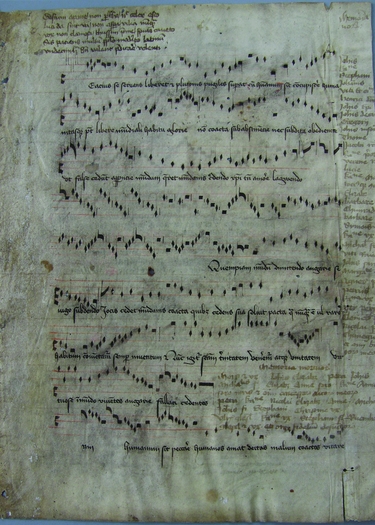
Beatius/Cum humanum in Würtzburg, Franziskanerkloster, Ms. I, 10a, fol. 2b (verso), photographed under ultraviolet light and digitally enhanced by David Catalunya.

Beatius/Cum humanum in Vienna, Austrian National Library, Fragm 123a (fol. 2v/2b).

Appendix 2: notes on the sources
Paris, Bibliothèque Nationale (F-Pn), nouvelles acquisitions latines 2444, fol. 49v (modern foliation)
Extent: the most complete source for Beatius/Cum humanum, the bifolium F-Pn 2444 transmits the full motetus and all but the final nineteen breves of the triplum (see Fig. 2). The wear in the middle of the page seems to have deterred attempts at transcription.Footnote 63 The texts as transmitted in F-Pn 2444 are corrupt in places and rhythmically irregular. The other motets on the fragment (which carries the modern foliation 48–9) are associated with Vitry: Flos/Celsa, In virtute/Decens and O canenda/Rex.
Dating and provenance: Reaney assigns a date in the mid-fourteenth century (‘c.1330–1350’) based on the two-column layout of the parchment bifolium and its concordances with I-IV 115 and F-CA 1328. The fragment can be located to Normandy by the fifteenth century, when a cursive hand in the bottom right margin of fol. 48 recorded a transfer of land in nearby Coutances.
Würzburg, Franziskanerkloster (D-WÜf), Ms. I, 10a, fol. 2b (verso)
Extent: the entire triplum and the motetus through breve 121 are preserved on one side of a (now-detached) parchment pastedown.Footnote 64 High-quality digital photography under regular and ultraviolet light carried out by David Catalunya in summer 2013 has rendered D-WÜf 10a eminently legible (see Fig. 3). In its digitally enhanced form this virtual object emerges as the best source for Beatius/Cum humanum: its better textual readings support the ones in A-Wn 123a, while its redaction of the notes matches the earlier and less ornamented version of F-Pn 2444. The edition in Appendix 3 is based primarily on D-WÜf 10a, though it uses variants from the other sources in cases of ambiguity, and necessarily reads the motetus part from F-Pn 2444 when this voice ends in D-WÜf 10a after bar 121.
Dating and provenance: the fragment survived as a rear pastedown for a fifteenth-century sermon collection. The same manuscript, which contained fourteenth-century French motets, such as Impudenter/Virtutibus and Flos/Celsa, seems to have provided the front pastedown. Both Lerch and Lüdtke assign a French origin to the pastedowns and place them in the second half of the fourteenth century, Lüdtke suggesting c.1365–75.Footnote 65
Vienna, Austrian National Library (A-Wn), Fragm 123a, fol. 2v (2b)Footnote 66
Extent: one side of a bifolium transmits the first thirty breves of the motetus and the entire triplum voice of Beatius/Cum humanum. A-Wn 123a gives better text readings than F-Pn 2444, while its musical readings are in some cases ornamented versions of those in the earlier sources, and not without problems – two clefs are missing and a third is confused (see Fig. 4, lines 4–6). In addition to Beatius/Cum humanum, the fragment contains several two-voice credo settings and a polyphonic Regina celi letare.
Dating and provenance: the paper bifolium shows a variety of hands and notational systems. Alexander Rausch places the primary hand, which executed two of the credos, in the second third of the fifteenth century, and suggests that the bifolium's repertory came to Mondsee via Bohemia.Footnote 67
Paris, Bibliothèque Nationale (F-Pn), nouvelles acquisitions françaises 23190 (Trémoïlle MS), fols. 38v–39 (lost)
Extent: the folios on which Beatius/Cum humanum appeared are missing, but the surviving index lists the motetus incipit ‘Cum humanum’. The motet apparently shared an opening with In virtute/Decens, which is also preserved in the bifolium F-Pn 2444.
Dating and provenance: as Margaret Bent has shown, the note of ownership dated 1376 only gives a terminus ante quem to motets that were once copied on the first thirty-two folios of F-Pn 23190; the layer in which Beatius/Cum humanum appeared was added sometime after this, though it contains some motets (e.g. Tuba/In arboris) thought to be much earlier.Footnote 68 The manuscript seems to have originated in French or Burgundian royal circles and by 1420 was inventoried among the possessions of John II of Burgundy (‘the Fearless’).Footnote 69
Appendix 3: Beatius/Cum humanum
This is not a diplomatic transcription, but an edition using a form of ars nova notation. Ligatures have been silently broken up to allow for notation in score, but have been taken into account for purposes of text underlay. Dots of division are not represented where bar lines do their work. Slurs indicate plicas. The tenor has been editorially supplied. Pn: F-Pn 2444; Wf: D-WÜf 10a; Vö: A-Wn 123a; see Appendix 1 for facsimiles and Appendix 2 for source information. Text underlay follows Vö and Wf, which usually agree, over Pn.
Variants: 3 Mot Vö sFmEsEmD; 8 Mot Vö sDmCsBmA; 13 Tr Vö sGmA for sG; 15 Mot Vö DCCB; Wf b-flat not signed; 18 Tr Pn sEmEsDmE; 20 Tr Vö mG for plica; Wf no G; 21 Tr Vö FFCD; Wf FFCD.

27 Tr Pn G; Vö b-flat not signed; 28 Tr Pn sDsDmE; 29–30 Tr Pn lD missing; 31 Mot Vö source ends after first note; 33 Tr Vö A for first m; 41 Tr Pn F; 44–6 Tr Pn DA ligated.

47 Tr Vö bAmB; 48 Tr Vö sCmB for sC; 50 Mot Pn D for F; 52 Mot Wf no plica; 53 Tr Pn no mG; 54 Tr Pn sAmGsFmE; Vö sEmF for sE; 57 Tr Vö mG for first mA; 58 Tr Pn upwards plica on D; 59 Tr Vö G for F; 60 Tr Vö FE for EE; 64 Tr Pn CA.

65 Tr Wf A for first B; 71 Tr Vö sss for ssm; 76 Tr Vö smss for smsm; 80 Mot Wf rest missing or rubbed; 83–4 Tr Wf rest missing or rubbed; 87–8 Tr Wf rest missing or rubbed; 89–90 Mot Wf rest missing; 95 Tr Vö CBG; 97 Tr Wf D for C.

99 Tr Vö CBG; 101 Tr Pn C for D; 103 Tr Vö CBG; 106 Wf rest missing; 96–109 Mot Pn notes a third too high due to cleffing error at line break; 107 Mot Wf E; 119 Mot Pn D; 121 Tr Pn missing rest; 124 Tr Vö missing rest; 122 Mot Wf source ends 126 Tr Pn extra breve rest follows this measure; Wf extra breve rest follows this measure; 130 Tr Pn A; 134 Tr Vö m for s.

140 Tr Pn C for B; 151–2 Tr Wf unclear – rest possibly missing; 152 Tr Vö rest missing; 153 Tr Vö sGmFsEmF; 155 Tr Vö rest missing; 159 Tr Vö downwards plica; 160 Tr Pn sGmFsEmD; 161 Tr Pn bF for sF; 163 Mot Pn rubbed; 164 Tr Pn sG for mG; Vö mA for mG; 165 Tr Vö AGGF; 168 Tr Pn sCmB for sB; Vö sDmCsCmB.

169–72 Tr Pn bC b rest, further rests missing; Wf lC, rests missing; 173 Tr Vö sEsG; 178 Tr Vö no signed sharp; 183 Mot Pn sDsCmD; 184 Mot Pn first note illegible due to scribal error; 185 Tr Wf sGsGmF.

191–2 Tr Vö sDsCmDsEsDmE; 201 Tr Vö mG for mC; 202 Tr Wf sB for mB; 204 Tr Vö sC for sCmB; 205 Tr Pn sGsG; 206 Tr Pn sFsEmD; Vö sGmFsEmD; 207 Tr Pn source ends.

219–20 Tr Wf unclear; 221 Tr Vö A for G; 223 Tr Vö bGmA; 224 Tr Vö sFmE for sEmD.