They [the PRI] are giving away the construction materials because of the governor’s campaign. That doesn’t matter, we need it, and when the candidate comes we will put up banners to show our support and [our gratitude]. He promised the material and here it is,” says Petra. “In contrast, those from the PAN give very little, just 15 bags of cement; with that one can’t do anything. And those from the PRD, poor devils, they give nothing.
7.1 Introduction
The PRI governor of Yucatán handed out thousands of portable washing machines to poor women prior to the 2000 presidential elections. He personally distributed 1,003 machines at a rally in Umán’s central plaza. PRI supporters were called to City Hall to turn over their voter identification cards to a local PRI leader and sign up to receive the washing machines at the upcoming rally. The governor’s convoy arrived early in the morning, and Governor Cervera Pacheco himself headed the rally, to chants of “Long Live the PRI!” (New York Times, June 18, 2000). Similar reports of overt vote buying came from all over the country. As in previous elections, the PRI handed out groceries and construction supplies and threatened to cut off subsidized milk rations to nursing mothers if they failed to show up for rallies in support of the PRI’s candidates. Party cadres gave poor housewives bags of rice, beans, and other foodstuffs purchased by a federal government charity headed by the First Lady. As they handed out these goods, party cadres registered the names of the people and made copies of their electoral identification cards. These were the typical vote-buying tactics in campaigns that the PRI’s electoral machine employed and continues to employ at election time.
More serious than campaign handouts, however, were the efforts to coordinate officials who administered government social programs to use them on behalf of the PRI’s campaigns. “The federal government’s social programs are PRI programs, and we’re going to use them to win the presidency,” said Manuel Bartlett, a party heavyweight and former interior minister who at the time was working in the PRI’s presidential campaign (New York Times, June 18, 2000). In the weeks before election day, it was not uncommon in Mexico to come across long queues of people waiting outside public buildings to receive a variety of benefits from social programs – for example, peasants waiting to receive their Procampo checks or mothers expecting subsidized food.
Nevertheless, the recently instituted social assistance program, Progresa, would prove more difficult to manipulate than Pronasol because party officials could no longer control the operation of the program. PRI brokers and some of the program’s village organizers made every effort to frighten beneficiaries by telling them they would be cut off from Progresa if they did not pledge support for the PRI’s candidate. In an attempt to lessen beneficiaries’ fears, Carlos Jarque, the secretary of social development, distributed a letter reminding them that the program did not obligate them to vote for any candidate. Back in 2000 that letter might not have been sufficient to reassure Progresa recipients that they were entitled to their benefits regardless of their vote choice. In those elections, poor voters whose lives had been improved by Progresa went to the polls burdened with anxiety. On the one hand, they feared that party officials would cut their benefits if they failed to signal their allegiance to the PRI. On the other, they feared that if the PRI lost the elections, the incoming administration would punish them for supporting the PRI and the program would be terminated.
After the PRI lost power in 2000, it gradually became clear to Progresa/Oportunidades beneficiaries that the CCT program was more insulated from political manipulation than preceding social programs. “One can be PANísta, PRIísta or PRDísta and still receive benefits from Oportunidades,” a Oaxacan mother of five told us in an interview in 2009. It is clear from our interviews in Oaxacan villages that the poor perceive important differences between the CCT and other social programs, and that they consider it an entitlement rather than a political handout that comes and goes with the election cycle.
This chapter attempts to evaluate voters’ responses to different strategies of vote buying. There are not many studies that answer elementary questions about the electoral yields of government programs in a systematic manner. Most empirical studies of distributive politics have focused on the logic of electoral investment – who gets what, where, and when (Ferejohn, Reference Ferejohn1974; Schady, Reference Schady2000; Dahlberg and Johansson, Reference Dahlberg and Johansson2002; Calvo and Murillo, Reference Calvo and Murillo2004; Stokes, Reference Stokes2005, Brusco et al., Reference Brusco, Nazareno and Stokes2004; Magaloni, Reference Magaloni2006; Magaloni et al., Reference Magaloni, Diaz-Cayeros, Estévez, Kitschelt and Wilkinson2007 are some examples), bypassing the issue of how voters actually respond to vote-buying efforts.
Our study employs both aggregate municipal-level electoral returns and individual-level survey evidence to assess the electoral consequences of two decades of antipoverty programs in Mexico. Recent scholarship has begun to explore the electoral payoffs of government transfers and programs (Magaloni, Reference Magaloni2006; Magaloni et al., Reference Magaloni, Diaz-Cayeros, Estévez, Kitschelt and Wilkinson2007; De la O, 2015; Hseih et al., 2011; Zucco, Reference Zucco2013). All these studies show that voters respond positively to government transfers, a finding that should surprise no one. Our approach moves beyond this research by comparing the electoral payoffs of various types of government programs. How many more votes does clientelism buy relative to entitlements? How many more votes do private transfers buy relative to public goods? These empirical questions are highly relevant for theorizing about distributive politics. Only by understanding the electoral consequences of different vote-buying strategies will we be able to comprehend why politicians choose distributive policies and their beneficiaries as they do.
7.2 The Payoffs for Electoral Investments
Recall from earlier chapters that we categorized Mexican social programs according to the type of benefits delivered – private or collective – and to their discretionary or nondiscretionary design. Discretionary private goods are what we have called clientelism. About a third of Pronasol expenditures from 1989 to 1994 fall into this category. Discretionary transfers of public goods geographically targeted, commonly classified as pork or pork-barreling, made up the larger remainder of Pronasol funds. Nondiscretionary distribution of private goods or entitlements is the third combination, which covers Progresa/Oportunidades, starting in 1997. The last combination is the nondiscretionary distribution of public goods, represented by the FISM program enacted in 1995.
Our theory of conditional party loyalty holds that a party machine targets particularistic transfers to reward the loyalty of its core supporters. The machine targets these benefits to loyal voters that are identified ex ante, according to their known political affinities and ongoing interactions with party agents. If it does not do so, its core voters may become detached and evolve into swing voters. Although the relationship is voluntary, an implicit (and often enough, quite explicit) threat of punishment sustains it. Voters stay loyal to the party because they receive their benefits and because they know these can be denied to them for political reasons.
Hence, our expectation is that clientelism should exhibit the highest electoral return. Discretionary transfers more easily targeted to the machine’s core voters are less subject to the problem of voter opportunism. But the logic of this political linkage implies a form of arm-twisting. Core voters respond to these transfers because they need to signal loyalty to the party in order to obtain similar benefits in the future. The perverse nature of this relationship is that voters can be bought off with an array of material inducements that prove not to be welfare-enhancing in the long run.
Discretionary public goods or pork-barreling projects are riskier investments since they are targeted to places with typically smaller cores where project beneficiaries include many nonsupporters. These transfers thus entail a sizeable problem of potential voter opportunism and, for that reason, we expect pork to return lower electoral yields on average than clientelism.
With respect to the electoral payoffs of nondiscretionary private and public goods, our vote-buying theory does not generate a priori expectations. Nonetheless, it makes intuitive sense to expect that voters will reward parties that transfer benefits to them which entail notable income and consumption gains. Thus, we expect beneficiaries of Progresa/Oportunidades to reward incumbents for improvements in their welfare regardless of the partisan identity of their benefactor. As for formula-based social infrastructure transfers, their electoral return should be no lower than that for discretionary pork-barrel projects, but not particularly higher since, in a federal system like Mexico’s, credit-claiming is more likely to generate rival partisan claims in municipalities under divided vertical government.
Our study of the electoral consequences of all these programs employs both individual-level survey evidence and aggregate electoral results for estimating their actual vote yields. We employ exit polls for the 2000 and 2006 presidential elections.Footnote 1 For our purposes, exit polls of election-day voters are better than postelectoral surveys, which in Mexico are characterized by substantial overreporting in favor of the winning candidate as well as implausible turnout rates. Preelectoral surveys, for their part, tend to have smaller samples with variable levels of undecided voters. They often do not capture last-moment shifts in sentiment and they cannot isolate actual voters through likely voter models.
We supplement our survey research with the systematic analysis of aggregate vote swings in the 1994, 2000, and 2006 presidential elections. Aggregate electoral data are necessary to calculate the electoral returns for many public goods, whose benefits are diffuse and poorly captured by conventional surveys. Surveys are well suited to the study of recipients of private goods in Progresa/Oportunidades but not those of the public goods distributed through Pronasol and FISM.Footnote 2
A second reason why it is difficult to study distributive politics through survey research is that it is practically impossible to rank-order beneficiaries according to the benefits they report having received. We are interested in measuring the yields for electoral investments in a bottom-line pesos-per-voter calculation. This task is simply easier to accomplish with aggregate electoral data than with election surveys limited by short questionnaires and interview times.
Finally, survey research is often inadequate for the study of clientelistic practices because many individuals avoid reporting the benefits received when these are understood to be illegal or corrupt. Specifically, in the comparison of programs we seek to make, survey respondents might be more willing to report benefits received from Progresa/Oportunidades than from Pronasol, creating a problem of underreporting for the latter program.Footnote 3 Although techniques such as list experiments can deal with these flaws, Mexican pollsters in the 1990s did not collect their data with such problems in mind.
7.3 The Political Context of Presidential Elections after 1988
The three elections we analyze in this chapter were all dramatic events. The 1994 election, while cleaner than the 1988 contest, was marked by considerable political violence before and after election day. The 2000 election was the watershed of the Mexican transition to democracy with the upheld defeat of the PRI by Vicente Fox. The controversial 2006 election was the closest race in the country’s history, pitting the two parties that had contested PRI hegemony since 1988 against each other.
The 1994 presidential election took place in a year of significant political turmoil, punctuated by the Zapatista uprising in the Southern state of Chiapas which erupted on the first day of 1994 and by the assassination of the PRI’s presidential candidate on the campaign trail in March. Although the substitute candidate, the technocrat Ernesto Zedillo, went on to score a comfortable triumph, without serious postelectoral conflicts, the long-standing Pax Priista had been shattered.
Initially, analysts thought that these events would jeopardize the peaceful transfer of power, sustained for over sixty years, since the last major political assassination and the creation of the PRI. For the purposes of this book, the Zapatista uprising is particularly noteworthy, since it emerged despite the political success of Pronasol, touted throughout the Salinas term as the definitive strategy for eradicating poverty in the country. The Zapatistas made it clear that poverty relief had yet to reach ample sectors of the destitute poor, especially among its indigenous peoples.
The 1994 presidential election was also special in that it took place after six years of structural transformation of the national economy. Mexico had joined the North American Free Trade Agreement in 1993 and was more fully integrated into international capital markets. By most accounts, macroeconomic stabilization had been successful and domestic consumption was rising, although economic growth remained anemic. Thus, the election as a referendum on economic performance, one of the PRI’s central strategies for the campaign, was by no means a foregone conclusion. The second strategic line was the constant reminder of welfare gains delivered through Pronasol. Despite the Chiapas uprising, the Colosio assassination, and prevailing discontent with the national economy, the PRI was reelected with just under 50 percent of the vote and a whopping margin over its two major rivals. In the next section, we analyze the contribution of Pronasol to the PRI’s electoral success in 1994.
Ernesto Zedillo initiated his presidency with the Tequila Crisis, which sent Mexico into a deep, albeit short, recession. Poverty reached alarming and unprecedented levels in the first two years of his presidency. According to the estimates shown in the first chapter, over 80 percent of rural citizens and over 60 percent of urban dwellers could not meet “basic capacities” (i.e., fulfill minimal nutrition requirements and provide health and education for their families). In reaction to the economic recession, the PRI lost a string of local elections in the aftermath of the crisis and then its majority in the Chamber of Deputies in the 1997 midterm elections. Legislative politics were utterly transformed. For the first time in its history, the PRI was obliged to compromise with the opposition in order to pass ordinary legislation. The establishment in 1997 of Progresa, as we discussed in earlier chapters, represented a turning point in the design of social policy. With Progresa, Mexico witnessed the advent of social entitlements for its poorest citizens. During the Zedillo administration, social infrastructure funds were also decentralized and the distribution of these funds increasingly fixed through poverty-based formulas. By the 2000 presidential elections, the PRI had renounced or been forced to renounce its discretion in the administration of antipoverty programs.
The 2000 presidential election marks the great divide in Mexico’s electoral history, when the PRI lost control of the presidency. PAN candidate Vicente Fox won with 43 percent of the vote, six points above the PRI’s candidate. Despite strong growth rates prior to the elections and high presidential approval rates, the PRI could not win the election because voters were fed up. They had lost confidence in the PRI and perceived that, if returned to power, the party would escort the country into yet another postelectoral recession (Magaloni and Poiré, Reference Magaloni, Poiré, Dominguez and Lawson2004; Magaloni, Reference Magaloni2006). Importantly, the elections were administered by the autonomous Federal Electoral Institute (IFE), which made electoral fraud at the ballot box and in the vote count practically impossible for the PRI. While the average voter was euphoric upon unseating the PRI, a more cautious mood prevailed among the poor, especially those benefiting from government programs such as Procampo and Progresa. The main question for them was whether the incoming PAN administration would retain these programs or scuttle them.
After numerous international policy evaluations supporting the effectiveness of Progresa in reducing extreme poverty, the Fox administration decided to continue with the program, but rebaptized it with a new name, Oportunidades. The expansion of the rural program and its extension to cities under Fox made for impressive coverage of poor households throughout the country. At the end of 1999, Progresa had reached approximately 2.6 million families in extreme poverty, about 40 percent of all rural households. By the end of 2005, coverage under Oportunidades had doubled to almost 5 million families, two-thirds in the countryside and the remainder comprising urban and semiurban households. By 2006 more than half of all families living under the poverty line in Mexico were recipients of these transfers.
Aside from Oportunidades, the Fox administration introduced a new social insurance program to remedy the truncated nature of health care delivery in the country. According to the 2000 census, some 58 percent of the population was not covered by the social security system (including the IMSS Solidaridad hospitals and clinics built with Pronasol funds). Seguro Popular was an ambitious program created to extend health coverage to this uninsured population. The program began in five states in 2001 and by the end of 2005 had been implemented in all thirty-one states plus the Federal District, affiliating almost three million families. In contrast to Oportunidades, centrally administered by the federal government, Seguro Popular was partially decentralized and potentially more subject to political manipulation in its selection and subsidization procedures. Coverage and spending varied widely among states and some doubts remain concerning the criteria for affiliation. Despite these shortcomings, Scott (2006) calculates the incidence of benefit distribution and concludes that affiliation in the new insurance program is more propoor than any other healthcare service except for Oportunidades and IMSS-Oportunidades.Footnote 4 Thus, the innovations in welfare policy engineered by the Fox government clearly entailed an important extension of tangible and needed benefits to the poor.
At the close of the Fox administration, the 2006 presidential election was the most contested election in Mexico’s postrevolutionary history. The front runners were Felipe Calderón, from the PAN, and Andres Manuel López Obrador, from the PRD. The margin of victory, after a recount of around 10 percent of total votes, was slightly more than half a percentage point. Many interpret the tight contest as the outcome of a pitched ideological battle that divided right from left, rich from poor, and North from South. From this perspective, the 2006 election was a prospective exercise, with a clear choice between right-wing continuity and left-wing populism. Yet the PAN’s triumph would not have materialized without the support of ample sectors of the poor, urban and rural, that voted for the right-wing party retrospectively as a result of Oportunidades.Footnote 5
The PRD did not recognize its defeat, claiming that the election had been rigged. López Obrador based his accusations of electoral fraud on several arguments. The first was that the computer program used to tally precinct-level vote totals had been rigged and inconsistencies in the vote count were apparent. He demanded a complete recount, although election law stipulated that ballot boxes uncontested by party representatives at the precinct level did not qualify for a recount. His second argument was that, throughout the campaign, the PAN had manipulated social transfers to the poor in order to buy their electoral support, severely undercutting the fairness of the election.Footnote 6
The claim that fraud was orchestrated in electronic form is hard to document and is a task that goes beyond the scope of this chapter.Footnote 7 But the accusation that the PAN used its access to patronage, pork, and clientelism to generate electoral support, particularly from the poor, is worth addressing. It is conceivable that the PAN used its power over federal resources, following the old practices of the PRI, to coerce or bribe poor voters. In particular, Alianza Cívica, one of the most important and prestigious NGOs engaged in electoral observation, had warned for months that the PAN was using federal social programs as vote-buying currency (Alianza Cívica, Reference Cívica2006). This perception was seconded by Fundar, an NGO for citizen oversight in budgetary matters (Fundar, Reference Fundar2006). The accusations could not be taken lightly, given the reputation and credibility of the sources.
President Fox and the Social Development Ministry (Sedesol) had anticipated these types of accusations, and as a result adopted a strategy of blindaje electoral, i.e., safeguards to shield federal programs from electoral manipulation (Sedesol, Reference Scott and Székeli2005). These safeguards retained the original prohibition from 1997 against the expansion of the CCT program in any federal election year. Further, Sedesol came to an agreement with the United Nations Development Program (UNDP) to make a thorough study of the operation of all its social programs during the election year, including surveys of beneficiaries and nonbeneficiaries, in order to gauge the occurrence of vote buying and coercion (PNUD, Reference Piattoni2007).Footnote 8
Our position on this contentious issue is that Oportunidades made the PAN‘s victory in 2006 possible, but that voters responded to the program freely. Vote buying and credit claiming are complementary facets of democratic politics. However, their scopes can overlap, ranging from voters responding freely to programmatic appeals and the benefits received through social programs to voters supporting a party out of fear of losing their benefits for political reasons. The institutional design of a given program is decisive, but popular perceptions may not turn on knowledge of their operation.
Oportunidades made an explicit effort to publicize the principle that program benefits were not contingent upon political behavior. The program posted a notice on all materials assuring beneficiaries that their participation in the program was not tied to partisan sympathies nor could their benefits be withdrawn for political motives. Beneficiaries were also constantly reminded that their benefits would continue so long as they complied with program requirements of school attendance and periodic visits to the health clinic. However, in a country with such a long tradition of clientelism, we cannot know whether beneficiaries actually believed these statements. Our intuition is that it takes some learning on the part of poor voters in Mexico to feel secure about their entitlements. The fact that Vicente Fox did not reverse Progresa after the PRI´s defeat in 2000 surely helped to assure them that welfare benefits were no longer vulnerable to election cycles nor to the political whims of the leadership.
7.4 Instrumental Variables in the Study of Vote Swings
To model the electoral payoffs of antipoverty programs, this section studies vote swings between presidential elections (1988–1994 and 1994–2000 for the PRI, and 2000–2006 for the PAN). Using interelectoral vote swings as dependent variables helps to address the potentially serious problems arising from omitted variable bias. To the extent that an independent variable remains constant between elections, its omission should not bias the results. Following Tucker (Reference Tucker2006), we calculate all electoral data in log-odds ratios, in order to keep estimates between the range of 0 and 1 and to ensure normality in their distributions.
A methodological problem we face in the study of electoral payoffs of antipoverty programs is endogeneity (as well as reverse causation). When incumbents assign discretionary resources, they surely do so in anticipation of voters’ responses. This implies that explanatory variables are likely to be correlated with the error terms of simple OLS regressions, producing biased and inconsistent estimates.
To model vote swings for 1988–1994 as the product of Pronasol‘s investments per capita in private and public goods, we take an instrumental variables approach. Potential candidates for instruments, as in the previous chapters, are related to physical and human geography. In particular, we use rugged terrain, the landlocked status of a municipality and the average distance from railroad tracks. These variables plausibly influenced investment decisions. The uneven nature of terrain, for example, is a natural factor taken into account when funding public infrastructure projects. It is harder and sometimes excessively costly to build and pave roads, dig ditches and water wells, construct health clinics and schools, and the like, where the terrain is rough and mountainous.
However, to be valid, instruments must work their effect only through expenditure, and thus be exogenous and uncorrelated with vote swings. We can be confident that by using geographic variables a problem of reverse causation is not present, because, for example, rugged terrain does not vary according to how voters behave; and railways in Mexico have not expanded at all since the 1940s. But to be truly convincing as instruments, we must believe that changes in party success are not dependent on these instrumental variables. Taking ruggedness as an example of the issue at hand, the PRI was historically entrenched in places where it was most difficult for opposition parties to successfully present candidates. In the 1960s, for example, the PAN mostly presented candidates in large cities of the Central highlands. But by the 1990s swings for or against the PRI were not particularly related to remote areas: when a PRI splinter occurred it was not uncommon to see massive swings in mountainous regions. To be sure there was gradual erosion of PRI support in the north of the country as democratization proceeded, but coastal municipalities had no particular political configuration making them more or less likely to swing in favor of one party or another. Hence landlocked municipalities had no specific pattern of vote swings as compared to the coast or the border. Furthermore, by the 1990s the places with historical proximity to railroad tracks had no particular advantage in modernization or specific political alignments, because by then the crucial developmental role was being played by highways. These geographic variables are hence good predictors of Pronasol investments but are uncorrelated with vote swings. Our diagnostic tests suggest that neither changes in vote shares nor in turnout are correlated with the residuals of a regression using these variables.Footnote 9
Thus our models employ geographical instruments as correlates of entrenched poverty to predict logged per capita private and public good allocations in Pronasol (private PC^ and public PC^). Our expectation is that the electoral yield for private goods should be significantly higher than that for public goods. The regression controls for the PRI’s vote share in 1988 (PRI 88) and the alpha and erosion parameters discussed in Chapter 4. Higher vote swings in favor of the PRI (or smaller swings against it) should characterize places with large cores (alpha) and slow erosion. We also expect smaller vote swings in places where the PRI performed exceedingly well in 1988. The regressions use state-fixed effects to control for other local patterns of politics stemming from, for example, the partisan identity of incumbent governors, party chapters’ mobilizational capacity, the concurrency of gubernatorial races, and the different types of local party system configurations. Results are reported in the first column of Table 7.1.Footnote 10
| PRI Vote Swing 1988–1994 | PRI Vote Swing 1994–2000 | PAN Vote Swing 2000–2006 | |||
|---|---|---|---|---|---|
| Private PC^ | 0.052 (0.008)** |
Progresa^ | 1.886 (0.389)** |
Oportunidades^ | 0.607 (0.108)** |
| Public PC^ | 0.034 (0.011)* |
FISM^ | 0.070 (0.037)* |
FISM^ | 0.069 (0.028)** |
| PRI 88 | –0.890 (0.024)** |
PRI 94 | –0.605 (0.028)** |
PAN 00 | –0.237 (0.015)** |
| Alpha | 0.043 (0.014)** |
Alpha | 0.076 (0.031)* |
||
| Decline | –0.022 (0.034) |
||||
| Constant | –0.755 (0.034)** |
Constant | –1.158 (0.252)** |
Constant | 1.756 (0.381)** |
| N = 2338 F(35,2302) 141.22 Pr>F 0.000 R2 0.619 |
N = 2346 F(34,2311) 65.12 Pr>F 0.000 R2 0.564 |
N = 2344 F(33,2310) 65.12 Pr>F 0.000 R2 0.336 | |||
Note: Regressions are run with robust standard errors and state fixed effects.
* Significant at the 95 percent level; ** significant at the 99 percent level.
All the coefficients perform as expected and all but one reach reasonable levels of statistical significance. Pronasol was a decisive factor in accounting for municipal vote swings in favor of the PRI in the 1994 presidential elections, even after controlling for state-fixed effects and the divergent electoral histories of municipalities since 1970, as measured by alpha and erosion.
These results reveal a powerful impact of clientelistic transfers vis-à-vis public goods. The vote-buying effect of private goods almost doubles that of collective ones. In terms of votes-per-peso it was significantly more effective for the PRI to distribute particularistic transfers to individuals and small groups of producers than to invest in social infrastructure projects or public goods provision for communities at large. Nonetheless, public goods provision also generated some voting support for the PRI.
Our results thus cast doubt on the existing analyses of Pronasol. Although myriad observers have accredited this program as a key factor in the PRI’s electoral recovery in the 1990s, most empirical analyses have concluded that Pronasol’s electoral effectiveness was disappointing. Bruhn (Reference Bruhn1996: 162) finds no evidence that Pronasol expenditures helped the PRI and undermined the left. Hiskey (1999: 128) concludes that the “political impact of Pronasol funds is noteworthy for its insignificance.” Although Molinar and Weldon claim to find positive effects for this program, their results are counterintuitive because vote gains are generated only in states where gubernatorial elections were held in 1991. “In states where elections for governor were not scheduled in 1991, the PRI did somewhat worse in the federal elections for every extra peso spent on Pronasol ” (Molinar and Weldon, Reference Molinar, Weldon, Cornelius, Craig and Fox1994: 137).
The columns in Table 7.1 present analogous results for the election that stamped the transition to democracy, but centered on the nondiscretionary social transfers introduced by the Zedillo administration. The 1994–2000 vote swings are a function of the instrumented municipal-level coverage of Progresa in 2000 (Progresa^) and the instrumented per capita expenditures in FISM (FISM^). The table also presents the analysis of 2000–2006 vote swings, this time for the PAN as the incumbent party, as a function of the instrumented change between 2000 and 2006 in the coverage of Oportunidades (Oportunidades^) and in the predicted per capita expenditures through FISM (FISM^). These regressions also use state-fixed effects to control for the idiosyncrasies of state-level politics.
Although we recognize that transfers within these programs were determined by objective formulas not easily manipulated, it is plausible that the expansion of Progresa and Oportunidades were politically determined. That is, the formulas constrained the politicians and policymakers to target the poor but they were not constrained in terms of phasing-in program expansion across states and municipalities.Footnote 11 This leeway to skew implementation compels us to instrument change in coverage in Progresa and Oportunidades to eliminate potential problems of endogeneity – that is, the possibility that higher increments in coverage were in part driven by expectations of electoral results. For the case of FISM, as discussed in the previous chapter, the fact that funding was determined by formulas does not rule out the possibility that the choice of the specific elements included in the formula and the distribution resulting from them were the product of political calculations by the incumbent party. Geographic instruments, as in the 1988–1994 model, are good predictors of allocations of Progresa/Oportunidades and FISM but are uncorrelated with the dependent variables.Footnote 12
Regression results perform as expected. Both Progresa and Oportunidades generated strong positive effects on the incumbent parties’ vote swings in the 2000 and 2006 elections. Progresa proved to be particularly potent in favoring the PRI in 2000, about three times more effective in vote gains than Oportunidades for the PAN in 2006. FISM also impacts vote swings in the expected direction. More per capita investment in social infrastructure at the municipal level translates into higher vote swings for the incumbent party in both elections.
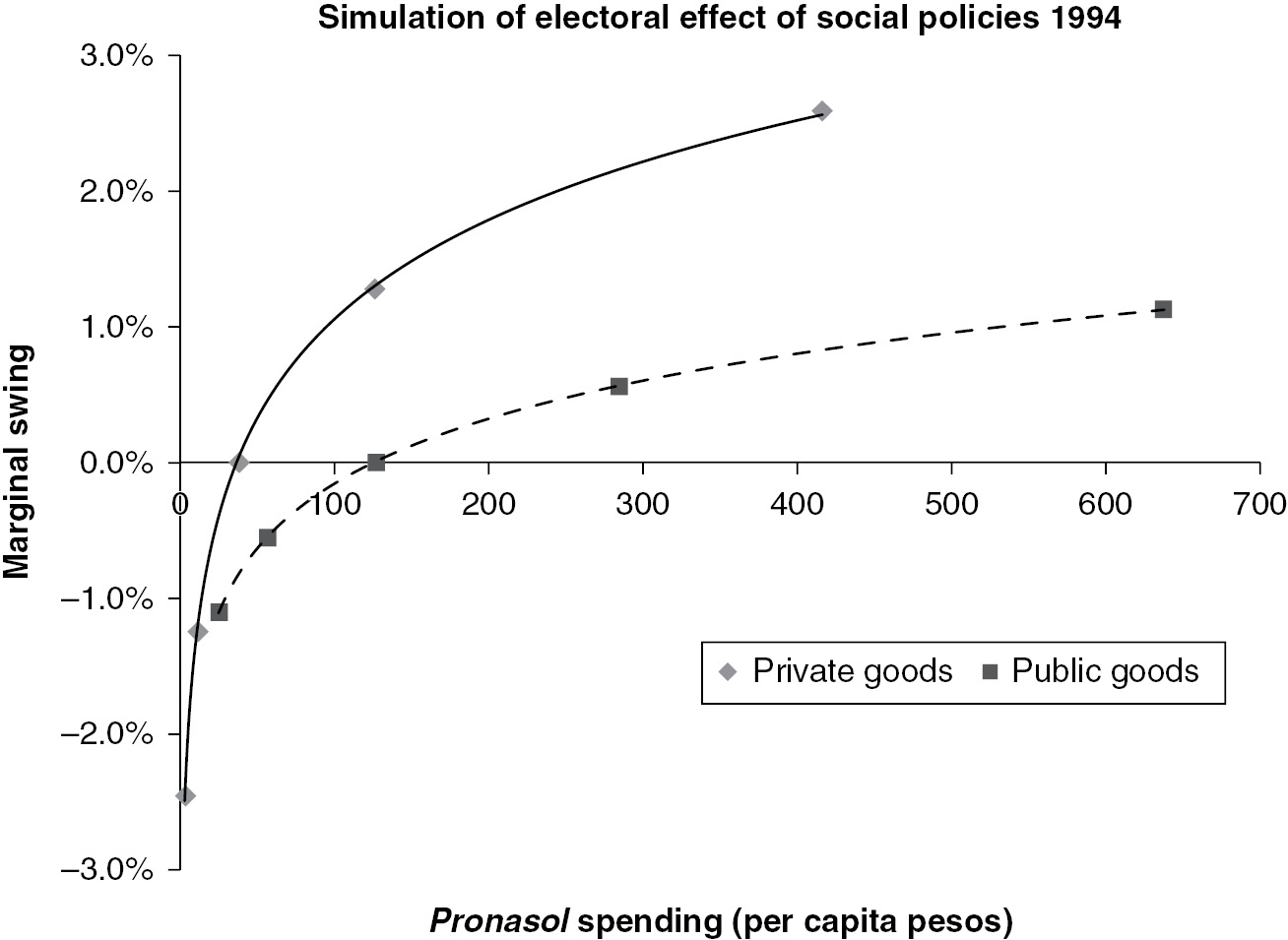
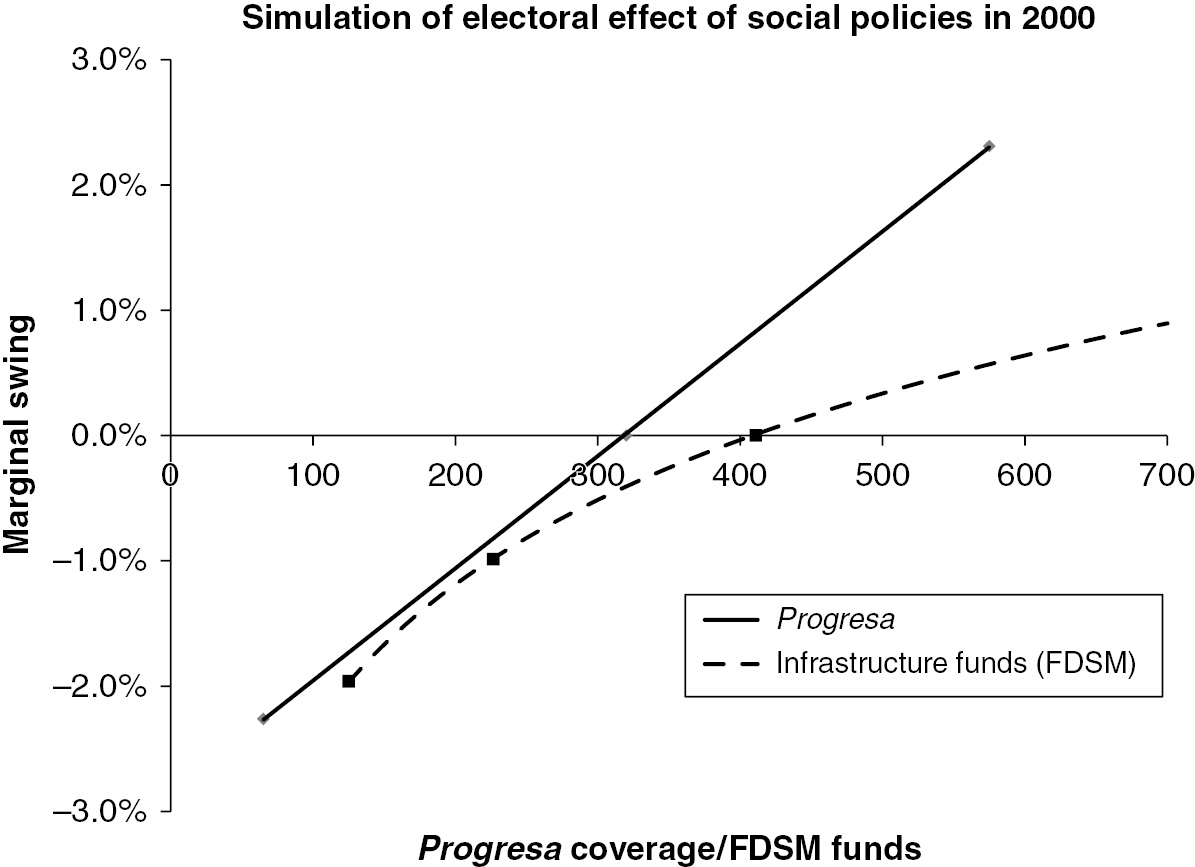
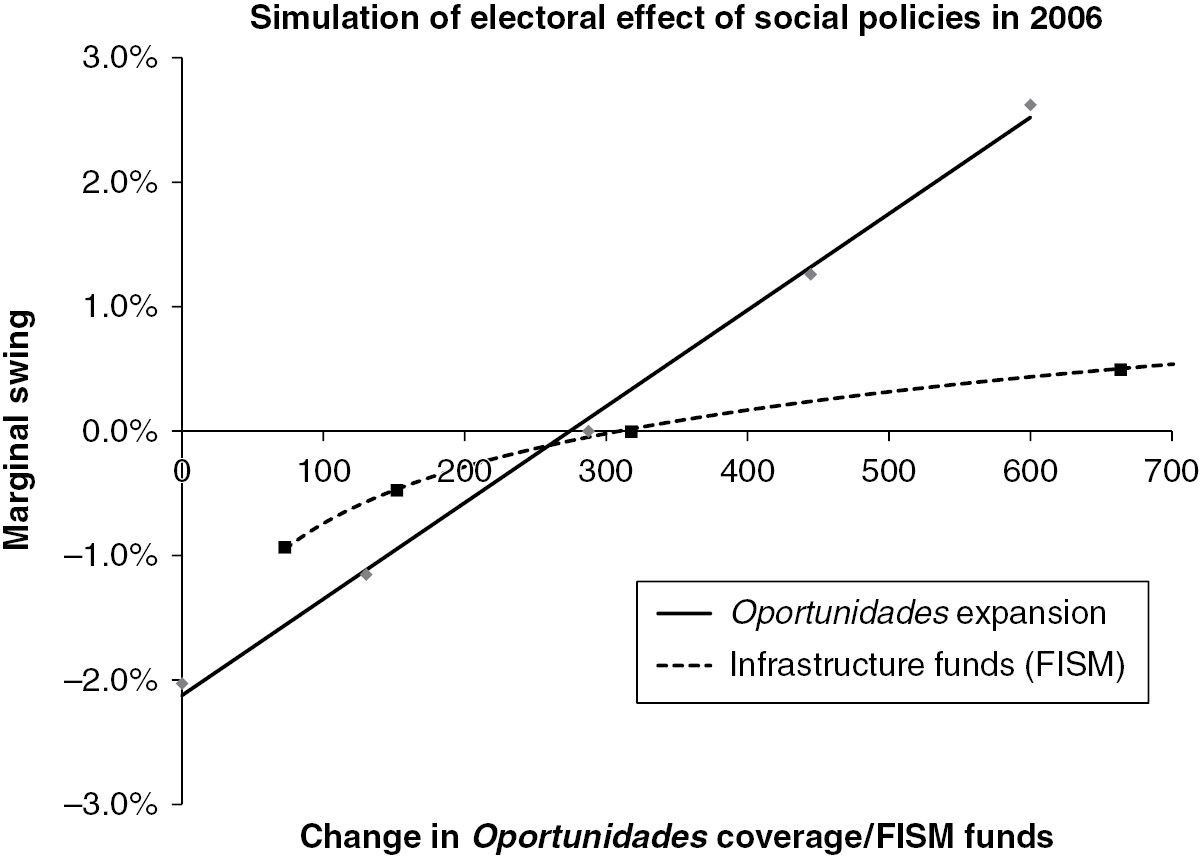
To have a sense of the range of effects, Figure 7.1 simulates the vote-buying effects of the various programs, distinguishing between private and public goods. The graph on the top simulates the effects of the discretionary program (the two basic categories of Pronasol transfers) and the other graphs those of the formula-based ones (Progresa/Oportunidades and FISM).
Simulated electoral returns of social programs.
The findings for Pronasol are striking, with far larger payoffs extracted from private goods. Relative to pork-barreling or discretionary public goods allocations, particularistic transfers are vastly superior for buying votes. For example, if the PRI spends 100 pesos per capita in private goods, the simulation predicts a swing of around one point in that party’s favor, while the same expense in public goods would not generate a positive vote swing. Moreover, against the 100 pesos per capita in clientelism, expenditures for pork would need to be almost six times as large in order to replicate a similar gain in votes. That does not mean that electoral investment in public goods is useless, since any money for pork may prevent adverse negative swings. However, there is no question that clientelistic transfers were more effective at producing electoral support for the PRI throughout the whole range of expenditures. Public goods also produced swings of considerable magnitude for this party at higher levels of expenditure, but never outpacing the yield from private goods.
The graphs for swings of the incumbent in 2000 (the PRI) and 2006 (the PAN) simulate the effects of nondiscretionary transfers for private and public goods. The electoral payoffs of nondiscretionary private goods (or entitlements) behave quite differently from those of particularistic transfers. The electoral swings for entitlements are not always higher than the payoffs from public goods. In these estimates, positive vote swings for the PAN in 2006 emerge only after better than half the municipality’s households receive benefits. Hence, the Fox administration’s interest in expanding Oportunidades. At very high levels of CCT coverage, vote swings easily outperform those observed from investments in public goods provision. When poverty relief through entitlements reaches a large critical mass within poor communities, the impact on electoral support for the benefactor (PRI and PAN alike) is stunning.Footnote 13 In contrast, districts with fewer inhabitants living in abject poverty (medium- and large-sized cities) are less generous, requiring stronger investment in public goods in order to generate additional voting support for the incumbent. Portfolio diversification, as we claimed earlier, is practically inevitable in more competitive contexts.
7.5 Investment Yields from CCTs
This section supplements the previous section’s findings with survey research. The study of antipoverty programs with individual-level data also presents serious challenges of selection bias. Thinking in terms of medical research and experiments can help to conceptualize some of the problems involved in studying these types of policy interventions. To estimate the effects of a drug or medical treatment, ideally one would like to have two individuals that are identical in all respects (age, diet, gender, lifestyle, ethnicity, etc.) except for the “treatment.” Medical research solves this issue through experimental design wherein a group of individuals with similar characteristics are randomly selected and divided into two groups, one receiving the “treatment” and the other (the “control” group) not.
As envisioned by its creator, Santiago Levy, Progresa was originally designed to allow for experimental evaluations. Communities with similar characteristics were identified at the onset of the program, but only a randomly selected group began to receive benefits immediately, while the others were incorporated 15 months later. In two innovative studies, Green (Reference Green2005) and De la O (2013) take advantage of the program’s randomization or the delay in incorporation to assess the effects of Progresa on turnout and voting choices. These studies arrive at opposite conclusions. Green finds that Progresa had no effect on voting choices, while De la O obtains a rise in turnout and an increase in the incumbent’s vote share.
A problem for our purposes to compare the variety of electoral strategies across elections is that there is no experimental setting available for Pronasol, FISM, and Oportunidades. If we want to compare the political impact of the various social protection programs, we must rely on observational data. We can, however, use statistical methods to deal with potential selection problems. That is, we contrast treated and untreated individuals by matching comparable persons in terms of the nonrandom set of characteristics that make them potential targets of selection into the program, but with some selected while the others are not. Specifically, we use a nonparametric technique, propensity score matching (PSM), to compare individuals along these lines (Ho et al., 2007; Rosenbaum and Rubin, Reference Rosenbaum and Rubin1983).Footnote 14 The treatment variable in this quasi-experiment is being a Progresa or Oportunidades recipient. We used a similar strategy in Diaz-Cayeros et al. (Reference Diaz-Cayeros and Magaloni2009) to evaluate the electoral impacts of Oportunidades and Seguro Popular on voting decisions in 2006.
In matching, the most common indicator of interest is the mean impact of the treatment on the treated. This indicator is also known as the average treatment effect on the treated (ATT). In the case at hand, we are interested in the comparison of the mean probability of voting for a given party from the treated group and its matched nontreated group. The method is based on an assumption of unit homogeneity. This means that the outcome of the nonparticipant can be taken as an indication of what would have happened holding all other relevant variables constant. In this sense, the hypotheses tests do not control for covariates, since they are already incorporated into the choice of observations to be compared.
Propensity score matching is relatively simple to perform. The first stage involves a probit (or logit) estimation of every individual’s probability of being selected as a Progresa/Oportunidades beneficiary. The second stage is a simple test of means, where treated observations sharing similar propensity scores are compared to untreated ones.
To ascertain the electoral payoffs of Progresa and Oportunidades, we employ two exit polls performed by the newspaper Reforma.Footnote 15 Reforma’s research department is credited with conducting some of the best electoral survey work in Mexico. Their questionnaires are rather comprehensive, including self-reporting of enrolment in Progresa and Oportunidades. The 2000 exit poll sampled 3,380 voters in 119 municipalities (including delegaciones or boroughs in Mexico City); the 2006 poll included 5,807 voters spread among 122 municipalities throughout the country.
The 2000 exit poll shows a relatively even distribution of votes for the PRI’s candidate, Francisco Labastida, in rural and urban localities. By contrast, the 2006 poll shows that support for Felipe Calderón varied considerably according to whether voters lived in rural or urban areas. The urban-rural gap in Calderón’s support is clear from both the survey and the official vote tally. According to official tallies, in rural areas his vote share was 29.7 percent, while in urban areas he reached 38.3 percent of the vote.
The descriptive statistics of the surveys (Table 7.2) show that Progresa recipients voted more frequently for the incumbent party’s candidate, Francisco Labastida – there is a 24 percent point gap in his favor between recipients and nonrecipients. Vicente Fox from the PAN seems to be particularly affected by Progresa, producing a 21 percent gap against him. Similarly, the 2006 poll shows that the PAN’s candidate received more support among beneficiaries of Oportunidades – 37 percent of beneficiaries voted for Calderón versus 32 percent of nonbeneficiaries, a gap of 5 points. If one were to view only the average vote shares for the three main presidential candidates in the 2006 elections among nonbeneficiaries of either program, a fierce tie between Calderón and López Obrador emerges, with Roberto Madrazo from the PRI in a distant third place overall. Among beneficiaries of the programs, however, Calderón outpaces López Obrador by double digits. Any one of these spreads is enough to have tilted the national election in Calderón’s favor.
| 2000 Elections Progresa | 2006 Elections Oportunidades | |||
|---|---|---|---|---|
| Beneficiary (%) | Nonbeneficiary (%) | Beneficiary (%) | Nonbeneficiary (%) | |
| Vote for PAN | 25.4 | 46.9 | 37.2 | 32.3 |
| Vote for PRD | 16.4 | 17.0 | 25.9 | 31.7 |
| Vote for PRI | 57.7 | 33.5 | 23.1 | 17.9 |
But the crucial inference that one wants to make is whether voters in 2000 supported the PRI because they received benefits from Progresa, or because some of the correlates of Labastida’s vote are also related to the selection criteria of beneficiaries into the social program. The same question arises with respect to the effects of Oportunidades on the support for the PAN in 2006.
Table 7.3 shows first-stage probit estimations of our PSM for Progresa and Oportunidades. In estimating the propensity scores, we use individual data from the survey merged with municipal-level data. The merger is important in our case because we know that selection into Progresa/Oportunidades was shaped both by income measured at the individual level in household surveys and by locality-level development indicators.Footnote 16 The merger follows electoral precinct identification at the polling points sampled for the exit poll.
| Model 1: Propensity Score, Progresa Beneficiary (2000) |
Model 2: Propensity Score, Oportunidades Beneficiary (2006) | ||
|---|---|---|---|
| Individual socioeconomic indicators | |||
| Age | –0.023 (0.016) | Age | –0.046 (0.011)** |
| Education | –0.123 (0.035)** | Education | –0.183 (0.025)** |
| Income | –0.090 (0.026)** | Income | –0.041 (0.011)** |
| Woman | 0.146 (0.075) * | Woman | 0.115 (0.050) * |
| Peasant farmer | 0.099 (0.119) | Peasant farmer | 0.158 (0.087) |
| Family size | 0.072 (0.039) | ||
| Aggregate socioeconomic indicators | |||
| Rural precinct | 0.519 (0.098)** | Rural precinct | 0.577 (0.056)** |
| Usos y costumbres | 0.213 (0.143) | Indians (municipal share) | 0.298 (0.189) |
| No water supply (%) | 0.850 (0.372) * | No water supply (%) | 0.166 (0.215) |
| No electricity (%) | –4.062 (0.721)** | No electricity (%) | –0.487 (0.477) |
| No sewerage (%) | 0.708 (0.329) * | No sewerage (%) | –0.847 (0.243)** |
| HDI (2000) | 0.701 (0.847) | ||
| Geographical correlates | |||
| Northing | 0.001 (0.000)** | Rainfall | 0.0003 (0.000)** |
| Easting | 0.0002 (0.000) | Easting | 0.0001 (0.000) |
| Population density | 0.0000 (0.000)** | Temperature | 0.0001 (0.000) |
| Distance to roads | 0.028 (0.007)** | Distance to roads | 0.010 (0.005)* |
| Distance to rails | 0.007 (0.002)** | ||
| Distance to city | 0.002 (0.001) | ||
| Landlocked | –0.301 (0.117)** | ||
| Policy-related variables | |||
| Progresa coverage, 2000 | 4.743 (2.556) * | Seguro Popular insured | 1.236 (0.058)** |
| Private goods % of funds in Pronasol, 1989–1994 | –0.347 (0.331) | Change in Oportunidades coverage, 2000–2006 | 1.403 (0.272)** |
| Constant | –1.857 (0.351)** | Constant | –1.430 (0.716) * |
| Observations | 2379 | Observations | 5019 |
| LR (20) | 328.88 | LR (17) | 1205.68 |
| Prob>LR | 0.0000 | Prob>LR | 0.0000 |
| Pseudo R2 | 0.168 | Pseudo R2 | 0.246 |
Note: Robust standard errors in parentheses.
* Significant at the 95% level; ** significant at the 99% level.
The combination of variables used to calculate the propensity score was inductive: we included variables with predictive power, while satisfying a balancing property among blocks of observations.Footnote 17 We did not include variables that measure vote choice or are closely related to it in a voting model, such as party ID or presidential approval, since those are the outcomes we are interested in studying. We use a rather exhaustive specification for predicting beneficiaries: we follow the practice of trying to include variables that are statistically significant predictors of selection into the program and that meet the balancing property. Thus, these models are similar to each other but not identical.Footnote 18
In table 7.4 we present differences-of-means tests between treated and untreated respondents, which is the program’s impact indicator or the ATT. In our case it corresponds to the comparison of the mean probability of voting for a given candidate between a treated group and its matched nontreated group. For our purposes, it is not necessary to include all relevant controls normally employed in vote choice models in order to infer the political effects of a given policy intervention.
| Vote in 2000 Effect of Progresa | Vote in 2006 Effect of Oportunidades | |||||
|---|---|---|---|---|---|---|
| National | Rural | Urban | National | Rural | Urban | |
| Vote for PRI candidate | 0.167 (0.058)** |
0.286 (0.071)** |
0.087 (0.050)a |
–0.049 (0.027)a |
0.020 (0.064) |
–0.071 (0.039)a |
| Vote for PAN candidate | –0.088 (0.043)* |
–0.195 (0.072)** |
–0.041 (0.050) |
0.113 (0.032)** |
0.113 (0.058)* |
0.126 (0.039)** |
| Vote for PRD candidate | –0.060 (0.046) |
–0.084 (0.064) |
–0.023 (0.039) |
–0.065 (0.037)a |
–0.144 (0.045)** |
–0.039 (0.037) |
| Approval | 0.228 (0.082)** |
0.383 (0.126)** |
0.108 (0.110) |
0.370 (0.060)** |
0.500 (0.116)** |
0.309 (0.060)** |
| Pocketbook | 0.309 (0.098)** |
0.655 (0.106)** |
0.207 (0.134) |
0.412 (0.051)** |
0.366 (0.089)** |
0.422 (0.080)** |
| PID PRI | 0.132 (0.051)** |
0.248 (0.079)** |
0.098 (0.064) |
–0.061 (0.030)* |
–0.046 (0.057) |
–0.045 (0.035) |
| PID PAN | –0.056 (0.034)a |
–0.130 (0.056)* |
–0.031 (0.047) |
0.114 (0.030)** |
0.124 (0.059)* |
0.142 (0.034)** |
| PID PRD | –0.038 (0.033) |
–0.062 (0.056) |
–0.054 (0.037) |
–0.004 (0.028) |
–0.046 (0.046) |
–0.019 (0.031) |
Note: Nearest Neighbor Matching Method with bootstrapped standard errors in parentheses.
* Significant at the 95 percent level; ** significant at the 99 percent level; a significant at the 90 percent level.
The first thing to highlight is that both programs produced significant vote returns for the incumbent parties that implemented them. In 2000, beneficiaries of Progresa were 17 percent more likely to support the PRI’s candidate. This probability jumps to 29 percent for rural beneficiaries, the program’s original target population, with respect to nonbeneficiaries within the rural subsample. In the cities, any impact of Progresa was negligible across the range of political variables. The results also demonstrate that the CCT program hurt the PAN, but not so much the PRD. Thus, our results contrast with Cornelius (Reference Cornelius, Domínguez and Lawson2004), who finds positive but rather marginal effects of Progresa in favor of the PRI (around 7 percent, just a bit more than in De la O, 2013). Cornelius’s study, however, is agnostic about selection bias problems.
In the case of Oportunidades, beneficiaries were 11 percent more likely to vote for the PAN’s candidate than nonbeneficiaries with very similar propensity scores – that is, individuals with the same sociodemographic and community-level characteristics. Program beneficiaries were, at the same time, 7 percent less likely to vote for the PRD’s candidate and 5 percent less likely to support the PRI’s candidate. Thus, our results validate López Obrador’s concerns about Oportunidades as a strategy to steal votes from the left. But they do not support the claim that program beneficiaries were manipulated or coerced into voting for the PAN. Rather, Oportunidades worked to create an electoral constituency for the right-wing party among poor voters, who otherwise probably would have voted for the PAN’s rivals. These results are opposed to Poiré and Estrada (Reference Poiré and Estrada2007), who report no favorable effect for the PAN nor any negative impact on support for other parties. These authors also ignore problems of selection bias.
Importantly, Oportunidades beneficiaries registered similar gains for the PAN in both subsamples. Given the dual expansion of the CCT program in those years, this result is consistent with expectations about beneficiaries’ response to new welfare benefits, regardless of partisan predispositions. The first wave of expansion occurred in rural municipalities between 2001 and 2004. The second one began in 2002, in a rapid extension of the program to urban contexts with modified selection procedures (including self-selection by potential beneficiaries with agency review of their applications). Both phases involved similar numbers of new beneficiaries.
Rural gains for the PAN, however, came almost exclusively at the expense of the left, while its urban gains were mostly charged against the PRI. It bears emphasizing that the effects of Oportunidades are smaller by half among rural beneficiaries than was the case for Progresa. Rural expansion of the program increased recipients about 60 percent over those incorporated by 2000, in the range of PAN gains in the countryside by 2006. With respect to the cities, the urban electorate is over twice as large as the rural one. While the urban premium for Oportunidades is smaller than the rural one for 2000, in absolute terms the PAN’s urban support in 2006 grows precisely as a result of its gains among the urban poor.
The last rows of Table 7.4 report the effects of the program on presidential approval, pocketbook evaluations, and partisan identification. These attitudes and assessments are, of course, strongly associated with vote choice, in most studies of electoral behavior. Consistently, the effect of the program on treated versus untreated voters is to increase presidential approval, reflect stronger pocketbook evaluations, and reveal more partisan identification in favor of the incumbent party. These results are in line with the effects on vote choice and, indeed, undergird them.
We highlight three implications from these results. First, it is clear that Progresa and Oportunidades produced high electoral payoffs for incumbent benefactors. While at first sight Progresa apparently reaped more votes for the PRI than did Oportunidades for the PAN, the payoffs from the latter may have been decisive in the PAN’s victory in 2006. The program enabled the PAN’s victory by generating support among the poor for this party’s candidate at the expense of his rivals (see also Magaloni et al., Reference Diaz-Cayeros and Magaloni2009). A similar dynamic in vote buying among rural beneficiaries of Progresa in 2000 proved insufficient for maintaining the incumbent party in power.
Second, these results suggest that partisan loyalties are conditional, as argued in Chapter 3. If one compares two individuals nearly identical in sociodemographic and municipal-level traits, one treated and the other not, their partisan identities are likely to be different as a result of these benefits. Welfare benefits appear to create or re-create partisan identification. In the Mexican case, Progresa reinforced the rural poor’s loyalties to the old ruling party, while Oportunidades helped the PAN generate new partisan sympathies in the same voter group and its urban counterpart. It is worth noting that the program works to decrease partisan identification with the PRI, but does not affect identification with the PRD. Notwithstanding the electoral success of the program in its two phases of implementation, predispositions among the poor in favor of the left perhaps remain latent and capable of being mobilized in future elections.
Third, a crucial way in which Progresa and Oportunidades shaped voting decisions is by spurring higher voter satisfaction with government performance (approval) and with their own material well-being (pocketbook evaluations). The impact of Progresa and Oportunidades on voters’ self-reported material improvements is impressive. For example, a rural Progresa beneficiary was 60 percent more likely to report that her material well-being had improved than a rural nonbeneficiary. Similarly, both programs cause a significant increase in presidential approval. In rural localities, recipients of Oportunidades were 50 percent more likely to approve of Vicente Fox as president than nonrecipients.
These patterns of preference beg the question of credit-claiming for Oportunidades, since it is an outgrowth of Progresa, introduced by a rival political party in 1997 and credibly claimed by the PRI as its own. Of course, the inherited program was almost entirely rural in its community coverage in 2000 and more narrowly distributed. The relative impact of this program’s expansion can be plausibly inferred by contrasting the columns of the table reporting rural subsamples. First, Oportunidades in 2006 does not affect rural beneficiaries’ support for the PRI nor their level of identification with that party. This suggests that the PRI suffered no adverse effects from rural expansion of the CCT program and that it was able to retain much of the rural support generated by Progresa until 2000. But secondly, if rural voters had credited the PRI for Oportunidades, they should not have returned higher yields for the PAN. These gains, combined with the high rates of presidential approval in the same subsample, would argue in favor of the opposite interpretation – namely, that beneficiaries in the countryside accurately credited the PAN for program maintenance and expansion.
7.6 The Efficacy of Vote-Buying Strategies
We began this chapter by asking about voters’ responses to different instruments of electoral investment. We classified these according to whether they deliver private or public goods and according to the level of government discretion in policy implementation. Our results provide a clear measure of the electoral benefits of clientelism relative to other vote-buying instruments, and unveil one powerful reason why politicians in the developing world have a strong preference for this form of political linkage. Clientelism produces high electoral yields at low cost and low risk. Politicians mobilize electoral support with selective inducements, and voters respond positively to these favors. Not only do they value the benefits as such; by staying loyal to the machine, they assure access to a future stream of benefits.
A second reason why clientelism exhibits high electoral returns, we have suggested, is because party machines can screen voters ex ante and target benefits to those who are most likely to vote for them – namely, loyal voters. In targeting their core voters, machines minimize the risk of voter opportunism. Our results also demonstrate that discretionary private goods have far higher electoral returns per peso spent than public goods projects. One possibility is that voters prefer excludable benefits over public goods that everyone can enjoy, as in Wantchekon (Reference Wantchekon2004). However, it seems implausible that voters not value public infrastructure projects that improve their welfare, often more than particularistic favors.
Another possibility explaining the lower electoral return of public goods projects, as suggested by our theoretical approach, is that they entail higher risk of voter opportunism. The PRI targeted public goods projects, as our results in Chapter 4 demonstrated, disproportionately to small-core districts in an attempt to buy off swing voters and even opposition backers. The electoral returns of these investments are hence lower because it costs more to buy nonloyal voters and because the machine cannot twist their arms to assure good behavior at the ballot box.
Despite having uncovered remarkable electoral efficiency for clientelism, we should note that our results leave room for optimism. Poor voters handsomely rewarded incumbents that were credited with establishing or expanding CCT programs. The delivery of welfare-enhancing benefits through entitlements and sustained policy innovation matters for a governing party’s electoral prospects. The influence on voting decisions exerted by such programs, singly and in combined form, is logically tied to a retrospective calculation that overshadows prospective ones. What is ironic in 2006 is the partisan identity of the two sides of vote buying, with the right delivering policy benefits unassociated with its historical reputation against the left credibly promising changes in distributive policies in the future. In the end, the average beneficiary reasoned in line with the saying, “Better a bird in the hand than two in the bush.” The Spanish version exaggerates the discount rate of the future: Más vale un pájaro en mano que cien (100) volando. Effective vote buying, in line with folk wisdom, is usually based on tangible exchanges from the past rather than welcome promises to the future. Vote buying of this sort is fully consistent with democracy and, as the two previous chapters have demonstrated, it is welfare-enhancing where clientelism is not.
We end our discussion in this chapter by reflecting on the limits of electoral accountability. Our results in this book reveal a paradox of pseudo-democratic and democratic politics. Clientelistic parties and patronage politics persist despite the fact that these fail to enhance the poor’s welfare, as Chapters 5 and 6 compellingly demonstrated. These practices persist because they exhibit high electoral returns.
This chapter has demonstrated that voters reward clientelism over other “vote-buying strategies,” including the provision of public goods and the distribution of welfare-enhancing targeted benefits through entitlement programs. Understanding why voters respond in this apparently irrational manner is critical for advancing knowledge on the workings of democracy and electoral accountability in developing societies.
Following Magaloni (Reference Magaloni2006) our approach stresses a collective action dilemma. Each individual core voter acting alone has powerful reasons to remain loyal to the machine, even if this is corrupt, because she wants to continue to receive benefits and spoils today and into the future. The clientelistic linkage implies a credible threat of punishment to those who defect to the opposition (Magaloni, Reference Magaloni2006). The PRI’s clientelistic practices, as the narratives at the beginning of the chapter suggest, demanded a clear choice from a loyal voter: either stick with the machine or be denied benefits. Only voters loyal to the machine are given access to its spoils. The credible threat of future punishment for disloyalty plays a central role in keeping voters loyal and to a large extent accounts for the high electoral yield of clientelism, despite the fact that this form of political linkage is not welfare enhancing.
The problem is one of voter coordination. If all core voters could coordinate to vote against the machine, they might arrive to a Pareto optimal equilibrium where politicians supply welfare-enhancing benefits and public goods. But if each individual voter defects in isolation, she will solely bear the cost of opposing the machine. Often only middle-class voters are able to bear the costs of exiting the machine and make “ideological investments.” The poor are more likely to remain trapped in clientelistic linkages.