


Introduction
There has been heartening progress in the training of clinical supervisors over the past decade, with international recognition of its importance, expert consensus regarding the supervision competencies, a proliferation of training opportunities, and the advent of supervisor accreditation (Watkins & Wang, Reference Watkins, Wang, Watkins and Milne2014). There is also greater agreement on the broad content of supervisor training, in terms of the competencies to be developed, which can be subsumed under nine themes (Olds & Hawkins, Reference Olds and Hawkins2014; Watkins & Wang, Reference Watkins, Wang, Watkins and Milne2014). At the heart of such content, there is unanimity about the supervision competencies, based on expert consensus (Roth & Pilling, Reference Roth and Pilling2007). These can provide a sound basis for structuring workshops, including the objectives and evaluation. The experiential learning methods which can be used to facilitate the supervisors’ acquisition of these competencies through training also enjoy widespread acceptance (e.g. direct observation and corrective feedback: Falender et al. Reference Falender, Cornish, Goodyear, Hatcher, Kaslow, Leventhal, Shafranske, Sigmon, Stoltenberg and Grus2004; Beidas & Kendall, Reference Beidas and Kendall2010). Completing the headings within a curriculum (Prideaux, Reference Prideaux2003), progress has been made in conceptualizing supervisor workshop evaluation and in developing related measurement instruments (Culloty et al. Reference Culloty, Milne and Sheikh2010; Lewis et al. Reference Lewis, Scott and Hendricks2014). CBT supervision appears to be keeping abreast (Reiser & Milne, Reference Reiser and Milne2016), and contributing to this progress through instruments and research. Taken together, these developments indicate that supervisor training is increasingly becoming evidence based (Mayer, Reference Mayer2008).
Yet there remain ‘vast’ possibilities for advancing supervisor training (Watkins & Wang, Reference Watkins, Wang, Watkins and Milne2014, p. 193), and a ‘more consistent, sustained and systematic attention across researchers and educators will be needed if the evidence-based challenge of supervisor training is to be most fully realised as a practical reality’ (Watkins & Milne, Reference Watkins, Milne, Watkins and Milne2014, p. 688). In particular, the implementation of instructional methods has lacked a scientific approach. According to Dorsey et al. (Reference Dorsey, Pullman, Deblinger, Berliner, Kerns, Thompson, Unutzer, Weisz and Garland2013), ‘there is little empirical guidance around which strategies are most critical, which combinations are most effective, and how these elements can be implemented effectively and efficiently’ (p. 2). I next consider the available research, before noting how supervision experts and educators have suggested we implement video material within training.
Effectiveness of video
As a general workshop method, video appears to have been little systematized, despite its popularity, its huge scope, the potential benefits, and the use of video recordings in therapy training since the 1960s (Huhra et al. Reference Huhra, Yamokoski-Maynhart and Prieto2008). This stands in marked contrast with the systematic use of video within individual CBT supervision (e.g. Reichelt et al. Reference Reichelt, James and Blackburn2003). Evaluation of video within supervision workshops has also been rare, although the effectiveness of video has been demonstrated within staff training (e.g. Catania et al. Reference Catania, Almeida, Liu-Constant and Reed2009; Parsons et al. Reference Parsons, Rollyson and Reid2012). Video was one of 15 methods reported within 11 controlled evaluations of supervisor training, and was utilized within eight of these studies (Milne et al. Reference Milne, Sheikh, Pattison and Wilkinson2011). As all these studies were included within the Milne et al. (Reference Milne, Sheikh, Pattison and Wilkinson2011) review because they were educationally effective, it suggests that video is not an essential training element. By contrast, Huhra et al. (Reference Huhra, Yamokoski-Maynhart and Prieto2008) concluded from a review of empirical research conducted in the 1960s and 1970s that video technology can ‘enhance trainee growth and . . . improve client care’ (p. 417). Specifically, this research, combined with their own experience, indicated to Huhra and colleagues that video recordings of the supervisees’ therapeutic work enabled supervisees to develop a more objective appreciation of their strengths and weaknesses, while simultaneously providing the supervisor with access to what was actually happening in therapy, increasing the supervisors’ involvement in enhancing the supervisees’ client care. This seems plausible, as when used within supervision, video appears to be useful. For instance, Jakob et al. (Reference Jakob, Weck and Bohus2013) reported that video was considered highly acceptable, useful and helpful by supervisors. In summary, although video material is considered something that should be emphasized within supervisor training (Newman, Reference Newman2013), the evidence for its effectiveness is sparse and mixed: there is insufficient empirical evidence on which to develop training guidelines. Although some additional but minor examples of video evaluation are noted below, the best available bases for developing training guidelines at present come from expert consensus and the wider training literature.
Despite the lack of evidence, video recordings are a promising and popular option for developing supervisor training: as already noted, a systematic review of 11 controlled studies of training, selected partly because they had been educationally effective, indicated that video demonstrations were utilized in eight of these studies (Milne et al. Reference Milne, Sheikh, Pattison and Wilkinson2011). The popularity of video material is also indicated informally, for example by workshop leaders’ reflections on how best to facilitate experiential learning within such workshops (Milne et al. Reference Milne, Scaife and Cliffe2009). Video recording first appeared within clinical supervisor training in the 1960s, with ‘interpersonal process recall’ initially becoming the most widely used application (Kagan, Reference Kagan and Hess1980). As just noted, subsequent studies are scarce, so the present review will supplement this best available research (from both the training and supervision literatures) by drawing on basic instructional theory, sketching out how specially prepared video material might best contribute to refinements in supervisor training within conventional (i.e. face-to-face, as opposed to distance learning, and other recent developments) staff training workshops. However, we first need to place such methods in the context of the training curriculum, especially the content, training objectives and learning outcomes (Prideaux, Reference Prideaux2003).
Expert consensus
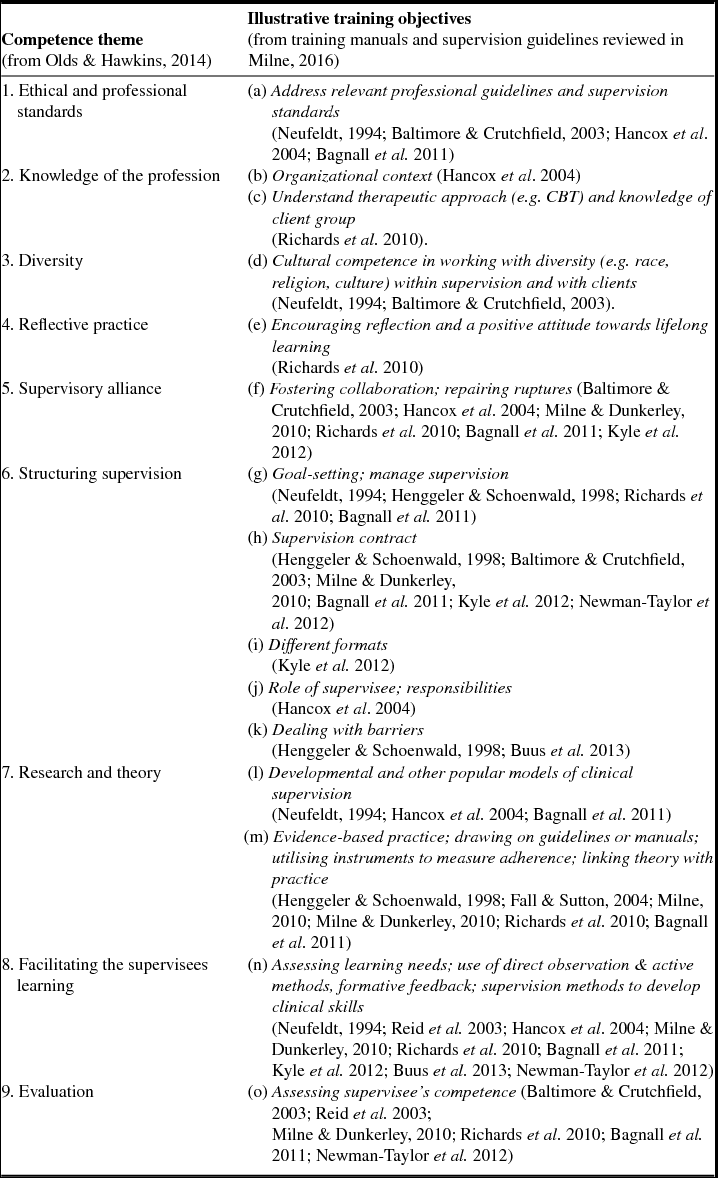
Across countries and disciplines, clinical supervisor training enjoys a high degree of expert consensus regarding the broad content and the targeted competencies (Watkins & Wang, Reference Watkins, Wang, Watkins and Milne2014). Table 1 presents a summary of the main themes derived by Olds & Hawkins (Reference Olds and Hawkins2014), which explicitly subsume the other major recent summaries (i.e. Rodolfa et al. Reference Rodolfa, Greenberg, Hunsley, Smith-Zoeller, Cox, Sammons and Spivak2013; Watkins, Reference Watkins2013). Such themes need to be translated into workshop objectives and intended learning outcomes (Harden, Reference Harden2002; Prideaux, Reference Prideaux2003). Therefore, alongside each broad competence theme from Olds & Hawkins (Reference Olds and Hawkins2014), Table 1 provides examples of specific training objectives (in italics). These represent the workshop content, drawn from the literature on supervision guidelines and supervisor training manuals (Milne, Reference Milne2016).
A competence-based specification of the content of supervisor training, based on the core themes defined by Olds & Hawkins (Reference Olds and Hawkins2014)

Although the emphasis differs across the cited studies, the examples in Table 1 suggest that there is also some consensus among researchers on the objectives of supervisor training, in that multiple studies have addressed these objectives. Indeed, some workshops have addressed whole competence frameworks, representing most of the nine themes (e.g. Bagnall et al. Reference Bagnall, Sloan, Platz and Murphy2011; Taylor et al. Reference Taylor, Gordon, Grist and Olding2012). Also relevant to the training context, systematic reviews of the optimal methods for training concur on the need to emphasize experiential methods (Beidas & Kendall, Reference Beidas and Kendall2010; Watkins & Wang, Reference Watkins, Wang, Watkins and Milne2014); and there are emergent frameworks for supervisor workshop evaluation, together with some promising instruments (Culloty et al. Reference Culloty, Milne and Sheikh2010; Lewis et al. Reference Lewis, Scott and Hendricks2014). Against this account of consensus, it should be acknowledged that there are variations in expert opinion, and that some of the available summaries do not explore areas of disagreement (e.g. Kaslow et al. Reference Kaslow, Borden, Collins, Forrest, Illfelder-Kaye, Nelson, Rallo, Vasquez and Willmuth2004).
Reasons for the popularity of video
Although lacking an evidence base of its own, video is a flexible technology, often used in conjunction with experiential methods, as versatile as any other workshop method, but especially popular. To illustrate, a survey of n=159 training directors indicated that video recordings were used on 60% of occasions (Romans et al. Reference Romans, Boswell, Carlozzi and Ferguson1995). These respondents attributed the popularity of video to the immediacy of feedback, to heightening skill acquisition, and to promoting learning from peers. To these uses can be added: the capacity to store an objective record of events (enabling evaluation or feedback); ease of dissemination; enhancing reflection and self-analysis; control of demonstrations and key incidents (e.g. pausing; replaying); strengthening instruction and feedback through pinpointing; creating specific learning or evaluation materials (e.g. vignettes); and capturing rare or inaccessible events (van Merrionboer & Boot, Reference Van Merrionboer, Boot and Ericsson2009). There are inevitably disadvantages, and perhaps the most notorious is evaluation anxiety, linked to negative self-awareness and inhibited functioning (e.g. ‘freezing’ during recording).
A further reason for developing the use of video recordings is that CBT practitioners are especially committed to an evidence-based approach, and have also long recognized the value of video material within supervision. It follows that evidence regarding video applications within CBT supervisor training is in particular need of attention. Having sketched out the relevant context, the focal question becomes: How can video recordings best contribute to clinical supervisor training?
Review of video material
The themes and more specific objectives within Table 1 provide a sound basis for developing a supervisor training programme. Video recordings could contribute to addressing the nine themes within a workshop. ‘Video’ refers to visually presented recordings (DVD or other formats), material that is recorded especially for (or during) a workshop, and which is intended to enhance distinctively the other training methods. Fundamentally, video recordings provide information through modelling and direct observation, part of the ‘essential’ supervision-of-supervision element within workshops (Falender et al. Reference Falender, Cornish, Goodyear, Hatcher, Kaslow, Leventhal, Shafranske, Sigmon, Stoltenberg and Grus2004, p. 780). Of course, technology has ushered in various alternatives or supplements to the traditional face-to-face workshop, such as video conferencing to enable distance learning in rural areas and other innovative options (Rousmaniere, Reference Rousmaniere, Watkins and Milne2014). But the focus here is on traditional workshops, as they are still the primary way that clinical supervisors are trained (Watkins & Wang, Reference Watkins, Wang, Watkins and Milne2014).
Some illustrative, current videos
Like evaluations, video recordings of supervision are scarce, particularly within research studies. More often they are prepared for local use and minimally disseminated. The sample that follows was built up by the author from personal enquiries, and from searching the literature. With rare exceptions (e.g. Sloan & Fleming, 2011), these recordings are reported without any accompanying evaluation, or any suggestions on how future evaluations might best be conducted. This means that the effectiveness of the example videos that now follow is largely unknown.
An example is the DVD ‘Psychology supervisor training’, which was designed for private reflective study (University of Wollongong, 2013). Through role-plays, the DVD covers planning supervision (using a competency-based approach), selecting supervision methods, the use of observational methods, and working with resistance (a rare illustration of an alliance rupture).
The Milton Erickson Foundation has published two DVDs portraying CBT supervision, one featuring David Barlow and a second featuring Judith Beck (‘How to supervise in cognitive therapy’, 2005). Beck starts with clinical details and formulation of a supervisee-selected patient, leading into mutual goal-setting, some educational role-playing, and action planning. In these two DVDs, the supervisees play themselves, as do the supervisors, but these depictions are not naturalistic, which some refer to as ‘real-play’.
Another stand-alone example that is designed to demonstrate a supervisor technique is ‘structured peer group supervision’ (Green & Akhurst, Reference Green and Akhurst2008). This is a naturalistic recording (i.e. unscripted and unrehearsed; supervision-as-usual). The DVD depicts a focused case description by the ‘presenter’; a period of questioning; reflective feedback and discussion; response by the presenter (after a period for reflection); and further exploration or closure.
The DVD ‘Make room for . . . clinical supervision’ (Hanlon & Sloan, Reference Hanlon and Sloan2010) was incorporated within a major supervisor training programme (Sloan & Fleming, 2011). It was initially unrelated to the guideline on supervision, also developed by Sloan and colleagues (Kyle et al. Reference Kyle, Sloan and Davies2012). The DVD was designed for novice supervisors and uses role-play scenes to illustrate competent supervision (goal-setting, models, feedback and evaluation). There are also policy statements and suggested reading (Hanlon & Sloan, Reference Hanlon and Sloan2011). Subsequent collaborations have led to these and other materials being combined within a 5-day workshop on CBT supervision, designed by National Education for Scotland (NES), subsequently retained within a 3-day generic workshop (Bagnall et al. Reference Bagnall, Sloan, Platz and Murphy2011). The 3-day workshop also incorporated a DVD depicting common ethical issues in supervision (Green, Reference Green2002). Before and after the workshop the participating supervisors’ (n=21) self-rated their proficiency, in relation to the generic competencies (Roth & Pilling, Reference Roth and Pilling2007), with favourable results. However, the DVD material was not assessed directly, although some of the feedback comments made by the participants indicated the need to make the video content more generic.
Another naturalistic DVD, used within the NES workshops above, was prepared by Milne and colleagues as part of an ‘Introduction to clinical supervision’ training manual (Milne, Reference Milne2010). Like the above examples, this DVD lasts about an hour, but differs in being made up of brief clips of different supervision dyads, selected to depict particular aspects of the workshop content. The workshop's slideshow suggests when particular clips might be played, but the workshop leader decides, as part of achieving the workshop objectives by using the various resources appropriately (the manual also includes video-related learning exercises). The DVD clips address: the supervision alliance/relationship; goal-setting and the supervision contact; facilitating the supervisee's learning; feedback and evaluation; concluding with learning and development for the supervisor. This DVD was evaluated informally during piloting, then as part of two general workshop evaluations (Milne, Reference Milne2010; Culloty et al. Reference Culloty, Milne and Sheikh2010). Both workshops received positive feedback from the participating supervisors and trainers, but there were few specific comments on the DVD material (those that were made were favourable, valuing the illustrations).
Also included within a comprehensive supervisor training workshop is the video in the Clinical Supervision Resource Kit (2005), prepared for the ‘alcohol and other drugs’ (AOD) field in Australia. The kit includes a full guideline, a demonstration DVD (csrk_demo_training_booklet_2.wmv), Powerpoint slides, a sample 1-day training programme, and other written guidance. The DVD is intended to play a central, integrating role within the 1-day workshop, linking guidelines, learning exercises, questions and other activities. It is designed to demonstrate clinical supervision and to stimulate learning (e.g. by prompting reflection). The material on the DVD is scripted and the supervision is role-played, but a therapy recording is presented within the 40-min recording, and there are helpful summaries and links to supporting guidance (e.g. recommendations for supervision). Together with the professional standard of the recording and the free and easy access online, this DVD is one of the best available training options.
A framework for future videos
Unlike the AOD example, the way that the currently available video material summarized above was utilized within workshops was rarely specified (another good example is Taylor et al. Reference Taylor, Gordon, Grist and Olding2012). The typical uses were to demonstrate a supervisory approach (e.g. CBT supervision), to illustrate competent supervision (in relation to several skills), and to contribute to the instructional variety and experiential emphasis of these training events. Equally uncertain is the information about when and how exactly to use the DVD material, which appeared to be left to the workshop leaders’ judgement.
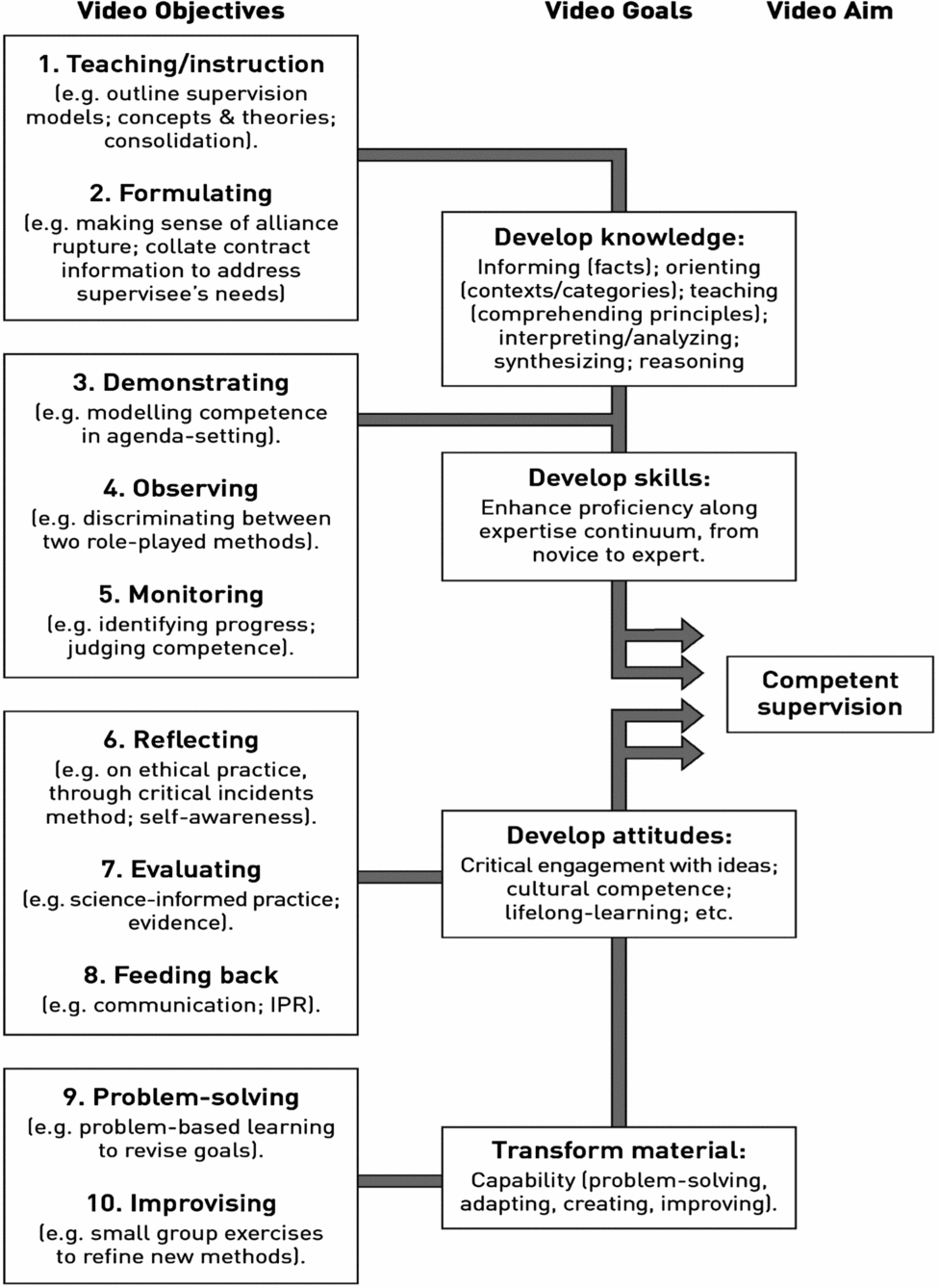
There are many more possible applications and potential learning outcomes. As set out in Figure 1, a more comprehensive framework can be created by building on these current videos through adding examples from the staff training literature and utilizing educational theory (Bloom et al. Reference Bloom, Englehart, Furst, Hill and Krathwohl1956; Harden, Reference Harden2002; Lyon et al. Reference Lyon, Stirman, Kerns and Bruns2011). Less frequently included in competence statements or training goals is the notion of ‘capability’ (Fraser & Greenhalgh, Reference Fraser and Greenhalgh2001), essentially the capacity to problem solve. This was added to Figure 1 as it is a classic educational goal, a logical part of supervisor development, and a recognized aspect of professional development within CBT (Bennett-Levy, Reference Bennett-Levy2006). Figure 1 links the 10 resulting video objectives, such as ‘teaching/instruction’, to illustrative learning outcomes (left-hand column, e.g. ‘outline supervision models’). These links, indicated by lines and arrows within the Figure, are only intended to suggest some of the more plausible relationships (e.g. that ‘teaching/instruction’ probably leads to the goal of ‘to develop knowledge’). Similarly, these objectives are grouped according to assumed relationships (e.g. that objectives 3–5 in Figure 1 may all primarily contribute to knowledge or skill development). Although there are some logical educational grounds for these suggested links, they are not intended to represent firm, evidence-based relationships. It is also recognized that any objective may contribute to multiple goals (e.g. ‘reflecting’ may contribute to knowledge development, as well as to the indicated attitude development). In short, Figure 1 is primarily hypothetical, intended to facilitate research and training practice by suggesting possible relationships.
A framework for using video material within supervisor training, linking objectives (e.g. ‘teaching’ or ‘demonstrating’) to the intended learning outcomes (headed ‘Video goals’, e.g. comprehending theories or demonstrating competencies), and to the overall aim of such training. Note that this framework depends primarily on expert opinion, rather than empirical evidence.

Figure 1 proposes that these broad applications and specific outcomes contribute to the broad video goals (e.g. develop knowledge), enabling the overall aim to be achieved more efficiently (i.e. competent supervision). Therefore, Figure 1 represents a carefully crafted menu of video options, a framework for refining supervisor training in the future. It complements the material in Table 1, as both summaries detail related aspects of the supervisor training curriculum.
Some practical considerations
Numerous practical questions arise when drawing on Figure 1, such as how long to allocate to video, and the best way to link video to other parts of the workshop. Some supervisor training manuals are prescriptive, indicating the optimal timing of video within a workshop, which clip should be used, and the related objective to be pursued. Other programmes encourage a more responsive approach, depending on the delegates’ progress or motivational level, therefore empowering the workshop leader to judge the best timing. In a sense, this can be construed as a micro-developmental model, where the workshop participants’ moment-to-moment needs guide the use of educational materials.
In very general terms, one might argue that video belongs between didactic methods (e.g. lecture or reading) and enactive ones (e.g. educational role-play), as indicated by ancient wisdom: ‘I hear and I forget; I see and I remember’; I do and I understand’ (old Chinese proverb). Some training models have operationalized this wisdom, following didactic (theoretical) instruction with experiential work, including video material (Kaslow et al. Reference Kaslow, Borden, Collins, Forrest, Illfelder-Kaye, Nelson, Rallo, Vasquez and Willmuth2004; Rakovshik & McManus, Reference Rakovshik and McManus2010; Watkins & Wang, Reference Watkins, Wang, Watkins and Milne2014). By contrast, modern educational thinking emphasizes the completion of all parts of the workshop programme, rather than following some pre-determined order or workshop plan (Prideaux, Reference Prideaux2003). To this advice we might add that using a blend of learning methods in a graded (needs-led) manner is associated with training effectiveness (Rakovshik & McManus, Reference Rakovshik and McManus2010; Bluestone et al. Reference Bluestone, Johnson, Fullerton, Carr, Alderman and BonTempo2013). Other considerations are to provide spaced, simulation-based, mastery-focused, and situated training (Bluestone et al. Reference Bluestone, Johnson, Fullerton, Carr, Alderman and BonTempo2013).
To apply these points to the use of video, workshops could stagger sessions across several weeks, allowing time to review or reflect on video material (Newman, Reference Newman2013), and could then make extensive use of high-fidelity behavioural rehearsal, primed by the use of naturalistic video demonstrations. Such rehearsal should continue until the workshop participants have demonstrated competence, ideally under routine work (supervision) conditions. In particular, simulation technologies (potentially including video material) have become a widely used and powerful training method within medical education (McGaghie et al. Reference McGaghie, Siddall, Mazmanian and Myers2014), and merit consideration within supervisor training.
Discussion
The present review has suggested how progress in supervisor training can be maintained through the enhanced use of video material. It has been argued that the current training applications of video lack procedural detail, are unnecessarily restricted, and lack an educational rationale or research support. This situation greatly hampers progress. A more precise, comprehensive and educationally informed framework was proposed, including 10 complementary video applications. To place this in context, links were made to the core supervision competencies and the related workshop content, culminating in a preliminary educational rationale for the use of video within supervisor training. This can foster the necessary research activity and enable supervisor trainers to be more efficient.
As the evidence base for videos is strikingly weak and inconclusive, the rationale for their use at present draws primarily on educational theory, findings from the staff training literature, and expert recommendation (e.g. Newman, Reference Newman2013). As with many other aspects of clinical supervision, there remains a great need for research that can further clarify the optimal role of video within workshops. Until then we will remain some way short of a fully evidence-based approach (Mayer, Reference Mayer2008). To initiate progress, replicable descriptions of the actual application of video material are required, alongside other workshop details (Phillips et al. 2014). The use of video within supervisor training should also be subjected to process and outcome evaluations, such as detailing how video was actually utilized (e.g. to demonstrate a technique), alongside the initial impacts (e.g. facilitating action planning). As published descriptions of training may be misleading, direct observation is recommended. To illustrate, Milne et al. (Reference Milne, Keegan, Westerman and Dudley2000) observed low adherence to a workshop training protocol, with experiential training occurring on only 6% of occasions. In time, such focused evaluations should be combined with complementary analyses of the relative role of other training methods, until we have established the optimal approach.
The weak scientific context creates problems for reviews such as the present one, as much potentially valuable information is unavailable and there are so few firm findings. Moreover, the rare research reports tend to be hard to interpret, as the precise nature of the video material lacks transparency. This is analogous to absent process data within an evaluation of therapy outcome, in that it makes inferences about cause and effect tenuous (Dorsey et al. Reference Dorsey, Pullman, Deblinger, Berliner, Kerns, Thompson, Unutzer, Weisz and Garland2013). In addition, the large potential range of applications of video material is only minimally explored within the reviewed studies and current videos. Last, most research is dated, and so analyses that take account of technological developments are absent, limiting significantly the relevance to current workshop practice. In summary, the present review was hampered by missing data, making inferences about the current status of video highly problematical. It follows that the suggestions for refining supervisor training through the use of videos should be subjected to careful evaluation.
It is concluded that application of this framework (Fig. 1) may enhance the effectiveness and efficiency of supervisor training, helping to maintain progress. However, given the lack of a firm evidence-base, care should be taken not to ossify the framework: hopefully future research will indicate important improvements to this preliminary thinking.
Summary
The present review considered how video recordings can best contribute to supervisory competence within supervisor training. Several current videos indicated valuable options (e.g. facilitating reflection), and it was suggested that there are several promising ways to broaden and deepen these applications (see Fig. 1). A comprehensive range of video applications of this kind increases the likelihood that learning needs can be met more efficiently. Further, recordings can probably best contribute when integrated more systematically with the rest of the workshop. Specific examples illustrated some novel video applications, such as ‘problem-solving’. Furthermore, a number of practical issues were addressed, which can strengthen the contribution of video material (e.g. sequencing so as to optimize experiential learning). The scope for research and development is considerable, as is supervisor training in general: we remain some way short of an evidence-based approach (Mayer, Reference Mayer2008), so especial care should be exercised in drawing on the tentative implications within the present review.
Declaration of Interest
None.
Acknowledgements
The author thanks Graham Sloan for information on his included work.
By the end of this review, the reader should be able to:
-
(1) List the nine suggested content areas for supervisor training.
-
(2) Suggest six different objectives when using video within a workshop.
-
(3) Summarize a learning exercise which depends on video material.



Comments
No Comments have been published for this article.