


Introduction
According to cognitive models of psychopathology, emotional disorders are maintained by biases and distortions in processing information (Beck, Reference Beck1976). One such bias is interpretation bias, in which ambiguous stimuli are interpreted as having an emotionally valenced quality – for example, people who are depressed may interpret neutral information as negative, while those with anxiety disorders may interpret neutral information as threatening (Hirsch et al., Reference Hirsch, Meeten, Krahé and Reeder2016; Mathews and MacLeod, Reference Mathews and MacLeod2005). These findings have emerged in the context of many different types of ambiguous information, including facial expressions, written scenarios and interoceptive sensations (Hirsch et al., Reference Hirsch, Meeten, Krahé and Reeder2016; Schoth and Liossi, Reference Schoth and Liossi2017). As research on this basic mechanism has flourished, evidence has subsequently emerged that directly modifying these biases via computerized tasks may be a viable intervention strategy for anxiety and depression (Holmes et al., Reference Holmes, Lang and Shah2009; MacLeod and Mathews, Reference MacLeod and Mathews2012).
Compared with those diagnosed with anxiety or depressive disorders, much less is known about the degree to which bipolar disorder is characterized by interpretation bias. However, a prominent model of cognition in bipolar disorder posits that interpretation biases play a key role in the development of mood symptoms. Holmes and colleagues argue that cognitive biases in interpretation are shaped and amplified by tendencies to experience more vivid and intrusive mental images (Holmes et al., Reference Holmes, Geddes, Colom and Goodwin2008). This theory includes the prediction that a combination of positive interpretation bias and vivid mental imagery of imagined positive events could amplify symptoms of mania. In the present study, we tested one component of this model among individuals at risk for bipolar disorder. We reasoned that if positive bias and vivid, positive imagery contribute to mania symptoms, similar cognitive factors involving aspects of positive bias and imagery might also confer higher vulnerability to bipolar disorder. As backdrop to this study, we first review two converging topics: interpretation bias in bipolar disorder and mental imagery in bipolar disorder.
Interpretation bias and bipolar disorder
Among individuals diagnosed with bipolar disorder, investigations of cognitive biases have yielded somewhat inconsistent results. At a broad level, some studies indicate that mania, the defining feature of bipolar disorder, is tied to positive cognitive biases (García-Blanco et al., Reference García-Blanco, Perea and Livianos2013; Murphy et al., Reference Murphy, Sahakian, Rubinsztein, Michael, Rogers, Robbins and Paykel1999), and there is evidence that people with bipolar disorder show overly positive appraisals of internal states (Dodd et al., Reference Dodd, Mansell, Morrison and Tai2011; Jones et al., Reference Jones, Mansell and Waller2006; Kelly et al., Reference Kelly, Mansell, Wood, Alatiq, Dodd and Searson2011; Mansell, Reference Mansell2006). In contrast, some studies find no evidence of positive biases (e.g. Peckham et al., Reference Peckham, Johnson and Tharp2016; Purcell et al., Reference Purcell, Lohani, Musket, Hay, Isaacowitz and Gruber2018), while others find that some with bipolar disorder show negative biases and negative appraisals of internal states (e.g. Lyon et al., Reference Lyon, Startup and Bentall1999; Mansell et al., Reference Mansell, Morrison, Reid, Lowens and Tai2007). However, very few studies have tested interpretation biases using stimuli such as ambiguous scenarios or words, methods that are commonly used to identify biases in mood and anxiety disorders (cf. Hirsch et al., Reference Hirsch, Meeten, Krahé and Reeder2016). The few studies that have used such measures do not show evidence for positive bias during remission or depressive episodes (Di Simplicio et al., Reference Di Simplicio, Renner, Blackwell, Mitchell, Stratford, Watson and Holmes2016; Holmes et al., Reference Holmes, Deeprose, Fairburn, Wallace-Hadrill, Bonsall, Geddes and Goodwin2011).
In comparison with diagnosed samples, more consistent evidence supports positive interpretation bias in people at risk for bipolar disorder. Evidence shows that positive cognitive biases are present in at-risk samples for various types of ambiguous stimuli, including ambiguous physical touch (Piff et al., Reference Piff, Purcell, Gruber, Hertenstein and Keltner2012), positive perceptions in dyadic couples’ interactions (Dutra et al., Reference Dutra, West, Impett, Oveis, Kogan, Keltner and Gruber2014), and positive appraisals of facial affect (Campellone et al., Reference Campellone, Peckham and Johnson2018; Trevisani et al., Reference Trevisani, Johnson and Carver2008). Similar to diagnosed samples, people at risk for bipolar disorder also report more positive interpretations of ambiguous internal states (Johnson and Jones, Reference Johnson and Jones2009; Jones et al., Reference Jones, Mansell and Waller2006; Kelly et al., Reference Kelly, Mansell, Sadhnani and Wood2012).
Although these findings indicate that people at risk for bipolar disorder may show a positive bias to some ambiguous stimuli, most of these studies have used tasks that measure interpretation using ambiguous faces or assessment of internal states. Interpretation bias paradigms that rely on facial stimuli may be problematic because some with bipolar disorder show difficulties with facial affect recognition of non-ambiguous stimuli (Kohler et al., Reference Kohler, Hoffman, Eastman, Healey and Moberg2011). Some have argued that ambiguous scenarios are a more ecologically valid approach to assessing interpretations of ambiguity (Schoth and Liossi, Reference Schoth and Liossi2017); accordingly, scenarios have been the more common approach to assessing interpretation bias in other disorders.
To our knowledge, ambiguous scenarios have not been used to probe interpretation bias in people at risk for bipolar disorder, and have only been used in one instance among those diagnosed with bipolar disorder (Di Simplicio et al., Reference Di Simplicio, Renner, Blackwell, Mitchell, Stratford, Watson and Holmes2016). To best assess the contribution of imagery and interpretation bias to risk for bipolar disorder, one goal of the present study was to assess interpretation bias among those at risk for bipolar disorder using a validated measure of interpretation of ambiguous scenarios.
Imagery and bipolar disorder
Empirically, diagnoses and risk of bipolar disorder are associated with elevated tendencies to experience mental images as vivid (Gregory et al., Reference Gregory, Brewin, Mansell and Donaldson2010; Holmes et al., Reference Holmes, Deeprose, Fairburn, Wallace-Hadrill, Bonsall, Geddes and Goodwin2011), intrusive (e.g. involuntary), and future-oriented (Deeprose et al., Reference Deeprose, Malik and Holmes2011; Di Simplicio et al., Reference Di Simplicio, Renner, Blackwell, Mitchell, Stratford, Watson and Holmes2016; Hales et al., Reference Hales, Deeprose, Goodwin and Holmes2011; Holmes et al., Reference Holmes, Deeprose, Fairburn, Wallace-Hadrill, Bonsall, Geddes and Goodwin2011). Among those diagnosed with bipolar disorder, involuntary imagery in particular is linked to mood instability (Holmes et al., Reference Holmes, Deeprose, Fairburn, Wallace-Hadrill, Bonsall, Geddes and Goodwin2011). Basic findings outside of bipolar disorder reveal that imagery has been shown to increase tendencies toward interpretation biases. That is, participants prompted to form images of positive stimuli showed more positive interpretations of ambiguous words on a transfer task (Pictet et al., Reference Pictet, Coughtrey, Mathews and Holmes2011), and participants trained to show negative interpretations of ambiguous stimuli report more negative mental imagery (Hertel et al., Reference Hertel, Mathews, Peterson and Kintner2003). Given the prominent role for involuntary imagery in bipolar disorder, and increasing evidence for a prominent role for involuntary imagery in psychopathology more broadly (Brewin et al., Reference Brewin, Gregory, Lipton and Burgess2010), understanding how interpretations biases and imagery jointly contribute to symptoms and mood episodes may have important clinical implications.
Little is known, however, about how individual differences in imagery guide cognitive interpretation biases within bipolar disorder. In one study, those with bipolar disorder rated ambiguous scenarios less positively than those without the disorder, but among those with bipolar disorder, those who reported more vivid images of a scenario showed more positive bias for that scenario (Holmes et al., Reference Holmes, Deeprose, Fairburn, Wallace-Hadrill, Bonsall, Geddes and Goodwin2011). In addition, imagery has been linked to memory bias for positive, high-activation words among people at risk for bipolar disorder (Pyle and Mansell, Reference Pyle and Mansell2010). However, no study to date has evaluated whether positive interpretation bias and involuntary imagery jointly influence greater risk for bipolar disorder. Extending a test of Holmes’ and colleagues (Reference Holmes, Geddes, Colom and Goodwin2008) hypothesis to an at-risk sample is a critical step to understanding if positive interpretation bias and mental imagery can help to explain vulnerability for bipolar disorder; this was the primary goal for the present study.
Aims and hypotheses
In the present study, we tested the degree to which interpretation bias and involuntary mental imagery are separately or jointly related to higher scores on a self-report measure previously linked to risk for bipolar disorder. In a non-clinical sample, we administered a battery of self-report measures to assess risk for mania, interpretation of ambiguous scenarios, and involuntary imagery about future self-relevant events. Given the inherent difficulty in isolating the role of imagery in measures of ambiguous scenarios, we chose a measure of interpretation bias (described below) that explicitly asks participants to rate both their interpretation and the vividness of the scenarios, so that the effects of image vividness could be accounted for in analyses of interpretation bias. Given evidence for some overlap between measures of positive affect and hypomania risk (Kirkland et al., Reference Kirkland, Gruber and Cunningham2015), we also included a separate measure of positive affect to better isolate effects of hypomania risk on positive bias. We hypothesized that risk for mania would be related to more positive interpretations of ambiguous situations and more frequent involuntary mental imagery, and to the interaction of involuntary imagery and positive interpretations of ambiguity, such that high levels of both would be particularly related to increased mania risk.
Method
Participants and design
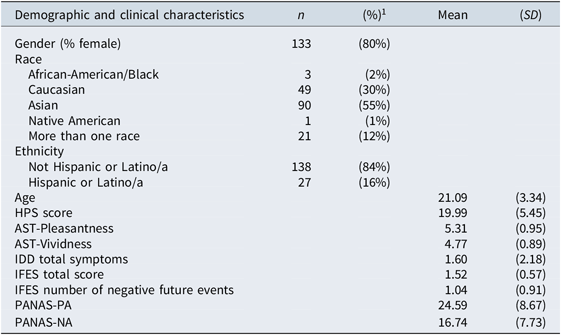
Participants (N = 206) were undergraduate college students who completed written informed consent, and then online demographic items and the self-report measures described below. Participants received partial course credit in psychology classes for taking part in this study. Measures were delivered through Qualtrics (Qualtrics, Provo, UT, USA). Some participants (17.96%; n = 37) either failed to respond correctly to a validity item (‘Please respond 3 to this question’) or failed to complete one or more of the primary study measures; these participants were excluded, leaving a final sample of 169 (78.70% female, mean age = 21.09 years, SD = 3.34, range: 18–50). Race and ethnicity are described in Table 1.
Descriptive statistics for primary study variables

AST, Ambiguous Scenarios Test; IFES, Impact of Future Events Scale; PANAS, Positive and Negative Affect Scale; RPA, Responses to Positive Affect Scale.
1 Percentage of valid data not including missing cases.
Measures
Ambiguous Scenarios Test-Depression (AST-D; Berna et al., Reference Berna, Lang, Goodwin and Holmes2011)
The AST-D is a self-report measure of interpretation bias. Participants read 24 ambiguous scenarios (e.g. ‘You go to a place you visited as a child. Walking around makes you feel emotional’), were asked to form an image of that scenario happening to them, and then rate how pleasant and vivid the image is. Pleasantness ratings, made on a 9-point Likert scale from ‘extremely unpleasant’ to ‘extremely pleasant’, are considered the index of interpretation bias. Vividness is rated on a 7-point Likert scale from ‘not vivid at all’ to ‘extremely vivid’. Although initially designed to capture potential depression-related biases (Berna et al., Reference Berna, Lang, Goodwin and Holmes2011), the AST has shown good validity in unselected college samples such as the present study (e.g. Cooper and Wade, Reference Cooper and Wade2015). Internal consistency was high for both subscales across the 24 scenarios (pleasantness α = 0.85, vividness α = 0.93).
Hypomanic Personality Scale (HPS; Eckblad and Chapman, Reference Eckblad and Chapman1986)
The HPS is a measure of lifetime experiences of mild hypomanic symptoms and of personality traits designed to identify those ‘predisposed to both hypomanic episodes and bipolar disorder’ (Eckblad and Chapman, Reference Eckblad and Chapman1986). The measure includes 48 items to assess risk for mania (e.g. ‘I frequently find that my thoughts are racing’); in the present study, these items were rated on a 0 (strongly disagree) to 3 (strongly agree) scale validated in previous work (e.g. Giovanelli et al., Reference Giovanelli, Hoerger, Johnson and Gruber2013). Participants are instructed to include only experiences that occurred when they were not under the influence of drugs. Across two longitudinal studies, higher HPS scores related concurrently and predictively to bipolar disorder and bipolar spectrum disorder diagnosis (Kwapil et al., Reference Kwapil, Miller, Zinser, Chapman, Chapman and Eckblad2000; Walsh et al., Reference Walsh, DeGeorge, Barrantes-Vidal and Kwapil2015). HPS scores are also linked to genetic polymorphisms related to bipolar disorder (Johnson et al., Reference Johnson, Carver, Joormann and Cuccaro2014a). We found the scale to have excellent internal consistency in our sample (α = 0.91). HPS scores were normally distributed; however, all but one participant in the study scored below the ‘high-risk’ range of 35 or higher used by previous studies (e.g. Johnson et al., Reference Johnson, Carver, Joormann and Cuccaro2014a).
Impact of Future Events Scale (IFES; Deeprose and Holmes, Reference Deeprose and Holmes2010)
The IFES is a measure of the degree to which a person experiences intrusive (involuntary), future-oriented mental imagery (Deeprose and Holmes, Reference Deeprose and Holmes2010). Participants are asked to identify three future events that they have been thinking about over the past 7 days, and to indicate whether each future event is positive or negative. They then answer 24 questions about the extent to which they experienced future-oriented imagery of these events over the past week (e.g. ‘Pictures about the future popped into my mind’) on a 0 (not at all) to 4 (extremely) scale. Internal consistency for this sample was good (α = 0.88). The IFES yields two scores: the valence of the three future events (i.e. how many of the three events were negative or positive), and the average level of involuntary future-oriented imagery from the 24-item scale. As in past research using the IFES, we focused on the average of the 24-item scale in our analysis, but controlled for the valence of negative and positive events. Higher IFES scores have been shown to relate to risk for bipolar disorder (Deeprose et al., Reference Deeprose, Malik and Holmes2011) and to bipolar disorder diagnoses (Holmes et al., Reference Holmes, Deeprose, Fairburn, Wallace-Hadrill, Bonsall, Geddes and Goodwin2011).
Inventory to Diagnose Depression (IDD)
Participants completed the IDD, a measure of current depression symptoms. Participants were asked to indicate the severity of symptoms of depression in the past week. For each of 22 symptoms, they select one of five possible responses describing the severity of the symptom (e.g. ‘My energy level was normal’ to ‘I felt tired or exhausted almost all of the time’). For each symptom endorsed, they were asked to indicate whether the symptom persisted at least 2 weeks. IDD scores cover the DSM symptoms of major depressive disorder (range: 0 to 9) and are significantly associated with diagnosis of major depressive disorder (Zimmerman and Coryell, Reference Zimmerman and Coryell1987). Internal consistency for this sample was excellent (α = 0. 93).
Positive and Negative Affect Schedule – 24 Item (PANAS-24)
As a measure of current mood, participants were asked to rate their current feelings using 12 positive (PA) and 12 negative affective (NA) state adjectives selected from the PANAS-X (12 negative and 12 positive; from Watson and Clark, Reference Watson and Clark1999). Each item was rated on a Likert scale from 1 (very slightly or not at all) to 5 (extremely). Internal consistency for our sample was excellent (PA α = 0.93, NA α = 0.93).
Analysis plan
Analyses were completed using IBM SPSS version 24.0 and Jamovi version 0.9. Before conducting tests of hypotheses, variables were graphed and their distributions checked for normality. Bivariate relationships between study variables were examined using Pearson correlations. To consider the hypothesis that interpretation bias, mental imagery, and their interaction were related to mania risk (HPS), we used a hierarchical linear regression. Independent variables were centred prior to analyses. Potential multivariate outliers were identified via evaluation of Mahalanobis distances. Additional regression diagnostics [tolerance and variance inflation factor (VIF) values] were evaluated to assess for the potential of multicollinearity.
Results
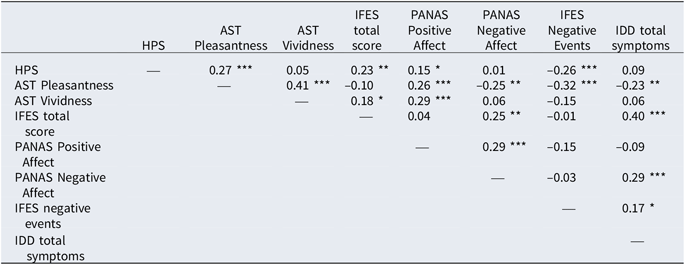
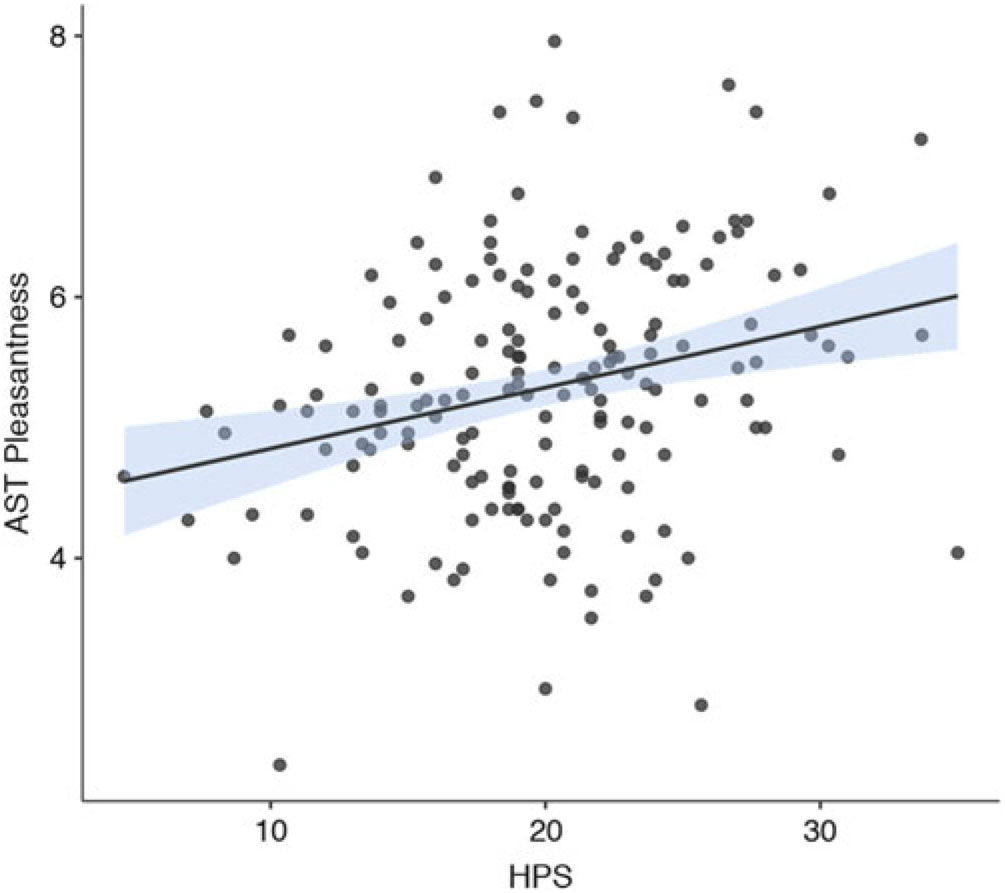
Descriptive statistics for the sample are shown in Table 1. Table 2 shows zero-order correlations between variables of interest. As would be expected, the two scales of the AST (Pleasantness and Vividness) were significantly correlated. HPS scores showed small, significant correlations with more positive interpretations of ambiguous scenarios (Fig. 1) and involuntary future-oriented mental imagery. Correlations of age and sex, and ANOVAs of race and ethnicity showed no significant relationship to HPS score (p > .25). Current depression symptoms were significantly correlated with more frequent involuntary imagery of future events.
Pearson correlations between primary study variable

*p < .05, **p < .01, ***p < .001. AST, Ambiguous Scenarios Test; IFES, Impact of Future Events Scale; PANAS, Positive and Negative Affect Scale; RPA, Responses to Positive Affect Scale.
Scatter plot of Interpretation Bias and Hypomanic Personality Scale (HPS). AST Pleasantness ratings on the y-axis refer to average ratings of the pleasantness of the 24 scenarios in the Ambiguous Scenarios Test. The shaded line shows the standard error of the mean.

Are interpretation bias, intrusive imagery, and their interaction related to risk for bipolar disorder?
Hierarchical multiple linear regression was used to test whether more positive interpretation of ambiguous scenarios (AST-pleasantness score), more frequent involuntary imagery of future events (IFES score), and their interaction would relate to higher scores on the HPS measure. An initial regression model revealed two potential multivariate outliers (Mahalanobis distances exceeding a threshold of χ2(10) = 29.59, p < .001); these two participants were removed from analysis.Footnote 1 AST-pleasantness score and involuntary imagery (IFES total score) were entered in block 1, as well as gender and age. The interaction term of Involuntary imagery × Interpretation bias was entered in block 2. State NA and PA (PANAS), depression symptoms (IDD), vividness ratings (AST) and overall number of negative future events (IFES) were entered as control variables in block 3, to evaluate if any observed relationships between HPS score, interpretation, and involuntary imagery remained significant after accounting for these additional variables. The overall model was significant; F (4,158) = 4.98, p < .001, adjusted R 2 = 0.09. HPS scores were unrelated to gender or age. However, both involuntary mental imagery (β = 0.25, p < .01) and more positive interpretation bias (β = 0.25, p < .01) each related significantly to higher HPS scores in block 1 (R 2 change = .11). The interaction term entered in block 2 (AST-pleasantness × IFES total score) did not significantly improve model fit: β = .05; R 2 change = .002, F (1,157) = .44, p = .51. In the final model [F (10,152) = 4.08, p < .001, adjusted R 2 = 0.16)], HPS scores were related to fewer future negative events on the IFES (β = –0.20, p = .02 and to lower vividness ratings on the AST (β = –0.24, p < .01. (The effect for vividness ratings was in the opposing direction to that shown in bivariate correlations.) HPS scores were not significantly related to positive or negative affect (PANAS), nor to current depressive symptoms (p > .07). However, both positive interpretation bias (β = .29, p < .01) and involuntary imagery (β = .22, p < .01) remained significantly related to HPS score in the presence of these additional control variables. The interaction term (AST-pleasantness × IFES total score) was not significant in this model; β = .04, p = .62. Inspection of regression diagnostics in this final model did not suggest the presence of multicollinearity (tolerance exceeded .58, with VIF less than 1.72 for all variables).
Discussion
Overly positive interpretation of ambiguous stimuli and involuntary mental imagery are proposed contributors to symptoms of mania (Holmes et al., Reference Holmes, Deeprose, Fairburn, Wallace-Hadrill, Bonsall, Geddes and Goodwin2011), yet little research has considered whether these two factors jointly contribute to risk for bipolar disorder. In the present study, both a more positive interpretation of ambiguous scenarios and enhanced involuntary mental imagery were associated with higher scores on the HPS measure, which has been shown to be associated with and to predict diagnosis of bipolar disorder (Kwapil et al., Reference Kwapil, Miller, Zinser, Chapman, Chapman and Eckblad2000; Walsh et al., Reference Walsh, DeGeorge, Barrantes-Vidal and Kwapil2015). These two dimensions did not interact. Strengths of this study include use of well-validated measures of imagery and interpretation bias, a large sample size with sufficient variability in HPS scores, and careful consideration of potential confounds (depression symptoms and mood state).
Previous findings link risk for bipolar disorder with more positive responses to other types of ambiguous stimuli, such as faces, internal sensations, and touch (Campellone et al., Reference Campellone, Peckham and Johnson2018; Dutra et al., Reference Dutra, West, Impett, Oveis, Kogan, Keltner and Gruber2014; Jones et al., Reference Jones, Mansell and Waller2006; Piff et al., Reference Piff, Purcell, Gruber, Hertenstein and Keltner2012; Trevisani et al., Reference Trevisani, Johnson and Carver2008). The present study extends these findings by showing that scores on the Hypomanic Personality Scale, a well-validated scale associated with risk for bipolar disorder, were significantly correlated with more positive interpretations of ambiguous scenarios. Although the magnitude of this effect was modest, the relationship between HPS scores and interpretation bias remained even when concurrently controlling for state affect, depression symptoms, and vividness of mental imagery. Across the present study and others in the field, consistent evidence is emerging that higher HPS scores are significantly associated with tendencies to perceive greater positivity in ambiguous situations. This pattern complements findings that subclinical depression and anxiety symptoms are tied to a more negative interpretation bias (e.g. Berna et al., Reference Berna, Lang, Goodwin and Holmes2011; Hindash and Amir, Reference Hindash and Amir2012; Steinman and Teachman, Reference Steinman and Teachman2010).
These findings are important to consider in the context of previous research on positivity-related traits in bipolar disorder. Consistent with the present findings, elevations in personality traits related to positive affect are also observed among unaffected first-degree relatives of those with bipolar disorder (Higier et al., Reference Higier, Jimenez, Hultman, Borg, Roman, Kizling and Cannon2014), indicating that elevated trait-like positivity may be related to aspects of vulnerability for the disorder. However, caution is warranted in assessing the results of undiagnosed samples, particularly given the partial overlap between measures of mania risk (such as the HPS) with positivity-relevant measures of extraversion and positive affect (e.g. Kirkland et al., Reference Kirkland, Gruber and Cunningham2015). It is also important to consider that the present study evaluated only two aspects of positivity. Other research demonstrates the importance of considering related constructs such as reactivity to positive stimuli (Gruber et al., Reference Gruber, Dutra, Eidelman, Johnson and Harvey2011a), impulsivity during positive mood (Muhtadie et al., Reference Muhtadie, Johnson, Carver, Gotlib and Ketter2014), and regulation of positive affect (Feldman et al., Reference Feldman, Joormann and Johnson2008). Finally, in the present study, higher scores on the HPS measure were modestly correlated with fewer negative future events listed on the IFES measure, potentially consistent with previous research indicating that higher scores on measures related to bipolar disorder are linked to optimism, predictions of success, and higher goal-setting for future rewarding events (Johnson and Carver, Reference Johnson and Carver2006; Schönfelder et al., Reference Schönfelder, Langer, Schneider and Wessa2017). Future studies would do well to conjointly consider how different aspects of positivity relate to risk for bipolar disorder, and from the use of prospective designs to understand whether these traits contribute to onset of the disorder.
Attempts to understand the nature of positivity-related traits in bipolar disorder must also contend with significant heterogeneity in outcomes and presentation. This heterogeneity is evident in the literature on positivity-related traits. Low levels of positive affect predict lower quality of life in people with bipolar disorder (Johnson et al., Reference Johnson, Tharp, Peckham and McMaster2016), yet other aspects of positivity are linked to negative outcomes. For example, heightened rumination on positive affect is related to more frequent episodes of mania (Gruber et al., Reference Gruber, Eidelman, Johnson, Smith and Harvey2011b). Another source of heterogeneity stems from the observations that many (but not all) individuals with bipolar disorder experience episodes of depression (Cuellar et al., Reference Cuellar, Johnson and Winters2005). In the present study, depression symptoms showed the inverse relationship to interpretation bias compared with the HPS measure: that is, higher levels of depression were correlated with a more negative interpretation bias, consistent with previous research (Hindash and Amir, Reference Hindash and Amir2012). Bipolar disorder and unipolar depression share a number of similar risk factors (Johnson et al., Reference Johnson, Cuellar, Peckham, Gotlib and Hammen2014b), and it is unknown how interpretation bias measures may help to specify risk profiles for depression vs mania. However, previous research indicates that negative interpretation bias predicts future depressive symptoms (Rude et al., Reference Rude, Wenzlaff, Gibbs, Vane and Whitney2002), while positive bias may protect against depression (Kleim et al., Reference Kleim, Thörn and Ehlert2014). Finally, although the present study focused on positive bias, future studies would do well to consider findings that some individuals with bipolar disorder may also show biases towards negative stimuli or to endorse negative beliefs about internal states (e.g. Lyon et al., Reference Lyon, Startup and Bentall1999; Mansell et al., Reference Mansell, Morrison, Reid, Lowens and Tai2007). Together, these findings support the need for multifaceted, longitudinal studies that consider positive-affect relevant traits alongside other well-established risk variables to help understand this significant variability in outcomes.
Separately, results of the present study showed that higher HPS scores are associated with more frequent experiences of involuntary future-oriented mental imagery, replicating previous research in this area (Deeprose et al., Reference Deeprose, Malik and Holmes2011; McCarthy-Jones et al., Reference McCarthy-Jones, Knowles and Rowse2012). This relationship between involuntary imagery and HPS scores remained significant even when controlling for interpretation bias, concurrent depression symptoms, and the vividness of images during the interpretation bias task. This finding is consistent with theoretical and empirical work emphasizing the importance of involuntary, prospective imagery in bipolar disorder (Holmes et al., Reference Holmes, Deeprose, Fairburn, Wallace-Hadrill, Bonsall, Geddes and Goodwin2011). In contrast to our hypotheses, imagery and interpretation bias did not interact. Comparisons to Holmes and colleagues’ (Reference Holmes, Geddes, Colom and Goodwin2008) model of imagery and bipolar disorder, however, are somewhat limited by the scope of the present study. First, the interpretation bias measure included in this study (the AST) inherently includes both an imagery rating and an interpretation rating, which may have limited our ability to detect any additional interaction of these dimensions. Also, this study evaluated one relatively specific aspect of imagery (i.e. future-oriented and involuntary), whereas the imagery-interpretation theory described by Holmes and colleagues describes a more detailed process that includes initial mood elevation, increased goal pursuit, and increased imagery in response to positive cues (Holmes et al., Reference Holmes, Geddes, Colom and Goodwin2008). Given that interpretation of ambiguous stimuli has been shown to be more positive after a mood induction for those at risk of bipolar disorder (Trevisani et al., Reference Trevisani, Johnson and Carver2008), future studies could test a more detailed set of hypotheses drawn from the theory of Holmes and colleagues by testing the impact of mood inductions on the effects of being high in both positive interpretation bias and imagery.
Results of the present study also support previous findings in isolating the particular types of mental imagery associated with mania risk. In the multiple regression, higher vividness ratings during the interpretation task correlated with lower scores on the HPS, yet involuntary, future-oriented mental imagery significantly correlated with higher scores. The inverse relationship between vividness ratings and HPS scores that emerged in regression analyses was somewhat surprising, given some previous studies showing elevated vividness ratings among individuals diagnosed with bipolar disorder (Gregory et al., Reference Gregory, Brewin, Mansell and Donaldson2010; Holmes et al., Reference Holmes, Deeprose, Fairburn, Wallace-Hadrill, Bonsall, Geddes and Goodwin2011). While speculative, the divergent findings regarding HPS scores and vividness vs volition of imagery indicate that enhanced vividness may be a feature of imagery more relevant to diagnosed samples as opposed to the student sample used in the present study. In contrast, the positive relationship between HPS scores and involuntary imagery is consistent with other studies showing a unique link between involuntary future-oriented forms of mental imagery and mood instability in bipolar disorder (Holmes et al., Reference Holmes, Deeprose, Fairburn, Wallace-Hadrill, Bonsall, Geddes and Goodwin2011). Moreover, this finding supports theory and research indicating that involuntary aspects of mental imagery in particular are relevant for psychological disorders (Brewin et al., Reference Brewin, Gregory, Lipton and Burgess2010; Holmes and Mathews, Reference Holmes and Mathews2010). Indeed, frequency of involuntary mental imagery was also correlated with current symptoms of depression in the present study, consistent with prior research (e.g. Deeprose and Holmes, Reference Deeprose and Holmes2010). However, the relationship between HPS scores and intrusive imagery remained even when controlling for depression symptoms and negative affect.
Several limitations are important to consider. The web-based data collection in the present study is less controlled than laboratory assessments of interpretation bias, which could affect the degree to which participants fully concentrated on imagining the scenarios used in the task. Second, the absence of follow-up prevents us from testing whether positive interpretation bias in those with higher HPS scores may lead to the onset of bipolar disorder over time. Third, HPS scores reported in this sample were largely below the level of cut-off scores used to index high levels of mania risk in other studies, indicating that despite the variability in HPS scores captured in our sample, it did not contain individuals at the highest risk for bipolar disorder. This limitation in range raises the possibility that the magnitude of correlations of the HPS with other measures is restricted, limiting the strength of findings. The use of a college student sample may have limited our ability to recruit individuals at the highest risk for bipolar disorder and may thus constrain the generalizability of study findings, although given the high rates of psychological disorders in college students (cf. Auerbach et al., Reference Auerbach, Alonso, Axinn, Cuijpers, Ebert, Green, Hwang, Kessler, Liu, Mortier, Nock, Pinder-Amaker, Sampson, Aguilar-Gaxiola, Al-Hamzawi, Andrade, Benjet, Caldas-de-Almeida, Demyttenaere, Florescu, de Girolamo, Gureje, Haro, Karam, Kiejna, Kovess-Masfety, Lee, McGrath, O’Neill, Pennell, Scott, ten Have, Torres, Zaslavsky, Zarkov and Bruffaerts2016), the sample was probably appropriate for testing hypotheses of psychopathology. Many previous studies have used selective recruitment strategies to target high-scoring individuals; this strategy could be used in future studies testing interpretation bias and imagery. Finally, current symptoms other than depression were not assessed among study participants. Anxiety symptoms are linked with more negative interpretation bias in many studies (Holmes et al., Reference Holmes, Geddes, Colom and Goodwin2008; Mathews and MacLeod, Reference Mathews and MacLeod2005), and are thought to be particularly relevant for bipolar disorder (Holmes et al., Reference Holmes, Geddes, Colom and Goodwin2008). The limited number of symptoms assessed also pre-empts any evaluation of trauma-relevant imagery; the present study focused only on imagery of future events, which does not allow for a test of how post-traumatic stress disorder or other trauma-related conditions may also influence involuntary images of past trauma. This may be particularly important for future studies assessing bipolar disorder, as trauma-related disorders are frequently co-morbid with bipolar disorder (Palmier-Claus et al., Reference Palmier-Claus, Berry, Bucci, Mansell and Varese2016).
Conclusions
In summary, this study provides evidence that more positive interpretations of ambiguous scenarios and more frequent involuntary mental imagery are relatively independent correlates of greater scores on the HPS. Studies assessing the prospective relationship between interpretative style and development of mood symptoms will be an important future step in evaluating the meaning of enhanced positive interpretations of ambiguity. Such work is needed, given that interpretation bias is a viable treatment target.
Acknowledgements
We thank Caroline Kinsey and Aly DiRocco for their help in preparing the measures used in this study.
Financial support
Dr Peckham was supported by NIMH grant F32 MH 115530 during preparation of this manuscript.
Conflicts of interest
Dr Peckham, Ms Modavi and Dr Johnson have no conflicts of interest with respect to this publication.
Ethical statements
All authors have abided by the Ethical Principles of Psychologists and Code of Conduct as set out by the APA. This research was approved by the Committee for the Protection of Human Subjects at the University of California, Berkeley (protocol no. 2014-07-6515).



Comments
No Comments have been published for this article.