Introduction
The sense of hearing is a vital element of socialisation, protection and well being in all animals, especially humans. Impaired hearing poses a serious, silent handicap that impacts negatively on the quality of life of affected individuals.Reference Dalton, Cruickshanks, Klein, Klein, Wiley and Nondahl1 Whether hearing loss is congenital or acquired, it can be classified as conductive or sensorineural. A combination of both types may occur; furthermore, sensorineural hearing loss can be further subclassified as sensory or neural. The severity and configuration of hearing loss usually predict the level of handicap imposed on the affected individual, and also dictate the urgency of medical attention.2, Reference Clark3
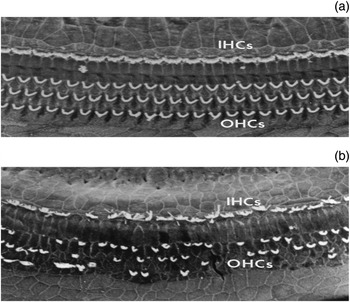
In the fields of otorhinolaryngology and audiology, giant strides have been made towards improving the quality of life of afflicted patients. Innovations range from psychosocial rehabilitation to the fitting of various new assistive communication devices, such as hearing aids, cochlear implants (CIs) and other implantable devices.Reference Haynes, Young, Wanna and Glasscock4, Reference Shinners, Hilton and Levine5 Greater success has been achieved in the management of conductive hearing loss, compared with the more complex sensorineural hearing disturbances. Reconstruction of the conductive apparatus of the earReference Luers, Beutner and Huttenbrink6 has proven an easier task than restoration of the sensorineural apparatus. Effective therapy for degenerated hair cells Figure 1a & b, third order neurons, ganglions, dendrites and synaptic pathways of the vestibulo-cochleo-cerebral pathway remains an enigma. High quality assistive devices such as bone-anchored hearing aids (BAHAs) and CIs have proven beneficial to some patients. However, the suboptimal quality of perceived sounds and speech, as well as the issues of cost, stigmatisation, inconvenience, and other socio-economic and behavioural factors, are as yet largely unresolved.Reference Kosztyla-Hojna, Rogowski, Kasperuk, Rutkowski and Rycko7–Reference Sanchez-Camon, Lassaletta, Castro and Gavilan9
Thus, despite the substantial progress made over the last century in understanding the phenomenon of hearing loss, sensorineural hearing loss remains a significant therapeutic challenge. Currently available therapeutic agents including antioxidants,Reference Muminov, Khatamov and Masharipov10 intracellular stress pathway inhibitors, and neurotrophic factor and neurotransmission blockers;Reference Winiarski, Kantor, Smereka and Jurkiewicz11 however, these only prevent hair cell loss, rather than provide a cure, and are often accompanied by debilitating adverse effects. Therefore, the development of new strategies that can overcome these barriers has become a major goal of otorhinolaryngology research.
One emerging potential strategy for sensorineural hearing loss reversal is transplantation of stem and progenitor cells to enable replacement and regeneration of degenerated neural tissue in the inner ear.Reference Dazert, Aletsee, Brors, Sudhoff, Ryan and Muller12–Reference Coleman, de Silva and Shepherd21 Promising developments in biotechnology and genetic engineering have encouraged a renewed search for a solution to sensorineural hearing loss.
This review provides an overview of recent research investigating the potential roles of stem and progenitor cells in the management of sensorineural hearing loss, and is presented as a contribution to the development of stem cell research protocols in this field.
Materials and methods
Data search strategy
We conducted a review of all studies on the role of stem cells in sensorineural hearing loss management published between 2000 and 2010, following initial discussions between two of the authors (TSI, an otolaryngologist, and BAC, a stem cell researcher).
Inclusion criteria comprised all experimental and review studies of stem cell management of sensorineural hearing loss, published in or translated into the English language, within the specified time frame. Articles thus identified were further filtered using the Jadad scale assessment (Oxford quality scoring system):22 only articles with a Jadad score of three or more were included.
Study design
A systematic literature review was conducted.
Data identification
Articles were identified using the following databases: Cochrane Library Ear, Nose and Throat Disorders; Medline; Google Scholar; Hinari; and the Online Library of Toronto University. The references within each article were also reviewed to identify further suitable articles. The following search term string was used: sensorineural hearing loss AND management AND stem cell.
Data collection analysis
A total of 455 and 29 600 articles were identified using Medline and Google Scholar, respectively. No studies were identified from the Cochrane Library Ear, Nose and Throat Disorders database. The Hinari and Online Library of Toronto University databases were used to retrieve the full text of relevant articles. Articles were assessed using the Jadad scale, following the set criteria, and the full text of each article was scrutinised to determine inclusion eligibility.
This process yielded 48 relevant articles, from the references of which another three articles were obtained.
Validity of assessment method
For those articles meeting the inclusion criteria, data were independently extracted and assessed by the authors, using standardised data forms; any disagreements were resolved by consensus.
Results
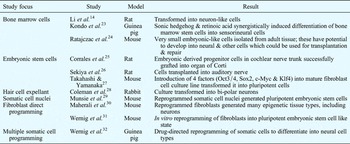
Thirty-six of the articles discussed the prospect of using progenitor stem cells in the restoration of damaged cells and sensorineural hearing loss function. Approximately 90 per cent of these articles reported experimental research using animal models; the remainder were reviews. Table I summarises the experimental focus, animal model type and results of the experimental studies.Reference Li, Liu and Wu14, Reference Kondo, Johnson, Yoder, Romand and Hashino23–Reference Wernig, Lengner, Hanna, Lodato, Steine and Foreman32 Eight articles discussed the clinical features of sensorineural hearing loss, six focused on existing treatment options and their disadvantages, and three presented general knowledge.
Scanning electron micrograph of Organ of Corti of the Cochlear showing the complexity of the inner hair cells (IHCs) and Outer hair cells (OHCs) arrangement for (a) normal hari cells and (b) destroyed hair cells. (Scale bar: 15 μm)

Experimental embryonic and pluripotent cell studies generating neural elements for potential otological transplant

Discussion
Stem cells are produced by multicellular organisms, and can be obtained from both embryonic and adult tissues. In the developing embryo, stem cells can differentiate into any type of specialised embryonic tissue. In the adult organism, stem cells and progenitor cells act as a repair system for the body, replenishing specialised cells but also maintaining the normal turnover of regenerative organs such as blood, skin and intestines.Reference Coleman, Fallon, Gillespie, de Silva and Shepherd28 Pluripotent stem cells are basic cells which have an indefinite capacity for self-renewal (via numerous cycles of mitotic cell division), while still maintaining their potential to differentiate into a diverse range of specialised cell types from any of the three somatic germinal layers (i.e. endoderm, mesoderm and ectoderm).Reference Munsie, Michalska, O'Brien, Trounson, Pera and Mountford29, Reference Evans and Kaufman33, Reference Ulloa-Montoya, Verfaillie and Hu34 These properties of pluripotent stem cells suggest that they could have a number of potential clinical applications, including regenerative therapy, drug discovery and development, and whole-cell delivery of gene therapies.Reference McNeish, Bell and Lemoine35–Reference Naveiras and Daley37
So far, the main source of pluripotent stem cells has been embryonic stem cells, i.e. cells from the inner cell mass of the blastocyst at developmental days 5 to 8.Reference Munsie, Michalska, O'Brien, Trounson, Pera and Mountford29, Reference Evans and Kaufman33 However, pluripotent stem cells equivalent to embryonic stem cells can also be found in a number of other tissues, including umbilical cord blood,Reference Ratajczak, Zuba-Surma, Machalinski and Kucia24 and can be generated by genetic reprogramming of human or mouse somatic cells to induce pluripotent stem cell production (see Table I).Reference Takahashi and Yamanaka27, Reference Maherali, Sridharan, Xie, Utikal, Eminli and Arnold30, Reference Wernig, Meissner, Foreman, Brambrink, Ku and Hochedlinger31, Reference Barrilleaux, Phinney, Prockop and O'Connor38, Reference Scheper and Copray39 These induced pluripotent stem cells have a developmental potency comparable to that of embryonic stem cells, with the ability to generate all functional embryonic cell types, including neurons, cardiomyocytes and haematopoietic cells.Reference Wernig, Lengner, Hanna, Lodato, Steine and Foreman32, Reference Hanna and Calkins40, Reference Dimos, Rodolfa, Niakan, Weisenthal, Mitsumoto and Chung41 The genetic reprogramming of adult mouse or human tissues to generate induced pluripotent stem cells has not only circumvented the ethical controversies associated with the use of human embryonic stem cells (believed to be derived from terminated embryos), but has also overcome the difficulty of generating patient- or disease-specific embryonic stem cells, which are required for their effective application.Reference Yamanaka42 Indeed, direct genetic reprogramming provides a realistic way of generating sufficient numbers of patient-specific pluripotent stem cells to be used for regenerative and therapeutic purposes, as demonstrated in mouse models of sensorineural hearing loss (Table I).Reference Bodmer43
Stem cells have been used experimentally in the inner ear in the hope that they will ultimately differentiate into hair cells and auditory neurons Figure 1a. Potential cell sources for such inner ear research include fetal dorsal root ganglion cells,Reference Hu and Ulfendahl20, Reference Regala, Duan, Zou, Salminen and Olivius44 neural progenitor cells,Reference Corrales, Pan, Li, Liberman, Heller and Edge25, Reference Ito, Shinkai, Hakamada, Honda and Kobayashi45 stem or progenitor cells isolated from the inner ear,Reference Li, Liu and Wu14, Reference Doetzlhofer, White, Johnson, Segil and Groves46–Reference Zhai, Shi, Wang, Zheng, Song and Hu48 immortalised auditory neuroblast cells,Reference Nicholl, Kneebone, Davies, Cacciabue-Rivolta, Rivolta and Coffey49, Reference Hildebrand, de Silva, Klockars, Rose, Price and Smith50 embryonic stem cells and their derived neuronal cells,Reference Li, Liu and Wu14, Reference Coleman, de Silva and Shepherd21, Reference Sekiya, Kojima, Matsumoto, Kim, Tamura and Ito26, Reference Regala, Duan, Zou, Salminen and Olivius44, Reference Hildebrand, de Silva, Klockars, Rose, Price and Smith50–Reference Sakamoto, Ukena, Takemori, Okamoto, Kawata and Tsutsui52 and marrow stromal cells treated with sonic hedgehog and retinoic acid (Table I).Reference Kondo, Johnson, Yoder, Romand and Hashino23
Stem cells can be directed to differentiate into bipolar auditory neurons (Table I) which can be used to replace those that degenerate following sensorineural hearing loss development.Reference Coleman, de Silva and Shepherd21 Coleman et al. Reference Coleman, de Silva and Shepherd21 investigated two co-culture models for their ability to direct the differentiation of mouse embryonic stem cells in vitro. Stem cells were induced to form neural precursors via timed exposure to retinoic acid, before being co-cultured with dissociated rat auditory neurons or hair cell explants isolated from post-natal day five rat pups. The co-culture of whole embryoid bodies with hair cell explants resulted in significantly greater numbers of bipolar cells displaying a morphology and neural protein expression analogous to that of mammalian auditory neurons grown in vitro. Thus, hair cell explant and embryoid body co-cultures hold promise for the identification of factors promoting auditory neuron differentiation in vitro. However, further investigations are necessary to determine whether the neuron-like cells generated from these treatments are functional and possess the characteristic electrophysiological properties of auditory neurons grown in vivo.
Interestingly, irrespective of the aetiology of sensorineural hearing loss (whether congenital, auto-immune, infective, traumatic or idiopathic), the degenerative changes are usually similar; therefore, molecular generation of the affected neuronal elements, and subsequent implantation, shows promise. The next challenge in this process may be how to preserve the regenerated organelles from subsequent pathological degeneration, especially as a result of autoimmune disease. However, it is worthy of note that some patients with autoimmune disorders have successfully received organ transplants.
Progress in this research field has been fiercely challenged by human ethical issues. However, new technologies have created an alternative to the use of embryos, utilising alternative stem cell study techniques. When these new technologies are perfected, stem cell research should be able to progress without necessarily requiring embryo cells.
From a clinical perspective, such technological development is likely to enable enormous progress both in genetic engineering and in the clinical treatment of various recalcitrant (human and animal) cell- and genome-related diseases, including sensorineural hearing loss.
Conclusion
Although success in humans has not yet been achieved, the use of stem cell and alternative stem cell technologies seems to represent the future for the treatment of recalcitrant sensorineural hearing loss. Therefore, further research in this field of study is imperative.