Introduction
On 1 March 2012, the Scottish Parliament enacted the Offensive Behaviour at Football and Threatening Communications (Scotland) Act, making the singing of ‘sectarian songs’ punishable by an unlimited fine and up to five years in prison.Footnote 2 Despite every other major political party voting against it, the ruling Scottish National Party (SNP) used its parliamentary majority to pass the Bill in an attempt to ‘tackle sectarianism … particularly where it incites religious hatred’ (Scottish Government 2011, p. 1). The Government argued that new legislation was required to address the issue, pointing to a series of events in 2011 that included: the chairman of the Scottish Police Federation calling for a ban on Old FirmFootnote 3 fixtures in light of the violence and trouble associated with them (Churchill Reference Churchill2011); a heated, public altercation by the football managers of Celtic and Rangers; liquid explosives posted to high-profile Celtic supporters (Carrell Reference Carrell2011); a knife posted to prominent Rangers supporter Donald Findlay QC (Watt Reference Watt2011); live bullets posted to Cardinal Keith O'Brien's Edinburgh home (Hamilton Reference Hamilton2011); and a heightening of tensions in Northern Ireland (McDonald Reference McDonald2011).Footnote 4
The connection between football and sectarianism in Scotland is well documented,Footnote 5 yet the relationship between music and sectarianism remains under-researched. The Old Firm's song traditions have been strongly influenced by binarisms between Catholicism/Protestantism, Irish nationalism/British unionism and republicanism/loyalism, yet prior to 2012 the two teams' experiences were quite different under the law. Using earlier legislation,Footnote 6 Scottish courts could impose additional penalties for offences aggravated by religious prejudice; those singing songs such as ‘Hullo, Hullo’, ‘The Famine Song’ and ‘No Pope of Rome’, sung by some Rangers fans against arch-rivals Celtic, could be prosecuted owing to their anti-Catholic content.Footnote 7 Yet, despite causing offence to some, the law was ineffective against Celtic fans singing Irish rebel songs because it was unclear as to whether they were religious or political.Footnote 8
The Offensive Behaviour at Football and Threatening Communications Act has been used to charge those singing rebel songs,Footnote 9 yet there is continuing debate over how this alleged offence should be dealt with.Footnote 10 Further, although singing sectarian songs in public is now illegal in Scotland, there has been no official definition as to what actually constitutes a ‘sectarian song’ and so it is left to the police to exercise their discretion in the matter (Waiton Reference Waiton2012, pp. 40–41). While some have focused on the use and interpretation of anti-Catholic music in Scotland (McFarland Reference McFarland1990; McKerrell Reference McKerrell2012, Reference McKerrell2015; Davies Reference Davies, Flint and Kelly2013; Millar Reference Millar2015), there has been little academic analysis of the use of Irish rebel songs (Boyle Reference Boyle, Harvey, Jones, McInroy and Milligan2002), which some consider to be anti-Protestant.Footnote 11 This article explores the social function and cultural perception of Irish rebel songs in the west coast of Scotland, examining what qualities lead to a song being perceived as ‘sectarian’, by focusing on song lyrics, performance context and extra-musical discourse. The article explores the practice of lyrical ‘add-ins’ that inflect the meaning of key songs and argues that the sectarianism of a song resides, at least in part, in the perception of the listener.
Sectarianism in Scotland
Sectarianism in Scotland can be traced back to the Reformation, when the country adopted a stricter and more puritanical Protestantism than that of England. While the Anglican Church of England considered itself both Catholic and Reformed, the Presbyterian Church of Scotland found the two mutually exclusive. Presbyterianism became a key part of Scotland's identity and something that, for 300 years, ‘defined the Scots to one another and to the rest of the world’ (Gallagher Reference Gallagher and Devine1991, p. 34). When the country formed a political union with England in 1707, the sovereignty of the Church of Scotland was non-negotiable, its serving to retain Scotland's identity within a larger polity. Yet such connections proved difficult for non-Protestants. James Handley refers to Scotland as having ‘traditional anti-Catholic prejudices’ and the country's Catholic population were the victims of sectarian prejudice and sporadic sectarian attacks throughout the eighteenth century (Handley Reference Handley1945, pp. 288–9).
In the nineteenth century, the Industrial Revolution created tensions between Scotland's population as a large influx of unskilled Irish labourers ‘undertook the type of work the native Scots would not or could not perform’ (Marshall Reference Marshall1996, p. 1). The incoming Irish sought better wages and upward social mobility, gaining employment in the manufacturing, mining and transportation industries. Irish immigration was such that, by 1840, working-class Irishmen were a prominent minority in Glasgow (Evans Reference Evans2001, p. 383), while Scotland, as a whole, had a ‘substantially larger proportion of Irish immigrants than either England or Wales’ (Evans Reference Evans2001, p. 455). The vast majority of such immigrants were Catholic and thus doubly disadvantaged, being both a national and religious minority.Footnote 12 Such differences were readily apparent through their accents, and ‘Irish’ and ‘Catholic’ were conflated and subordinated to form a new Constitutive Other. With the mass failure of Ireland's potato crop in 1845, the steady stream of Irish workers into Scotland quickly became a torrent, as huge numbers fled the devastating effects of the Great Famine (Adamson Reference Adamson and Wood1994, p. 20). Many of those who arrived in Scotland were poor and desperate, compounding the negative stereotypes already surrounding the Irish in Scotland (Handley Reference Handley1945, pp. 170–71). As the century drew on, the Church of Scotland offered aid and sustenance to Scotland's new Irish community, yet such assistance was often conditional upon the recipient renouncing their Catholic faith (Burke Reference Burke and Bradley2004, p. 103).
Seeking to alleviate the socioeconomic situation of Glasgow's large Irish-Catholic community, Brother Walfrid, a Glasgow-based Irish-Catholic monk, formed Celtic Football Club as a charitable organisation in November 1887, using Celtic as a means to raise funds to feed and clothe the poor in the city's East End. Given Celtic's Irish connections, Irish nationalism and Home Rule politics were prevalent from the club's inception and Michael Davitt, founder of the nationalist Irish Land League, was invited to lay the first piece of turf at Celtic Park, which was transported from County Donegal (Gallagher Reference Gallagher1987, p. 26).Footnote 13 The team played their first match against Rangers Football Club, another Glasgow-based team that had been formed some 16 years earlier. Rangers had a strong Protestant, British unionist identity, which emerged in the late nineteenth century, with their connection to the Clyde shipyards, and intensified when the Belfast-based Harland and Wolfe established a Glasgow base in 1912. Such factors contributed towards Rangers' policy of refusing to sign Catholic players, which began in the 1920s,Footnote 14 and formed part of a general climate of anti-Catholicism that stretched throughout the decade and beyond. In 1920, Alexander Ratcliffe formed the right-wing, anti-Catholic, Scottish Protestant League and in 1923 the Church of Scotland published its infamous sectarian tract ‘The Menace of the Irish Race to our Scottish Nationality’, which accused Irish Catholics of subverting Scotland's Presbyterian values through drunkenness, crime and fecklessness (Bruce et al. Reference Bruce, Glendinning, Paterson and Rosie2004, p. 128).Footnote 15 The Global Depression heightened sectarian tensions, as Irish Catholic immigrants became convenient scapegoats to explain the country's economic downturn. In 1933, Ratcliffe's Scottish Protestant League gained over 71,000 votes in Glasgow, some 23% of the total, before infighting and dissatisfaction saw the party fade into obscurity (Smyth Reference Smyth2000, p. 196).
Tensions between Scotland's Catholic and Protestant population increased, again, with the onset of the Troubles, a 30-year ethno-national conflict in Northern Ireland that began as a Civil Rights movement to attain equal treatment for Catholics under the law, but became a struggle over Northern Ireland's constitutional position within the United Kingdom. Scottish soldiers were sent to keep the peace, yet their perceived Protestant unionist bias complicated their task (Wood Reference Wood1994, p. 154). The close cultural ties between the Protestant unionist community and the Scottish soldiers compounded Catholic nationalist suspicions over the soldiers' neutrality.Footnote 16 Wood quotes one Belfast resident who recounted hearing Scots soldiers singing loyalist songs ‘at the tops of their voices' while driving through exclusively Catholic nationalist areas, remarking: ‘They were making an essential point for the IRA more effectively than the IRA could do themselves’ (Wood Reference Wood1994, p. 152). Such singing was commonplace in Scotland's football terraces and there were many songs influenced by the Troubles sung by both Rangers and Celtic supporters. The connection between Rangers supporters' songs and sectarianism has been examined elsewhere;Footnote 17 it is to songs sung by Celtic supporters to which we now turn.
What is Irish rebel music?
Irish rebel music is a subgenre of Irish folk music, with much the same instrumentation, but with lyrics predominantly concerned with Irish republicanism. Rebel music has a long history, which largely stems from – and focuses on – the country's awkward and complicated relationship with its larger island neighbour: Great Britain. Irish rebel songs draw on many themes including colonialism, discrimination, racism, republicanism, slavery and sedition. Historically, those singing them have risked being hanged (Curtis Reference Curtis1985), flogged (Warfield Reference Warfield and Bradley2006) or imprisoned (Waiton Reference Waiton2012), suggesting a longstanding awareness of their political power. Many rebel songs are centuries old and, like many folksong traditions, are preserved and distributed through oral transmission. As with Stephanus Muller's work on Nkosi, the pan-African liberation anthem, rebel songs' ‘humble and rather obscure origins and the lack of information available about the composer[s], conspire to invest [them] with the elusive kudos accompanying the words “by the people”’ (Muller Reference Muller2001, p. 24). Yet just as there is no official definition as to what constitutes a ‘sectarian song’, neither is there an authoritative definition of ‘Irish rebel music’; it has no place in The New Grove Dictionary of Music and Musicians or the Oxford Dictionary of Music, a testament to its underground, under-researched and under-valued nature within the academy.
Although there have been many prominent Protestant Irish republicans, particularly among the late eighteenth-century United Irishmen, rebel music has become polarised over religious grounds and it is now strongly associated with the Catholic community; it is pejoratively referred to as ‘diddly-dee’ music (Stokes Reference Stokes and Stokes1994; Cooper Reference Cooper2010). While very few rebel songs are overtly anti-Protestant,Footnote 18 in the way that their loyalist equivalents are anti-Catholic, some argue they are ‘politically sectarian’ owing to the way they are used against the loyalist and unionist communities of Scotland and Northern Ireland and their anti-British stance more generally (Gow Reference Gow2013). That these songs are sung almost exclusively by the Catholic community further exacerbates their perception as sectarian.
Bradley makes reference to an Irish rebel scene in Scotland ‘where mainly young men (but not solely) gather in venues where bands perform songs that remember and celebrate perceived patriots and “freedom advancing” events in Irish history’ (Bradley et al. Reference Bradley, Walter, Hickman, Morgan and Bradley2009, p. 195). He describes this as ‘a qualitatively different version of the Irish-British colonial conflict from that which dominates throughout much of Britain, particularly in much of the British media’ (Bradley et al. Reference Bradley, Walter, Hickman, Morgan and Bradley2009). Within a football setting, Bradley describes how Celtic supporters use such songs and the appeal they have for fans and members of the Irish diaspora. He quotes one fan who said:
[A]ll these guys had the same views, sang the same songs and just thought the same as me. I mean I could be totally wrong, but standing there in that crowd, that was the feeling I got and it was the only time in the whole week I could get that feeling … every week you could stand there to your heart's content and it made me feel really Irish, it made me feel really good. (Bradley Reference Bradley2006, p. 1195)
Such environments offer Scotland's Irish diaspora an opportunity to express and perform a particular form of Irish republicanism in spite of their geographical remoteness from the island. Anderson points to such instances of group singing as ‘occasions for unisonality, for the echoed physical realization of the imagined community’ (Anderson Reference Anderson1991, p. 145), highlighting the important role music plays in creating collective identities and consolidating group cohesion. Through their vivid depiction of Self and Other, rebel songs also chime with Frith's theorisations of identity as ‘an experiential process which is most vividly grasped as music [emphasis in original]’ owing to the intensity with which it offers ‘a sense of both self and others, of the subjective in the collective’ (Frith Reference Frith, Hall and du Gay1996, p. 110).
The use of such songs also resonates with Stokes's explanation of Celtic music's appeal to the Irish diaspora, where ‘“Celtic” music … allows people access to – in their own terms – a domain of “Celtdom” denied to them by the complexities of, for example, a Celtic language, or the theoretical and practical difficulties of maintaining a coherent political identity’ (Stokes Reference Stokes and Stokes1994, p. 6). Boyle posits that the commemorative nature of Scotland's rebel music scene, which has grown exponentially since the 1990s, is a direct consequence of the mass-assimilation of the country's Irish community and is tied to ‘a deepening crisis of identity along not just one, but a multiplicity of axes (age, gender, class and so on, as well as nationality)’, which have created the need for a ‘redemptive identity’ (Boyle Reference Boyle, Harvey, Jones, McInroy and Milligan2002, p. 183). Boyle posits that the rebel music scene, functioning in different ways for different groups, has grown in popularity because of its promise to provide such an identity, and conceives of it ‘as an effort to “crystallise and secrete” models of masculinity which restore a sense of ontological security to young adult males uncertain about their place or role in society’ (Boyle Reference Boyle, Harvey, Jones, McInroy and Milligan2002, p. 184).
Thus, in their most positive sense, Irish rebel songs afford Scotland's Irish diaspora a means to assert, experience and perform their Irish-Catholic alterity collectively. Yet this benign intent can be offset by how the music is perceived by elements of Scotland's majority Protestant population. The Wolfe Tones are an example of Celtic music – in both senses of the word – and those at their concerts, in football terraces and in pubs across the country clearly deploy this music as a signifier of their Irish identity, free from the complexities of the Irish language. Yet their music is not universal.
The Wolfe Tones
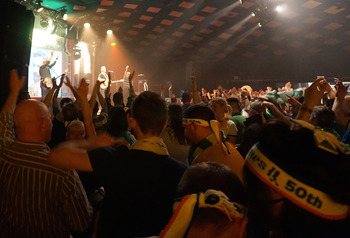
The Wolfe Tones are perhaps the most well-known example of an Irish rebel band, having performed over 14,000 shows throughout the past 50 years, in such venues as New York's Carnegie Hall, the Paris Olympia and Melbourne's Victoria Hall (Figure 1; Warfield Reference Warfield and Bradley2006, p. 185). The band's accolades include being awarded the keys to the cities of New York and Los Angeles, while their version of Thomas Davis' nineteenth-century rebel song ‘A Nation Once Again’ was voted the world's favourite song in a 2002 BBC World poll (Warfield Reference Warfield2012). The quartet formed in Kilrush, County Clare, in August 1963, recorded several albums and had 12 top-10 hits in the Irish charts.Footnote 19 The band's name derives from the leader of the 1798 Irish Rebellion, Theobald Wolfe Tone, and much of their music espouses their republican politics. The Wolfe Tones toured regularly and enjoyed support from across the English-speaking world. Yet when Derek Warfield dissolved the group, in 2001, Fintan O'Toole of The Irish Times described it as: ‘A win–win situation. A gain both for Irish traditional music and for Irish politics' (O'Toole Reference O'Toole2002). O'Toole described the group as ‘one of the key weapons in the republican armoury’ and said their music expressed ‘a visceral hatred of all things English’ (O'Toole Reference O'Toole2002).
Fans wearing Wolfe Tones headscarves at the band's 50th Anniversary Concert, in Glasgow Barrowlands, 22 November 2014.

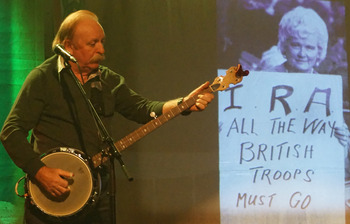
The Wolfe Tones' career pre-dates Northern Ireland's Troubles and the band continued to perform after the Good Friday Agreement, yet their music and its message are frequently associated with the Provisional IRA and its campaign. Following the band's split, three of the four founding members quickly reformed as ‘Brian Warfield, Tommy Byrne and Noel Nagle formerly of The Wolfe Tones’. They continue to enjoy some popularity, particularly in Scotland, Ireland and North America, performing their unique brand of rebel songs across the English-speaking world (Figure 2). Yet their music remains contentious and highly divisive. Large portions of the Wolfe Tones' followers are drawn from Celtic football fans and the band's members are staunch supporters of the team.Footnote 20 It is telling that Bruce begins his description of Celtic Football Club with reference to its song tradition (Bruce et al. Reference Bruce, Glendinning, Paterson and Rosie2004, pp. 128–9). The Wolfe Tones wrote and recorded ‘Celtic Symphony’ in 1988 to celebrate Celtic's centenary and the music video was filmed inside Celtic Park, illustrating the close relationship they once enjoyed with the club's owners.
‘Celtic Symphony’ is one of the most popular – and controversial – rebel songs sung in Scotland today, yet while thousands used to sing this at Celtic Park, it is not often heard in full anymore, largely because of the Government's new law. When it is heard, the offending chorus ‘Ooh ah, up the RA’, the ‘RA’ being the IRA, is often substituted for or ‘Ooh, ah, up the Celts’ or ‘Ooh ah, Samaras’.Footnote 22
Brian Warfield performs in Glasgow's Barrowlands, with slideshow accompaniment.

Another rebel song popular among Celtic supporters, and popularised by the Wolfe Tones, is Paddy McGuigan's 1968 ‘Boys Of The Old Brigade’, a song about the role of the IRA during the Irish War of Independence (1919–1921). The lyrics to the first verse and chorus are given below; the ‘add-in’ is included in parentheses:
While there used to be a close relationship between the Wolfe Tones and Celtic Football Club, Celtic's board have moved to distance themselves from the Wolfe Tones – and Irish republicanism more generally – owing to rebel music's perceived sectarian nature. This was illustrated on 18 December 2002, when Celtic's chief executive wrote to the club's 50,000 season ticket holders asking them to stop singing pro-IRA songs (Kelly Reference Kelly2003, p. 43). Under the Scottish Government's new law, several of the Wolfe Tones' songs have effectively been outlawed and Celtic no longer allow the band to advertise their shows in its programmes (Kenny Reference Kenny2002).Footnote 24
Scotland's preeminent historian, T.M. Devine, argued that singing pro-IRA songs was not sectarian because the IRA was not sectarian in intent.Footnote 25 Yet, while true on one level, his comments ring hollow to many because of the IRA's perceived sectarian nature, particularly that of the Provisional IRA (PIRA) and other, more recent, dissident groups such as the Continuity IRA (CIRA), the Real IRA (RIRA) and the ‘new IRA’.Footnote 26 For those within Northern Ireland's Protestant community, ‘IRA violence against so-called “legitimate” targets of the State has been experienced … as ethnic cleansing’ (Higgins and Brewer Reference Higgins, Brewer, Hargie and Dickson2003, p. 109). Higgins and Brewer maintain that this is as a result of the interconnection between Protestant identity and British identity and that ‘anti-Britishness easily blends into anti-Protestantism as Protestants perceive it’ (Higgins and Brewer Reference Higgins, Brewer, Hargie and Dickson2003). Of the 1064 Protestants killed during Northern Ireland's ‘Troubles’, three-quarters were killed by the PIRA (Fay et al. Reference Fay, Morrissey and Smyth1998). The PIRA purported to be the protector of Northern Ireland's Catholic community and so are often viewed as a manifestation of that community; that so many Protestants – many of whom maintain close cultural, historical and familial links with Scotland – were murdered by the PIRA problematises any attempt to classify the PIRA as non-sectarian. That the PIRA were, and are, often simply referred to as ‘the IRA’ further complicates this issue.
Reception conditions meaning
In keeping with the Barthesian notion that meaning is created by the recipient (Barthes Reference Barthes and Heath1977), Dahlhaus offers an explanation as to how such a process functions within music. Writing about perception in relation to ‘nationalistic music’, he argues:
[I]f a composer intended a piece of music to be national in character and the hearers believe it to be so, that is something which the historian must accept as an aesthetic fact, even if stylistic analysis – the attempt to ‘verify’ the aesthetic premise by reference to musical features – fails to produce any evidence. There is no line of argument which would make it permissible to leave ideological ‘appearances’ out of account in assessing the aesthetic ‘reality’. (Dahlhaus Reference Dahlhaus and Whittall1980, pp. 86–7)
For many in Scotland, particularly those of a Protestant, unionist or loyalist persuasion, the ideological appearance of rebel songs is that they are sectarian. Despite some claiming they are singing ‘political songs’, they become sectarian on account of their being perceived that way.Footnote 27 Indeed Dahlhaus extends this premise to the realm of folk music, in the second section of his chapter, where he uses the example of ‘gypsy’ music as authentic Hungarian music:
[S]o long as gypsy music in Hungary was regarded as authentically Hungarian, it was authentically Hungarian; the historical error has to be taken at its face value as an aesthetic truth, for it takes a collective agreement to stamp certain traits as national ones. (Dahlhaus Reference Dahlhaus and Whittall1980, p. 92)
That some in Scotland hear ‘Celtic Symphony’ and ‘The Boys of the Old Brigade’ as sectarian means that we must treat their historical error as an aesthetic truth. It is often argued that these rebel songs refer not to the recent Troubles, but rather to the early twentieth century and the formation of the Irish Free State. Yet the inclusion of the add-in ‘Provisional Wing’ to ‘The Boys of the Old Brigade’ transforms the song's meaning, relocating it within another, much more contentious, sociopolitical context.
A similar argument could be made with the Wolfe Tones' ballad ‘Joe McDonnell’. McDonnell was arrested and interned under Section 12 of the Northern Ireland Special Powers Act for behaving ‘in a manner prejudicial to the preservation of the peace or maintenance of order’ (Taylor Reference Taylor1997, p. 92). The Act, introduced in 1971, was a response to the 300 explosions, 320 shootings and over 600 people hospitalised that year in Northern Ireland; it saw the mass arrest and internment – without trial – of over 300 republican suspects (Taylor Reference Taylor1997, pp. 92–3). After his release, McDonnell joined the Provisional IRA's Belfast Brigade before being arrested and imprisoned for 14 years following the bombing of a furniture showroom (Taylor Reference Taylor1997, p. 243). In 1981, Joe McDonnell joined nine other volunteers who began a hunger strike over the removal of republican prisoners' Special Category Status and reclassification as criminals.Footnote 28 McDonnell died on 8 July 1981, 61 days after beginning his hunger strike (Taylor Reference Taylor1997, p. 247).
During the concerts I attended at Glasgow's Barrowlands, from 2012 to 2015, the Wolfe Tones' renditions of ‘Joe McDonnell’ were shown a reverence akin to a religious rite.Footnote 29 As a mark of respect, the band asked the crowd to sit in silence, while the more pious made their way to the front to kneel at the stage. That these audiences were mostly – if only nominally – Catholic bestows the ritual with even more religious significance and serves to conflate Catholicism's connection with Irish republicanism. The various add-ins attached to ‘Joe McDonnell’ recontextualise its meaning, making the song much more sectarian in nature. Further, given the widespread knowledge of such add-ins, it could be argued that the meaning of each of these songs has been changed and cannot be undone, even if one omits the offending add-ins.Footnote 30
In ‘Joe McDonnell’, the offending add-ins are ‘Ya Filthy Hun’ and the long, drawn-out chants of ‘P-I, P-I, P-IRA’ at the end of the song. While the term PIRA is shorthand for the ‘Provisional Irish Republican Army’, and the audience's chanting indicates their support for the organisation, ‘Hun’ is something of a contested concept. Some argue a ‘Hun’ merely refers to a supporter of Glasgow Rangers Football Club; others consider the term to be a sectarian slight.
What is a ‘Hun’?
During the Justice Committee debate over the introduction of the Offensive Behaviour at Football and Threatening Communications Bill, Jeanette Findlay – an Economics lecturer at the University of Glasgow, chair of the Celtic TrustFootnote 32 and a vocal supporter of Celtic fans' right to sing Irish rebel songs – was asked by committee member and MSP Humza Yousaf what the term ‘Hun’ meant, questioning whether it was sectarian. Findlay replied: ‘in all my life the term Hun has never been used to apply to a Protestant or any member of any religious group. It refers to a Rangers supporter’ (Findlay Reference Findlay2011, p. 170). Yousaf, himself a Celtic supporter, made reference to his hearing the term denote a supporter of Heart of Midlothian Football Club, to which Findlay replied: ‘It is just applied as a football rivalry term. It doesn't have any religious connotation whatsoever; it never has' (Findlay Reference Findlay2011). The term ‘Hun’ is most often applied to Rangers supporters, yet Yousaf's ability to disprove Findlay's claim that it was exclusive to supporters of that club is telling. That the term is used to describe other groups such as the Orange Order and the British Army, other football teams such as Hearts, Kilmarnock and Motherwell, as well as its use within ‘Joe McDonnell’, suggests that there is more to the term than Findlay attests.
Nil By Mouth, Scotland's leading anti-sectarianism charity, considers ‘Hun’ to be ‘Offensive sectarian language … used negatively against Protestants or those perceived to be’ (Scott Reference Scott2013).Footnote 33 The term ‘Hun’ is most commonly deployed against Rangers football fans where it is closely bound to the perception of their being the Protestant embodiment of the Scottish/British state. This is in contrast to the Celtic fan, the embodiment of ‘the Scottish-Irish-Catholic community as low other’ (McKerrell Reference McKerrell2012, p. 2). Thus, in ‘Joe McDonnell’ it seems unlikely that the soldier looking down his gun is being a ‘Filthy Hun’ because he supports Rangers Football Club, but rather because he is a representative of the hegemonic power of the repressive British state, in contrast to the relatively powerless Irish-Catholic low Other.
References to ‘Huns’ are found in other Wolfe Tones songs. The earliest example is taken from ‘The Foggy Dew’, which, while not written by the band, was the title-track of their debut album in 1965 and was recorded again for their 1978 compilation Best of the Celts; it is a popular feature in the band's set:
Another reference to ‘Huns’ appears in the form of an add-in, sung by the audience, to ‘The Merry Ploughboy’. Taken from the Wolfe Tones’ 1967 EP The Teddy Bear's Head,Footnote 35 the song was written by one of twentieth-century Ireland's most influential songwriters, Dominic Behan,Footnote 36 and has been performed by many artists; it has featured in every Wolfe Tones concert I have attended. The add-ins are, again, included in parentheses:
An alternative version of the song, sung by some fans, substitutes the lines ‘Where the bayonets flash and the rifles crash, To the echo of a Thompson gun’ for the more sectarian ‘Where our bayonets slash the Orange sash to the echo of a Thompson gun’. The Orange sash is the most readily identifiable signifier of the Orange Order, an exclusively Protestant fraternal organisation that dates back to 1795. That those singing the song wish to cut through this sash, worn across the Orangeman's torso, illustrates the willingness of some audience members to perform sectarian violence – symbolically – even if such acts are not realised physically.
Lastly, and most difficult to refute, is the K.A.H. graffiti, found on walls in Northern Ireland. In a 2011 Vice documentary on Northern Ireland, the interviewer asked a Catholic teenager what it meant:
Catholic teenager: That's ‘Kill All Huns’. Protestants basically.
Interviewer: And Huns are Protestants?
Catholic teenager: Yes. (Moynihan Reference Moynihan2011)
While it can be folly to draw too many parallels with Northern Ireland, a large portion of Celtic's support is from there, and a large part of Scotland's sectarianism stems from there. The teenager's bald conflation of ‘Hun’ and ‘Protestant’ clearly contradicts Findlay's claims.
Combined with the reference in ‘Joe McDonnell’, these ciphers imply that the term ‘Hun’ does not simply refer to a Rangers football supporter. This lends weight to the suggestion that ‘Hun’ is a sectarian term closely bound to a British/Protestant identity. The term is fiercely defended by those who seek to deploy it in reference to Rangers supporters, but to others it has become a form of codified sectarianism tied to complex notions of Britishness, Protestantism and the Scottish football team seen to encapsulate these traits in their most complete form: Rangers. The notion that the Wolfe Tones' music has come to mean something greater than the sum of its parts has gained credibility among Scotland's political elite. That Scotland's Lord Advocate specifically named the chorus of the ‘Celtic Symphony’ and ‘The Boys of The Old Brigade’ as punishable under the new Act, in his guidelines to the police, emphasises how seriously the Scottish establishment takes the singing of these songs (Rose Reference Rose2012).
The Wolfe Tones' Brian Warfield criticised the new law and Celtic Football Club's attempts to limit the singing of their songs in an open letter to the club, accusing Celtic's board of ‘attacking the song traditions of Ireland’ (Warfield Reference Warfield2011). Warfield wrote:
[B]anning or outlawing a song is morally wrong and really is just a cosmetic exercise to pacify bigots. It ignores the real problem, which lies at the heart of the society that feels a need of this oppressive action, sectarianism and racial discrimination are the main problem. Ask any Catholic who has sought a house or position of employment over the years and he will tell you about discrimination. It is nothing to do with music or song, which is just a reaction to the problem.
Get rid of sectarianism and injustice in the society and the song is just a song it's a harmless story. WHAT ARE THE REASONS WE REQUIRE TO BAN A SONG, DOES IT JUST HAVE TO BE IRISH. WILL WE GO AS FAR AS BANNING THE FLOWER OF SCOTLAND OR SONGS ABOUT BONNIE PRINCE CHARLIE or the JACOBITES ARE THEY REBEL SONGS [emphasis in original]. I think not, try it and you will meet with opposition. (Warfield Reference Warfield2011)
Warfield continued by linking the rebel songs sung by Celtic football fans to ‘seditious music’ of the past:
The policy you have now embarked upon is unjust and oppressive and if you study history it was counter productive in the past. There is a history of outlawing and banning songs and songsters against the Irish and the Scots. Yet there is more so called seditious music surviving from these traditions than from any other country in Europe. Many harpers and bards were beheaded, many minstrels were exiled or imprisoned for carrying the story of their people. STILL THEIR MUSIC LIVES ON TO THIS DAY [emphasis in original] … Why is it that the Irish song tradition is attacked as a problem, they are not sectarian or bigoted in words or expression but carry the story of the Irish peoples' struggle against oppression, hunger and injustice. It's the story of human misery and suffering, of a fight against famine and disease, and then a fight for freedom and human dignity. (Warfield Reference Warfield2011)
In response to the Scottish Government and the board of Celtic Football Club ‘attacking the song traditions of Ireland’, the Wolfe Tones released ‘The Celtic People’, found on their latest album Child of Destiny, which strikes a defiant tone towards the new law.
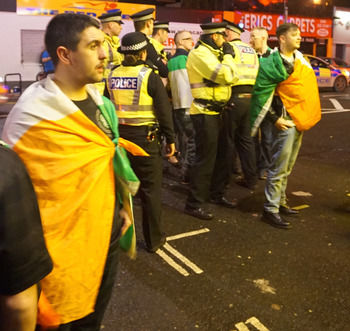
At a concert I attended in Glasgow's Barrowlands, on 24 November 2012, Brian Warfield prefaced the song with a long and drawn-out attack on Scotland's lawmakers and their enforcers – the police. There was a heavy police presence at the concert, more than I have seen at any of their gigs or any concert in that venue (Figure 3). Warfield implored the crowd to stand with him in rejecting the new law and shouted at the police:
Yet Warfield is not alone in his rejection of the new law. As mentioned, none of the other main political parties voted to pass the new legislation and were it not for the SNP's large parliamentary majority, it would not have succeeded in becoming law. During Scotland's 2012 council elections, several months after the Act became law, one independent candidate in Glasgow based his entire campaign around opposing the law.Footnote 39 The candidate, Thomas Rannachan, believed the new law to be a disproportionate response to a long-standing issue and argued it was a ‘Trojan horse’ in vilifying the Irish-Scottish community and also the young unemployed male community, which he believed would be ‘hardest kicked by this beast’.Footnote 40 Rannachan's disapproval of the law is perhaps understandable with regards the nuanced performance of some rebel songs, which require add-ins to become sectarian. Others are more difficult to defend.
Police question one fan, while others stand outside Glasgow's Barrowlands draped in the Irish Tricolour.

Roamin’ in the Gloamin’
As with much music in the sectarian canon, ‘Roamin’ in the Gloamin’’ is recycled, or, in musicological terms, contrafactum. Both the tune and title are borrowed from a 1910 song that was written, composed and sung by the Scottish entertainer Harry Lauder. First performed during the Christmas pantomime Red Riding Hood, in Glasgow's Theatre Royal, the song was an instant success and proved to be the Lauder's biggest hit (Irving Reference Irving1968, pp. 58–9).
That Lauder's old-time Scottish song has been reworked as an Irish rebel song is deeply ironic, particularly when one considers his background.
A short, sturdy man bedecked in kilt and balmoral, Lauder was the archetypal ‘Scotsman’ and his persona ‘did more than any other person to propagate the image of the Scot’ (Irving Reference Irving1968, p. 8). Lauder's family was devoutly Protestant, following the Calvinist tradition of Scotland's national church, a tradition he himself maintained (Lauder Reference Lauder1928, pp. 31–2). Lauder made his professional debut in the loyalist town of Larkhall, before achieving a success that saw him perform his unique blend of music and comedy throughout the English-speaking world (Irving Reference Irving1968, p. 28). Harry Lauder's son was killed while serving in the First World War and, after volunteering and being turned down on account of his advanced years, Lauder pressed the War Office to allow him to travel to France and entertain the troops, in memory of his son. Lauder formed and funded a recruiting band, actively encouraging young men to enlist. He gave speeches on the virtues of military service and, although too old to fight in the trenches of the First World War, Lauder sang there, accompanied by a small five-octave piano designed for that express purpose. After visiting his son's grave, the emotional climax of his French tour, Lauder returned to Britain. He met with the Minister of Pensions to discuss plans for a charity project, the ‘Harry Lauder Million-Pound Fund for Maimed Men, Scottish Soldiers and Sailors’; he performed concerts and gave speeches throughout Britain, Canada and the United States to raise money for the project (Irving Reference Irving1968, p. 96).
It is estimated that over 12,000 troops were recruited through Lauder's efforts and, as a result, he was made a Knight of the British Empire in 1919 (Durndell Reference Durndell2013). Winston Churchill found that Lauder ‘by his inspiring songs and valiant life, rendered measureless service to the Scottish race and to the British Empire’ (Churchill Reference Churchill2005, p. 530). Thus, betwixt his British patriotism, his Scottish iconography and his Protestant faith, Lauder was the antithesis of the Irish-Catholic rebel; that one of his most lasting legacies in the Scottish conscious is a warped, sectarian version of his 1910 pantomime song seems profoundly paradoxical. To those of a strongly loyalist or unionist persuasion this juxtaposition must only heighten its offensiveness.
The chorus derides John Knox, leader of the Protestant Reformation in Scotland, who founded the Church of Scotland in 1560 and ‘King Billy’, known formally as William III of England and II of Scotland, who took an oath to uphold the ‘Protestant reformed religion established by law’ (Edwards Reference Edwards1999, p. 150). However the most bitter language is reserved for the verses, which feature lines such as ‘fuck your Queen’, while the Orange Order, an exclusively Protestant fraternal organisation that hosts contentious parades across Scotland and Northern Ireland, are referred to as ‘Huns banging drums’ and ‘big hairy cunts’ whose wives smell of ‘pish and shite’.Footnote 43 These figures are discussed in opposition to Roman Catholics, establishing a dichotomy between the two. In so doing, it further diminishes the claim that ‘Hun’ merely denotes a Rangers supporter, as discussed earlier, and emphasises the term's anti-Protestant and sectarian meaning.
Music as a weapon
It should be noted that there has been considerable opposition to the singing of ‘Roamin’ in the Gloamin’’ from within Celtic's support, not least from the Celtic's ultras the ‘Green Brigade’;Footnote 44 that the song has largely disappeared from football stadiums; and that this happened before the introduction of the 2012 Offensive Behaviour at Football and Threatening Communications (Scotland) Act. Yet while attending the Wolfe Tones' 50th anniversary concert in Glasgow's Barrowlands, on 22 November 2014, I heard the song performed – with gusto – by groups of men on two separate occasions and there are those who feel strongly about singing the song and keeping it within the tradition. The following comments were taken from the football forum TalkCeltic.net while lurking; they refer to fans' feelings about ‘Roamin in the Gloamin’’ and date back to a thread from March 2008:Footnote 45
Hate this song religious triumphalism at its fucking best.Footnote 46
Love this song Religious triumphalism and its fucking great.Footnote 47
‘Celts have a Catholic heritage and they are proud of it, I'm also a religious Catholic and I see no reason not to sing that song cos it only shows our Irish and accordingly Catholic history and roots. that's all about it and I can't understand why you argue so much about that. Anyone who hates Catholic songs or who isn't proud of Celtic's Catholic and Irish heritage should fuck off and join the Huns! all in all I'm at one with Óglaigh na hÉireann,Footnote 48 AndyMc I can't understand you and hope you are a true Celtic fan.Footnote 49
Same here.Footnote 50
i'm a fenian, I've always been a fenian, always will be a fenian … I'll die a fenian … I've sang this song since I was wee … love it!!!!!!!!!!!!!!!!!! we sang it through all the shite we had to wade through growing up, as a testament to our unwavering belief in our faith and heritage.Footnote 51
Such comments illustrate the tension within groups of Celtic fans, and by extension, within the Irish-Catholic diaspora more generally, as to how their Irishness, their Catholicism and their support for Celtic should be celebrated – through music – in Scotland. Scotsman's conflation of Irish and Catholic is an unfortunate syllogism, which compounds the binarisms that often perpetuate sectarian behaviour. More sinisterly, his stating that ‘Anyone who hates Catholic songs or who isn't proud of Celtic's Catholic and Irish heritage should fuck off and join the Huns!’ and ‘AndyMc I can't understand you and hope you're a true Celtic fan’, are emblematic of Bourdieu's doxa (Reference Bourdieu and Nice1977), whereby a community that feels threatened by others, who affect its reputation, values or beliefs, tends to protect itself by producing this defensive discourse for orthodoxy.
A more recent thread, again from TalkCeltic.net, forwards similar arguments to those outlined above. However, it presents us with a clearer example of music being deployed as a weapon:
At the end of the day, wether you agree with it or not … It doesn't make one difference to me. I'll be singing it on Sunday and singing italong with another few choice songs as soon as I hear the Hello Hello, Big Jock Knew and The famine Song. Fuck King Billy, John Knox and all the DOBSFootnote 52 giving OUR ENTIRE SUPPORT the same kind of abuse as each other, wether we be Catholic Protestand, Atheist, Muslim etc.Footnote 53
Tony Cliffton's insistence that he will sing ‘Roamin in the Gloamin’’ once he hears Rangers fans singing three of Rangers' most anti-Catholic songs is a clear illustration of music's use as a weapon and the power of rebel songs to offend the opposing side. It shows that fans are aware of rebel songs' power, that they relish it, and that they are calculating in how they deploy such music. Such use of music as a weapon is in keeping with models discussed in the wider literature, particularly those theories espoused by Pettan (Reference Pettan and Pettan1998), Cusick (Reference Cusick2006, Reference Cusick2008) and Johnson and Cloonan (Reference Johnson and Cloonan2008), Goodman (Reference Goodman2010) and in O'Connell and Castelo-Branco (Reference O'Connell and El-Shawan Castelo-Branco2010).
It could be argued that this negative manifestation of Catholicism has its positive counterpart, wherein Celtic fans sing Catholic hymns, such as the ever-popular ‘Walk with me oh my Lord’, during games. This could be viewed as an expression of fans' Catholic faith and a tangible, as well as vocal, representation of the club's origins and history. Alternatively, it could be viewed as another example of music's use as a weapon and an illustration that no songs are sacred enough not to be deployed in the denigration of the opposition. Celtic fans' embracing of Catholicism could also be read as a means to distance themselves from ‘Protestant’ Rangers, exaggerating the difference between themselves and their biggest rivals.Footnote 54 This diametrical opposition is evinced through the teams' grafting their difference onto various dichotomies: Catholic/Protestant; Irish/British; nationalist/unionist; republican/loyalist; colonised/coloniser; Constitutive Other/Hegemonic Majority. The tactic serves to heighten tensions and rivalries, even if only superficially, and is common practice within fan culture.Footnote 55 Such ‘hegemonic fandom’ is characterised by ‘spiteful aggression; an appetite for anger and pique; and petty or cultivated hostilities and grudges, typically directed with special venom at one particular level’ (Davis Reference Davis, Flint and Kelly2013, p. 115). In the Scottish context, Davis uses the narrower term of ‘football sectarianism’, wherein, as above, fans step into identities to polarise, and be polarised by, the opposing side. Despite its not being heartfelt, Davis employs a Kantian universalism to argue that, because it ‘entails the absence of due respect for the human worth of its victims … to treat the individual members of at least one group as ends-in-themselves’, football sectarianism is ‘morally impermissible’ (Davis Reference Davis, Flint and Kelly2013, p. 119).
Conclusion
In the closing line of his essay, ‘Irish music and song’, the Wolfe Tones’ Brian Warfield concludes: ‘In the face of bigotry, racism and sectarianism, song and music is a way to challenge these destructive social and cultural forces: so the cry is “let the people sing, their stories and their songs”’ (Warfield Reference Warfield and Bradley2006, p. 186). Yet whether by fault or design, Warfield's deployment of ‘Let the people sing’Footnote 56 as a means to tackle sectarianism through praxis is deeply problematic and displays an ignorance of his own music's political power and the negative sectarian message it connotes for some, outwith the band's fan base. As the growing corpus on music and conflict illustrates, the use of music and songs can be deeply problematic and, rather than challenging destructive social and cultural forces, can serve to compound and perpetuate them; it is the very charge levelled at the Wolfe Tones and the reason much of their music is now banned from public space in Scotland.
The battle against sectarianism has become something of a cause célèbre in Scotland, with successive governments – of various political stripes – committing themselves to tackling the problem through public consultations, changes in the law and millions of pounds invested in equality programmes. Yet unlike sexism or racism, the country lacks consensus on what constitutes ‘sectarianism’. This article has argued that the sectarianism of Irish rebel songs is often contextual and highly contested. Extreme examples of rebel songs, such as ‘Roamin in the Gloamin’’ are overtly sectarian, while more innocuous ballads can become sectarian through lyrical ‘add-ins’, which inflect the meaning of key songs. Ireland's connection to Scotland, through those who settled there and who went on to form and shape the country's biggest football team, is still reflected in the songs that are sung and those used to offend Celtic's opposition – most notably Rangers FC. However, when there is no explicit guidance on what can and cannot be sung, and no definition as to why such songs are offensive, debates over rebel songs and their use and misuse in Scottish society seem set to continue for some time.