





1. Introduction
Development minerals, defined as minerals and materials mined, processed, and used domestically in construction, manufacturing, infrastructure and agriculture, including sand, stone, gravel, clay, dimension stones, and mineral fertilisers (Franks, Reference Franks2020), play a fundamental role in supporting urban growth and everyday development needs. Among them, sand is the second most consumed natural resource in the world after water (UNEP, 2022), yet it receives far less policy attention, regulatory oversight, and institutional support than high-value or critical minerals (Franks et al., Reference Franks, Keenan and Hailu2023). Current global debates focus on critical minerals linked to energy transitions, industrial competitiveness, and national security (International Energy Agency, 2021; United Nations, 2024), while construction materials such as sand are often taken for granted.
Globally, sand and other aggregates are extracted in vast quantities, with an annual demand estimated at 40–50 billion tonnes (UNEP, 2019), although precise data remain uncertain (Miatto et al., Reference Miatto, Schandl, Fishman and Tanikawa2017; Schandl et al., Reference Schandl, Fischer-kowalski, West, Giljum, Dittrich, Eisenmenger, Geschke, Lieber, Wieland, Schaffartzik, Krausmann, Gierlinger, Hosking, Lenzen, Tanikawa, Miatto and Fishman2018). In geological terms, sand refers to granular material with particle sizes between 0.063 and 2 mm (Blott & Pye, Reference Blott and Pye2012). In Indonesia, however, sand is defined more broadly as a fine aggregate used in construction, consisting of particles smaller than 4.75 mm (National Standardization Agency of Indonesia, 1990). This study follows the Indonesian classification, as it reflects how sand is defined and regulated in practice. This definition focuses on construction sand and distinguishes it from high-purity quartz sand, which has recently attracted policy attention as a strategic industrial mineral.
Construction-grade sand suitable for building is finite and unevenly distributed, creating supply risks and environmental challenges due to unsustainable extraction practices (UNEP, 2026). Rising population, urbanisation, and infrastructure development are expected to significantly increase demand, intensifying pressure on river systems where most construction sand is extracted (Leal Filho et al., Reference Leal Filho, Hunt, Lingos, Platje, Vieira, Will and Gavriletea2021; Zhong et al., Reference Zhong, Deetman, Tukker and Behrens2022). These pressures are particularly acute in countries such as Indonesia, where river-based extraction dominates and governance frameworks have not kept pace with demand.
Sand is essential for Indonesian national development, with the construction sector contributing USD 128.78 billion to GDP in 2023 (BPS - Statistics Indonesia, 2024). Artisanal and small-scale sand mining (ASSM) dominates domestic production, accounting for over 90% of total output (BPS - Statistics Indonesia, 2023). In Indonesia, sand mining is legally recognised under the People's Mining permit system and Mining Business Permit, although formalisation among People's Mining operations remains low, and a significant proportion of extraction occurs outside the regulatory framework. At the same time, demand continues to grow due to rapid urbanisation and large-scale infrastructure projects (Safitri & Pradipta, Reference Safitri and Pradipta2023; Susanto, Reference Susanto2024; Wulan, Reference Wulan2024). Sand is essential to Indonesian national development, yet it remains marginal within policy and governance systems, with significant environmental and social consequences (Arsyad et al., Reference Arsyad, Rukmana, Salman, Alimuddin, Arifin, Jamaluddin, Hamzah, Nurdirman, Ihsan and Bauna2024; Nawiyanto et al., Reference Nawiyanto, Krisnadi, Endrayadi, Handayani, Salindri and Calvaryni2020).
Existing research has largely documented the ecological and social effects of sand extraction (e.g., Arjun et al., Reference Arjun, Panda and Arun2023; Damseth et al., Reference Damseth, Thakur, Kumar, Kumar, Mahajan, Kumari, Sharma and Sharma2024; Koehnken et al., Reference Koehnken, Rintoul, Goichot, Tickner, Loftus and Acreman2020), while studies on artisanal and small-scale mining (ASM) have concentrated on high-value minerals such as gold (e.g., D'avignon, Reference D'avignon2018; Tuffour et al., Reference Tuffour, Patnaik and Ayikoru2025). As a result, there is limited understanding of how historical policy decisions have shaped the governance of sand and ASSM.
This study addresses this gap by examining the historical evolution of environmental governance in Indonesia's ASSM sector. Drawing on a political ecology approach, it argues that the current neglect of sand is not accidental but reflects long-standing policy priorities, institutional arrangements, and governance knowledge that have been built around high-value minerals and repeatedly applied to other minerals without adaptation. This study further argues that addressing these governance gaps requires context-specific environmental standards, particularly for river-based operations, and a reclassification of sand as a development mineral within Indonesia's mineral security frameworks. By analysing policies, regulations, and institutional practices from the Dutch colonial period (approximately seventeenth century to 1945) to the present, this study asks:
How has environmental governance in Indonesia's ASSM sector evolved, and how have historical policy decisions influenced regulatory priorities and institutional support for the sector?
This study makes two contributions. First, it provides a historical account of sand and ASSM governance in Indonesia, showing how past policy decisions have shaped current regulatory approaches. Second, it demonstrates how political ecology can reveal the structural roots of governance gaps in development mineral sectors, providing a basis for governance reforms that recognise the contribution of development minerals to national development and community livelihoods.
For clarity, this paper uses ‘People's Mining’ to denote ASM as defined in Indonesian law, including instruments such as People's Mining Permits (IPR) and People's Mining Zones (WPR). The term ‘ASM’ is used when discussing international studies or comparative cases across minerals, in line with broader global ASM scholarship, and ‘ASSM’ specifically for artisanal and small-scale sand mining, which is the focus of this study.
2. Theoretical framework
2.1. Political ecology approach
Political ecology examines ‘the social and political conditions surrounding the causes, experiences and management of environmental problems’ (Forsyth, Reference Forsyth2003, p. 2). Rather than treating environmental degradation as the result of purely ecological processes or local behaviour, political ecology emphasises that environmental outcomes are shaped by broader political, economic, and institutional forces (Blaikie & Brookfield, Reference Blaikie and Brookfield1987; Bryant, Reference Bryant1998). It also highlights how environmental knowledge is produced, interpreted and used within governance processes (Forsyth, Reference Forsyth2003).
This study applies political ecology as the overarching framework, with a historical focus to examine how governance arrangements have developed over time and how institutional assumptions about sand have shaped regulatory priorities. From this perspective, environmental issues are understood not only through ecological evidence but also through socially shaped interpretations influenced by experience, culture, and institutional context (Escobar, Reference Escobar1996; Forsyth, Reference Forsyth2003).
Historical analysis is central to this approach because it explains how current environmental governance arrangements are shaped by past decisions and which actors had greater influence over how resources were regulated and managed (Davis, Reference Davis, McCarthy, Perreault and Bridge2015; Offen, Reference Offen2004). Rather than treating environmental problems as recent or isolated, historical analysis of political ecology situates them within longer-term processes of resource control, regulation, and knowledge formation (Davis, Reference Davis, McCarthy, Perreault and Bridge2015). This is particularly important in post-colonial contexts, where earlier governance systems continue to influence patterns of access, authority, and environmental management (Offen, Reference Offen2004). For example, Blaikie and Brookfield (Reference Blaikie and Brookfield1987), show that land degradation cannot be understood without examining the historical policies, economic pressures, and political decisions that structure land use over time.
Empirical studies further illustrate how these historical processes operate in practice. Mathevet et al. (Reference Mathevet, Peluso, Couespel and Robbins2015) show that conflicts over wetland use in the Camargue are rooted in long-term transformations in property rights, resource access, and state interventions, rather than in recent management failures. Similarly, historical political ecology analysis of gold mining in Ghana demonstrates how political and economic decisions, shifting power relations, and state-led interventions have produced enduring patterns of ecological degradation, which may intensify with the growing demand for critical minerals (Obodai, Reference Obodai2026).
In sand and ASSM studies, political ecology shows how power relations, fragmented governance, and competing knowledge shape environmental outcomes. Miller (Reference Miller2022) demonstrates how knowledge boundaries between local miners and external actors, together with fragmented governance across administrative levels, shape environmental management in volcanic sand mining. Similarly, Bisht (Reference Bisht2021) highlights how sand extraction frontiers are characterised by elite capture and inequality, while Suykens et al. (Reference Suykens, Rahman, Khan and Dhali2025) show that sand governance in Bangladesh is shaped by local actor configurations, tax systems, and uneven power relations.
2.2. Sand, sustainability, and mineral security
Minerals are essential to human development, yet they remain largely absent from the Sustainable Development Goals, revealing a gap between their material importance and their recognition in policy (Franks et al., Reference Franks, Keenan and Hailu2023). Current debates tend to focus on ‘critical minerals’, which are prioritised based on economic value, supply risk, and national security, rather than on minerals needed to meet basic human needs such as shelter, mobility, communication, energy, and sustenance (Franks et al., Reference Franks, Rogers, Weldegiorgis, Lawson, Gallagher, Gardner, Aska, Linus and Varshney2025). Sand extraction, especially from rivers, carries significant environmental and social consequences when poorly managed (Bendixen et al., Reference Bendixen, Best, Hackney and Iversen2019; Okur et al., Reference Okur, Erturaç and Nicoll2023).
This uneven attention is reflected in how sand mining is governed. Studies show that responsibilities are often unclear, rules are not applied consistently, and there is a gap between what policies require and what actually happens in practice (Gunawardhana et al., Reference Gunawardhana, Dushyantha, Nipunika, Rathnayake, Kuruppu, Weerakoon and Cooray2025). More broadly, weak governance has been linked to environmental degradation and resource overexploitation in sand mining (Ganie & Bhat, Reference Ganie and Bhat2024).
Global demand for sand is projected to increase by approximately 45% between 2020 and 2060 (Zhong et al., Reference Zhong, Deetman, Tukker and Behrens2022), while partial substitutes, such as recycled materials and manufactured sand, remain insufficient to replace natural river sources (Bhoopathy & Subramanian, Reference Bhoopathy and Subramanian2022). UNEP (2026) identifies fragmented governance as a fundamental problem in global sand management.
Nevertheless, environmental governance challenges in sand mining and ASSM are not merely technical or administrative issues. They are also closely linked to how sand is positioned within broader policy priorities and mineral governance frameworks. This highlights the need to examine how sand has historically been treated in mining policy and how these governance trajectories continue to shape current regulatory arrangements.
3. Methodology
3.1. Research design
This study adopts a narrative review to trace the historical evolution of environmental governance in ASSM in Indonesia. The approach integrates diverse sources, including academic literature, policy documents, and grey literature, and enables interpretative analysis of regulatory evolution and institutional dynamics (Baumeister & Leary, Reference Baumeister and Leary1997; Snyder, Reference Snyder2019). A narrative review is suitable for this study because it allows analysis of how ideas, policies, and governance approaches evolve, rather than focusing solely on synthesising findings across studies. This flexibility supports an iterative process of interpretation, enabling connections to be made between historical developments and current governance practices (Juntunen & Lehenkari, Reference Juntunen and Lehenkari2021).
3.2. Data sources
The primary data consist of mining and ASM regulations, covering the Dutch colonial period, the Old Order (1945–1966), the New Order (1966–1998), and the Reformation Era (1998–present). Supplementary evidence includes grey literature such as government and NGO reports, newspaper articles, and government websites, which contain regulatory data, including mining permits. Peer-reviewed journal articles and theses are also used to examine the historical development of mining in Indonesia and assess the environmental impacts of sand mining. Archival records, defined as historical documents preserved for their long-term value and created as by-products of institutional or administrative activity (International Council on Archives, n.d..), are critical for reconstructing earlier governance practices. These include statistical yearbooks, organisational records, maps, and historical mining reports (Okello-obura, Reference Okello-obura2011; Yin, Reference Yin2018).
Sources were identified through targeted searches of academic databases (e.g., Scopus, JSTOR), government portals, public libraries, historical newspaper sites, and institutional repositories. Inclusion criteria emphasised relevance to sand mining policy and governance, historical depth, and institutional context. Documents that lacked sufficient credibility or were unrelated to the Indonesian case (e.g., unverifiable authorship, absence of a publication source, inconsistent or unsupported claims, or lack of direct relevance to the Indonesian context) were excluded. A significant portion of colonial-era records, including reports, maps, and newspapers, was accessed through Leiden University Library, HathiTrust, and Delpher. Many were available only as scanned Dutch-language documents, which were translated using digital tools (e.g., Google Translate). To improve reliability, translations were cross-checked against existing academic analyses of the same regulations and reports (e.g., Kaur & Diehl, Reference Kaur and Diehl1996; De Ruiter, Reference De Ruiter2016) and triangulated with related statistical and documentary sources.
3.3. Analysis and limitations
Data were analysed using qualitative content analysis to examine how sand has been framed and regulated over time, with particular attention to how policy documents define sand, structure regulatory approaches, and reflect institutional priorities. This analysis was guided by a historical political ecology perspective, focusing on how governance arrangements have developed over time and how these developments shape current environmental management practices. Quantitative data, including production volumes, demographic trends, and permit numbers, were used to contextualise policy changes and support the analysis. Sand production volumes (m3) were converted to weight (tonnes) for comparison with other commodities. The analysis also considered how different actors influence the ways sand is understood and governed, linking policy changes to broader socio-environmental implications. This study had several limitations. It relied on available policy documents and secondary data, which may not fully capture local practices. In addition, standardised conversion introduced approximation in production comparisons. These limitations were addressed through transparent data selection and triangulation across multiple sources.
4. Evolution of mining governance and policy priorities in Indonesia
Indonesia's mining governance has been shaped by mineral security priorities since Dutch colonisation in the late seventeenth century. Early economic activity focused on spices, later shifted to plantation crops, and eventually to minerals such as tin and coal, which supported European industrial and energy needs (Friederich & Van Leeuwen, Reference Friederich and Van Leeuwen2017; Ross, Reference Ross2014; Wie, Reference Wie, Buelens and Frankema2013). This focus on securing valuable resources continues today, as reflected in Indonesia's role as a major exporter of thermal coal (Maguire, Reference Maguire2024) and a leading producer of nickel (S&P Global Market, 2024).
Prior to the introduction of colonial mining frameworks, mineral extraction in Indonesia was carried out largely through community-based practices, particularly for gold and diamonds (Leeuwen, Reference Leeuwen2022; Yogi & Awantara, Reference Yogi and Awantara2024). The introduction of colonial mining laws transferred authority over mineral resources to the state, which established a permit-and-concession system requiring formal approval for extraction activities (Kaur & Diehl, Reference Kaur and Diehl1996; De Ruiter, Reference De Ruiter2016). Local people continued mining in similar ways, but these activities were not formally recognised by the state and became part of the informal sector.
To understand how this situation developed, it is necessary to examine how mining governance evolved across the colonial, post-independence, and reform periods. Early European legal frameworks, such as the Napoleonic Mining Act of 1810, which established state ownership of underground minerals, and the 1850 Mining Regulation, which introduced concession systems (De Ruiter, Reference De Ruiter2016), laid the foundation for state control over mineral resources. These developments informed the more formalised governance structures later implemented in the Dutch East Indies.
Table 1 summarises the key legislative and regulatory developments formally applied in the Dutch East Indies (Dutch colonial era) and later in Indonesia, and therefore does not include earlier European legal frameworks, such as the 1810 and 1850 regulations.
Evolution of mining regulations in Indonesia relevant to ASM and ASSM

Table 1 Long description
Years, regulations, and key relevance to ASM and ASSM are listed across five eras: Dutch Colonial Era, Old Order Era, New Order Era, and Reformation Era. Dutch Colonial Era entries include 1899 Indische Mijnwet Staatsblad 1899 number 214 on mining concessions, 1906 Mijnordonnantie 1906 Number 434 recognising Indigenous mining and defining Mine Inspector duties, and 1923 Staatsblad 1923 number 565 allowing local people to mine diamonds without a concession title. Old Order Era includes 1960 Government Regulation in Lieu of Law number 37 of 1960 on Mining, providing an early legal definition of Peoples Mining. New Order Era includes 1967 Law number 11 of 1967 promoting foreign capital investment and classifying minerals into strategic A, vital B, and other C; 1969 Government Regulation Number 32 of 1969 setting initial rules for ASM area and duration including 5 hectares and 5 year permits; and two 1986 decrees, one limiting mining depth and mechanical power for Peoples Mining of Classes A and B, and one regulating river based extraction techniques and safety requirements for Group C materials. Reformation Era entries include 2009 Law number 4 of 2009 redefining Peoples Mining and introducing criteria for Peoples Mining Areas; 2010 Government Regulation number 23 of 2010 setting administrative and technical requirements for Peoples Mining permits including financial obligations, depth limits, machinery limits, and restrictions on heavy equipment and explosives; 2020 Law Number 3 of 2020 recentralising mining permit authority under the central government; 2021 Government Regulation Number 96 of 2021 setting technical requirements and prohibiting explosives and mercury; 2022 Presidential Regulation number 55 of 2022 redelegating authority for issuing Peoples Mining permits to provincial governments; 2023 Government Regulation Number 25 of 2023 stating Peoples Mining Areas are designated by the Minister based on governors proposals; 2024 Ministry of Energy and Mineral Resources decree number 174. K/MB.01/MEM. B/2024 setting guidelines for area establishment, IPR permitting and planning, fees, technical standards, and environmental and production monitoring; and 2025 Law number 2 of 2025 formalising designation of Peoples Mining Areas by governors and integration into provincial and district or city spatial plans.
Note: Full bibliographic details for the legal instruments listed in this table are provided in the reference list.
4.1. The Dutch colonial era (before 1945)
4.1.1. Legal control and resource classification in the colonial era
Mining governance became more structured with the introduction of the Indische Mijnwet (Dutch East Indies Mining Law) of 1899 (the 1899 Mining Law), which granted the colonial government full control over mineral resources and introduced a permit system for private companies (Kaur & Diehl, Reference Kaur and Diehl1996). These developments correspond to the regulatory timeline presented in Table 1.
The law defined mining broadly, covering underground and surface extraction, drilling, and related activities. It classified minerals according to their economic and strategic value, such as precious metals, fuels, and industrial minerals, and allowed the Governor-General to expand this list over time. This classification determined which resources received state attention.
Although environmental protection was not an explicit objective, some mining risks were addressed. Concession holders were made liable for damage to people or property. These measures were mainly intended to prevent disputes, protect infrastructure, and reduce financial liability, rather than to safeguard the environment.
In practice, governance focused on petroleum, coal, tin, and gold because of their economic and strategic value (De Ruiter, Reference De Ruiter2016). These commodities dominated exploration and reporting, while other low-value minerals received little to no attention, as evidenced by sand and other construction materials, which were not formally classified in the regulations.
4.1.2. Strategic commodities and governance prioritisation
Colonial reporting further reveals how attention was directed toward selected commodities. Reports such as the Koloniaal Verslag and Jaarboek van het Mijnwezen documented production, concessions, and workforce data, with a strong focus on tin and coal (De Ruiter, Reference De Ruiter2016). These sectors were documented in detail, including production figures and workforce structures.
Gold mining also received attention, despite limited economic success. Between 1895 and 1920, nearly 200 companies were established, but only a few operations generated profits. High operating costs, poor ore quality, and limited geological expertise led to widespread failure, including in government-run mines, yet the sector continued to attract investment and reporting (De Ruiter, Reference De Ruiter2016; Ter Braake, Reference Ter Braake1944).
In contrast, sand received little attention despite its widespread use. Sand was essential for infrastructure, including roads, ports, and construction. For example, the construction of the Tanjung Priok port in 1877 used more than 86,000 m3 of sand, and later projects in Semarang and Belawan required large volumes for reclamation and structural works (Ministerie Government of the Dutch East Indies, 1923; Ministerie van Koloniën, 1920; Van Koloniën, Reference Ministerie van Koloniën1877, Reference Ministerie van Koloniën1915). Sand was also used in mining operations, such as backfill in coal extraction (Ter Braake, Reference Ter Braake1944).
Because sand was not classified as a mining commodity, it could be freely extracted, sometimes using prison labour for public works. Reports from Medan and Tjipinang prisons describe inmates producing several cubic metres of sand per day (‘De arbeid in onze gevangenis’, 1927; ‘Gevangenisbedrijven’, 1926). During periods of economic hardship, sand extraction also served as a livelihood strategy; for example, peasants in West Indramayu collected river sand as supplementary income during a late-nineteenth-century famine (Fernando, Reference Fernando2010). These practices continue today in many parts of the Global South (Hatlebakk et al., Reference Hatlebakk, Rahman and Suykens2024).
Sand was often framed not as a resource but as a problem. Colonial records described sandbanks as navigation hazards that could endanger vessels; for example, the sinking of the Sri Tandai ship in 1922 was attributed to sandbanks near Bengkulu (Ministerie van Koloniën, 1923).
This framing is also evident in colonial mapping practices (Figure 1), where sandbanks were documented by the Topografische Dienst primarily as navigational hazards rather than as extractable resources. Contemporary satellite imagery of the same locations shows that these sandbanks are no longer clearly visible, possibly reflecting natural change or subsequent extraction.
Temporal comparison of the same river system between 1932 and 2025. (a) Colonial topographic map titled Gouvernement Celebes en Onderh, produced by the Topografische Dienst (Batavia), 1932, showing sandbanks along river channels mapped primarily as navigational features (Source: Topografische Dienst (Batavia), 1932, via Leiden University Libraries, Public Domain). (b) Google Earth satellite imagery (2025) showing the same area under present-day conditions for comparison with the 1932 colonial map.

Figure 1 Long description
A colonial topographic map titled Gouvernement Celebes en Onderh. The map depicts a coastal river system with a prominently meandering river channel that curves toward the coastline. Sandbanks are marked along the river channels using line annotations and shading. A rectangular inset box highlights a central section of the river. A small locator map appears in the lower left corner. A scale bar and printed text notes appear along the bottom edge. No north arrow is visible on this map. Place name labels are printed across the map but are not fully legible at this resolution. Image B shows satellite imagery of the same coastal river system. The river channel is visible curving toward the coast, with a wide meander. The channel edges appear clearly defined. A large area of cleared or bare land is visible near the center left of the image. Dense built-up settlement is visible in the lower right quadrant. Patches of dense vegetation cover the upper right and central portions of the imagery. Part ial cloud cover is visible over parts of the land and coastal water. No sandbanks are clearly distinguishable along the river channel in the 2025 imagery. No legend or north arrow is present in the satellite panel. A label reading link appears in the lower left of the satellite panel.
4.1.3. Colonial governance of ASM
The legal basis for ASM can be traced to Article 6(2) of the 1899 mining law, which exempted Indigenous peoples engaged in small-scale extraction for personal use. This reflects characteristics similar to modern ASM, including low technology use and livelihood-based production (Mutagwaba et al., Reference Mutagwaba, Tindyebwa, Makanta, Kaballega and Maeda2018; World Bank, 2024). Rather than prohibiting these practices, the colonial state tolerated them informally, allowing subsistence-oriented mining to continue without formal licences. Decisions on eligibility were left to the Governor-General's discretion, enabling the state to accommodate widespread livelihood mining while maintaining control and avoiding social unrest.
The 1906 Mining Ordinance offered further recognition of inlandsche ontginningen (Indigenous mining operations or ASM). Concession holders, mainly private mining companies operating under colonial permits, were required to exclude Indigenous mining areas from their maps unless they obtained explicit consent, and local officials were tasked with issuing documentation. These provisions gave Indigenous miners a measure of spatial protection but offered little substantive support: there were no safety requirements, technical assistance, or environmental safeguards.
Inspection and monitoring arrangements further reinforced this imbalance. Under the 1906 Mining Ordinance, mine inspectors were primarily trained to supervise large-scale underground and surface mining, with no explicit mandate to oversee ASM or river-based extraction. As a result, both ASM activities and company-operated river-based mining – where sand extraction commonly occurs – remained largely outside formal inspection and regulatory supervision.
Economic priorities also shaped how ASM activities were documented. Whereas large-scale mining (LSM) was systematically recorded, ASM production was recorded selectively, and attention focused on commodities that generated fiscal returns, such as diamonds and gold (Ministerie van Koloniën, 1919, 1920, 1921, 1922, 1923). Diamonds, in particular, were documented in detail, including production volumes and market values, reflecting their importance as a taxable export commodity.
This fiscal emphasis helps explain why diamonds became the only ASM activity subject to dedicated regulation. Under Staatsblad 1923 Number 565, local authorities were required to issue licences, collect fees, and oversee safety in diamond mining operations using mechanical equipment. Officials were permitted to retain a share of these fees, creating direct incentives for supervision and enforcement. Regulation was therefore driven primarily by revenue considerations rather than by broader objectives of sector development or environmental governance. Moreover, the absence of sand within Indigenous mining records and regulations illustrates how colonial governance produced hierarchies within ASM itself: high-value commodities were monitored and regulated, while low-value resources such as sand were largely ignored.
4.2. The post-colonialisation – Old Order era (1945–1966)
4.2.1. State sovereignty and legal reforms
Following independence in 1945, Indonesia restructured its legal framework to assert sovereignty over natural resources. Article 33(3) of the 1945 Constitution established that land, water, and natural resources are under the control of the state for the benefit of the people. This principle was implemented through Government Regulation in Lieu of Law (Perpu) Number 37 of 1960 on Mining (the 1960 law), which replaced the colonial concession system with a nationalised regime. All minerals became state assets, and mining was redefined as a staged process under state authority. The law framed mineral resources as essential for both industrial development and public welfare.
4.2.2. Commodity classification and sand as an ‘other’ resource
The 1960 law introduced a three-tier classification of mining commodities. Class A (strategic) included minerals essential for national defence and economic stability, such as coal, tin, and nickel. Class B (vital) covered minerals needed to meet public demand, including gold, silver, gemstones, copper, and quartz. Class C (other) comprised materials considered abundant or of lower economic value, such as sand, granite, clay, and other construction materials. Sand was included in legal classifications for the first time, though it was placed in the lowest classification of mining commodities.
4.2.3. Early recognition of People's Mining
The 1960 law also formally recognised ASM as Pertambangan Rakyat (People's Mining), defined as small-scale, livelihood-based extraction using simple tools and often organised through local customs or cooperatives. However, during this period, government attention remained focused on agriculture and food security (Devi & Prayogo, Reference Devi and Prayogo2013; Hill, Reference Hill1997). Mining regulation provided little operational guidance, environmental safeguards, or institutional support for People's Mining.
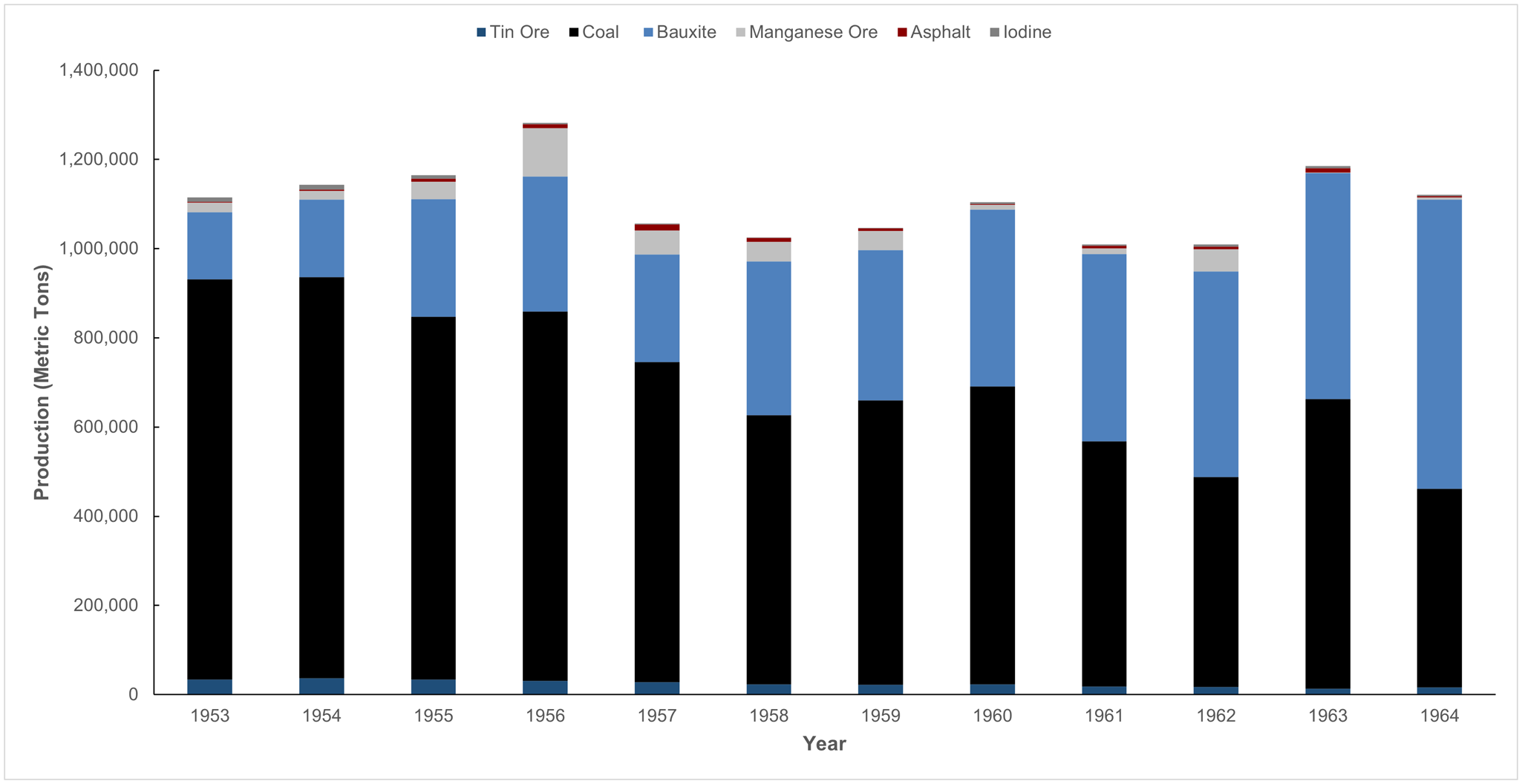
Production statistics during this period mainly captured LSM outputs, including tin, coal, bauxite, manganese, and asphalt (Figure 2). Petroleum and salt are excluded here, as petroleum falls outside of mineral mining, and salt is produced through evaporation rather than geological extraction (Sukiyah et al., Reference Sukiyah, Isnaniawardhani, Sudradjat and Muhamadsyah2017). Sand and other Class C materials were not recorded in official statistics, suggesting they were not a priority in government reporting systems.
Indonesian mining production between 1953 and 1964 in the Old Order era.

4.3. New Order era (1966–1998)
4.3.1. Mining priorities and foreign investment
The New Order government introduced Mining Law Number 11 of 1967, which replaced the 1960 law while maintaining its three-tier commodity classification: Class A (strategic), Class B (vital), and Class C (other). Class A and B minerals, such as coal, nickel, and gold, were managed by the central government, while Class C minerals, including sand, were handled by provincial governments.
The law also introduced the Contract of Work mechanism, which facilitated foreign direct investment in the mining sector. This framework enabled the entry of major multinational projects such as Freeport's copper and gold mine in Papua, Inco's nickel operations in Sulawesi, and Kaltim Prima Coal in Kalimantan (Van der Eng, Reference Van der Eng, Badia-miró, Pinilla and Willebald2015), cementing the government's focus on strategic mineral development.
Official policy documents reflected this prioritisation. The Mining Investment Guide promoted Class A and B minerals as key drivers of industrialisation and economic growth (Sigit et al., Reference Sigit, Purbo-hadiwidjojo, Sulasmoro and Wirjosudjono1969). While Class C minerals, including limestone, dolomite, marble, quartz sand, clays, and phosphate rock, were explicitly labelled as ‘less important’ (Sigit et al., Reference Sigit, Purbo-hadiwidjojo, Sulasmoro and Wirjosudjono1969, p. 23). In regulatory terms, quartz sand refers to sand materials used for construction or other industrial purposes and is classified under Class C, distinct from quartz crystal, which is treated as a higher-value mineral in Class B. This commodity levelling reflects a mineral security policy preference that prioritised materials according to their perceived importance to the state and their integration into broader economic and market systems.
This segregation of authority led to weak and uneven regulation. Records of Class C mining permits are limited, and there is little evidence that environmental or technical standards were applied consistently. Most existing regulations were designed for LSM of Class A and B minerals, such as surface and underground coal or metal mining. As a result, Class C minerals were governed by rules poorly suited to their scale and extraction methods, leaving significant gaps in oversight.
Despite the New Order government's focus on industrialisation and infrastructure development (Kuncoro & Resosudarmo, Reference Kuncoro, Resosudarmo, Fanelli and McMahon2006), official mining statistics rarely recorded the production of ordinary construction sand (e.g., BPS - Statistics Indonesia, 1985). When recorded, sand mainly appeared as iron sand, suggesting that ordinary construction sand remained largely invisible in national mining records.
4.3.2. ASM governance and the People's Mining Permit
ASM was formally regulated through Izin Pertambangan Rakyat or IPR (People's Mining Permits) and Wilayah Pertambangan Rakyat or WPR (People's Mining Zone), introduced under Government Regulation Number 32 of 1969 and further detailed in Ministerial Decree Number 01 P/201/M.PE/1986. These provisions limited participation to local residents, restricted permit sizes, and imposed constraints on depth and equipment use.
While these regulations were intended to recognise and organise People's Mining, they mainly increased government control without providing enough support. As shown in Table 2, miners faced strict limits on land size, equipment, and participation. At the same time, support such as technical guidance, market access, and financial assistance was mentioned in the regulations but not clearly implemented.
Key regulatory provisions for people's mining under Ministerial Decree Number 01 P/201/M.PE/1986

Table 2 Long description
Two columns list each Aspect and its Key Provisions for people′s mining. Scope covers Groups A and B, with specific guidelines for gold in alluvial and primary forms, diamond mining, and white tin commodities. Spatial framework sets a People′s Mining Zone maximum of 25 hectares per designated area. Eligible Participants are strictly penduduk setempat, local residents, and outsiders are explicitly prohibited. Technical restriction sets a maximum depth of 25 meters for wells and tunnels, limits equipment to 25 horsepower mechanical power, and prohibits heavy equipment and explosives. Financial obligation requires payment of a people mining levy, with tariffs set by local governments based on ministerial guidelines. Technical Supervision assigns mine inspectors and local technical officers to monitor environmental impacts including pollution and land degradation. Support and Development assigns regional governments responsibility for technical guidance, marketing assistance, and cooperative development programs, and mentions capital assistance without specifying funding mechanisms.
A separate set of rules governed river-based sand mining under Ministerial Decree Number 458/KPTS/1986. These rules distinguished mechanised mining operations carried out by companies or other formal entities from People's Mining conducted by local communities using simple tools (Table 3), with People's Mining supervised by local officers whose technical qualifications were not clearly defined.
Governance and operational differences in Class C river mining under Ministerial Decree Number 458/KPTS/1986

Table 3 Long description
Aspects compare company-based mining and people′s mining across permit issuer, production volume, key obligations, and supervision. Permit issuer is listed as, Governor for company-based mining and, Regent or Mayor for people′s mining. Production volume is described as, greater than 100 cubic meters per day or uses machinery for company-based mining, and, 100 cubic meters per day or less and manual tool for people′s mining. Key obligations for company-based mining include technical data submission, environmental planning, daily and periodic production and mining reporting, and area rehabilitation. Key obligations for people′s mining include basic data submission, monthly reporting, and restoring riverbank damage. Supervision is by Public Works officers with technical recommendations for company-based mining, and by local officers with undefined qualifications for people′s mining.
Estimated annual production value of major mining commodities in Indonesia, 2007–2024 (million USD)

Table 4 Long description
Annual production values in million USD are listed by year for four commodities: sand, nickel, gold, and coal, covering 2007 to 2015 and 2017 to 2024. Sand ranges from 246.79 in 2023 to 1,609.08 in 2012, with 332.14 in 2024. Nickel ranges from 137.49 in 2009 to 5,416.35 in 2024, with 3,044.60 in 2022 and 4,087.99 in 2023. Gold ranges from 1,276.02 in 2007 to 7,355.26 in 2023, with 5,888.56 in 2024. Coal ranges from 6,346.76 in 2007 to 182,090.84 in 2022, then 158,521.79 in 2023 and 104,609.69 in 2024. Coal is higher than the other three commodities in every listed year. The year 2016 does not appear in the year column.
Note: Sand production generated between approximately USD 200 million and USD 1.6 billion annually from 2007 to 2024. In contrast, coal exceeded USD 180 billion in 2022, and nickel surpassed USD 5 billion in recent years.
Environmental requirements also differed between the two. Company-based operations followed Environmental Impact Assessment (AMDAL) documents, while People's Mining followed simplified Environmental Management and Monitoring Plans (UKL–UPL). Although these simpler rules were intended to reduce the burden on People's Mining, many still struggled to meet them. Preparing environmental documents and carrying out monitoring required skills and resources that were often not available, making compliance difficult and leading to weak implementation in practice (Macdonald et al., Reference Macdonald, Lund, Blanchette, Mccullough, Sui, Sun and Wang2014). These challenges were particularly evident in sand mining. As a low priority within state mineral policy and regulatory frameworks, sand extraction – especially in riverine areas – was weakly governed, and its environmental impacts were rarely addressed in practice during this period.
4.4. Reformation Era (1998–present)
4.4.1. Critical mineral priorities and sand's limited policy visibility
The Reformation Era brought significant changes to Indonesia's mining governance. Law Number 4 of 2009 on Mineral and Coal Mining replaced the earlier framework and introduced policies such as a ban on raw ore exports, while aligning with decentralisation by granting regional governments, including provincial and district-level authorities (regents and mayors), the authority to issue mining permits, including those for People's Mining.
However, decentralisation resulted in widespread irregularities in permit issuance. Local officials, particularly regents and mayors, were often involved in corrupt permit issuance, leading to a surge in mining permits that reached approximately 10,900, many of which lacked proper oversight or legal clarity (Hamidi, Reference Hamidi2015).
Subsequent reforms sought to address these problems through recentralisation. Law Number 23 of 2014 on Local Government transferred licencing authority to provincial governments, and Law Number 3 of 2020 on Mineral and Coal Mining, which amended Law Number 4 of 2009, further consolidated regulatory power under the central government. This, however, created administrative bottlenecks, as the system struggled to process more than 10,000 permit requests across all mineral categories (Wahyudi, Reference Wahyudi2022). Presidential Regulation Number 55 of 2022 subsequently redelegated some authority back to provincial governments.
Under Government Regulation Number 23 of 2010 concerning the Implementation of Mineral and Coal Mining Business Activities, mining commodities are classified into five categories: radioactive minerals; metallic minerals (e.g., gold, nickel, copper); non-metallic minerals (e.g., sulphur, dolomite, and zircon); rocks; and coal. Sand is generally classified under the ‘rocks’ category. According to Government Regulation Number 96 of 2021, which amends Government Regulation Number 23 of 2010 concerning the Implementation of Mineral and Coal Mining Business Activities, this classification applies to materials that do not contain metallic or non-metallic mineral elements in economically significant quantities from a mining perspective.
At the same time, the regulation recognises specific types of sand with industrial value, such as quartz sand used in cement and other industries. More recent policy developments further elevate this distinction. For example, the Energy and Mineral Resources Ministerial Decree Number 296 K/MB.01/MEM.B/2023 concerning Determining Types of Commodities Included in the Critical Mineral Classification, classifies silica, including quartz sand, as a critical mineral due to its importance to national industry and supply security. However, no explicit thresholds or criteria are provided to distinguish when sand should be treated as an ordinary material or as a higher-value mineral, and there is limited evidence on how such distinctions are applied in practice. As a result, its regulatory treatment remains unclear and may vary in practice.
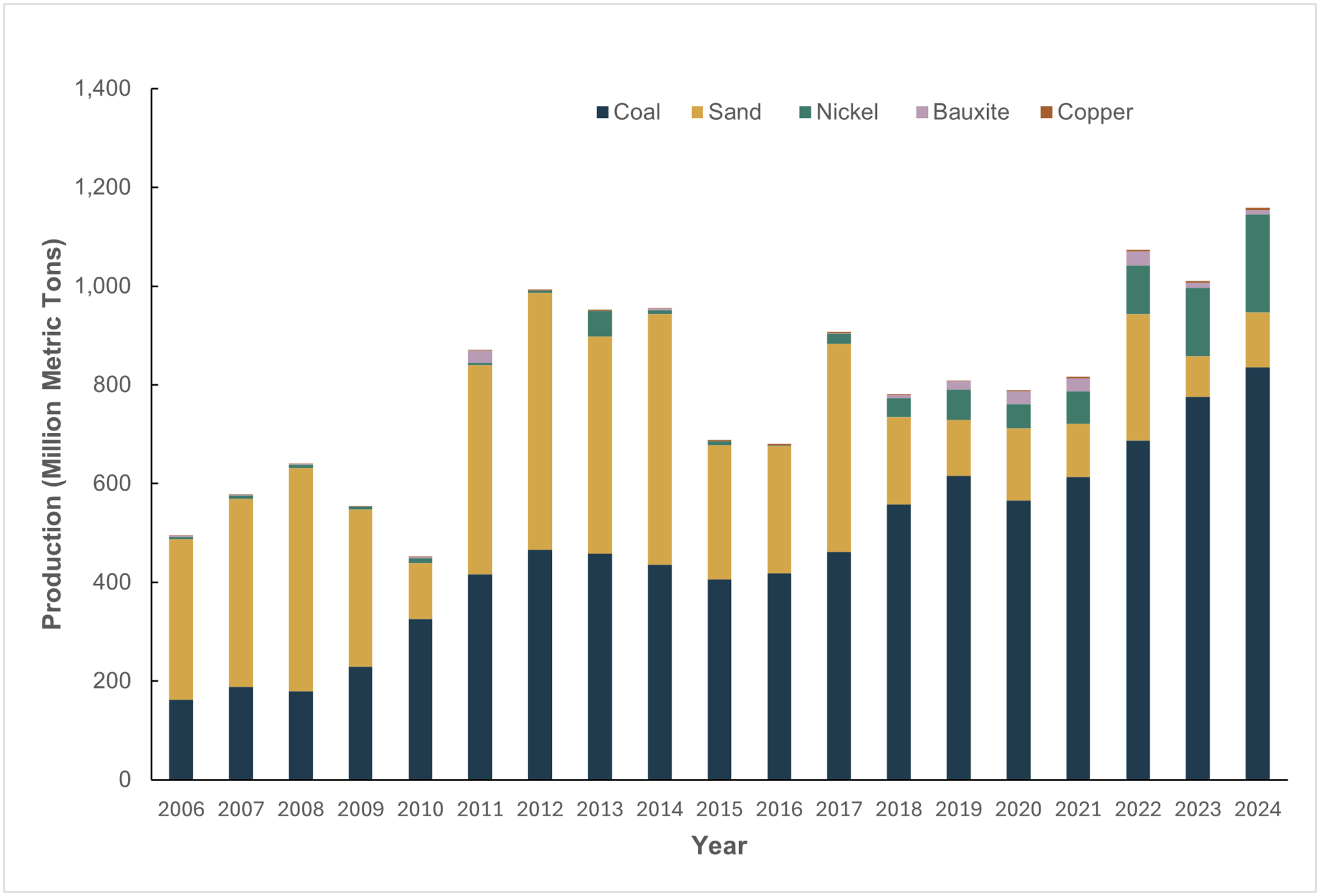
Despite this, sand is extracted in very large volumes. Between 2006 and 2012, sand was Indonesia's largest mining commodity by volume, and it remained second only to coal from 2013 to 2022, before being overtaken by nickel in 2023 and 2024 (Figure 3). Using global extraction estimates of 40–50 billion metric tonnes (UNEP, 2019), Indonesia's output of approximately 100 to 500 million metric tonnes would suggest a share of roughly 0.2–1.3 per cent of global supply. However, this estimate should be interpreted with caution due to inconsistencies in reporting at both national and global levels.
Production of major mining commodities in Indonesia 2006–2023 (BPS - Statistics Indonesia, 2011, 2025a, 2025b, 2025c). Sand production was converted from m3 using a bulk density of 1.68 g/cm3 (Abdias et al., Reference Abdias, Blanche, Nana, Abanda, François and Chrispin2023).

From an economic perspective, commodities such as coal, nickel, and gold generate much higher value than sand does. In 2007, the production value of gold was about 1.5 times the value of sand; by 2024, it was approximately 18 times the value of sand, reflecting rising global gold prices while sand's value remained relatively stagnant or declined (Figure 4).
Production value of sand, nickel, gold, and coal in Indonesia, 2007–2024 (BPS - Statistics Indonesia, 2009, 2011, 2012, 2014, 2016, 2018a, 2018b, 2019, 2020, 2021, 2022, 2023, 2025a, 2025c). Data for 2016 are excluded due to incomplete reporting in the national mineral production statistics. This graphic is based on data in Table 4. The y-axis uses a logarithmic scale because coal production values are substantially higher than those of sand and most other minerals. On a linear scale, these differences would compress the lower-value mineral series near the bottom of the graph, making their trends difficult to distinguish.

Despite its central role in domestic infrastructure, neither the Mineral and Coal Investment Guide (Ministry of Energy and Mineral Resources, 2020) nor the Grand Strategy for Minerals and Coal (Ministry of Energy and Mineral Resources, 2021) includes sand among the resources warranting strategic attention.
4.4.2. Permit dynamics and governance imbalance
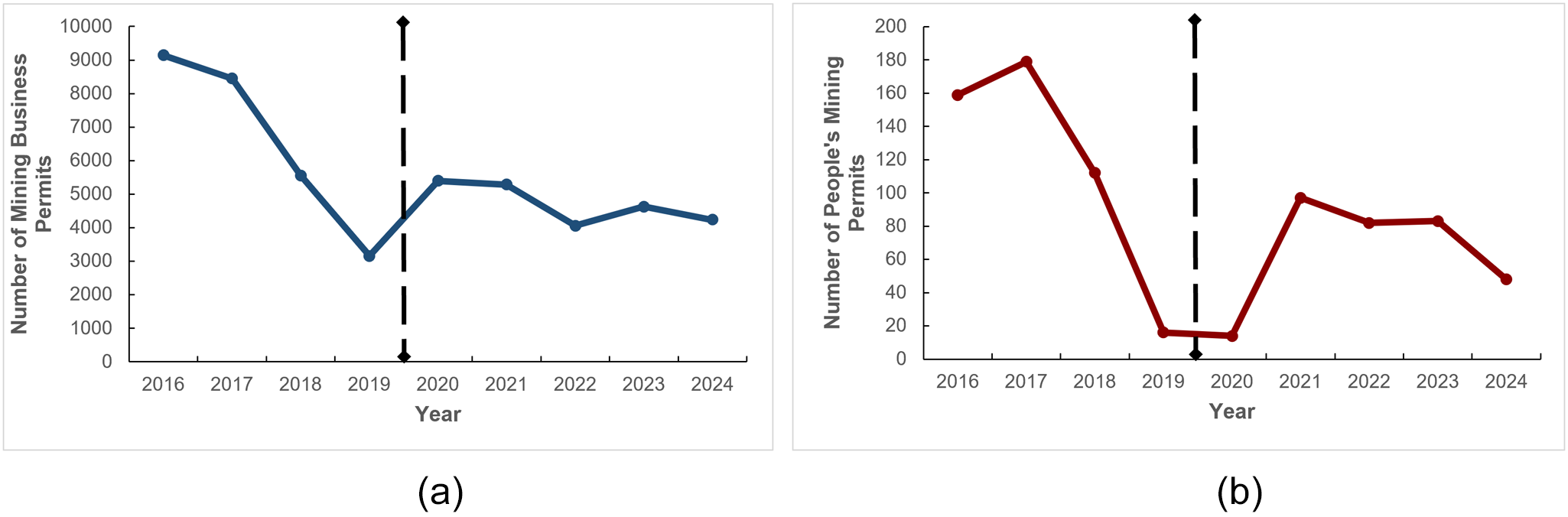
A similar governance challenge can be observed in the implementation of ASM governance in Indonesia. Although more than 66,000 ha have been designated as People's Mining Zone, only a small portion has been converted into active People's Mining Permits (Savitri, Reference Savitri2024). Trends in mining permits indicate that different processes are affecting Mining Business Permits (IUPs) and People's Mining Permits. As shown in Figure 5, the decline in IUP numbers is largely associated with the government's ‘clean and clear’ verification process, which removed non-compliant or overlapping licences (Widjanarko & Gultom, Reference Widjanarko and Gultom2024). In contrast, the decline in People's Mining Permits reflects limited issuance of new permits and difficulties extending existing ones, rather than cancellations.
Trends in active mining permits in Indonesia, 2016–2024: (a) Mining Business Permit and (b) People's Mining Permits. The dashed line indicates the 2020 amendment to the mining law (Law Number 3/2020). Source: Ministry of Energy and Mineral Resources (2025).

4.4.3. ASSM governance in the Reformation Era
The Reformation Era also reshaped how People's Mining was governed and conceptualised. Earlier regulations introduced the People's Mining Zone and People's Mining Permit frameworks, but Law Number 4 of 2009 further structured them by explicitly tying People's Mining to designated zones and introducing clearer administrative requirements. The 2020 amendment further tightened this framework. As summarised in Table 5, these changes included stricter zoning criteria and a shift of authority to provincial and central bodies. The transition from direct capital assistance to training programs may create an obstacle to formalisation for small-scale miners who lack the immediate resources to participate in the formal system.
Legal and institutional framework for People's Mining/ASM permits in Indonesia

Table 5 Long description
Categories compare 2009 regimes with 2020 and 2025 regimes across zone designation, permit area and duration, commodity types, technical requirements, environmental responsibilities, financial obligation, and rights. For Peoples Mining Zone designation, 2009 uses Regent or Mayor designation after consultation with the District Parliament, with criteria of primary deposit depth up to 25 meters and maximum area 25 hectares; 2020 and 2025 use Minister designation based on provincial proposals, include secondary minerals in rivers, allow primary deposit depth up to 100 meters and maximum area 100 hectares, require spatial planning criteria, require government guarantee of area stability even if land use changes, and require an environmental document prepared collaboratively by the Ministry of Energy and Mineral Resources and authorized provincial mining and environment agencies. For permit area and duration, 2009 sets individual miners up to 1 hectare, community groups up to 5 hectares, and cooperatives up to 10 hectares with a 5 year duration extendable; 2020 and 2025 set individual miners up to 5 hectares and cooperatives up to 10 hectares with a 10 year duration extendable twice for 5 years. For commodity types, 2009 includes metallic minerals, non metallic minerals, rocks and stones, and coal; 2020 and 2025 include metallic minerals, non metallic minerals, and rocks and stones, and state that coal is excluded. For technical requirements, 2009 lists no explosives and a maximum 25 horsepower machinery limit; 2020 and 2025 list no explosives and hazardous materials, no power limitation for machinery, no underground mining for the individual permit, and a mining plan document requirement. For environmental responsibilities, both regimes list environmental management and monitoring plans, UKL UPL, while environmental management practice is with local government in 2009 and with provincial government in 2020 and 2025. For financial obligation, 2009 lists a production fee, while 2020 and 2025 list a Peoples Mining Fee, IPERA, to manage the environment with a portion covering reclamation and environmental monitoring costs. For rights, 2009 lists training and supervision, eligibility for capital support, and technical assistance from local government; 2020 and 2025 list technical guidance, training in safety, environment and management from provincial government, and supervision from provincial government.
Note: This table refers only to People's Mining/ASM permits and does not apply to Mining Business Permits (IUP) for larger commercial operations. Metallic minerals include gold, nickel, and copper; non-metallic minerals include sulphur and zircon; rocks include sand and stones.
These structural hurdles are compounded by recent technical regulations, such as the Energy and Mineral Resources Ministerial Decree Number 174.K/MB.01/MEM.B/2024 on Guidelines for the Implementation of People's Mining Permits. While the decree establishes robust technical, safety, and environmental guidance for People's Mining, its standards are largely modelled on corporate-scale protocols. This technical complexity can create significant barriers to compliance for small-scale operators who often lack the capital or specialised expertise required to meet such benchmarks (World Bank, 2023). Furthermore, because the decree's technical provisions were developed using the extraction logic of high-value minerals in underground or surface mines, applying it uniformly across all mineral commodities leaves river-based sand extraction, the primary site of Indonesian sand mining, with rules that do not reflect its operational realities. This ‘one-size-fits-all’ approach creates operational uncertainty for miners and complicates oversight for regulators.
4.4.4. Impacts of sand mining: environmental, social, and economic dimension
The environmental, social, and economic impacts of sand mining in Indonesia are not isolated outcomes of extraction but are closely linked to how the sector has been governed, particularly its historical neglect and limited regulatory attention. Environmentally, unsustainable extraction has degraded river systems, lowered water levels, and disrupted irrigation flows (Nawiyanto et al., Reference Nawiyanto, Krisnadi, Endrayadi, Handayani, Salindri and Calvaryni2020), while inadequate reclamation contributes to soil erosion and landslides, damaging farmland and grazing areas (Arsyad et al., Reference Arsyad, Rukmana, Salman, Alimuddin, Arifin, Jamaluddin, Hamzah, Nurdirman, Ihsan and Bauna2024). These disruptions undermine both ecological stability and agricultural resilience.
Socially, ASSM supports rural livelihoods in Indonesia (Arsyad et al., Reference Arsyad, Rukmana, Salman, Alimuddin, Arifin, Jamaluddin, Hamzah, Nurdirman, Ihsan and Bauna2024; Risyanto & Ritohardoyo, Reference Risyanto and Ritohardoyo2003); however, these benefits are uneven. Excessive extraction has damaged infrastructure, including dams in Yogyakarta (Junianto, Reference Junianto2025), and created tensions between miners and farming communities as land and water systems degrade (Purnomo et al., Reference Purnomo, Utomo, Pertiwi, Laili, Pariasa, Riyanto, Andriatmoko and Handono2021).
Economically, sand mining in Indonesia contributes to construction and local economic activity (Arsyad et al., Reference Arsyad, Rukmana, Salman and Alimuddin2020). However, its long-term economic impacts are predominantly negative. Unsustainable sand mining practices in Indonesia have resulted in annual agricultural productivity losses estimated at USD 1.1 million in South Sulawesi (Arsyad et al., Reference Arsyad, Rukmana, Salman, Alimuddin, Arifin, Jamaluddin, Hamzah, Nurdirman, Ihsan and Bauna2024), and rehabilitating abandoned sand mines in West Java costs USD 1.2 million per ha (Wasis et al., Reference Wasis, Saharjo, Kusumadewi, Utami and Putra2018).
5. Discussion
Sand mining has historically received limited regulatory attention within Indonesian mineral governance, despite its important role in infrastructure development and rural livelihoods. This reflects the wider marginalisation of development minerals within mineral policy (Franks et al., Reference Franks, Keenan and Hailu2023).
Mining governance in Indonesia was originally developed during the colonial period to supervise large-scale operations extracting high-value minerals. While this discussion focuses on the colonial period onward, earlier forms of sand extraction likely existed but were not formally incorporated into governance frameworks. When regulations for ASM, including ASSM, were introduced in the post-independence period, they largely adopted existing frameworks rather than developing systems suited to smaller-scale or context-specific operations. Current regulations do not match the realities of river-based sand mining, as they were designed for surface and underground extraction sites rather than dynamic river environments. As a result, the rules remain general and provide limited technical guidance.
Political ecology research shows how environmental knowledge shapes governance within institutions (Forsyth, Reference Forsyth2003; Kull, Reference Kull2004). In Indonesia, the application of general mining rules to river-based sand extraction may reflect an institutional assumption that sand can be governed without commodity – or ecosystem-specific regulation. This may help explain the limited regulatory attention and absence of river-specific guidance identified in the preceding analysis.
In practice, general and unclear rules make enforcement difficult. When requirements are not clearly defined, it becomes harder to determine whether mining activities comply with regulations, particularly in river environments. Thus, enforcement may be applied inconsistently, with similar situations treated differently across locations or by different government inspectors. A contributing factor to this gap is that supervision of river sand mining shifted from public works agencies, which had familiarity with river systems, to mining agencies whose inspection frameworks were developed for the underground and surface extraction of high-value minerals. The same kind of fragmented institutional authority has been documented in volcanic sand mining on Mount Merapi, Indonesia's most active volcano. Overlapping jurisdictions among decentralised government agencies have created confusion over which agency is responsible, weakening coordination and limiting enforcement of mining regulations (Miller, Reference Miller2022).
Comparable institutional and regulatory mismatches are evident elsewhere. In Bangladesh, for example, sand mining is governed through a leasing system drawn from fisheries governance rather than mining law (Suykens et al., Reference Suykens, Rahman, Khan and Dhali2025). Because this system was not designed for mineral extraction, it encourages intensive extraction within short lease periods and complicates local enforcement. Similarly, in Mozambique, licencing systems designed for LSM have been extended to artisanal and small-scale gold mining, requiring operators to follow procedures poorly suited to their scale of operation (Hilson et al., Reference Hilson, Mondlane, Hilson, Arnall and Laing2021).
The classification of sand as ‘rocks’ in Indonesian mining law further reduces its importance in policy. Unlike minerals with industrial and export value, rocks are treated as bulk materials subject to minimal regulatory oversight. This reinforces the idea that sand is not a priority and limits the development of better regulations. Reclassifying sand as a development mineral, alongside regulatory and institutional changes, could increase its visibility and improve its governance (Franks et al., Reference Franks, Keenan and Hailu2023).
Sand's exclusion from strategic planning suggests that Indonesia's mineral-security framework remains centred on state-defined strategic and economic priorities. More broadly, mineral-security agendas tend to prioritise national security and supply concerns over access to minerals needed for human development (Franks et al., Reference Franks, Rogers, Weldegiorgis, Lawson, Gallagher, Gardner, Aska, Linus and Varshney2025).
As global demand for sand increases, regulatory attention remains uneven. Policy attention increasingly favours sand associated with industrial production and export markets, while small-scale river-based extraction remains marginal. For example, a USD 11.5 billion investment by the Xinyi Group in silica sand processing in Indonesia shows how this specific sand type is becoming strategically important (Widianto, Reference Widianto2023). Similarly, Indonesia's decision to reopen sea sand exports highlights growing economic interest in sand resources, while raising environmental concerns (Bioantika & Octaviano, Reference Bioantika and Octaviano2025).
Together, these developments indicate that governance attention is increasingly directed toward sand types serving industrial and export markets, widening the gap between industrial sand production and small-scale river extraction. This shift is not unique to Indonesia but reflects a broader pattern in global sand governance, where rising demand elevates the strategic importance of high-value sand while small-scale construction sand extraction remains weakly governed. As governance frameworks formalise around large-scale industrial operations, compliance expectations for small-scale miners are likely to rise without corresponding increases in technical support or institutional recognition, deepening existing patterns of marginalisation.
Addressing this requires targeted regulatory reform by government agencies, supported by international organisations and development partners. Although global ASM initiatives have often focused on strategic minerals such as gold and tin (Pact Mines to Markets (M2M) Program, 2017; PlanetGOLD Indonesia, 2022), emerging work on sustainable aggregate sourcing (Rogers et al., Reference Rogers, Aska, Junior, Smith, Lee, Mohammed and Franks2024), OECD guidance (OECD, 2026), and the UNEP/GRID-Geneva Sand & Sustainability Programme (UN Environment Programme/GRID-Geneva, n.d.) provides useful starting points for more inclusive sand governance. Building on these initiatives, Indonesian mineral policy should recognise sand as a development mineral and establish a dedicated framework for the sector. This framework should address domestic sand supply-chain governance and include environmental management guidelines specifically for small-scale sand mining in river systems.
Within this broader reform agenda, miner-focused platforms such as the Delve Exchange offer a potentially adaptable model for peer-to-peer knowledge sharing (Delve, 2025). Extending this approach to government and academic actors could help incorporate miners’ practical knowledge into regulatory design and implementation.
6. Conclusion
This study reveals that the marginalisation of sand in Indonesian mineral governance has deep historical roots, shaped by policy priorities that have consistently favoured large-scale and high-value minerals. As a result, ASSM remains doubly marginalised, both within the broader ASM sector and within mineral security debates.
From a political ecology perspective, this marginalisation reflects how institutions define which resources matter, whose needs are prioritised, and which forms of extraction receive regulatory attention. By tracing how sand has been framed and governed across colonial and post-colonial periods, this study shows that current governance gaps are not simply technical failures but reflect long-standing institutional assumptions, embedded since the colonial period, that construction sand requires minimal regulatory attention. This has contributed to weak regulatory adaptation, limited institutional support, environmental degradation, social conflict, and missed opportunities for inclusive development.
Improving ASSM environmental governance requires a shift in how sand is recognised within mineral governance systems. Governance structures must be redesigned specifically for river-based extraction, rather than adapted from frameworks built for surface or underground mining. Establishing a dedicated ASM unit, separate from LSM supervision, could help ensure small-scale operators receive policies tailored to their specific extraction contexts, including river-based, inland, and coastal settings, as well as the livelihood-oriented nature of their production. A dedicated unit for development minerals could similarly ensure that commodities such as sand are governed through frameworks that reflect their domestic development value, rather than being treated as low-priority categories within broader mining administration. Beyond institutional restructuring, stronger coordination with river management agencies is also needed to prevent overlaps and conflicts.
These reforms require not only structural change but also inclusive participation and knowledge sharing across government, industry, and mining communities. They should draw on UNEP's Sand and Sustainability report (UNEP, 2026), while adapting global guidance to the specific institutional and river-based conditions of Indonesian ASSM.
Future research should measure ASSM's contribution to national sand supply, compare river-specific governance frameworks across Southeast Asia, and examine how industrial sand governance affects small-scale miners’ livelihoods and regulatory practice.
Addressing the governance imbalances identified in this study requires a human-centred reframing of mineral security, one that goes beyond state and international market priorities to include the everyday needs of communities that depend on development minerals for shelters, infrastructure, and livelihoods. This requires not only better regulations but also a fundamental rethinking of whose resources count and whose do not.
Acknowledgements
The authors gratefully acknowledge the Indonesian Endowment Fund for Education Agency (Lembaga Pengelola Dana Pendidikan – LPDP), Indonesian Ministry of Finance, for supporting this research through a scholarship awarded to Hernandi Albeto Octaviano. The views expressed in this paper are solely those of the authors and do not necessarily represent those of the funding agency, nor of any Indonesian or Australian Government institution, official, or political entity. The authors also sincerely thank Dr Ben Ellis and Dr Yulfia for their constructive feedback and insightful comments, which significantly improved the clarity and quality of this manuscript.
Author contributions
Writing – original draft, Project administration, Methodology, Investigation, Funding acquisition, Formal analysis, Data curation, Conceptualisation: H.A.O.; Review, editing and supervising: P.R., L.L., and F.S.W.
Data availability statement
This study did not involve the novel creation, generation, or analysis of primary research materials. All relevant literature is cited in the References.
Funding statement
This research was supported by a scholarship provided to Hernandi Albeto Octaviano by LPDP (LOG-763/LPDP.3/2023).
Competing interests
The authors declare no conflicts of interest.
Use of artificial intelligence (AI) tools
During the preparation of this work, the authors used Microsoft Copilot to assist with improving the clarity, structure, and readability of the text. All content generated or refined with the help of this tool was carefully reviewed and edited by the authors, who takes full responsibility for the final version of the manuscript.







 Open access

