The site of Chavín de Huántar has long been recognized as playing a crucial role in the emergence of complex societies in the Central Andes. Pedro Cieza de Leon in the mid-sixteenth century, Ernst Middendorf in the late nineteenth century, and Julio C. Tello in the early twentieth century all attributed exceptional importance to the site (Kauffmann Doig Reference Kauffmann Doig1966). Archaeological research carried out at Chavín de Huántar for more than a century has confirmed this assessment, and a large literature has been produced on the stone sculpture, iconography, cosmology, economy, hydraulic technology, architecture, subsistence system, ceramic artifacts, and other features of the site (Ravines Reference Ravines2012a).
Despite the volume of research and publications, there remains a lack of consensus regarding Chavín de Huántar's chronology and history. When was the site founded? When was its period of greatest prosperity and prestige, and when was the site abandoned? Because these chronological questions have remained unresolved, it has been difficult to place Chavín de Huántar within its larger socioeconomic and political context in the Central Andes.
In this article, I provide a new set of calibrated radiocarbon dates made on the animal bones recovered in 1975 from domestic refuse at Chavín de Huántar. These remains were found in association with unmixed deposits of pottery and can be linked to the three-phase relative ceramic sequence proposed for this civic-ceremonial center (Burger Reference Burger1984, Reference Burger1998). The stratigraphic associations of these AMS measurements permit the definition of a radiocarbon chronology for the site that can serve as the basis for a clearer vision of the panregional role of Chavín de Huántar during the late Initial Period and Early Horizon. The proposed radiocarbon chronology also suggests that some current interpretations of the history of Chavín de Huántar are problematic; these are discussed in the conclusion.
Historical Background
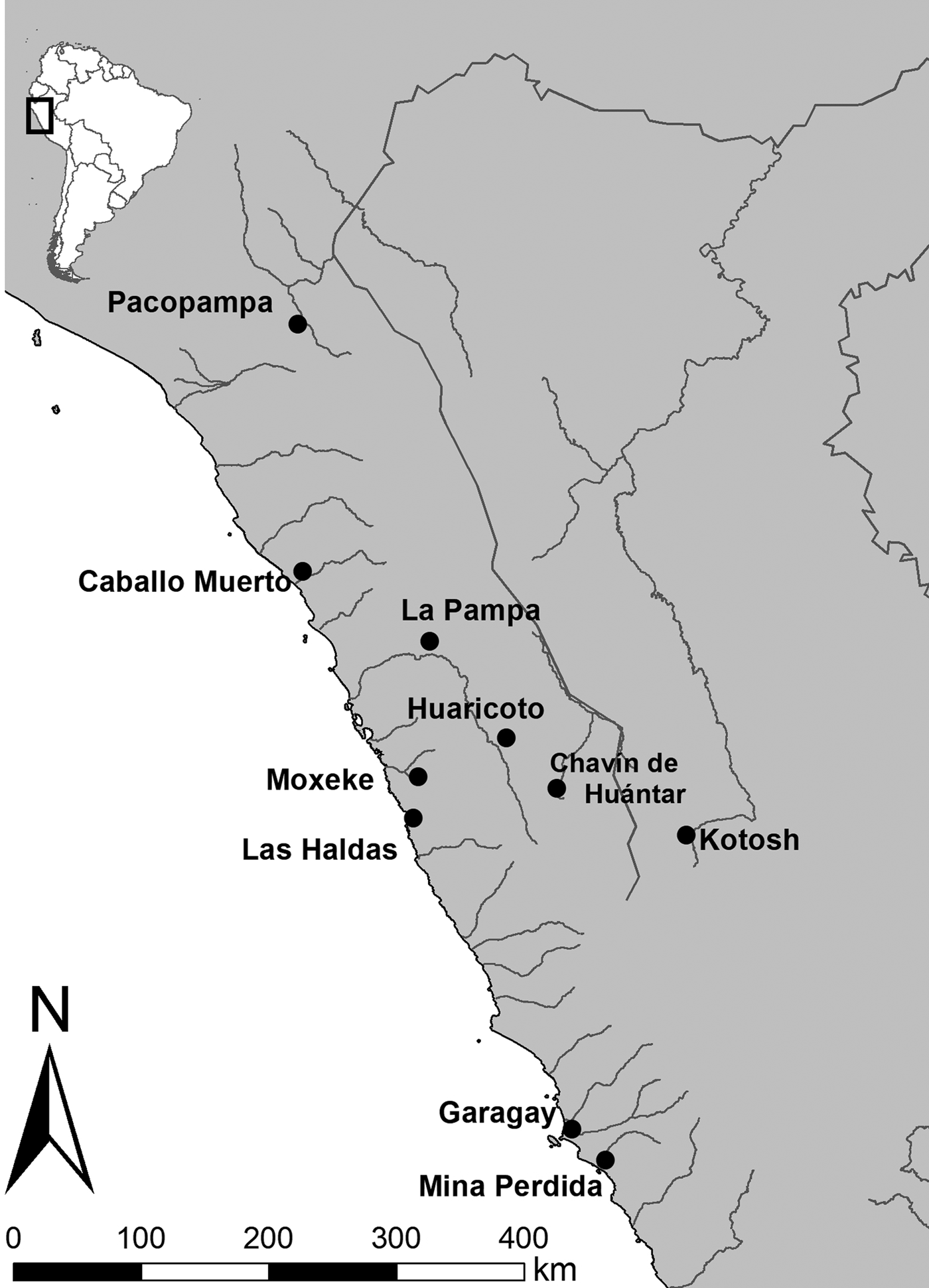
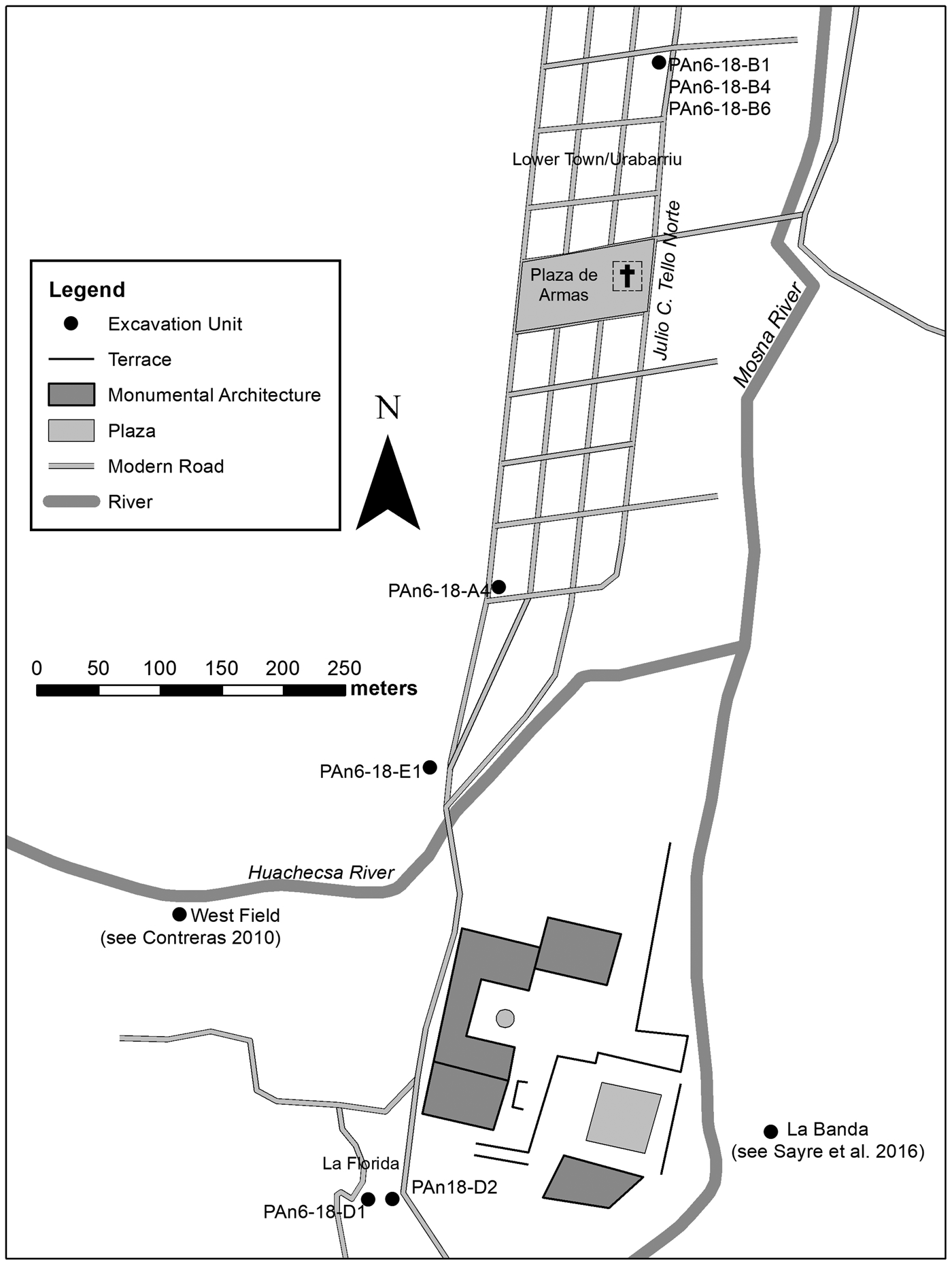
The archaeological site of Chavín de Huántar is located in the northern highlands of Peru at 3,150 m above sea level (Figure 1). The large masonry constructions that constitute its ceremonial core are situated on the valley floor where the Huachecsa River flows into the larger Mosna River (Figure 2; Supplemental Figure 1). The current evidence for prehistoric occupation at Chavín de Huántar indicates that it covered at least 50 ha of the valley floor and adjacent lower slopes (Burger Reference Burger1984:Map 4; Gamboa Reference Gamboa and Ibarra2016; Ravines Reference Ravines2012b; Sayre Reference Sayre2010). Although the most intensively investigated portion of Chavín de Huántar is its ceremonial core, most of the site was dedicated to residences and other activity areas catering to the site's inhabitants. In addition to its permanent population, Chavín de Huántar is believed to have hosted pilgrims and other visitors from outside its catchment area. At its height, it could be described as a proto-urban center with a cosmopolitan ambience and a population of two to three thousand people. Based on our current knowledge, Chavín de Huántar was larger in area and population than any contemporary center in the highlands and coast of Peru (Burger Reference Burger1984, Reference Burger1992, Reference Burger, Renfrew and Bahn2014).
Archaeological sites discussed in the text (Prepared by Christopher Milan).

Location of excavations in Chavín de Huántar that produced the radiocarbon measurements discussed in the text (Prepared by Christopher Milan).

The dating of Chavín de Huántar has been a contentious subject for more than a century. It was only with the stratigraphic excavations at the site by Julio C. Tello in 1934 that the great chronological age of Chavín de Huántar was demonstrated (Tello Reference Tello1943, Reference Tello1960). Despite subsequent investigations by Wendell Bennett, Jorge Muelle, Manuel Chavez Ballón, and others, the Chavín culture at the site was always treated as existing in an indivisible block of time.
The first investigator to publish a chronology for the Chavín cultural component at Chavín de Huántar was John Rowe. He was an archaeologist known for his concern with diachronic control; for example, he proposed the relative chronological framework for the Central Andes used in this article (Rowe Reference Rowe1962a; Supplemental Figure 2). In 1961 Rowe excavated in the ceremonial core, but was unable to divide the Chavín materials into chronological phases because all of the ceramic artifacts recovered came from a single time period (Burger Reference Burger1984:171–172). Nevertheless, he drew on his observations and those of site archaeologist Marino Gonzales to propose two linked relative chronologies: a three-phase sequence for the monumental architecture (Old Temple/Transition/New Temple) and a four-phase stylistic sequence for the stone sculpture (AB/C/D/EF; Rowe Reference Rowe1962b).
In 1966, Luis Lumbreras and Hernán Amat initiated a program of investigations at Chavín de Huántar that involved extensive excavation, but as with Tello and Bennett, they encountered widespread mixing of deposits because of the numerous episodes of rebuilding in the area of public architecture. In an effort to finally produce a ceramic chronology for the Chavín occupation, Lumbreras focused on two deposits of contrasting “Chavín-style” pottery: one was a group of more than six hundred vessels in a subterranean complex known as the Galería de las Ofrendas, and the other consisted of sherds found in a stone-lined canal referred to as the Galería de las Rocas. Although lacking stratigraphic evidence, Lumbreras and Amat believed the Rocas pottery to be older and the Ofrendas to be more recent (Lumbreras Reference Lumbreras1967, Reference Lumbreras1970; Lumbreras and Amat Reference Lumbreras and Amat1969). In the 1970s, Lumbreras interpreted the diverse pottery styles in the Galería de las Ofrendas as representing different periods of time, and he used them as the basis of various multiphase ceramic sequences (Lumbreras Reference Lumbreras1973, Reference Lumbreras1974, Reference Lumbreras1977). Subsequent work demonstrated that Lumbreras and Amat had the Rocas/Ofrendas sequence reversed and that the variation in the ceramic styles found in the Galería de las Ofrendas was the result of multiple exotic sources of pottery, rather than temporal factors (Burger Reference Burger1981, Reference Burger1984; Lumbreras Reference Lumbreras1993, Reference Lumbreras2007).
Lumbreras and Amat also published the first attempt to use radiocarbon dating to create an “absolute” or 14C chronology for Chavín de Huántar (Lumbreras Reference Lumbreras1973, Reference Lumbreras1974; Lumbreras and Amat Reference Lumbreras and Amat1969). The measurements used to assess the age of the pottery from the Galería de las Rocas were carried out on bones found on the canal floor. Whether because of insufficient collagen in the bones, difficulty with collagen extraction, or contamination of the bones soaked in water draining from constructions that included limestone (or some combination of these and other factors), the measurements from the Galería de las Rocas proved to be older than those from the Galería de las Ofrendas and consequently misleading (Burger Reference Burger1981). Given these and other confusing measurements from mixed contexts, no credible radiocarbon chronology was produced.
In 1975 I carried out excavations in residential areas of Chavín de Huántar (Burger Reference Burger1984). In these areas, disturbance was comparatively slight, and stratified domestic garbage was encountered in most excavations. These small-scale investigations revealed evidence of stone houses, masonry footings for buildings of perishable material, workshop areas, and stone terrace walls, as well as abundant refuse.
Based on 12 excavations in the settlement zone surrounding the monumental core on the western banks of the Mosna River, I proposed a relative pottery chronology consisting of three sequential phases beginning with the Urabarriu Phase, followed by the Chakinani Phase, and ending with the Janabarriu Phase. The order of the Janabarriu and Chakinani ceramic phases was demonstrated by stratigraphic superposition; the placement of the Urabarriu Phase before the Chakinani Phase was based primarily on stylistic and seriational grounds. A stylistic analysis of the ceramics revealed an in situ evolution of the pottery style over time that was cut short by the abandonment of the Chavín de Huántar settlement at the end of the Janabarriu Phase (Burger Reference Burger1984, Reference Burger1998; Supplemental Figure 3).
A reoccupation of the site was characterized by pottery in the Huarás (or White-on-Red) style. These ceramic artifacts are radically different from the Janabarriu pottery in form, decoration, and technology (Bennett Reference Bennett1944). The placement of Huarás phase houses in what had been sacred areas, such as Chavín de Huántar's Circular Plaza, and the reuse of religious sculpture in domestic structures likewise suggest that a radical cultural break occurred between the Janabarriu Phase and the Huarás occupation (Burger Reference Burger1992; Lumbreras Reference Lumbreras1974).
The Chavín-style ceramic artifacts I recovered in the residential areas did not differ in style or technology from those recovered in the Temple sector by Tello, Bennett, Gonzales, and Rowe, and thus it can be assumed that the ceramic sequence generated from the residential area at Chavín de Huántar can be used as a chronological tool in the ceremonial core (Burger Reference Burger1984; Lumbreras Reference Lumbreras1989).
In fact, the three-phase pottery sequence developed for the Chavín occupation made it possible to trace the growth of the site from a lightly inhabited ceremonial center in the Urabarriu Phase to a proto-urban settlement in the Janabarriu Phase (Burger Reference Burger1984, Reference Burger1992). Similarly, the sequence made it possible to identify the transformation of the local economy from one dependent on hunting for much of its meat to one reliant on the herding of domesticated llamas (Miller Reference Miller and Burger1984; Miller and Burger Reference Miller and Burger1995), and from its dependence on local and semilocal lithic material such as quartzite in the Urabarriu Phase to obsidian brought from the Quispisisa source 590 km to the south (Burger Reference Burger1984; Burger et al. Reference Burger, Lau, Ponte, Glascock, Herrera, Orsini and Lane2006). As these observations illustrate, the relative ceramic chronology proposed has proven to be a valuable aid in studying the socioeconomic transformation of Chavín de Huántar.
In 1981 I published an article attempting to delineate an absolute chronology by linking the ceramic chronology to radiocarbon measurements run on carbonized wood at the University of California, Riverside and Illinois State Geological Survey laboratories. Due to a limited budget, only 10 samples were analyzed for the three phases, and because of the lack of consensus regarding calibration curves at the time, the measurements were presented uncorrected in radiocarbon years. The Urabarriu and Chakinani measurements were consistent with the proposed order of the ceramic sequence, but two of the three Janabarriu results were more recent than anticipated (Supplemental Figure 4). Based on the 10 measurements, the following uncalibrated radiocarbon chronology was proposed: Urabarriu Phase (850–460 BC), Chakinani Phase (460–390 BC), and Janabarriu Phase (390–200 BC).
These temporal estimates led me to argue that Chavín de Huántar was occupied during the first millennium BC and that, although some overlap occurred during the late Initial Period, most of Chavín de Huántar's occupation was more recent than that of coastal sites such as Garagay in the Rimac Valley, Haldas in the Casma Valley, and Caballo Muerto in the Moche Valley. Before my proposed chronology, these and other large coastal sites had usually been interpreted as the result of “Chavín influence” (Burger Reference Burger1981). Moreover, I noted that the zenith of cultural developments at Chavín de Huántar occurred during the Janabarriu Phase, long after the decline or collapse of most major coastal centers around 900–800 BC (Burger Reference Burger1981, Reference Burger1992, Reference Burger, Silverman and Isbell2008)
The 1981 radiocarbon chronology I proposed for Chavín de Huántar represented an advance in the site's chronometric dating, but it had some serious limitations. By using uncalibrated dates, I did not take into account the problems presented by the Halstatt Plateau, the period between 800–400 BC during which radiocarbon dating is problematic because of the fluctuations of 14C in the atmosphere (e.g., Guilderson et al. Reference Guilderson, Reimer and Brown2005). Moreover, later investigators had difficulties comparing my uncalibrated 14C chronology with their calibrated radiocarbon chronologies from Chavín de Huántar and other sites.
Another problem with the 1981 chronology was the assumption that the end of the Janabarriu Phase at Chavín de Huántar was followed immediately by the Huarás Phase. As noted, the Huarás occupation at Chavín de Huántar consisted of a small village, much of which was built on top of the ceremonial core (Lumbreras Reference Lumbreras1970). Because the Huarás settlement did not extend west of the ceremonial core to where most of the earlier inhabitants of the Janabarriu Phase settlement had lived, I did not recover evidence to date this reoccupation. Lacking reliable dates for the end of the Janabarriu Phase or any dates for the local Huarás phase, I used an estimate of 200 BC for the beginning of the Huarás culture in Ancash and as the terminus ante quem for the Janabarriu Phase, without considering the possibility of a hiatus between the Janabarriu Phase and the Huarás Phase occupation or that the Huarás Phase may have begun earlier than 200 BC at Chavín de Huántar.
In 1989, Lumbreras published a synthesis of his work at Chavín de Huántar and offered a new absolute chronology that took my work into account, but proposed a different four-phase chronology: Urabarriu (1200–800 BC), Ofrendas (800–600 BC), Chakinani (600–400 BC), and Rocas or Janabarriu (400–200 BC). Perhaps most notable in the new Lumbreras sequence were the increased estimate for the beginning of the Urabarriu Phase and the insistence that the Ofrendas assemblage constituted a local ceramic phase (Lumbreras Reference Lumbreras1989).
In 1995, Lumbreras and John Rick of Stanford University initiated a new project at Chavín de Huántar, and their investigations have lasted for more than two decades. Once again, the research was focused on the site's ceremonial core, although work has occasionally extended to La Banda on the east bank of the Mosna River directly across from the monumental architecture and to the West Field area located to the northwest of the monumental platform complex (Figure 2; Contreras Reference Contreras2010; Sayre et al. Reference Sayre, Miller and Rosenfeld2016).
In the ceremonial core, a member of Rick's team, Silvia Kembel, proposed a detailed hypothetical building chronology of five stages subdivided into 15 episodes (Kembel Reference Kembel2001, Reference Kembel, Conklin and Quilter2008). Unfortunately, she has not been able to date this sequence chronometrically or to link it to a relative chronology such as the sculptural sequence proposed by Rowe or the ceramic sequence proposed by Burger. On the contrary, the Stanford Project has raised doubts about the validity of these sequences, although they have not proposed an alternative ceramic or sculptural chronology for Chavín de Huántar (e.g., Kembel Reference Kembel, Conklin and Quilter2008; Mesía Reference Mesía2007). As with past investigations, the Stanford Project has faced problems in locating undisturbed stratified refuse in the ceremonial core. In fact, according to Rick (Reference Rick, Kevin, Ogburn and Conlee2005), most Chavín structures and surfaces that they have uncovered lack any cultural materials whatsoever.
Thus, after two decades Rick and his colleagues have not produced a chronological framework suitable for analyzing the diachronic developments at Chavín de Huántar and integrating them into the larger framework of Central Andean prehistory. They have used the Kembel construction sequence to fill this vacuum, but this approach has limited applicability for questions outside narrow ones related to the ceremonial core itself.
New Radiocarbon Results from the Chavín de Huántar Settlement
Methodology and Sample
A new attempt at linking the Chavín de Huántar ceramic chronology to radiocarbon measurements was not undertaken until 2016. At that time, I realized that it would be feasible to use the AMS method to obtain reliable radiocarbon measurements from animal bones recovered from the refuse associated with the three ceramic phases. With the advances in AMS techniques, the dating of collagen in bone is now considered to be as reliable as the dating of wood or other organic remains (Potter et al. Reference Potter, Reuther, Newbold and Yoder2012). Moreover, terrestrial herbivore remains are not affected by the old wood problem or freshwater/marine reservoir effects, and large bones are less likely to have been affected by stratigraphic mixing than small charcoal pieces. Studies have demonstrated the efficacy of bone collagen dating compared to other approaches, such as the analysis of carbonized wood. In this case, the bones analyzed have the advantage of coming from llamas (Lama glama), a domesticated animal that was slaughtered for meat between the ages of three and eight years (Miller and Burger Reference Miller and Burger1995). As a consequence, it is possible to avoid the “old wood” problem in which the measurement reflects the age of the older tree rings, rather than the year the wood was used (Schiffer Reference Schiffer1986).
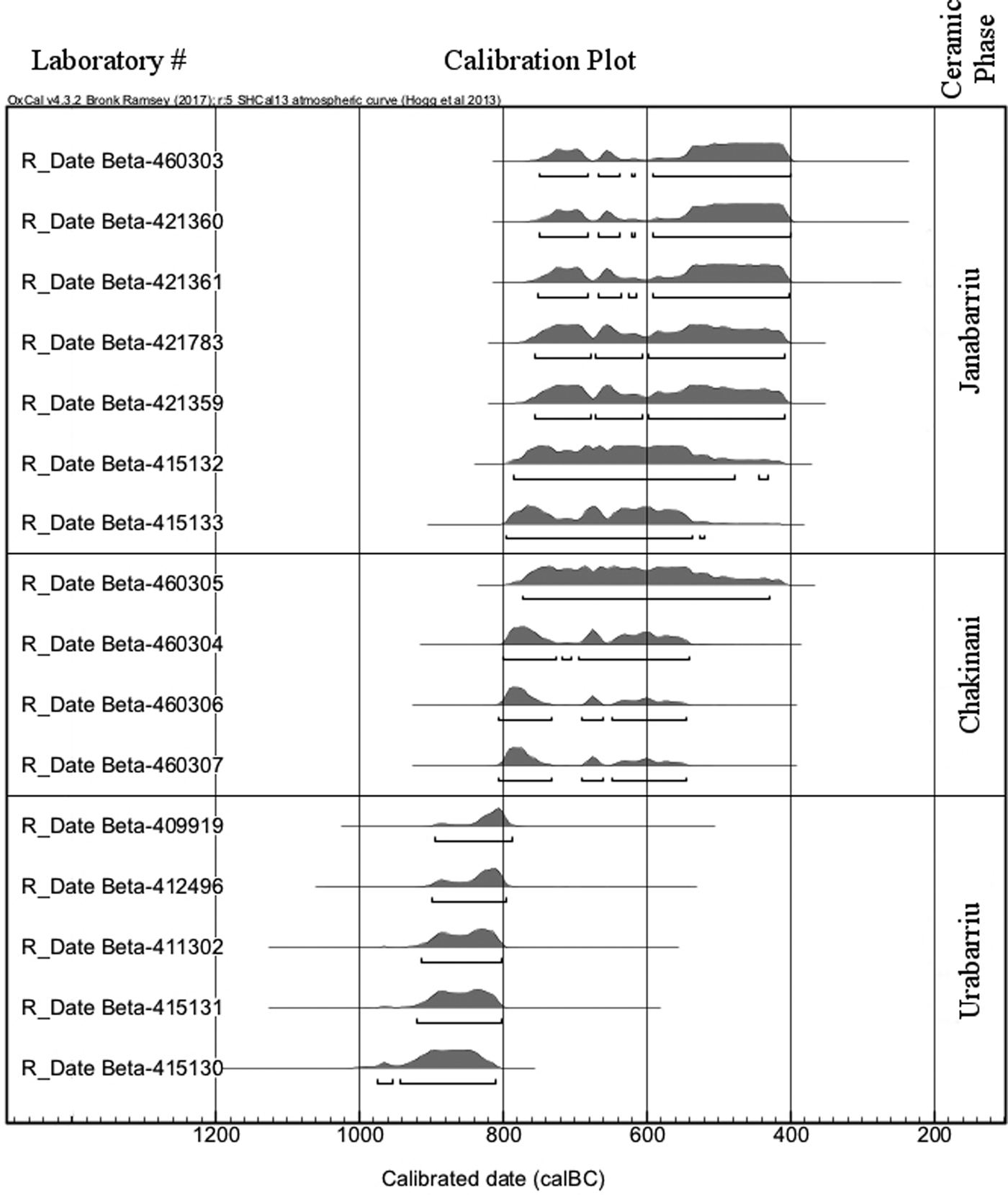
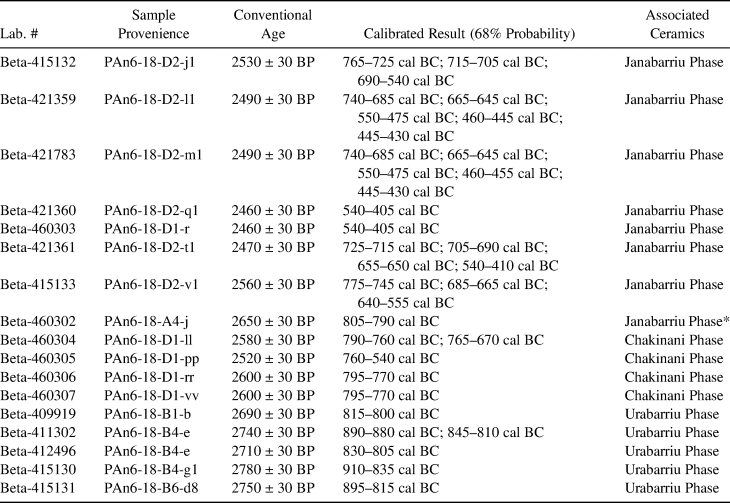
After completing the faunal analysis of the Chavín de Huántar materials in California (Miller and Burger Reference Miller and Burger1995), the bones were returned to Peru and stored at the Museo Nacional de Arqueología, Antropología, e Historia del Perú (MNAAHP). To produce the new radiocarbon chronology, bones were selected from the 1975 Chavín de Huántar faunal collection that represented the three chronological phases: Urabarriu Phase (n = 5), Chakinani Phase (n = 4), and Janabarriu Phase (n = 8). The samples were run using the AMS radiocarbon technique at Beta Analytic Inc. The procedure featured collagen extraction following Beta's standard methods, and systematic corrections were made for carbon isotopes. The calibration of the dates was carried out by Darden Hood, director of Beta Analytic, using the Betacal 3.21 and the SHCAL13 database (Table 1). A second alternative calibration of the measurements was carried out by Jason Nesbitt (Figure 3) using the OxCal v4.3.2 Brock Ramsey program for the southern hemisphere (Hogg et al. Reference Hogg, Hua, Blackwell, Niu, Buck, Guilderson, Heaton, Palmer, Reimer, Reimer, Turney and Zimmerman2013). In contrast to the earlier 14C measurements from the 1970s that had standard 1-sigma errors varying from 75–210 years (Burger Reference Burger1981), the AMS measurements on each of the samples had a standard error of 30 years. Other improvements have been made over the decades in the cleaning and preparation of the samples. In addition, the samples in this study were analyzed using a single set of protocols at the same laboratory, which may have reduced anomalous variability between measurements.
Plot of calibration probability distributions of the new AMS measurements for the ceramic sequence from Chavín de Huántar.

New AMS Measurements on Bone Samples from Chavín de Huántar.

All samples were unburned mammal bone recovered during the 1975 excavations in the settlement of Chavín de Huántar.
* This sample is conisdered an outlier.
Archaeological Context
Before discussing the measurements themselves, it is worth summarizing the provenience of the samples tested (Figure 2; see Burger Reference Burger1984 for more details). In some cases, different contexts were sampled than in Burger (Reference Burger1981) because of the absence of appropriate bones from the contexts sampled in the earlier study. The five bone samples associated with Urabarriu pottery came from excavations in sector B in the northern or lower (Urabarriu) section of Chavín de Huántar. This zone was situated 675 m from the Old Temple in an area currently covered by housing. The fieldwork took place in an open lot adjacent to Avenida Julio C. Tello Norte (Figure 2). The first of the excavations (B1–4) covered 20 m2; the second (B5–7) covered 14 m2 (Burger Reference Burger1984:Map 1, Figure 3). The excavations reached a depth of 3.5 m before encountering subsoil and river cobbles. Both exposed the hearting of a low stone platform with a poorly preserved earthen floor running on top of the cobble core. Four human crania, a cup, a bottle, and carbonized wild fruits had been placed as offerings within the platform (Burger Reference Burger1984:28–34, Figures 9, 10, 25, 37), which had been built above a semi-subterranean circular stone-lined feature. The pottery recovered from the cultural strata in these two excavations was Urabarriu in style, and the samples selected for AMS analysis represented the entire stratigraphic sequence.
The four bone samples associated with the Chakinani Phase pottery come from excavation D1, a 3 x 2 m unit located on the valley slopes roughly 100 m from the New Temple (Burger Reference Burger1984:21–26, Map 1, Figure 8). The excavation was placed in a potato field in a neighborhood known as La Florida. The unit was noteworthy both because of its considerable depth, and as in excavation E1, there was a superposition of Janabarriu Phase pottery above earlier ceramic deposits. In the case of E1, the Janabarriu deposits were found on top of a small amount of Urabarriu pottery, whereas in D1, the Janabarriu ceramic artifacts were found in strata above those containing Chakinani Phase pottery (Burger Reference Burger1984:Figures 7, 8).
The excavation of D1 unearthed a low masonry terrace that incorporated offerings of guinea pigs and spondylus shell. Fifty-three fragments of Spondylus sp., including beads, pendants, unfinished cut fragments and production debris, had been placed in the platform wall and beneath its floor (Burger Reference Burger1984:Figure 432, Charts 14, 15); these were intermixed with remains of at least 40 guinea pigs (Burger Reference Burger1992). Beneath the terrace was an earlier freestanding residential structure with eight intact courses. A stone ear spool fragment covered with cinnabar pigment was found in the household refuse. The two superimposed masonry constructions in D1 were both associated with Janabarriu Phase pottery and other refuse.
Brown clayey soil and gravel mixed with Chakinani ceramic artifacts, bone, carbonized plant fragments, and other refuse were found below the lower stone structure at a depth of 330 to 545 cm beneath the surface. No features were found in this stratum. The Chakinani bone samples analyzed caome from different layers within the thick brown clayey deposit.
As noted, eight samples of bone associated with Janabarriu pottery were dated in this study. Six of them were taken from excavation D2, a 2 x 2 m unit situated to the east of D1 (Burger Reference Burger1984:Map 1). Unit D2 featured two superimposed Janabarriu structures, but it lacked evidence of Chakinani refuse beneath them. The Janabarriu deposits reached a depth of 2.8 m and included exotic materials, such as a fragment of gold jewelry, and fish and shellfish remains brought from the Pacific coast (Burger Reference Burger1984:Chart 18, 19). The six bones analyzed span the use of the two Janabarriu masonry structures. A sample from the Janabarriu layers in D1 was also dated. It comes from one of the layers deposited after the abandonment of the residence, but before construction of the masonry platform on top of it.
A final Janabarriu sample was analyzed from A4 (Burger Reference Burger1984), a unit located on the north side of the Huachecsa River within the modern town. The investigations encountered two superimposed freestanding Janabarriu structures associated with refuse; it was hypothesized that they belonged to rectangular residences. The sample analyzed was visibly different from all other bone samples studied because it had a surface sheen that looked like a chemical coating applied for conservation purposes. To address this problem, Beta Analytic applied special cleaning procedures not used on the other samples. Despite these efforts, the date produced is slightly older than the other Janabarriu samples, and the measurement is considered be an outlier, not accurately reflecting its age. It is shown in Table 1, but was not included in the phase averages or in the calibration curves illustrated in Figures 3–5.
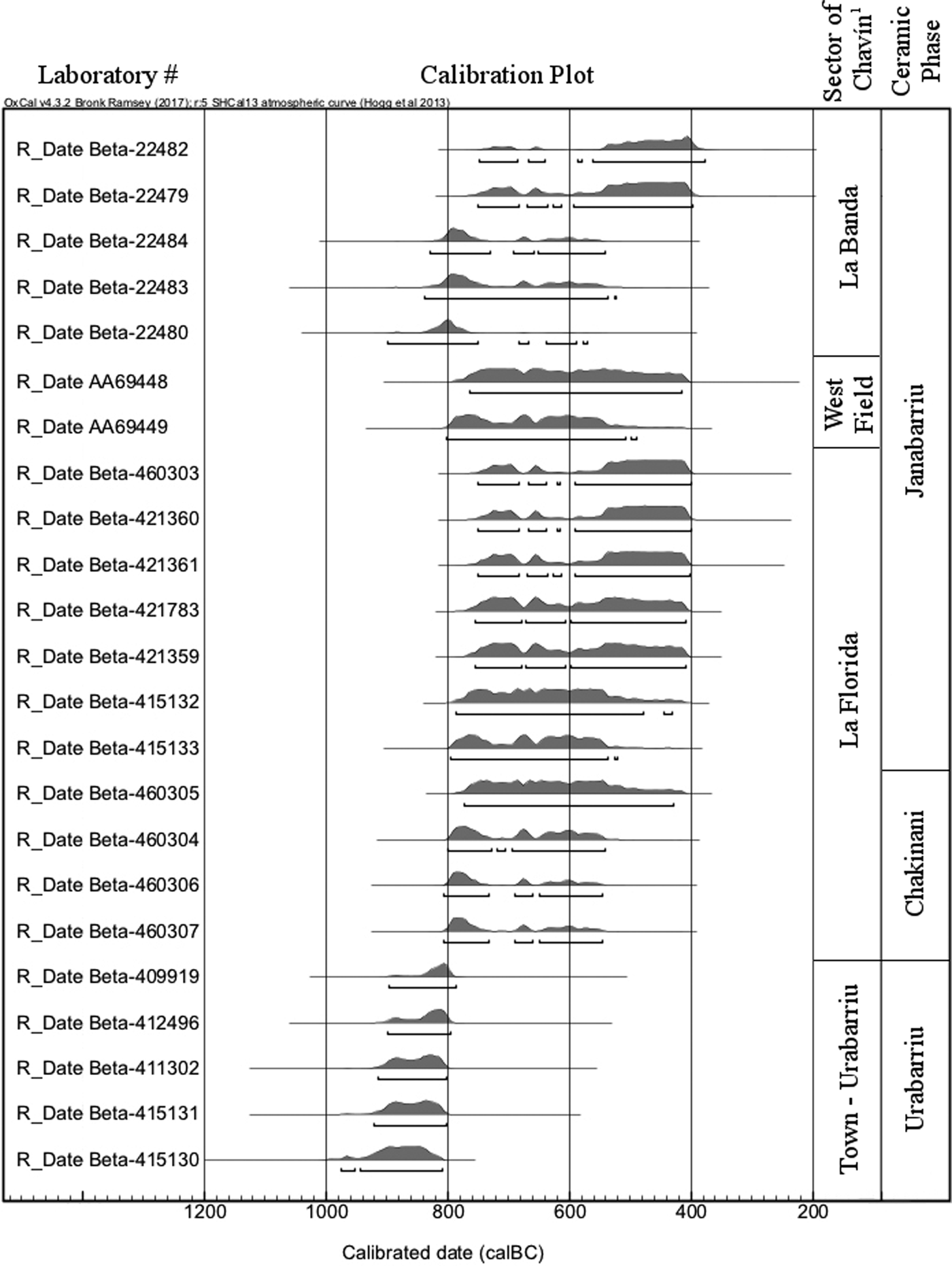
Plot comparing the calibration probability distributions of the AMS measurements from Chavín de Huántar using samples from the 1975 excavations by Burger in the Chavín settlement to those on measurements in La Banda by Sayre and colleagues (Reference Sayre, Miller and Rosenfeld2016) and in West Field by Contreras (Reference Contreras2010)Footnote 1.

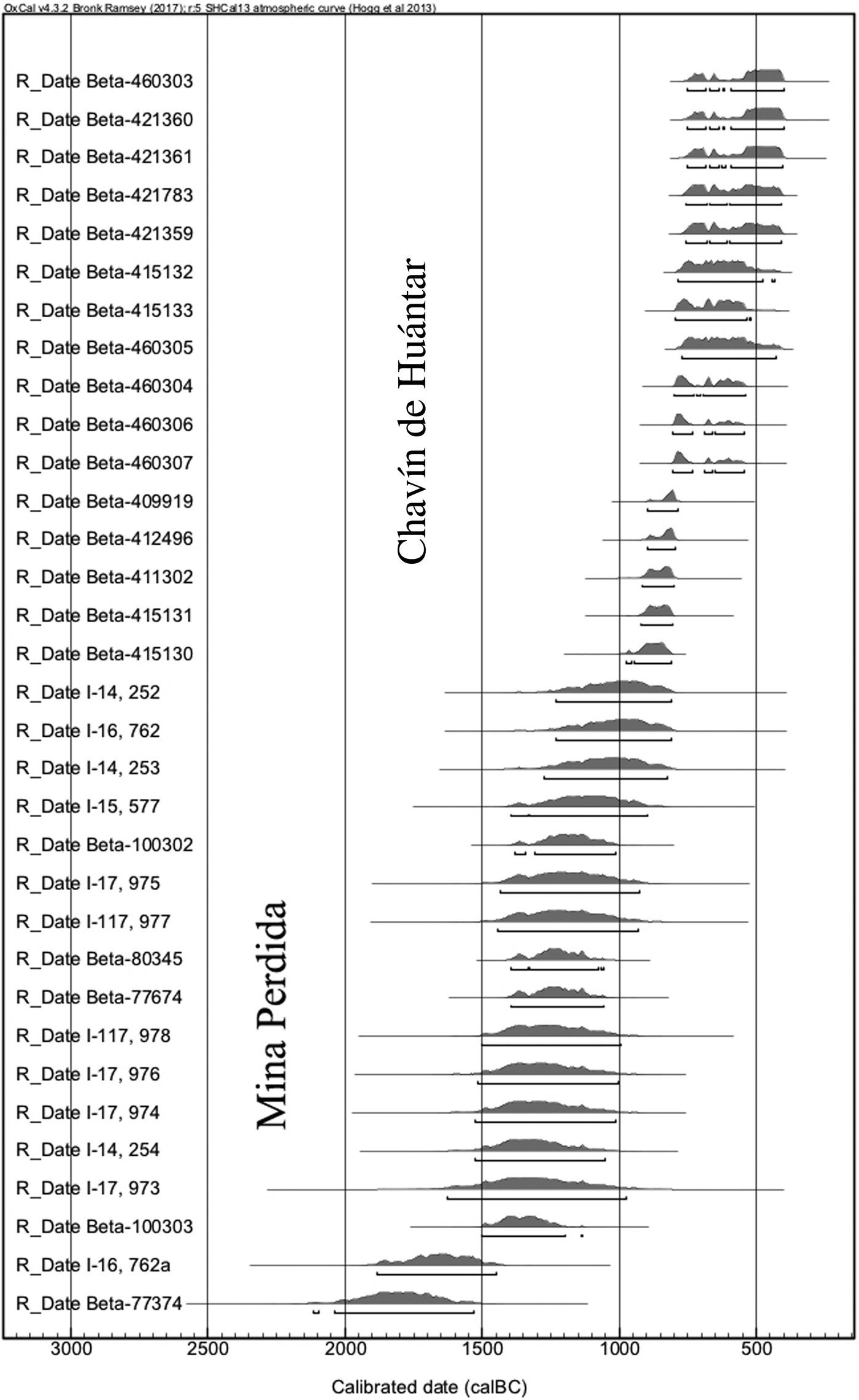
Plot comparing calibration probability distributions of new AMS measurements from Chavín de Huántar to those available from the Manchay culture complex of Mina Perdida, Lurín Valley.

Results
As Table 1 and Figure 3 illustrate, the AMS dating of the bone samples from Chavín de Huántar presents a coherent pattern that is consistent with stratigraphic and stylistic evidence. Hood, director of Beta Analytic, calculated an average for the measurements of each phase, using SHCAL 13, with the following results: Urabarriu Phase (2734 ± 13 cal BP), Chakinani Phase (2575 ± 15 cal BP), and Janabarriu Phase (2494 ± 11 cal BP).
The five samples with Urabarriu associations form a tight cluster that is older than those produced by the Chakinani and Janabarriu Phase samples. These measurements when calibrated suggest that the Urabarriu Phase extended from roughly 950 cal BC–800 cal BC. In considering the Chakinani and Janabarriu Phase dates, it should be kept in mind that both fall within the Halstatt Plateau. As a consequence, these AMS measurements are not expected to reflect differences in time as clearly as 14C dates falling before or after the Halstatt Plateau. This is reflected in the list of the calibrated dates shown in Table 1 and Figure 3. Nonetheless, it is noteworthy that the 1-sigma range for the four Chakinani measurements all fall between 800 cal BC and 700 cal BC. As mentioned, Chakinani pottery was found beneath Janabarriu pottery (Burger Reference Burger1984), so the Janabarriu dates should be more recent than those of the Chakinani Phase: with the exception of the outlier from unit A4, the Janabarriu samples dated for this study are younger than those of the Chakinani Phase, thus confirming stratigraphic expectations. This temporal difference is also reflected in the averages calculated by Hood.
If the calibrated 14C measurements are considered in relationship to provenience, a plausible estimate for the duration of the three phases is that the Urabarriu Phase lasted from 950–800 cal BC, the Chakinani Phase from 800–700 cal BC, and the Janabarriu Phase from 700–400 cal BC. None of the measurements indicate that the Janabarriu Phase continued after 400 cal BC. The dates were independently modeled by Ivan Ghezzi, using Bayesian statistics in OxCal v4.3.2 (Supplemental Text 1), which produced the following results at 95.4% probability: Urabarriu Phase (895–783 cal BC), Chakinani Phase (820–720 cal BC), and Janabarriu Phase (700–500 cal BC). The modeled estimates differ slightly from the ranges proposed. If the modeled estimates are partially or fully supported by future measurements, the length of the Chavín occupation at Chavín de Huántar would only be about four centuries, a shorter period of time than many investigators have assumed.
Wider Implications
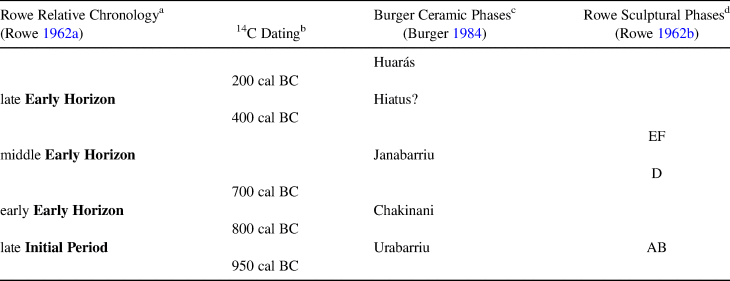
The new radiocarbon measurements provide the basis for revising the chronometric estimates of the Chavín de Huántar ceramic chronology as follows: Urabarriu Phase (950–800 cal BC), Chakinani Phase (800–700 cal BC), and Janabarriu Phase (700–400 cal BC). These chronometric estimates can be linked to a modified version of Rowe's sculptural sequence (Reference Rowe1962b) to provide a broader chronological foundation for discussing the site (Table 2; Burger Reference Burger1992). Moreover, the AMS results reported here have wider implications for understanding the site of Chavín de Huántar and the way in which it related to developments in the Peruvian highlands, coast, ceja de selva, and tropical forest. Due to space limitations, I only briefly discuss several of these implications.
Chronological Relationships between the Radiocarbon, Ceramic, and Sculptural Sequences for Chavín de Huántar.

a I introduced the terminology “early,” “middle,” and “late.”
b The 14C estimates represented in this column reflect my judgement based on the measurements discussed in this article.
c The ceramic phases are those discussed in Burger (Reference Burger1984) and illustrated in Supplementary Materials Figures 3a–c. The hypothetical hiatus reflects my current thinking.
d The sculptural sequence for the Chavín temple was published by Rowe (Reference Rowe1962b). The absence of Rowe's Phase C and the correlation with the 14C dates and ceramic phases reflect my current judgment.
Implications for the Ceramic Sequence
The new measurements provide independent 14C confirmation for the ceramic sequence developed four decades ago in Chavín de Huántar's residential zone (Burger Reference Burger and Matos1979). As discussed earlier, the new results are consistent with the stratigraphic and stylistic evidence (Burger Reference Burger1984, Reference Burger1998). This is significant because Rick and his colleagues have been ambivalent about the pottery sequence. For example, their work has often disregarded the Chakinani Phase (e.g., Rick Reference Rick, Conklin and Quilter2008:Figure 1.6; Rick et al. Reference Rick, Mesia, Contreras, Kembel, Rick, Sayre and Wolf2010:Figure 25). Members of the Stanford Project have also shown reservations about using the term “Janabarriu Phase” and instead have referred to this phase of pottery as “janabarroide” (e.g., Rick et al. Reference Rick, Mesia, Contreras, Kembel, Rick, Sayre and Wolf2010:Figure 25). The reason given for this terminological innovation is that “the dates originally assigned by Burger in 1981 were different from those of the janabarroide ceramics [sic] and the associated Black and White stage architecture” (Rick Reference Rick and Seki2014:270). From my perspective, the use of the term “janabarroide” is unjustified because the definition of Janabarriu Phase pottery was stylistic and based on stratigraphic associations. The fact that the style of the pottery recovered by the Stanford Project was the same as that described (Burger Reference Burger1984) is sufficient to permit application of the term “Janabarriu” to the ceramic artifacts. Presumably, with the publication of the calibrated AMS dates, the original term “Janabarriu” will be acceptable to all concerned.
Rick has argued that Janabarriu is not a naturally evolved phase of Chavín pottery (Rick Reference Rick and Seki2014; Rick et al. Reference Rick, Mesia, Contreras, Kembel, Rick, Sayre and Wolf2010, see also Mesía Reference Mesía2007). These misgivings are unjustified because the forms, decorative modes, and production technology developed smoothly out of the Chakinani Phase (Burger Reference Burger1984; Supplemental Figure 3).
Moreover, the relationship of Janabarriu pottery to the ceremonial architecture was questioned by the supposedly inconsistent contexts and associations encountered in the ceremonial core. For example, Kembel (Reference Kembel, Conklin and Quilter2008:73) asserts that recent investigations suggest “a new relationship between Janabarriu ceramics and the architectural sequence…. In particular, excavations of contexts radiocarbon dated to approximately 800–500 BC and 1200–800 BC include Janabarriu ceramics respectively.” As the 14C evidence presented here demonstrates, the presence of Janabarriu-style pottery in layers dating to 1200–800 BC must be the result of mixing, and the associations from the ceremonial core are better understood as the result of stratigraphic disturbance, rather than being indicative of a new relationship between the pottery and architectural sequences.
The Founding of Chavín de Huántar
The radiocarbon measurements indicate that the Urabarriu Phase corresponds to a period lasting roughly 150 years. The use of the ceremonial core during this time is attested to by the work of Tello, Bennett, Fung, and Lumbreras, all of whom encountered Urabarriu Phase pottery in this area (Burger Reference Burger1984). Rosa Fung found unmixed Urabarriu pottery in her excavations near the ceremonial core adjacent to the Huachecsa River (Fung Reference Fung1976; Lucy Salazar, personal communication 2018).
Pottery styles older than the Urabarriu Phase ceramic artifacts have not been identified at Chavín de Huántar. Ceramic assemblages more ancient than Urabarriu are known from many northern highland sites, including Early Huacaloma ceramic artifacts from Cajamarca (Terada and Onuki Reference Terada and Onuki1985), Toril ceramic artifacts from Huaricoto (Burger Reference Burger1985), Yesopampa ceramic artifacts from La Pampa (Terada Reference Terada1979), Pandanche ceramic artifacts from Pacopampa (Kaulicke Reference Kaulicke1975), and Wairajirca ceramic artifacts from Kotosh (Izumi and Sono Reference Izumi and Sono1963). These highland ceramic styles dating to the mid-second millennium BC should have facilitated identification of a pre-Urabarriu style at Chavín de Huántar if one existed. Considering the widespread mixing in the ceremonial core, as well as the numerous excavations there, the failure to identify a pre-Urabarriu pottery style at Chavín de Huántar cannot be dismissed cavalierly as a function of sampling.
The apparent lack of pre-Urabarriu pottery suggests that the Chavín de Huántar temple was founded during the Urabarriu Phase. If the Urabarriu Phase is the earliest occupation at Chavín de Huántar, excluding consideration of an unrelated preceramic occupation (Rick Reference Rick, Conklin and Quilter2008), the establishment of the site can be estimated to be approximately 950 cal BC. Despite this, publications by members of the Stanford Project have consistently stated that the Chavín de Huántar temple was founded no later than 1200 cal BC (e.g., Contreras and Keefer Reference Contreras and Keefer2004; Rick Reference Rick and Sharon2006; Rick et al. Reference Rick, Mesia, Contreras, Kembel, Rick, Sayre and Wolf2010) and perhaps as early as 1500 cal BC (Lumbreras Reference Lumbreras and Fux2013; Rick Reference Rick, Kevin, Ogburn and Conlee2005; Rosenfeld and Sayre Reference Rosenfeld and Sayre2016). In one chart (Rick Reference Rick, Kevin, Ogburn and Conlee2005), the Separate Mound State is shown as dating to 1500–1200 BC, whereas the Expansion Stage and the Consolidation Stage appear to fall between 1200–1000 BC. These chronological estimates have been influential not only among archaeologists but also with the general public. For example, a 2006 postage stamp issued by the Peruvian government celebrating the Chavín de Huántar archaeological site shows 1200 BC as its age.
Although it is impossible to exclude the possibility of Urabarriu deposits older than the ones dated here or even the existence of pre-Urabarriu ceramic artifacts or architecture, it is important to recognize that the existence of public architecture before 950 cal BC has never been empirically demonstrated at Chavín de Huántar. Because no diagnostic ceramic artifacts or organic materials have been recovered in association with the hypothetical earlier stages of the temple, there is no basis for determining their age and duration. Attempts to clarify this chronological impasse using thermoluminescence (OSL) and organic material in wall mortar and clay plaster have yielded confusing and contradictory results (Feathers et al. Reference Feathers and Kembel2008; Kembel and Haas Reference Kembel and Haas2015).
The Panregional Context of the Emergence of Chavín de Huántar
It would appear that 950 cal BC is the earliest radiocarbon-based estimate that can be proposed for the establishment of the Chavín de Huántar temple and its residential sector. This has implications for evaluating the existing models for the temple's origins. Although I have suggested that the founding of Chavín de Huántar can best be understood as the culmination of Initial Period developments on the coast, highlands, ceja de selva, and eastern lowlands during the second millennium BC (Burger Reference Burger1981, Reference Burger1992, Reference Burger, Renfrew and Bahn2014), Rick and his colleagues have argued that Chavín de Huántar is simply one of many coeval “Formative” developments occurring during the Initial Period (Kembel Reference Kembel, Conklin and Quilter2008; Rick Reference Rick, Conklin and Quilter2008). My model proposes that architectural and iconographic features used for centuries along the central coast, north coast, and northern highlands before Chavín de Huántar's establishment were consciously combined to produce the international or cosmopolitan style that characterized Chavín de Huántar, Rick's model, in contrast, suggests that Chavín de Huántar was essentially contemporary with these other cultural traditions and simply shared numerous features with them as a result of peer–polity interaction (Kembel and Rick Reference Kembel, Rick and Silverman2004).
When my model was originally published (Burger Reference Burger1981), there were only very limited data available from sites such as Garagay, Caballo Muerto, and Haldas. Since then, much additional work has been carried out on the central coast, north-central coast, and north coast, and the findings leave no doubt that many of the distinctive regional features of civic-ceremonial centers along the coast go back to the beginning of the Initial Period (ca. 1700 cal BC) or, in some cases, into the late Preceramic Period (ca. 2500 cal BC) and earlier (Fuchs et al. Reference Fuchs, Renate Patzche and Briceño2009). If Chavín de Huántar was founded around 950 cal BC, it is misleading to characterize it as just one of many competing coeval Initial Period religious and cultural traditions.
If we compare the set of radiocarbon dates for Mina Perdida, the largest U-shaped civic-ceremonial complexes of the Manchay culture in the Lurin Valley (Burger and Salazar Reference Burger, Salazar, Conklin and Quilter2008:Table 3.1, Reference Burger, Salazar, Burger and Rosenswig2012), with the 14C dates from Chavín de Huántar, the chronological difference between the sites is obvious. The oldest 14C date from Mina Perdida (Beta-77373), which is associated with the first of six superimposed central staircases belonging to the central platform mound, produced an age range of 1927–1681 cal BC (1-sigma). In contrast, Chavín de Huántar appears to have been founded only shortly before Mina Perdida was abandoned (Figure 5). This same point could be made by comparing the dates from Chavín de Huántar with dates from the Cupisnique center of Caballo Muerto in the Moche Valley or the major Initial Period centers in Casma, such as Sechin Alto, Sechin Bajo, and Moxeke/Pampa de las Llamas (Fuchs et al. Reference Fuchs, Renate Patzche and Briceño2009; Nesbitt Reference Nesbitt2016; Pozorski and Pozorski Reference Pozorski and Pozorski1987, Reference Pozorski and Pozorski2018).
There was a period of one or two centuries, roughly between 950–800 cal BC, when some large coastal centers coexisted with Chavín de Huántar. This overlap during the late Initial Period has long been recognized (Burger Reference Burger1981, Reference Burger1992). Without it, the emulation of nonlocal features by Chavín de Huántar and the importation of their exotic products, as attested to by the associations in the Galería de las Ofrendas, could not have occurred.
As demonstrated here, the overlap between 950–800 cal BC corresponds to the Urabarriu Phase at Chavín de Huántar; significantly, this period has been recognized as a time of crisis for the large civic-ceremonial centers of the central and north coast. This time of troubles on the coast ultimately led to the complete abandonment of many of the centers and a decline in the scale and quality of public construction in others. The suggestion that the rise of Chavín de Huántar may have been related to these coastal sociopolitical problems seems even more convincing now than it did when it was originally suggested in 1981 (Burger and Salazar Reference Burger, Salazar, Conklin and Quilter2008; Nesbitt Reference Nesbitt2016; Onuki Reference Onuki and Fux2013; Pozorski and Pozorski Reference Pozorski and Pozorski1987, Reference Pozorski and Pozorski2018; Quilter Reference Quilter2014; Sandweiss et al. Reference Sandweiss, Maasch, Richardson, Burger and Rollins2001; Shibata Reference Shibata and Seki2014), but assertions of Chavín de Huántar's early establishment by Rick and others obscure this panregional pattern. Moreover, members of the Stanford project have further confused the possible relationship between the decline of the Initial Period coastal centers and the rise of Chavín de Huántar by mistakenly citing a date of 500 BC for the “coastal crisis” (Kembel Reference Kembel, Conklin and Quilter2008; Kembel and Haas Reference Kembel and Haas2015; Kembel and Rick Reference Kembel, Rick and Silverman2004), rather than 950–800 cal BC that I proposed (Burger Reference Burger1992).
The Zenith of Chavín de Huántar
Another question that remains a point of contention is when the zenith of the cultural development of Chavín de Huántar occurred. Using the relative ceramic sequence developed and the associated results of survey and excavation at the site, the obvious answer would seem to be that it was during the early portion of the Janabarrriu Phase (approximately 700–550 cal BC) when the settlement surrounding the temple grew from a small support population to that of a proto-urban center. This is also the time that the largest quantity and variety of imported exotics such as obsidian, cinnabar, gold, Pacific fish and spondylus shell were recovered in the residential area (Burger Reference Burger1984, Reference Burger1992, Reference Burger, Silverman and Isbell2008).
Investigations on the east bank of the Mosna River have shown that the residential occupation of La Banda was associated with Janabarriu Phase pottery (Figure 2; Gamboa Reference Gamboa and Ibarra2016; Sayre Reference Sayre2010). Sayre's work also revealed a Janabarriu Phase bone workshop that included the carving of Pacific mammal bone such as whale (Sayre et al. Reference Sayre, Miller and Rosenfeld2016). Thus, the research in La Banda reinforces the conclusion that it was during the Janabarriu Phase that Chavín de Huántar achieved its maximum size. Not coincidentally, the Janabarriu Phase is also the time when socioeconomic stratification became manifest in a host of ways, including the differential consumption of young and tender llama meat by elite groups in the settlement (Burger Reference Burger1992, Reference Burger, Silverman and Isbell2008; Miller and Burger Reference Miller and Burger1995).
Arguing that the site's apogee occurred during the early Janabarriu Phase does not deny the considerable prestige of Chavín de Huántar during Urabarriu and Chakinani times or the likelihood that important constructions were built at Chavín de Huántar during those earlier phases. Yet, it was during the Janabarriu Phase that the builders of the temple engaged in an ambitious construction program that included the Black and White Portal, the Plaza Menor, and the Plaza Mayor (the large rectangular plaza), as well as the platform mounds that flank the Plaza Mayor. I have argued elsewhere that this architectural expansion was initiated to accommodate the increasing number of worshipers. The expansion of the public architecture during this time occurred in response to the increasing popularity of Chavín de Huántar as a panregional pilgrimage center and the consequent arrival of a larger number of outsiders to worship and perhaps to trade at informal markets outside of the ceremonial core (Burger Reference Burger, Hirth and Pillsbury2013). Consistent with this claim, the growth of the settlement around the temple is hypothesized to be the result of rural inhabitants relocating around the center in order to provide goods and services for the flourishing ceremonial center and its visitors (Burger Reference Burger1992).
A fundamentally different interpretation of the development of Chavín de Huántar has been repeatedly advocated by Kembel on the basis of her hypothetical architectural sequence for the monumental core. In her doctoral dissertation and subsequent writings, she has argued that the center reached its final monumental construction stage by approximately 750 BC (Kembel Reference Kembel2001, Reference Kembel, Conklin and Quilter2008:62). When this conclusion was originally presented, there was a paucity of 14C dates with clear associations tied to the architectural sequence, just as there was a general absence of artifacts associated with Kembel's 15 building episodes.
More recently, Kembel and Haas (Reference Kembel and Haas2015) attempted to date the construction episodes using organic material taken from the wall plastering in the galleries. Unfortunately, the order of the dates does not correspond to the hypothesized order of construction, and there are numerous inconsistencies even within individual galleries. Despite this, Kembel and Haas concluded that these measurements confirm that most ceremonial construction had been completed by 800 cal BC and that the period between 800–500 cal BC was one of stasis. Although this conclusion is consistent with Kembel's Reference Kembel2001 dissertation findings, it presents some conundrums. Why would the period of greatest demographic growth and economic activity in the residential sectors of Chavín de Huántar have been marked by a paralysis in corporate construction? And if that stasis occurred, why are Janabarriu cultural materials dated between 700–400 cal BC the most commonly recovered materials throughout the ceremonial core? Clearly, the pattern of artifact deposition suggests an increase in ritual activity during the Janabarriu Phase in the ceremonial core, rather than a period of stasis.
Similarly, how can a supposed halt in construction be reconciled with the large numbers of stone sculptures documented in Rowe's Phase D style, the sculptural style linked to the Janabarriu ceramic artifacts and the Black and White Portal (Table 2; Burger Reference Burger1984, Reference Burger1992; Rowe Reference Rowe1962b). Moreover, the period between 800–500 BC is the time when Chavín de Huántar's panregional influence appears to be strongest and when its style is most widely emulated by independent groups hundreds of kilometers away (Burger Reference Burger and Keatinge1988, Reference Burger1992, Reference Burger and Rice1993, Reference Burger, Silverman and Isbell2008).
In an effort to explain these apparent contradictions, Kembel (Reference Kembel, Conklin and Quilter2008) speculates that the drastic increase of population in the Chakinani and Janabarriu Phases could represent the influx of people attracted to the previously restricted monumental center in the wake of the diminishing functioning of the temple. Yet this explanation does not explain what would attract migrants to a religious center in sharp decline or why distant centers would choose to adopt cultural features of a center in crisis.
Although Kembel's explanation should not be rejected out of hand, it seems likely that the methodology she used to estimate the construction sequence was unsuccessful and that it may have led to incorrect conclusions. The implausibility of many of Kembel's interpretations suggests that the entire building sequence and its chronometric dating proposed by her need to be critically and independently reevaluated.
The Abandonment of the Civic-Ceremonial Center of Chavín de Huántar
None of the eight AMS measurements associated with Janbarriu Phase materials fall after 400 cal BC; given that the Halstatt Plateau ended by 400 BC, a Janabarriu occupation after that date should be reflected in the 14C measurements if such an occupation had occurred. The new 14C samples for the Janabarriu Phase presented here mainly come from excavation units in the La Florida sector to the south of the Huachecsa River, and it is therefore worth comparing these measurements to those analyzed from Sayre's excavations in La Banda and Contreras's investigations in the West Field (Figure 2) to see whether these other sectors of the site show the same pattern of abandonment before 400 cal BC. The 14C measurements from La Banda and the West Field came from samples recovered in strata characterized by Janabarriu Phase pottery (Contreras Reference Contreras2010; Rick et al. Reference Rick, Mesia, Contreras, Kembel, Rick, Sayre and Wolf2010:Table 2; Sayre et al. Reference Sayre, Miller and Rosenfeld2016). As illustrated in Figure 4, these measurements from the investigations in the West Field and La Banda are consistent with the dating for the Janabarriu Phase based on samples from La Florida. Without question, the dates published by Sayre and Contreras likewise suggest abandonment of the Early Horizon settlement no later than 400 cal BC.
Rick and his colleagues have argued that a major earthquake damaged the Chavín de Huántar complex around 500 cal BC and that this catastrophic event was followed by construction activities attempting to stabilize the ceremonial architecture (Rick Reference Rick, Conklin and Quilter2008). Kembel (Reference Kembel, Conklin and Quilter2008) refers to the post-earthquake period as the Support Stage and observes that, like the preceding Black and White Stage, it was associated with Janabarriu Phase pottery. Unfortunately, the timing of the earthquake event is based on a single radiocarbon measurement taken from organic material in the fill of a postdisaster construction. Thus, the oft-cited 500 BC date of the earthquake is only a rough approximation, and it could have occurred many decades earlier or later (Rick Reference Rick, Conklin and Quilter2008).
The final abandonment of the Janabarriu residential areas surrounding the ceremonial core may have been a response to the inability of the sacred center of Chavín de Huántar to continue to attract pilgrims and visitors in the wake of this hypothetical disaster. Nonetheless, Chavín de Huántar is situated in an earthquake zone, and it must have experienced tectonic events on several occasions during its lengthy history. A single earthquake alone is insufficient to explain the abandonment of Chavín de Huántar. However, the inability of the temple community to fully recover its dynamism after such an event would suggest flaws in the temple's socioeconomic and political system, perhaps as a result of contradictions stemming from increasing socioeconomic inequality and the hierarchical claims of the temple's religious leaders.
Judging from the evidence available, the socioeconomic collapse of Chavín de Huántar after the hypothetical “destruction event” was not immediate or unequivocal, and it deserves more detailed study and consideration. According to the evidence presented by Kembel (Reference Kembel, Conklin and Quilter2008), the Support Stage that followed the posited earthquake involved an ambitious building program that included constructions with massive unconsolidated fills that would have required the mobilization of large amounts of public labor. Moreover, it is likely that elaborate public religious art continued to be made during this final period of temple activity. It probably included the production of the Raimondi Stone and other sculptures in the style referred to by Rowe as EF (Table 2). Among these late carvings are two large columns, one of white granite and the other of black limestone, flanking the staircase that led into the Plaza Mayor. At least one of these columns was still in production when the ceremonial core ceased to function in the fifth century BC (Burger Reference Burger1992:Figure 172).
Acknowledgements
I am indebted to George Miller, whose retirement led to this study, and to Ivan Ghezzi and his staff at the MNAAHP for locating my faunal collections. Thanks to Cynthia Dreier, Corey Herrmann, Jason Nesbitt, Yuichi Matsumoto, Chris Milan, and Steve Wegner for assistance with the text, calibrations, graphics, and comments on the content; to Ivan Ghezzi and Sturt Manning for their Bayesian analysis of the measurements; and to Darden Hood for his insights. I also am grateful to Lucy Salazar and Jeffrey Quilter for suggestions on the manuscript.
Data Availability Statement
All of the data used in this study appear in the article itself or have been previously published in cited materials.
Supplementary Materials
For supplementary materials accompanying this article, visit https://doi.org/10.1017/laq.2019.17.
Supplemental Figure 1. Photograph of the masonry facade of the main temple platform at Chavín de Huántar.
Supplemental Figure 2. Alternative chronological systems for the Central Andes (After Quilter Reference Quilter2014:Figure 2.4).
Supplemental Figure 3. (a) Urabarriu Phase ceramic artifacts; (b) Chakinani Phase ceramic artifacts; (c) Janabarriu Phase ceramic artifacts (After Burger Reference Burger and Matos1979).
Supplemental Figure 4. Calibration plots for radiocarbon measurements made on carbonized organic material from 1975 excavations in the Chavín settlement; uncalibrated measurements are published in Burger (Reference Burger1981, Reference Burger1984). It is worth noting that the Urabarriu, Chakinani, and one of the Janbarriu Phase measurements in Burger (Reference Burger1981) are consistent with the new AMS dates, but they lack the precision of the more recent measurements (Plot by Jason Nesbitt).
Supplemental Text 1. Codes for procedures employed in Bayesian analysis by Sturt Manning and Ivan Ghezzi.