


Introduction
The European Union (EU) is the world’s largest donor of foreign aid, providing over 50 billion Euro a year to help recipient countries overcome poverty and advance global development (European Commission, 2025). A significant share of this aid is allocated to states in the EU neighbourhoodFootnote 1 (Shyrokykh, Reference Shyrokykh2017; Shyrokykh and Solander, Reference Shyrokykh and Solander2025). Among the top recipient countries of EU aid between 2011 and 2023 were: Türkiye, Ukraine and Morocco, with respective amounts of 37.5 billion Euros, 27.1 billion Euros and 14.9 billion Euros (the total sums allocated between 2011 and 2023) (European Union, 2025). Overall, approximately 3.6 percent of EU aid is allocated for democracy assistance (Gafuri, Reference Gafuri2022).
Whether (and to what extent) democracy assistance is effective remains debated. It is intended to enhance democratisation by focussing on supporting institutions and agents of democratic change (e.g., civil society and bodies entrusted with oversight and checks and balances). This particular purpose is what distinguishes democracy assistance from other forms of foreign aid (Gisselquist et al., Reference Gisselquist2021). However, existing work offers no consensus on the effects of democracy assistance. Studies have detected positive (Finkel et al., Reference Finkel2007; Gafuri, Reference Gafuri2022; Heinrich and Loftis, Reference Heinrich and Loftis2019; Scott and Steele, Reference Scott and Steele2011; Solander, Reference Solander2025), negative (Bosin, Reference Bosin2012; Dietrich and Wright, Reference Dietrich and Wright2015; Scott and Steele, Reference Scott and Steele2005; Shyrokykh, Reference Shyrokykh2017) and no effects on the levels of democracy in recipient countries (Bicchi, Reference Bicchi2009; Grimm and Leininger, Reference Grimm and Leininger2012; Grimm and Lou Mathis, Reference Grimm and Lou Mathis2018).Footnote 2 Related research on foreign aid is similarly inconclusive (Altunbaş and Thornton, Reference Altunbaş and Thornton2014; Charron, Reference Charron2011; Djankov et al., Reference Djankov2008; Haass, Reference Haass2021; Knack, Reference Knack2004).
While the related works focus on various geographic regions, time periods, methodological approaches, and donors (Gisselquist et al., Reference Gisselquist2021) they agree that the effects of democracy assistance and foreign aid, in general, depend on the specific international and country-level conditions under which they are provided (Dutta et al., Reference Dutta2013; Gisselquist et al., Reference Gisselquist2021; Kono and Montinola, Reference Kono and Montinola2009). In this regard, several studies suggest that the recipient state’s capacity to administer financial assistance matters (Ahmed, Reference Ahmed2020; Englehart, Reference Englehart2009; Feeny and McGillivray, Reference Feeny and McGillivray2009; Fortin, Reference Fortin2012; Shyrokykh, Reference Shyrokykh2017). Yet the link between administrative state capacity and the effectiveness of democracy assistance remains underexplored and undertheorised. Because (administrative) state capacity is a fundamental characteristic of modern states and not linked to a particular regime type (Mann, Reference Mann1984; Mazzuca, Reference Mazzuca2010), it can also serve undemocratic purposes and help to maintain authoritarian regimes (Andersson and Teorell, Reference Andersson and Teorell2025; Hanson, Reference Hanson2018; Seeberg, Reference Seeberg2014).
This paper addresses this gap and contributes to the debate on the domestic factors that shape the impact of EU democracy assistance. We focus on recipient states’ administrative capacity—defined as the quality of a state’s administrative capabilities in implementing policies and providing public goods and services (Dincecco and Wang, Reference Dincecco, Wang, Jenkins and Rubin2024; Khemani, Reference Khemani2019; Mann, Reference Mann1984; Ottervik, Reference Ottervik2013)—and argue that it is key to explaining the diverse effects of democracy assistance on levels of democracy. Only states with sufficient administrative capacity can provide their populations with essential public goods and services, including security, law and order, economic development, as well as access to food, education, and public infrastructure (Call, Reference Call2011, 306; Carment et al., Reference Carment2011; Carment and Samy, Reference Carment and Samy2017). We argue that this also applies to the management of democracy assistance, which must be allocated, distributed, monitored and reported on by beneficiary states. Accordingly, states that have sufficient capacity to administer these processes are more likely to put assistance into practice. Conversely, if state capacity is lacking, democracy assistance may even become a burden for beneficiaries, overwhelming them with tasks they cannot complete. In this case, states might be unable to absorb and implement the provided assistance effectively (Ahmed, Reference Ahmed2020; Feeny and McGillivray, Reference Feeny and McGillivray2009; In’airat, Reference In’airat2012), making it less likely to improve levels of democracy.
To test our assumption, we investigate EU democracy assistance to 23 countries in the EU’s neighbourhood, with varying administrative capacity, EU membership prospects, and assistance received from the EU. Our data covers the period from 2007 to 2021. Our analysis proceeds in two steps. First, we identify how democracy assistance affects a country’s level of democracy. Our focus is on electoral democracy as it reflects the EU’s primary emphasis on EU democracy promotion in its neighbourhood. For example, building on Merkel’s (Reference Merkel2004) embedded democracy concept, Grimm et al., (Reference Grimm2025) demonstrate that electoral democracy is at the very core of the EU’s democracy promotion. They show that references to elections and electoral processes dominate over other elements of democracy (i.e., civil rights, political rights, horizontal accountability, and effective power to govern). Second, we investigate whether (and to what extent) administrative capacity shapes this effect. We find that, jointly, democracy assistance and administrative capacity positively affect the level of democracy. This effect exhibits a commutative nature: it increases over time, indicating that democracy assistance allocated to states with higher capacity yields larger effects.
Geographically, we focus on the European neighbourhood region, broadly understood as encompassing countries in the Eastern Partnership, Western Balkans, and Southern Neighbourhood. In comparison to single-case studies or comparative studies of individual states (Shyrokykh, Reference Shyrokykh2017), we address the entire EU neighbourhood, a region that receives the most EU assistance per state and where democracy promotion is one of the EU’s strategic objectives (for more, see Shyrokykh and Solander, Reference Shyrokykh and Solander2025; for descriptive statistics, see the online Appendix Figures A1 and A2). The European neighbourhood provides a valuable setting for analysing the effects of EU democracy assistance across varying contexts, as it comprises states that differ in membership credibility, the extent of democracy assistance in the region, political stability, economic development, historical trajectories, and, importantly, administrative state capacity. This variance allows us to assess the direct effects of democracy assistance and how differences in administrative state capacity condition the effectiveness of democracy assistance.
The remainder of the paper is structured as follows. First, we contextualise our study within the field of democracy promotion studies. Next, we introduce the conceptual foundations of EU democracy assistance and administrative state capacity and formulate our hypotheses. In the subsequent section, we describe the design of our time-series cross-sectional analysis and present and discuss our findings. We conclude by discussing policy implications and outlining directions for future research.
Background
Democracy promotion refers to instruments of external democratisation—including diplomatic, political, developmental and at times even military activities—to support the building of democratic institutions and the empowerment of democratic behaviour (Leininger, Reference Leininger2022). Democracy assistance, in turn, describes the economic component of democracy promotion: it is a subtype of foreign aid that entails the provision of financial assistance in the form of non-profit grants and technical assistance in the form of consultancy (Grimm and Lou Mathis, Reference Grimm and Lou Mathis2015). It is designed to contribute to democratic capacity building by supporting free and fair elections, political institutions, civil society organisations, and the media (Scott and Steele, Reference Scott and Steele2011).
While states have engaged in democracy promotion for several decades, democracy assistance has only been provided since the end of the Cold War (Burnell, Reference Burnell2011; Gafuri, Reference Gafuri2022; Kumar, Reference Kumar2013; Shyrokykh, Reference Shyrokykh2017). Since then, the democracy promotion toolbox of Western actors has evolved from a one-size-fits-all strategy to one that considers a diverse array of political contexts (Carothers, Reference Carothers2009; Shyrokykh and Solander, Reference Shyrokykh and Solander2025). The EU’s approach mirrors this development. Initially, most of its democracy assistance was targeted at supporting top-down processes of democratisation; the only exception was the European Instrument for Democracy and Human Rights (EIDHR), which provided civil society assistance. Yet the Union’s tableau of instruments has broadened through the introduction of the European Neighbourhood Policy in 2004, the Eastern Partnership program (EaP) in 2009, and the reform of the European Neighbourhood Policy in 2011 (Fiedlschuster, Reference Fiedlschuster2018, 49–68; Schumacher, Reference Schumacher and Sadiki2015). More recent measures have been directed at bottom-up processes, increasingly supporting civil society organisations (Fiedlschuster, Reference Fiedlschuster2018, 68–70). In practice, various democracy EU assistance instruments are simultaneously employed (Grimm, Reference Grimm2010, 74–77; van Hüllen and Stahn, Reference van Hüllen, Stahn and Magen2009, 125).
Overall, democracy assistance is an integral part of the EU’s foreign policy and democracy promotion agenda. This is reflected in its founding treaties (European Union, 2007, Art. 21) and is frequently reaffirmed in strategic documents such as the 2016 Global Strategy for Foreign and Security Policy (European Union, 2016, 15) or the 2021 New Partnership for Democracy and Shared Prosperity with the Southern Mediterranean (European Commission, 2021, 3). By promoting democracy, the EU seeks to create stable and well-functioning democratic systems, foster democratic institution-building, empower democratic political actors, and nurture favourable conditions for democratisation.
Theory and hypotheses: EU democracy assistance and administrative state capacity
The effects of democracy assistance are manifold and remain subject to debate. Related contributions focus on distinct geographic regions, donors, periods, methodological approaches, as well as forms of aid and draw a mixed picture (Gisselquist et al., Reference Gisselquist2021). Several quantitative studies on democracy assistance by the US and members of the Organisation for Economic Cooperation and Development (OECD) have reported positive effects, concluding that democracy assistance generally fosters democratisation. This happens, for example, through the empowerment of local agents (Finkel et al., Reference Finkel2007; Kalyvitis and Vlachaki, Reference Kalyvitis and Vlachaki2010; Scott and Steele, Reference Scott and Steele2011), the reduction of multiparty failure and electoral misconduct (Dietrich and Wright, Reference Dietrich and Wright2015), and the increase in government accountability (Heinrich and Loftis, Reference Heinrich and Loftis2019). Democracy assistance by the EU can also have a positive effect on the levels of democracy in recipient countries, as recently shown by Gafuri (Reference Gafuri2022) who analysed the impact of EU democracy assistance on democracy levels globally in 126 countries. She attributes this to the EU’s model of incentive-based conditionality, under which compliance with (democratic) reforms is rewarded with, for example, enhanced trade relations, financial aid, or market access, as well as to its various monitoring mechanisms that allow for tracking and evaluating the implementation of the provided assistance.
However, other, mainly qualitative, studies have found that such assistance does not result in democratisation. For example, in the Mediterranean, Bicchi (Reference Bicchi2009, Reference Bicchi2010) finds that both EU and national decisions about spending and implementation, divergent interests among donors and recipients, as well as related policy ambiguities, have undermined the effects of democracy assistance. Others have stressed the possibility of conflicting EU policy objectives in the Neighbourhood (Grimm and Leininger, Reference Grimm and Leininger2012; Grimm and Lou Mathis, Reference Grimm and Lou Mathis2018; Shyrokykh and Solander, Reference Shyrokykh and Solander2025), emphasising the politicisation of EU aid (Schito, Reference Schito2021; Youngs and Zihnioğlu, Reference Youngs and Zihnioğlu2021) as well as the lack of political will in supporting democratisation in certain countries (Grimm and Lou Mathis, Reference Grimm and Lou Mathis2015). Still others have even found that aid can have a negative side effect on beneficiary states’ human rights situation (Shyrokykh, Reference Shyrokykh2017). A similar, mixed picture is presented in the literature on general foreign aid, which finds a positive (Altunbaş and Thornton, Reference Altunbaş and Thornton2014; Dunning, Reference Dunning2004; Goldsmith, Reference Goldsmith2001a, Reference Goldsmith2001b; Heckelman, Reference Heckelman2010; Solander, Reference Solander2025), negative (Bräutigam and Knack, Reference Bräutigam and Knack2004; Djankov et al., Reference Djankov2008; Hook, Reference Hook1998; Regan, Reference Regan1995) or no relationship (Askarov and Doucouliagos, Reference Askarov and Doucouliagos2013; Knack, Reference Knack2004) between foreign aid and democratisation.
In summary, existing studies demonstrate a generally positive effect of EU democracy assistance, which can, however, be conditioned by various domestic and international factors. Building on the EU’s expected outcome of its democracy assistance policy and the comprehensive body of literature on its effectiveness, we propose the following baseline hypothesis:
EU democracy assistance increases levels of democracy in recipient states (H1).
With that, we do not exclude the possibility that the effect of EU democracy assistance on levels of democracy in recipient states may vary due to other factors, such as their status vis-à-vis the EU (Lundsgaarde, Reference Lundsgaarde2013; Mesquita and Smith, Reference Mesquita and Smith2007). While the interplay of these factors is hard to detect in single or comparative case studies, we account for the effects of such factors by including relevant control variables in time-series cross-sectional analysis (see next section).
Yet we posit that the administrative capacity of recipient states is key to explaining the varying effects of democracy assistance on levels of democracy. It relates to Mann’s (Reference Mann1984) notion of infrastructural power and refers to the quality of a state’s administrative capabilities in implementing policies and providing public goods and services (Cingolani, Reference Cingolani2013; Grimm, Reference Grimm, Carment and Samy2023, 20). As such, it is one of several dimensions of state capacity, next to the coercive, extractive, and information capacity of the state (Cingolani, Reference Cingolani2013; Hanson and Sigman, Reference Hanson and Sigman2021; Khemani, Reference Khemani2019; Ottervik, Reference Ottervik2013; Thies, Reference Thies2015). Together, these dimensions define a state’s ability to effectively formulate and implement policy goals (Dincecco and Wang, Reference Dincecco, Wang, Jenkins and Rubin2024; Hanson and Sigman, Reference Hanson and Sigman2021; Mann, Reference Mann1984; Khemani, Reference Khemani2019; Ottervik, Reference Ottervik2013) and enable it to establish a social order that allows for peaceful interactions among individuals and groups (Przeworski, Reference Przeworski1995, 110).
We hold that states’ administrative capabilities matter for the management and provision of democracy assistance. As recipients of democracy assistance, states can not only expect to benefit from the support provided by the EU but are also responsible for managing, allocating, implementing, and monitoring the funds received. Thus, from an administrative perspective, managing democracy assistance constitutes a multifaceted task that comes with diverse requirements for recipients’ administrative apparatus. To handle the assistance received, states need, among other things, technical equipment, trained personnel, accountability and transparency systems, as well as national planning, implementation, monitoring and evaluation routines. The EU’s expectations on the reporting of aid can, for example, be found in the individual Partnership and Association Agreements with third states, as well as the EU’s general principles and guidelines provided under the Neighbourhood, Development and International Cooperation Instrument (European Union, 2021), the Common Methodology for State Aid Evaluation (European Commission, 2014) and the Regulations on the Financial Rules Applicable to the General Budget of the Union (European Union, 2024).
The extent to which states can fulfil these requirements crucially depends on their administrative capacity, which describes their ability to effectively formulate and implement policy goals (Dincecco and Wang, Reference Dincecco, Wang, Jenkins and Rubin2024; Hanson and Sigman, Reference Hanson and Sigman2021; Khemani, Reference Khemani2019; Mann, Reference Mann1984; Ottervik, Reference Ottervik2013). A sufficient level of administrative state capacity, for example, increases the organisational capabilities of state agencies and improves the provision of public goods (D’Arcy and Nistotskaya, Reference D’Arcy and Nistotskaya2017; Tilly, Reference Tilly2007). This happens through a competent bureaucracy, staffed with well-trained and equipped personnel, that can collect relevant information, monitor ongoing processes, and advise policymakers (Hanson, Reference Hanson2015). Insufficient administrative systems are characterised by political interference, clientelism and corruption (Evans and Rauch, Reference Evans and Rauch1999; Lewis, Reference Lewis2008; Peters, Reference Peters and Neuhold2013). As a result, they are characterised by lower levels of competence, efficiency, and legitimacy (Lewis, Reference Lewis2008; Peters and Pierre, Reference Peters, Pierre, Peters and Pierre2004). Building on these insights, a higher level of administrative capacity should enable recipient states to receive, process, and implement democracy assistance more effectively.
Different streams in International Relations literature further support this expectation. Transition and democratisation research, for example, hints at the facilitating role of administrative state capacity, as it allows states to absorb aid and assistance (Feeny and McGillivray, Reference Feeny and McGillivray2009; Feeny and de Silva, Reference Feeny and de Silva2012) and helps them to advance human well-being, economic growth, personal security and their human rights situation (Cronert and Hadenius, Reference Cronert and Hadenius2021; Englehart, Reference Englehart2009; Evans and Rauch, Reference Evans and Rauch1999). Conversely, several studies show that states with a lack of administrative capacity cannot effectively comply with administrative requirements and fail to absorb the related assistance completely (Burnside and Dollar, Reference Burnside and Dollar2000; McGillivray, Reference McGillivray and Kamrava2016, 275; Moss et al., Reference Moss2006). The effect of limited administrative capacity has, in particular, been convincingly demonstrated in studies of European regional funds, which show that the lack of administrative capacity in beneficiary EU regions is a primary explanation for the ineffective absorption of regional development funds (Bachtrögler-Unger, Reference Bachtrögler-Unger2024).
In a similar way, research on compliance sheds light on when a cooperation outcome, such as supporting democratic agents and institutions in recipient states, might fail. It demonstrates that although most states intend to comply with the rules of international cooperation when entering it, non-compliance may occur, among other reasons, due to the lack of resources and capacities (Chayes et al., Reference Chayes and Weiss2000; Mitchell and Keilbach, Reference Mitchell and Keilbach2001; Raustiala and Slaughter, Reference Raustiala, Slaughter and Carlsnaes2002). Therefore, much of democracy assistance is paired with technical assistance aimed at transferring knowledge and skills to enhance states’ capacity to manage financial assistance, implement it, and report on it (Shyrokykh, Reference Shyrokykh2017).
The quality of a state’s administration is further regarded as a necessary condition for democratisation (Fortin, Reference Fortin2012; Huber et al., Reference Huber1997). Carothers (Reference Carothers2007, 13) argues that “the rule of law and a well-functioning state should be in place before a society democratizes.” Hence, to achieve positive outcomes, external democratisation efforts should focus on building the state and the rule of law, while also promoting democratic participation through elections. Similarly, in her analysis of post-communist states, Fortin (Reference Fortin2012, 904) concludes that “for democracy to flourish, the state must possess the means necessary to maintain the rule of law, to protect the rights of citizens, and to regulate economic transactions.” This also includes administrative branches that enable and ensure the maintenance and operation of an electoral system (Ventriss et al., Reference Ventriss2019). Elections, for example, require that states manage an electoral register, provide and distribute necessary election documents, set up polling stations, and organise the vote counting; each step in compliance with democratic standards.
Other work on how administrative capacity shapes various democracy indicators bolsters this notion. Fortin-Rittberger (Reference Fortin-Rittberger2014) identifies a positive correlation between a state’s administrative capacity and its human rights situation. Further, high state capacity in the sense of effective administration is associated with higher accountability (Englehart, Reference Englehart2009), low levels of corruption (Bäck and Hadenius, Reference Bäck and Hadenius2008; Charron and Lapuente, Reference Charron and Lapuente2009), as well as positive experiences with the administration, which shape the perception of the state and its performance (Peters and Pierre, Reference Peters and Pierre2018).
However, it is important to note that (administrative) state capacity is a fundamental characteristic of modern states and is not linked to a particular regime type (Mann, Reference Mann1984; Mazzuca, Reference Mazzuca2010). As it can also serve undemocratic purposes, it is regarded as a “double-edged sword” that can help maintain authoritarian rule (Andersson and Teorell, Reference Andersson and Teorell2025; Hanson, Reference Hanson2018; Seeberg, Reference Seeberg2014). In North Macedonia, for example, increased administrative state capacity drove democratisation. After gaining independence in 1991, the republic was characterised by an ethnic divide between ethnic Macedonians and ethnic Albanians (Daskalovski, Reference Daskalovski2004; Vankovska, Reference Vankovska2020; Zendeli, Reference Zendeli2012). By implementing several major public administration reforms, the state professionalised, decentralised, and depoliticised its administration. This, in turn, increased political participation, strengthened local self-government, and allowed to pay greater attention to minority demands. Together, this contributed to a more pluralistic democratic rule (Daskalovski, Reference Daskalovski2004; Zendeli, Reference Zendeli2012). In Lebanon, by contrast, the administrative system is significantly controlled by political parties, religious groups and militias that promote sectarianism as well as clientelist and confessional interests (Antoun, Reference Antoun1989; El-Zein and Sims, Reference El-Zein and Sims2004; Hashemi and Postel, Reference Hashemi and Postel2017). As a result, public administration is characterised by service delivery gaps, corruption, lack of representation and persistent mistrust (Haase, Reference Haase2018; Harb and Atallah, Reference Harb, Atallah, Atallah and Harb2015; Leenders, Reference Leenders2012). This fosters political tensions and turns the state’s administration into an obstacle to democratisation (Hoffman, Reference Hoffman2020; Salloukh et al., Reference Salloukh2015).
Thus, in the context of democratisation processes, we conclude that states with sufficient capacity are more likely to effectively allocate, implement, monitor, and report on the assistance provided. If administrative state capacity is lacking, democracy assistance can become a burden for beneficiaries, overwhelming them with duties they cannot fulfil because they cannot effectively absorb and implement the assistance they receive. Such conditions make it less likely for democracy assistance to improve levels of democracy in recipient states. Building on this, we formulate our second hypothesis as follows:
The higher a state’s administrative capacity, the greater the impact of EU democracy assistance on levels of democracy (H2).
Research design and data
To investigate the direct and conditional effect of EU democracy assistance, we build on a unique time-series cross-sectional dataset compiled within the research project EMBRACE that contains the level of electoral democracy and democracy assistance provided by the EU to 23 neighbouring countries from 2007 to 2021 (Shyrokykh et al., Reference Shyrokykh2025). These countries are Morocco, Algeria, Tunisia, Libya, Egypt, Israel, Lebanon, Jordan, Palestine, and Syria in Northern Africa and the Middle East, as well as Azerbaijan, Georgia, Armenia, Belarus, Moldova, and Ukraine in Eastern Europe and six Western Balkan states (i.e., Albania, Bosnia and Herzegovina, North Macedonia, Montenegro, Kosovo, and Serbia) and Türkiye. They vary substantially in the depth of their European integration, with the Western Balkans and Türkiye having a much longer history of accession conditionality. They also differ in their levels of democracy and democratic trajectories over time (see online Appendix Figure A3). In terms of regimes, most of them are either electoral autocracies (i.e., Albania, Bosnia and Herzegovina, Algeria, Azerbaijan, Egypt, Georgia, Lebanon, Palestine/West Bank, Serbia, Tunisia, Türkiye, and Ukraine) or electoral democracies (Israel, Montenegro, Armenia, Kosovo, Liberia, Moldova, and North Macedonia), with no liberal democracies and several closed autocracies (i.e., Belarus, Jordan, Libya, Morocco, Palestine/Gaza, and Syria).Footnote 3 Our dataset covers the period from 2007 to 2021. All the data used were collected in 2023 and reflect the latest data available at that time.
Our dependent variable is electoral democracy, which captures Dahl’s (Reference Dahl1971, Reference Dahl1989) concept of polyarchy. Electoral democracy ensures that those in power are held accountable to the people through competitive elections with universal suffrage. The concept also captures the freedoms guaranteed for political and civil society groups, the integrity of elections being free from fraud or systemic irregularities, and the ability of elections to influence the selection of the country’s chief executive. Furthermore, electoral democracy relies on fundamental freedoms of expression and on an independent media capable of offering diverse perspectives on political issues.Footnote 4 Thus, the V-Dem measure of polyarchy incorporates freedom of association, suffrage, clean elections, elected executive, freedom of expression, and alternative sources of information (Coppedge et al., Reference Coppedge2023). We use the Varieties of Democracy (V-Dem) index, which captures electoral democracy as a weighted average of (and multiplicative interactions between) indices measuring the freedom of association, clean elections, freedom of expression and alternative sources of information, elected officials, and suffrage (Coppedge et al., Reference Coppedge2023). We use V-Dem data rather than alternative datasets (e.g., Policy V or Freedom House), as it is the most widely used and up-to-date dataset available for comparative politics research. Additionally, the V-Dem data allows us to distinguish between electoral democracy and the quality of democratic institutions (which are captured by the Polity projectFootnote 5), and freedoms and liberties (captured by Freedom House dataFootnote 6).
The independent variable is (log) disbursements of democracy assistance (in millions of USD in constant prices) by EU member states and EU institutions. It captures disbursements to “government and civil society organisations” under the purpose classification code 150 in the OECD Development Assistance Committee (DAC) 5 code system “government and civil society organisations” (OECD, 2023). These aid disbursements are directly aimed at democracy promotion in the recipient country through support for democratic participation and civil society, rule of law, election support, human rights, and freedom of media support. But the data also captures aid allocated for objectives indirectly linked to democracy, such as gender equality, peace, and security. The United Kingdom’s aid allocation data stopped after it left the Union on 31 January 2020.
To operationalise Hypothesis 2, we employ the widely used World Bank Government Effectiveness IndexFootnote 7 to measure the administrative capacity of states (Cronert and Hadenius, Reference Cronert and Hadenius2021; Ottervik, Reference Ottervik2013). This index captures perceptions of the quality of public services, the quality of the civil service and its degree of independence from political pressures, control over corruption, the quality of policy formulation and implementation, and the credibility of the government’s commitment to such policies. The estimate gives the country’s score on the aggregate indicator in units of a standard normal distribution, i.e., ranging from approximately −2.5 to 2.5. We use the Government Effectiveness Index rather than alternative measures to capture administrative state capacity, as it focuses on the administrative characteristics of state capacity (Vaccaro, Reference Vaccaro2023), is widely used (Mogues and Erman, Reference Mogues and Erman2020; Ottervik, Reference Ottervik2013; Serikbayeva et al., Reference Serikbayeva2021; Shyrokykh, Reference Shyrokykh2017), has broad coverage of countries, and is available throughout the studied time period.
Finally, we add four control variables to consider the influence of potential confounding factors on democracy levels. First, we control for each country’s level of integration with the EU (0 = the country has no membership aspirations; 1 = the country’s political leadership has publicly announced its membership aspirations; 2 = EU membership application has been submitted; 3 = candidacy has been granted; 4 = EU accession negotiations have started). European integration can affect the level of democracy in candidate countries, as democracy is one of the fundamental prerequisites for deepening economic and political ties with the EU, as stated in the Copenhagen criteria. The coding is based on information available on the European Commission’s webpage (European Commission, 2025) and related documents. For example, the EU officially announced and recognised the Western Balkan states’ membership aspirations at the Thessaloniki Summit in 2003.Footnote 8 We code the first year of countries’ membership aspirations following the coding in Shyrokykh (Reference Shyrokykh2020) including the 2004 Orange Revolution in Ukraine, the 2003 Rose Revolution in Georgia, and Moldova’s gradual pro-EU reorientation after 2005, marked by the signing of the EU-Moldova Action Plan under the new European Neighbourhood Policy, committing Moldova to further reforms (Ministry of Foreign Affairs of the Republic of Moldova, n.d.).
The second control variable captures interstate and intrastate conflicts, as they can affect a country’s state of democracy. We use the Uppsala Conflict Data Program/Peace Research Institute Oslo (UCDP/PRIO) dataset to capture both (Uppsala Conflict Data Program, 2024). As third control variable, we introduce (log) gross domestic product (GDP) per capita (in USD) as a control variable (World Bank, 2023) because countries with higher levels of economic development might be less likely to receive financial assistance. Last, we introduce (log) population (World Bank, 2023) as fourth control variable to account for the role of population size. We include regional dummies in the robustness check because these variables are time-invariant and cannot be estimated in fixed-effects models.
Model specification
We perform an ordinary least squares (OLS) regression analysis on time-series cross-sectional data; a unit of analysis is a country-year. To address serial correlation, cross-sectional dependence, and heteroscedasticity within the data, we use Driscoll and Kraay’s (Reference Driscoll and Kraay1998) standard errors. The Driscoll-Kraay estimator produces heteroskedasticity- and autocorrelation-consistent standard errors that are robust to general forms of spatial and temporal dependence (Hoechle, Reference Hoechle2007). Furthermore, we use a fixed-effects model to control for time-invariant, country-specific characteristics. Given that changes in the independent variable can take time to generate changes in the dependent variable, the models are estimated with lags of the explanatory variable. We use 1–5-year lags of the independent variable to account for the short- and long-term effects of changes in democracy assistance on the levels of democracy in beneficiary countries.
The models with lags also minimise possible simultaneity or reverse causation problems, otherwise known as endogeneity (Arellano and Bond, Reference Arellano and Bond1991). Since democratisation is a precondition for allocating democracy assistance (Shyrokykh and Solander, Reference Shyrokykh and Solander2025) and Solander, Reference Solander2025), we make additional steps to address the direction of causality. Therefore, in the next section, we describe an alternative model specification—a two-stage OLS model widely employed to account for the possibility of reverse causality (Leszczensky and Wolbring, Reference Leszczensky and Wolbring2022)—used as a robustness check (for the detailed description of the model specification, see the next section).
Results and discussion
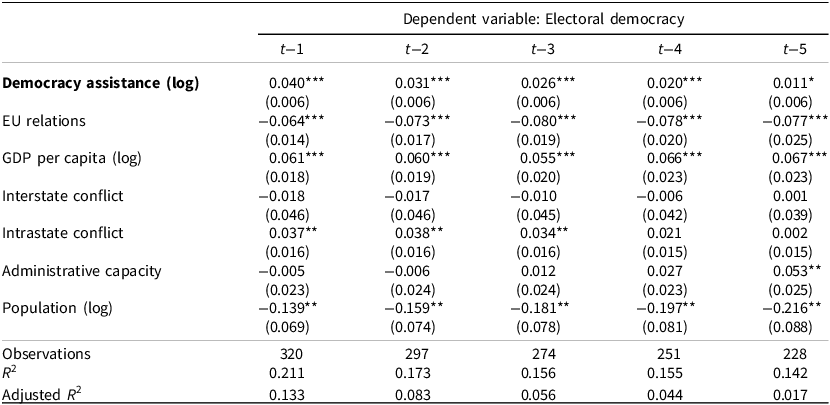
This section reports the results of our time-series cross-sectional regression analysis. Hypothesis 1, suggesting that EU democracy assistance increases levels of democracy in recipient states, is confirmed. The independent variable consistently produces positive and statistically significant effects across all models that employ different lags (Table 1). The higher the level of assistance allocated in previous periods, the higher the level of electoral democracy. The results should be interpreted as a percentage change in democracy since the independent variable is a log of assistance. In other words, a 1 percent increase in democracy assistance boosts electoral democracy by 0.01–0.04 units (on the range 0–1). The decreasing size of the coefficients in models with varying lags (from t–1 to t–5) suggests that the positive impact of democracy assistance on electoral democracy decreases over time.
Effects of democracy assistance on electoral democracy

Table 1. Long description
The table presents the results of a regression analysis examining the impact of different factors on electoral democracy over various time lags. It includes columns for different time lags (t-1 to t-5) and rows for different variables such as Democracy assistance (log), EU relations, GDP per capita (log), Interstate conflict, Intrastate conflict, Administrative capacity, and Population (log). Each cell contains a value representing the effect size and its standard error. The table also includes the number of observations, R-squared, and adjusted R-squared values for each model. Notable trends include the positive effect of democracy assistance and GDP per capita on electoral democracy, and the negative effect of EU relations and population size.
Note: Models are estimated using a fixed-effects model with Driscoll-Kraay robust standard errors. Levels of statistical significance: *p < 0.1; **p < 0.05; ***p < 0.01.
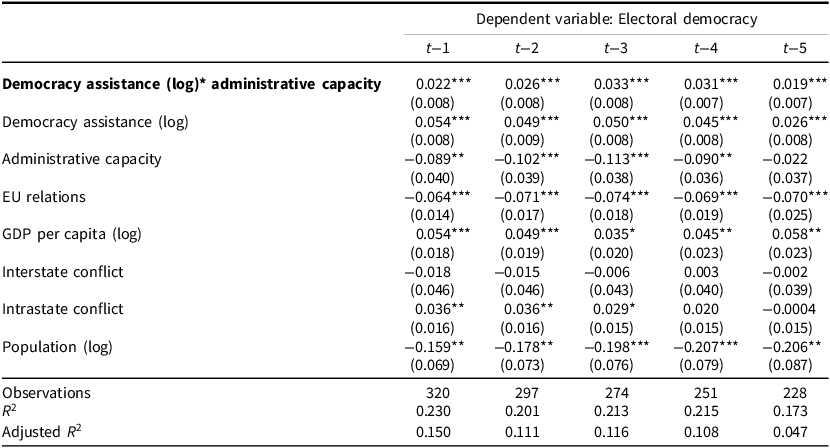
The test for Hypothesis 2 also reveals encouraging results. The interaction term between (log) democracy assistance and administrative capacity is consistently positive and statistically significant across all models (Table 2). This suggests that, jointly, democracy assistance and administrative capacity have a positive effect on the level of democracy. The results demonstrate that the effects persist and increase over time up to year 3, after which they gradually decrease. Unlike the results reported in Table 1, the size of the effects increases with time, indicating that when democracy assistance is provided to countries with higher administrative capacity, it is more likely to have a longer-lasting positive effect on democracy.
Conditional effects of democracy assistance on electoral democracy

Table 2. Long description
A table with six rows and eleven columns comparing the effects of democracy assistance on electoral democracy over time. The columns are labeled with time lags (t-1 to t-5) and the rows are labeled with different variables including Democracy assistance (log)* administrative capacity, Democracy assistance (log), Administrative capacity, EU relations, GDP per capita (log), Interstate conflict, Intrastate conflict, Population (log), Observations, R-squared, and Adjusted R-squared. Each cell contains numerical values representing the coefficients and standard errors for each variable at different time lags. Notable trends include consistently positive and significant effects of democracy assistance and administrative capacity on electoral democracy up to year 3, followed by a gradual decrease. The table also shows the number of observations and R-squared values for each model.
Note: Models are estimated using a fixed-effects model with Driscoll-Kraay robust standard errors. Levels of statistical significance: *p < 0.1; **p < 0.05; ***p < 0.01.
Interestingly, the negative coefficient for administrative capacity indicates that at low levels of EU democracy assistance, higher administrative capacity is associated with lower levels of democracy (Table 2).Footnote 9 Empirically, this pattern is consistent with countries that receive little EU democracy support, such as Belarus, Algeria, and Azerbaijan (see Appendix Figure A4). In these contexts, stronger administrative capacity is associated with lower democracy scores. This again highlights the dual nature of administrative state capacity: in more democratic states, it can facilitate the positive effects of external assistance, whereas in authoritarian countries, it may be used to further suppress civil and political rights, as in Belarus.
To visualise the results reported in Table 2, we report the results in a conditional marginal effects plot in Appendix Figure A5. It illustrates the conditional marginal effects of lagged (log) financial assistance on electoral democracy across observed levels of state capacity (ranging from −1.8 to +1.3), rather than the maximum values the variable can take per its design. The estimates at the extremes of the administrative state capacity distribution should nevertheless be interpreted cautiously because relatively few observations fall in these regions (see Appendix Figure A6). In all, consistent with the results reported in Table 2, the estimated effect of financial assistance increases as state capacity improves.
We also find that intrastate conflict is positively associated with democracy (Tables 1 and 2), which at first glance might seem counterintuitive. This result can be explained by the fact that some countries, for which intrastate conflict is coded as “1,” enhanced their democracy in the presence of conflicts (e.g., Georgia post-2008 and Ukraine post-2014). Here, the association between the two variables can be explained by the fact that, in the context of wars with Russia or Russia-supported separatist groups, states have few viable regional partners to turn to other than the EU. To deepen political and economic relations with the EU, they must improve their democratic standards.
Additionally, the EU relations variable is negatively associated with democracy (Tables 1 and 2). This echoes the findings of Shyrokykh and Solander (Reference Shyrokykh and Solander2025), who explain the negative association by the protracted process of enlargement, particularly among candidate countries in the Western Balkans and Türkiye. Many of the candidate countries have been disappointed about the protracted accession process, which ultimately led to democratic stagnation and the halting of democratic reforms (Gafuri and Muftuler-Bac, Reference Gafuri and Muftuler-Bac2021). A common criticism voiced in those countries was that existing member states do not want new member states to join the Union, which ultimately deprived candidate countries of the incentive to carry out democratic reforms, as the prospects of merit-based accession were no longer credible (ibid). It is also worth noting that democracy assistance, administrative state capacity, and EU integration are closely linked, as the accession process presupposes substantial administrative reforms and economic development. At the same time, eligibility for aid as defined by the OECD is primarily determined by income-based criteria targeting countries in greater need. As countries move closer to EU membership, they tend to improve their economic conditions, which may gradually reduce their eligibility for such aid, while simultaneously strengthening their state capacity.
Robustness checks
To assess the robustness of the findings obtained using the fixed-effects model with Driscoll-Kraay robust standard errors, we conduct several checks and report the results in the Appendix. First, we add additional control variables. We add EU aid for other purposes (total EU aid in USD millions) as it can indirectly affect democracy. We take the data from the OECD (2023). Then, we add a control for economic agreements between the EU and each country in our dataset. Such agreements may lock in democratic standards, as trade agreements are conditional on respect for fundamental values, and the more advanced the agreements, the stronger the lock-in effect. We construct a variable that captures the degree of formalised, treaty-based economic integration with the EU, rather than all forms of trade preferences. It is coded as follows: 0 = no agreement regulating cooperation is in force; 1 = Technical Assistance to the Commonwealth of Independent States is in force; 2 = Partnership and Cooperation Agreement is in force; 3 = (Stabilisation and) Association Agreement is in force. The data are coded based on Shyrokykh (Reference Shyrokykh2020) and complemented by EU documents (European Union, 2020; European Union, n.d.). Compared to agreements with limited scope, such as the Generalised Scheme of Preferences (GSP) and GSP+, agreements that we code are broader in sectoral coverage. Additionally, only Syria currently benefits from GSP.Footnote 10 The results are reported in Appendix Tables A2 and A3.
Second, we use two-way fixed effects to account for exogenous time-specific shocks (see Appendix Table A4). Next, we substitute the original measure of democracy assistance in (log) million USD by a measure of democracy assistance per capita in USD. Appendix Table A5 reports the results of the analysis. In the main model, we report results in (log) million USD rather than per capita because democracy assistance targets state institutions rather than individual citizens.
Additionally, we substitute the polyarchy index with the V-Dem liberal democracy index as an alternative measure of democracy. Interestingly, the results are of a similar size, although smaller than those from models with electoral democracy as the dependent variable. This indicates that democracy assistance has a greater effect on electoral democracy than on liberal democracy, confirming the results of earlier work. The difference in the coefficient sizes can be attributed to the political costs for incumbents of improving the protection of citizens’ political and civil rights (Shyrokykh, Reference Shyrokykh2019). Results are reported in Appendix Table A6.
Moreover, in addition to the models with multiple lags reported in the section above, which, by themselves, may partially address concerns about endogeneity, the results are checked against two-stage least squares models using the instrumental variable approach. The potentially endogenous variable is democracy assistance, which is instrumented using its one- and two-year lagged values. Because these values are taken from earlier years, they are unlikely to be affected by current levels of democracy, while still predicting current levels of assistance. Results are reported in Table A7. Following standard practice, the first-stage and second-stage results are reported separately to illustrate both the relevance of the instruments and the estimated causal effect. Similar to the results reported in Table 1 above, an increase in democracy assistance is associated with an increase in democracy. This suggests that endogeneity bias is limited. Taken together, the results obtained with alternative models are consistent with those reported above.
Last, to capture specific regional dynamics which may define a country’s trajectory of democratic development, we include dummy variables for three regions: Southern neighbourhood, Eastern partnership, and the MENA region (0 = not belonging to a region; 1 = belonging to a region). Because these variables are time-invariant and cannot be estimated in fixed-effects models, we estimate this model using random effects (Appendix Table A8).
Conclusion
As EU member states and institutions invest increasingly more in democracy assistance in the neighbourhood (primarily as a result of enlargement and the European Neighbourhood Policy), it is crucial to understand the effects of this investment and the conditions under which it is more likely to affect the level of democracy in beneficiary countries. To that end, we examined the nexus between democracy assistance and the administrative capacity of recipient states, revealing that lower levels of administrative capacity may constrain the effect of EU democracy assistance. In doing so, we contribute to the debate on the Union’s democracy promotion policy in the neighbourhood and the conditional factors that may facilitate or obstruct its effects. We conclude that states with established administrative systems and well-functioning institutions can facilitate the positive effects of these funds, ensuring their effective allocation and implementation. Without such capacity, democracy assistance can become a burden and will not achieve its initial intent.
However, one should not forget the ambivalent nature of state capacity. On the one hand, high state capacity can reinforce democracy by enabling governments to effectively implement democratically adopted policies, enforce the rule of law, and provide essential public goods such as security, education, healthcare, and infrastructure. Effective and impartial public administration also helps ensure free and fair elections, protect citizens’ rights, and strengthen trust in democratic institutions. As a result, citizens are more likely to view democratic governance as legitimate and responsive.
On the other hand, strong state capacity can also undermine democracy if it is not constrained by effective checks and balances. A highly capable state possesses extensive administrative and coercive resources that governments may use to centralise power, weaken political opposition, or restrict civil liberties. Professional bureaucracies, police forces, and intelligence agencies can facilitate surveillance and repression, while insulated administrative elites may reduce democratic accountability by exercising considerable influence over policymaking without adequate public oversight. Moreover, high state capacity can contribute to the stability and resilience of authoritarian regimes by enabling them to govern effectively and provide public goods without expanding political participation. Belarus and Azerbaijan (which currently do not receive much EU funding) are such non-democratic states with high degrees of (administrative) state capacity and serve as examples of how states can use their capacity to oppress political opposition and publicly voiced dissent.
Consequently, the impact of state capacity on democracy depends not only on the strength of state institutions but also on the existence of democratic constraints that ensure state power is exercised in an accountable and transparent manner. Hence, to ensure that democracy assistance exerts positive effects on levels of democracy, democracy promoters also need to consider carefully how and when to contribute to the strengthening of administrative state capacity. Further research should contribute to identifying those assistance-giving strategies that best combine the support for democratisation and the support for strengthening state capacity.
Our aim in the contribution at hand has been less ambitious. In accounting for differing administrative state capacity across the European Neighbourhood, our study reveals its conditional effect on EU democracy assistance. Consequently, the analysis yields insights that contribute to a deeper theoretical understanding of international democracy promotion while also informing policy debates regarding the design and application of EU external governance tools.
Our findings suggest that EU donors should be sensitive to the domestic conditions in their beneficiaries, particularly the state’s administrative capacity. In states with higher administrative capacity, democracy assistance might be more likely to be better absorbed than in states with lower administrative capacity; however, a separate study on funds absorption is needed. From a conceptual point of view, future research could focus on the different dimensions of administrative state capacity to examine which administrative requirements related to democracy assistance have a particularly strong conditioning effect on the recipient’s level of democracy. This would not only advance our understanding of the effects of democracy assistance but also improve our understanding of (administrative) state capacity. Additionally, future research should investigate in detail how and via what instruments the EU supports capacity building in beneficiary countries and to what effect. It is also essential to establish whether and how supporting a state’s administrative capacity could play into the hands of incumbent authoritarian elites, contributing to the stabilisation of authoritarian or hybrid regimes. It would also be valuable to investigate the effect on levels of democracy in countries that have experienced substantial democratic deficits beyond the EU neighbourhood.
Supplementary material
The supplementary material for this article can be found at https://doi.org/10.1017/S1755773926100745
Data availability statement
The data and the code for reproducing the results reported in this article can be found at: https://github.com/shikarina/Administrative_State_Capacity_and_Aid
Acknowledgements
We are grateful to the editors and three anonymous reviewers for their valuable advice. Previous versions of this paper have been presented at the ECPR Joint Sessions of Workshops 2025 and the ISA Annual Convention 2025. We thank Marianne Kneuer, Leonie Reicheneder, Jonas Wolff, and Nea Solander for their valuable feedback on previous versions of this paper. Further, we thank Dusan Ristic, Nea Solander, Renee Haegele, Julius Bopp, Lilly Blättner and Julius Köster for their support as research assistants.
Author contributions
All authors equally contributed to the manuscript.
Financial support
This paper was written within the Horizon Europe Research Consortium “Embracing Change: Overcoming Obstacles and Advancing Democracy in the European Neighbourhood (EMBRACE),” funded by the European Union under Grant Agreement 101060809.
Competing interests
The authors declared no potential conflicts of interest with respect to the research, authorship, and/or publication of this article.
Ethical standards
Not applicable.
Consent to participate
Not applicable.
Consent for publication
Not applicable.
Editing assistance
The manuscript received language editing by KRF-Research: https://www.krf-research.com/.


 Open access

