Introduction
Historically, the systematics of nematodes were based on host specificity, life cycle and morphological features such as the digestive tract, mouth capsule or reproductive organs (Durette-Desset et al., Reference Durette-Desset, Beveridge and Spratt1994). The difficult structure of morphological traits, together with a high level of homoplasy and a lack of information about life traits of many species, led to problems in determining phylogenetic relationships of nematodes (Chilton et al., Reference Chilton, Gasser and Beveridge1997). Moreover, phylogenetic reconstructions were hindered by the extremely high number of species of these ecologically diverse helminths (Dorris et al., Reference Dorris, De Ley and Blaxter1999). In general, the morphological identification of closely related nematodes species is difficult (Blaxter, Reference Blaxter2003). For this reason molecular techniques were introduced in addition to morphological traits for species identification independent of developmental stages (Gasser, Reference Gasser, Kennedy and Harnett2001). In recent years ribosomal DNA has been used most extensively for investigating phylogenetic relationships of nematode species (Blouin, Reference Blouin2002). Besides the highly variable, non-coding internal transcribed spacer regions (ITS-1, ITS-2), which are commonly used to distinguish between closely related species (Gasser & Newton, Reference Gasser and Newton2000) or for detecting cryptic species (Chilton et al., Reference Chilton, Gasser and Beveridge1995), the slowly evolving 18S (small subunit, SSU) gene region is a useful tool for the analysis of distantly related taxa (Meldal et al., Reference Meldal, Debenham, De Ley, Tandingan De Ley, Vanfleteren, Vierstraete, Bert, Borgonie, Moens, Tyler, Austen, Blaxter, Rogers and Lambshead2007).
The results of the molecular analyses led to a fundamental revision of nematode phylogeny. Since Blaxter et al. (Reference Blaxter, De Ley, Gareys, Liu, Scheideman, Vierstraete, Vanfleteren, Mackey, Dorris, Frisse, Vida and Thomas1998) analysed the phylogenetic relationships of 53 nematode species based on 53 SSU sequences, actually more than 300 SSU sequences of nematode taxa, including parasitic and free-living nematode species, are now known (Blaxter, Reference Blaxter2003). The main focus of most studies was on investigating economically or medically important species, primarily of humans or domestic animals (Lukes et al., Reference Lukes, Horák and Scholz2005). Hence some areas of nematode phylogeny are still underrepresented, especially the species-rich infraorder Spiruromorpha, which includes a heterogeneous group of, mainly parasitic, nematodes. The former order Spirurida has been reclassified several times recently. The division in the suborder Camallanina, which was divided in two superfamilies, and the suborder Spirurina, which was divided into ten superfamilies (Anderson & Bain, Reference Anderson, Bain, Anderson, Chabaud and Willmot1975, Reference Anderson, Bain, Anderson, Chabaud and Willmot1976), was rejected by the introduction of molecular data. The newly defined suborder Spirurina consists of the former suborders Camallanina and Spirurida, which are now reclassified as infraorders, as well as the former orders Ascaridida, Oxyurida and Rhigonematida (Blaxter, Reference Blaxter2003). Actually only few molecular data are known from nematode species of the infraorder Spiruromorpha (Wijová et al., Reference Wijová, Moravec, Horák and Lukes2006).
Free-ranging birds of prey from Germany serve as hosts for many different nematode species. Beside intestinal ascarids, hairworms and strongylid species, the majority of these nematodes belong to the infraorder Spiruromorpha, which live as adults in the stomach of the raptors (Krone & Cooper, Reference Krone, Cooper and Cooper2002) or in the air sacs, like Serratospiculum tendo (Ward & Fairchild, Reference Ward and Fairchild1972). Arthropods are presumed to be intermediate hosts. The birds probably become infected with nematodes by ingesting the intermediate hosts directly or by ingesting small birds or mammals, which serve as paratenic hosts (Anderson, Reference Anderson2000). Morphological features of nematodes from birds of prey are well described (Skrjabin & Sobolev, Reference Skrjabin, Sobolev and Skrjabin1963, Reference Skrjabin, Sobolev and Skrjabin1964, Reference Skrjabin, Sobolev and Skrjabin1965), but actually hardly any molecular data are known.
The aim of the study was therefore to investigate phylogenetic relationships of nematode species from birds of prey, based on SSU sequences. The molecular data were used to verify the traditional morphological systematic of nematodes from birds of prey with a main focus on spirurid species.
Material and methods
Nematode collection
A total of 153 birds of 15 species were examined for nematodes in their digestive tract and respiratory system: 28 white-tailed sea eagles (Haliaeetus albicilla), 18 sparrowhawks (Accipiter nisus), 15 Eurasian buzzards (Buteo buteo), 15 common kestrels (Falco tinnunculus), 15 peregrine falcons (Falco peregrinus), 13 Northern goshawks (Accipiter gentilis), 12 red kites (Milvus milvus), 8 ospreys (Pandion haliaetus), 7 hobbys (Falco subbuteo), 7 marsh harriers (Circus aeruginosus), 5 black kites (Milvus migrans), 4 honey buzzards (Pernis apivorus), 3 Montagu's harriers (Circus pygargus), 2 merlins (Falco columbarius) and 1 rough-legged buzzard (Buteo lagopus). From July 1996 to October 2005 dead birds were obtained from different rehabilitation stations located in the following federal countries of Germany: Berlin, Brandenburg, Baden-Wuerttemberg, Lower Saxony, West Pomerania, Saxony-Anhalt, North Rhine Westphalia, Saxony and Thuringia (in total longitude 47°16′, latitude 5°56′). The birds were sent to the Leibniz Institute for Zoo and Wildlife Research, Berlin, for routine post-mortem examination focused on parasites (Doster & Goater, Reference Doster, Goater, Clayton and Moore1997). The digestive and the respiratory tracts were opened and tissues as well as contents were examined. Nematodes were removed, cleaned in isotonic NaCl solution and stored at − 20°C. Specimens were cleared in lactophenol, examined and photographed using a microscope (Zeiss Axioskop™). The nematodes were identified using the keys of Anderson & Bain (Reference Anderson, Bain, Anderson, Chabaud and Willmot1975, Reference Anderson, Bain, Anderson, Chabaud and Willmot1976) and Skrjabin & Sobolev (Reference Skrjabin, Sobolev and Skrjabin1963, Reference Skrjabin, Sobolev and Skrjabin1964, Reference Skrjabin, Sobolev and Skrjabin1965).
DNA extraction, amplification and sequencing
Genomic DNA was prepared from single adult worms using the QIAGEN DNeasy Tissue Kit (Qiagen GmbH, Hilden, Germany) as recommended by the manufacturer.
The 18S rDNA region was amplified using the primers suggested by Blaxter lab nematode genomics (http://www.nematodes.org). Because of the length of the 1700 bp gene region, the 18S fragment was amplified in 3–4 parts using internal primers. The PCR was performed in a total volume of 25 μl using 1 × buffer, 1.5 mm MgCl2, 50 mm of each dNTP, 0.2 pmol/μl of each primer, 0.02 U/μl of Taq-DNA-polymerase (Eppendorf, Hamburg, Germany) and 0.5 μl of the extracted genomic DNA, under the following conditions: 96°C, 45 s (denaturation); 50°C, 60 s (annealing); 72°C, 60 s (extension) for 30 cycles. In each PCR run a negative control without DNA was included and, in addition, host DNA of each host species was subjected to the same PCR procedure as for nematode DNA. PCR products were detected on 1.5% agarose gel containing 0.1 μg/ml ethidium bromide.
After purifying the PCR products with EZNA Cycle-Pure Kit (Peqlab, Erlangen, Germany) direct cycle sequencing was carried out using the BigDye™ Terminator Cycle Sequencing Ready Reaction Kit 3.1 (Applied Biosystems, Weiterstadt, Germany) following the manufacturer's instructions. Sequencing was performed in both directions using the amplification primers.
Phylogenetic analysis
The parts of the 18S fragments were added together using Bioedit (version 7.0.5.2; T-Hall, Ibis Biosciences, Carlsbad, California, USA; available at http://www.mbio.ncsu.edu/BioEdit/bioedit.html). The sequences were aligned using ClustalX, version 1.4 (available at http://www-igbmc.u-strasbg.fr/BioInfo/ClustalX), and the phylogenetic analyses were performed using MEGA 3.1 (Kumar et al., Reference Kumar, Tamura and Nei2004). With the aligned sequences neighbour-joining and maximum parsimony trees were calculated based on Kimura-2-Parameter (using MEGA 3.1; Kumar et al., 2004). The phylogenetic tree was rooted with the 18S sequence of the cestode Diphyllobotrium latum (DQ925309) used as an outgroup.
Results
Recovered nematodes
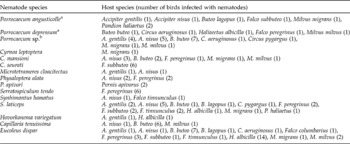
In total 51.7% of the birds of prey were infected with nematodes. The nematodes belonged to 14 species: infraorder Ascaridomorpha: Porrocaecum angusticolle, P. depressum; infraorder Spiruromorpha: Cyrnea leptoptera, C. mansioni, C. seurati, Microtetrameres cloacitectus, Physaloptera alata, P. apivori, Serratospiculum tendo, Synhimantus hamatus, S. laticeps; suborder Rhabditina: Hovorkonema variegatum; order Trichinellida: Capillaria tenuissima, Eucoleus dispar. All nematodes were parasites in the digestive system of the raptors, except the air-sac worm S. tendo, which inhabits the air sacs of peregrine falcons, and the strongylid H. variegatum, which lives in the trachea and bronchi of the birds. The highest number of different nematode species were found in sparrowhawks. Intestinal ascarids of the genus Porrocaecum were the parasites most often diagnosed. Porrocaecum spp., as well as the hairworm Eucoleus dispar, which live in the mucosa of the upper alimentary tract, had the broadest host range. Both were detected in 12 of 15 examined host species. The host specificity of parasitic nematodes from raptors was on average low, six of nine nematode species had more than one host. The highest host specificity was found in spirurid nematodes. On average 2–4 individuals of each species were found, no macroscopic pathological alterations were diagnosed. In table 1 all diagnosed nematodes are listed with their hosts.
The occurrence of nematode species in avian hosts from July 1996 to October 2005.

a Identification based on DNA sequencing.
b Identification based on morphological traits.
Molecular analysis
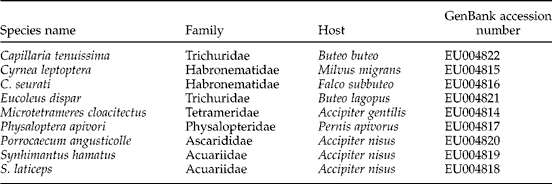
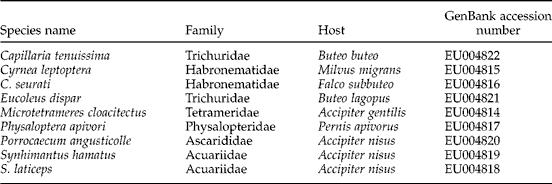
The PCR products were of similar size on the agarose gel. No PCR product of the negative controls or of the host DNA samples was amplified. Nine new 18S sequences of parasitic nematodes from birds of prey were obtained in this study (see table 2). The length of the 18S fragments ranged from 1715 bp (Porrocaecum angusticolle) to 1767 bp (Eucoleus dispar, Capillaria tenuissima), the average length was 1729 bp. The G+C content ranged from 49.2% (Cyrnea leptoptera) to 50.2% (C. tenuissima). The average sequence variation based on Kimura-2-Parameter, including all sequences was 13.5%, the average distance in the infraorder Spiruromorpha was 3.1%. Sequence variation in the infraorder Spiruromorpha ranged from 0.4% to 4.6%. The distance between the distantly related nematode species Hovorkonema variegatum and Capillaria tenuissima was 40.3%.
List of nematodes from which the 18S rDNA gene region was sequenced, with family, host and NCBI GenBank accession number.
Phylogenetic analysis
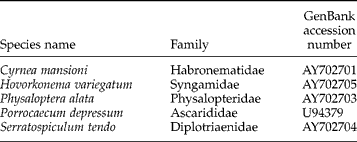
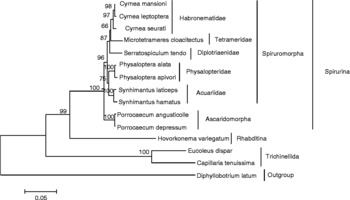
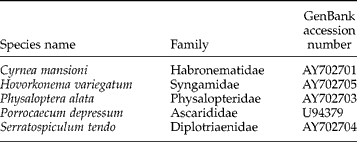
The dataset was completed with five 18S sequences obtained from NCBI GenBank, which are listed in table 3. Grouped together with the outgroup Diphyllobotrium latum, the sequences resulted in a stable alignment. Both neighbour-joining and maximum parsimony analysis revealed almost identical and well-supported trees. Variation of the outgroup did not change the internal branching pattern. The neighbour-joining tree of parasitic nematodes from birds of prey based on 18S sequences is shown in fig. 1.
List of nematode species from which the 18S rDNA gene region was obtained from NCBI GenBank, with family and GenBank accession number.
Phylogenetic relationships of parasitic nematodes from birds of prey, based on neighbour-joining analysis, Kimura-2-Parameter, 1000 bootstrap replications, with Diphyllobotrium latum as the outgroup.

Discussion
The number of raptors infected with nematodes (51.7%) is similar to that found by Lierz et al. (Reference Lierz, Göbel and Schuster2002) (48.8% of 84 wild raptors and owls from Germany infected with nematodes). A higher number of 89% of infected raptors was reported by Krone (Reference Krone, Lumeij, Remple, Redig, Lierz and Cooper2000), who examined 194 free-ranging birds of prey from Germany. Spirurid nematodes were diagnosed in 34% of the raptors examined in the present study. Again, Krone (Reference Krone, Lumeij, Remple, Redig, Lierz and Cooper2000) diagnosed a higher prevalence of 43% of spirurid nematodes in his study. These differences in prevalence can be explained by differences in species composition of the investigated raptors. Lierz et al. (Reference Lierz, Göbel and Schuster2002) speculated that birds of prey with a broad prey spectrum, such as Eurasian buzzards, serve as host for a broad spectrum of different endoparasite species. Contradicting Lierz et al. (Reference Lierz, Göbel and Schuster2002), in the present study the sparrowhawk, which preys mainly on small passerine birds, was the host with the highest diversity of nematode species. According to the data of Krone (Reference Krone, Lumeij, Remple, Redig, Lierz and Cooper2000) and Lierz et al. (Reference Lierz, Göbel and Schuster2002) the host specificity of the nematodes was low. No macroscopic pathological alterations due to nematode infection were observed. In general, the pathogenicity of nematodes in birds of prey is low, depending on the number of nematodes and health status and age of the hosts (Krone & Cooper, Reference Krone, Cooper and Cooper2002).
The sequenced 18S gene regions ranged from 1682 to 1767 bp. These data are in agreement with the results of Wijová et al. (Reference Wijová, Moravec, Horák and Lukes2006), who sequenced 18S gene regions of nematode species of the suborder Spirurina ranging from 1642 to 1787 bp.
Two different species of the genus Porrocaecum could be identified: Porrocaecum depressum and Porrocaecum angusticolle (Hartwich, Reference Hartwich1975).
The phylogenetic tree of the nematodes of birds of prey agrees with the morphological classification. According to Meldal et al. (Reference Meldal, Debenham, De Ley, Tandingan De Ley, Vanfleteren, Vierstraete, Bert, Borgonie, Moens, Tyler, Austen, Blaxter, Rogers and Lambshead2007) ascarid nematodes of the genus Porrocaecum are closely related to the Spiruromorpha. Our study confirms the placement of the former order Ascaridida in the recently defined suborder Spirurina.
Chabaud & Bain (Reference Chabaud and Bain1994) analysed the evolutionary relationships of Spirurida based on life cycle and morphological traits. They suggest that the spirurid family Physalopteridae separated early from the spirurid families Habronematidae, Tetrameridae, Acuariidae and Diplotriaenidae. This hypothesis is rejected by the analysis of the 18S gene region. In the phylogenetic tree shown in fig. 1, the family Physalopteridae forms a well-supported clade together with the family Acuariidae. To confirm this result more sequences of nematodes from other spirurid families would be necessary.
In this study the phylogenetic relationships of parasitic nematodes of raptors from Germany were compared with traditional morphological systematics. A good congruence between the morphological systematics and the constructed 18S phylogenetic tree was observed. The family Physalopteridae is more closely related to the family Acuariidae than to the families Habronematidae and Tetrameridae according to the analysis of the 18S gene region.