Picture the following situation: parents Tim and Jan are taking their five-your-old daughter Hannah to the park for a picnic. On the way to the park, Tim comments to Jan that the weather is perfect for a picnic. As they unpack their food, it begins to rain. Jan comments, ‘What perfect weather for a picnic’. How will Hannah interpret this remark? Will she recognize her mother's use of sarcasm? How will she view her mother's non-literal criticism of her father's faulty weather forecast – as being playful or hurtful? As illustrated, one of the challenges children face in metalinguistic development is appreciating non-literal language, for which a speaker's intentions differ from the literal meanings of their words. Sarcasm is one form of non-literal language which children are likely to encounter in their daily discourse experiences with some regularity; sarcastic remarks are used in 8 percent of conversational turns between adult friends (Gibbs, Reference Gibbs2000). Given sarcasm's conventionality, it is particularly interesting to investigate the development of children's ability to comprehend the sarcastic speaker's meaning and to appreciate the speaker's pragmatic purpose in speaking sarcastically.
Children's understanding of sarcastic speech
There is evidence that children begin to comprehend the sarcastic speaker's non-literal meaning and pragmatic intent to ridicule or to be ‘mean’ around six years of age (Dews et al., Reference Dews, Winner, Kaplan, Rosenblatt, Hunt, Lim, McGovern, Qualter and Smarsh1996; Harris & Pexman, Reference Harris and Pexman2003; Hancock, Dunham & Purdy, Reference Hancock, Dunham and Purdy2000). Further, research suggests that after about age six children attend to relevant sources of information in attributing sarcastic intent, such as incongruity (Ackerman, Reference Ackerman1983), echoic mention (Hancock et al., Reference Hancock, Dunham and Purdy2000), intonation (Capelli, Nakagawa & Madden, Reference Capelli, Nakagawa and Madden1990) and speaker personality traits (Pexman, Glenwright, Hala, Kowbel & Jungen, Reference Pexman, Glenwright, Hala, Kowbel and Jungen2006). The ability to use these cues and to appreciate the social functions of sarcasm continues to develop through middle childhood, and there is evidence that this ability is still improving at age twelve or thirteen (Demorest, Meyer, Phelps, Gardner & Winner, Reference Demorest, Meyer, Phelps, Gardner and Winner1984).
One crucial social cognitive development that allows children to understand the meaning and purpose of non-literal speech acts such as sarcasm is a child's incremental level of understanding of the speaker's mental state (i.e. theory of mind). Over the past thirty years, research has documented that children show a developmental progression whereby they first distinguish a speaker's use of non-literal language from literal language by determining what the speaker believes, and later come to appreciate the speaker's intent in using non-literal language (for a review see Filipova & Astington, Reference Filipova and Astington2008). For instance, Ackerman (Reference Ackerman1983) suggested that five- to six-year-old children can distinguish sarcasm from literal language (i.e. they infer what the sarcastic speaker believes) but they cannot appreciate the sarcastic speaker's intended pragmatic purpose for using sarcasm (i.e. what the speaker intends) because this second inference requires further knowledge. Hancock et al. (Reference Hancock, Dunham and Purdy2000) revisited this issue by presenting five- to six-year-olds with videotaped scenarios that ended with sarcastic criticisms (e.g. ‘You are a really good basketball player’) and literal criticisms (e.g. ‘You are a really bad basketball player’) with similar results: children could understand what the sarcastic speaker believed (e.g. that the listener was not a good basketball player) but struggled to appreciate the speaker's intent in making the remark (e.g. to tease, to mock and/or to be somewhat mean to the listener). Hancock et al. (Reference Hancock, Dunham and Purdy2000) explained this two-step developmental progression in sarcasm appreciation by citing prior claims that comprehension of sarcastic speaker belief requires first-order reasoning about belief states whereas appreciation of sarcastic speaker intent requires second-order reasoning about belief states (e.g. Demorest et al., Reference Demorest, Meyer, Phelps, Gardner and Winner1984; Winner & Leekam, Reference Winner and Leekam1991). This explanation is grounded in theory of mind studies showing children develop the ability to make first-order mental state attributions between four and five years of age but cannot attribute second-order belief states until six to eight years of age (Perner & Wimmer, Reference Perner and Wimmer1985; Sullivan, Winner & Hopfield, Reference Sullivan, Winner and Hopfield1995; Winner & Leekam, Reference Winner and Leekam1991). The link between sarcasm understanding and second-order mental state reasoning has also been established for populations who have difficulty with both abilities, such as children with autism (Happé, Reference Happé1993) and people with closed head injuries (Dennis, Purvis, Barnes, Wilkinson & Winner, Reference Dennis, Purvis, Barnes, Wilkinson and Winner2001; McDonald & Pearce, Reference McDonald and Pearce1996).
While it is clear that sarcasm appreciation requires second-order mental-state reasoning, there is evidence that this skill also demands social learning (Pexman & Glenwright, Reference Pexman and Glenwright2007). Children require a certain degree of conversational awareness about sarcasm, acquired through personal experience, to appreciate that sarcasm can be used to be playful, to tease and to convey humor. Accordingly, children's sarcasm appreciation is linked to their parents' self-reported sarcasm use (Hala, Pexman, Climie, Rostad & Glenwright, Reference Hala, Pexman, Climie, Rostad, Glenwright, Carpendale, Iarocci, Müller, Sokol and Youngin press) and children show higher levels of comprehension for more conventional sarcastic speech forms like sarcastic criticisms compared to less conventional forms like sarcastic compliments (de Groot, Kaplan, Rosenblatt, Dews & Winner, Reference Dews and Winner1995; Dews & Winner, Reference Dews, Winner, Mandell and McCabe1997; Hancock et al., Reference Hancock, Dunham and Purdy2000; Harris & Pexman, Reference Harris and Pexman2003). Indeed, different types of non-literal remarks serve different pragmatic purposes and children must learn to appreciate these distinctions.
Sarcasm and verbal irony are both non-literal language forms with which a speaker communicates a meaning opposite to the literal sense of an utterance and reminds listeners of an unmet expectation (Lee & Katz, Reference Lee and Katz1998). Studies of children's interpretation of non-literal language have tended to ignore the distinction between sarcasm and verbal irony, treating these terms as synonyms. Most research concerning children's comprehension of ‘verbal irony’ has focused on sarcasm. While the terms ‘sarcasm’ and ‘verbal irony’ are commonly used interchangeably in the developmental literature, research on adults' perceptions has shown an implicit distinction between these figurations.
Adults' interpretations of sarcasm and verbal irony
When adults read statements directed at different topics, they judge statements referring to a specific individual's failure to meet an expectation as sarcastic but they judge statements referring to expectations that are unmet, but at the fault of no particular individual, as ironic (Lee & Katz, Reference Lee and Katz1998). That is, adult perceptions reveal a tacit recognition that sarcasm involves the availability of a specific target but verbal irony does not (Kreuz, Reference Kreuz2000; Kreuz & Glucksberg, Reference Kreuz and Glucksberg1989; Lee & Katz, Reference Lee and Katz1998). Adult data also indicated that sarcastic speakers are perceived as expressing disapproval with the intent to hurt the target (Kreuz & Glucksberg, Reference Kreuz and Glucksberg1989). Analyses of adult perceptions show that speaker attitude for sarcastic statements is perceived as more negative than for ironic statements. Sarcasm and verbal irony both allow the speaker to express a critical attitude with humor but sarcasm serves an additional ridiculing function that irony does not: the target of sarcastic criticism is a person while the target of ironic criticism is not personal. Consider these versions of the example presented previously:
(1) On the way to the park, Tim comments to Jan that the weather is perfect for a picnic. As they unpack their food, it begins to rain. Jan comments ‘What perfect weather for a picnic’.
(2) Tim and Jan walk to the park to have a picnic. As they unpack their food, it begins to rain. Jan comments ‘What perfect weather for a picnic’.
In (1), Jan's sarcastic criticism targets Tim's inaccurate weather forecast. In contrast, in (2), Jan's ironic criticism targets the generally agreed-on preference for good weather during picnics and so no particular person is criticized.
The issue of how people perceive non-literal language is much debated. It has been argued that no single theory adequately accounts for all instances of sarcasm or irony (Pexman, Reference Pexman2008; Utsumi, Reference Utsumi2000). Importantly, no developmental theory of sarcasm and irony comprehension exists and there is a clear need for more research on children's impressions of sarcastic and ironic language for future theory development. While there is a growing body of literature concerning children's understanding of sarcasm, it remains unexplored whether children, like adults, are sensitive to the availability of a specific target to distinguish between sarcasm and verbal irony. The distinction between sarcasm and irony is a particularly interesting one because it reflects a subtle distinction in terms of understanding others' minds. That is, the distinction between sarcasm and irony depends on sensitivity to the way others will view a remark as a function of the others' personal stake in the subject of criticism – sarcastic remarks are made with the intent to criticize, mock or tease a particular person whereas ironic remarks are less personal by virtue of lacking a particular victim. Along these lines, sarcasm can be viewed as a riskier speech form than irony for the speaker because the target who has a personal stake in the subject of criticism may perceive speaker attitude as being particularly hurtful rather than playful. Consequently, sensitivity to this distinction reflects appreciation of the non-literal speaker's attitude coupled with understanding how interlocutors might interpret speaker attitude from their own vantage points and, as such, constitutes an impressive social–cognitive achievement.
The present research
Our main goal was to investigate whether five- to six-year-old children and nine- to ten-year-old children distinguish between sarcastic criticisms and ironic criticisms in order to examine the development of this distinction. Children were presented with puppet shows depicting situations where: (1) a speaker commented on a specific target's failure to meet an expectation (sarcasm); or (2) a speaker commented on a non-specific target's failure to meet a speaker's expectation (irony). We did not expect that children would be familiar with the terms ‘sarcasm’ and ‘irony’ but rather that they would have different perceptions of personal and non-personal criticism. These perceptions were gauged in three different ways, each allowing for children to demonstrate distinct perceptions of sarcasm and irony. Based on results from the described sarcasm comprehension literature, we expected that five- to six-year-olds would be just beginning to comprehend the meaning of non-literal criticisms, and that this emerging proficiency would be demonstrated by lower accuracy on appraisals of the non-literal speaker's belief. With emerging appreciation of non-literal language we predicted that the younger children would not show recognition of the distinction between sarcasm and verbal irony. We predicted that nine- to ten-year-olds, however, would be more proficient at comprehending non-literal language, and that this proficiency would be demonstrated by higher accuracy on appraisals of the non-literal speaker's belief. With stronger appreciation of non-literal language and, with consideration of research showing improvement in empathy and social perspective-taking skills late in middle childhood (e.g. Bryant, Reference Bryant1982), nine- to ten-year-olds should demonstrate sensitivity to the distinction between sarcasm and verbal irony in the following ways as afforded by our methodology.
First, children were asked to rate speaker attitude for sarcastic criticisms and ironic criticisms by indicating how nice or mean they viewed the speaker puppet's intentions to be in making the remark. Here, recognition of the distinction between sarcasm and irony would be evidenced if children rated speaker attitude for sarcastic criticisms (directed at specific targets) as more ‘mean’ than ironic criticisms (directed at non-specific targets). We expected that by nine or ten years of age children should be able to distinguish sarcasm from irony and they should show an appreciation of how these two figurations reflect distinct speaker attitudes, but we did not expect five- to six-year-olds to show evidence of this distinction. Second, children were asked to indicate whether they identified more with the speaker or target/listener in the puppet show. We reasoned that if children differentiated between sarcasm and irony they should identify with speakers of sarcastic criticisms less often than with speakers of ironic criticisms. Our reasoning for this prediction was twofold. We expected that age-related enhancement in perspective taking would help children to consider the feelings of the person being sarcastically criticized and they would therefore be more inclined to relate to the person being criticized compared to the speaker whose intent is to be mean. In addition, we reasoned that older children would be motivated, to some degree, to win the approval of others by behaving like ‘good girls’ and ‘good boys’ (Kohlberg, Reference Kohlberg and Goslin1969). In order to meet the expectations of these roles children may be less inclined to identify with a speaker who sarcastically criticizes and therefore intends to be mean.
Third, children were asked to justify or explain their identification response and we reasoned that these justifications should reveal stronger disapproval for sarcastic criticisms than for ironic criticisms. We hypothesized that justifications from the younger age group would express comparable levels of disapproval for all non-literal criticisms whereas justifications from the older age group would express higher levels of disapproval for sarcastic criticisms than for ironic criticisms.
METHOD
Participants
Participants were 71 five- to six-year-olds (34 boys, 37 girls, aged 5 ; 3 to 6 ; 11, M=6·2) and 71 nine- to ten-year-olds (41 boys, 30 girls, aged 9 ; 0 to 10 ; 11, M=10·9). Children in the younger age group were recruited from kindergarten and grade 1 classrooms, whereas the children in the older group were recruited from grade 5 and grade 6 classrooms. All of the children were from middle-class families and spoke English as their primary language.
Materials
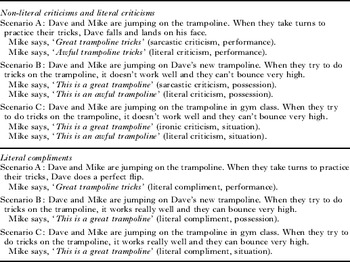
Nine puppet show scenarios depicting common children's activities were presented to each child. To thoroughly test our central research question, we operationalized a specific target of ridicule in two ways: in terms of a target's performance and in terms of a target's possession. In the performance condition, the speaker commented on a target's ability to perform an everyday activity (e.g. jumping on a trampoline). In the possession condition, the speaker commented on the quality of the target's possession (e.g. a bike). When the target was non-specific, the speaker commented on the quality of something in the situation that did not belong to an identified party (situation condition). Thus, there were three topic conditions: a target's performance, a target's possession or a general situation. Three puppet shows were depicted for each statement type: non-literal criticisms, literal criticisms and literal compliments, and each statement type was presented with each topic condition: target's performance, target's possession or situation (see Table 1). Within the three non-literal criticism shows, two shows presented sarcastic criticisms where a specific target was criticized and one presented an ironic criticism where a non-specific target was criticized. For the sarcastic criticism (performance condition) shows, the speaker puppet evaluated a target puppet's failed performance of an activity (e.g. doing tricks on a trampoline, falling, and landing on his/her face). For the sarcastic criticism (possession condition) shows, the puppet evaluated a target's possession (e.g. Dave's new trampoline) as being faulty in some way (e.g. unable to bounce very high). In the ironic criticism shows, the speaker remarked on a situation where there was no obvious party responsible for an unmet expectation or unexpected outcome (e.g. a faulty trampoline used in gym class). Shows where literal criticisms were presented took the same form as the shows where non-literal criticisms were presented, except that these shows ended in a literal criticism. Literal compliments served as control statements for non-literal criticisms with the same wording and opposite meaning to ensure that correct speaker belief answers varied across puppet shows.
Sample puppet show scenarios

After each puppet show, children were asked whether the speaker made a positive evaluation or a negative evaluation to determine whether they correctly attributed the speaker's belief. Next, children rated the speaker's attitude in making the remark on a nice–mean scale to evaluate whether they correctly understood the speaker's attitude. Then children were asked an identification question to assess which puppet (e.g. speaker or target/other) they perceived to be most like them, and they were asked to explain their choice in the justification question. For literal compliments the speaker belief and attitude were positive, whereas for the literal and non-literal criticisms the speaker belief and attitude were negative. Dialogues for the puppet shows were prerecorded by a narrator such that sarcastic criticisms and ironic criticisms were voiced with a prolonged articulation and exaggerated pitch; these are the intonational features that developmental studies have identified as representing sarcasm/verbal irony (e.g. Ackerman, Reference Ackerman1983; Capelli et al., Reference Capelli, Nakagawa and Madden1990; de Groot et al., Reference de Groot, Kaplan, Rosenblatt, Dews and Winner1995; Nakassis & Snedeker, Reference Nakassis, Snedeker, Greenhill, Hughs, Littlefield and Walsh2002). Literal criticisms were voiced at the pace of regular speech with a lower pitch to sound cold and blunt whereas literal compliments were voiced at regular pace with a higher pitch to sound warm and sincere.
Procedure
Prior to testing, children were trained on the Nice/Mean rating scale (Figure 1). The children were told that the six faces on the scale corresponded to the following evaluations, from left to right: very nice, nice, a little bit nice, a little bit mean, mean and very mean.
Nice/Mean Scale for speaker attitude ratings.

After each puppet show, children were asked the following questions with specific wording adapted to the relevant condition and show. The examples below illustrate the wording of these questions for shows in the possession condition:
(1) Speaker belief. Participants were asked whether the speaker meant what he or she said to assess whether children interpreted the speaker's statement as a compliment or a criticism. For example, ‘When Mike said ‘This is a great trampoline’, did he think that Dave's new trampoline was good or bad?'
(2) Speaker attitude. Children were asked to rate the speaker's attitude conveyed by the remark on the Nice/Mean scale (e.g. ‘Point to one of these faces to show me how mean or nice Mike was trying to be when he said ‘This is a great trampoline’.')
(3) Identification. Children were asked with which puppet they most identified (e.g. ‘Which of these puppets acts most like you – Dave or Mike?’).
(4) Identification justification. Children were asked why they made that choice (e.g. ‘You said that Mike acts most like you. Why?’).
For Questions 1 and 2 the experimenter repeated the statement made by the speaker puppet with the same intonation used on the audiotape. The experimenter alternated the order of question options (i.e. good/bad, nice/mean, target name/speaker name) across items. The procedure took an average of 25 minutes per participant.
Design
Each child watched a total of nine puppet shows containing three non-literal criticisms (one of each topic condition: sarcastic–performance, sarcastic–possession, ironic–situation), three literal criticisms (one of each topic condition: performance, possession, situation) and three literal compliments (one of each topic condition: performance, possession, situation). Nine versions of the materials were devised so that each puppet show was depicted with every statement and topic condition across participants. Within each version, puppet show order was randomized.
RESULTS
Speaker belief and speaker attitude responses for each statement type for boys and girls were compared with independent t-tests and there were no significant effects of gender. In all cases, results were analyzed with subjects treated as a random factor (i.e. subjects analyses, F 1 or t 1) and, separately, items treated as a random factor (i.e. items analyses, F 2 or t 2). The small number of items (nine puppet shows per participant) reduced the power of the items analyses but the results of these tests were generally consistent with those of the subjects analyses. Results are reported for effects for which the subject analyses were significant and conclusions were based on significant effects in the subject analyses. Responses for literal compliments were not included in these analyses because the literal compliments served as control statements and were not relevant to any research goals.
Speaker belief responses
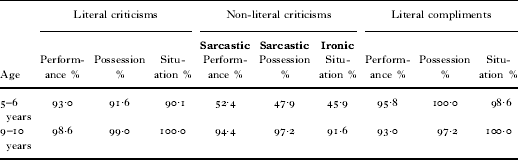
Speaker belief responses were deemed correct when the child indicated that sarcastic criticisms, ironic criticisms and literal criticisms were negative evaluations and that literal compliments were positive evaluations. The percentages of correct speaker belief responses (understanding that a non-literal speaker held a belief opposite to that conveyed by the literal sense of the statement and that a literal speaker held a belief consistent with that conveyed by the literal sense of the statement) were calculated for each age group across the nine conditions and are shown in Table 2.
Percentages of correctly attributed speaker belief for literal criticisms, non-literal criticisms and literal compliments as a function of statement topic and participant age group

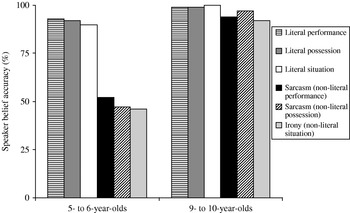
Speaker attitude was considered to be correctly attributed when children indicated that a non-literal speaker held a belief opposite to that conveyed by the literal sense of the statement and that a literal speaker held a belief consistent with that conveyed by the literal sense of the statement. We did not compare participants' speaker belief accuracy to chance levels since others have argued that literal and ironic interpretations are not equally likely alternatives (e.g. Ackerman, Reference Ackerman1983; Grice, Reference Grice, Cole and Morgan1975). That is, in most conversational contexts the literal interpretation is more likely. Instead, we compared the rates of correct appraisals across conditions. The percentages of correctly interpreted speaker belief responses for five- to six-year-olds and nine- to ten-year-olds were compared with a 2 (Age Group: 5–6, 9–10)×2 (Criticism Type: Non-literal, Literal)×3 (Topic: Performance, Possession, Situation) repeated measures ANOVA with age group as a between-subjects factor. This analysis yielded a significant age group by criticism type interaction (F 1(1, 140)=44·32, p<0·001, η2=0·24; F 2(1, 8)=40·66, p<0·001, η2=0·84). The interaction was due to the fact that nine- to ten-year-olds correctly interpreted significantly more non-literal criticisms (M=94·31, SD=17·91) than did five- to six-year-olds (M=49·13, SD=40·20), but both nine- to ten-year-olds (M=99·04, SD=5·66) and five- to six-year-olds (M=91·94, SD=20·40) were highly proficient at interpreting literal criticisms. The three-way interaction was not significant (F 1(2, 280)=1·11, p=0·33, η2=0·07; F 2(2, 16)=0·61, p=0·55, η2=0·07). As illustrated in Figure 2, speaker belief accuracy for both five- to six-year-olds and nine- to ten-year-olds did not vary as a function of statement topic.
Mean speaker belief comprehension accuracy for each age group, as a function of criticism topic condition (literal compliments excluded).

Results of these analyses also included significant main effects of criticism type (F 1(1, 140)=74·14, p<0·001, η2=0·35; F 2(1, 8)=42·18, p<0·001, η2=0·84), topic (F 1(2, 280)=3·09, p=0·05, η2=0·02; F 2(2, 16)=0·47, p=0·64, η2=0·05) and age group (F 1(1, 140)=75·58, p<0·001, η2=0·35; F 2(1, 8)=96·74, p<0·001, η2=0·92). The criticism type by topic interaction was not significant (F 1(1, 140)=1·96, p=0·15, η2=0·02; F 2(2, 16)=0·39, p=0·68, η2=0·05), nor was the topic by age group interaction (F 1(2, 280)=2·20, p=0·14, η2=0·02; F 2(2, 16)=0·36, p=0·71, η2=0·04).
The mean percentages of correct responses to the first, second and third speaker belief questions for non-literal criticisms for each age group were compared with a repeated measures ANOVA with order as a within-subjects factor. This analysis showed that children did not become increasingly accurate at interpreting speaker belief as more non-literal criticisms were presented and so order was not a confounding factor.
Speaker attitude ratings
Speaker attitude ratings on the Nice/Mean scale were coded so that 1=very nice, 2=nice, 3=a little bit nice, 4=a little bit mean, 5=mean, and 6=very mean. When we compared mean ratings on this scale with a 2 (Age Group: 5–6, 9–10)×2 (Criticism Type: Non-literal, Literal)×3 (Statement Topic: Performance, Possession, Situation) repeated measures ANOVA with age group as a between-subjects factor, the analyses only included data for participants who correctly attributed speaker belief for all six criticism topic conditions, thereby considerably reducing the eligible data for five- to six-year-olds (n=22). In order to more closely examine children's ratings of attitude according to our key variables of interest, we compared mean ratings of speaker attitude for the three non-literal criticism topic conditions separately for each age group with one-way ANOVAs. As illustrated in Figure 3, the one-way ANOVA on speaker attitude ratings for non-literal criticisms for five- to six-year-olds showed that the effect of topic was not significant (F 1(2, 42)=1·54, p=0·22, η2=0·07; F 2(2, 16)=0·54, p=0·60, η2=0·06): the younger children perceived that speakers of non-literal criticisms directed at a target's performance (M=4·66, SD=1·17) intended to be just as mean as did speakers of criticisms directed at a target's possession (M=4·88, SD=1·20) and speakers of criticisms directed at a situation (M=4·60, SD=1·30). These results show that although five- to six-year-old children are beginning to understand the figurative meanings of sarcasm and irony, they are not yet sensitive to the distinction between the intended pragmatic purposes of these figurations. In contrast, the ANOVA on speaker attitude ratings for nine- to ten-year-olds showed that the effect of topic was significant (F 1(2, 122)=11·80, p<0·001, η2=0·87; F 2(2, 16)=10·07, p<0·001, η2=0·56). Post hoc tests adjusted for multiple comparisons (Bonferroni correction) showed that older children perceived that speakers of criticisms directed at a target's performance (M=4·85, SD=1·15) intended to be just as mean as did speakers of criticisms directed at a target's possession (M=4·76, SD=0·90, t 1(65)=0·36, p>0·05; t 2(8)=0·14, p>0·05), but both were rated as being more mean than were the speakers of criticisms directed at a situation (M=4·05, SD=0·97) (t 1(62)=3·87, p<0·01; t 2(8)=3·07, p<0·05, and t 1(63)=4·91, p<0·01; t 2(8)=5·77, p<0·01, respectively). These results suggest that nine- to ten-year-old children are sensitive to the distinction between speaker attitude for sarcasm and irony; speakers of sarcastic criticisms directed at a target who has failed to perform a task and speakers of sarcastic criticisms directed at a target who owned a faulty possession were both rated as being meaner than were speakers of ironic criticisms.
Mean speaker attitude ratings for each age group, as a function of criticism topic condition (literal compliments excluded).

As illustrated in Figure 3, the one-way ANOVA on speaker attitude ratings for literal criticisms for five- to six-year-olds showed that the effect of topic was significant (F 1(2, 114)=14·98, p<0·001, η2=0·21; F 2(2, 16)=8·62, p=0·003, η2=0·52). Post hoc tests with Bonferroni correction showed that the younger children perceived that speakers of literal criticisms directed at a target's performance (M=4·68, SD=1·25) and speakers of literal criticisms directed at a target's possession (M=5·12, SD=0·76) were being equally mean (t 1(60)=1·80, p>0·01; t 2(8)=2·02, p>0·05). Further, both literal criticisms of performances and possessions were rated as being meaner than literal criticisms of situations (M=4·06, SD=1·42, t 1(59)=2·91, p<0·01; t 2(8)=3·03, p<0·05, and t 1(60)=5·07, p<0·01; t 2(8)=3·36, p<0·05, respectively). These results show that five- to six-year-old children show some sensitivity to statement topic and the consequences for speaker attitude, but only for literal criticisms. The ANOVA on speaker attitude ratings for literal criticisms for nine- to ten-year-olds showed that the effect of topic was also significant (F 1(2, 122)=11·80, p<0·001, η2=0·87; F 2(2, 16)=19·46, p<0·001, η2=0·71): as with younger children, older children perceived that speakers of literal criticisms directed at a target's performance (M=4·86, SD=0·80) intended to be just as mean as did speakers of criticisms directed at a target's possession (M=4·70, SD=0·77, t 1(68)=1·07, p>0·05; t 2(8)=0·54, p>0·05), but both were rated as being more mean than were the speakers of criticisms directed at a situation (M=3·77, SD=1·17, t 1(69)=5·39, p<0·01; t 2(8)=6·58, p<0·01, and t 1(69)=5·25, p<0·01; t 2(8)=4·74, p=0·01, respectively).
Identification responses
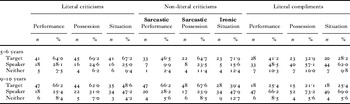
Table 3 displays the number of children in each age group who identified with the target or speaker for each statement topic condition. Identification responses were only included when speaker belief was correctly attributed. In the performance condition and the possession condition, children could choose to identify with either the speaker or the target of criticism. In the situation condition, children could identify with either the speaker or the other puppet (who was not the target of the remark but who could be considered the listener). Values do not add to n=71 or 100% due to missing data (i.e. incorrect speaker belief responses, ‘I don't know’, or responses that could not be coded).
Identification responses provided for each statement topic as a function of statement type and participant age group

We first tested for age differences in the frequencies of children's identification with the target (versus speaker) for non-literal criticisms and found a significant age difference (χ 2 (1, N=285)=13·07, p<0·001), largely because five- and six-year-olds demonstrated a stronger tendency to identify with the target of non-literal criticisms than did nine- and ten-year-olds. Further chi-square analyses showed that the frequencies of target identification responses did not differ as a function of statement topic condition for the five- to six-year-olds (χ 2 (2, N=95)=1·24, p=0·54). There were, however, significant differences in frequencies of target identification responses as a function of statement topic condition for the nine to-ten-year-olds (χ 2 (2, N=190)=11·52, p=0·003). In particular, nine- to ten-year-olds tended to identify more with the target (than the speaker) for sarcastic criticisms directed at a target's failed performance and for sarcastic criticisms directed at a target's possession, but for ironic criticisms directed at situations these children tended to identify more with the speaker (than the target). These results show that five- to six-year-olds tended to relate to the target/listener when the speaker made a non-literal criticism, regardless of whether the remark was sarcastic or ironic. In contrast, older children showed sensitivity to the distinction between sarcasm and verbal irony; following sarcastic remarks nine- to ten-year-old children were more inclined to identify with the target (not the speaker) and following ironic remarks they were more likely to identify with the speaker.
We next tested for age differences in the frequencies of children's identification with the target (versus speaker) for literal criticisms and found an age difference (χ 2 (1, N=378)=3·85, significant with p=0·05). Five- and six-year-olds demonstrated a stronger tendency to identify with the target of literal criticisms than did nine- and ten-year-olds. Further chi-square analyses showed that the frequencies of target identification responses did not differ as a function of statement topic condition for the five- to six-year-olds (χ 2 (2, N=178)=0·01, p=0·99). There were, however, significant differences in frequencies of target identification responses as a function of statement topic condition for the nine- to ten-year-olds (χ 2 (2, N=200)=7·26, p=0·03). In particular, nine- to ten-year-olds tended to identify more with the target (than the speaker) for literal criticisms directed at a target's failed performance and for literal criticisms directed at a target's possession, but for literal criticisms directed at situations these children tended to identify equally with the speaker and the target.
Justifications for identification responses
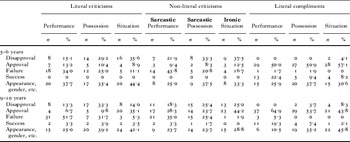
Responses to the identification question (e.g. speaker, target/listener) were categorized and justifications for identifying with particular puppets were thematically coded (see Table 4). Children's justifications provided information about their perceptions of communicative intent for literal criticisms and non-literal criticisms and these are captured in the first four categories. Some explanations for identification responses pertained to the puppets' gender or appearance and did not reveal as much about children's impressions of speaker intent so they were grouped together in the last category. Thus, five themes were devised for coding participants' justifications:
(1) Disapproval. Participant indicated that they would not say what the speaker said, e.g. ‘I just don't say that to people’ or explained why they disapproved of the statement, e.g. ‘Cause what he said was mean’.
(2) Approval. Participant expressed approval of what the speaker said or described instances where they had made similar remarks, e.g. ‘I would say that to my brother’.
(3) Failure (Identify with failure/Owning faulty possession/Experiences with bad luck): Participant related to target's failed performance, e.g. ‘Cause I can't skate well’, to having a faulty possession, e.g. ‘My stuff gets broken’, or to experiences with bad luck, e.g. ‘I've played a popped soccer ball’.
(4) Success (Identify with success/Owning functional possession/Experiences of good luck): Participant related to the target's successful performance, e.g. ‘I'm good at snowboarding’, to having functional possessions, e.g. ‘I have a trampoline too’, or to experiences with good luck, e.g. ‘I went mini-golfing and we had the whole place to ourselves!’.
(5) Appearance, gender, interests, activities: Participant referred to the puppet's appearance, e.g. ‘I like to wear pink’ or gender, e.g. ‘He's a boy too’.
Agreement between two independent raters' coding of justification responses was acceptable (k=0·79).
Justifications provided for identification responses by age group as a function of statement topic condition

As illustrated in Table 4, children's justifications for identifying with targets/listeners and speakers are combined. Justifications were only included when speaker belief was correctly attributed. Values do not add to n=71 for each age group or 100% due to missing data (i.e. incorrect speaker belief responses, ‘I don't know’, or responses that could not be coded).
In analyses of children's justification responses we first tested for age differences in the frequencies of justification themes for non-literal criticisms and found a significant age difference (χ 2 (5, N=256)=25·65, p<0·001), largely because five- and six-year-olds provided fewer ‘approval’ justifications than did nine- and ten-year-olds. Further chi-square analyses showed that the frequencies of ‘approval’ and ‘disapproval’ justifications did not differ as a function of statement topic condition for either the five- to six-year-olds (χ 2 (2, N=93)=0·27, p=0·88) or the nine to-ten-year-olds (χ 2 (2, N=32)=1·72, p=0·42). These results show that five- to six-year-old children express less approval for non-literal speech than do nine- to ten-year-old children. These results also show that neither group of children demonstrated sensitivity to the distinction between sarcasm and verbal irony in their justification responses; expressions of approval or disapproval were not contingent on the topic of non-literal criticism.
We next tested for age differences in the frequencies of themes of children's justification responses for literal criticisms and again found a significant age difference (χ 2 (5, N=320)=15·86, p=0·007), largely because five- and six-year-olds provided fewer ‘approval’ justifications than did nine- and ten-year-olds. Further chi-square analyses showed that the frequencies of ‘approval’ and ‘disapproval’ justifications did not differ as a function of statement topic condition for the five- to six-year-olds (χ 2 (2, N=54)=3·08, p=0·22). There were, however, significant differences in frequencies of ‘approval’ and ‘disapproval’ justifications as a function of statement topic condition for the nine- to-ten-year-olds (χ 2 (2, N=62)=12·82, p=0·002). In particular, nine- to ten-year-olds tended to offer disapproval justifications for literal criticisms directed at a target's failed performance and for literal criticisms directed at a target's possession, but for literal criticisms directed at situations nine- to ten-year-olds tended to offer approval justifications. Unlike the results for justifications of identification responses for non-literal criticisms, the results for justification of identification responses for literal criticisms showed that nine- to ten-year-olds are sensitive to the distinction between criticizing a specific target and criticizing a situation.
DISCUSSION
The main goals of this study were: (1) to investigate when children first become sensitive to the availability of a specific target as a cue to distinguish sarcasm and irony; and (2) to determine the developmental pattern of this distinction. Results showed that although five- to six-year-old children are beginning to show modest accuracy inferring speaker belief for sarcastic criticisms and ironic criticisms, they do not distinguish these speech acts. In contrast, results showed that nine- to ten-year-old children can distinguish sarcasm from irony and they demonstrated this sensitivity in two different ways. First, although nine- to ten-year-olds were able to infer speaker belief just as accurately for sarcastic criticisms as for ironic criticisms, they rated speaker attitude for sarcastic criticisms as more negative (i.e. meaner) than speaker attitude for ironic criticisms. Although nine- to ten-year-olds are likely not familiar with the terms ‘sarcasm’ and ‘irony’, their perceptions of speaker attitude reflect an implicit sensitivity to this distinction. Second, nine- to ten-year-olds demonstrated an appreciation for the distinction between sarcasm and verbal irony in their identification responses. That is, older children were more likely to identify with the target than with the speaker for sarcastic criticisms, but they were just as likely to identify with the speaker and listener for ironic criticisms. These findings show that older children tend to empathize with specific targets of sarcastic criticism. When no specific target has been criticized (i.e. ironic criticisms), however, nine- to ten-year-olds are equally likely to identify with the speaker and listener.
In contrast, the five- to six-year-old children in the present study did not demonstrate the same sensitivities. Speaker attitude ratings for five- to six-year-olds suggested that they perceived all non-literal criticisms to be equally negative, regardless of whether the remark is directed at a specific target. In addition, the children in the younger age group tended to identify with the non-speaker puppet despite the content of the criticism. Taken together, the results from the two age groups indicate that children become sensitive to the distinction between sarcasm and irony somewhere between six and nine years of age.
Clues about this emerging sensitivity may be gleaned from our data from literal criticisms. As illustrated in Figure 3, five- to six-year-olds did show a statement topic effect for speaker intent judgments of literal criticisms. In particular, literal criticisms of a situation were perceived to be less mean than were literal criticisms of a target's possession or performance. Thus, in their interpretations of intent for literal language these younger children were starting to show sensitivity to the implications of a specific target for how mean a remark is perceived to be. Yet these children did not show the same sensitivity in their interpretations of non-literal criticisms. Our speculation is that as these children gain more experience with non-literal language and more proficiency in its interpretation, the sensitivity to statement topic they show for literal language will extend to non-literal language and they will begin to show sensitivity to the distinction between sarcasm and irony, just as the nine- and ten-year-old children do.
Despite these promising results and observed age differences, we acknowledge that nine- to ten-year-olds in the present study did not distinguish sarcasm and verbal irony in their open-ended identification justification responses. These children did, however, distinguish literal criticisms of specific targets from literal criticisms of situations in their justification responses. Thus, nine- to ten-year-olds cannot yet distinguish sarcasm from irony in their justification responses, but show sensitivity to the presence of a specific target in their justification responses for literal criticisms. It therefore seems probable that children's sensitivity to the distinction between irony and sarcasm is not evident in their justification responses until sometime after 10 years of age.
We also acknowledge that the identification question is not a direct test of children's interpretation of literal or non-literal language, nor is it a direct measure of children's empathy. Further, children's responses to the identification question could be subject to social desirability biases; children may express disapproval for speakers or fail to identify with mean speakers because of their concerns about appearing kind or polite in their responses. Nonetheless, the fact that older children's responses to the identification question varied as a function of the statement topic condition seems to be a reflection of their appreciation for the social consequences of different types of criticism. Whether fuelled by social desirability concerns or not, the children registered a distinction between criticism of a specific target and criticism of a situation and appreciation for this distinction is essential to the distinction between sarcasm and irony.
Non-literal language can be used to achieve a variety of social functions. It can be used to soften a criticism (the ‘muting function’ of irony, Dews & Winner, Reference Dews and Winner1995) and, accordingly, non-literal criticism is sometimes perceived as less critical than is literal criticism (Dews, Kaplan & Winner, Reference Dews, Kaplan and Winner1995). In contrast, others have reported that non-literal criticism is perceived as more negative than is literal criticism (Colston, Reference Colston1997). The reasons for these different perceptions are not well understood, but Pexman & Olineck (Reference Pexman and Olineck2002) identified some of the relevant factors. For instance, if listeners rate the speaker's underlying intent they tend to perceive non-literal criticism to be more mocking than literal criticism, but if listeners rate the social impressions created by the speaker's remark they tend to perceive non-literal criticism to be more polite than literal criticism. Much of this research on irony's social functions has been conducted with adult participants, but in a previous study with child participants (aged five to seven years) Harris & Pexman (Reference Harris and Pexman2003) reported that children rated non-literal criticisms to be less mean than literal criticisms, demonstrating the muting function in children's perceptions of non-literal language. In the present study, however, children's ratings of speaker intent to be ‘mean’ showed that they perceived non-literal criticisms to be just as mean as literal criticisms. As such, there was no evidence for the muting function. Given the mixed research with adults, it is perhaps not surprising that the muting function does not apply in all cases. In future research it would be helpful to systematically explore the conditions in which children show sensitivity to the muting function.
This research shows that nine- to ten-year-old children use information about a target's personal stake in a situation to differentiate between sarcastic remarks and ironic remarks. That is, nine- to ten-year-old children monitor the involvement of different parties in a situation and draw inferences about what non-literal criticism will mean for the feelings of those parties. Nine- to ten-year-old children in the present study considered the feelings of the characters when they rated speaker attitude and their ability to empathize with target characters supported their ability to distinguish sarcasm from irony. There was evidence that this appreciation for characters' feelings is present in five- to six-year-olds but cannot yet be applied to appreciation of speaker intent for non-literal language.
There is clearly a need for more developmental tests to further investigate children's impressions of different ironies. We investigated one distinction here, but there are other non-literal forms that should be examined, such as understatement and hyperbole. By nine to ten years of age, children's sensitivity to the distinction between sarcasm and verbal irony highlights their impressive understanding of how people's feelings are affected by others' speech and this understanding likely supports sensitivity to distinctions among other non-literal forms. Any future developmental theory of non-literal language comprehension will need to include a mechanism by which children learn to coordinate aspects of the situation, like the implications for others, with the speakers' words and other cues in order to reason about speaker intent.