

1. Introduction
‘I’m not a criminal’, said Paddington, hotly. ‘I’m a bear!’Footnote 1
Rights of Nature (RoN) is described as a legal revolution,Footnote 2 gaining momentum at local, national, and international scales.Footnote 3 RoN advances law by recognizing nature,Footnote 4 and increasingly wild animals, as holders of legal rights. This article argues that the recognition of the RoN encompassing ecosystems, species, and wild animals, offers a foundation for integrating non-anthropocentric ethical considerations into existing legal and policy frameworks, influencing both their interpretation and application. Such integration facilitates the reconciliation of interests among humans, nature, and animals, even in conflict scenarios, with the potential to better protect animals and humans as well as the wider ecosystems they inhabit.
Human–wildlife conflicts are widespread globally and are predicted to escalate with climate change.Footnote 5 Several countries in South America, as well as India and New Zealand, have implemented rights-based legal frameworks for the protection of wild animals. These evolving legal measures are considered part of an emerging body of transnational law and norms,Footnote 6 establishing fundamental principles aimed at balancing human rights, rights of nature, and wild animal rights. Such frameworks offer important guidance for more equitable solutions to the challenges presented by human–wildlife conflicts.
The limitations of Western institutional and legal frameworks in achieving interspecies justice arguably stem from their emphasis on individual human rights and neoliberal economic paradigms, which predominantly categorize nature and wild animals as property and prioritize environmental protection through narrowly defined obligations.Footnote 7 RoN has begun to challenge these dominant liberal notions of property by recognizing nature as a legal entity and granting nature specific rights, thereby affirming the interconnectedness of humans and the natural world. RoN enhances affirmative obligations for states, including regulatory bodies, and private actors under state regulation, to uphold these rights, providing nature with legal standing to seek redress.Footnote 8 Building upon this foundation, this article argues that such responsibilities should extend beyond ecosystems or species to encompass the rights of individual wild animals.
Through focusing on the specific case of human–bear conflicts in the Ecuadorian Andes, the article examines the opportunities and implications of recognizing the rights of individual wild animals. The research focuses on a site within the Ecuadorian Andean Bear Corridor, one of 36 recognized global biodiversity hotspots,Footnote 9 currently facing some of the highest and fastest deforestation rates worldwide.Footnote 10 It is home to the Andean (spectacled) bear (Tremarctos ornatus), a species considered vulnerable to extinction as a result of habitat loss and incidents of killing in retaliation for predation of local communities’ crops and livestock.Footnote 11
A socio-legal approach is taken to explore the possible applications of RoN for wild animal rights. A legal doctrinal analysis and literature review are complemented by initial primary data, collected during four field trips conducted between 2022 and 2025, which includes informal interviews and ethnography from five local communities, and meetings with government and legal experts.Footnote 12 While no formal thematic coding was undertaken, the qualitative data informs the legal analysis by grounding it in the socio-ecological realities of the region. Quotes illustrate real-world tensions or experiences with legal principles.
The article begins by examining different ontologies that can inform environmental laws (Section 2). It then analyzes legal frameworks for wild animal protection (Section 3) before looking at approaches to legal personhood and developments in human rights-based approaches in Argentina, Colombia, India, Brazil, and California (United States (US)) for wild animals (Section 4.1 and 4.2). Focusing on the evolution of RoN in Ecuador, included in its Constitution since 2008,Footnote 13 the article then analyzes complex jurisprudence that illustrates opportunities and tensions in attributing rights to different elements of nature (ecosystems, species, individuals), as well as between humans and wildlife in pluralist frameworks (Section 4.3). Together, this jurisprudence forms an emerging body of transnational law relevant to wild animal protection in conflict situations.
The analysis identifies key legal principles for addressing human–wildlife conflict (Section 5). The Andean bear case study demonstrates how this framework can be applied in practice by recognizing wild animals as individual legal subjects, imposing obligations to consider the well-being and lived experiences of individual animals, and providing principled guidance for balancing different rights (Sections 6 and 7). Finally, the article proposes a RoN framework and guiding principles for resolving human–wildlife conflicts (Section 8).
The article notes the need for further legal precedent to establish RoN principles in conflict situations and to generate context-specific guidelines. Legal guidance for human–wildlife conflicts could facilitate the resolution of such issues and clarify the roles of the state, public authorities, and other stakeholders when conflicts arise. Such precedents have the potential to inform international practice by providing clear directions on balancing different rights and responsibilities.Footnote 14
2. Ontological Review
Understanding the complexities of implementing RoN involves examining its underlying ontology alongside the theoretical foundations of established legal frameworks. This process requires lawyers, legislators, and policy makers to move beyond ‘positivist’ objective law, which is generally viewed as separate from social factors and moral standards. The following ontological review demonstrates how conceptions of nature in law are influenced by diverse philosophical and ethical perspectives.
2.1. Anthropocentricism and Western Legal Traditions
Ecocentrism, sentiocentrism, and biocentrism directly challenge Western development theories underpinned by anthropocentric ontology, which have become widely entrenched since early Judeo-Christianity.Footnote 15 The Bible embedded the concept of human dominion over other species and initiated the human–nature binary in European thought, overriding previous pagan understandings of humans as part of nature and protecting nature as sacred and sentient. Anthropocentric perspectives of nature are reflected in capitalist discourses and biodiversity law,Footnote 16 focusing on resource extraction, prioritizing human interests, and neglecting the intrinsic value of nature and wild animals. The predominant environmental legal discourse is designed to facilitate human development and economic growth, failing to effectively conserve nature and wildlife.Footnote 17 This is evident from the many environmental crises the world is currently experiencing as human societies breach (or are at imminent risk of breaching) multiple planetary boundaries,Footnote 18 and have ushered in the sixth mass extinction, where a million species are at risk.Footnote 19
Human–wildlife conflicts present a serious global challenge and are expected to increase as a result of habitat fragmentation, restoration, and protected area expansion. Wildlife is forced into closer contact with human communitiesFootnote 20 as species density increases.Footnote 21 Wild animals can pose a threat to human livelihoods through predation of livestock,Footnote 22 destruction of crops,Footnote 23 human attack,Footnote 24 and spread of disease, and can force changes in lifestyles and livelihoods.Footnote 25 Such threats often result in lethal control of wildlife by humans.Footnote 26
Urgent actions to conserve and restore biodiversity are essential to create a safe and just operating space for humansFootnote 27 and all other animals.Footnote 28 Yet, anthropocentric environmental law and policy frameworks often rely on economic valuation concepts such as ‘ecosystem services’ and ‘natural capital’, which in turn underpin conservation instruments, including biodiversity and carbon offsetting. These approaches have been widely criticized for failing adequately to support ecological integrity and, in some cases, producing flawed outcomes for humans, nature, and wild animals alike.Footnote 29 Furthermore, wild animals are largely classified as objects or commodities and not recognized as sentient beings or holders of rights.Footnote 30
2.2. Indigenous Cosmologies and Ecocentrism
Ecocentric understandings of the human–nature relationship recognize the intrinsic value of nature independently of human valuations, and are often seen as arising from diverse Indigenous cosmologies. Recognizing variation in diverse Indigenous perspectives, most are rooted in appreciating the interconnectedness of all species, thus transcending the human–nature binary. Astor-Aguilera highlights three key aspects of Indigenous cosmovision in Latin America: (i) daily life is tied to cosmological beliefs; (ii) all beings – human, animal, plant – and certain objects, are viewed as kin or potential kin; and (iii) each being belongs to broader communities made up of visible and invisible entities.Footnote 31
For the Indigenous Kichwa peoples of the Andes, the concept of Pachamama or Mother Earth expresses their kin-like relationship with our planet and sumak kawsay (broadly interpreted as buen vivir or ‘good living’) expresses a way of life that is community-centric, ecologically balanced, and culturally sensitive.Footnote 32 In such contexts, well-being is understood within the wider social context of the community, including nature and wild animals, and unique environmental situations.
Indigenous cosmovisions, and particularly those of Kichwa peoples, have played a fundamental role in inspiring and providing momentum for the development of RoN in Ecuador.Footnote 33 The Confederation of Indigenous Nationalities of Ecuador (CONAIE) played a key role in the radical overhaul of Ecuador’s Constitution in 2008 by former President Rafael Correa.Footnote 34 While representing a bold step towards ecocentrism, it is important to note the limits of Ecuador’s approach; it is still founded on a Western-style legal ‘rights-based’ system, which arguably can never fully represent diverse Indigenous relational perspectives of nature, incorporating both intrinsic values and instrumental uses.Footnote 35 Furthermore, not all Indigenous communities and local communities in Ecuador living in proximity with nature share similar visions. Mestizo communities, consisting of people with a mix of Spanish and Indigenous ancestry, constitute more than 77.5% of Ecuador’s population,Footnote 36 and may have different perspectives of nature than those generally associated with Indigenous peoples.Footnote 37 Despite these challenges and recognizing law as a ‘blunt instrument’, RoN is widely regarded as one of the most significant legal developments for biodiversity this century.Footnote 38
2.3. Sentiocentrism, Biocentrism, and Wild Animal Rights
Sentiocentrism is an ethical perspective that assigns moral consideration to all sentient beings, based on their capacity to suffer or experience well-being rather than membership of a species. This builds on Singer’s influential work in animal philosophy, which argues that moral standing is based on the ability to suffer;Footnote 39 it calls for welfare reforms to reduce exploitation and criticizes ‘speciesism’ by asserting that any animal capable of pain deserves moral consideration, although this does not necessarily entail identical treatment. In contrast, Regan argues that animals as ‘subjects-of-a-life’ hold inherent rights that preclude their instrumental use,Footnote 40 while Nussbaum advances a capabilities framework,Footnote 41 emphasizing that justice requires enabling each species to flourish according to its characteristic capabilities, thereby expanding beyond both welfare and rights models.
Such philosophies deepen the ethical foundations of RoN in relation to animals, appreciating (i) their inherent moral worth irrespective of their ecological function; (ii) their entitlement to moral consideration; and (iii) that justice requires enabling both humans and animals to flourish according to their species-specific capabilities.Footnote 42 These perspectives are reflected in key judgments that adopt rights-based approaches for wild animals (Section 4).
Biocentrism expands the ethical framework by assigning intrinsic moral value to all living organisms – including plants, animals, and fungi – based on their status as living beings, rather than their usefulness to humans or capacity for suffering.Footnote 43
3. Environmental Law and Ethics
Despite advances in animal welfare lawFootnote 44 and growing international recognition of animals’ intrinsic value, the welfare of wild animals remains marginal in conservation law compared with the regulation of domesticated animals.Footnote 45 Wildlife law has largely prioritized anthropocentric goals such as conservation of habitats, species, biodiversity, and ecosystems, while neglecting the humane treatment of individual wild animals.Footnote 46 Such welfarist approaches often treat animals as property, reinforcing human moral superiority, and falling short of recognizing animals as rights holders.Footnote 47
Kurki argues that in some contexts conservation law creates a form of quasi-rights for some animals, where strong conservation status ‘crowds out’ ownership and animals move beyond being treated as ‘things’.Footnote 48 For example, the European Union (EU) Habitats DirectiveFootnote 49 protects many wild animals on conservation grounds and, to some extent, on welfare grounds.Footnote 50 Yet, this framework does not bestow them with rights, or recognize them as legal subjects.
Acknowledging diverse moral understandings of wild animals exposes the limitations of dominant conservation practices. For example, domestic and international conservation law and sustainable development policy tend to be framed in technocratic and utilitarian terms,Footnote 51 largely divorced from ethical debate. An illustration of this is how lethal control of invasive species and native animals considered pests often causes suffering to sentient animals, yet is justified as necessary for restoring biodiversity or achieving an often unattainable ‘pristine’ environment.Footnote 52 Such approaches risk sidelining the rights, welfare, and dignity of wild animals, raising concerns that conservation law remains speciesist in orientation.Footnote 53
RoN reorients Western-based legal frameworks by encompassing elements of ecocentrism, sentiocentrism, and biocentrism, reinforcing ethical obligations to recognize nature, species, and individual wild animals as rights-holders and not merely as property or ecological components. Furthermore, while RoN incorporates anthropocentric elements, including human flourishing, as part of broader ecological systems, it does not extend to legitimizing capitalist economic expansion, which is premised on extraction and accumulation rather than reciprocity and regeneration.
Rights protect fundamental interests that are typically threatened not only by private actors but also by states, such as the rights to life, liberty, and freedom from torture and inhumane or degrading treatment.Footnote 54 Granting rights to nature, including to wild animals, shifts their status from legal objects to legal subjects, requiring humans and institutions to acknowledge their claims.
Rights serve multiple functions: they are practical tools for protection, normative markers of respect, and symbolic expressions of moral community.Footnote 55 Cochrane identifies three core functions of holding rights: (i) protective: offering direct safeguards to rights-holders; (ii) generative: cultivating duties of respect; and (iii) fallback: enabling enforceable claims when social or cultural empathy is absent.Footnote 56
In this sense, the RoN framework (including wild animal rights) is not just a legal instrument; it is a catalyst for reshaping human–nature relationships. RoN expands legal protection and fosters normative shifts towards more respectful relationships between humans, nature, and animals. As such, rights-based approaches are essential components of transformative governance, helping to rebalance entrenched power asymmetries that underpin the biodiversity crisis.Footnote 57
Rights of nature are situated within a pluralist legal framework that accommodates diverse ontologies and ethical perspectives.Footnote 58 They are not grounded in a single ethical philosophy but reflect the coexistence, and at times tensions, between different ontologies. This pluralism is visible in RoN jurisprudence, where different ontologies are applied in practice and where the flourishing of humans, ecosystems, individual animals, and wider living communities are brought into dialogue, even where their interests conflict. One area where such tensions emerge is human–wildlife conflict, where the protection of ecosystems or individual species may clash with the livelihoods, safety, and cultural practices of local communities. In this article, we aim to advance the normative development of wild animal rights through RoN by articulating principles and a framework to guide its application in the context of human–wildlife conflict.
4. The Legal Evolution of Wild Animal Rights
Judicial interpretation, informed by legal and scientific experts, has been central to the gradual recognition of wild animal rights, creating legal precedents that shift animals from being property or ‘things’ towards becoming rights-bearing subjects. Three main legal mechanisms can be identified: (i) recognition of legal personhood for captive wild animals, (ii) the extension of constitutional human rights to animals, and (iii) embedding wild animal rights within RoN jurisprudence. Viewing individual wild animal rights through a ‘nature-based’ lensFootnote 59 is an important normative shift. Collectively, these approaches illustrate a complex legal framework within which emerging principles have the potential to serve as a transnational basis for managing human–wildlife conflicts.
4.1. Legal Personhood for Captive Wild Animals
Courts in several jurisdictions have granted legal personhood to captive wild animals, recognizing those animals as entities that hold rights, often through habeas corpus petitions that challenge their confinement.Footnote 60
Argentinian courts recognized Sandra, an orangutan (in 2014),Footnote 61 and Cecilia, a chimpanzee (in 2016),Footnote 62 as non-human subjects of rights. Both apes were ordered to be released based on their rights to bodily liberty, a suitable environment, and freedom from cruel treatment.Footnote 63 In 2017 in Colombia, a lower court briefly granted habeas corpus to Chucho, an Andean bear, before reversal on appeal.Footnote 64 In 2023, Ojai in California (US) enacted a municipal ordinance granting legal rights to elephants, including bodily liberty.Footnote 65 These measures reframe captivity as a rights violation and help to normalize rights-based claims that can inform protection in the wild.
4.2. Animal Rights as Human Rights
The Indian Supreme Court, in Jallikattu I (2014), widened the ‘right to life’ under Article 21 of the Constitution to include animals, and determined that all animals, both domesticated and wild, possess the right to life and to live with intrinsic worth, honour, and dignity, although Jallikattu II (2023) narrowed this stance.Footnote 66
The Brazilian Superior Court of Justice, in the Verdinho parrot case (2019),Footnote 67 extended the constitutional principle of human dignity to an individual wild animal, drawing on RoN from Ecuador, Bolivia, and Colombia recognizing the intrinsic value and dignity of individual animals and affirming animals as subjects of rights.Footnote 68
These cases demonstrate how human rights frameworks have been interpreted to encompass the dignity and intrinsic value of animals, highlighting an opportunity for other countries.
4.3. The Evolution of RoN for Animals
Although integrating human rights principles into animal rights marks significant progress, these strategies continue to prioritize human perspectives and are rooted in anthropocentrism. Nevertheless, they leverage established human rights frameworks available in many countries.Footnote 69 By contrast, RoN, with its diverse ontological foundations, offers stronger potential to recognize and secure the rights of wild animals. RoN is a rapidly growing global movement, with more than 60 of the nearly 600 documented ecojurisprudence initiativesFootnote 70 explicitly touching on wild animal protection,Footnote 71 demonstrating the growing scope and significance of RoN in reshaping human–nature–animal relations.
Ecuador is often heralded as world-leading in RoN and remains the most advanced jurisdiction, having enshrined RoN in its 2008 Constitution.Footnote 72 Bolivia’s 2009 Law of Mother Earth, municipal efforts in Brazil, and Panama’s 2022 national Rights of Nature law are examples of legislative recognition of RoN.Footnote 73 Courts in Peru, Colombia, and Chile have applied RoN principles to protect rivers and the Colombian Amazon,Footnote 74 demonstrating judicial approaches even without explicit constitutional provisions.Footnote 75 Countries such as Ireland,Footnote 76 Sweden,Footnote 77 Germany,Footnote 78 and Switzerland are actively discussing constitutional recognition of RoN.Footnote 79
Early critiques argued that RoN might be merely symbolic or overridden by other rights.Footnote 80 However, since 2019, Ecuador’s re-established Constitutional Court has developed a solid body of jurisprudence addressing these concerns professionally and consistently. A recent referendum confirmed that most Ecuadorian voters support the Constitution, affirming its continuing validity.Footnote 81 The helpful analysis by Kaufmann and Martin of Ecuador’s 55 RoN casesFootnote 82 highlights core judicial contributions in terms of (i) defining RoN with scientific evidence; (ii) setting specific standards for balancing rights of nature with human rights and existing environmental law; (iii) clarifying the content of rights of nature and their application; (iv) establishing hierarchies of rights; (v) defining violations; and (vi) outlining state and citizen duties, sanctions, and enforcement. The following chronological analysis of jurisprudence examines the development of wild animal rights through the application of RoN in five recent cases in Ecuador.
The jaguar and condor hunting cases (2014)
The hunting of threatened species was addressed by Ecuadorian courts before the re-establishment of the Constitutional Court. In 2014, in two separate cases – one involving the killing of a condor, the other a jaguar – the courts found that such killings violated the species’ right to exist under Article 71 of the 2008 Constitution, which states that ‘Nature, or Pacha Mama …, has the right to integral respect for its existence and for the maintenance and regeneration of its life cycles, structure, functions and evolutionary processes’.Footnote 83
The courts also established that the Ministry of Environment was obligated to prosecute under Article 73 of the Constitution, which requires the state, through its competent authorities (including the Ministry of Environment), ‘[t]o apply preventive and restrictive measures on activities that might lead to the extinction of species’.Footnote 84
In both cases the hunters were both imprisoned for six months for crimes against nature with the judges also drawing on Article 247 of the Organic Integral Criminal Code.Footnote 85
These cases, arising from the killing of individual animals, recognized the rights of threatened wild species and their collective right to exist. The judicial reasoning, however, centred on species-level protection rather than the welfare and rights of the individual animals concerned.
The shark fin cases (2011, 2017)
The shark fin cases address the rights of protected migratory species within designated protected areas. These cases relied on arguments similar to those used in the condor and jaguar cases, asserting that large-scale shark killings in the Galápagos Islands constituted crimes against flora and fauna under Article 71 of the Constitution and Article 247 of the Organic Integral Criminal Code.Footnote 86 Following the 2011 Cayas Shrimper judgment,Footnote 87 the judges placed the rights of nature (here sharks) above economic interests and property rights within the protected area. Yet, sharks as migratory species are not fully safeguarded. The species-level approach fails to protect sharks moving from protected areas into exclusive economic zones where they face increased risks of harm.Footnote 88 Although sharks are classified as ‘hydrobiological resources’ under the Organic Law for the Development of Aquaculture and Fisheries,Footnote 89 their protected status exposes a tension between their treatment as exploitable resources and rights-bearing species requiring protection, thus highlighting a deeper normative tension within the legal framework, whereby conservation is subsumed within a paradigm of sustainable exploitation.
Sharks are migratory, and beyond protected areas they are seen primarily as exploitable assets with very limited protection in international waters.Footnote 90 Despite their protection under the Convention on International Trade in Endangered Species of Wild Fauna and Flora (CITES),Footnote 91 which suspended commercial trade, such measures do not address the underlying drivers of exploitation, as they neither prohibit capture nor effectively regulate fishing practices on the high seas.Footnote 92 The ‘universality’ of Ecuadorian RoN is theoretically granted by Article 397 from a principle based on Article 71, under which legal entities worldwide are potentially granted standing to demand enforcement of RoN in Ecuador. The application of the universality principle has been tested but was unsuccessful. The Deepwater Horizon caseFootnote 93 tested the purported universality of RoN by extending claims of environmental harm occurring outside Ecuadorian jurisdiction. The Ecuadorian courts, however, rejected the claim on formal jurisdictional grounds, thereby exposing the territorial limits of an ostensibly universal framework.
Ecuador’s species-level approach to the protection of sharks in protected areas is limited, and the country remains a major exporter of shark products; beyond these areas, protection is further weakened as sharks continue to be regulated as fishery resources, and legal loopholes facilitate commercial shark killing as ‘by-catch’,Footnote 94 permitting their capture and trade under fisheries management frameworks.Footnote 95
The Long Nose Harlequin frog case (2020)
The Long Nose Harlequin frog case was brought by local communities on behalf of the critically endangered frogs and focused on the rights and relationship between a protected species and its habitat. The Longnose Harlequin frog (Atelopus longirostris) and the Confusing Rocket frog (Ectopoglossus confusus), which were thought to be extinct but subsequently rediscovered, were found to be subjects of rights threatened by the Llurimagua mining concession, which had already destroyed 700 hectares of forest and caused serious water pollution. It was held that the mining companies violated Articles 71 (vital cycles), 73 (preventing extinction), and 61 (right to prior and informed community consultation). The right to habitat protection was also affirmed, as the frogs’ survival is closely linked to the condition of the Intag forest ecosystem.
In the first instance ruling, the judge not only affirmed nature’s intrinsic rights but recognized that species (just a few in number) are owners of rights, even if not significant from the public interest perspective.Footnote 96 The judgment thus affirmed that a very small group of wild animals have constitutional rights that must be protected. On appeal, a 2023 judgment of the Provincial Court of Justice of Imbabura (appellate level)Footnote 97 affirmed the lower court’s ruling. The Court reiterated that rights of nature, like the rest of the rights enshrined in the Ecuadorian Constitution, are ‘inalienable, indivisible, interdependent, of equal hierarchy and require obligatory protection’.Footnote 98 The Court clarified that such rights should not be viewed through an anthropocentric lens; rather, nature possesses rights independent of any direct human benefit. By recognizing the intrinsic worth of endangered wildlife, this decision marks a substantial advancement in both animal welfare and ecosystem protection.
The Los Cedros case (2021)
The case of the Los Cedros Protected Forest involved a highly biodiverse protected cloud forest region in the Ecuadorian Andes threatened by mining activities. A constitutional protective action was initiated on behalf of the forest, resulting in the revocation of the mining licence on the ground of violations of rights of nature. In the Los Cedros case, the legal arguments were grounded not in the protection of a single species or animal, but rather in the area’s high level of species richness.
Los Cedros established the ‘ecological tolerance principle’ based upon a commitment to the protection of nature’s basic characteristics, life cycles, and biological interactions under Article 71 of the Ecuadorian Constitution,Footnote 99 and the ‘pro natura preference’ principle whereby all public servants must apply the norm and interpretation that most favours the effective enforcement of rights and guarantees, including the rights of nature. The ‘in dubio pro natura’ principle means that, when in doubt, environmental legislation should be interpreted for the most favourable protection of nature.Footnote 100 While the judgment did not recognize the rights of wild animals per se, it established an important precursor to the ‘ecological principle’ established in the Estrellita monkey case (detailed below). Furthermore, the precautionary principle, established in international environmental law and enshrined in Article 73, was a fundamental pillar of the judgment. The final ruling of the Constitutional Court of Ecuador stated that it should be applied to ecosystems where there is risk of species extinction, destruction of ecosystems or permanent alternation of natural cycles,Footnote 101 thus reaffirming a broader understanding of the rights of nature at the ecosystem level. While Los Cedros marks a vital step in recognizing ecosystem-level rights, individual animals are protected only indirectly, as components of the wider ecosystem.
The Estrellita monkey case (2022)
In 2022, the Estrellita monkey case marked a radical step forward by extending RoN to an individual wild animal.Footnote 102 Estrellita, a critically endangered woolly monkey (Lagothrix lagotricha), was removed from the wild as an infant and lived with her owner for 18 years before being seized by authorities and transferred to a zoo, where she subsequently passed away. Her owner sued Ecuador’s Ministry of the Environment for habeas corpus (false imprisonment), but the claim was dismissed as it applies only to humans and became moot after her death.
Later the Constitutional Court determined that RoN applies not only to ecosystems and species but also to individual wild animals, stating that ‘[a]nimals should not only be protected from an ecosystemic perspective or with a view to the needs of human beings, but mainly from a perspective that focuses on their individuality and intrinsic value’.Footnote 103
The recognition of animals as rights-bearing subjects is groundbreaking. The Court affirmed their legal personhood and sentience – the ability of animals subjectively to feel life experiences, such as life itself.Footnote 104
The Constitutional Court identified a set of rights for wild animals generally and not just protected animals. These include the rights to exist; not to be hunted, captured or traded; to free animal behaviour according to species-specific instincts; to develop biological cycles and interactions; to live in harmony with a habitat, and to demand their rights from the competent authorities.Footnote 105 These rights ‘bestowed’ upon wild animals are potentially far reaching and have wider ramifications.
Two key principles were established. Firstly, the ‘inter species’ principle aims to guarantee the protection of animals according to their characteristics, processes, life cycles, structures, functions, and evolutionary processes.Footnote 106 Rights will thus vary depending on species characteristics. For example, the right to respect and conserve the areas of distribution and migratory routes is a right that would be engaged only for animals with migratory behaviour.Footnote 107
Secondly, the ‘ecological principle’ acknowledges biological interactions between species to ensure ecological equilibrium, such as predator–prey relations, recognizing that humans too are predators. The ‘ecological principle’ requires public authorities to ensure that biological interactions maintain their natural balance.Footnote 108 The Court held that biological interactions place a limit on the rights of animals under RoN. Notably, the right of humans to consume animals is upheld through the ‘ecological principle’.Footnote 109
The judgment includes significant caveats for animal rights. It excludes invasive alien species,Footnote 110 and leaves domesticated and farmed animals outside its scope,Footnote 111 reinforcing limitations for animal rights. Reference to a ‘natural balance’ suggests that nature is a self-regulating and harmonious system, which is a scientifically weak notion and labelled an enduring myth based on a misconception that risks undermining environmental responsibility.Footnote 112 Critics rightly argue that these caveats undermine the reach of the Estrellita judgment;Footnote 113 yet, the ruling remains a major step forward for wild animal welfare. It embeds the idea of ‘compassionate conservation’ in law,Footnote 114 requiring biodiversity protection to account for the rights, welfare, and sentience of individual animals. The recognition of animal sentience reflects calls for interspecies solidarity in conservation,Footnote 115 where the ethical position of actions taken to protect biodiversity should be guided by compassion for all sentient beings.
Beyond Ecuador, jurisdictions such as Panama have begun to recognize wild animal rights explicitly with enforceable legal duties on the state and private actors.Footnote 116 Similarly, in 2023, Indigenous leaders in New Zealand, the Cook Islands, Tahiti, Tonga, Hawaii, and Rapanui (Easter Island) signed the He Whakaputanga Moana (Declaration for the Ocean),Footnote 117 an Indigenous law recognizing whales and dolphins as legal persons with inherent rights including to movement, culture, and restoration.
5. Discussion
The analysis above uncovers key principles for wild animal protection under a RoN approach that can be drawn upon globally:
-
1. Individual wild animals possess certain rights, including the right to exist, the freedom to engage in natural behaviour, and the preservation of habitat integrity; they are legal persons and are entitled to dignity, as they are sentient beings.
-
2. Rights of wild animal species. Killing an individual animal may constitute a violation if it significantly harms the survival of the species.
-
3. Rights of ecosystems. The ‘ecological tolerance principle’ protects the fundamental life cycles and interactions of ecosystems, recognizing the rights of ‘non-human species’ within ecosystems and their intrinsic value.
-
4. The ‘interspecies principle’ tailors rights to species-specific needs, including the flourishing of individual wild animals.
-
5. The ‘ecological principle’ acknowledges biological interactions between species for ecological equilibrium, recognizing humans as predators with their right to feed on other animals as part of the trophic chain.
-
6. States have duties to enforce the rights of nature (including for individual animals), and to take preventive action to prevent rights violations. If unsure about the scope of environmental norms, public authorities must interpret environmental law in the most protective way for nature (pro natura preference principle).
-
7. Preventive action is warranted despite scientific uncertainty (the precautionary principle); when doubt persists, in dubio pro natura directs decision-makers to adopt the most nature-protective interpretation, including for the rights of wild animals.
The recognition of RoN has been articulated at many levels: ecosystems, species, and individual, three natures, each with distinctive opportunities and limitations for wild animal protection. At the ecosystem level, exemplified by the Los Cedros case, RoN protects ecological integrity by safeguarding life cycles, biological interactions, and systemic processes. This holistic approach resonates with established principles such as precaution and ecological tolerance, ensuring wide-ranging environmental protection. Yet, by prioritizing systems over living beings, it risks overlooking the well-being of individual animals and, in other contexts, may permit extractive activities as long as ecosystem resilience is broadly maintained. At the species level, as seen in Ecuador’s condor and jaguar cases, RoN provides strong protection for threatened or endangered species and creates clear legal duties for state intervention but it may privilege charismatic or high-profile species and rarely addresses the rights of individuals.
The most radical innovation has been the recognition of rights of individual animals, as in the Estrellita monkey case, affirming their intrinsic value, sentience, and legal personhood. This article argues that recognizing RoN at this micro level is as important as recognition at the ecosystem level. Safeguarding individuals elevates standards of protection for all, because it requires attention not only to population survival but also to the dignity, well-being and intrinsic value of each being. Where species-focused conservation may tolerate the loss of some individuals as acceptable for the good of the population, micro-level recognition challenges this logic by affirming that every life holds independent worth. A key question is whether the recognition of individual animal rights risks overlooking the relational and systemic nature of ecological harm.
We argue that this tension does not undermine the case for recognizing individual animal rights, but rather highlights the necessity of integrating multiple levels of protection within RoN frameworks. Recognizing the rights of individual animals in nature expands the legal duty from solely managing populations and ecosystems towards ensuring conditions that allow individuals to flourish according to their species-specific capabilities. This approach fundamentally challenges the legitimacy of practices such as culling or habitat trade-offs, which are often justified under a species-level or ecosystemic approach.
Instead, recognizing the rights of individual animals in nature emphasizes the specific requirements of an animal, as a sentient being, the rights of which are being infringed. For the Andean bear this would mean removing threats of unlawful killing, ensuring sufficient food, suitable habitat, roaming range, and social interactions. Taking such an approach would not only call for an end to these harmful practices (such as hunting), instead prioritizing context-specific alternatives, including coexistence-based strategies, and exclusion measures. Furthermore, approaches such as promoting the restoration of ecosystems for the flourishing of the bear (and by proxy other parts of nature) better align with emerging ethical frameworks such as compassionate conservation and interspecies justice, which reject the expendability of individual animals. In respect of the Andean bear conflict, Section 7 illustrates a more detailed application and framework of principles for balancing RoN (ecosystem, species, and individual) and human rights.
The Constitutional Court has emphasized that each case should be interpreted according to the particularities of the case to achieve a balance between the rights holders (animals, nature, and humans), which requires an integrated and systems-level approach.Footnote 118 The balancing exercise is context-dependent: it may involve the ethical management of invasive alien species while safeguarding native biodiversity, the evaluation of rehabilitation practices for wild animals in captivity in the light of individual welfare, or the upholding of the rights of species and ecosystems (such as frogs and cloud forest habitats), with growing pressures from extractive activities.
Recognizing wild animal rights through the RoN at multiple levels highlights the complex task of reconciling diverse values; it also offers a promising pathway by developing principled methods to weigh competing obligations in different contexts.
Beyond Ecuador’s RoN jurisprudence, additional rights and principles emerge from legal personhood and human rights-based approaches that support the protection of wild animals. Jurisprudence in Colombia, Brazil, Argentina, and India, and emerging precedents in the US reflect a growing willingness to recognize animals as legal subjects and, in some instances, as ‘non-human’ persons and subjects of rights, entitled to dignity and respect. Guardianship modelsFootnote 119 can be developed to assign people who can speak for animals and represent their interests in legal, policy, and social forums, thus supporting legal representation for animals.
An Ecuadorian RoN lawyer commented: ‘When the frog can’t speak, the court must hear those who can translate the voice of nature such as scientists and Indigenous and local communities’.Footnote 120
6. The Andean Bear Case Study
The earlier case law analysis demonstrates how judges in Ecuador have adopted a pluralistic interpretation of RoN, considering ecosystems, species, and wild animals as three forms of nature. Human–wildlife conflicts implicate diverse rights-holders; yet, at the time of writing, there is no precedent on how the rights of individual wild animals in conflict situations should be balanced with competing claims. The remainder of the article demonstrates how the legal principles established for wild animals identified in the preceding legal analysis can be applied in the context of the currently observed Andean bear conflict to protect individual wild bears and their habitat, as well as alleviate poverty for local famers. This novel RoN-principled approach to address human–wildlife conflicts provides an example for other species conflicts, even where rights of nature are not yet enshrined in law, carefully considering individual animal flourishing, ecosystem integrity, and social contexts to develop equitable solutions.Footnote 121
The Ecuadorian Andes, a global biodiversity hotspot,Footnote 122 host high levels of endemic species, including the vulnerable Andean bearFootnote 123 and the critically endangered Ecuadorian White-fronted capuchin monkey (Cebus aequatorialis).Footnote 124 Once widely distributed from Venezuela to Bolivia, with the Ecuadorian Andes being one of the core distribution areas,Footnote 125 the Andean bear has suffered substantial regional range contraction and severe fragmentation across the Andes.Footnote 126 Though solitary, shy, non-aggressive, and largely vegetarian,Footnote 127 the bears’ habitat, including cloud forest, has been threatened by rapid deforestation and agricultural expansion. The Ecuadorian Andes have experienced exceptional rates of deforestation in recent decades and have seen some of the highest and fastest rates of deforestation and forest degradation in the world.Footnote 128 The expansion of agricultural land ownership has led to increased deforestation driven by cash and subsistence farming. Even within protected areas, small-scale farming of cash and subsistence crops such as sugar, maize and cattle has reduced tree cover to 10% in many places.Footnote 129 Habitat loss and fragmentation have several consequences, including heightened vulnerability to hunting;Footnote 130 increased likelihood of bears moving into farms, where they may be killed;Footnote 131 and disrupted seasonal movements and long-term population viability.Footnote 132
Livestock predation and crop raiding compound these pressures. Bears are suspected of cattle killing and eating crops such as sugar cane and maize, undermining local livelihoods.Footnote 133 In turn, retaliatory killings are common.Footnote 134 These dynamics are embedded in broader patterns of economic vulnerability: the agricultural reforms of 1960 focused on land redistributionFootnote 135 and moving away from the inequitable hacienda system;Footnote 136 yet, limited land titles and restricted access to land, water, and credit have resulted in a cycle of intensive land use, resource degradation, and persistent poverty.Footnote 137
A member of the provincial government commented that ‘30% of the province of Pichincha lacks land titles, and 60% of those cases are rural agricultural lands. Without titles people are invisible to the state: no Socio Bosque payments, no sale, no inheritance’.Footnote 138
Local livelihoods are further shaped by consumption patterns that place unjust responsibility for biodiversity conservation on already marginalized Indigenous and local communities, making them answerable for global environmental commitments.Footnote 139
Governance gaps exacerbate conflict. Policy interventions to incentivize forest protection were introduced in 2008 through the Socio-Bosque Payments Scheme (SBPS), a voluntary initiative where private and communal forest landowners enter into conservation agreements with the Ministry of Environment in return for annual payments for each hectare of forest cover maintained. The SBPS is intended to improve both forest conservation and poverty alleviation.Footnote 140 Furthermore, those with land titles can claim support from the government when they have experienced bear predation.Footnote 141 A fundamental issue with the SBPS, however, is the inability of those without land titles to make claims, thus excluding many of the poorest and most vulnerable and thus entrenching and exacerbating inequalities.Footnote 142
As a community member commented, ‘[i]f they (the government) don’t act, people will shoot the bears. In another community that threat unlocked support through the provision of trout farms, beehives, and electric fences’.Footnote 143
Cultural perceptions of bears amplify conflict. Studies show that cattle losses were often automatically attributed to bears, even where evidence points to other causes such as pumas, disease, and theft, and a common argument that bears should be killed as a preventative measure.Footnote 144 Yet, the perceived threat from bears is frequently greater than the actual damage that they cause.Footnote 145 Fear-led narratives, reinforced by historical mistrust of state-led conservation, construct bears as dangerous animals and pests that need to be controlled.Footnote 146 These perceptions not only fuel retaliatory killings but also undermine tolerance for coexistence measures, creating a major barrier to long-term human–bear coexistence.
7. From Conflict to Coexistence: Applying RoN Principles for Wild Animal Protection to the Andean Bear Conflict
How can the rights of the Andean bear be balanced with RoN more broadly and human rights to achieve a more harmonious coexistence within the Andean Bear Corridor? Law courts already play an important role in balancing different interests by drawing upon environmental law, constitutional rights, and principles such as precaution and proportionality.Footnote 147 However, this article argues that human–wildlife conflicts are best approached through a RoN lens that establishes a legal foundation for equitable decision-making where the rights of humans, ecosystems, species and individual animals must all be considered. The following section applies the principles identified in Section 6 to key issues raised by the Andean bear case study.
7.1. Habitat Fragmentation and Encroachment
The ‘interspecies principle’ holds that an individual animal’s rights must be interpreted considering their species-specific needs and life cycles.Footnote 148 Supporting this, the Longnose Harlequin frog case affirmed that even small groups of vulnerable animals merit protection, with habitat protection flowing from their recognition as rights-bearing subjects. Once an individual or small group of animals is acknowledged as rights-holder, their right to habitat and ecological conditions necessary for them to flourish follows.
A legal expert on RoN commented: ‘Start from the animal’s eyes. What does it need? If you protect the bear, then you protect the forest’.Footnote 149
For Andean bears, this implies safeguarding sufficient roaming ranges, dietary sources, and genetic diversity: rights that inherently extend to their habitats and migratory corridors. This approach has the potential to reduce the evidentiary burden typically required to prove the biodiversity value of entire ecosystems, as protecting an individual rights-bearing wild animal implicitly safeguards their habitat and, by extension, other species within it. The collection of species-specific data (by scientists and local communities) will determine the minimum requirements for animal flourishing, providing admissible evidence of the necessary environmental protection to uphold the Andean bear’s rights, such as connected habitat corridors and sufficient food sources.
The principles of ecological tolerance and pro natura preference reinforce the duty of the state and public authorities to prioritize and safeguard ecosystems’ basic functions and cycles. Human rights principles further support the claim that wild animals are entitled to dignity, respect, and quality of life, strengthening the argument that bears’ lives and forms of behaviour must be legally protected.
7.2. Livestock Predation, Retaliatory Killings, and Governance Gaps
The ecological principle acknowledges the necessity of biological interactions (such as predation and human use) that can limit an individual animal’s rights. The Estrellita case states that pest control for protecting livestock, crops, and human health can be covered by the ecological principle. Further, Article 74 of the Constitution affirms the right of people and communities to benefit from the environment for buen vivir. Yet, the courts must balance the ‘ecological principle’ with the ‘interspecies principle’ and suggest an integrated case-by-case approach by courts and the competent authorities deciding each case.
Balancing the conflicting rights is assisted by a proportionality test, whereby all rights must be considered. Winter’s ‘eco-proportionality’ can be drawn upon, which states that activities and actions affecting the environment must (i) pursue a legitimate societal goal, (ii) pass the suitability test (the activity must be capable of serving the objective), and (iii) be irreplaceable by less intrusive alternatives.Footnote 150 The balancing rule states that the greater the potential harm, the more significant the benefit must be to justify accepting the negative impact.
Eco-proportionality, as applied to the Andean bear case, weighs up the impact of killing Andean bears against current agricultural land use and broader RoN. While acknowledging farming as a legitimate societal goal and considering rights of local communities under the ecological principle, we argue that bear killing is a disproportionate activity, considering that (i) the bear is a vulnerable species with rights (as part of the ecosystem, a protected species and an individual); (ii) the harm threshold is high (death of individual bears and the impact on species and ecosystem health); and (iii) importantly, there are less-intrusive alternatives to resolve the conflict (supporting land titles and alternative land management practices, providing resources such as electric fences and cow bells, implementing stronger policies for the restoration and protection of habitat in the Andean Bear Corridor). Therefore, the state is under a duty to resolve the conflict through less-intrusive measures upholding the rights of Andean bears.
The precautionary principle provides further grounds for protecting bears, the population thresholds of which are vulnerable to extinction and uncertainty in the project area. For local farmers, precaution does not prohibit livelihoods, but it imposes a presumption in favour of nature; the in dubio pro natura principle is relevant for activities that raise risk and thus obliges state support for coexistence measures during uncertainty.
While killing bears is an illegal activity, enforcement is problematic both practically and ethically. Ethical means to address the conflict include the development of new land-use policies for the Andean Bear Corridor, which secure habitat connectivity and support farmers’ constitutional rights to livelihood and social well-being. This implies a shift towards stewardship-based co-management that strengthens bear conservation and supports local livelihoods.
The facilitation of community land titles, and co-development of appropriate land management plans aimed at reducing bear predation alongside forest restoration, would act to preserve and restore the Andean bears’ habitat and reduce bear killings. For successful implementation, the plans should support sustainable livelihoods that alleviate poverty while also reducing conflict with bears. The contribution of local non-governmental organizations working with local communities in supporting the production of land management plans is crucial, but their capacity is limited by funding. The state is under a duty to implement measures to safeguard rights of nature that encompass individual bears, including through taking preventive measures.
The current compensation schemes are flawed and disparate, and discourage husbandry effort, cause resentment within communities and fail to change attitudes towards wild animals.Footnote 151 Possible alternatives include funds for preventive measures (such as electric fencing, cow bells), incentive payments for coexistence where communities receive ongoing support and benefits for maintaining practices that allow bears to thrive (such as preserving wildlife corridors, adopting bear-friendly practices), and livelihood diversification schemes to support alternative incomes (such as honey production, handicrafts, citizen science, community wildlife guardianship jobs).
Community-appointed guardians could represent RoN, including the rights of Andean bears, in administrative and judicial processes, ensuring those interests are weighed alongside local community claims.
7.3. Cultural Perceptions
A community elder commented: ‘The bear is a plague; it takes all our corn and sometimes cattle; the Ministry pays us nothing’.Footnote 152
Negative perceptions of bears as pests remain a key barrier to coexistence. RoN frames ecological and animal flourishing foregrounding the interconnectedness of all living beings and recognizing humans as part of nature. State support is vital to educate local communities in their understanding of bears’ rights, needs, and movements, while also facilitating the adoption of more bear-friendly farming practices.Footnote 153
Education, awareness and participatory governance initiatives (such as rights-based clinics, community mapping, citizen science initiatives and guardianship) could facilitate cultural change. Education initiatives can be challenging to implement because of continued predation.Footnote 154 Adequately acknowledging the threats that bears pose to livelihoods with accurate recording of loss and appropriate means of redress are key to fostering coexistence.
8. RoN Principles for Human–Wildlife Conflict
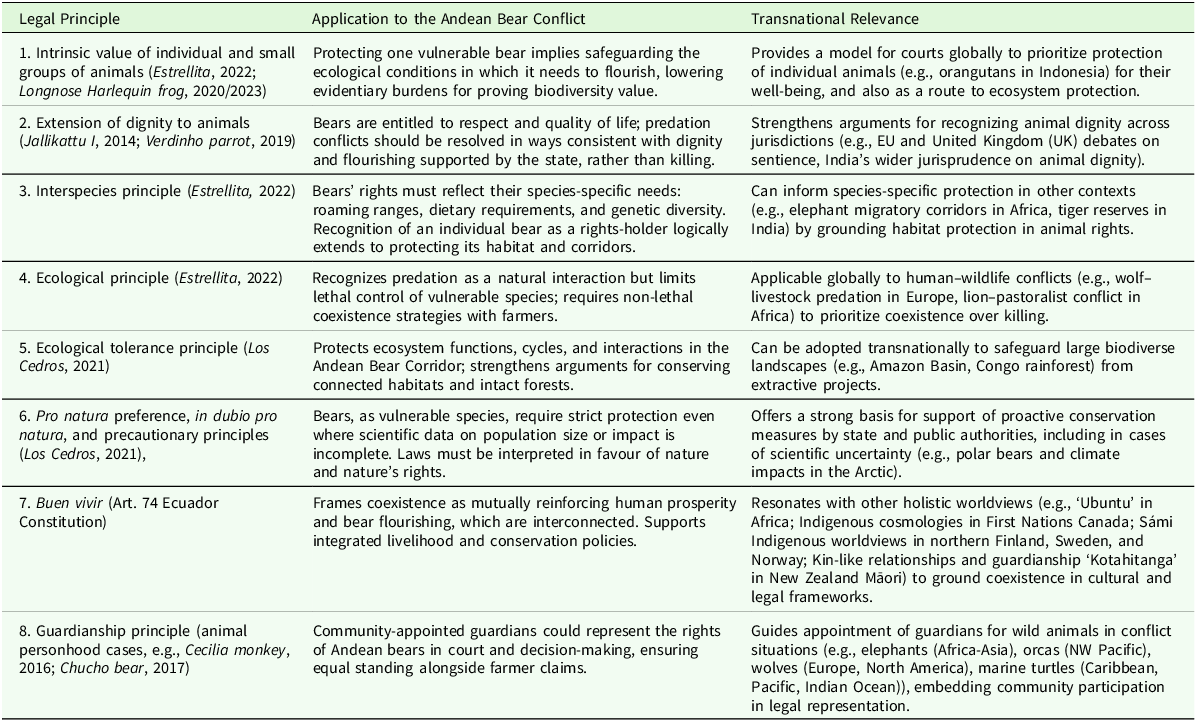
The legal principles identified and applied have broader significance beyond Ecuador, offering both a transferable framework for the wider Andean Bear Corridor (Peru and Colombia) as well as for human–wildlife conflicts in different global contexts (Table 1). ‘Interspecies’ and ‘ecological’ principles guide forms of protection suited to different species and contexts, precautionary and ecological tolerance principles support ecosystem safeguards, and guardianship mechanisms, along with cultural frameworks like buen vivir, embed rights in ethical, participatory practice. Collectively, they define an emerging transnational legal approach balancing the well-being of humans, ecosystems, species, and individual animals, all of which must be considered within a pluralist, rights-based model.
Legal Principles for Wild Animals, Their Application to the Andean Bear and Transnational Implications

Table 1 Long description
A table with three columns and eight rows. The columns are labeled ‘Legal Principle’, ‘Application to the Andean Bear Conflict’, and ‘Transnational Relevance’. The rows list different legal principles and their applications. Row 1: Legal Principle: Intrinsic value of individual and small groups of animals; Application to the Andean Bear Conflict: Protecting one vulnerable bear implies safeguarding the ecological conditions in which it needs to flourish, lowering evidentiary burdens for proving biodiversity value; Transnational Relevance: Provides a model for courts globally to prioritize protection of individual animals (e.g., orangutans in Indonesia) for their well-being, and also as a route to ecosystem protection. Row 2: Legal Principle: Extension of dignity to animals; Application to the Andean Bear Conflict: Bears are entitled to respect and quality of life; predation conflicts should be resolved in ways consistent with dignity and flourishing supported by the state, rather than killing; Transnational Relevance: Strengthens arguments for recognizing animal dignity across jurisdictions (e.g., EU and United Kingdom (UK) debates on sentience, India’s wider jurisprudence on animal dignity). Row 3: Legal Principle: Interspecies principle; Application to the Andean Bear Conflict: Bears’ rights must reflect their species-specific needs: roaming ranges, dietary requirements, and genetic diversity. Recognition of an individual bear as a rights-holder logically extends to protecting its habitat and corridors; Transnational Relevance: Can inform species-specific protection in other contexts (e.g., elephant migratory corridors in Africa, tiger reserves in India) by grounding habitat protection in animal rights. Row 4: Legal Principle: Ecological principle; Application to the Andean Bear Conflict: Recognizes predation as a natural interaction but limits lethal control of vulnerable species; requires non-lethal coexistence strategies with farmers; Transnational Relevance: Applicable globally to human-wildlife conflicts (e.g., wolf-livestock predation in Europe, lion-pastoralist conflict in Africa) to prioritize coexistence over killing. Row 5: Legal Principle: Ecological tolerance principle; Application to the Andean Bear Conflict: Protects ecosystem functions, cycles, and interactions in the Andean Bear Corridor; strengthens arguments for conserving connected habitats and intact forests; Transnational Relevance: Can be adopted transnationally to safeguard large biodiverse landscapes (e.g., Amazon Basin, Congo rainforest) from extractive projects. Row 6: Legal Principle: Pro natura preference, in dubio pro natura, and precautionary principles; Application to the Andean Bear Conflict: Bears, as vulnerable species, require strict protection even where scientific data on population size or impact is incomplete. Laws must be interpreted in favour of nature and the bears’ rights; Transnational Relevance: Offers a strong basis for support of proactive conservation measures by state and public authorities, including in cases of scientific uncertainty (e.g., polar bears and climate impacts in the Arctic). Row 7: Legal Principle: Buen vivir (Art. 74 Ecuador Constitution); Application to the Andean Bear Conflict: Frames coexistence as mutually reinforcing human prosperity and bear flourishing, which are interconnected. Supports integrated livelihood and conservation policies; Transnational Relevance: Resonates with other holistic worldviews, e.g., ‘Ubuntu’ in Africa; Indigenous cosmologies in First Nations Canada; Sámi Indigenous worldviews in northern Finland, Sweden, and Norway; Kin-like relationships ‘Kotahitanga’ in New Zealand Māori, to ground coexistence in cultural and legal frameworks. Row 8: Legal Principle: Guardianship principle (animal personhood cases, e.g., Cecilia Monkey, 2016; Chucho Bear, 2017); Application to the Andean Bear Conflict: Community-appointed guardians could represent the rights of Andean bears in court and decision-making, ensuring equal standing alongside farmer claims; Transnational Relevance: Guides appointment of guardians for wild animals in conflict situations, e.g., elephants (Africa-Asia), orcas (NW Pacific), wolves (Europe, North America), marine turtles (Caribbean, Pacific, Indian Ocean), embedding community participation in legal representation.
Operational tests in conflict cases include (i) a species-specific capabilities test (defining minimum requirements for individual animal flourishing); (ii) eco-proportionality and precautionary tests (prioritizing nature when assessing the necessity and harm of proposed actions); and (iii) ecological balancing tests (evaluating human–wildlife interactions and addressing impacts on vulnerable communities).
If the tests produce conflicting results, eco-proportionality and the precautionary principle take normative precedence. Where a proposed action entails risks of irreversible harm or scientific uncertainty, states and public bodies should give priority to maintaining ecological integrity and protecting vulnerable species, alongside safeguarding the rights and well-being of individual animals. Ecocentric, biocentric, and sentiocentric perspectives recognize animals not merely as components of ecosystems, but as beings with their own interests and rights to flourish. Accordingly, these approaches reject assessing ecological or animal harm solely in terms of economic benefit or human convenience. Ecological balancing remains relevant but operates strictly within limits set by precaution and established ecological thresholds, ensuring that neither systemic environmental damage nor unjustified harm to individual animals is permitted, particularly where such harm would undermine the conditions necessary for ecological and multispecies sustainability.
A precautionary approach based on RoN can be fair to local communities if guided by procedural and distributive justice. Recognizing ecological integrity and animal rights means viewing people as part of nature, with long-term reliance on healthy ecosystems that benefit all of nature. Fairness requires participation, addressing power imbalances, assigning greater responsibilities to states and businesses, and protecting community livelihoods and culture.
9. Conclusion
This article has examined the expansion of RoN and related rights-based approaches for wild animals, identifying their role in forming a transnational normative framework relevant to human–wildlife conflicts. Through analysis of Ecuadorian jurisprudence and comparative developments in Argentina, Colombia, California, Brazil, India, Panama, and New Zealand, the article outlines a framework consisting of key rights and legal principles – including interspecies specificity, intrinsic value, dignity, precaution, ecological tolerance, ecological balancing, buen vivir and guardianship – which collectively shift wildlife governance from exclusive species, or ecosystem-level metrics, towards recognizing rights for ecosystems, species, and individual animals alongside human rights. The Andean bear case study illustrates how these principles can be applied to address conflict dynamics such as habitat fragmentation, predation, crop damage, retaliatory killing, governance challenges, and cultural perceptions to balance diverse values of nature.
Firstly, the article demonstrated that RoN jurisprudence provides a multi-scalar structure of protection, encompassing ecosystem integrity (Los Cedros), species-level duties (condor, jaguar and shark cases), and recognition of individual sentient animals as rights-holders (Estrellita). This framework has various strengths and limitations; combined with dignity-based reasoning and personhood/guardianship from other jurisdictions, it presents a more comprehensive model of protection. Secondly, operational tests are outlined for courts and public bodies in conflict cases: (i) a species-specific capabilities test; (ii) eco-proportionality and precautionary tests; and (iii) ecological balancing tests. Institutional mechanisms such as guardianship, standing, participatory monitoring and co-designed land management plans for coexistence are suggested to implement and enforce rights.
Applied to the Andean Bear Corridor, these principles could support a rights-based pathway from conflict to coexistence. Recognizing the Andean bear as a rights-holder entails protecting its habitat, roaming corridors, and other needs, while restricting lethal control measures based on the bear’s intrinsic value and sentience. RoN frameworks also acknowledge farmers’ constitutional interests, advocating remedies such as non-lethal deterrence, compensation redesign, livelihood diversification, and community-led planning to balance animal rights, human well-being, and ecosystem function. The article therefore advocates structured pluralism among competing value claims, drawing on legal principles refined through case law. Establishing a clear precedent in Ecuador on human–wildlife conflict would provide a model for comparative law and policy across borders.
Limitations and risks have also been noted, including the capacity and mandates of ministries and other public bodies for implementation, statutory loopholes, entrenched cultural perceptions, and selective focus on certain wild animals.
Building upon this analysis, this article proposes a research and policy agenda that includes the development and empirical evaluation of coexistence measures mandated by RoN, alongside the creation of rights-based indicators for animal welfare and community well-being. This agenda further encompasses the development of guidance for courts to implement proposed legal tests, support for alternative land-use policies, the codification of rules on standing and guardianship of wild animals, and the establishment of templates and standards for coexistence-based land management plans. At the international level, it calls for decisions and guidance such as those developed under the United Nations (UN) Convention on Biological Diversity (CBD),Footnote 155 as well as capacity-building initiatives to support the implementation of RoN-consistent principles in addressing human–wildlife conflict to support wider implementation.
The Andean bear case has been presented as one example with broader relevance to human–wildlife conflicts globally. It provides insights into how recognizing an individual animal’s rights can contribute to both the animal’s welfare as well as broader habitat and ecological protection. This approach reframes conflicts as governance issues that can be addressed through legal, participatory, and adaptive solutions. Balancing ecological integrity, interspecies justice, and diverse values in transnational environmental law is challenging, but a RoN approach, based on intrinsic value and animal sentience, provides a transformative framework to address these issues. The framework supports progression from symbolic recognition of rights in human–wildlife conflicts to operative standards for coexistence that are ecologically sound, ethically consistent, and socially equitable.
Acknowledgements
The authors gratefully acknowledge the engagement and support of the University of Sussex Sustainability Research Programme and thank the three anonymous peer reviewers for TEL, whose comments significantly helped to improve the script. We also thank Helena Howe for her helpful informal review of this work. We remain indebted to the humans and non-humans of Ecuador, particularly in the five rural communities on which our work has focused, who have shared their lives and experiences with us.
Funding statement
Not applicable.
Competing interests
The authors declare none.

 Open access

