Introduction
For the past 40 years, research on schizophrenia has distinguished the concepts of positive and negative symptoms, whether as separate syndromes of the same disease (Crow, Reference Crow1980) or as dimensions on which individuals with strong positive symptom profiles differ appreciably from those with the most prominent negative ones (Andreasen and Olsen, Reference Andreasen and Olsen1982). However, negative and positive symptoms might not sit in opposition, as they may originate in the same processes (Pogue-Geile and Harrow, Reference Pogue-Geile and Harrow1984). They may also influence each other, directly or indirectly. We recently reported that negative symptoms do not predict positive symptoms in people with established schizophrenia, whereas evidence for the opposite causal direction was ambiguous (Carrà et al., Reference Carrà, Crocamo, Angermeyer, Brugha, Toumi and Bebbington2018).
Depressive symptoms are associated with positive psychotic symptoms (Sax et al., Reference Sax, Strakowski, Keck, Upadhyaya, West and McElroy1996), though they do not necessarily predict each other longitudinally (Yung et al., Reference Yung, Buckby, Cosgrave, Killackey, Baker, Cotton and McGorry2007). The development of depression may be explained to an extent as a secondary response to the impact of schizophrenia on social status and circumstances (Birchwood et al., Reference Birchwood, Iqbal and Upthegrove2005). However, it may also represent a propensity to affective dysregulation intrinsic to the schizophrenic disorder itself (Marwaha et al., Reference Marwaha, Broome, Bebbington, Kuipers and Freeman2014). Certainly, depression sometimes precedes the earliest stages of psychosis (Fusar-Poli et al., Reference Fusar-Poli, Nelson, Valmaggia, Yung and McGuire2014), and specific features like anhedonia may need to be investigated transdiagnostically at a symptom level (Upthegrove et al., Reference Upthegrove, Marwaha and Birchwood2017). In particular, the apparent linkage between positive and negative symptoms may include an important contribution from depressed mood, as both cross-sectional and longitudinal studies of schizophrenia confirm that negative and depressive symptoms are associated, albeit to a varying extent (e.g. Millan et al., Reference Millan, Fone, Steckler and Horan2014). Moreover, in periods of remission from positive symptoms, depressive and negative symptoms may be similarly associated with impaired functional recovery (Best et al., Reference Best, Gupta, Bowie and Harvey2014). Assessed cross-sectionally, negative symptoms do emerge as a factor distinguishable from depression and other affective symptoms (Blanchard and Cohen, Reference Blanchard and Cohen2006). A recent systematic review has proposed that symptoms of low mood, suicidal ideation and pessimism may be more specifically related to depression, while alogia and blunted affect are specifically characteristic of negative symptoms. Anhedonia, anergia and avolition may be common to both (Krynicki et al., Reference Krynicki, Upthegrove, Deakin and Barnes2018). In addition, following the onset of psychosis, negative and depressive dimensions are associated with distinct patient characteristics (Quattrone et al., Reference Quattrone, Di Forti, Gayer-Anderson, Ferraro, Jongsma, Tripoli, La Cascia, La Barbera, Tarricone, Berardi, Szöke, Arango, Lasalvia, Tortelli, Llorca, de Haan, Velthorst, Bobes, Bernardo, Sanjuán, Santos, Arrojo, Del-Ben, Menezes, Selten, Jones, Kirkbride, Richards, O'Donovan, Sham, Vassos, Rutten, van Os, Morgan, Lewis, Murray and Reininghaus2018), suggesting a discrimination between the two domains.
However, some studies have shown that reduction in depressed mood may lead to the alleviation of negative symptoms (Buchanan, Reference Buchanan2007). Thus, if we accept that depression is, at least to some extent, intrinsic to the schizophrenic illness itself (Upthegrove et al., Reference Upthegrove, Marwaha and Birchwood2017), this might imply the existence of common aetiological factors, but also a salient role for depression in the causation of negative symptoms.
Some of the overlaps between depressed mood and negative symptoms may be conceptual, as apparent from the phenomenological problems of distinguishing them (Bosanac and Castle, Reference Bosanac and Castle2012). However, work using Research Domain Criteria (RDoC) (Cuthbert and Kozak, Reference Cuthbert and Kozak2013) does suggest significant differences between psychotic and depressive symptoms in terms of the reward-related and hedonic deficits associated with them. Thus, people with psychosis have difficulties in translating reward into action-selection whereas their in-the-moment hedonic processing is relatively intact. In contrast, these processes seem to be impaired in people with depressive psychopathology (Barch et al., Reference Barch, Pagliaccio and Luking2016). After controlling for depression, impaired well-being in psychosis seems to be associated with the avolition-apathy negative symptom dimension, but not with the diminished expressivity reflected in blunted affect and poverty of speech (Strauss et al., Reference Strauss, Sandt, Catalano and Allen2012). This suggests that, at least in some clinical populations, the reduced well-being seen in individuals with negative symptoms may be independent of the psychological processes underpinning depression.
A further issue involves the effects of medication in increasing both depression levels and (by definition secondary) negative symptoms (Carpenter et al., Reference Carpenter, Heinrichs and Wagman1988). Although the impact of both first- and second-generation antipsychotics on negative symptoms remains questionable (Leucht et al., Reference Leucht, Arbter, Engel, Kissling and Davis2009), we should take them into account in assessing the pathway between positive and negative symptoms and the role of depression.
Overall, several lines of evidence suggest that positive, depressive and negative symptoms in psychosis are distinct, but might partake in a common longitudinal pathway. The European Schizophrenia Cohort (EuroSC) provides an opportunity to test this, since it was specifically set up to compare the attributes and correlates of schizophrenia in large and representative cohorts from three European countries, France, Germany, and the UK (Bebbington et al., Reference Bebbington, Angermeyer, Azorin, Brugha, Kilian, Johnson, Toumi and Kornfeld2005).
We carried out a three-wave prospective analysis to study the potential mediating role of depression on the longitudinal interplay between positive and negative schizophrenic symptoms, based on the latent variable (cross-lagged) structural equation modelling. We hypothesized that depressive symptoms would mediate the pathways leading from positive to negative symptoms.
Methods
Participants
The EuroSC project involved a 2-year naturalistic follow-up of a cohort of people aged 18–64, suffering from schizophrenia. They were in contact with community outpatient services in three mental health catchment areas in France, four in Germany, and two in the UK. It was set up to identify and describe treatments and methods of care for people with schizophrenia, and to relate these to clinical outcomes, health conditions, and quality of life. Local ethical approval for the study was obtained in each country. The settings, sampling strategies, inclusion/exclusion criteria and demographic and clinical characteristics are fully described elsewhere (Bebbington et al., Reference Bebbington, Angermeyer, Azorin, Brugha, Kilian, Johnson, Toumi and Kornfeld2005). Eligible patients had a diagnosis of schizophrenia according to DSM–IV criteria, and had given signed informed consent. People were excluded if they had been hospitalized for the past 12 months, or were currently intoxicated, roofless or planning to leave the area (all making follow-up assessment impracticable). Information was also collected on first (FGA) and second (SGA) generation antipsychotic, and antidepressant medications. In total, 1208 people with schizophrenia participated in the study, 288 in France, 302 in the UK, and 618 in Germany.
Measures
An extensive battery of instruments was used to collect information in face-to-face interviews. Only those relevant to this study are presented here. In the UK and Germany, SCAN (Schedules for Clinical Assessment in Neuropsychiatry-version 1.0) (WHO, 1992) was used to evaluate the 4-week period before the interview and the most significant period of earlier psychopathology. Its component algorithm then allowed the establishment of diagnoses of schizophrenia. In the French centres, schizophrenia was identified using the Structured Clinical Interview for DSM-IV (Spitzer et al., Reference Spitzer, Williams, Gibbon and First1992). Information on symptom profile at the different time-points was based on the 30-item interviewer-administered Positive and Negative Syndrome Scale (PANSS) (Norman et al., Reference Norman, Malla, Cortese and Diaz1996). Each symptom is rated in relation to the previous 72 h on a 7-point scale. PANSS has the advantage of codifying the distinction between positive and negative symptoms (Kay, Reference Kay1990). In the current analysis, we included the positive and negative sub-scores (based on items P1–P7, and N1–N7, respectively) (Kay et al., Reference Kay, Opler and Lindenmayer1989; Addington et al., Reference Addington, Addington and Schissel1990, Reference Addington, Addington, Maticka-Tyndale and Joyce1992).
Depression levels were established from the Calgary Depression Scale for Schizophrenia (CDSS) (Addington et al., Reference Addington, Addington and Schissel1990, Reference Addington, Addington, Maticka-Tyndale and Joyce1992), which comprises nine items, providing scores ranging from zero to 27. It is widely used to assess depression in contradistinction to negative symptoms, as it focuses on subjective reports of hopelessness, guilt, and suicidal ideation.
Procedures
Research assistants consecutively contacted individuals from the list of potential participants, and sought their informed consent after assurance of confidentiality. Interviews took place at home or in the clinical service. The initial assessment took around 3 h, the subsequent assessments are slightly less. Participants completed standardized measures at baseline (T0) and every 6 months for the following 2 years. The current analysis used assessments at baseline (Time 0: T0), and at 6- and 12-month follow-up (T6 and T12). These intervals were chosen for analysis on the basis that they were clinically appropriate for investigating the mediating role of depression levels in the longitudinal interplay between positive and negative symptoms: assuming distinctness of these symptom domains, mutual relationships need sufficient time to be apparent, especially for people with the established schizophrenic illness. At the 6-month follow-up, 1024 respondents took part, while at 12-month follow-up 962 did so.
Analysis
The present study evaluated potential mediation through an autoregressive approach based on structural equation modelling in order to allow opposite paths to be estimated simultaneously (Lockhart et al., Reference Lockhart, MacKinnon and Ohlrich2011). Positive and negative symptoms were fitted as latent variables, while we used a single-indicator latent variable for depression in order to comply with general recommendations on mediator measurement error (Maxwell and Cole, Reference Maxwell and Cole2007). Our measurement model was based on previous analyses of this cohort that explored whether latent positive symptoms would affect latent later negative symptoms or vice versa (Carrà et al., Reference Carrà, Crocamo, Angermeyer, Brugha, Toumi and Bebbington2018). In sum, two factors measuring positive (P1, P3–P7) and negative (N1–N6) items from PANSS yielded a measurement model with an acceptable fit, allowing us to test its structural equivalent [(χ2 (543) = 2045.784, p < 0.001; CFI = 0.935; Root Mean Square Error of Approximation (RMSEA) = 0.048 (90% CI 0.046, 0.050); Standardized Root Mean Square Residual (SRMR) = 0.062]. Further details are reported elsewhere (Carrà et al., Reference Carrà, Crocamo, Angermeyer, Brugha, Toumi and Bebbington2018).
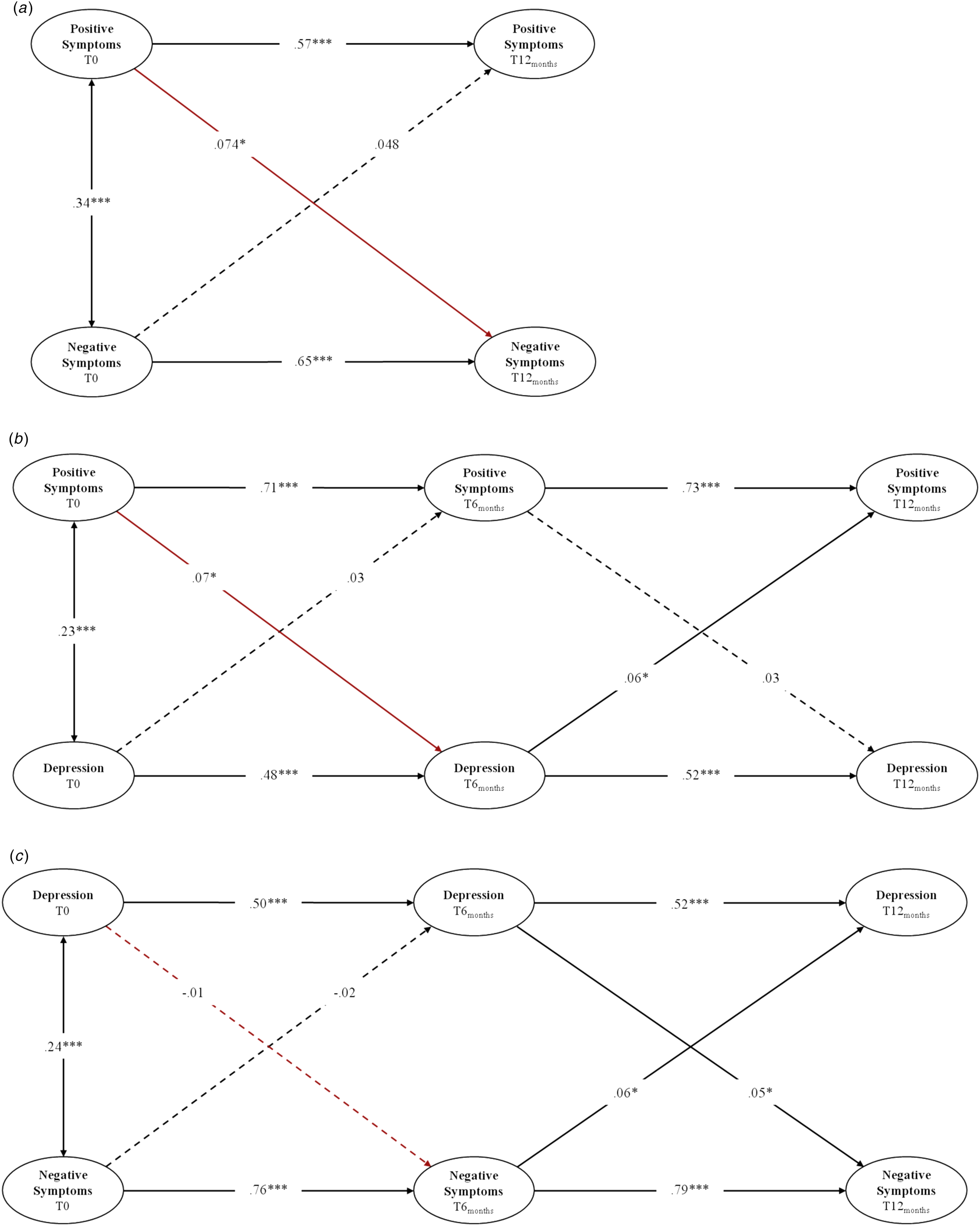
Analyses were performed using Mplus 8 (Muthén and Muthén, Reference Muthén and Muthén2017). We used the full information maximum likelihood estimation assuming missing at random data, as initial analysis of the data showed no evidence of multivariate non-normality and there was little missing data (2% of item responses were missing across T0–T12). We fitted bivariate structural cross-lagged models in turn, to test the longitudinal associations between latent constructs for positive symptoms at baseline (T0) and negative symptoms at T12 (Fig. 1a); positive symptoms at baseline (T0) and depression at T6 (Fig. 1b); and depression at T6 and negative symptoms at T12 (Fig. 1c). These relationships are a precondition for inferring our hypothesized pathway via depression.
Standardized structural coefficients for the bivariate models of: (a) PANSS positive at T0 and negative at T12; (b) PANSS positive at T0 and CDSS at T6; and (c) CDSS at T6 and PANSS negative at T12.

We allowed correlations between the variables and the errors of individual items over time, in order to account for consistency in item-specific variance (Cole and Maxwell, Reference Cole and Maxwell2003). The cross-lagged paths estimate the effect of one variable on the other, after controlling for the stability of the latent constructs over time. As expected in a clinical population with established schizophrenia assessed 6-monthly, there was no indication of measurement variance (results available upon request). Nested models with constraints on the structural autoregressive paths over time did not indicate that the paths of interest (positive and negative symptoms across T0, T6, and T12) varied appreciably. This modification was therefore retained. If bivariate models showed any significant paths from either positive or negative to depressive symptoms, we fitted additional structural autoregressive mediation models.
Based on these models, we assessed total, direct and indirect effects in order to evaluate the impact of the putative mediator on the longitudinal relationship. The product of coefficients method estimated the indirect effect of positive symptoms on negative symptoms through the mediator (i.e. depression). For this, we used the Mplus MODEL INDIRECT command and relevant options. Bootstrap confidence intervals were obtained for the effects.
Following conventional recommendations (Hu and Bentler, Reference Hu and Bentler1999), we report three goodness-of-fit-indices. The Comparative Fit Index (CFI) represents the extent to which the hypothesized model fits the data better than a null model. The SRMR signifies the standardized difference between observed and predicted correlations for the hypothesized model. Lastly, the RMSEA assesses the extent to which the hypothesized model fits the data. Values >0.90 (CFI), and <0.08 (SRMR) and 0.05 (RMSEA) indicate an acceptable fit between models and data (Hu and Bentler, Reference Hu and Bentler1999). For the final models, we also calculated standardized estimates. We controlled for the potential confounding role of antipsychotic and antidepressant medications (as observed time-varying covariates), and of gender (as a time-invariant covariate). Dosages of both medication types were determined by the treating clinicians in terms of adequacy and analyzed in broad categories. Antipsychotic medication status was taken into account, including dummy variables in the model to distinguish between monotherapy and the combination of FGAs and SGAs.
Results
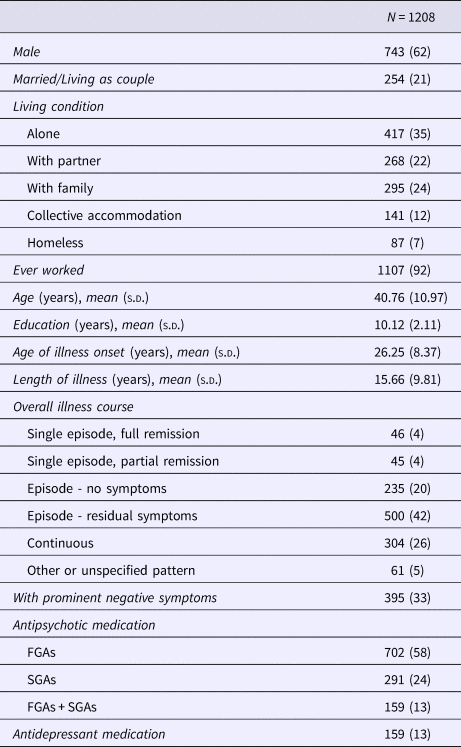
Table 1 shows the main sociodemographic and clinical characteristics of the sample at baseline. Participants were more often male (62%) and the mean age was 40.76 (s.d. = 10.97) years. Considerable differences in terms of length of illness were found (years: mean = 15.66, s.d. = 9.81). Attrition analyses showed no significant differences between participants with data missing at follow-up and those with complete data, on demographic characteristics or any other variables, including overall illness course (p = 0.154), length of illness (p = 0.301), and antipsychotic (p = 0.238) or antidepressant (p = 0.684) medications.
Sociodemographic and clinical characteristics at study entry of the study sample

First- (FGAs) and second-generation (SGAs) antipsychotics.
Values in parentheses are percentages except as otherwise indicated.
The mean scores for the psychotic symptoms and depression measures are shown in Table 2.
Means and s.d. for PANSS, CDSS total scores at different times

Positive and Negative Syndrome Scale (PANSS); Calgary Depression Scale for Schizophrenia (CDSS). There are missing values for some items that SEM dealt with: the greatest numbers of missing items is for T3 CDSS.
The average score for depressive symptoms was 2.91 (s.d. = 3.58), and only about 30–40% of participants from the three different countries reported a CDSS score higher than 3.
We first report the bivariate models. The model estimating the cross-lagged relationships between positive symptoms at baseline (T0) and negative symptoms at T12 showed a significant path (β = 0.074, p = 0.021), whereas there was no support for pathways in the opposite direction (Fig. 1a). In addition, the models quantifying the associations of the putative mediator depression at T6, with positive symptoms at baseline (T0) (Fig. 1b), and with negative symptoms at T12 (Fig. 1c), were both significant (β = 0.068, p = 0.036; and β = 0.046, p = 0.043, respectively). However, depression at T6 was also significantly associated with positive symptoms at T12 (β = 0.058, p = 0.037), as were negative symptoms at T6 with depression at T12 (β = 0.061, p = 0.048). Taken together, these bivariate analyses suggested a potential mediating role for depression.
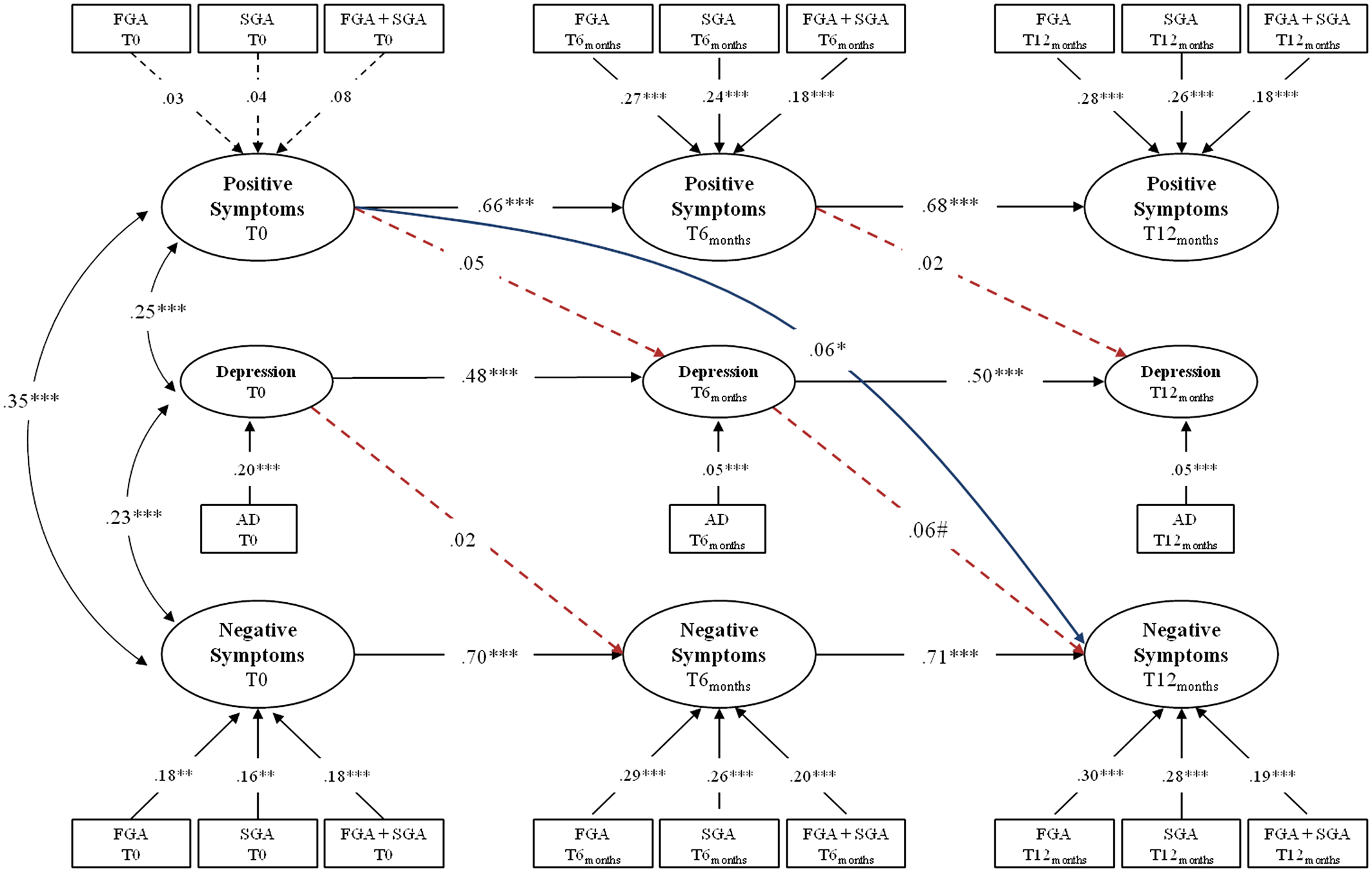
We consequently fitted a dedicated mediation model. Figure 2 shows the structural equation model testing the longitudinal indirect effect from positive symptoms at T0 to negative symptoms at T12, via depression at T6, holding antipsychotic and antidepressant medication status as observed time-varying, and gender as time-invariant covariates.
Structural equation model for testing longitudinal indirect effects from positive to negative symptoms via depression levels with gender as time-invariant and both antipsychotic and antidepressant medications as observed time-varying covariates (standardized coefficients).
Ellipses represent latent variables. Rectangles represent observed (measured) time-varying covariates. Single-headed and double-headed arrows represent the effect of one variable on another and within-time correlations between pairs of latent variables, respectively. Dashed lines represent non-significant paths. T0 = baseline, T6 = 6 months follow-up; T12 = 12 months follow-up. #p < 0.1, *p < 0.05, **p < 0.01, ***p < 0.001.

The various cross-sectional correlations at T0 between positive, depressive and negative symptoms, were all strong and significant, as would be expected in this clinical population. In addition, the structural model showed strong and significant autoregressive paths over time (all Ps < 0.001) for both latent positive and latent negative symptoms. Furthermore, the model supported a significant direct effect of positive symptoms at T0 on negative symptoms at T12 (β = 0.06, p = 0.048). However, when we assessed mediation via depression, positive symptoms at T0 were not associated with depression at T6 (β = 0.05, p = 0.173), and this in turn showed no association with negative symptoms at T12. There was consequently no significant indirect effect of positive on negative symptoms. The model showed acceptable fit to the data [(χ2 (1168) = 3573.604, p < 0.001; CFI = 0.901; RMSEA = 0.041 (90% CI 0.040, 0.043); SRMR = 0.065].
Discussion
Main findings
In a large, representative cohort of people with schizophrenia, we tested the hypothesis that depressive symptoms would mediate the effect of initial positive symptoms on negative symptoms 12 months later. Even though the baseline point might relate to varying stages of disorder, all symptom types declined in frequency over this period, albeit modestly so. Although we uncovered the required associations between positive symptoms at baseline and negative symptoms at 12 months, and between both of these and CDSS depression levels at 6 months, depression could not be said to mediate the longitudinal association between PANSS scores: virtually all the effect was direct. The results from the modelling therefore did not support our hypothesis.
Interpretation of findings
Although we established a longitudinal interplay between positive and negative symptoms in our study, this was not mediated by depressive symptoms as assessed with the CDSS. Nevertheless, depression was cross-sectionally correlated with both positive and negative symptoms, as if it might be in some sense integral to schizophrenic illness (Upthegrove et al., Reference Upthegrove, Birchwood, Ross, Brunett, McCollum and Jones2010), albeit distinct from core psychotic symptoms.
One of the problems of testing temporal relationships between symptoms is that it is hostage to the interval between measurements and its relationship to the temporal attributes of the causal effect. If the data collection interval is too long or too short, causal effects may be missed. This cannot be ruled out in panel studies. A recent paper using Directed Acyclic Graphs to analyze temporal relationships between affective and psychotic symptoms in the general population did identify effects operating over an 18-month period, in particular, a potential feedback loop between worry and paranoia (Kuipers et al., Reference Kuipers, Moffa, Kuipers, Freeman and Bebbington2019). There was however no measure of negative symptoms. The most robust way of demonstrating causal links between symptoms is by assuming that they represent psychological processes capable of direct manipulation: this approach has been adopted increasingly with psychotic conditions in the last 20years, as reviewed by Brown and colleagues (Reference Brown, Waite and Freeman2018). There was substantial evidence relating to the effect of manipulating negative aspects of mood on paranoid ideation.
Depression in people with schizophrenia is a controversial issue in Kraepelinian categorical and hierarchical diagnostic systems (Upthegrove et al., Reference Upthegrove, Marwaha and Birchwood2017), and distinguishing depressive and negative symptoms is intrinsically challenging (Bosanac and Castle, Reference Bosanac and Castle2012). Empirically, negative symptoms resolve themselves into two factors: the first encompasses alogia and diminished expression of affect, while the second involves avolition, including anhedonia and asociality (Blanchard and Cohen, Reference Blanchard and Cohen2006). However, whereas anhedonia is common to negative symptoms and to depression, subjective reports of hopelessness, guilt and suicidal ideation may be restricted to depressive illness (Addington et al., Reference Addington, Addington and Atkinson1996). Thus depression operates through multiple pathways that are not entirely understood, and which may in part be separate from those linking psychotic symptoms. It may be better conceived through the RDoC approach to negative symptoms, with its ‘positive valence’ system. This proposes differences in the mechanisms of motivational and hedonic impairments across distinct diagnostic categories, including depression and schizophrenia (Cuthbert and Kozak, Reference Cuthbert and Kozak2013). In particular, there seems to be a critical disparity in the nature of incentive processing impairments. Thus it appears that the pathways leading to impairments in motivated behavior in psychotic and depressive illness are different (Barch et al., Reference Barch, Pagliaccio and Luking2016). Impaired incentive processing in schizophrenia may be more related to compromised goal representation and utilization mechanisms than to fundamental deficits in hedonic experience (Kring and Barch, Reference Kring and Barch2014). On the other hand it has been argued that, in the context of depression, altered incentive processing is more strongly linked to deficits in hedonic experience, which spread to produce impaired motivated behaviour (Liu et al., Reference Liu, Wang, Shang, Shen, Li, Cheung and Chan2014). Thus, whilst anhedonia broadly defined may be found in different diagnostic categories, specific sub-domains (e.g. anticipatory, consummatory, and motivational anhedonia) may be more specific (Upthegrove et al., Reference Upthegrove, Birchwood, Ross, Brunett, McCollum and Jones2010), acting in concert with apathy, social withdrawal, negative self-concept (Barrowclough et al., Reference Barrowclough, Tarrier, Humphreys, Ward, Gregg and Andrews2003), self-stigma, and poor motivation to build the core features of depression in schizophrenia (Sandhu et al., Reference Sandhu, Ives, Birchwood and Upthegrove2013). This is consistent with a recent, elegant, dimensional model (albeit so far mainly based on cross-sectional evidence), which proposes a triple partition of the relationship between depressive and negative features (Krynicki et al., Reference Krynicki, Upthegrove, Deakin and Barnes2018). This distinguishes symptoms spanning both depressive and negative symptoms (e.g. anergia) from those representing specific symptoms of depression (e.g. hopelessness) and negative symptoms (such as blunted affect). Future research should seek longitudinal evidence for this proposed tripartite model in people with schizophrenia. This may provide a more detailed understanding of the underlying phenomena, specifically the depressive domains that may be considered integral to schizophrenic illness. Despite our failure to find a longitudinal relationship between negative symptoms and the broad domain of depressive symptoms assessed by the CDSS, cross-sectional evidence from our study might nevertheless be useful for testing this tripartite model.
While our findings have implications for the conceptualization of schizophrenic processes, they also reflect on rational treatment choices. Antidepressants are prescribed to around 30% of people with schizophrenia (Mao and Zhang, Reference Mao and Zhang2015). The main guidelines are unclear about their use in managing depressive and negative symptoms in schizophrenia (Lehman et al., Reference Lehman, Lieberman, Dixon, McGlashan, Miller, Perkins and Kreyenbuhl2004; Buchanan et al., Reference Buchanan, Kreyenbuhl, Kelly, Noel, Boggs, Fischer, Himelhoch, Fang, Peterson, Aquino and Keller2010; Barnes et al., Reference Barnes2011; NICE, 2014). While using them carries little risk of side effects and relapse in psychosis, they have scant effect on either depressive or negative symptoms (Helfer et al., Reference Helfer, Samara, Huhn, Klupp, Leucht, Zhu, Engel and Leucht2016). Our findings indirectly support this pessimistic view of the likely effect of antidepressant prescription on negative symptoms (Fusar-Poli et al., Reference Fusar-Poli, Papanastasiou, Stahl, Rocchetti, Carpenter, Shergill and McGuire2015), the treatment of which remains disappointing (Kirkpatrick et al., Reference Kirkpatrick, Fenton, Carpenter and Marder2006). Adaptations of cognitive behavioural therapy (CBT) found useful for anxiety and depression are routinely recommended for people with schizophrenia (NICE, 2014). However, CBT research in recent years has primarily focused on effects on positive symptoms, on the transition from high-risk status and, more recently, on distress. As yet no studies have targeted depression as a primary outcome (Mehl et al., Reference Mehl, Werner and Lincoln2015). CBT interventions may therefore need further development to address the specific problems posed by the depressive experience in people with schizophrenia.
Strengths and limitations
Our analyses represent a significant advance over cross-sectional studies, where inferences about the directionality of association must inevitably be very tentative. While our retention of participants in the later time-points was good, attrition inevitably tends to distort the representativeness of samples. Moreover, we lacked information on reasons for refusal and drop out during the follow up. ICD-10 and DSM-IV equivalent research diagnoses for schizophrenia and the assessment of positive and negative symptoms were based on formal interviews, whilst depression was assessed by the CDSS, which focuses specifically on symptoms distinct from those that in their nature might be secondary manifestations of negative symptoms. In addition, by using the PANSS we excluded those negative symptoms with a strong a priori likelihood of being secondary.
Furthermore, our design, which excluded recently hospitalized subjects, would tend to reduce the likelihood of secondary negative symptoms. We controlled for time-varying levels of antipsychotic and antidepressant medication, as this might affect symptom levels differentially and hence the corresponding correlations (Sarkar et al., Reference Sarkar, Hillner and Velligan2015). We analyzed medication status as determined by the treating clinicians in broad categories, as a more detailed categorization would have been difficult to interpret and of questionable benefit (Leucht et al., Reference Leucht, Arbter, Engel, Kissling and Davis2009).
We should acknowledge other limitations. First, we had no access to information on people who declined to participate in the study. While attempts were made to guarantee comparable recruitment procedures across the centers of the study, there will have been variations in the quality and accessibility of services (Carrà et al., Reference Carrà, Johnson, Crocamo, Angermeyer, Brugha, Azorin, Toumi and Bebbington2016). However, basic sensitivity analyses supported comparability between groups. In addition, although the level of depression varied considerably across our sample, the average score suggested depression at a subclinical level (Müller et al., Reference Müller, Brening, Gensch, Klinga, Kienzle and Müller2005). This was fairly consistent across the three national samples, but we were unable to control specifically for potential site effects, as the limited number of clusters made multilevel analysis infeasible. Future research should consider specific items in order to evaluate mechanisms operating between different types of positive and negative symptoms, given that the factor loadings assessed by SEM might not be able to uncover their unique contribution.
Finally, while our cross-lagged longitudinal models can provide information about causal ordering, the gold standard of causal inference remains targeted intervention (Kenny, Reference Kenny, Everitt and Howell2005).
Conclusion
Our understanding of the interplay between different symptoms in schizophrenia remains limited, with corresponding limitations on treatment strategies. In particular, the nature of negative symptoms and their relationship with depression is far from fully understood despite ongoing efforts seeking biomarkers and endophenotypes. Pharmacological and other treatment strategies are likely to remain tentative until these gaps are filled. Research should also maintain a focus on non-biological factors, which have a role regardless of any underlying disease process.
Author ORCIDs
Giuseppe Carrà, 0000-0002-6877-6169; Cristina Crocamo, 0000-0002-2979-2107; Francesco Bartoli, 0000-0003-2612-4119; Traolach Brugha, 0000-0002-9786-9591; Mondher Toumi, 0000-0001-7939-7204; Paul Bebbington, 0000-0002-6030-7456.
Acknowledgements
Our thanks to all the patients and staff that helped with the study and to the Camden and Islington Mental Health and NHS Foundation Trust and the Leicestershire Partnership NHS Trust R&D Programme and to those who collected the data and otherwise contributed to the main study, including Gloria Castagna, Ilaria Riboldi and Giulia Trotta. The EuroSC study was funded by an unrestricted research grant from Lundbeck A/S and a grant from the German Federal Ministry of Education and Research in the framework of the Research Association Public Health Saxony (grant no. 01EG9732/7).
Conflict of interest
None.
Ethical standards
The authors assert that all procedures contributing to this work comply with the ethical standards of the relevant national and institutional committees on human experimentation and with the Helsinki Declaration of 1975, as revised in 2008.