Brain development is thought to be affected by several factors of which iodine and thyroid hormones are key. The impact of thyroid hormones on brain development may become apparent either during intrauterine development or shortly after birth (Stenzel & Huttner, Reference Stenzel and Huttner2013). Thyroid-stimulating hormone (TSH) regulates the synthesis and secretion of the thyroid hormone, thyroxine (FT4) (Brent, Reference Brent2012). Clinically, TSH and FT4 are used as indicators to assess thyroid function. Moreover, thyroid peroxidase (TPO), an enzyme normally found in the thyroid gland, plays an important role in the production of thyroid hormones. The presence of thyroid peroxidase antibodies (TPO-Abs), exert influence on FT4 and TSH resulting in thyroid failure and spontaneous termination of pregnancy by acting directly on the placenta (Balucan, Morshed, & Davies, Reference Balucan, Morshed and Davies2013).
Maternal thyroid dysfunction impairs neurogenesis through initial downregulation of transcription factors (Mohan et al., Reference Mohan, Sinha, Pathak, Rastogi, Kumar, Pal and Godbole2012). Fetal brain development begins immediately after conception in the process of neurulation whereby neural tube cells are folded, followed by neuronal proliferation, migration, myelination, synaptogenesis, and apoptosis (Stiles & Jernigan, Reference Stiles and Jernigan2010). It has been reported that FT4 selectively regulates genes expressed in the ventricular zone of the fetal cortex (Dowling, Martz, Leonard, & Zoeller, Reference Dowling, Martz, Leonard and Zoeller2000), supporting the important actions of thyroid hormone on the developing brain. Studies also suggest that excess or insufficient thyroid hormones may lead to structural and functional changes in early brain development (Bernal, Reference Bernal, De Groot, Chrousos and Dungan2000). Maternal supply is the only source of thyroid hormone for the fetus until the second trimester of pregnancy, by which time the fetus begins producing thyroid hormone. Although fetal thyroid starts functioning, maternal transfer of thyroid hormones continues until term and represents an important source of fetal thyroid hormone supply (de Escobar, Obregon, & del Rey, Reference de Escobar, Obregon and del Rey2004).
Depressive and anxiety disorders are frequent in children (Wehry et al., Reference Wehry, McNamara, Adler, Eliassen, Croarkin, Cerullo and Strawn2015). Depression in childhood and adolescence is a persistent, debilitating problem undermining social and school functioning, and prompting substantial mental health service use (McLeod, Weisz, & Wood, Reference McLeod, Weisz and Wood2007). The pathways of depressive disorders are complex and multifactorial, indicating the role of genetic and environmental components (Pasquini, Berardelli, & Biondi, Reference Pasquini, Berardelli and Biondi2014). Findings from a meta-analysis examining the association between parenting and childhood depression suggested that depression is likely the result of a complex set of interactions between biological vulnerabilities and environmental influences (McLeod et al., Reference McLeod, Weisz and Wood2007). Neuroscience studies have also suggested that gene modifications play a role in neurogenesis and that neuroplasticity might play a role in the development of mood disorders (Brunoni, Lopes, & Fregni, Reference Brunoni, Lopes and Fregni2008). Variation on gene expression decreases the signaling activity between the hippocampus and brain cortical regions that has been linked with hyperthyroidism (Zhang, Liu, Zhang, et al., Reference Zhang, Liu, Zhang, Song, Hou, Chen and Lii2014). Further, an animal model study demonstrated that both hypothyroidism and hyperthyroidism have bidirectional effects on anxiety- and depression-like behaviors in rats. The study showed that reduced levels of brain serotonin and increased levels of hippocampal brain-derived neurotrophic factor were found in the hypothyroid rats. On the other hand, the hyperthyroid rats presented higher anxiety- and depression-like behaviors, higher brain serotonin level, and lower hippocampal brain-derived neurotrophic factor levels (Yu et al., Reference Yu, Zhou, Yang, Jiang, Wang, Lv and Mao2015).
Imbalances in circulating maternal thyroid hormone during pregnancy might play a crucial role in early brain development and later development of neurologic consequences as well. It is detrimental for the fetus throughout pregnancy, but is particularly risky during the first trimester of pregnancy, when the mother is the only source of hormone for the developing brain (de Escobar et al., Reference de Escobar, Obregon and del Rey2004). Studies have revealed that neurobehavioral disorders, including attention deficit hyperactivity disorder and autism in the offspring, are associated with maternal thyroid dysfunction during pregnancy (Andersen, Olsen, Wu, & Laurberg, Reference Andersen, Olsen, Wu and Laurberg2014; Brown et al., Reference Brown, Surcel, Hinkka-Yli-Salomäki, Cheslack-Postava, Bao and Sourander2015; Gyllenberg et al., Reference Gyllenberg, Sourander, Surcel, Hinkka-Yli-Salomaki, McKeague and Brown2015; Modesto et al., Reference Modesto, Tiemeier, Peeters, Jaddoe, Hofman, Verhulst and Ghassabian2015; Roman et al., Reference Roman, Ghassabian, Bongers-Schokking, Jaddoe, Hofman, de Rijke and Tiemeier2013); however, not all findings provided consistent results (Chevrier et al., Reference Chevrier, Harley, Kogut, Holland, Johnson and Eskenazi2011). Although early detection of thyroid disorders during pregnancy is necessary to prevent pregnancy-related complications and its transferable effect to the fetus, universal screening of pregnant women for thyroid dysfunction is still debatable (Alexander et al., Reference Alexander, Pearce, Brent, Brown, Chen, Dosiou and Sullivan2017). Hence, enlightening the association between maternal thyroid function during pregnancy and offspring depression and anxiety is highly relevant for public health and clinical practice. In this paper, we aim to investigate the relationship between maternal thyroid function during pregnancy and offspring depression and anxiety using a large birth cohort study. We hypothesize that excess or insufficient thyroid hormones and/or the presence of TPO-Abs in early pregnancy increases the risk of offspring depression and anxiety in childhood and adolescence.
Methods
Participants
Data were sourced from the Avon Longitudinal Study of Parents and Children (ALSPAC), also known as “Children of the 90s” study. It is a longitudinal birth cohort study that enrolled pregnant women residing in Bristol, Avon, UK, with an expected delivery date between April 1, 1991, and December 31, 1992. Full details of the cohort are available online at http://www.bris.ac.uk/alspac/researchers/data-access/data-dictionary/.
In phase I, 14,541 pregnancies were recruited antenatally during 1990 through 1992. Of these 14,541 pregnancies, 14,676 offspring were conceived including multiple pregnancies. In phase II, at the age of 7 years, a further 456 children from 452 (2.2% of eligible) pregnancies were recruited postnatally for the “Focus @7” clinical assessment. An additional 257 children were recruited during phase III at age 8 years, giving a total of 15,247 (75.3% of eligible) enrolled pregnancies (Boyd et al., Reference Boyd, Golding, Macleod, Lawlor, Fraser, Henderson and Davey Smith2013; Fraser et al., Reference Fraser, Macdonald-Wallis, Tilling, Boyd, Golding, Davey Smith and Lawlor2013).
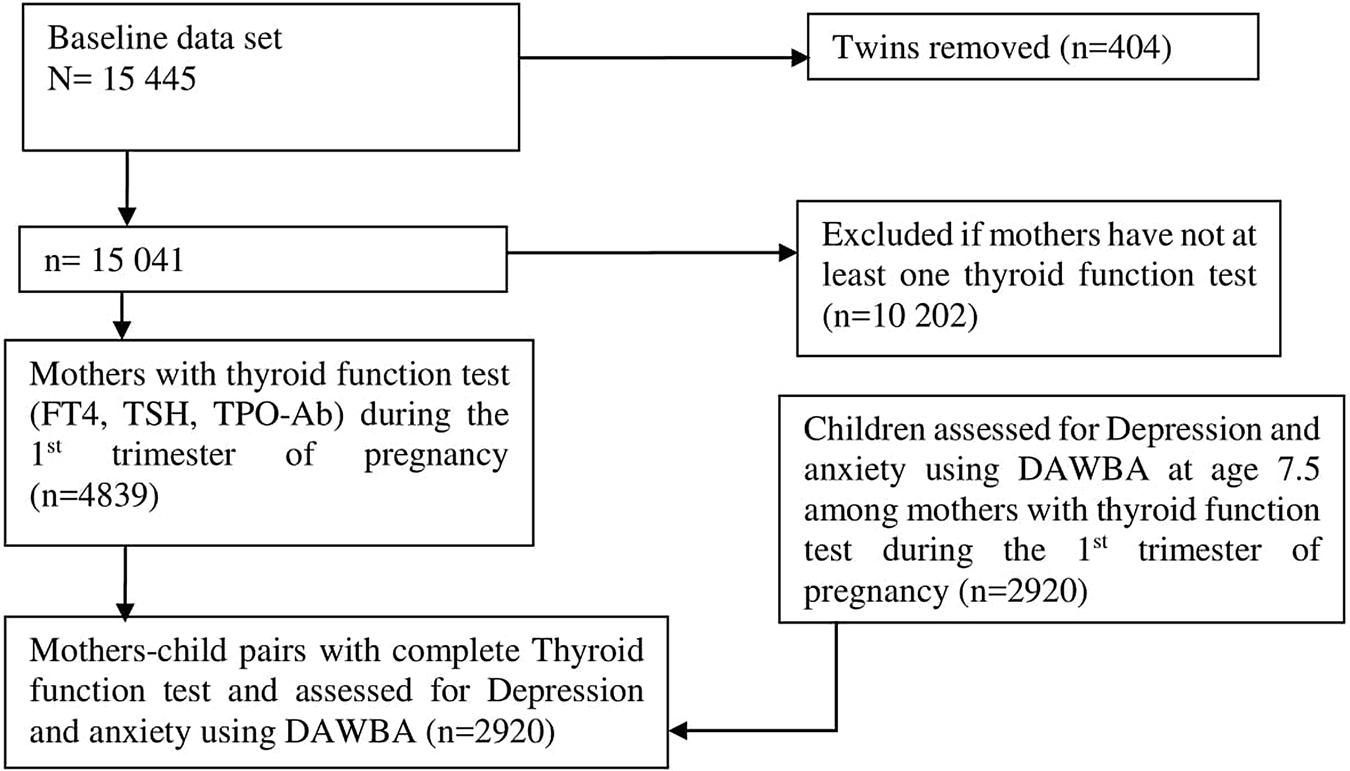
Serum was collected on 4,839 mothers during the first trimester of pregnancy and used for a thyroid function test. A total of 2,920 children remained in our analysis who were assessed for depression and anxiety using the Development and Well-Being Assessment (DAWBA) at age 7.5 and whose mothers had data on thyroid function during the first trimester of pregnancy. All mother-child pairs (twin births were excluded) with complete thyroid function tests during the first trimester of pregnancy and offspring outcome were included in this study (Figure 1). Ethical approval for the study was obtained from the ALSPAC Ethics and Law Committee and the local research ethics committees.
Flow diagram showing the current data set used for the analysis. DAWBA, Development and Well-Being Assessment; FT4, free thyroxine; TPO-Ab, thyroid peroxidase antibody; TSH, thyroid-stimulating hormone.

Maternal thyroid parameters
Maternal thyroid parameters were assessed during the first trimester of pregnancy. TSH levels, FT4, and TPO-Ab were assessed on stored samples using an Abbott Architect i2000 with a functional sensitivity ≤0.05 mIU/l. Inter- and intra-assay coefficients of variation were <5% for all analytes. The limit of detection of TSH was <0.005 mIU/l. The limit of detection of FT4 was 0.3 pmol/l. The 95% range of TSH levels was 0.077–3.24 mIU/l (2.5th–97.5th centile), and the 95% range of FT4 levels was 12.43–22.52 pmol/l (0.97–1.75 ng/dl). A TPO titer ≥6 IU/ml was classed as positive.
Child depression and anxiety
Depression and anxiety were assessed using the DAWBA at ages 7.5 (parent-reported) and 15 years (self-reported) and were coded according to Diagnostic and Statistical Manual of Mental Disorders, 4th ed., criteria. The DAWBA has been validated and used in a national survey of >10,000 children and adolescents in the United Kingdom (Ford, Goodman, & Meltzer, Reference Ford, Goodman and Meltzer2003). To generate Diagnostic and Statistical Manual of Mental Disorders, 4th ed., psychiatric diagnoses, the questionnaires include questions regarding psychiatric symptoms and their resultant impact. The responses are entered into a computer program that integrates the information and provides likely diagnoses where appropriate. These are then assessed by experienced clinical raters who decide whether to accept or overturn the computer diagnosis (or lack of diagnosis). Ordered categorical measures of the prevalence of clinician-based disorders were then generated followed by binary outcome measures (Goodman, Heiervang, Collishaw, & Goodman, Reference Goodman, Heiervang, Collishaw and Goodman2011). Because ALSPAC does not include continuous measures of depression/anxiety symptom, we used the categorical measures of child depression and anxiety as defined by the DAWBA bands.
Confounders
Maternal, paternal, and child related factors were also obtained and assessed for the strength of evidence in the main analysis. Maternal sociodemographic characteristics, pregnancy-related complications, antenatal depression, alcohol use and regular smoking, use of iodine, and zinc and vitamin D during pregnancy were obtained. Paternal age, educational status, mental health status, alcohol use, and smoking status were also assessed. Child's gender, birthweight, head circumference, thyroid parameters at age 7, Apgar score, and intake of iodine, zinc, and vitamin D were also obtained. In addition to the sociodemographic and lifestyle factors, we have adjusted for the status of micronutrients such as zinc and vitamin D because they have been linked to impaired neurodevelopment (Fuglestad, Kroupina, Johnson, & Georgieff, Reference Fuglestad, Kroupina, Johnson and Georgieff2016; Whitehouse et al., Reference Whitehouse, Holt, Serralha, Holt, Hart and Kusel2013).
Statistical analysis
Descriptive statistical analyses were first conducted. Maternal thyroid parameters (FT4, TSH, and TPO-Ab) were fitted as continuous variables, whereas child depression and anxiety were included as binary outcomes. We used the Spearman correlation coefficient to determine the association between thyroid parameters. We have regressed thyroid parameters as continuous variables to increase our power to detect a relation between thyroid function and offspring mental health. We first performed univariate analysis to assess the relationship between offspring depression and anxiety, maternal thyroid parameters, and covariates. Next, the odds of presenting with depression and anxiety at ages 7.5 and 15 years were estimated using generalized estimating equations (GEE) with adjustment for confounders. Z-scores were computed for thyroid measures to present effects for a change of 1 standard deviation. Sensitivity analysis were also conducted to examine whether attrition might have biased the results (Supplementary Tables 1 and 2). Missing data on covariates were imputed using imputation by chained equations with 20 imputation sets. All statistical analyses were performed using STATA, version 14.0, software.
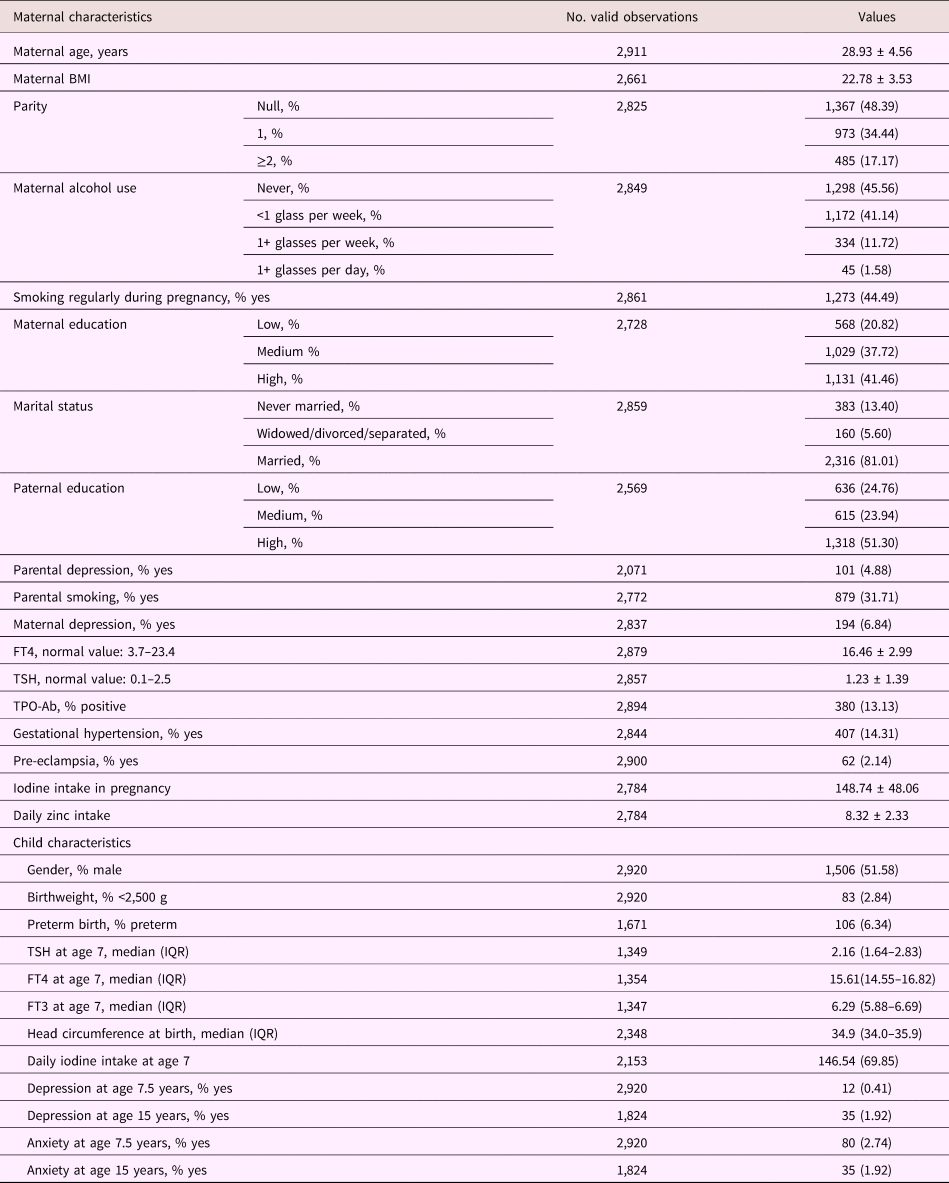
Characteristics of participants

Note: Values are mean (standard deviation) unless otherwise noted. BMI = body mass index; FT3 = free triiodothyronine; FT4 = free thyroxine; IQR, interquartile ratio; TSH = thyroid-stimulating hormone; TPO-Ab = thyroperoxidase antibody.
Logistic regression of maternal thyroid function in the first trimester of pregnancy and children's depression and anxiety at ages 7.5 and 15 years

CI = confidence interval; FT4 = free thyroxine; OR = odds ratio; TSH = thyroid-stimulating hormone; TPO-Ab = thyroperoxidase antibody; zFT4 = Z-score of FT4; zTSH = Z-score of TSH; zTPO-Ab = Z-score of TPO-Ab. ap < .05.
Results
In this study, a total of 2920 mother-child pairs were included. Of these, 2,316 (81.01%) mothers were married, 20.8% had low education level, 45.6% reported never drinking during the first 3 months of pregnancy, and 44.5% reported being regular smokers during pregnancy. The mean maternal age and body mass index were 28.9 ± 4.6 and 22.8 ± 3.5, respectively. The Spearman correlation coefficient test showed that TSH and FT4 were negatively correlated (r = −0.27; 95% confidence interval (95% CI [−0.30, −0.25]) whereas TSH and TPO-Ab were positively correlated (r = 0.15, 95% CI [0.12, 0.18]). Both the mean values of TSH and FT4 of mothers during pregnancy were in the normal range and 13.1% were positive for TPO-Ab. More than one-half (51.6%) of the children were males. Only 2.8% and 6.3% of children had birthweights below 2,500 g and preterm birth, respectively. Twelve (0.4%) and 1.9% had depression disorders at ages 7.5 and 15 years, respectively. Similarly, 2.7% and 1.9% had anxiety disorders at ages 7.5 and 15, respectively (Table 1). The overlap in children with depression and anxiety was 0.17% at age 7.5 and 0.27% at age 15.
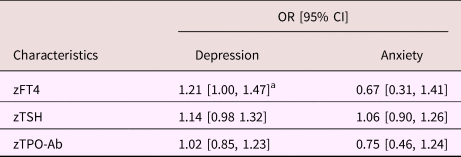
We regressed offspring depression at ages 7.5 and 15 with maternal thyroid function parameters including FT4, TSH, and TPO-Ab with separate analysis at each age using logistic regression (Table 2) and a combination of the two using GEE to account for nonindependence between outcomes of the same individual (Table 3). The results presented in this paper are the combined estimates obtained at ages 7.5 and 15 from GEE analysis.
Generalized estimating equation of maternal thyroid function in the first trimester of pregnancy and children's depression and anxiety at ages 7.5 and 15 years

CI = confidence interval; FT4 = free thyroxine; OR = odds ratio; TSH = thyroid-stimulating hormone; TPO-Ab = thyroperoxidase antibody; zFT4 = Z-score of FT4; zTSH = Z-score of TSH; zTPO-Ab = Z-score of TPO-Ab. ap < .05.
The levels of maternal FT4 during the first trimester of pregnancy were associated with child depression (odds ratio [OR] = 1.21, 95% CI [1.00, 1.14]); however, TSH and TPO-Ab were not associated with depression in children across the ages of 7.5 and 15 (Table 3). Separate analysis of offspring depression at age 7.5 showed no significant association with each thyroid test, although we found a positive association with FT4 at age 15 (Table 2). Maternal thyroid function parameters were also examined with offspring anxiety. There was no relation among maternal levels of TSH, FT4, and TPO-Ab and childhood anxiety (Table 3).
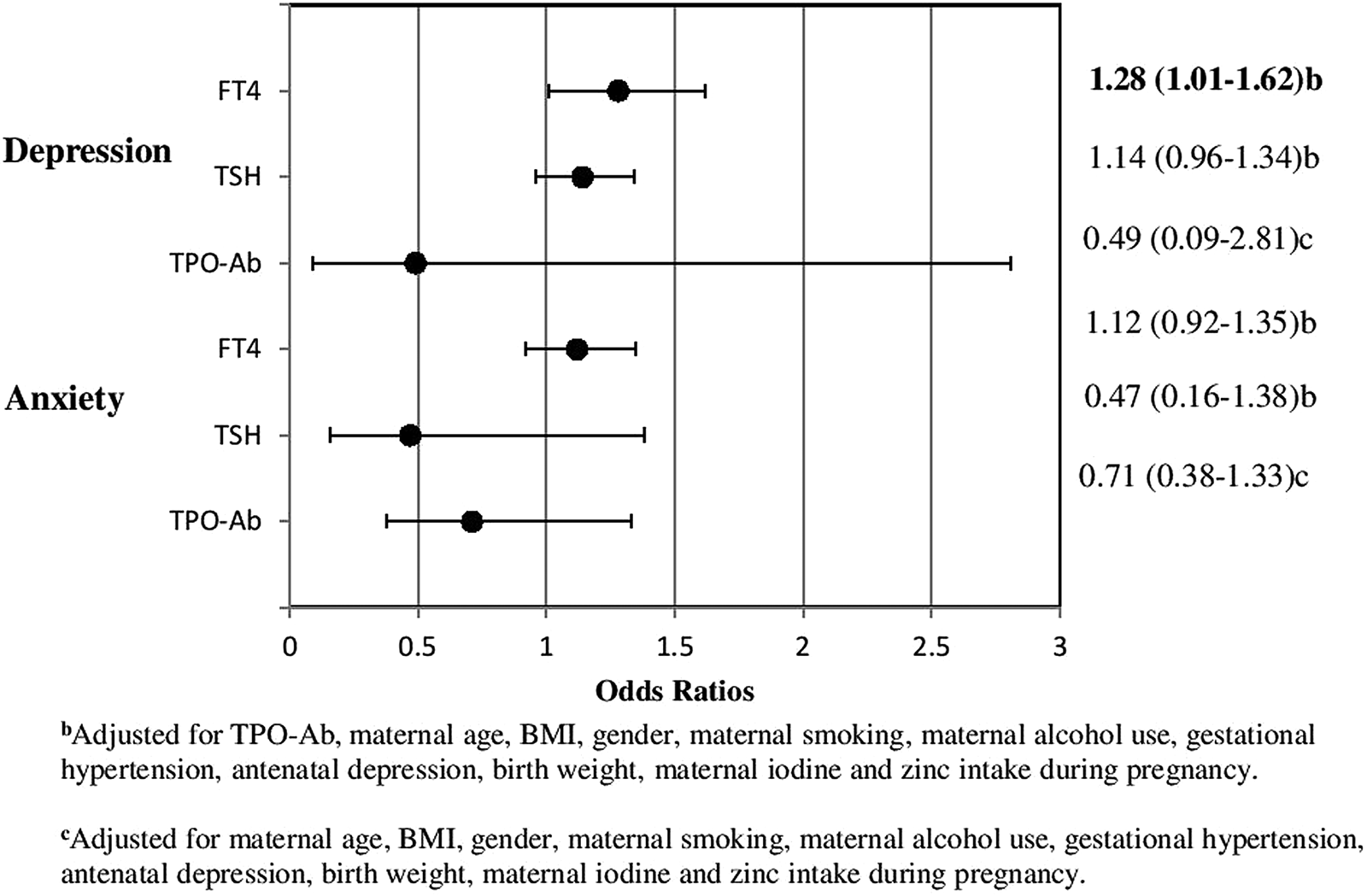
An increase in 1 standard deviation in FT4 level during pregnancy increased the odds of child depression by 26% after adjustment for maternal age, body mass index, gender, birthweight, maternal smoking, maternal depression, gestational hypertension, and zinc and iodine intake during pregnancy (OR = 1.26, 95% CI [1.01, 1.58]). We included TPO-Ab status in the model to assess whether it confounded our results. Estimates remained virtually unchanged after this factor was included in the analysis (OR = 1.28, 95% CI [1.01, 1.62]) (Figure 2). A sensitivity analysis comparing the natural cohort with the imputed data found no difference between those retained in this analysis and those lost to follow-up (Supplementary Tables 1 and 2).
Generalized estimating equation regressions of maternal thyroid function in the first trimester of pregnancy on children's depression and anxiety. BMI, body mass index; FT4, free thyroxine; TPO-Ab, thyroid peroxidase antibody; TSH, thyroid-stimulating hormone.

Discussion
Early life factors are likely determinants of neurodevelopmental problems in children and adolescents (Bale et al., Reference Bale, Baram, Brown, Goldstein, Insel, McCarthy and Nestler2010). In the present study, we used the ALSPAC data to investigate the role of antenatal thyroid function on offspring depression and anxiety, assessed using a semistructured psychiatric interview tool (DAWBA). Although a few studies are available on the impact of maternal prenatal thyroid function and neurological outcomes, such as offspring IQ and attention deficit hyperactivity disorder, this study is the first to investigate a potential association with offspring depression and anxiety. Establishing such associations is highly relevant for public health and clinical practice because there are at present no clear directions from clinical guidelines regarding the screening and management of thyroid dysfunction during pregnancy (Alexander et al., Reference Alexander, Pearce, Brent, Brown, Chen, Dosiou and Sullivan2017).
Thyroid hormones, specifically FT4, are essential for brain maturation influencing neurogenesis, neuronal migration, neuronal and glial cell differentiation, myelination, and synaptogenesis. The synthesis and circulation of FT4 is stimulated and regulated by TSH or thyrotropin; hence, its dysfunction will counter the effect of circulating FT4 level. In addition, TPO-Abs may influence FT4 and TSH, resulting in thyroid dysfunction. We found no relationship between maternal levels of thyroid hormones and offspring anxiety. On the other hand, increased FT4 during the first trimester of pregnancy increased the odds of offspring depression by 28%. This finding is in agreement with a meta-analysis study that suggests that higher levels of FT4 are associated with increased risk of depression in the general population (Williams et al., Reference Williams, Harris, Dayan, Evans, Gallacher and Ben-Shlomo2009). Separate analysis of offspring depression at age 7.5 showed no significant association with each thyroid test, although we found positive association with FT4 at age 15. This might be due to the rates of depression that are higher in early adolescence compared with rates of depression in childhood. The discrepancy might also arise from the difference between parent and child reports of children's depressive symptoms and a decrease in accuracy of parents’ reports because of reduced parent-child contact.
Although the mechanisms underlying the association between excess FT4 levels and depression are not clearly identified, there are possible biological mechanisms suggesting the relationship between high levels of FT4 and the risk of offspring depression. One potential explanation for the association between maternal FT4 levels and offspring depression is that imbalances in FT4 levels contribute to structural and functional brain abnormalities through distinct alterations in brain makeup. Brain regions that play a significant role in depression are the amygdala, thalamus, and hippocampus. An experimental study on healthy adult humans found that excess FT4 levels induce distinct alterations in brain structures (Göbel et al., Reference Göbel, Heldmann, Göttlich, Dirk, Brabant and Münte2015). A study conducted among patients with hyperthyroidism revealed reduced gray matter volume in the hippocampus, parahippocampal gyrus, and lingual gyrus (Zhang, Song, Yin, et al., Reference Zhang, Song, Yin, Zhang, Liu, Wang and Lii2014). In turn, it has been suggested that structural and functional abnormalities of the cerebellum and disrupted cortical connections are strongly related with depression (Phillips, Hewedi, Eissa, & Moustafa, Reference Phillips, Hewedi, Eissa and Moustafa2015). Moreover, the major stages of fetal brain development occur in the first trimester of pregnancy when the fetus depends entirely on maternally supplied thyroid hormone passing through the placenta (James, Franklyn, & Kilby, Reference James, Franklyn and Kilby2007). Failure to reach the demand impairs neurogenesis through initial downregulation of transcription factors (Mohan et al., Reference Mohan, Sinha, Pathak, Rastogi, Kumar, Pal and Godbole2012). This finding, therefore, suggests that a shift in thyroid hormone level in early brain development may affect future mood-related disorders in the offspring.
A recent neuroimaging study has revealed that alterations, particularly reductions in the medial orbitofrontal cortex, are likely to precede the emergence of depression and predicted the onset of the disorder in adolescents (Foland-Ross et al., Reference Foland-Ross, Sacchet, Prasad, Gilbert, Thompson and Gotlib2015). Another longitudinal study examining structural brain development and depression onset during adolescence found that an attenuation of the normative pattern of change in hippocampus, putamen, and amygdala volumes from ages 12 to 16 was associated with the onset of depressive disorder during adolescence (Whittle et al., Reference Whittle, Lichter, Dennison, Vijayakumar, Schwartz, Byrne and Allen2014). Thyroid hormones regulate transcriptional activity of target genes via their nuclear thyroid hormone receptors; even mild and transient changes in maternal thyroid hormone levels can directly affect and alter the gene expression profile and thus disturb fetal brain development (Medici et al., Reference Medici, Timmermans, Visser, de Muinck Keizer-Schrama, Jaddoe, Hofman and Steegers2013; Stenzel & Huttner, Reference Stenzel and Huttner2013). Evidence from animal studies confirmed that cortical thickness of the brain is highly sensitive and correlated with the level of thyroid hormone during this critical brain development stage (Bernal, Reference Bernal, De Groot, Chrousos and Dungan2000; Stenzel & Huttner, Reference Stenzel and Huttner2013). Cortical progenitor proliferation is highly dependent on the activation of integrin αvβ3, cell surface receptor for thyroid hormones, for its expansion; thus, lack of activation of integrin αvβ3 or absence of binding of thyroid hormone to integrin αvβ3 hinders the expansion of neocortex leaving delayed or abnormal brain development (Stenzel, Wilsch-Brauninger, Wong, Heuer, & Huttner, Reference Stenzel, Wilsch-Brauninger, Wong, Heuer and Huttner2014). Similarly, intermediate progenitor cells derived neuronal differentiation in developing neocortex has been found to be responsive to the level of maternal thyroid hormone, highlighting its effect in the early pregnancy stage (Mohan et al., Reference Mohan, Sinha, Pathak, Rastogi, Kumar, Pal and Godbole2012).
Another possible explanation for the association between maternal FT4 levels and offspring depression is that excess FT4 may modulate the brain serotonin system. As the literature indicates (Bauer, Heinz, & Whybrow, Reference Bauer, Heinz and Whybrow2002), thyroid hormones may increase cortical serotonin receptor sensitivity and has a modulating effect on the brain serotonin system, suggesting altered serotonin metabolism during the hyperthyroid state. Neurotransmitters, especially the serotonin system (e.g., serotonin-transporter-linked polymorphic region), are novel areas of focus in which depression and anxiety onset could be determined. Certain genes modified in the earlier intrauterine environment can be “molded” by external factors, leading to lower serotonin transporter binding playing a role in the onset of depression (Mann, Reference Mann2013). These studies suggest support for our findings; however, further research is needed to explicate the link among antenatal thyroid hormone, candidate genes, and onset of offspring depression and anxiety.
The question of why FT4 but not TSH (and TPO-Ab) is associated with depression disorder deserves further attention. The null association with anxiety could be due to the differences in subvolumes of distinct brain regions affected or unmeasured factors. van Tol et al. (Reference van Tol, van der Wee, van den Heuvel, Nielen, Demenescu, Aleman and Veltman2010) demonstrated that reduced right inferior frontal gyrus volumes were observed in depressive disorders and that reduced left middle/superior temporal gyrus volume were observed in anxiety disorders. Circulating FT4 may have a more fundamental influence on the right inferior frontal gyrus than left middle/superior temporal gyrus volume accountable for the association observed between FT4 and depression, but not with anxiety (Miao et al., Reference Miao, Zhang, Guan, Ye, Zhang, Zhang and Li2011). Future studies are needed to unravel the link among the levels of thyroid hormone in early life, psychiatric disorder-related gene candidates, and particularly depression in late childhood and adolescence.
This study has several strengths. Primarily, it is a large, population-based analysis based on the ALSPAC study. Second, it is the first study with the capacity to show a relationship between antenatal thyroid function and offspring depression. Third, offspring depression and anxiety were assessed at two time points (ages 7.5 and 15 years) using the DAWBA, which is one of the most robust measures of clinically relevant depression and anxiety in children and adolescents. Parent-reported assessment was used to ascertain offspring depression and anxiety at age 7.5, which has the limitation of partly reflecting mothers’ own mental health or mothers’ perception of her offspring's mental health status. The prevalence rate of depression and anxiety in our participants were, however, lower than the expected prevalence in this population (National Collaborating Centre for Mental Health, 2005). This suggests that DAWBA may underestimate the true rate of diagnosis because it identifies more severe cases compared with other measures (Goodman, Ford, Richards, Gatward, & Meltzer, Reference Goodman, Ford, Richards, Gatward and Meltzer2000). In addition, the use of measures of thyroid function in biosamples is one of the strengths of this study. Important additional strengths are that we assessed a wide range of confounders, including maternal factors (age, zinc and iodine intake, body mass index, smoking, depression, and gestational hypertension), child factors (gestational age, birthweight, gender, head circumference), and paternal factors (age, smoking, depression, educational status). We have assessed the potential role of offspring thyroid hormone level at age 7 and postnatal depression. We found it did not change our results and did not mediate the main association (results not shown).
This study also has some limitations. We were unable to assess the influence of genetic traits, which may have accounted for the variance in childhood depression. We did not have information about the mother's medication status in relation to thyroid disorder and other comorbidities. Pregnancy-related complications and comorbidities might introduce thyroid hormone imbalances or vice versa, resulting in diverse offspring health outcomes depending on the management provided (Männistö et al., Reference Männistö, Mendola, Grewal, Xie, Chen and Laughon2013; Stagnaro-Green et al., Reference Stagnaro-Green, Abalovich, Alexander, Azizi, Mestman, Negro and Wiersinga2011). Second, as with many other longitudinal, population-based studies, we experienced attrition that may introduce bias in our results; however, the rate of offspring depression and anxiety in the natural cohort and in this study did not differ, which suggests our results may not be substantively affected by selection bias (Supplementary Table 1). It is important that our sample size was in keeping with similar studies based on the ALSPAC biological data component (Alwan, Cade, Greenwood, Deanfield, & Lawlor, Reference Alwan, Cade, Greenwood, Deanfield and Lawlor2014; Anderson et al., Reference Anderson, Hoath, Zammit, Meyer, Pell, Mackay and Smith2016; Taylor et al., Reference Taylor, Howe, Heron, Ware, Hickman and Munafo2014).
In conclusion, an increased level of maternal FT4 during the first trimester of pregnancy is associated with an increased risk of offspring depression. Further studies are necessary to replicate our finding and to understand the mechanisms among antenatal thyroid hormone, candidate genes, and onset of offspring depression and anxiety.
Financial support. The Avon Longitudinal Study of Parents and Children is supported by the UK Medical Research Council and Wellcome (Grant 102215/2/13/2) and the University of Bristol. Thyroxine, thyroid-stimulating hormone and thyroid antibody measurements on ALSPAC maternal pregnancy samples were analyzed at the University of Glasgow with funding obtained by Professor Scott Nelson from the Chief Scientific Officer of Scotland (ETM/97). D.M. F. is supported by the University of Queensland Centennial Scholarship and Research Training program. K.B. and R.A. are funded by a University of Queensland senior Strategic Development fellowship.
Acknowledgments
We are extremely grateful to all the families who took part in this study, the midwives for their help in recruiting them, and the whole ALSPAC team, which includes interviewers, computer and laboratory technicians, clerical workers, research scientists, volunteers, managers, receptionists, and nurses.
Author ORCIDs
Dagnachew Muluye Fetene 0000-0001-8148-6580.
Conflict of interest
All authors declare no conflicts of interest.
Supplementary material
To view the supplementary material for this article, please visit https://doi.org/10.1017/S0954579418001657