Introduction
In developed countries, despite improved access to medical and community care, more older adults are unable to remain living at home in the community. These older adults are frequently placed in residential aged care facilities (RACFs), with numbers expected to increase as the population ages (Australian Institute of Health and Welfare, 2016).
Many people are familiar with using touchscreen technology (TT) such as iPads and other equivalent tablets. For older adults, the effects of age may lead to barriers to the uptake of TT (Magnusson et al., Reference Magnusson, Hanson and Borg2004); however, if they can see the benefits and if there is age-appropriate training available, older adults can succesfully adopt new technology (Westphal et al., Reference Westphal, Dingjan and Attoe2010). Because older adults in RACFs are becoming more TT literate it makes sense that staff who work there could engage them with TT (Upton et al., Reference Upton, Upton, Jones, Jutla and Brooker2011). As well as internet-based programs such as You-Tube, TT have a wide variety of applications which can be stimulating and engaging. Examples include interactive games and puzzles.
RACF staff can play an important role in engaging residents with TTs, but their perceptions of TTs, and current usage practices remains unclear. The Technology Acceptance Model (TAM) developed by Davis (Reference Davis1989) is one model which may help explain technology acceptance and usage. It states that people are more likely to use technology if they perceive it is easy to use, and will improve and enhance their own performance (Davis, Reference Davis1989).
The aims of this project were to investigate (1) RACF staff current experience (such as their confidence and frequency of use) using TTs before these are introduced; (2) their perceptions about engaging residents with TT (including how this might help them care for the residents); and (3) what methods of training would support them in using TTs to engage residents.
Methods
Four RACFs which specialized in supporting older adults with psychiatric disorders, three high level (increased staff ratios to provide more support to more dependent residents) and one low level (lower staff ratios and more independent residents) in metropolitan Victoria, Australia were selected by convenience for participation.
A 10-item self-administered TT usage questionnaire developed by the researchers, with some items based on TAM, was used to explore staff perceptions of proficiency, interest, and confidence using these devices with older adults living in RACFs. Confidence and interest were measured on a numerical interval scale, from 0–5 for “confidence” and 0–10 for “interest,” with an arbitrary cut-off of a score ≥ 3 and ≥5, respectively. Proficiency of TT was measured using Yes/No questions concerning basic tasks such as “Can you turn the device on/off?” and ”Can you open/close apps?” To ascertain training approaches, RACF staff preferred to help them use TTs with residents, there were five suggestions with Yes/No responses for each. These included “self-directed learning,” “handouts,” and “group in-service education sessions.” Staff demographics such as age range and role were also collected.
Meetings were completed with the nurse unit managers (NUMs) of each RACF to discuss the project and 30 questionnaires were left with each NUM to distribute to staff within each facility. Envelopes for the questionnaires were provided to ensure anonymity and these were collected one month after the initial meeting. There was no follow-up to obtain more questionnaires.
This project was completed between February 2015 and December 2015 following approval from the relevant hospital human ethics committees.
Statistical analyses
Descriptive statistics were used explore the staff demographics. Percentages were used to calculate responses to questions. Binomial one-sample t-tests were used to compare percentages in dichotomous responses.
Results
Sixty-two questionnaires were completed in this convenience cross-sectional project. Two partially completed questionnaires were excluded from the analysis. Out of the 60, there were 19 and 11 questionnaires returned from two facilities, respectively, and 15 each from the two other facilities. An exact response rate could not be estimated given the turnover of staff and number of staff who only worked a few regular shifts. Because 120 questionnaires were distributed, it was estimated that approximately 50% were returned.
Demographics of staff participants
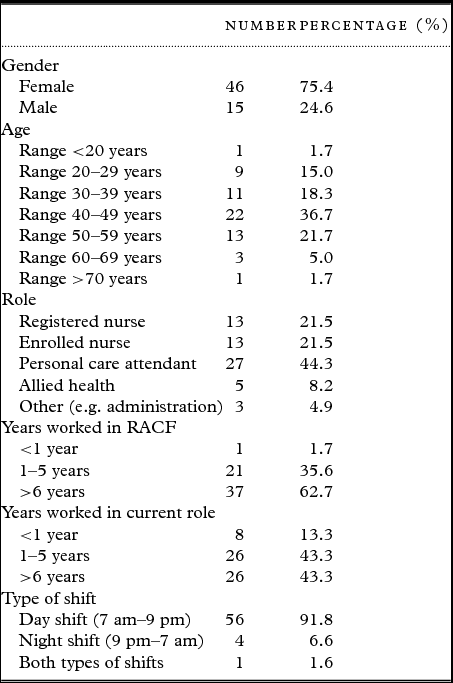
A quarter of respondents (25.8%) reported working at the low-level RACF. The majority of the staff respondents were female (75.4%). Over 50% were aged between 40 to 49 years old, and 50 to 59 years old, with the majority of them working as personal care attendants (44.3%) or nurses (42.2%). The majority had worked in RACFs for 1 to 5 (43.3%) or 6 or more years (43.3%). See Table 1 for details.
Demographic information for the staff respondents

RACF: residential aged care facility.
TT usage
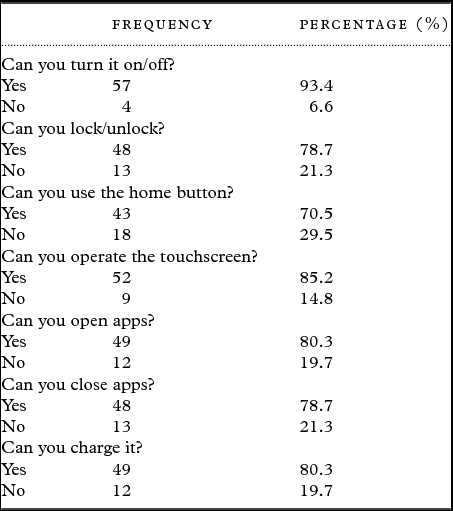
The majority of respondents had used TTs previously (85%) with Apple iPads being the more commonly used brand (75%). Seventy percent of them stated they were confident using TTs (that is, scored ≥ 3 on a 0–5 scale). TTs were reported to be used at least daily (72.5%). Investigating proficiency, more than 70% of respondents were able to perform basic TT tasks. Social media, communication, music, self-education, and other types of media (including television and movies) were reported to be used by more than 50% of the respondents. More than 90% of respondents reported they were skilled in using applications (see Table 2).
Touchscreen technology usage information

Apps: applications.
Using TT with residents
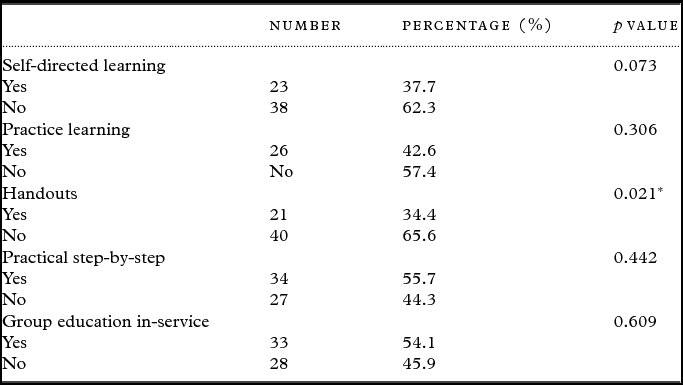
Almost 70% of respondents felt mostly confident (scoring ≥3 on the scale) engaging with residents with TT, and a similar percentage also expressed interest in using TTs with residents (scoring ≥5 on the scale). Seventy percent reported that engaging residents with TTs would help them care for their resident more effectively. With regard to suggested methods for training, apart from “handouts” [(t(59) = 10.69, p = 0.021], there were no significant differences in Yes/No responses (see Table 3). For example, 54.1% of staff responded “Yes” to “group in-services” and 55.7% of staff responded “Yes” to “step-by-step demonstration.”
Methods of supporting staff to engage residents with tablet technology

*Significant at p < 0.05 (two-tailed).
Discussion
The staff who participated in this project were mostly female, middle-aged, and were either personal care attendants or nurses. Unsurprisingly, they reported confidence in using TTs, and used them for social media and communication. A large percentage of respondents were interested in engaging residents with TT, reported this would help them in their care of the residents, and felt confident in doing so. Desired training methods included group in-services and step-by-step demonstrations.
It is encouraging that respondents were interested in engaging residents with TTs, given training, support, availability of the devices, and receptive residents. However, it remains unclear whether positive interest and confidence correlates with implementation and confidence in implementation. A previous study (Loi et al., Reference Loi2016) reported on a trial where staff administered an intervention using TT and applications as a non-pharmacological intervention for challenging behaviors. Staff who were involved had positive comments about the intervention (such as being surprised at seeing residents engage with the TT), but they also reported being stressed about the intervention, and expressed concerns about the time the intervention took away from their other duties, and the TT themselves (for example, breaking them or the residents breaking them).
Thus, to consolidate staff's continual engagement of residents using TTs, ongoing support, rather than just a “one-off” session may be required using different approaches to training. A study investigating physicians’ acceptance of telemedicine also suggested that providing thorough user training is vital for strengthening their perceptions of the usefulness of the technology, and thus their acceptance (Hu et al., Reference Hu, Chau, Sheng and Tam1999).
The TAM requires that both usefulness of the technology and ease-of-use are important components for acceptance. Following on from these findings, a crucial part of the support for staff would involve factors that reinforce that using TTs will enhance and improve their care for the residents (Yu et al., Reference Yu, Li and Gagnon2009). These factors might include highlighting the psychosocial benefits of engaging residents with TT for both residents and staff.
The limitations of this project include only focusing on staff working in specialist RACFs, which reduces the generalizability of results. The cross-sectional nature also means that capturing a representative number of staff was unlikely as staff turnover is frequent and temporary staff may have completed the questionnaires. No valid information regarding non-respondents could be obtained. Reasons could include staff being unaware of the questionnaire, being absent, or they were too busy providing care with no time to respond. Another important limitation pertained to the questionnaire itself. There was only one item corresponding to staff perceived usefulness and the dichotomous (Yes/No) responses to different training methods may have led to the ambivalent responses. In addition, there may be other models apart from the TAM which may be better for technology acceptance.
However, as far as the authors are aware, this paper is one of the first which reports on familiarity and confidence of TT usage by staff in RACFs. It provides important information about potential uptake and acceptance by RACF staff in engaging residents with TTs and relevant information on which methods could be used to support them. Future investigation using larger samples in general RACFs and exploring the residents’ view of TT would provide more substantial data. Furthermore, the results from this project can be used to inform appropriate training for staff.
Conflict of interest
None.
Description of authors’ roles
SM Loi and A Westphal conceived, designed, and implemented the study. SM Loi completed the statistical analysis. SM Loi and A Westphal contributed to writing the paper. NT Lautenschlager supervised SM Loi and A Westphal.
Acknowledgments
The authors would like to acknowledge the staff who participated in the project. Funding was provided by the Mazda Foundation.