




No CrossRef data available.
Article contents
Doppler echocardiographic predictors of outcome in newborns with persistent pulmonary hypertension
Published online by Cambridge University Press: 21 January 2005
Abstract
Patients: We studied retrospectively the echocardiographic features of newborns with persistent pulmonary hypertension who had been randomised to receive inhaled nitric oxide or conventional therapy. We sought to identify the predictors of extracorporeal membrane oxygenation therapy, death, and response to inhaled nitric oxide. Results: Among 85 neonates studied, an extrapulmonary right-to-left shunt through either an oval foramen and/or an arterial duct was present in 80 (94%) cases. In the 64 patients (75%) with adequate images for measurements, left ventricular ejection fraction was normal or mildly depressed in 87%, but there was a decreased index of left ventricular output, inferior to 2 l/min/m2, in 61% of the cases. Using multivariate analysis, an exclusive right-to-left ductal shunt was found to be an independent predictor of death, with odds ratio of 7.8, and 95% confidence intervals from 1.2 to 52.8, with a p value of 0.04. There was also a non-significant trend toward greater use of extracorporeal membrane oxygenation in patients with a predominant left-to-right ductal shunt, the odds ratio being 0.13, with 95% confidence intervals from 0.01 to 1.22, and a p value of 0.07. In the 40 patients randomised to receive inhaled nitric oxide, 28 had a positive response as defined by a 20% reduction in the index of oxygenation as measured from the post-ductal arterial blood gas sample. A left-to-right atrial shunt increased the risk of failing to respond to inhaled nitric oxide, with an odds ratio of 7.46, 95% confidence intervals from 1.23 to 45.1, and a p value of 0.028. Conclusion: Detailed Doppler echocardiographic screening of patients with suspected persistent pulmonary hypertension of the newborn may refine the selection of groups for specific treatment, and identify risk factors.
Information
- Type
- Original Article
- Information
- Copyright
- © 2004 Cambridge University Press
Persistent pulmonary hypertension of the newborn is characterised by increased pulmonary vascular resistance, intra- or extrapulmonary right-to-left shunting, and severe hypoxaemia. In this heterogeneous group of patients, hypoxaemia is thought to be due, in part, to right-to-left shunts across the atrial septum or through the persistently patent arterial duct, although such shunting can also occur in the lungs. Various treatments designed to decrease pulmonary vascular resistance, such as alkalinisation, hyperventilation, and use of intravenous vasodilators, are not always successful, and largely unproven. Extracorporeal membrane oxygenation has improved survival, but is associated with haemorrhagic and neurologic complications. Inhalation of nitric oxide has been shown to improve oxygenation, and reduces the need for extracorporeal membrane oxygenation in these patients.1–7 Some patients, however, fail to respond to inhalation of nitric oxide without an apparent explanation.6 The non-invasive technique of echocardiography permits measurement of pulmonary arterial pressures, ventricular function and output, and estimates both the direction and degree of shunting. Although there are several reports of echocardiographic findings in newborns with persistent pulmonary hypertension,3, 5, 8–11 the investigation of neonates born at term, or near-term, and receiving inhaled nitric oxide, has been limited to the assessment of pulmonary blood flow10 and pressure.5 The goal of our study, therefore, was to describe the echocardiographic findings in this setting, to determine factors related to death and treatment with extracorporeal membrane oxygenation, and to assess the response to inhalation of nitric oxide.
Patients and methods
Subjects
We retrospectively reviewed all neonates born with a gestational age of 34 weeks or above who had been admitted to Children’s Hospital, Boston between September 1992 and January 1997, with persistent pulmonary hypertension. During this period, all the patients with persistent pulmonary hypertension of the newborn were enrolled in a prospective randomised trial of inhaled nitric oxide. The methodology and results of the trial have been published previously.1–7 Briefly, all newborns were entered into the trial when they had a gestational age of 34 weeks or above, post-ductal arterial hypoxaemia with an arterial oxygen pressure less than 100 mmHg on fraction of inspired oxygen of 1.0, and echocardiographic findings consistent with persistent pulmonary hypertension of the newborn, specifically right-to-left or bidirectional shunting at the level of the arterial duct or oval foramen, or evidence of elevated pulmonary arterial pressure as estimated by Doppler assessment of tricuspid regurgitation or the position of the ventricular septum. Infants were randomly assigned to receive, from 1992 through 1994, a starting dose of 80 ppm of inhaled nitric oxide, or 40 parts from 1994 through 1997, or to continue with conventional therapies, the latter including mechanical ventilation, alkalinisation, sedation and muscle relaxation, fluid resuscitation, and inotropic support, as needed. The trial had excluded patients with major congenital anomalies, such as structural heart disease or diaphragmatic hernia.
The demographic characteristics of the patients and arterial blood gases before and 15 min after initiation of treatment, either inhalation of nitric oxide or conventional therapy, were also collected. The oxygenation index was calculated as the mean airway pressure multiplied by the fraction of inspired oxygen multiplied by 100 and divided by the aortic oxygen pressure so as to assess the baseline oxygenation. In patients randomised to inhale nitric oxide, a positive response was defined by more than 20% decrease in the index of oxygenation as measured in the arterial blood gas collected at post-ductal level 15 min after inhalation. Patients with less than 20% decrease in the index were considered to be non-responders.
Echocardiography
An independent echocardiographer (A.F.), blinded to the nature of outcome of treatment, reviewed the initial echocardiographic videotape of every patient, and collected or calculated the following data using offline measurements:
- Qualitative left and right ventricular systolic function, which was graded as normal, mildly, moderately, or severely depressed.
- Left ventricular ejection fraction, calculated using the modified Simpson's rule.
- Left ventricular stroke volume calculated as end-diastolic minus end-systolic volume.
- Left ventricular output as stroke volume multiplied by heart rate.
- The degree of tricuspid regurgitation, which was graded as none, mild, moderate, or severe, according to the width of the jet at its origin as seen by colour-Doppler flow mapping.
- The pattern of atrial and ductal shunt during the cardiac cycle evaluated by pulsed and colour-Doppler, this being classified as right-to-left, left-to-right, or bidirectional.
Statistical analysis
Descriptive data for continuous variables are presented as median values and ranges. Continuous variables were compared with Student’s t-test when the data were normally distributed as estimated using the Kolmogorov–Smirnov test. Otherwise, they were compared with the Wilcoxon test. Qualitative variables were compared with χ2 test, along with Fisher's exact test, when appropriate. The demographic and echocardiographic parameters were entered in a univariate model, using logistic regression for continuous data, and either the χ2 or Fisher’s exact test for qualitative data, in order to identify predictors of death, the need for extracorporeal membrane oxygenation, and a suboptimal response to inhalation of nitric oxide. Univariate predictors with a level of significance inferior to 0.20 were entered into a multivariate model of logistic regression, with the use of a backward-elimination algorithm. The level of significance for the multivariate model was set at 0.05. Data analysis was performed using SPSS version 8.0.1. (SPSS Inc., Chicago, IL).
Results
During the period of study, 90 neonates had been diagnosed with persistent pulmonary hypertension of the newborn. We excluded 5 of these patients, in whom the initial echocardiogram had been performed at another institution (Fig. 1). The clinical and haemodynamic characteristics of the 85 remaining patients are shown in Table 1. In 80 patients (94%), there was extrapulmonary right-to-left shunting, either through an oval foramen and/or a persistently patent arterial duct. The atrial shunt was right-to-left, or bidirectional, in 62 (73%) patients. When bidirectional, the atrial shunt was predominantly left-to-right in systole, and right-to-left in diastole. The majority of the newborns with a patent duct had no aliasing of the colour-Doppler velocities, consistent with an unrestrictive shunting. Bidirectional, or exclusively right-to-left ductal shunting, was found in 62 (73%) cases. The pattern of bidirectional ductal shunting was right-to-left in systole, with a left-to-right flow in diastole. Qualitatively, left and right ventricular systolic function was normal, or mildly depressed, in the majority of the patients. In 64 patients (75%), we found images adequate for measurements of left ventricular ejection fraction and stroke volume. Left ventricular ejection fraction was normal or mildly depressed in 87% of the cases, but a decreased index of left ventricular output, inferior to 2 l/min/m2, was found in 61% of the patients.

Figure 1. Profile of the study.
Table 1. Characteristics of the 85 patients with persistent pulmonary hypertension.

Using multivariate analysis, exclusive right-to-left ductal shunting was significantly associated with death, having an odds ratio of 7.8, and 95% confidence intervals from 1.2 to 52.8, with a p value equal to 0.04. Right-to-left ductal shunting was present in 13 of 85 patients (15%, Table 1), 3 of whom subsequently died, with alveolar capillary dysplasia being identified on post-mortem examination in 2 of these neonates. In the third patient, there was a right ventricular dependent circulation, and this neonate died with an intracranial haemorrhage while on extracorporeal membrane oxygenation. In the 4 remaining neonates who died, the ductal shunt was bidirectional in 3, while the arterial duct had closed in the remaining case. In 2 patients with a bidirectional ductal shunt, death was due to renal failure and severe perinatal depression, respectively. The last patient, with a bidirectional ductal shunt, died from respiratory failure after 8 days of extracorporeal membrane oxygenation. He was found, at autopsy, to have alveolar capillary dysplasia. The patient with a closed duct had clinical features consistent with alveolar capillary dysplasia, with echocardiographic evidence of systemic pulmonary arterial pressures. He died from respiratory failure while receiving extracorporeal membrane oxygenation. Permission to perform an autopsy was not obtained.
There was a non-significant trend for patients with exclusively left-to-right ductal shunting to have a greater requirement for extracorporeal membrane oxygenation, with odds ratio of 0.13, and 95% confidence intervals from 0.01 to 1.22, giving a p value equal to 0.07. Of the 5 patients with exclusively left-to-right ductal shunting, 4 required extracorporeal membrane oxygenation, even though the index of oxygenation at 15 min was inferior to 40 in all 5 patients, varying from 19 to 39, with a median value of 31. Associated conditions in these four receiving extracorporeal oxygenation at entry into the trial had been meconium aspiration syndrome in 2 cases, persistent pulmonary hypertension in 1 case, and sepsis with respiratory distress in the other patient. Baseline left ventricular function was qualitatively normal in 3 of the 4 patients, and mildly depressed in one. The common clinical feature that led to cannulation to provide extracorporeal membrane oxygenation in the 4 patients was haemodynamic instability, with hypo-tension refractory to increasing volume or inotropic support. All 4 patients survived.
In all, 44 neonates were randomised to inhale nitric oxide at a starting dose of 40–80 ppm. In four patients, baseline data to calculate the index of oxygenation was not available, so they were excluded from further analysis because their response to inhalation of nitric oxide could not be determined (Fig. 1). The clinical and haemodynamic characteristics of the 40 remaining patients are summarised in Table 2. In 28 patients, there was a positive response to inhalation, whereas 12 had failed to respond, having a decrease of less than 20% in the index of oxygenation. Clinical condition, outcome, and echocardiographic data were similar in those who responded or failed to respond to inhalation of nitric oxide (Table 2).
Table 2. Clinical outcome and echocardiographic data of the 40 patients treated with inhaled nitric oxide.

Multivariate analysis of demographic and echocardiographic parameters in the 40 patients assigned to inhale nitric oxide demonstrated that an exclusive left-to-right atrial shunt increased the risk of failing to respond to the therapy, with an odds ratio of 7.46, 95% confidence intervals from 1.23 to 45.1, and a p value equal to 0.028. In the 28 patients who responded positively to inhalation of nitric oxide, the atrial shunt was left-to-right in 6 (21%), whereas in the 12 who failed to respond, the atrial shunt was left-to-right in half (Table 2). All the patients with an exclusively right-to-left atrial shunt responded positively to nitric oxide. The clinical presentation of the 6 who failed to respond in the setting of a left-to-right shunt was meconium aspiration syndrome in 4 cases, pneumonia in 1 case, and persistent pulmonary hypertension in the other patient. This last patient, with an exclusively left-to-right shunt at the atrial level, also had a right-to-left ductal shunt. His left ventricular function was severely depressed, with echocardiographic evidence of a right ventricular dependent circulation. He responded poorly to inhalation of nitric oxide, with persistence of hypoxaemia and haemodynamic deterioration necessitating extracorporeal membrane oxygenation.
Discussion
A comprehensive echocardiographic examination is an integral element of the initial evaluation of newborns with persistent pulmonary hypertension, both in order to exclude structural congenital heart disease, and to assess cardiac function.11 Echocardiography is also a valuable non-invasive method for evaluating the degree of pulmonary hypertension, the extrapulmonary shunt, and ventricular function.3, 5, 8–12 In the present study, the majority of the patients had either normal, or only mildly depressed, left and right ventricular systolic function. Several factors can cause biventricular dysfunction in newborns with persistent pulmonary hypertension. These include pulmonary hypertension by itself, an alteration in the left ventricular geometry due to the pressure overloaded right ventricle, hypoxaemia causing generalised myocardial ischeamia, and metabolic acidemia.13 As in our study, however, others have found significant depression of left ventricular function in less than one-fifth of patients with persistent pulmonary hyper-tension of the newborn.8, 11 Right ventricular dysfunction is probably more common, and is thought to be due to increased afterload,8 although rarely estimated in echocardiographic studies because precise assessment is difficult on account of the complex geometry of the morphologically right ventricle. A low left ventricular output has also been found in many patients with persistent pulmonary hypertension of the newborn,8, 11 another feature replicated in our cases. Rather than left ventricular dysfunction, this low output may be the consequence of a decreased left ventricular filling due to reduced pulmonary venous return in the setting of high pulmonary vascular resistance and positive pressure ventilation.8 Of our patients, 94% had right-to-left extrapulmonary shunting at the level of either the atrial septum or the persistently patent arterial duct, again as reported in other studies.4, 6 On rare occasions, hypoxaemia with intrapulmonary shunting and elevated pulmonary arterial pressure may be associated with a left-to-right extrapulmonary shunting, and pulmonary vascular resistance that is substantially subsystemic.8
Although echocardiography has become a routine technique for evaluation of newborns with persistent pulmonary hypertension, the predictive value of the various Doppler echocardiographic measurements has not been clearly established. Previous echocardiographic studies of such newborns have usually concentrated on one particular physiologic variable. Several approaches have focused on measurements of pulmonary arterial pressure.5, 9, 11 Although suprasystemic pulmonary arterial pressure was found to be associated with death in some patients,9 Skinner et al.11 failed to establish any significant correlation between the degree of increased pulmonary arterial pressure and death. Other echocardiographic studies that focused on assessment of the flow of blood to the lungs showed that this correlated with oxygenation.10, 12
In our study, we have shown that, in patients with persistent pulmonary hypertension of the newborn, an exclusively right-to-left ductal shunt is an independent risk factor for death, with an odds ratio of 7.8, and a p value equal to 0.04. The significance of the shunting across the arterial duct, however, remains unknown. First, the diameter of the duct varies widely in newborns,8 although most ducts are not restrictive.4 Second, shunting across the duct is not the only source of hypoxaemia in neonates with persistent pulmonary hypertension, as there may also be shunting across the atrial septum or within the lungs.8 Musewe et al. found that the patients with right-to-left ductal shunting had the highest pulmonary arterial pressures, and persistently right-to-left ductal shunting was often associated with death.9 It is reasonable, therefore, to suspect that poor outcome in this subgroup of patients reflects the severity of pulmonary vascular disease, and may include those patients with alveolar capillary dysplasia and pulmonary hypoplasia.
Extracorporeal membrane oxygenation was required in just over a third of our patients, specifically in 31 of 85. Criterions for the initiation of extracorporeal membrane oxygenation included an index of oxygenation superior to 40 with vasodilator therapy or persistent haemodynamic instability with inadequate perfusion despite inotropic support, and was instituted at the discretion of the attending physician.1, 7 Patients with exclusively left-to-right flow across the arterial duct had a tendency to require extracorporeal membrane oxygenation more frequently compared to those with a bidirectional or right-to-left ductal flow, with an odds ratio of 0.13, and a p value equal to 0.07. Our five patients with a left-to-right ductal shunt who required extracorporeal membrane oxygenation had hypotension in the setting of normal or mildly depressed left ventricular function as assessed by echocardiography. A possible explanation for this observation is that the source of hypoxaemia in these patients is often shunting within the lungs or across the atrial septum, and their pulmonary vascular resistance may be relatively low.14 Vasodilatory therapy that aims at lowering pulmonary vascular resistance, therefore, might aggravate redistribution of blood from the systemic to the pulmonary circulation, reduce systemic perfusion, and worsen the exchange of gases within the lungs. Measures to treat pulmonary hypertension in this instance may exacerbate left-to-right shunting, and increase the likelihood of requiring mechanical support.
Inhalation of nitric oxide has been shown in several studies to improve oxygenation and reduce the need for extracorporeal membrane oxygenation in newborns with persistent pulmonary hypertension.1–7 The results of our present study, however, indicate that an exclusively left-to-right shunt across the atrial septum increases the risk of failing to respond to nitric oxide, with an odds ratio of 7.46, and a p value equal to 0.028. Left-to-right shunting across the atrial septum is usual in newborns with a patent oval foramen and normally compliant ventricles. In persistent pulmonary hypertension of the newborn, a left-to-right atrial shunt associated with a predominantly left-to-right ductal shunt and a normal biventricular function may reflect intrapulmonary shunting. In this subgroup of patients, systemic oxygenation is significantly less improved by inhalation of nitric oxide.10 Another potential pathophysiologic mechanism that underlies this finding may involve reduced left ventricular compliance, leading to increased left atrial pressure, with a resultant left-to-right shunt across the oval foramen. Decreased left ventricular compliance may occur in persistent pulmonary hypertension of the newborn due to adverse interaction between the ventricles, a leftward shift of the ventricular septum secondary to right ventricular hypertension, decreased left ventricular diastolic filling, and left ventricular systolic dysfunction due to decreased preload, hypoxaemia, and acidosis. Even when left ventricular systolic function is severely depressed in these patients, the right ventricle can maintain systemic output through the patent arterial duct. Selective pulmonary vasodilation with inhalation of nitric oxide in this circumstance may not give the desired clinical response, because the blood flowing across the duct is redistributed away from the systemic circulation towards the lungs, decreasing post-ductal systemic output, and increasing the left atrial pressure.14
Several technical aspects of echocardiography limit the conclusions of this study. Precise measurements to assess left and right ventricular function are difficult to perform in these small patients due to their unstable clinical condition. The evaluation of left ventricular ejection and output by offline measurements was only feasible in three-quarters of our cases. The measurements of left ventricular volume to calculate the output may not be accurate, since the higher right-sided pressures may distort ventricular shape and septal motion.3 We did not quantify the percentage of right-to-left atrial or ductal shunting in cases of bidirectional shunting. In many of the echocardiographic records, a good quality peak velocity of tricuspid incompetence accurately to permit measurement of systolic pulmonary arterial pressure was not available. The majority of our patients, nonetheless, had a non restrictive and patent arterial duct, as is well recognised in persistent pulmonary hypertension of the newborn.4 In these circumstances, the pulmonary arterial systolic pressure must nearly equal the systemic pressure.4, 15
In conclusion, we have described the descriptive and predictive features of echocardiography in persistent pulmonary hypertension of the newborn. A pure right-to-left ductal shunt identified the patients who are at increased risk of death. A pure left-to-right ductal shunt tends to be associated with greater need for extracorporeal membrane oxygenation, and should prompt cautious re-evaluation of the indication for further treatment aimed at increasing pulmonary vasodilation. The direction of flow across the atrial septum helps to distinguish patients who respond poorly to inhalation of nitric oxide, although the significance of this finding needs to be clarified. Detailed Doppler echocardiographic screening of patients with suspected persistent pulmonary hypertension of the newborn may serve to identify groups requiring specific treatment, and establish factors for risk.
Acknowledgement
Alain Fraisse was supported by the Boston Children's Heart Foundation.
References
Christou H, Van Marter LJ, Wessel DL, et al. Inhaled nitric oxide reduces the need for extracorporeal membrane oxygenation in infants with persistent pulmonary hypertension of the newborn. Crit Care Med 2000; 28: 3722–3727.Google Scholar
Clark RH, Kueser TJ, Walker MW, et al. Low-dose nitric oxide therapy for persistent pulmonary hypertension of the newborn. New Engl J Med 2000; 342: 469–474.Google Scholar
Day RW. Right ventricular size is acutely decreased by inhaled nitric oxide in newborns with pulmonary hypertension. Am J Perinat 1998; 15: 445–451.Google Scholar
Day RW, Lynch JM, White KS, Ward RM. Acute response to inhaled nitric oxide in newborns with respiratory failure and pulmonary hypertension. Pediatrics 1996; 98: 698–705.Google Scholar
Ochikubo CG, Waffarn F, Turbow R, Kanakriyeh M. Echocardiographic evidence of improved hemodynamics during inhaled nitric oxide therapy for persistent pulmonary hypertension of the newborn. Pediatr Cardiol 1997; 18: 282–287.Google Scholar
The Neonatal Inhaled Nitric Oxide Study Group. Inhaled nitric oxide in full-term and nearly full-term new infants with hypoxic respiratory failure. New Engl J Med 1997; 336: 597–604.
Wessel DL, Adiata I, Van Marter LJ, Thompson JE, Stark AR, Kourembanas S. Improved oxygenation in a randomized trial of inhaled nitric oxide for persistent hypertension of the newborn. Pediatrics 1997; 100: 1–7.Google Scholar
Evans N, Kluckow M, Currie A. Range of echocardiographic findings in term neonates with high oxygen requirements. Arch Dis Child 1998; 78: F105–F111.Google Scholar
Musewe NN, Poppe D, Smallhorn JF, et al. Doppler echocardiographic measurement of pulmonary artery pressure from ductal Doppler velocities in the newborn. J Am Coll Cardiol 1990; 15: 446–456.Google Scholar
Rozé JC, Storme L, Zupan V, Morville P, Dinh-Xuan AT, Mercier JC. Echocardiographic investigation of inhaled nitric oxide in newborn babies with severe hypoxemia. Lancet 1994; 344: 303–305.Google Scholar
Skinner JR, Hunter S, Hey EN. Haemodynamic features at presentation in persistent pulmonary hypertension of the newborn and outcome. Arch Dis Child 1996; 74: F26–F32.Google Scholar
Gournay V, Cambonie G, Rozé JC. Doppler echocardiographic assessment of pulmonary blood flow in healthy newborns. Acta Paediatr 1998; 87: 419–423.Google Scholar
St John Sutton MG, Meyer RA. Left ventricular function in persistent pulmonary hypertension of the newborn. Computer analysis of the echocardiogram. Br Heart J 1983; 50: 540–549.Google Scholar
Henrichsen T, Goldman A, Macrae D. Inhaled nitric oxide can cause severe systemic hypotension. J Pediatr 1996; 129: 183.Google Scholar
Day RW. Evaluation of neonatal pulmonary hypertension by Doppler echocardiography. Pediatr Cardiol 1998; 19: 439.Google Scholar

Profile of the study.
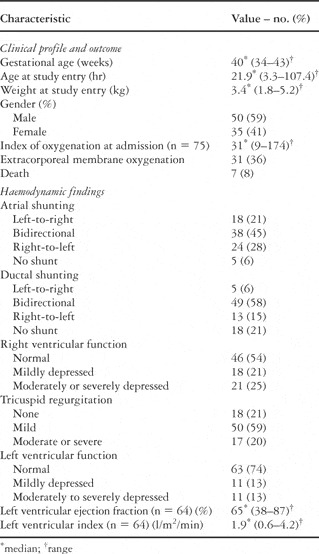
Table 1.
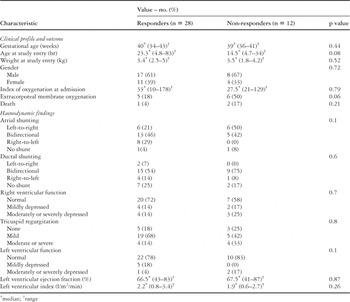
Table 2.
 You have
Access
- 30
- Cited by