




No CrossRef data available.
Early work as a source of developmental discontinuity during the transition to adulthood
Published online by Cambridge University Press: 01 December 2004
Abstract
From a developmental perspective, work has been considered as both a deleterious and salutary experience. According to one prominent view, part-time work places adolescents at risk because it limits participation in more developmentally beneficial activities and confronts them with stressors for which they are not yet ready. If this were the case, teenage part-time work would be “stress sensitizing,” lowering thresholds of reactivity to subsequent stressors and increasing the risk of poor young-adult mental health. As a result, early work experience could interfere with adequate preparation for adulthood. A more optimistic perspective, shared by some social scientists and most parents, is that employment for the young person signifies progress in moving toward adulthood and promotes adaptation to the work environment. Challenges at work are considered to be “steeling,” fostering coping resources that alleviate the detrimental effects of subsequent stressors, especially those encountered in the workplace. These processes would promote resilience and psychological well-being in early adulthood. This research examines these alternatives, using data from the Youth Development Study (1988–2000) covering the period from adolescence (age 14–15) to early adulthood (age 26–27). The analysis indicates that the character of their teenage work experience is a source of resilience as young adults make the transition from school to work.Earlier versions of this article were presented at the World Congress of Sociology, Brisbane, Australia, July 2002; at the annual meeting of the American Psychological Association, Chicago, August 2002; and at the biennial meeting of the Society for Research on Child Development, Tampa, April 2003. This research is supported by grants from the National Institute of Child Health and Human Development (HD44138) and the National Institute of Mental Health (MH42843). The authors thank Michael Finch for helpful advice regarding the data analysis.
Information
- Type
- Research Article
- Information
- Copyright
- © 2004 Cambridge University Press
This article addresses work experience as a source of distress, as well as mental health, during adolescence and the transition to adulthood. Understanding the environmental sources of mental health in adolescence is especially germane because negative mood is often initially manifest and increases in prevalence during this period (Cicchetti & Toth, 1995; Compas & Hammen, 1996; Ebata, Peterson, & Conger, 1990). Adolescents' self-concepts may be quite vulnerable as they encounter new challenges and environments (Simmons & Blyth, 1987). Adolescents must adapt to many new circumstances as they acquire greater autonomy from their families and make their way into new social contexts; often, these are subjectively experienced as stressful. Given the unfamiliarity of the new situations confronting them, and increasing performance pressures, it is not surprising to find increases in dysphoria, diminished self-esteem, and threats to self-confidence during this phase of the life course (Simmons, 2001).
During adolescence, most young people acquire their first formal jobs; many begin to work informally for pay even at younger ages (about age 12). Although almost all adolescents in the United States are employed sometime during their high school years (Committee on the Health and Safety Implications of Child Labor, 1998), the consequences of this new experience for their mental health, either contemporaneously or over the long term, have been given relatively little attention. Instead, social scientists have focused on the family, school, and peer group as the crucial contexts for personality formation and mental health.
Prominent developmental psychologists believe that early employment places adolescents at risk, diminishing their mental health as well as their future prospects in life. Greenberger and Steinberg (1986) framed the risks of paid work largely in terms of its “opportunity costs”; because work consumes so much time, adolescents lose a valuable moratorium period to explore alternative identities and interests. They expressed fear that working disrupts bonds with parents, and even close relationships with peers (Greenberger, 1988), the social supports that enable youth to successfully cope with problems.
Consistent with this point of view, Bachman and Schulenberg (1993), on the basis of the national Monitoring the Future surveys of high school seniors, have reported that long hours of work are associated with unhealthy lifestyles (less sleep and exercise, skipping breakfast). They warn that youth employment is part of a syndrome of “precocious development,” precipitating a hastened transition to adulthood. Intensive work hours in adolescence are linked with more frequent use of alcohol, cigarettes, and illicit drugs, as well as more minor delinquency and school misconduct (Bachman, Bare, & Frankie, 1986; Bachman & Schulenberg, 1993; Blum & Rinehart, 1997; Greenberger, 1984; Greenberger & Steinberg, 1986; McMorris & Uggen, 2000; Mihalic & Elliott, 1997; Safron, Bachman, & Schulenberg, 2001; Schulenberg & Bachman, 1993; Staff, Mortimer, & Uggen, 2003; Staff & Uggen, 2003; Steinberg & Dornbusch, 1991; Steinberg, Greenberger, Garduque, Ruggiero, & Vaux, 1982; Wright, Cullen, & Williams, 1997). Acquaintances with older coworkers in the work setting could introduce adolescents prematurely to alcohol and other substance use, the more “adultlike” ways of handling stress or using leisure time. Alternatively, youth with higher rates of delinquency and substance use could select themselves into work environments that offer fewer constraints on their subsequent behavior, which would render the effect of work hours on problem behaviors to be spurious (Paternoster, Bushway, Brame, & Apel, 2003).
Others emphasize deleterious circumstances within the work setting, adolescents' exposure to hazardous work conditions (Parker, Carl, French, & Martin, 1994) and job stressors that can evoke distress and increase the risk of both injury and illness. It is sometimes alleged that employed adolescents' alcohol use reflects the stresses they experience at work (Greenberger & Steinberg, 1986), and their attempts to restore a positive mood state. The consequences of employment for depressed mood itself, however, have received rather little empirical attention (Shanahan, Finch, Mortimer, & Ryu, 1991). Nor has there been very much study of work in relation to the adolescent's sense of mastery (Finch, Shanahan, Mortimer, & Ryu, 1991) or self-esteem.
Notwithstanding these concerns, others have emphasized the positive developmental consequences of paid work, as it is believed to expose the adolescent to new challenges and to promote valuable coping skills (Mortimer, 2003). Parents of teenagers believe that paid work builds character, instills a positive work ethic, and provides opportunities for growth-inducing experiences that are not likely to be encountered in other settings (Aronson, Mortimer, Zierman, & Hacker, 1996; Phillips & Sandstrom, 1990). Elder's (1974) classic study found that adolescents in the depression era, whose families were economically pressed, contributed to the family economy by paid work or through household labor. The more positive mental health and achievement of this cohort, in contrast to those who were younger at the time, were attributed to the self-confidence gained from helping the family at a time of great need (Elder & Rockwell, 1979). Adolescent employment is found to be associated with self-reported dependability, personal responsibility, punctuality, and self-reliance (Greenberger, 1984; Greenberger & Steinberg, 1986). The role of future worker is a key component of the adolescent future “possible self” (Johnson & Mortimer, 2000; Markus, Cross, & Wurf, 1990). Just having a job may lead to changed self-concepts and new identities, new expectations of responsibility and independence on the part of parents (Aronson et al., 1996; Phillips & Sandstrom, 1990), and high esteem in the eyes of peers (Mortimer & Shanahan, 1991).
The ability to function effectively in the work world could signal to the adolescent an immediate capacity to control important outcomes, as well as to function capably as an adult in the future. Employed adolescents may learn to better manage their time as they juggle the multiple activities of worker, student, friend, and family member. Contrary to a “zero-sum” model of time allocation, both employment and hours of work have been found to be positively related to involvement in school activities (Mihalic & Elliott, 1997); most adolescents who have paid jobs combine employment with substantial involvement in school-related and other domains (Shanahan & Flaherty, 2001). Capably handling diverse activities in adolescence could promote a self-image as one who is able to meet the challenges of diverse adult roles (Elder & Caspi, 1990), heightening self-esteem and self-efficacy, and lessening the likelihood of depressive mood states.
The few investigations of adolescent work and mental health have focused on the degree to which adolescents are invested in employment (hours of work per week); they have mainly yielded null findings (Bachman, Bare, & Frankie, 1986; Bachman & Schulenberg, 1993; Steinberg & Dornbusch, 1991; Steinberg, Fegley, & Dornbusch, 1993). Similarly, in the Youth Development Study (YDS), indicators of temporal investment in employment (work status, hours of work per week during the sophomore, junior, and senior years of high school, and the cumulative duration and intensity of work during the same period) bore no consistent relation to adolescent mental health dimensions (including self-esteem, self-efficacy, well-being, depressive affect, and self-derogation or negative self-esteem) during high school (see Mortimer, Finch, & Ryu, 1994, 19961
The specification of work intensity included continuous measures and dummy variables with varying cutoffs (e.g., more than 20 [or 30] hr/week, 20 [or 30] hr or less, and nonemployment; see Mortimer et al., 1996). Cumulative hours of work in each of the 3 years were found to have positive effects on self-esteem and self-efficacy, as well as positive effects on depressive affect, but only in one model specification (Mortimer et al., 1996).
A more promising line of research is based on the premise that the consequences of part-time work for adolescent mental health will depend on its quality. The quality of adult work has pervasive consequences for psychological functioning, the self-concept, and manifold indicators of mental health (Baker & Green, 1991; Erickson & Wharton, 1997; Johansson & Aronsson, 1991; Kohn & Schooler, 1983; Martin & Roman, 1996; Mortimer, Lorence, & Kumka, 1986; Ross & Wright, 1998; Warr, 1987). For adults, the multifaceted quality of work has been assessed in terms of its provision of extrinsic and intrinsic rewards, and its stressful features. These qualities can similarly be observed in adolescents' jobs.
The focus of this article is on the stressfulness of the adolescent work experience. Greenberger (1983, 1988) depicts young workers as taking on adult responsibilities without adequate coping skills. Research in the developmental literature (see Simmons & Blyth, 1987) points to the dangers inherent in experiencing problems too soon, before the person is ready to handle them effectively. In this case, work stressors could increase adolescent vulnerability and be “stress sensitizing,” lowering thresholds of reactivity and diminishing coping skills when similar problems are subsequently encountered. The experience of overwhelming stressors at work, or failure in managing diverse responsibilities, could foster a general sense of ineffectuality, depressive affect, and low self-esteem.
Alternatively, the psychological benefits of encountering and successfully dealing with difficult situations are well known (Compas, 1987; Masten & Garmezy, 1985; Rutter, 1985; Simmons & Blyth, 1987). Shanahan and Mortimer (1996, p. 190) have proposed a model of “eustress,” specifying the processes through which stressful experiences can foster successful adaptation. As they observe, “… people are adaptive and, when threatened with stressors, make a wide range of adjustments to avoid distressful reactions. In the process of coping with stressors, the individual's adaptive capacity may be enhanced and, by maintaining the self's integrity in the wake of stressors, the individual may experience a range of positive outcomes.”
According to this model, stressful experiences may have both immediate and long-term consequences. Primary eustress occurs when “eustressful” outcomes, including a sense of challenge, heightened confidence, and the development of coping skills, occur simultaneously with, or very shortly after, the experience of stressors. Secondary eustress occurs when earlier stressful experiences heighten the person's adaptive capacity in the face of later stressful encounters. Successful mastery of difficult tasks, even when they are perceived initially as stressful, can enhance self-efficacy, heighten thresholds of reactivity to subsequently experienced stressors, strengthen motivational structures to surmount them, and increase the propensity to select contexts that are ever more challenging yet still controllable. If these outcomes occur, early problems at work could be protective. In Rutter's (1985) terms, they would “steel” the adolescent for future challenges, as well as promote optimistic cognitions, favorable self-conceptions, and positive affect. In this way, they may promote resilience (Luthar, Cicchetti, & Becker, 2000).
Analyses of longitudinal data from the YDS, incorporating controls for background and lagged criterion variables, show that adolescent work stressors and early decision-making capacity on the job heighten adolescent males' distress, while the acquisition of useful skills on the job diminishes males' depressive affect (Shanahan, 1992; Shanahan et al., 1991).2
There is evidence from the Monitoring the Future studies (Schulenberg & Bachman, 1993) that skill utilization at work is also negatively associated with seniors' cigarette, marijuana, and alcohol use (the latter, only for females).
The quality of work experience has also been found to condition the effects of work hours. When work is of poor quality, long working hours may have deleterious consequences for personal development. Shanahan (1992) reports that both work stress and self-direction increase depressed mood only among YDS boys working more than the median number of hours in the 10th and 12th grades. Showing a similar pattern, seniors in the Monitoring the Future study, who described their jobs unfavorably (as not using their skills, unconnected to the future, and “the kind of work that people do just for the money”), used cigarettes more frequently as their work intensity increased (Schulenberg & Bachman, 1993). In the Monitoring the Future study, work intensity was found to be less consequential for youth who described their jobs as relevant to their futures.
Prior studies thus show that high levels of work demand tend to be accompanied by increases in adolescent distress, and that negative psychological outcomes are exacerbated when such work is prolonged. These investigations focus on the more immediate impacts of employment, its consequences while youth are still in high school. They provide little evidence for a primary or contemporaneous eustress model.
However, if experiences in adolescence are formative (Alwin, 1994; Alwin & McCammon, 2003), and if the secondary eustress model has merit, then part-time work in middle to late adolescence could have more salutary long-term consequences. This conceptualization suggests a more complex process through which early work stressors might affect the self-concept and depressed mood in early adulthood. That is, in the presence of similar work stressors in young adulthood, mental health functioning could be enhanced by the prior experience of stressors. The mental health of those without such early preparatory or steeling experience would be more compromised by work stressors in early adulthood.
Accordingly, the present research examines plausible interactions between work stressors experienced in adolescence and in early adulthood as they affect mental health. For it may be that the benefits of early work experiences, and especially work stressors, would be fully apparent only when the youth is similarly challenged in the early adult period. That is, early work stressors, although experienced contemporaneously as stressful, may have longer term salutary consequences by enhancing coping skills. By taking into account subsequent circumstances, we are able to test the “stress-sensitizing” and steeling hypotheses directly.
Method
Data source
Data from the YDS, an ongoing prospective longitudinal study of a community sample of adolescents and their parents, are brought to bear on these issues. An initial panel of 1,000 adolescents, chosen randomly from students registered in the St. Paul, Minnesota, public school district, was surveyed annually from the 9th (1988) to the 12th (1991) grades in high school, with excellent panel retention (93%) over the 4-year period. Yearly questionnaires, administered in the schools, included a large battery of items concerning experiences in work, family, school, and the peer group, as well as indicators of mental health. The surveys were mailed to students who were not present for either of two school administrations. To understand parental perspectives on teenage employment, and to obtain accurate information about socioeconomic status and other family background characteristics, mothers and fathers were surveyed by mail in the first and fourth years of the study.
In the 3 years following high school (1992, 1993, and 1994), the respondents were mailed a brief “life history calendar” (Freedman, Thornton, Camburn, Alwin, & Young–DeMarco, 1988). In the Spring of 1995, approximately 4 years after most adolescents' graduation from high school (when most were 21–22 years of age), an extensive survey was conducted including measures of educational and occupational attainment, sociobehavioral adjustment, and mental health. Almost 78% of the original participants were retained up to 1995, and 76% through the similar 2000 survey. The data enable us to examine the consequences of high school work experiences up until the respondents were 26 and 27 years of age.
Measurement
The key predictors in this analysis are job stressors, reflecting work conditions during high school, young-adult work stressors, and their interaction. The outcome variables are depressive affect, self-esteem, and self-efficacy during and after high school. Coping responses in the face of young-adult work stressors (escapism, anger/frustration, and rational action) constitute potential mediating variables in our analyses. Controls include socioeconomic background variables, gender, grade point average in the ninth grade, and lagged mental health variables. All the measures, including the family socioeconomic status and other variables entered as controls, are shown in Appendix A.
Work conditions
The adolescent work stressor measures were obtained in the sophomore, junior, and senior years of high school (1989–1991), as well as 4 (1995) and 9 years (2000) after high school. Ninth grade employment was not considered because much of paid work at this time is of an informal nature (Mortimer et al., 1994). Early work stressors are referenced by eight items reflecting time pressure, exposure to noxious work conditions, work overload, the lack of clarity in job responsibilities, and responsibility for things that are perceived as outside one's control. During high school, work stressor index scores were computed for each year (10th, 11th, and 12th grades) that the respondent was employed. They refer to jobs held at the time of each survey administration during the school year. Respondents may have held other jobs, between surveys, but the quality of these jobs is not known. Unweighted item response scores were summed for each year of employment. (Because only 29% of the respondents were employed at all three observations during high school, no attempt was made to derive item weights that would be equivalent across years; 31% worked 2 years, 22% worked only 1 year.) In the high school period, the work stressor index reflects the average quality of work (mean scores) over the years in which the respondent was employed. For some respondents, it is based on jobs held at three time periods; others will have had paid employment at only one or two times. Thus, these measures do not reflect the length of time the stressors were experienced. Approximately 18% of respondents did not work at the time of the sophomore, junior, or senior survey administrations, and therefore are not included in these analyses.
We utilize parallel work stressor indices (additive response composites) of employed respondents measured 4 and 9 years after high school, in 1995 and 2000. To enable a fuller specification of the work-related sources of young-adult mental health, we include extrinsic and intrinsic rewards in early adulthood, as well as work hours, in the analysis. In the extrinsic domain are indicators of wage satisfaction and actual pay. Intrinsically, some work provides opportunities to learn skills that will be useful to young people in the future; other work does not. When the worker is learning new things, tasks are more likely to be experienced subjectively as challenging and interesting, promoting psychological engagement and positive mental health (Csikszentmihalyi & Schneider, 2000).
Mental health outcomes
Depressive affect was measured by the General Well-Being Scale of the Current Health Insurance Study Mental Health Battery (see Ware, Johnson, Davis–Avery, & Brook, 1979) in the 9th grade and 12th grade and 4 (1995) and 9 years (2000) after high school. Items reflective of depressive affect assess feeling depressed; being under strain, stress, or pressure; and feeling downhearted, blue, and moody. Positive self-esteem was measured with the Rosenberg Self-Esteem Scale (Rosenberg, 1965) and mastery with the Pearlin Mastery Scale (Pearlin, Menaghan, Lieberman, & Mullan, 1981) at the same times. The unstandardized loadings for each construct, derived from a confirmatory factor analysis using LISREL 8, were used as item weights (as shown in Appendix A). Multiple group comparisons showed that these loadings did not significantly differ by gender or across waves of measurement. That is, constraining the lambdas to be the same across gender groups and time (Waves 1, 4, 8, and 12) yielded a solution that was not a significantly poorer fit than was obtained when all measurement parameters were allowed to be freely estimated. As expected, the zero-order correlations of the mental health indicators are positive for self-esteem and mastery in the most recent wave of data (r = .525, p < .001) and negative for depressed mood and self-esteem (r = −.420, p < .001) and mastery (r = −.526, p < .001). A correlation matrix of mental health, work quality, and background variables is shown in Appendix B.
Mediating variables
We assess the potential mediation of three work-related coping responses in the face of young-adult work stressors, distinguishing problem-focused and emotion-focused coping (Bridges, 2003). Rational action, representing problem-focused coping, is indicated by a composite measure. A worker using this strategy considers various modes of handling work problems, gives more attention to planning and priorities, thinks objectively, discusses the problem with the supervisor or coworkers, does not let the problem go until it is solved, takes action based on an understanding of the problem, and seeks out additional information. Emotion-focused coping includes cognitive or behavioral strategies to reduce stress. An escapist coping strategy involves going out with family and friends and forgetting about work problems, distracting oneself by having fun, becoming more involved in nonwork activities, thinking of good things in the future, trying to reassure oneself that everything is going to work out fine, and remembering that others have more problems. The anger and frustration strategy references expressing frustration by swearing, slamming things down, crumpling up paper, and losing temper for a moment. The unstandardized loadings for each construct, derived from a confirmatory factor analysis, were used as item weights (see Appendix A).
Procedure
An ordinary least-squares (OLS) regression analysis proceeds in a stepwise sequence, addressing the following six questions.
Question 1
Do high school work stressors influence 12th grade self-esteem, self-efficacy, and depressed mood? To take into account likely sources of spuriousness, we control for intensive work hours during the high school period (1 = respondents that averaged more than 20 hr/week of paid work during the sophomore, junior, and senior year; 0 = 20 hr or less), as well as social background variables, including family income, parents' education, race, and gender; grade point average; and lagged mental health (measured at the age of 14 or 15, in Wave 1). For example, adolescents who come from higher income families, and who have more highly educated parents, are found to acquire less stressful jobs; higher achievers in school also report less job stress during high school (Mortimer, Harley, & Staff, 2002). These adolescents may also have more positive mental health. Adolescent girls consistently report more depressive affect (as well as experiencing more clinical depression) than boys (Compas & Hammen, 1996), lower self-esteem, and lower efficacy. Simmons and Blyth (1987) note adolescent girls' special psychological vulnerability to the coincidence of pubertal and environmental changes. Boys, however, report more work stressors than girls (Mortimer et al., 1994, 2002).
Finally, associations between work quality indicators and mental health may result from a process of selection through which the more mentally healthy teenagers subsequently acquire higher quality work experiences. For example, depressed mood in the ninth grade predicts more stressful work experiences during high school (Mortimer et al., 2002). It is therefore useful to control lagged variables, measured prior to the work experiences, in assessing the consequences of work for mental health.
Question 2
Do high school work stressors influence young-adult mental health measured at the age of 20–21 (1995)? In these analyses, we control for intensive work hours during the high school period, family background, race, gender, and grade point average, and lagged mental health measured in Wave 4.
It should be noted that the lagged mental health variables are measured during the fourth year of the study when most youth were seniors in high school. This strategy makes the analyses especially stringent because any effect of early work experiences mediated by psychological changes during high school would not be registered in our analysis as longer term consequences of adolescent work. This specification, however, is in accord with the secondary eustress model, which highlights the longer term beneficial implications of stressful circumstances, mediated by adaptive coping strategies (not simply by psychological stability).
Question 3
Do work experiences 4 years after high school, including extrinsic rewards, intrinsic rewards, and work hours, as well as work stressors influence the same dimensions of mental health?
Question 4
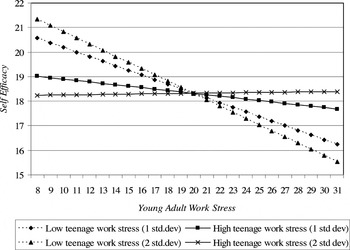
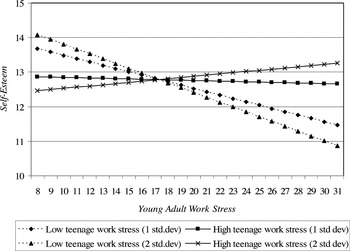
Do early work stressors condition the mental health impacts of subsequently experienced stressors? We assess this effect by including an interaction term in the equation (young-adult stressors multiplied by early work stressors). We also graph expected values of depressive affect, self-esteem, and self-efficacy as adult work stress increases, for those who experienced greater and lesser degrees of work stressors in adolescence (measured at both 1 and 2 SD above and below the mean).
Question 5
Do coping responses, including rational action, escapism, and the expression of anger, mediate the conditional response to early adult work stressors?
Question 6
Do teenage work stressors condition the effects of stressors experienced 9 years after high school on self-esteem, self-efficacy, and depressed mood when the young people are mostly 26 and 27 years old (2000)? In these analyses, we include lagged measures of mental health, adult work experiences, teenage work stressors, background variables, and an interaction term (adult work stressors multiplied by early work stressors). Repeating the analyses 8 years after the high school period enables identification of the developmental scope of eustressful or “distressful” consequences of teenage work as youth make the transition to adulthood.
Findings
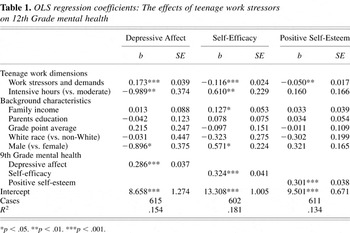
The OLS regression coefficients displayed in Table 1 show that adolescent work stressors have significant deleterious effects on self-esteem, self-efficacy, and depressive affect during high school (1991) when background variables, intensive work hours, and the lagged psychological indices measured 4 years earlier are controlled. In view of the attention directed to adolescent work hours, it is noteworthy that intensive employment has no negative effects on mental health in high school or subsequently (Tables 1, 2, 3, 4, 5, 6, and 7). In fact, youth who worked longer hours during high school exhibit less depressed mood and greater self-efficacy. Intensive work also did not moderate the effects of stressors on any occasion (as indicated by nonsignificant [Work Stressor × Intensity] interactions, analyses not shown). We conclude that high intensity work is not a risk factor for poor mental health.
OLS regression coefficients: The effects of teenage work stressors on 12th Grade mental health

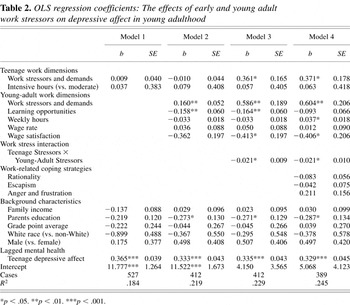
OLS regression coefficients: The effects of early and young adult work stressors on depressive affect in young adulthood

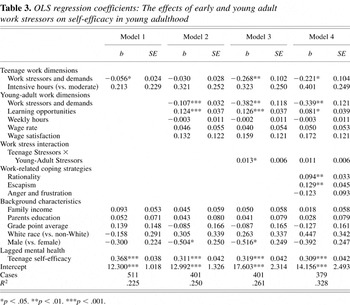
OLS regression coefficients: The effects of early and young adult work stressors on self-efficacy in young adulthood

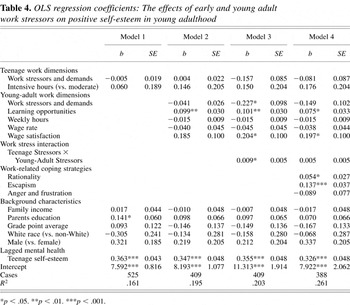
OLS regression coefficients: The effects of early and young adult work stressors on positive self-esteem in young adulthood

OLS regression of coefficients: The effects of early and adult work stressors on depressive affect in adulthood

OLS regression coefficients: The effects of early and adult work stressors on self-efficacy in adulthood

OLS regression coefficients: The effects of early and adult work stressors on positive self-esteem in adulthood

The first model in Tables 2, 3, and 4 enables assessment of the effects of the high school work stressors on mental health 4 years later (1995), when the respondents were 20 and 21 years old. Early work stressors are found to have negative (still distressful) effects on self-efficacy 4 years after high school (p < .05), but no significant impacts on self-esteem or depressive affect. As noted, the fact that Wave 4 (senior year in high school) lagged mental health variables are controlled makes these analyses particularly stringent. When Wave 1 depressive affect is substituted for the Wave 4 measure as a control, teenage work stressors are found to significantly heighten depressed mood and lower self-efficacy in 1995, but have no long-term effects on self-esteem (see Mortimer et al., 2002). Again, we include Wave 4 (1991) lagged psychological variables here because this specification is more consistent with a secondary eustress model.
In all of the models in Tables 1, 2, 3, and 4, lagged mental health measures significantly predict later mental health outcomes, which suggest stability in mental health over this period of adolescence and the transition to adulthood. Inclusion of the other control variables (family background, early school performance, race, and gender) is less predictive of mental health with few exceptions. For example, boys in the senior year of high school display higher self-efficacy and lower rates of depressive affect than girls (see Table 1). Four years after the high school period, gender differences in depressed mood disappear (Table 2), although males show lower self-efficacy in two model specifications (Table 3). Males manifest higher self-efficacy 8 years after high school (Table 6). Few of the family background measures (parent's education, family income, family composition, and nativity) significantly affect mental health outcomes 4 (1995) and 8 years (2000) after the high school period, when the lagged variables are controlled.
The second series of equations enable assessment of the effects of contemporaneous (1995) work quality variables on mental health (see model 2 in Tables 2, 3, and 4). Contemporaneous young-adult work stressors diminish the sense of efficacy and heighten depressed mood, but do not appear to influence self-esteem. Learning opportunities at work are found to enhance self-efficacy and self-esteem, and to diminish depressive affect. None of the three mental health variables are significantly predicted by actual pay, wage satisfaction, or by the degree of work investment (hours of work).
Most pertinent to our present concerns, once the contemporaneous work experiences are considered, the adolescent work stressors are found to have no significant effects. From this, one might conclude that high school work experiences no longer matter at all, as their formative impact is seemingly overtaken by experiences that are more recent. On the basis of this null pattern, one might reasonably conclude that over the long term, neither the eustressful nor the distressful models are correct. Instead, high school work experience simply does not matter for longer term mental health outcomes.
The third model of Tables 2, 3, and 4 assesses the hypothesized conditioning effect, whether early work stressors moderate the influence of subsequent stressors on mental health. An interaction term, formed by multiplying young-adult work stressors by teenage work stressors, is added to the model. This interaction term is found have a significant positive effect on self-efficacy and self-esteem, and a negative effect on depressed mood (p < .05 for each). Across the three outcome variables, the conditioning influence of high school work experience is clearly present and consistent in dampening the effects of young-adult work stressors on mental health. That is, early work stressors are found to reduce the positive effects of contemporaneous (1995) work stressors on depressive affect, as well as their negative effects on self-esteem and mastery.
These effects may be observed when the expected values for mental health indicators are plotted against contemporaneous work stressors for groups experiencing high and low adolescent work stress (divided 1 and 2 SD above and below the mean). As is shown in Figures 1, 2, and 3, mental health remains relatively constant as young-adult work stressors increase for the higher adolescent work stress groups. That is, depressive affect does not increase with greater young-adult work stressors; and self-esteem and self-efficacy do not diminish. It is among the respondents who experienced relatively little work stressors in adolescence that we see the more pronounced deleterious effects of young-adult work stressors on mental health.3
Work intensity was not found to intensify or moderate this conditioning pattern; insertion of three-way interactions into Model 3 (Teenage Intensive Work Hours × Teenage Work Stressors × Young-Adult Work Stressors) yielded no significant coefficients.

Depressive affect in young adulthood (age 22) by teenage and young-adult work stress.

Self-efficacy in young adulthood (age 22) by teenage and young-adult work stress.

Positive self-esteem in young adulthood (age 22) by teenage and young-adult work stress.
It should be noted that high school work stressors and 1995 work stressors are positively correlated (r = .338, p < .001). Interpreting this positive association is beyond the scope of the present article. It could be attributable to several processes, for example, early work stressors enable the person to withstand subsequent stressors more readily; alternatively, the positive association could be explained by workers' stable tendency to perceive and report stressful circumstances in the work environment; other factors fostering stability in occupational trajectories may also be relevant.
We now consider coping resources that could mediate these conditioning relationships. If such mediation occurs, one might expect that early work stressors would predict the coping responses. There is very limited support for this hypothesis. We find that early work stressors have no significant effect on the use of rational action or anger as a coping strategy, and only marginal predictive capacity with respect to subsequent escapism (p < .10; table not shown, available from authors). When all three coping variables are entered in the final models (Model 4 in Tables 2, 3, and 4), the conditioning effect disappears for self-esteem and self-efficacy. It remains for depressed mood. It should be noted that the coping strategies have direct effects on mental health. Rational coping is positively related to self-efficacy and self-esteem. Escapism is also positively associated with self-esteem and self-efficacy. As operationalized here, this mode of coping might not be entirely dysfunctional; being able to remove oneself and disengage from a stressful circumstance may, in fact, be helpful in alleviating distress and enabling recuperation.
It is conceivable that work experience itself is a key mediator. That is, persons who experienced more work stressors during high school may have entered the full-time workforce earlier than other youth. We found earlier that high levels of investment in work during high school were associated with both higher work stress and rapid acquisition of full-time jobs after high school (Mortimer, 2003). Thus, those who experienced higher levels of work stressors during high school had more months of full-time work by 1995 and therefore more time since high school to adapt to work stressors. However, when the average number of months of full-time work each year during the 4 years since leaving high school (1992, 1993, 1994, and 1995) was added to two of our equations (not shown), it had no significant additive effects on the mental health variables and no effects on the interaction term.
We also estimated sample selectivity models that include a selection to work hazard for each of the mental health outcomes (see Appendix C). Nonrandom selection to work could be a problem in our previous models because only 65% of the 780 respondents retained by the 1995 survey reported being employed both in the high school period (on the occasions of survey administration) and in 1995, when many respondents are still in school. Thus, our preceding analyses that include interactions of teenage and young-adult work stressors (Models 3 and 4, Tables 2, 3, and 4) do not include respondents who were missing information regarding their high school work history (5%), nor respondents who were not working in one or both of these periods (14.5% were employed at some point during their sophomore, junior, or senior year in high school but not in 1995, 10.5% were employed in 1995 but not in high school, and 5% were not employed during both periods). Therefore, when estimating the longer term consequences of high school work experiences on mental health, we included a selection to work lambda to adjust our regression estimates for the propensity to be employed in young adulthood.
Using LIMDEP 8, we estimated the effects of work stressors and intensive work hours in the high school period, as well as gender (male vs. female), nativity (US vs. foreign born), family composition (two parents vs. other), race (White vs. non-White), parental education, and family income on the propensity for employment in 1995. The selection to work equation was significant, χ2 (9) = 22.91, p < .01, and suggested Whites and those respondents from families with higher incomes were more likely to be employed in 1995 than non-Whites and those with lower family incomes in 1988. Work stress during the high school period also increased the propensity of employment in young adulthood, although intensive hours of work did not predict job holding in 1995. Family composition, parental education, gender, nativity, and grade point average did not significantly predict employment. Although teenage work stressors are positively correlated with young-adulthood work stressors (as shown in Appendix B), and increase the likelihood of employment in 1995, the inclusion of the selection to work lambda did not appreciably change the magnitude of the work effects nor the interaction of teenage and young-adult work stressors on contemporaneous mental health outcomes.
We also considered the possibility that sample attrition could potentially bias our pattern of findings. Of the original 1,000 respondents in 1988, approximately 22% had attrited from the sample by 1995. Mental health did not differ between youth who remained in the panel by 1995 and those who attrited. (Appendix D shows the relationship between sample retention by 1995 and 2000 and the background and psychological variables.) We estimated the effects of prior work stressors and intensive hours, as well as measures of family background and school performance, on the likelihood of panel retention by 1995. Although males, non-Whites, and youth with lower levels of parental education were more likely to leave the study by 1995 than females, Whites, and youth with higher levels of parental education, inclusion of a sample retention hazard in our analyses did not change the direction or magnitude of our findings, nor did the sample retention lambda have statistically significant effects on mental health (tables not shown).
A final analysis (Tables 5, 6, and 7) replicates the models shown in models 2–4, using Wave 12 mental health outcomes (9 years beyond high school, when the youth were 26 and 27 years old). Teenage work stressors still are shown to have a negative effect on self-efficacy net of background variables and self-efficacy measured in 1991 (again, these psychological dimensions show significant stability over this 9-year period). But, high school work stressors have no long-term additive effects on self-esteem or depressed mood, extending to Wave 12 (whether the Wave 12 work variables are included, as shown in Model 2, or not included, as in Model 1). There is, however, a significant negative effect of adolescent work stressors on self-efficacy. Nor do high school work stressors moderate the negative effects of contemporaneous (Wave 12) work stressors on any of the three mental health variables (Model 3); this lack of moderation is indicated by the now nonsignificant interaction terms. Thus, by this latter stage in the transition to adulthood, the secondary eustress process, observed in 1995, appears to have dissipated.4
We also considered the possibility that the decision to work in 2000, as well as sample attrition, may have influenced our findings. Slightly more respondents were employed in both the high school period and in 2000 (72%) than in 1995 (65%). The sample attrition rate by 2000 was also higher (24% of the original sample) than in 1995 (22%). However, the inclusion of a selection to work lambda in 2000, as well as models that included a sample retention lambda by 2000, did not change this pattern of findings.
Given the fact that boys and girls have different work experiences, and that boys consistently report more work stressors (Mortimer, 2003), as well as the differential meaning of the work role to the sexes, it is plausible to assume that the relations shown in this article could differ between men and women. However, the coefficients for the interaction of gender and both early work stressors and intensive hours (Gender × Teenage Work Stressors; Gender × Teenage Intensive Work Hours) as well as three-way interactions (Gender × Teenage Work Stressors × Young-Adult Work Stressors) were nonsignificant. We conclude that the process of secondary eustress shown in this analysis applies to both men and women.
Conclusion
The connection between work quality and adult mental health has been clearly established (Kohn & Schooler, 1983; Mortimer et al., 1986; Warr, 1987). Because adolescent work is so circumscribed, for many youth limited to service sector employment in the secondary labor market, the quality of adolescent work might appear to have limited variability, and to be uniformly low (Greenberger & Steinberg, 1986, Chapter 2; but also see Greenberger, Steinberg, & Ruggiero, 1982). If this were the case, it would make little sense to investigate the effects of variation in the quality of adolescent work on mental health. Moreover, because most students do not view their high school jobs as leading to adult employment, these jobs are often thought to have minimal salience, and therefore little psychological or behavioral impact. Perhaps partly because of these assumptions, the quality of work experience, as a potential determinant of adolescent or young-adult mental health, has received so little empirical scrutiny.
Contrary to these suppositions, the analyses presented here suggest that for adolescents, as for adults, work quality is consequential for mental health. Adolescent work stressors were associated with diminished self-esteem, lower self-efficacy, and higher levels of depressed mood during high school. Four and 9 years after high school, adolescent work stressors are still found to diminish feelings of self-efficacy, although they had no significant influence on self-esteem or depressive affect after high school when more proximal measures of work stress are considered.
This pattern indicates that early work stressors have some negative influence, but no contemporaneous or longer term beneficial or eustressful outcomes, based on notions of steeling or “stress inoculation,” when they are considered as independent additive predictors of mental health. It is only in the presence of young-adult work stressors that their significant positive influence is observed. That is, we find consistent evidence with respect to all three outcomes (self-esteem, self-efficacy, and depressed mood) that early work stressors moderate the deleterious effects of early adult work stressors on mental health 4 years following high school. It is among those who experience relatively little work stress during adolescence that young-adult work stressors diminish self-esteem and self-efficacy and heighten depressed mood. Here we find substantial corroboration of the secondary eustress model.
We have also shown that the conditional effects of early work on self-esteem and self-efficacy 4 years after high school are reduced to statistical insignificance when three coping mechanisms (rational action, anger, and escapism, or withdrawal from the stressful scene) are entered into the equations. This pattern would suggest a process of mediation: the coping resources acquired early on in the workplace enable some young people to better handle stressful circumstances in their subsequent jobs. Still, we have not been able to convincingly demonstrate that stressful work experiences engender these coping strategies (finding only weak predictive influence). Moreover, the statistically significant interaction of early and subsequent work stressors, in reducing depressive mood, remains even when the coping resources are taken into account. It may be that early work stressors affect the development of coping skills in other ways, not captured by the three coping variables measured here.
The findings presented in this article thus suggest that early work stressors heighten youth's subsequent adaptation to the work role by enhancing their resilience in the face of subsequent work stressors. We have observed these outcomes 4 years after high school, when many of the young people are in a fairly early stage of transition to adulthood. Most of the young people were still pursuing postsecondary education at this time; in fact, 51.4% of the respondents reported attending at least 1 month of higher education in 1995. Further study is needed, perhaps utilizing more qualitative methodologies, to determine precisely how adolescent work experiences engender adaptive strategies and responses.
The same eustressful patterns, however, are no longer apparent 9 years after high school, by which time most youth would have had substantially more full-time work experience and be further along in their transition to adulthood. Adolescent exposure to stressful work may be most promotive of successful coping strategies in the initial stage of the early adult career. Still, because mental health tends to be stable over time, the earlier conditioning effects of teenage work experience are likely to have long-lasting positive sequelae.
Returning to the theme of this special issue, this article finds evidence for the proposed process of secondary eustress, which may be considered a pattern of developmental discontinuity. From an environmental perspective, discontinuity refers to a change in external conditions. From a psychological perspective, discontinuity references individual instability over time. Consideration of individual in context brings these two approaches together ecologically and raises the intriguing possibility that associations bridging these levels of analysis may be different as persons move through successive stages of development. Furthermore, as we have seen, experiences at earlier times may condition individuals' responses to their environments in subsequent periods of the life course. Such patterns suggest a more encompassing or global kind of discontinuity than manifest at either the individual or the environmental levels: here we draw attention to developmental discontinuity in the relations between social context, on the one hand, and individual psychological states and levels of functioning, on the other.
In this study, those youth who experience heightened work stressors in adolescence are found to exhibit lower self-esteem, lesser mastery, and more depressive affect. However, these same adolescents, in the face of work stressors 4 years after high school, are found to be more resilient than their peers who have not had these earlier preparatory experiences. For them, short-term losses have yielded long-term gains. Resilience is not, in this instance, manifest as a persistent trait, as a stable capacity to maintain positive mental states in the presence of environmental stressors. Instead, mental health is maintained in the face of challenging circumstances after earlier-stage decrements in well-being in response to the same kinds of stressors.
Resilience has recently been defined as “… the maintenance of positive adjustment under challenging life conditions” (Luthar et al., 2000, p. 546). This conceptualization, referencing “competence despite diversity” (p. 554), draws attention to contemporaneous protective factors, such as supportive relationships or salutary personality traits, which enable individuals to neutralize, or effectively cope with, stressors. There is substantial interest in the literature in the stability of such resilient adaptation (Masten, Hubbard, Gest, Tellegen, Garmezy, & Ramirez, 1999). Accordingly, Luthar et al. (2000, p. 535) argue that “longitudinal studies must investigate not only the stability of resilience over time, but also the ability of formerly resilient individuals to ‘bounce back’ after difficult periods, to achieving earlier resilient adaptation.” In this article, we have identified an alternative, relatively long-term process of discontinuity, not stability, that appears to generate resilience; a process through which individuals who are exposed to stressors in adolescence exhibit negative psychological reactions contemporaneously; but not when confronted with similar stressors in a subsequent period of development. Stressors that are detrimental to mental health earlier in life are, in fact, shown to be protective later on, conferring resilience in the face of similar challenges. This long-term pathway is fully consistent with Elder's documentation of psychological benefits in adulthood for those experiencing Depression era economic loss during adolescence (Elder, 1974; Elder & Rockwell, 1979).
From a policy perspective, the findings should not be construed as suggesting that efforts to protect employed adolescents are not needed. Clearly, there are dangers in the workplace, and adolescents are sometimes subjected to highly injurious conditions (Committee on the Health and Safety Implications of Child Labor, 1998). Instead, what is indicated is that the relatively moderate levels of work stressors reported by a community sample of employed adolescents present stage-appropriate challenges that enhance preparation for subsequent challenges at work. This conclusion is consistent with the overwhelmingly positive assessments of YDS parents, when asked about their own prior work experience and that of their children (Aronson et al., 1996), as well as the adolescents' own quite salutary evaluations (Mortimer, 2003; Mortimer et al., 1994). In the study of work, as well as other domains, primary attention is often directed to problems and pathological outcomes, the distressful consequences of stressors. Hopefully, these findings will encourage researchers to give more attention in the future to the study of adolescent work and to the positive eustressful processes, stimulated by work experiences, during the transition to adulthood.
Appendix A. Selected measures


Appendix B

Appendix C

Appendix D

References
REFERENCES
Alwin, D. E.
(1994).
Aging, personality, and social change: The stability of individual
differences over the life span. In
D. L. Featherman,
R. M. Lerner, &
M. Perlmutter (Eds.)
Life span development and behavior (pp.
135–185).
Hillsdale, NJ:
Erlbaum.
Alwin, D. E., &
McCammon, R. J.
(2003).
Generations, cohorts, and social change. In
J. T. Mortimer &
M. Shanahan (Eds.),
Handbook of the life course (pp.
23–50).
New York:
Kluwer Academic/Plenum Press.
Aronson, P. J.,
Mortimer, J. T.,
Zierman, C., &
Hacker, M.
(1996).
Generational differences in early work experiences and
evaluations. In
J. T. Mortimer &
M. D. Finch (Eds.)
Adolescents, work, and family: An intergenerational developmental
analysis (pp.
25–62).
Newbury Park, CA:
Sage.
Bachman, J. G.,
Bare, D. E., &
Frankie, E. I.
(1986).
Correlates of employment among high school seniors.
Ann Arbor, MI:
Institute for Social Research.
Bachman, J. G., &
Schulenberg, J.
(1993).
How part-time work intensity relates to drug use, problem behavior,
time use, and satisfaction among high school seniors: Are these
consequences or merely correlates?
Developmental Psychology
29,
220–235.Google Scholar
Baker, F., &
Green, G. M.
(1991).
Work, health, and productivity: Overview. In
G. M. Green &
F. Baker (Eds.),
Work, health and productivity (pp.
3–29).
New York:
Oxford University Press.
Blum, R. W., &
Rinehart, P. M.
(1997).
Reducing the risk: Connections that make a difference in the lives
of youth.
Minneapolis, MN:
University of Minnesota.
Bridges, L. J.
(2003).
Coping as an element of developmental well-being. In
M. H. Bornstein,
L. Davidson,
C. L. M. Keyes, &
K. A. Moore (Eds.),
Well-being. Positive development across the life course (pp.
155–166).
Mahwah, NJ:
Erlbaum.
Call, K. T.
(1996).
The implications of helpfulness for possible selves. In
J. T. Mortimer &
M. D. Finch (Eds.),
Adolescents, work, and family: An intergenerational developmental
analysis (pp.
63–96)
Newbury Park, CA:
Sage.
Call, K. T., &
Mortimer, J. T.
(2002).
Arenas of comfort and adolescent stress: Evidence from a
prospective longitudinal study.
Hillsdale, NJ:
Erlbaum.
Call, K. T.,
Mortimer, J. T., &
Shanahan, M.
(1995).
Helpfulness and the development of competence in adolescence.
Child Development
66,
129–138.Google Scholar
Cicchetti, D., &
Toth, S. L.
(1995).
Developmental psychopathology and disorders of affect. In
D. Cicchetti &
D. J. Cohen (Eds.),
Developmental psychopathology, Vol. 2. Risk, disorder and
adaptation (pp.
369–420).
New York:
Wiley.
Committee on the Health and Safety Implications of Child
Labor.
(1998).
Protecting youth at work.
Washington, DC:
National Academy Press.
Compas, B. E.
(1987).
Coping with stress during childhood and adolescence.
Psychological Bulletin
101,
393–403.Google Scholar
Compas, B. E., &
Hammen, C. L.
(1996).
Child and adolescent depression: Covariation and comorbidity in
development. In
R. J. Haggerty,
L. R. Sherrod,
N. Garmezy, &
M. Rutter (Eds.),
Stress, risk, and resilience in children and adolescents. Process,
mechanisms, and interventions (pp.
225–267).
Cambridge:
Cambridge University Press.
Csikszentmihalyi, M., &
Schneider, B.
(2000).
Becoming adult: How teenagers prepare for the world of work.
New York:
Basic Books.
Ebata, A. T.,
Peterson, A. C., &
Conger, J .J.
(1990).
The development of psychopathology in adolescence. In
J. Rolf,
A. S. Masten,
D. Cicchetti,
K. H. Nuechterlein, &
S. Weintraub (Eds.),
Risk and protective factors in the development of psychopathology
(pp.
308–333).
New York:
Cambridge University Press.
Elder, G. H., Jr.
(1974).
Children of the great depression.
Chicago, IL:
University of Chicago Press.
Elder, G. H., &
Caspi, A.
(1990).
Studying lives in changing society: Sociological and
personological explorations. In
A. I. Rabin,
R. A. Zucker,
R. Emmons, &
S. Franks (Eds.),
Studying persons and lives (pp.
201–247).
New York:
Springer.
Elder, G. H., &
Rockwell, R. C.
(1979).
Economic depression and postwar opportunity in men's lives: A
study of life patterns and health. In
R. G. Simmons (Ed.),
Research in community and mental health (pp.
249–303).
Greenwich, CT:
JAI Press.
Erickson, R., &
Wharton, A.
(1997).
Inauthenticity and depression: Assessing the consequences of
interactive service work.
Work and Occupations
24,
188–213.Google Scholar
Finch, M. D.,
Shanahan, M. J.,
Mortimer, J. T., &
Ryu, S.
(1991).
Work experience and control orientation in adolescence.
American Sociological Review
56,
597–611.Google Scholar
Freedman, D.,
Thornton, A.,
Camburn, D.,
Alwin, D., &
Young–DeMarco, L.
(1988).
The life history calendar: A technique for collecting
retrospective data. In
C. C. Clogg (Ed.),
Sociological methodology (pp.
37–68).
San Francisco, CA:
Jossey–Bass.
Greenberger, E.
(1983).
A researcher in the policy arena: The case of child labor.
American Psychologist
38,
104–111.Google Scholar
Greenberger, E.
(1984).
Children, family, and work. In
N. D. Repucci,
L. A. Weithorn,
E. P. Mulvey, &
J. Monahan (Eds.),
Children, mental health, and the law (pp.
103–122).
Beverly Hills, CA:
Sage.
Greenberger, E.
(1988).
Working in teenage America. In
J. T. Mortimer &
K. M. Borman (Eds.),
Work experience and psychological development through the life span
(pp.
21–50).
Boulder, CO:
Westview.
Greenberger, E., &
Steinberg, L. D.
(1986).
When teenagers work: The psychological and social costs of
adolescent employment.
New York:
Basic Books.
Greenberger, E.,
Steinberg, L. D., &
Ruggiero, M.
(1982).
A job is a job is a job or is it? Behavioral observations in the
adolescent workplace.
Work and Occupations
9,
79–96.Google Scholar
Johnson, M. K., &
Mortimer, J. T.
(2000).
Work-family orientations and attainments in the early life
course. In
T. L. Parcel &
D. B. Cornfield (Eds.)
Work and family: Research informing policy.
Newbury Park, CA:
Sage.
Johansson, G., &
Aronsson, G.
(1991).
Psychosocial factors in the workplace. In
G. M. Green &
F. Baker (Eds.),
Work, health, and productivity (pp.
179–197).
New York:
Oxford University Press.
Kohn, M. L., &
Schooler, C.
(1983).
Work and personality: An inquiry into the impact of social
stratification.
Norwood, NJ:
Ablex.
Luthar, S. S.,
Cicchetti, D., &
Becker, B.
(2000).
The construct of resilience: A critical evaluation and guidelines
for future work.
Child Development
71,
543–562.Google Scholar
Markus, H.,
Cross, S., &
Wurf, E.
(1990).
The role of the self-system in competence. In
R. J. Sternberg, &
J. Kolligan, Jr. (Eds.),
Competence considered (pp.
205–226).
New Haven, CT:
Yale University Press.
Martin, J. K., &
Roman, P. M.
(1996).
Job satisfaction, job reward characteristics, and employees'
problem drinking behaviors.
Work and Occupations
23,
4–25.Google Scholar
Masten, A. S., &
Garmezy, N.
(1985).
Risk, vulnerability, and protective factors in developmental
psychopathology. In
B. B. Lahey &
A. E. Kazdin (Eds.),
Advances in clinical child psychology
(Vol. 8, pp.
1–52).
New York:
Plenum Press.
Masten, A. S.,
Hubbard, J. J.,
Gest, S. D.,
Tellegen, A.,
Garmezy, N., &
Ramirez, M.
(1999).
Adaptation in the context of adversity: Pathways to resilience and
maladaptation from childhood to late adolescence.
Development and Psychopathology
11,
143–169.Google Scholar
McMorris, B., &
Uggen, C.
(2000).
Alcohol and employment in the transition to adulthood.
Journal of Health and Social Behavior
41,
276–294.Google Scholar
Mihalic, S., &
Elliott, D.
(1997).
Short- and long-term consequences of adolescent work.
Youth and Society
28,
464–498.Google Scholar
Mortimer, J. T.
(2003).
Working and growing up in America.
Cambridge, MA:
Harvard University Press.
Mortimer, J. T.,
Finch, M. D, &
Ryu, S.
(1994).
Work intensity and the mental health of high school students: A
test of three behavioral models.
Paper presented at the 1994 World Congress of Sociology,
Bielefeld, Germany.
Mortimer, J. T.,
Finch, M. D.,
Ryu, S.,
Shanahan, M. J., &
Call, K.
(1996).
The effects of work intensity on adolescent mental health,
achievement, and behavioral adjustment: New evidence from a prospective
study.
Child Development
67,
1243–1261.Google Scholar
Mortimer, J. T.,
Harley, C., &
Staff, J.
(2002).
The quality of work and youth mental health.
Work and Occupations
29,
166–197.Google Scholar
Mortimer, J. T., &
Johnson, M. K.
(1998).
New perspectives on adolescent work and the transition to
adulthood. In
R. Jessor (Ed.),
New perspectives on adolescent risk behavior (pp.
425–496).
New York:
Cambridge University Press.
Mortimer, J. T.,
Lorence, J., &
Kumka, D.
(1986).
Work, family, and personality: Transition to adulthood.
Norwood, NJ:
Ablex.
Mortimer, J. T., &
Shanahan, M. J.
(1991).
Adolescent work experience and relations with peers.
Paper presented at the annual meeting of the American Sociological
Association, Cincinnati, OH.
Mortimer, J. T., &
Shanahan, M. J.
(1994).
Adolescent work experience and family relationships.
Work and Occupations
21,
369–384.Google Scholar
Parker, D.,
Carl, W.,
French, L., &
Martin, F.
(1994).
Characteristics of adolescent work injuries reported to the
Minnesota department of labor and industry.
American Journal of Public Health
84,
606–611.Google Scholar
Paternoster, R.,
Bushway, S.,
Brame, R., &
Apel, R.
(2003).
The effect of teenage employment on delinquency and problem
behaviors.
Social Forces
82,
297–336.Google Scholar
Pearlin, L. I.,
Menaghan, E. G.,
Lieberman, M. A., &
Mullan, J. T.
(1981).
The stress process.
Journal of Health and Social Behavior
22,
337–356.Google Scholar
Phillips, S., &
Sandstrom, K. L.
(1990).
Parental attitudes towards youth work.
Youth and Society
22,
160–183.Google Scholar
Rosenberg, M.
(1965).
Society and the adolescent self-image.
Princeton, NJ:
Princeton University Press.
Ross, C., &
Wright, M.
(1998).
Women's work, men's work, and the sense of control.
Work and Occupations
25,
333–355.Google Scholar
Rutter, M.
(1985).
Resilience in the face of adversity: Protective factors and
resistance to psychiatric disorder.
British Journal of Psychiatry
147,
598–611.Google Scholar
Safron, D.,
Bachman, J., &
Schulenberg, J.
(2001).
Part-time work and hurried adolescence: The links among work
intensity, social activities, health behaviors, and substance use.
Journal of Health and Social Behavior
42,
425–449.Google Scholar
Schulenberg, J., &
Bachman, J. G.
(1993).
Long hours on the job? Not so bad for some types of jobs: The
quality of work and substance use, affect and stress.
Paper presented at the biennial meeting of the Society for
Research on Child Development, New Orleans, LA.
Shanahan, M. J.
(1992).
High school work experiences and depressed mood.
Paper presented at the annual meeting of the American Sociological
Association, Pittsburgh, PA.
Shanahan, M. J.,
Finch, M. D.,
Mortimer, J. T., &
Ryu, S.
(1991).
Adolescent work experience and depressive affect.
Social Psychology Quarterly
54,
299–317.Google Scholar
Shanahan, M. J., &
Flaherty, B. P.
(2001).
Dynamic patterns of time use in adolescence.
Child Development
72,
385–401.Google Scholar
Shanahan, M. J., &
Mortimer, J. T.
(1996).
Understanding the positive consequences of psychosocial stress. In
B. Markovsky,
M. Lovaglia, &
R. Simon (Eds.),
Advances in group processes
(Vol. 13, pp.
189–209).
Greenwich, CT:
JAI Press.
Simmons, R. G.
(2001).
Comfort with the self. In
T. J. Owens,
S. Stryker, &
N. Goodman (Eds.),
Extending self-esteem theory and research: Sociological and
psychological currents.
New York:
Cambridge University Press.
Simmons, R. G., &
Blyth, D. A.
(1987).
Moving into adolescence: The impact of pubertal change and school
context.
Hawthorne, NY:
Aldine de Gruyter.
Staff, J.,
Mortimer, J. T., &
Uggen, C.
(2003).
Work and leisure in adolescence. In
J. T. Mortimer &
M. Shanahan (Eds.),
Handbook of the life course (pp.
429–450).
New York:
Kluwer Academic/Plenum Press.
Staff, J., &
Uggen, C.
(2003).
The fruits of good work: Early work experiences and adolescent
deviance.
Journal of Research in Crime and Delinquency
40,
263–290.Google Scholar
Steinberg, L. D., &
Dornbusch, S. M.
(1991).
Negative correlates of part-time employment during adolescence:
Replication and elaboration.
Developmental Psychology
27,
304–313.Google Scholar
Steinberg, L. D.,
Fegley, S., &
Dornbusch, S. M.
(1993).
Negative impact of part-time work on adolescent adjustment:
Evidence from a longitudinal study.
Developmental Psychology
29,
171–180.Google Scholar
Steinberg, L. D.,
Greenberger, E.,
Garduque, L.,
Ruggiero, M., &
Vaux, A.
(1982).
Effects of working on adolescent development.
Developmental Psychology
18,
385–395.Google Scholar
Ware, J. E.,
Johnson, S. A.,
Davis–Avery, A., &
Brook, R. H.
(1979).
Current HIS mental health battery. In
Conceptualization and measurement of health for adults in the
health insurance study
(Vol. 3, r. 1987/3, Hew, Appendix E. Mental Health).
Santa Monica, CA:
Rand Corporation.
Warr, P.
(1987).
Work, unemployment, and mental health.
Oxford:
Oxford University Press.
Wright, J. P.,
Cullen, F. T., &
Williams, N.
(1997).
Working while in school and delinquent involvement: Implications
for social policy.
Crime and Delinquency
43,
203–221.Google Scholar
OLS regression coefficients: The effects of teenage work stressors on 12th Grade mental health
OLS regression coefficients: The effects of early and young adult work stressors on depressive affect in young adulthood
OLS regression coefficients: The effects of early and young adult work stressors on self-efficacy in young adulthood
OLS regression coefficients: The effects of early and young adult work stressors on positive self-esteem in young adulthood
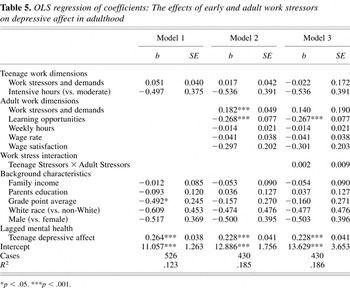
OLS regression of coefficients: The effects of early and adult work stressors on depressive affect in adulthood
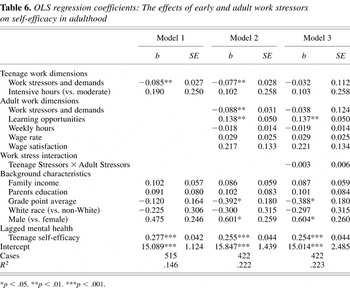
OLS regression coefficients: The effects of early and adult work stressors on self-efficacy in adulthood
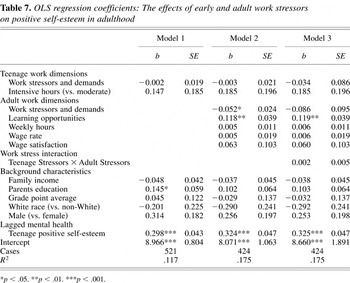
OLS regression coefficients: The effects of early and adult work stressors on positive self-esteem in adulthood
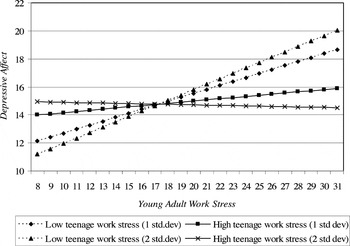
Depressive affect in young adulthood (age 22) by teenage and young-adult work stress.
Self-efficacy in young adulthood (age 22) by teenage and young-adult work stress.
Positive self-esteem in young adulthood (age 22) by teenage and young-adult work stress.
 You have
Access
- 69
- Cited by