INTRODUCTION
Declining fertility rates, freedom of movement policies, and globalization processes have produced major demographic shifts in all European Union (EU) states. In the 1990s, the EU adopted a broad spectrum of programs, directives, and action plans intended to eliminate old and new forms of discrimination, grounded in sex, race/ethnic origin, religion, disability, and sexual orientation. Moving beyond its original aim of creating a prosperous “single market” pursuing largely economic priorities, the EU increasingly sees itself as a promoter of transnational norms and multicultural identities under the rubric “unity in diversity.” An example of this is the emphasizing of social inclusion under its “Europe of Knowledge 2020” campaign, where the community embraced “an in-depth medium-term strategy to enhance the knowledge and skills of all Europe's citizens” (Commission Communication 1997).
Germany has experienced more dramatic demographic shifts than most; population losses incurred in two world wars led to the recruitment of millions of guest-workers, coupled with generous co-ethnic repatriation, and asylum policies, at least through 1993. By 2002, its population included 7.3 million “foreigners,” only 5.8 million of whom had physically migrated; 1.66 million had actually been born there (Independent Commission on Migration to Germany 2001, 14). Most were concentrated in urban areas, accounting for nearly 30% of the residents in Frankfurt/Main, 25% in Stuttgart, 24% in Munich, and 14% in Berlin (Independent Commission on Migration to Germany 2001, 15ff; Prußky Reference Prußky2007, 13). Political leaders nonetheless continued to insist as late as 1991 that Germany was “not a land of immigration,” and thus saw little need to integrate countless non-citizens. The new millennium brought increasing recognition that without the so-called foreigners, its social security system would not survive a tidal wave of Baby Boomer retirements: 22% of its citizens are already over 60; by 2035, a majority will be 50+ (Ulrich Reference Ulrich2001, 26–28). Modern Germany moreover finds itself lagging behind in technological innovation and “the competition for the best brains,” ignoring a formidable source of potential brain-power sitting in its own back-yard — two million youth of migrant descent.
New laws enacted under the first SPD-Green Government (1998–2005) afforded Germany the chance to remedy many integration failures of the last four decades, especially in relation to “guest-worker” offspring (Mushaben Reference Mushaben2008). The citizenship law (Staatsangehörigkeitsgesetz) enacted in 2000, coupled with its first real immigration law (Zuwanderungsgesetz) of 2005, now applies jus soli (birth place) rights to children born on German soil after 1991, provided that at least one parent is a permanent resident. Having finally jettisoned the equation “citizenship equals ethnicity” (under the old jus sanguinis regime), Germany now faces new debates over “who is integratable,” based on an erroneous conflation of “cultural” values and religious practices, perceived as immutable forces in the wake of September 11. Positing an ideological clash of cultures, many politicians across Europe, in general, and Germany, in particular, have rushed to oppose Muslim headscarves as well as parental demands for Islamic instruction in public schools. Higher fertility rates among families of migrant origin, coupled with increasing residential segregation, have turned many schools into “a field where a struggle is taking place over positions between agents equipped with different habitus and dispositions” (Moldenhawer Reference Moldenhawer2005, 69), especially in cities functioning as migration magnets.
“Failed integration” manifests itself in consistently low levels of educational attainment, disproportionately high unemployment rates, and other signs of social alienation among ethnic minorities in Germany. Challenging the findings of oft-cited, sensationalized studies suggesting that “religiosity” among young Muslims pre-destines them for lives of sexual oppression, Islamic “fundamentalism,” or criminal violence (Kelek Reference Kelek2005; Heitmeyer, Dollase and Vossen Reference Heitmeyer, Dollase and Vossen1996; Zentrum Demokratische Kultur 2003), I argue here that a primary cause of “failed integration” rests in the country's refusal to recognize new linkages between value education and citizenship training throughout the public school landscape. Insisting on a historically negotiated framework of church-state relations dating back several hundred years, Germany relies on an arcane definition of state neutrality that clearly sustains the dominance of some religions at the expense of others in public schools.
As results from the Program for International Student Assessment for the last decade clearly demonstrate, Germany's educational system has entered a state of crisis for reasons extending well beyond religious instruction in the classroom. I limit my analysis to this issue to show that permitting Islamic instruction in public schools on par with other “recognized” religions would (1) foster tolerance, promote dialogue, and generate shared values among majority and minority pupils, all of which are essential for democracy; (2) assist policymakers in replenishing the Federal Republic of Germany's (FRG's) rapidly retiring labor force, by fostering the skills and brain-power of Muslim youth (with or without headscarves); and, over time, (3) create a stronger sense of “identity,” thus encouraging political participation among new citizens.
The investigation begins by exploring connections between state neutrality, value education, and citizenship training, on the one hand, and religion and integration on the other hand; especially as such linkages were understood prior to the terrorist attacks of September 11. Mounting concerns about “religious” fundamentalism and European security have since reconfigured perceptions regarding the compatibility of Islam and democracy, deflecting attention from real problems of education and integration. Next, we consider the legal hurdles faith communities must overcome in Germany to secure status as a “corporate entity under public law” (Körperschaftsstatus). Once “recognized,” religious denominations can offer formal in-school instruction, becoming eligible for accredited teacher training, tax-funded salaries, construction subsidies, and other institutional privileges. The third section outlines different curricular models utilized by the Länder, followed by a closer look at Islamic instruction in Berlin, where a key court ruling, and a 2009 referendum on obligatory religion classes, have compelled authorities to take a more pro-active approach. The case study incorporates educational statistics pertaining to youth of migrant origin, attesting that conflicts over Islamic instruction are but a smoke-screen for deeply entrenched, institutionalized patterns of minority discrimination. The conclusion addresses constitutional dilemmas inherent in Germany's approach to “value education,” against the backdrop of the new EU anti-discrimination directives.
ISLAM VERSUS INTEGRATION: PERPETUATING FALSE DICHOTOMIES
Linked to history, language, and identity, religion, like the nation, evokes an imagined community, positing an immediate communion among like-minded members, irrespective of diaspora settings. It easily lends itself to transnational practice, since many faiths lack a centralized authority, allow for divergent sects and construct places of worship, along with new rituals, wherever its practitioners emigrate. Yet religion can also be used to sustain or re-establish affective and material bonds to a former homeland. In new settings, shared religious values offer a moral compass and an emotional anchor amidst stormy processes of readjustment (Hirschman Reference Hirschman2004; Kastoryano Reference Kastoryano2004). Migration often leads to cultural disorientation, occupational disqualification (Mushaben Reference Mushaben2009) and a loss of parental authority. Religion can be used to frame new “hyphenated” identities and to develop new sources of social capital, as well as to “prop up sagging patriarchal family structures” and family honor (Tan and Waldhoff Reference Tan, Waldhoff, Horrocks and Kolinsky1996) in the new homeland.
Migration scholars have recently begun to discern new linkages among citizenship regimes, human rights frameworks, and religious “claims-making” (Koopmans and Statham Reference Koopmans, Statham, Giugni and Passy2005; Koenig Reference Koenig2007), but few used these ties to challenge the path-dependent paradigm of church-state relationships at the national level. Emerging out of centuries of religious persecution and strife between Catholics and Protestants, European precepts like laicité, secularity, and neutrality were initially embedded in modern constitutions to preclude yet another destabilizing Kulturkampf between leftist anti-clericals and right-wing conservatives regarding church monopolies over educational policy, for example, in Germany and France. Countries such as Italy, Ireland, and the United Kingdom guaranteed a monopoly on religious education on behalf of their respective “national churches” while others, including The Netherlands and the United States, preach (but do not always practice) a complete separation of church and state.Footnote 1
More recent debates concerning state recognition of diverse faith communities often conflate culture with religion as grounds for measuring a group's “integration potential.” Grand-theoretical analyses asserting the irreconcilability of Islam and democracy (Huntington Reference Huntington1996) are far from incontrovertible, however, since they tend to equate the authoritarian qua theocratic proclivities of select states with the “will of the people” forced to live under them. Cesari (Reference Cesari2004) and Minkenberg (Reference Minkenberg2007), inter alia, counter that geo-political and regional factors, along with patriarchal social orders, contribute more to democratic deficits than theistically deterministic religions. Norris and Inglehart (Reference Norris and Inglehart2003), for example, established that Middle Eastern citizens “strongly agree” that democracy is better than any other form of government, that leaders should be accountable to freely elected parliaments, and that officials selected on the basis of religious orthodoxy are not the best qualified. The “cultural fault line” separating majority western and Muslim regimes has more to do with sex than democracy: residents of predominantly Muslim societies are less supportive of divorce, abortion, and homosexuality (Schiffauer Reference Schiffauer1983); the fact that such views are overwhelmingly shared by “democratic” Greek, Irish, and Polish citizens is rarely mentioned.
I concur with Koenig (Reference Koenig2007, 914) that “European forms of religious governance were all premised on a national paradigm of social order in linking up the legal and political status of religious communities with the construction of the imagined community of the nation.” Fifty years of migration history have altered and enriched many parts of the social order, but the political-legal status of most religions is still determined on the basis of an “imagined” Christian community, despite decades of declining membership in the latter. In accordance with citizenship research of the last decade, one could argue that what is really driving state refusal to recognize Islam in countries with significant migrant populations is “that the de-coupling of rights, membership and collective identity is strengthening the individual and sub-national actors in making claims for religious recognition against the sovereign nation-state” (Koenig Reference Koenig2007, 914). The pursuit of individual freedoms is only one factor chipping away at sovereignty; the Europeanization of social policy domains is another process putting national identities at risk.
Well before the “global war on terrorism” rendered some religions less equal (and more suspect) than others in pluralist democracies, Torney-Purta and Schwille (Reference Torney-Purta and Schwille1986) developed a comparative framework for assessing the efforts of most states to educate their citizen-subjects. Their theoretical conclusions derived from empirical studies by the International Association for the Evaluation of Educational Achievement, sampling a broad assortment of industrialized countries. Before we turn to the specific hurdles encountered by Muslims in their quest for state recognition in Germany, let us review their “seven assertions” (Torney-Purta and Schwille Reference Torney-Purta and Schwille1986, 31–44) regarding the role of value education at school in fostering a national consciousness:
(1) No institution with education as its primary aim can be value neutral. (2) Countries differ in the values that characterize their political cultures and their stated educational goals. (3) No Western industrialized country has had a uniformly high level of success in transmitting civic values, perhaps because subtle incompatibilities between goals exist. (4) The learning of values is strongly influenced by many factors that are outside the control of educators and educational policymakers, such as national culture and subcultures, economic structures, and unique historical events. (5) Notwithstanding the importance of non-school and nationally idiosyncratic factors, educational policy has been somewhat effective in bringing about desired changes in values. (6) A number of nations have developed curricular goals (and associated materials) to promote common core values. In some countries, these programs give more importance to collective welfare, in others to individual benefits (although no country completely neglects either). (7) The learning of values in school is not limited to mandated programs of moral and civic education. Students also learn values (especially cooperation, rights of self-expression, respect for other persons, and respect for authority) from the ways that schools embody these values in organization, teaching practice, and social climate.
Propositions one, four, and seven are of particular relevance here. Public education “by its very nature” is laden with values insofar as “teachers consider some things worth learning and others not, some student behaviors constructive and others not” (Torney-Purta and Schwille Reference Torney-Purta and Schwille1986, 31). Beyond the explicit goals enshrined in state-imposed lesson plans lies an “implicit curriculum” structuring relationships, norms, and behaviors inside and outside the school. Systemic values conveyed in the classroom are sometimes contradictory, for example, gender equality versus traditional family values — particularly in settings where religious instruction of any kind is directly approved and subsidized by the state: The Catholic Church, for example, is accepted as part of the “free democratic order,” although it actively opposes equal opportunity for would-be female priests, and allies itself with Islamic states on reproductive health issues. Teachers not only expect or reject certain student behaviors, encouraging or undermining class discussion, and decision-making (Frontalunterricht), but they also render life-shaping judgments regarding individual career trajectories, e.g., relegating disproportionate numbers of minority youth to dead-end secondary or “special education” schools. Nor is it true that “the family is the parents' responsibility, the school is the teachers' and the street is the jurisdiction of the police” (Driessen and Merry Reference Driessen and Merry2006, 210). Schools have few opportunities for reversing disadvantages caused by environmental factors and conflicting public policies, including outright discrimination, low educational attainment among parents, residential segregation, and a chronic lack of nurseries/kindergartens to foster early-age language skills.
Rather than deny the fact that many types of implicit curriculum are operationalized in schools under the guise of state neutrality, authorities need to replace rhetoric with resources. The German Conference of State Educational Ministers declared in 1996 that all pupils should be required to “become aware of their own cultural socialization, gain knowledge of other cultures, develop curiosity, openness and an understanding of other cultural imprints, recognize their fears and endure tensions (…) respect otherness, reflect their own standpoints (…) and solve conflicts resulting from ethnic, cultural or religious affiliation in a peaceful manner” (Miera Reference Miera2007, 3). We now consider the legal barriers state officials continue to uphold, rendering their own educational goals impossible to achieve.
RELIGION AS POWER MANAGEMENT: “CORPORATE STATUS” AND CLASSROOM INSTRUCTION
Although world religions transported themselves across continents and centuries “without the aid of federated administrative structures” (Levitt Reference Levitt2001), the domestication of different faiths in the global age is a complicated process. The secularization of European societies means paradoxically, that non-Christians need special rights nowadays, to ensure them the same religious freedoms historically accorded others. In 2002, 33% of all Germans classified themselves as Protestant, 33% as Catholic, 34% embraced some other faith or none at all. Easterners upset the balance: 70% label themselves atheists and 84% among youth. Despite this shift, constitutionally mandated religious instruction privileges the first two groups even in the eastern states (Spiewak Reference Spiewak2009).
Policy-makers still construe religion as an immutable belief system rather than as an evolving web of shared values and cultural traditions, while scholars employing cultural arguments posit a degree of homogeneity among Muslims that is at odds with reality.Footnote 2 Thousands of Germany's Muslims stem not from Turkey but rather from Bosnia, Lebanon, Afghanistan, Iran, Iraq, Saudi Arabia, Morocco, Algeria, and Southeast Asia.Footnote 3 Recognizing ethnic differences does not automatically accommodate religious differences, however. “Turkish” Muslims, including ethnic Kurds and Zazas, define themselves as Ahmaddiyya, Alevis, Sunnis, Shi'ites, or Suffis, accounting for at least 90 different theological communities in Berlin alone. Between the waves of Russian Jews, Muslim refugees, and third-generation Turks, migration has pluralized the religious playing-field across Europe, complicating efforts to shore up “national” identities in the face of globalization. Religion becomes an oversimplified identity-marker for “foreigners” lumped together in Leitkultur (“leading” or dominant culture) consciousness.Footnote 4
One reason why European religious debates remained dormant for so long was the assumption that guest-workers would return to their countries of origin, unlike many Bosnians and Iranian asylum-seekers fleeing godless or theocratic regimes. Second, arguments that religious identity does not yield to assimilation contradict the fact that first generation laborers were overwhelmingly secular when they arrived in the 1960s. Headscarves were a non-topic: Turkish women found jobs in the electronic and textile industries, displaying little engagement in religious communities; paradoxically, religious identification is growing among teens educated in Germany. Third, observing the special treatment accorded Jewish immigrants, younger cohorts have learned to frame their demands for parity in analogous constitutional terms. Politicians insist that the “West is still Christian,” but one million Catholics and 1.2 million Protestants (20%) officially “quit” their churches between 1980 and 1992 — although migration from Poland has stabilized figures in some Catholic parishes. Mosque “membership” grew 34% between 1991 and 2003 (Mushaben Reference Mushaben2008).
A 2008 survey concluded that 41% of Germany's three million Muslims label themselves “very religious,” compared to 18% of its Christian population (Migration und Bevölkerung 2005).Footnote 5 For many, Islam is a lived faith that cannot be confined to an hour of worship one day per week; it shapes consumption, attire, divorce/custody issues, healthcare and business practices, suggesting that formal recognition would necessitate host-country adaptation across many domains.Footnote 6 Jonker (Reference Jonker2002a, 9) puts it bluntly: “Those who do best are the ones who have distanced themselves the farthest from Islamic orthodoxy. It includes the laicist Turks and secular Iranians, Afghans and Lebanese who are increasingly finding their way into politics, administration, academia, and social professions.” Alevis are well adjusted to the German way of life and thus “find allies over and over”; Sunnis, by contrast, are left to their own devices. Muslim groups demand that Islam come to enjoy “an equality of truth” relative to other belief systems, not simply a “parity of tolerance” (Koopmans et al. Reference Koopmans, Statham, Giugni and Passy2005, 32). The closer to orthodoxy practicing Muslims appear to be, the more barriers to integration governments seek to erect.
Characterizing religion as “power management,” Rolf Schieder notes that beliefs secure the right to flourish “under the label of religion” as a result of complex historical negotiation. Lacking a civil-religion tradition, value questions are shaped by the fact that “the Holocaust is a damn big shadow that will follow them into eternity with every step” (Schieder Reference Schieder2001, 119, 156).Footnote 7 Presidents Richard von Weizsäcker and Johannes Rau, Protestant synod members, often invoked morality in their speeches but came nowhere close to the appeals for divine blessing routinely iterated by their United States' counterparts. Still, the German state collects and redistributes taxes to “recognized” faith communities, derived from the 8–9% surcharge on personal income taxes. A 1992 survey found that 64% of all Germans wanted the tax (used to register members) abolished in favor of voluntary contributions. While nationals insist on historical differences rooted in “Judeo-Christian” values, Muslims emphasize equal treatment, for example, the right to be “taxed” like other faith communities to fund places of worship.
High courts in each Land (state) must accord “corporate status under public law” (Körperschaftsrecht) before authorities can draw up service contracts with recognized religious representatives. German federalism permits administrative discretion, undermining equality before the law. Posited as the norm, the Lutheran Church is the template demanded by all the rest. It relies on “a democratically chosen board and internal structures which have shaped it more and more into the grit of bureaucracy” (Jonker Reference Jonker2002a, Reference Jonker, Shadid and van Koningsveld2002b, Reference Jonker2002c). Over the last century, the Lutheran Church “perfected the standard” used to evaluate new religious candidates. The Catholic Church had trouble meeting the pre-requisites back in the 1920s, as did the Jewish community. Their history, Jonker (Reference Jonker2002a; Reference Jonker, Shadid and van Koningsveld2002b; Reference Jonker2002c) attests, “is a telling example for (sic) the difficulties the Muslim communities face today … finding enough experts to answer the standard of bureaucracy.”
Islam does not rely on religious intermediaries beyond the Prophet Mohammed; from the moment of birth, a believer's relationship to Allah is personal and direct. To justify state recognition, believers must demonstrate “self-organization” as well as clear differentiation from other faith groups, although both ideas are antithetical to Islamic tradition. The result is a form of theological entrapment for Muslim communities:
On the one hand, legislature (sic) has set up rules for the acceptance of new faith communities. In turn, these set into motion the building of a new center and a new periphery, forcing activist believers and secularized Muslims into two different camps … the trap is functioning. German judges and politicians see themselves confronted by Muslim communities of orthodox and engaged believers, which are accused by other Muslims to be in pursuit of extreme political aims. Fear of “Islam” does the rest (Jonker Reference Jonker, Shadid and van Koningsveld2002b, 45).
Only 1.2% of Germany's estimated 2.8–3.2 million Muslims “associate” with radical or extremist organizations (Deutscher Reference Deutscher2002, 5). Since the Al Qaeda attacks of 2001, however, Islam has been “reified as the primary marker of difference, and demonised, with the help of the media, as fundamentalistic and terroristic (sic). Despite more than thirty years of coexistence with Islamic believers in Frankfurt and other German and European cities, social intolerance based on ignorance is still the rule rather than the exception” (Klopp Reference Klopp2001, 120).
Against the backdrop of home-grown terrorism in Hamburg, Madrid, and London, lawmakers insist that fundamentalist organizations mobilize Muslims against the host society, fears not born out by ethnic associational patterns over time (Mushaben Reference Mushaben2008). Indeed, first generation migrants were more attracted to orthodox groups when they were the only game in town. Controlled by the Turkish government, mosques and Qur'an schools focused on homeland developments. In 1961, there were an estimated 6,500 Muslims in the FRG, rising to 2.5 million by 1995 (Deutscher Reference Deutscher2002). Quantitative growth has been matched by qualitative differentiation. Over 2000 Islamic organizations boasted up to half a million members in 1995 (including so-called Festival Muslims, since there are no dues requirements). The Turkish Islamic Union of the Agency for Religion (DITIB) encompasses 725 entities. The Association of Islamic Cultural Centers covers another 299 groups; and even the ultra-conservative Milli Görüs needs to build consensus among 274 mosque communities. The largest of eight umbrella associations is the Turkish Islamic Association, which has 740 member associations; next is the Association for a New World View in Europe, with 262 member organizations, added to 82 Alevi communities (Mushaben Reference Mushaben2008). Religious divisions are compounded by ethnic differences, e.g., Kurds versus Turks versus Arabs.
Limitations on social capital formation by way of Islamic associations existed well before the attacks of September 11. The first barrier is structural in nature. Given 3.2 million Muslims (450,000 of whom are citizens), Islam is now the third largest religion; yet state authorities refuse to accord Körperschaft status, due to its lack of a formal, central authority or an overarching leader like the Pope, or the Archbishop of Canterbury (Kemal Ataturk secularized Turkey in 1928 by eliminating the globally recognized position of Caliph). The absence of a worldwide rabbinical leader denied Judaism recognition in the 1920s, with barbaric results, but it was granted in 1971. Leaderless Alevis have attained Körperschaft-status in four states. In December 2000, the Constitutional Court granted corporate status to Jehovah's Witnesses. Besides rejecting blood transfusions, this group refuses military service, abjures voting (denouncing the rule of law as “the work of the devil”) and opposes dialogue with state officials or other faith communities.
Islam's lack of a clear hierarchy and transparent organizational structure is only one excuse for denying its faithful the right to school instruction. Another is its inability to provide proof of a homogenous membership sharing a doctrinal consensus. Configuring Islamic community life to fit an historical template rooted in the Lutheran Church would require diverse theological camps, opposing each other for centuries, to subject themselves to a uniform structure and to espousing a single creed. This is equivalent to expecting “Christians” as disparate as Catholics, Evangelicals, Baptists, and Mormons to align themselves unanimously with Lutherans. Given their diverse ethnic and linguistic backgrounds, triggering recurrent wars in their states of origin, Muslims Sooner resemble devout, multi-denominational Protestants than orthodox Catholics who follow a single set of doctrinal precepts interpreted by an “infallible” Pope. First-generation laborers had neither the time nor the theological expertise demanded by ministerial bureaucrats; second-generation offspring remained secular. Third-generation believers enjoy some university access but are too young for leadership positions.
Durability is a third formal requirement. Without a unified authority, there is purportedly no basis for determining whether a religion will “persist” long enough to justify public subsidies, although Islam has existed for over a thousand years; much younger Mormons and Salvation Army communities do enjoy “corporate” status. Worldwide there are more practicing Muslims than Christians. In exchange for providing a regular tax base, instructional and construction subsidies, the state requires recognized communities to supply pastoral care in hospitals, prisons, and the armed services, to manage teacher training and curriculum development, as well as to assume welfare responsibilities. Aging first-generation guest-workers already have a need for nursing homes, hospice care, and religious facilities for “settling debts with Allah.” By 1988, Berlin had two Muslim cemeteries, Columbiadamm/Neukölln and Gatow/Spandau. In Bavaria, 250 of the 260 Turkish-nationals were sent “back” for burial in 1999 due to a lack of permanent cemeteries; the rule that Muslims be interned within 24 hours of death has led to new ethnic business opportunities: overnight shipping (Deutscher 2001, 21).
ISLAM IN THE CLASSROOM: STATE CURRICULAR MODELS
The German constitution (Article 7GG) requires that public schools provide religion “as a regular part of the curriculum” in consultation with the respective faith communities. State neutrality is implicit in this passage, to ensure that no one religion dominates others. Religious instruction in schools is largely denominational (bekennend) in character; yet state educational ministers exercise disproportionate control over curricula, textbook selection, and qualifying exams for teachers. Klopp (Reference Klopp2001, 103) asserts that children of migrant background in Frankfurt are frequently “torn” between a fundamentalist version of Islamic tradition and German secularism. Had he visited Passau, he might have seen school kids “torn” between secularism and Über-Catholicism! Declaring “education to honor God” an official learning objective for every pupil, Bavarian authorities hung 50,000 crucifixes in public classrooms — until the High Court declared them unconstitutional in 1995 (BverfGE 93, 1).
Denied a formal place in schools, Islamic instruction for migrant offspring was initially provided by teachers trained and paid by Turkish and Saudi regimes through the 1970s. Imported class materials offered few “practical moral choices” concerning the local environment. Discrimination affecting housing, education, and employment opportunities through the 1980s enabled imported or self-radicalized “men of God” (Schiffauer Reference Schiffauer2000) to create organizations offering welfare alternatives, a sense of belonging, and religious services. About 24% (2,000) of all Turkish children attended Qur'an schools in the mid-1980s. Today nearly 750,000 Muslim children in German schools are “constitutionally” entitled to over 700 hours of religious instruction.
German federalism accords the states significant educational autonomy, leading to 16 different approaches. Three basic models emerged by the early 1990s, affording disparate opportunities for citizenship training. The first model (1980s) left voluntary religious instruction up to externally funded Qur'anic schools, producing little childhood integration. The second embedded Islamic instruction in Turkish mother-tongue lessons (in “foreigner only” classes) to prepare children for “homeland” return. Much of Bavaria, for example, still relies on religious syllabi and teachers supplied by the Turkish government. The third model, denominational, offers instruction in German, giving children the tools they need to share their beliefs with non-Muslims, and relate their values to experiences in the new homeland. Parents prefer the latter model that they see as “a clear upgrading” of Islam's curricular standing (Pfaff Reference Pfaff2000, 16).
Reflecting the third model, North Rhine-Westphalia made mother-tongue Islamic instruction available to 40 elementary school pupils in 1986, extending lessons through 10th grade by 1991; in 1999 it declared these lessons (now taught in 160 schools), a subject that students must pass to advance to the next grade (Pfaff Reference Pfaff2000, 10). Authorities worked with representatives of divergent groups to structure courses for 240,000 Muslims (9%); consultations included experts from the Education School at the University of Hanover and the Theological Faculty in Ankara. Their aim was to teach Islam in German, affording students a healthier basis for personal religious identities while opening their Christian peers to different faiths. In 1995–1996, state authorities approved a curriculum for grades 7–10. Materials are produced by the regional Institute for Schools and Continuing Education. Although the final product was presented to Muslim organizations for comment, the radical Kaplan movement in Köln, the Central Council of Muslims in Germany, and the Islamic Council objected to the state's “preemptive” action in federal court. No longer employed by the Turkish government, teachers are vetted by educational administrators; lessons are voluntary.
Baden-Württemberg decided not to wait out final verdicts in four cases related to “corporate status,” establishing cooperative curriculum development and teacher training programs. Bavaria created a Round Table while trials were pending there, but it was never convened. Several schools in Erlangen developed a pilot program in 2001 but were ordered to put the project on hold “until the rest of the state had ‘caught up’” (Jonker Reference Jonker, Shadid and van Koningsveld2002b, 47). Local Muslims subsequently formed their own association to deal with state officials; they now use a curriculum drawn up by Muslims as well as education department staff and church representatives (!). Teachers are trained in Munster and Nuremberg (Hawranek Reference Hawranek2008). Cognizant that almost 40% of Frankfurt's pupils are affected, the Islamic task force of Hesse works with Office of Multi-cultural Affairs to secure equal footing. Courses are taught in German by Muslims.
Exemplifying a fourth model, Hamburg has circumvented Article 7GG constraints through the development of an “ecumenical,” non-proselytizing program. Under the motto, “religion for all,” representatives from Lutheran, Catholic, Jewish, Greek Orthodox, and other faith communities rotate teaching responsibilities, providing instruction to mixed groups as an ongoing moral dialogue. In 1998, it invited Muslim organizations to join the consortium. As of 2000, neither Mecklenburg-Vorpommern, Saxony, nor Saxon-Anhalt offered any classes to Muslim pupils, owing to a dearth of minorities and the predominance of atheists in the East. In the early 1990s, Brandenburg introduced a fifth model, based on a completely non-denominational life-training, ethics and religion course, and hotly contested at the time.
The recognition problem resulting from different state models is that decisions “for” or “against” the models are often grounded in divergent legal precepts found in the Basic Law, for example, Article 4, individual religious freedom; Article 6, parental rights; Article 7, state obligations and (penumbral) neutrality (Zacharias Reference Zacharias2005). In June 1998, the Federal Administrative Court ruled that Article 7GG mandates a material educational obligation for the state, giving it “the authority to introduce new and supplementary instructional fields such as the discipline of Ethics, “taught in a neutral fashion devoid of a particular world view” (Schieder Reference Schieder2001, 168). This verdict shifted the paradigm for Islam in state-mandated classes, as Die Zeit noted in an article titled “Allah is ready for school” (Spiewak Reference Spiewak1998). Catholic, Protestant, and Jewish leaders support Muslim demands for equal-opportunity instruction, although their primary interest lies in retaining denominational instruction. Developments in Berlin suggest that a failure to respond to Muslim needs can hold negative consequences for established faith communities as well.
TOO LITTLE, TOO LATE: ISLAMIC FEDERATION VERSUS BERLIN
Berlin's special Four-Power status exempted it from Basic Law provisions through 1989, as did Soviet General Schukow's insistence in 1947 that school law allow parents to decide to impart — or not impart — religious education to their children. Schools in Berlin and Bremen set aside two hours each week for voluntary, denominational instruction; as of 2000, 52% of the elementary pupils, 78% of secondary students, and 88% of the Gymnasium youth opted out of religion or “world view” classes (Knubbertz Reference Knubbertz2000, 17). Only 37 of 500 schools offered the latter. A decade of legal battles forced authorities in 1998 to provide religious instruction for 35,000 Muslim pupils, of whom 54,537 were from a migrant background.
Home to 140,000 Muslims and 70+ mosques, Berlin bears witness to deep divisions within the community as a whole. The capital city is home to four theological orientations, resulting in 90 different mosque tendencies, despite multiple umbrella organizations, for example, the Berlin-specific Islamische Religionsgemeinschaft e.V., the Zentralrat der Muslime in Deutschland, and the Islamrat für die Bundesrepublik. They include 72 Sunni mosques (ministering to persons of Turkish, Arabic, Bosnian or Pakistani origin, and German converts), two Alevi, and two Ahmaddiyya communities, as well as seven Shiite groups with diverse ethnic roots, for example, Azerbaijan, Iranian, Lebanese (Spielhaus and Färber Reference Spielhaus and Färber2007, 106–108). As of January 2005, 212,723 of Berlin's 450,900 “non-German” residents were at least nominally “Muslim,” encompassing 170,000 “Turks,” 34,000 from Arabic states, and 12,000 more from “countries with Muslim majorities” (Spielhaus and Färber Reference Spielhaus and Färber2007, 19). Some 70% of all pupils in Mitte, Neukölln, and Kreuzberg are non-nationals.
The Islamic Federation-Berlin (IFB) has filed multiple suits, seeking a place in schools. The IFB constitutes a radical-conservative community, one of 17 roof-organizations established by Milli Görüs in 1980, linked to the (Egyptian based) Muslim Brotherhood. Calling for a Sharia state, its clerics are openly hostile toward the non-Muslim majority; it directs several Arabic, Bosnian, and Albanian mosques as well. Denouncing moral turpitude and persecution in the world around them, its leaders instrumentalize discrimination for internal mobilization. Jonker (Reference Jonker2002a, 13) observes: Community formation looks as follows: patriarchal, without middle management, internally closed with a swelling generational conflict, lacking any consideration for the abilities of women, presenting a sole partner responsible for dialogue along the border between inside and outside, and adhering to a collective perception that they are not understood, confirmed from time to time by mishaps in external communication.
Mindful of its extremist ties, Berlin judges “repeatedly sent the Federation home again,” requiring it to establish organizational transparency and continuity,” as well as “proof of the validity of its religious consensus….” They ordered the IFB to “build a new organisation embodying its own idea of religious consensus and a marked distance to all other Islamic schools and directions of thought. In other words, to set up a denomination modelled on the Lutheran Church and to forget about the Umma as the unity of all Muslims and Quran and Sunna as their common basis…” although “it is no business of any German court to push a faith community into heresy” (Jonker 2002b, 46). In 1998, the court finally sided with the Federation. Never expecting to win, the IFB was unable to sustain mosque alliances pulled together for the trial, much less to design a suitable curriculum. It also met with immediate resistance from the Turkish Islamic Union, the Union of Islamic Culture Centers, and the secular Turkish Association of Berlin-Brandenburg, supporting inter-faith training in mixed classes. Commissioner Barbara John called associational choice “unfortunate” but recognized the verdict as “the result of our own failure to come up with a different solution earlier” (cited in Cohen Reference Cohen1998; Fahrun Reference Fahrun2005).
In 1999, the Islamic Federation began offering religious instruction in German to 4,000 children at 37 schools; Berlin covers personnel costs for its 23 teachers (Vieth-Entus Reference Vieth-Entus2005). Alevis instruct another 400; the Turkish Ministry (DITIB) has not filed for instruction rights. In June 2005, authorities amended school law, henceforth requiring academic training and language testing administered by the Goethe Institute for Islamic instructors, to demonstrate “perfect knowledge of German.” Berlin Assembly member Özcan Mutlu (SPD-Green) welcomed the requirement as a way to reign in fundamentalist tendencies and aid pupils in communicating their values to peers. Education Minister Klaus Bölger (SPD) moved to offer Islamic studies as an independent discipline coupled with special teacher-training at the Free University.
Many mosques offer their own classes for a reported 2,098 children. The method used to impart the “6 + 5” (six articles of faith, five pillars of obligation) involves memorizing scripts. Pupils also learn the Arabic alphabet, practice ritual-behaviors and prayers, listen to stories about the Prophet, sing and undertake artistic projects; they may also get help with homework. All are sex-segregated, purportedly because “they learn better,” since girls are “not as noisy,” yet more successful than boys even in this educational context (Jonker Reference Jonker2007). Among 31 entities surveyed recently, seven offered instruction in German, eight in Turkish, five in Arabic; the others combined German with Arabic and/or Turkish (Spielhaus and Färber Reference Spielhaus and Färber2007, 51).
Under an SPD/PDS (Post-Communist Party of Democratic Socialism) coalition, Berlin officials decided to copy a model now firmly rooted in Brandenburg, utilizing a non-denominational “life training and ethics” approach. In 2005, hundreds of Catholics and Protestants demonstrated in front of City Hall, protesting plans to oblige students in grades 7–10 to participate in an ethics/world religions course, rendering denominational classes voluntary — especially in view of the high numbers “opting out.” Reluctant to lose a traditional, tax-subsidized bully pulpit in public schools, protestors declared: “God is more powerful than the Senate” (Berliner Zetung 2005). In 2006, the Berlin Senate made “non-professing” ethics instruction mandatory for all students as of grade seven. Hoping to foster more democratic participation in local affairs, the “red-red” government had also revised the Berlin Constitution (Article 61) that year, enabling groups who collect at least 20,000 signatures to call for a referendum.
Garnering the requisite signatures, established churches joined forces under a new association, “Pro-Religion,” with the aim of restoring mandatory religious instruction and turning ethics into a voluntary course. On April 26, 2009, with a turn-out of only 29%, 51.5% rejected the “Pro-Reli” initiative, 48.4% supported it; the latter comprised only 14% of the 25% (611,422 — among 2.45 million eligible voters) needed for passage (Kirschbaum Reference Kirschbaum2009). One prominent Protestant cleric asserted, “you can only develop tolerance if you know what your own values are,” conveyed through “authentic believers.” Pro-Reli founder, Catholic Christoph Lehmann now contends, “naturally we will also mobilize on behalf of Muslims” (Lau Reference Lau2008).
EDUCATIONAL APARTHEID: THE PATH TO SOCIO-ECONOMIC EXCLUSION
Integration Commissioner Günther Piening and Reigning Mayor Klaus Wowereit recognize that if Berlin officials had taken a pro-active stance on Muslim inclusion following unification, they could have treated other social exclusion problems simultaneously. In 1993, 16% of Turkish parents sent their children to Koran schools, rising to 20% by 2000. Two-thirds of parents would prefer Islamic courses in school, taught in German by locally trained teachers, rather than by fundamentalist imams financed by Turkey or Saudi Arabia. Parents want moral education preparing their children for the society in which they live; if Germans do not provide it, they turn to other sources. Schiffauer (Reference Schiffauer1997; Reference Schiffauer2000) likewise observes that “civil-izing Islamic instruction” by bringing it into public schools would encourage alienated males, especially, to “come out of the shadows of the hidden courtyards” (Spielhaus and Färber Reference Spielhaus and Färber2007, 4). The re-discovery of Muslim identity affords disadvantaged youth alternative sources of mobility and recognition.
As Marshall and Bottomore (Reference Marshall and Bottomore1992, 16) recognized: “The education of children has a direct bearing on citizenship, and when the state guarantees that all children shall be educated, it has the requirements and the nature of citizenship definitely in mind. It is trying to stimulate the growth of citizens in the making.” The truth is, “hardly any institution in the Federal Republic has been so poorly prepared for the second and third generation of migrants as the schools” (Klopp Reference Klopp2001, 103). Upheld by lawmakers longer than by migrants themselves (Mushaben Reference Mushaben2008), the myth of return led many parents through the early 1980s to push for job training that would “transfer back” to Turkey. Prior to 1996, it was legal for Germany's 16 states to segregate non-nationals into “regular foreigner classes,” on the assumption that they would eventually return to countries they only knew from vacations. Few did.
Disproportionate numbers of ethnic youth are still channeled into school types that do not qualify them for access to new market sectors. Ending in grade 9, the Hauptschule has become a dumping ground for students judged unfit for skilled labor. Sonderschulen are “special schools” for children with learning impairments; the share of migrant children assigned to such schools increased between 1976 and 1990. Realschulen allow children to pursue advanced education in technical fields, or to switch to higher schools, but teachers control selection. Gymnasien are where pupils complete exams required for university admission. Since education is crucial for labor market positioning, even indirect forms of discrimination like residential segregation result in disadvantages. The FRG has no tradition of and few training programs on “diversity pedagogy,” or even teaching German as a second language.
First-generation guest-workers consisted predominantly of males born in Turkey between 1935 and 1955. Evincing few language skills enabling them to interact with the host society, they established soccer teams and private “mosques” (in run-down tenements), to overcome the intense isolation that fueled a desire to earn money quickly and depart (Schiffauer Reference Schiffauer1991; Greve and Çinar Reference Greve and Çinar1987). When employers extended their contracts, men rented run-down apartments, bringing over wives and children (Abadan-Una Reference Abadan-Unat1976; Mushaben Reference Mushaben, Basgoz and Furniss1985). Social advances among the pioneer generation “were seldom tied to career mobility but were connected to extensive labor activity coupled with high savings and investment activity (mostly through property acquisition and entrepreneurship in the homeland) as well as through a shift to self-employment” (Bundesministerium für Familie, Frauen und Jugend 2003, 5). These workers were disproportionately concentrated in sectors later subject to structural adjustment and outsourcing to less developed countries.
Second-generation cohorts (born 1955–1975) saw their status improve slightly as they acquired language skills and inter-ethnic contacts; still, roughly 75% wound-up as un-/semi-skilled workers in 1984, 58% in 1989 (Seifert Reference Seifert1992). As families learned to navigate the dual educational system, “foreigners” securing apprenticeships rose from 27% (1987) to 40% (1992); the former were over-represented among welders, auto-mechanics, grocery clerks, and beauticians (Bommes Reference Bommes1999, 29). Males who followed in their fathers’ occupational footsteps saw more downward than upward mobility. Old barriers, such as temporary work permits, lack of formal education or language skills were replaced by new ones linked to autochthonous feeder-institutions. Career choices for successor cohorts were limited not by birthplace but by “pre-selection” criteria, shielding natives from competition (Zentrum für Türkeistudien Reference Zacharias2001).
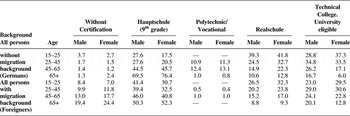
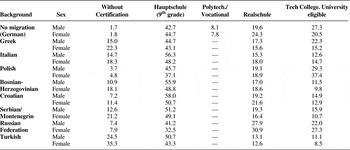
Comprising the third generation, children born through 1991 had at least one parent with permanent-resident status. Despite efforts in some states to draw more into higher order schools, minorities remain the obvious losers in the face of increasing competition. The jobless rate among Turkish workers rose from 4.2% in 1979, to 14.8% in 1985, to 24% by 1997; the latter figure encompasses youth schooled in Germany. Micro-census data indicate a worsening of educational outcomes during the 1990s, when 56% of German-Turkish youth and 50% of Italian parentage dropped out of the Hauptschule (Bommes Reference Bommes1999, 12). In Frankfurt, where migrant offspring comprise 37% of school enrollments; the proportion channeled into “special education” rose from 22.7% in 1980 to 45.3% in 1998. Hauptschule enrollments grew from 41.4% to 62.5%, leaving two-thirds stuck in institutions that do not qualify them for high-tech work in a global economy (Klopp Reference Klopp2001, 102). The share of apprenticeships filled by “foreigners” fell from 41% (1995) to 38% (1998). Minority unemployment is double that of Germans, posing “an integration barrier of the first order”; the 4% classified as city employees, mostly sanitation workers, maintain proverbial “German cleanliness” (Klopp Reference Klopp2001, 19) (Tables 1 and 2).
Highest Level of School Completion, according to Age, Sex and Migration background (in %)

Source: Microcensus 2006, adapted from: Manuel Siegert. Reference Siegert2007. Schulische Bildung von Migranten in Deutschland. (Working Paper 13). Berlin: Bundesamt für Migration und Flüchtlingen, p. 48.
Highest School Level attained, according to Ethnicity and Sex (in %)

Source: Micro-census. 2006, adapted from Manuel Siegert. Reference Siegert2007. Schulische Bildung von Migranten in Deutschland. (Working Paper 13). Berlin: Bundesamt für Migration und Flüchtlingen, p. 51.
Many Länder still rely on half-day schools, now blamed for measurable deterioration in educational outcomes among all students in the FRG. Only 2% of the existing care-facilities accept children younger than three; children in ethnically segregated districts have little chance to learn German before first grade. In 2007, Family Minister Ursula Von der Leyen (a Christian Democratic Union mother of seven!) finally moved the Grand Coalition to accept a legislative package expanding childcare options for all. Still, occupational mobility depends on more than early language acquisition and formal accreditation; one's chances of moving up the career ladder in white-collar domains are grounded in subjective qualities, like a perceived “ability to get along.” Thus, youth of migrant descent have yet to reap the presumed benefits of higher education, owing to classroom discrimination and social capital factors; only 8.9% qualified for college admission in 2006 (25% among natives); 41% stem from “lower, educationally distant” social groups (Prußky Reference Prußky2007, 11). While 83% of German academic offspring attend university, only 7% of German-Turkish families hold high social standing (Bundesministerium für Familie, Frauen und Jugend 2003). Minorities remain unable to access positions in the new economy due to their lack of “Vitamin C” (connections). In a highly regulated market, jobs are distributed not on the basis of fairness but by way of contacts, guilds, agencies, and professional groups that serve as gatekeepers (Bommes Reference Bommes1999; De Graaf and Flap Reference De Graaf and Flap1988).
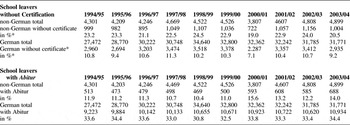
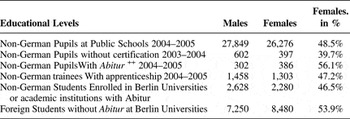
Proud of its “multi-culti” reputation, the capital city promotes religious and cultural diversity as positive and enriching in relation to special events, like its annual Carneval of Cultures, assembling over 4000 dance groups and floats. Diversity becomes a problem, however, as soon as it starts to challenge institutional practices and structures, especially when Islam is at issue. A major educational reform law passed in 2004 ostensibly seeks to enable all pupils “to learn about and understand their own and other cultures; to encounter people from different backgrounds, religions or world views without prejudices; to participate in cultures peacefully coexisting by developing intercultural competence, and to stand up for the right to live and the dignity of all human beings (Senatsverwaltung Berlin 2004, §3). Day to day policies nonetheless “take deficits among migrant pupils as a point of departure,” sooner concentrating on German language, norms and values. Even Berlin's pro-active integration plan, “Supporting Diversity — Strengthening Cohesion” (amended 2007), suggests that freedom of religion for all potentially threatens the democratic order: “The realization of constitutionally stated freedom of religion in school does not proceed without problems. Fears of anti-democratic influences lead to a reconsideration of the quality of religion as a school subject” (Miera Reference Miera2007, 7) (Tables 3 and 4).
Drop-outs vs. University-eligible Students in Berlin, 1994–2004

Source: Ohliger and Raiser. 2006. Integration und Migration in Berlin, p. 25, p. 35.
Male and Female Educational Attainment in Berlin (2004)

++ Public and private schools, excluding vocational and “second-path” admission
Source: Ohliger and Raiser. 2006. Integration und Migration in Berlin, p. 37.
In 2004, 24% of minority children left Berlin schools without certification, while 12% qualified for university admission; not surprisingly, the unemployment rate among non-nationals is twice the indigenous rate. Comprising a smaller proportion of the school population, ethnic females are less likely to leave school with formal certification but paradoxically more intent on qualifying for tertiary institutions. According to Spiewak (Reference Spiewak2005),
German school officials have been feeding Muslim children with only half-hearted experiments or risky emergency-solutions…. First, we declare ourselves not responsible (for integration), later we complain that young Muslims are being sucked into conspiracies through radical Islamic slogans…. The struggle for the hearts and minds of Muslim offspring is taking place on German soil but without German participation…. A young Muslim in Germany can't learn anything about a different, enlightened Islam because school bureaucracies block Islam. Conservative politicians, who mean assimilation when they say integration, will see to it that it stays that way….
Like the mushrooming of mosques in urban areas, adolescents claiming a right to religious freedom, and instruction testify to the permanent nature of migration. The share of Turkish residents professing a “close relationship to religion” fell from 19% in 1989 to 11% by 1997 (Mushaben Reference Mushaben2008). One-third (primarily men) regularly attend mosques, holding steady since 1993. Their views of Islam are “more enlightened and critical,” supporting more dialogue between Muslims/non-Muslims (77%). While a fourth harbors reservations regarding hejab in a non-Muslim country, 70% said it was “not a problem” in 2001. Not only does denying “recognition” to a world religion in a country committed to pluralist democracy pose a normative paradox, but as Lakotta (Reference Lakotta2008) observes, offering Islamic instruction on par with other “voluntary“ denominational classes would also provide new sources of personal identification with school, helping to channel ethnic youth into higher educational venues.
There are multiple reasons as to why educational ministers are now intent on incorporating Islamic studies, taught in German, into their curricula. Such classes, first and foremost, allow Muslim students to serve as “the experts,” fostering self-confidence as they discuss their way(s) of looking at the world. Second, they foster German as the principle language of social communication, since many children do not speak fluent Turkish, Arabic, Iranian, or Bosnian anyway. Their progress moreover motivates parents to become more involved in schools. Third, evidence suggests that fewer school-yard fights occur between clashing groups of different ethnic background (Arabs versus Turks) as they discover common elements of their Muslim identity. Fourth, alienated by traditional Qur'anic lessons run by old men who push rote learning of Arabic texts and even apply corporal punishment, many adolescents reject parental efforts to secure their moral training in mosques. Fifth, learning that some women wear headscarves while others do not (e.g., female teachers) makes these cultural differences more relevant, and thus a positive thing to study, in contrast to negative stereotypes imposed from without. Such teachers convey new images of female authority, adding legitimacy to women's efforts to interpret religious texts themselves (Spiewak Reference Spiewak2008). Pupils, in turn, can ask questions normally shunned in mosques regarding make-up, birth control, domestic violence, et cetera. A final positive benefit for children of migrant descent is that classroom instruction treating them like other “people of the book” (Protestants, Catholics, Jews) would promote an image of “modern Muslims” open to theological debate and dialogue regarding public policy issues, i.e., drugs, juvenile delinquency, domestic violence.
Children of German parentage, on the other hand, would learn that their Muslim counterparts are not oppressed by a single set of Sharia interpretations that have not changed over centuries, especially in matters of gender relations. Local Muslim groups joining together to create mutually acceptable curricula and materials (as in Erlangen and Lower Saxony) would assist judges and lawmakers in overcoming their hang-ups regarding Islam's lack of structure and hierarchical leadership (“no pope, no bishops, no synods”). Home-grown teachers produced by way of new university programs would professionalize and standardize course offerings. This, in turn, will ensure greater transparency regarding the dogmas and values conveyed, as teachers and students discover overlaps with other faith groups, as occurs in Hamburg. Finally, Germans would also be required to engage in “open dialogue,” to overcome prejudices grounded in a lot of historical ignorance or misinformation. Many young Turks reportedly believe that Muhammed was born in Istanbul and Attaturk was his prophet! Correspondingly, few German youth realize that Hitler, a Catholic, signed a concordat with the Vatican to prevent “interference” in fascist extermination campaigns.Footnote 8
Recent studies moreover establish a positive correlation between the migration experiences of teachers and grade improvement across a variety of school subjects (Heckmann Reference Heckmann2009).Footnote 9 Drawing on an “ethnic mentoring”-approach used in the Netherlands, the program matched teachers and pupils according to ethno-cultural background. During the first wave alone, 50% improved their marks by an entire grade in three areas, German, math, and English; those who benefited the most (70%) moved up at least one whole grade (from “deficient/inadequate” to “satisfactory”) in German and English and 50% in math. Qualitative interviews attribute their success to pupil identification with tutors, trusting that a teacher with similar background will better understand their problems. Researchers noted improvement in 40% of the cases where teachers spoke the same home-language, only 25% where backgrounds did not overlap. Participants also fared better compared to a classroom control group not receiving additional tutoring. Positive results were further ascribed to specialized teacher training in German as a second language; 90% of the adult participants felt more confident and better equipped to deal with broader classroom problems after the trial period (Heckmann Reference Heckmann2009, 11–13).
This is not to argue that classroom religious instruction per se leads to better school performance, nor that “integration” and “citizenship training” stops at the schoolyard gate. Adding Islam to voluntary school curriculum would afford closure in districts where self-integration has taken place, and supply bridges in areas where self-isolation might occur. Potential employers, including the state itself, need to actively link educational with occupational opportunity. Berlin, again, affords a positive example: In 2005, authorities launched a campaign under the rubric “Berlin needs You!” to attract more minority youth to civil service positions, albeit only without headscarves. In 2006, 8.7% (58 of 668) of the new apprentices were minorities; in 2007, their share rose to 13.2% (91 of 688). In the ethnically concentrated districts of Reinickendorf, Kreuzberg und Neukölln, more than 35% of these slots went to youth of migrant descent, added to 24% in state offices, and 10% among new police recruits (Integrationsbeauftragter, press release, November 8, 2007). Nationally, applicants seeking apprenticeships rose to 763,000 in 2007, an increase of 22,100 attributed to more intense vocational counseling; those lacking apprenticeships also grew by 9,000, totaling 49,500. Another 15,400 vacancies went unfilled, due to qualification mismatches and regional disparities. Germany will require an additional 135,000 natural scientists and 95,000 engineers by 2014 (Prußky Reference Prußky2007, 13) — at present only 25% of all university students complete degrees! This confirms my earlier argument that fostering the skills and brain-power of Muslim youth (with or without headscarves) will aid policy-makers in replenishing the country's rapidly retiring labor force.
CONCLUSION: PUTTING THE “R” INTO INTEGRATION AND NATIONAL INTEREST
Moldenhawer (Reference Moldenhawer2005, 70) observes, “symbolic power in the school operates through mis-recognition of the relations of domination.” Power is maintained by social practices rooted in the “implied recognition” of some groups who, over time, have come to see their own position, habitus, and dispositions as “neutral.” It is nonsense to argue that “all religions are treated equally” as long some are not equally situated under German law. It is just as erroneous to treat local Muslim engagement as a post-September 11 “security question” rather than as a quintessential integration question. The main problem remains Islam's lack of legal recognition. Transparent instruction in schools, or “world religion” courses for everyone could diffuse fears of underground terrorist plots, and aid ethnic youth in their search for blended identities. After all, Kostakopoulou (Reference Kostakopoulou2004, 653) writes, “existing institutional limitations are almost never simply barriers; they are invitations to further institutional reform.” Kastoryano (Reference Kastoryano1998, 242) adds, “each time academics, policy makers and journalists have arrived at a threshold that they thought should not be crossed for fear of social breakdown or national disintegration, the threshold has in fact been surpassed and breakdown did not occur.”
As Torney-Purta and Schwille's (Reference Torney-Purta and Schwille1986) cross-national comparison attested, no institution promoting education is truly value neutral. Indeed, calling for more value education as early as kindergarten, Minister Von der Leyen curiously invited only the heads of Christian churches to join her special advisory circle in April 2006. The real problem is that “politicians demand more value education on the part of schools and churches but at the same time undermine the integrative powers of schools and church through the conscious deregulation of society in the name of economic competitiveness” (Schieder Reference Schieder2001, 191). Affirming a second “assertion” advanced in 1986 — that value inculcation is heavily influenced by factors outside the control of educators, that is, neighborhood conditions, and economic opportunity structures, I contend that “deregulation” is implicitly coupled with the belief that so-called “foreigners” ought to continue functioning as an exploitable service-economy reserve (cf. Kozol Reference Kozol2005). Germany's ability to compete in the global economy nonetheless depends on the educational attainments of this group.
The lack of Islamic instruction in state schools is a metaphor for other forms of educational opportunity denied. After decades of proclaiming it wanted to avoid “American conditions” (Kozol Reference Kozol2005), it now confronts ethnic qua education ghettos of its own making. The problem remains a dearth of qualified “Muslim” educators: Germany currently needs eight times more teachers for minority children already in its schools, despite new training programs established at Münster, Erlangen, Osnabrück. The lack of teachers with migrant background extends well beyond state mandated religion classes, however.
Ex-Commissioner Marieluise Beck (2002) opined, “The answer to the question, how does one spell integration with an R for religion, is found above all at the communal level.” As its 2003 Handbook of Religions testifies, Berlin is taking a pro-active approach to religious pluralization to avoid further polarization: “If we don't help them now then we will have a problem… A mosque or an association that takes on as many of these social problems as possible has the best chance of really being accepted in the neighborhood and district, and to afford an important reference point in the social topography of the city” (Spielhaus and Färber Reference Spielhaus and Färber2007, 57). Islamic places of worship have become social service centers in Berlin's most troubled districts; once they acquire institutional privileges; religious leaders are drawn into regular exchanges with local authorities, promoting learning experiences on both sides (Mushaben Reference Mushaben2008). This bears out my argument that granting Islamic instruction in public schools the same status as other “recognized religions” does promote tolerance, dialogue, and shared values not only among children but also among formerly segregated imams and politicians, essential for democracy.
Migration scholars have long recognized the civic qua social capital potential inherent in religious communities (Hirschmann 2004; Cesari Reference Cesari2004; Bielefeldt Reference Bielefeld2003). Finding “‘religious space” in schools thus becomes a crucial step in securing minority “political space,” that is, a chance to participate in decision-making, in the polity at large. As Torney-Purta and Schwille (Reference Torney-Purta and Schwille1986, 44) determined, learning values in school “is not limited to mandated programs of moral and civic education.” Students also learn cooperation, self-expression, tolerance, and respect for new authorities through effective teaching practices and nurturing social climates. It is not coincidental that Özcan Mutlu (Green), Dilek Kolat (SPD), Baba Evrim (PDS), and Sayan Gyasettin (PDS) — all duly elected members of the Berlin Assembly — commenced their political careers as local educational activists (e,g., in the Turkish Parents’ Association). This confirms my final argument that responsiveness to minority qua Muslim claims-making contributes to both personal and collective “identity,” fostering political participation among new citizens.
Debates over Islamic instruction have created new value dilemmas extending well beyond German constitutional questions. The 1997 Amsterdam Treaty empowers the European Union to combat all discrimination based on sex, race, ethnicity, religion, inter alia, reinforced by recent directives.Footnote 10 The Commission's Europe of Knowledge campaign seeks to enhance citizenship and achieve “employability through the acquisition of competencies made necessary through changes in work and its organization” (Commission Communication 1997). It also seeks to foster physical and virtual mobility through exchange programs and communication technologies, to foster innovation through language and (inter)cultural skills, pilot projects and transnational partnerships, and to improve youth training and placement in all Member States. The Berlin Senate has proclaimed these goals, along with gender mainstreaming, binding for all state decisions. The bottom line is that “Germany cannot attempt to hide behind Europe. There is a nation-state level, and a European level. The opportunities missed at the national level cannot simply be delegated to the European address” (Bade, Reference Bade1996, 430).
Educating for democratic citizenship must begin with the assumption that all children are capable of assuming rights and responsibilities, irrespective of “cultural” and other differences. Germany's demographic, economic, and political self-interests would best be served by jettisoning out-dated vocational tracking policies and exclusionary curricular models. Enough of the brain waste: the potential for brain-gain, capable of generating solutions to a host of other societal conflicts, is immense. Integration is occurring across urban settings employing diverse strategic approaches, for example, in Berlin, Frankfurt, and Stuttgart but all point in the same direction: although not sufficient conditions for mediating socio-cultural conflict, equal access to educational opportunity and collective religious freedom are absolutely necessary ones.