With the onset of the coronavirus disease 2019 (COVID-19) pandemic, Israeli hospitals implemented nationally directed isolation protocols for inpatients with confirmed infection. Dedicated wards and intensive care units were established to treat COVID-19 patients exclusively. These wards were constructed according to structural and engineering protocols designed to separate them from other hospital areas, and staff were trained in proper use of personal protective equipment (PPE) to minimize risk of exposure. These wards had a staff rest area, and initially it was recommended that staff work a maximum of 2 hours within the isolation ward, and then rest for 2 hours. Wards were equipped with remote care equipment (cameras and microphones) to minimize staff entry to the patient area (Supplementary Fig. S1 online). Treatment of COVID-19 patients outside of the designated wards was also subject to the isolation and PPE protocols governing care within the designated wards.
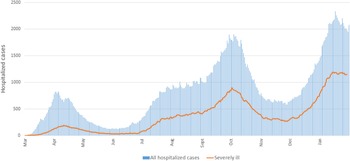
During the study period, Israel experienced 3 discrete waves of COVID-19, the first peak in March–April 2020, the second peak in September–October 2020, and the third peak in December 2020–January 2021. The peak number of COVID-19 patients hospitalized in acute-care hospitals in Israel increased with each wave, reaching by the third wave ∼14% of total acute-care inpatient beds nationwide. With each wave, the peak proportion of severely ill patients among all hospitalized COVID-19 patients increased (32%, 55%, and 59%, respectively) (Fig. 1). 1
Hospitalized COVID-19 patients, Israel, March 1, 2020-January 31, 2021. Source: https://datadashboard.health.gov.il/COVID-19/general.

Routine national surveillance of healthcare-acquired infections continued during the COVID-19 era, and this surveillance extended to the COVID-19 inpatient care units. In this context, we collected data on acquired cases of colonization and infection with several healthcare-associated bacterial pathogens, which we have designated sentinel bacteria. We report here the incidence of cases of hospital-acquired sentinel bacteria among COVID-19 patients in Israeli general hospitals during the first 11 months of the outbreak, from March 2020 through January 2021.
Methods
General hospitals in Israel are required to report to the National Center for Infection Control incident cases of the following sentinel bacteria: carbapenemase-producing Enterobacterales (CPE), carbapenem-resistant Acinetobacter baumannii (CRAB), methicillin-resistant Staphylococcus aureus (MRSA), vancomycin-resistant enterococci (VRE), and Clostridioides difficile (CD). Data on CPE include both clinical and surveillance cultures. For the other pathogens, clinical cultures alone are reported. In addition, all cases of bacteremia caused by the following bacteria are reported: Klebsiella pneumoniae, Escherichia coli, S. aureus, Enterococcus faecalis, E. faecium, Pseudomonas aeruginosa and A. baumannii. For all cases reported, uniform criteria are used to identify new hospital-acquired cases. Hospital acquisition is determined based on time from hospital admission until sampling date of the positive culture.
These data are used to generate reports of the following combined acquisition measures:
-
1) Acquisition measure 1: Sentinel bacteria - CPE, CRAB, MRSA, VRE, CD
-
2) Acquisition measure 2: Sentinel bacteremia – all 7 species, all antibiotic susceptibility profiles
-
3) Acquisition measure 3: Sentinel bacteremia, antimicrobial- resistant – carbapenem-resistant K. pneumoniae, ceftazidime-resistant K. pneumoniae, carbapenem-resistant E. coli, ceftazidime-resistant E. coli, MRSA, VRE, carbapenem-resistant Pseudomonas aeruginosa, and CRAB.
During the study period, the reports were cross-matched with patient-level data regarding hospitalization of COVID-19 patients – defined as patients with PCR-confirmed SARS-CoV-2 infection hospitalized in wards and intensive care units (ICUs) - provided by the Ministry of Health, in order to generate incidence rates for each measure expressed as number of acquisition events per 10,000 COVID-19 patient-days. Additionally, incidence rates for the 3 acquisition measures among COVID-19 patients were compared to corresponding rates for general medical wards and ICUs in 2019.
The study was approved by the jurisdictional internal review board.
Results
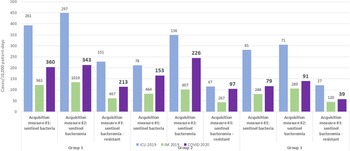
Data were included from 26 hospitals, comprising ∼14,700 licensed acute-care beds (91% of total licensed acute care beds in the country). Hospitals were grouped according to size and complexity of case mix (group 1, large - ≥ 800 beds - and/or tertiary-care general hospitals, n=8; group 2, non–tertiary-care, 400–799 beds, n=9; Group 3, 200–399 beds, n=6; Group 4, children’s hospital, n=1; group 5, <200 beds, n=2). Analyzing data from hospital groups 1–3, we found that for all 3 acquisition measures, rates were higher among COVID-19 patients than they were among patients on general medical wards in 2019, but lower than those among patients in intensive care units in 2019 (Fig. 2).
Incidence of sentinel bacteria acquisition according to hospital group. Comparison between COVID-19 patients during the study period and patients in medical wards and ICUs in 2019. Note. Number on top of column is the absolute number of cases. ICU, intensive care unit; IM, internal medicine ward; COVID, hospitalized COVID-19 patients.

Acquisition measure 1
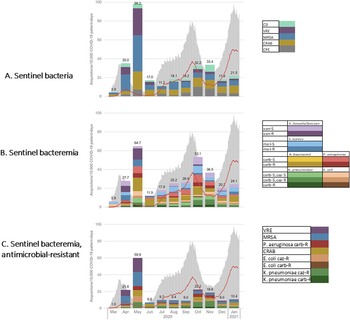
Overall, 596 cases of sentinel bacteria acquisition were recorded in COVID-19 patients from the 26 included hospitals during the study period. Two species causing clinical infection, MRSA and CRAB, accounted for ∼60% of cases (∼30% each).
The incidence rate and absolute incidence are shown in Figures 3A and S2A, respectively. The month with the highest absolute number of cases was January 2021, when Israel was in the midst of the third wave of the COVID-19 outbreak and prevalence of COVID patients on hospital wards was at its height. The month with the highest incidence rate was May 2020, when Israel was emerging from the first COVID-19 wave. Wide variation in incidence was evident between hospitals, even within the same group (data not shown).
Monthly incidence rate of acquisition events among COVID-19 patients, Israeli general hospitals, March 2020-January 2021. Background represents hospitalized COVID-19 patients in Israel, March 2020-January 2021, as shown in Figure 1. Shaded curve, all hospitalized cases; red line, severely ill. Note. CD, Clostridium difficile; VRE, vancomycin-resistant enterococci; MRSA, methicillin-resistant Staphylococcus aureus; CRAB, carbapenem-resistant Acinetobacter baumannii; CPE, carbapenemase-producing Enterobacterales; van, vancomycin; met, methicillin; carb, carbapenem; caz, ceftazidime; S, susceptible; R, resistant.

Acquisition measure 2
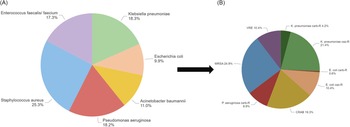
Overall, 663 cases of acquired bacteremia caused by the 7 sentinel bacteria occurred in COVID-19 patients during the study period. Four species accounted for 73% of all cases: S. aureus, Klebsiella spp, A. baumannii, and P. aeruginosa (Fig. 4A). The pathogen distribution was similar to that in acquired sentinel bacteremia in medical wards and ICUs during 2019, prior to the onset of the pandemic (data not shown).
Pathogen distribution in hospital-acquired bacteremia caused by sentinel bacteria among COVID-19 patients, Israeli general hospitals, March 2020-January 2021. A. All sentinel bacteria; B. Antibiotic-resistant sentinel bacteria. Note. VRE, vancomycin-resistant enterococci; MRSA, methicillin-resistant Staphylococcus aureus; CRAB, carbapenem-resistant Acinetobacter baumannii; carb, carbapenem; caz, ceftazidime; R, resistant

The incidence rate and absolute incidence of bacteremia caused by sentinel bacteria are shown in Figures 3B and S2B, respectively. The month with the highest absolute number of cases was October, when Israel was in the midst of the second wave of the COVID-19 outbreak. The month with the highest incidence rate was again May. Here also, wide variation in incidence was evident between hospitals, even within the same group (data not shown).
Acquisition measure 3
Overall, 353 cases of acquired bacteremia with antimicrobial-resistant phenotypes of the sentinel bacteria occurred in COVID-19 patients during the study period. Three species accounted for 66% of all cases: MRSA, CRAB, and ceftazidime-resistant Klebsiella spp. (Fig. 4B). During the study period, gram-positive pathogens and nonfermenters comprised 63% of the pathogens accounting for acquired antimicrobial-resistant sentinel bacteremia, and Enterobacterales 37%, the reverse of the respective proportions in medical wards and general ICUs during 2019, prior to the onset of the pandemic (data not shown).
The incidence rate and absolute incidence of bacteremia caused by antimicrobial-resistant sentinel bacteria are shown in Figs. 3C and S2C, respectively. Here too, the month with the highest absolute number of cases was October, and the month with the highest incidence rate was May. And here as well, wide variation in incidence was evident between hospitals, even within the same group (data not shown).
Discussion
In this study using country-level surveillance data from Israel, we reported on 3 indicators of MDRO acquisition and HAI in COVID-19 units. The incidence of acquisition of sentinel MDRO in COVID-19 units in 2020 was higher than in general medical wards but lower than in intensive care units in 2019. MRSA and CRAB infections accounted for approximately 60% of all acquisitions in COVID-19 units. Among the 7 sentinel bacteria monitored, S. aureus was the most common cause of HA-BSI in COVID-19 patients, and MRSA was the most common cause of antimicrobial-resistant HA-BSI.
The incidence of HAI in the context of COVID-19 has been reported on 2 levels: (1) generally, throughout the inpatient population, Reference Polly, de Almeida, Lennon, Cortês, Costa and Guimarães2–Reference Wee, Conceicao and Tan5 and (2) specifically, regarding coinfection of hospitalized patients with SARS-CoV-2 and a healthcare-associated bacterial pathogen. Reference Cona, Tavelli and Renzelli6–Reference Kampmeier, Tönnies, Correa-Martinez, Mellmann and Schwierzeck10 We focused exclusively on COVID-19 patients hospitalized in acute care facilities in Israel during the first 11 months of the pandemic. We considered 3 indicators of acquisition of healthcare-associated bacterial pathogens: incidence of infection or colonization with sentinel bacteria, incidence of bacteremia caused by all sentinel bacteria, and incidence of bacteremia caused specifically by antimicrobial-resistant sentinel bacteria. We focused on incidence among patients with a diagnosis of COVID-19, hospitalized either in designated COVID-19 wards, or in isolation in a general hospital unit during the first year of the pandemic in Israel, which encompassed 3 waves of infection.
We found increased incidence in all 3 acquisition indicators among COVID-19 patients relative to general internal medicine wards in 2019. Among general hospitals of 200 beds and more, the increase in rate was ∼2-fold among the larger hospitals, and less pronounced among the smaller hospitals. The incidence rates among COVID-19 patients remained several-fold lower than those among ICU patients prior to the COVID-19 outbreak. The peak months of absolute incidence for the 3 indicators (ie, October 2020 and January 2021) corresponded as expected, with waves of COVID-19 incidence and resulting high occupancy of acute-care beds with COVID-19 patients.
The peak in May of the incidence rate for all 3 acquisition indicators coincided with the waning of the first wave. This finding can perhaps be explained by a rapid decline in the number of hospitalized COVID-19 patients during the month of May. Those remaining likely had severe illness and prolonged hospitalization, perhaps including immunosuppressive medication used to treat COVID-19. Therefore, they were at high risk for healthcare-associated infection. Differences in illness type and acuity among hospitalized patients with COVID-19, compared with medical and ICU patients prior to the pandemic, may also help explain the difference in distribution of pathogens isolated in cases of antimicrobial-resistant sentinel bacteremia.
During the early months of the pandemic, there were several reports finding a low incidence of HAI and MDRO acquisition among COVID-19 patients. Reference Hughes, Troise, Donaldson, Mughal and Moore11–Reference Cole and Barnard14 The authors of these studies concluded that the heightened emphasis on infection control in response to COVID-19 had a beneficial impact on nosocomial transmission of other pathogens. However, since that early period, a growing body of literature has demonstrated an increase in HA-BSI and MDRO acquisition during the COVID-19 pandemic. Data from the US National Healthcare Safety Network (NHSN) showed a significant increase in the incidence of central line-associated BSI (CLABSI) and MRSA HA-BSI in each of the last three quarters of 2020, compared to the last three quarters of 2019. Reference Weiner-Lastinger, Pattabiraman and Konnor15 Using NHSN data from 148 hospitals, Baker et al reported that for each 0.1 increase in the monthly number of discharges of COVID-19 patients per staffed bed, the incidence of CLABSI rose by 14% and the incidence of MRSA HA-BSI rose by 9%. Reference Baker, Sands and Huang16 In a study from a London hospital group, the HA-BSI rate per 100,000 patient-days was 170.2 among COVID-19 patients, compared with 90.1 among other patients. Reference Zhu, Rawson and Mookerjee17 Proposed explanations for the rise in the incidence of HAI and MDRO acquisition since the earliest months of the pandemic include staffing shortages, higher patient acuity leading to greater and prolonged use of invasive devices, and diversion of infection control staff to COVID-19-related tasks. Reference Gottlieb and Fridkin18
The care of COVID-19 patients in the hospital setting presents challenges in infection prevention and control above and beyond those of standard inpatient care. Among these challenges are engineering requirements unique to COVID-19 isolation units, cumbersome requirements for use of PPE, the concentration of acutely ill patients with a range of comorbidities, who would normally be cared for in specialized wards, and healthcare workers’ fear of contracting COVID-19.
Interestingly and perhaps counterintuitively, the peak in acquisition rate that we observed early in the study period did not correspond with the proportion of severely ill patients among all COVID-19 patients hospitalized. This proportion peaked at 32% in the first wave, substantially lower than the peak of 55% in the second wave and of 59% in the third wave. A possible explanation for this observation may lie in the fear that accompanied care of COVID-19 patients during the first wave, resulting in inadequate adherence to basic measures of infection prevention, including principles of glove removal and hand hygiene. Reference Gottesman, Fedorowsky, Yerushalmi, Lellouche and Nutman19 Healthcare workers may have been reluctant to enter patient rooms, relying instead on remote care technology but potentially missing early signs of device-associated infection. By the second and third waves, as mechanisms of COVID-19 transmission were better understood, healthcare worker fears subsided and adherence to infection prevention guidance likely improved. Although this proposed explanation is but one of many that are plausible, it is backed by personal observations of the authors on site visits to participating hospitals during the various stages of the pandemic. Focusing, then, on measures to enhance adherence, including alleviation of fears through education, may be key to further improvement in nosocomial infection prevention in future stages of the COVID-19 pandemic.
Among the strengths of this study are the fact that it reports national-level data and includes ongoing surveillance of all common hospital-associated bacterial pathogens. As these are routinely collected data, a limitation of the study is that they do not include factors associated with HAI (eg, staff-patient ratios, ward occupancy, compliance with infection prevention and control measures, and environmental cleaning and disinfection).
In summary, hospitalized COVID-19 patients experienced nosocomial bacterial infection at higher rates than patients on prepandemic general medical wards, adding to the complexity of their care. Our findings confirm those of others worldwide, and they can be explained by a number of factors influencing the inpatient care of COVID-19 patients. Lower rates of nosocomial infection after the first wave suggest that healthcare worker practices, rather than patient-related factors, were perhaps responsible for most of these infections. Addressing these challenges successfully, by infection prevention and control staff and hospital leadership, will be required to improve patient safety in future phases of the pandemic.
Supplementary material
To view supplementary material for this article, please visit https://doi.org/10.1017/ice.2022.267
Acknowledgments
The authors thank Ms. Lidia Pavlov for her technical assistance in preparing the figures for this manuscript.
Financial support
The study was funded through the operating budget of the National Center for Infection Control. There were no additional sources of funding.
Conflicts of interest
All authors report no conflicts of interest relevant to this article.