Introduction
In the post-war period, the distribution of goods across borders has become increasingly affected by the proliferation of standards (Essaji, Reference Essaji2008), with increased regulatory intensity being particularly noticeable in the food and agricultural sector (Roberts, Reference Roberts1999; Josling et al., Reference Josling, Roberts and Orden2004; Henson and Jaffee, Reference Henson and Jaffee2008). Based on data for the two-digit Harmonized System (HS), Essaji (Reference Essaji2008) finds six of the ten sectors with the highest intensity of regulations cover food and agricultural products.
Increased use of standards is typically regarded as the response of policymakers to demands for improved product safety, increased environmental protection, and greater product information (Roberts, Reference Roberts1999; Wilson, Reference Wilson2008). Key here is the role of standards in solving market failures, Josling et al. (Reference Josling, Roberts and Orden2004) suggesting they can be classified under two broad categories: (i) provision of public goods in production and (ii) reduction of transactions costs associated with information asymmetries concerning product characteristics.
While standards should be targeted at market failures, there is also acknowledgement that they may provide protection for domestic producers and are, therefore, subject to ‘regulatory capture’ (Fischer and Serra, Reference Fischer and Serra2000; Sturm, Reference Sturm2006). Given the potential for standards to distort international trade, a key outcome from formation of the World Trade Organization (WTO) in 1994 was the Agreement on the Application of Sanitary and Phytosanitary Measures (SPS), and the revised Agreement on Technical Barriers to Trade (TBT). The objective of these agreements is to ensure that standards, while potentially meeting legitimate economic objectives, are not disguised restrictions on international trade (Josling, Reference Josling2008).
Although the focus of this article is not the intricacies of trade law, it is interesting to note that between 1995 and 2002, WTO members filed 32 requests for formal consultations related to food regulation trade barriers under the WTO's dispute settlement process (Josling et al., Reference Josling, Roberts and Orden2004). These covered a wide range of sectors and technical regulations, and involved both developed and developing countries as petitioners and respondents. Perhaps the most analyzed Panel and Appellate Board rulings have been those involving the US complaint against the European Community's (EC) use of measures concerning the use of hormones in meat and meat products, and India, Malaysia, Pakistan, and Thailand's complaint against the US prohibition of imports of shrimp and shrimp products.
The tension between standards being targeted at market failures, versus the possibility that they may provide protection to domestic producers, has characterized much of their economic analysis. In an early contribution, Casella (Reference Casella, Bhagwati and Hudec1996) examined standards in the context of provision of public goods. Given that demand for public goods depends on economic primitives, such as factor endowments, consumer preferences, and technology, necessarily provision differs between countries depending on their stage of development. Casella (Reference Casella, Bhagwati and Hudec1996) showed that with international trade, standards of developed and developing countries will converge over time, if demand for standards is a function of the level of income. The implication of this result is that if trade itself eventually results in countries establishing similar standards for the provision of public goods, there is no need for such standards to be harmonized as a pre-condition for trade liberalization.
In contrast to this benign view of standards, there has been considerable discussion of the problems faced by developing countries in accessing developed country markets, the latter typically having higher levels of regulatory intensity than the former (Essaji, Reference Essaji2008). Testing the hypothesis of ‘standards as barriers’ has been a dominant feature of the empirical research on the impact of food safety regulations on trade flows of specific food and agricultural commodities, e.g. Calvin and Krissoff (Reference Calvin and Krissoff1998), Paarlberg and Lee (Reference Paarlberg and Lee1998), Otsuki, et al. (Reference Otsuki, Wilson and Sewadeh2001), Wilson and Otsuki (Reference Wilson and Otsuki2004), Peterson and Orden (Reference Peterson and Orden2005), and Anders and Caswell (Reference Anders and Caswell2009). A common finding of these studies is that more stringent standards imposed by developed countries act as barriers to trade. Essaji (Reference Essaji2008), whose broad cross-section of industries includes the food and agricultural sector, also finds strong empirical evidence that standards negatively affect the exports of developing countries.
As noted above, standards are often justified as a means of solving specific market failures. However, it is typically claimed that developing countries are hampered in their ability to meet standards due to a lack of necessary human capital and poor governance (Essaji, Reference Essaji2008). The latter also presents empirical evidence to support the hypothesis that the capacity to satisfy standards is correlated with real GDP per capita, such that developing countries specialize away from industries with heavier regulatory burdens. From this, the policy implication is drawn that there is a need to target aid for trade at enabling developing countries to better meet standards.
In light of these empirical findings, the objective of this article is to explore the link between trade and standards through adaptation of a general equilibrium model that captures the following: developing countries have a lower capacity to meet standards and thereby specialize in exporting products that face lower regulatory burdens. A key question at this point though is why a general equilibrium model when much of the empirical analysis of standards, as well as some of the theoretical analysis, has been partial equilibrium in nature?
Recent work by Sheldon and Roe (Reference Sheldon and Roe2009) examines how labeling standards may affect the gains from international integration when using a model of vertical product differentiation. Their results show that depending on the type of labeling regime, it is possible for a developed country to export high-quality goods in exchange for low-quality goods produced by a developing country. While the model details the nature of competition between firms and the impact of given distributions of income on the number of goods supplied in equilibrium, it ignores why there might actually be a difference in incomes across countries. This requires making an explicit connection between the factor endowments of developed and developing countries, their resulting incomes and choice of standards, and how this might be used to explain patterns of trade specialization. This suggests a general equilibrium model.
The article is outlined as follows: in Section 1, a general equilibrium model is outlined, drawing extensively on existing work in the trade and environmental economics literature. This analysis is designed to capture North–South trade where standards are targeted at negative externalities, such as the use of pesticides in agricultural production. In Sections 2 and 3, the hypothesis of standards as ‘barriers to trade’ is considered, followed by a discussion of aid for trade as a means to change the composition of exports by the South. Finally, the article is summarized, and some conclusions are drawn concerning potential future research on standards and trade.
1. A model of North–South trade and standards
To provide a theoretical underpinning to Essaji's (2008) empirical results, a model of trade in the presence of environmental externalities due to Copeland and Taylor (Reference Copeland and Taylor1994) is adapted to the case of standards (see online appendix). Assume there is a bloc of countries representing the developed North and a bloc representing the developing South, producing along a continuum of consumption goods, z∈[0, 1] with one primary input, effective labor l. Part of this continuum consists of food consumption goods, the remainder being other non-food goods. A local public bad b is also produced jointly with each consumption good z in the continuum, aggregate production of the public bad being D. In the case of food production, use of pesticides generates a local public bad if there are health risks associated with on-farm ingestion by agricultural labor, as well as air and drinking-water contamination, and dietary exposure to pesticide residues (Wilson and Otsuki, Reference Wilson and Otsuki2004).
On the consumption side, consumers in the North and South have identical utility functions, and their share of spending on each consumption good z in the continuum is a constant. The indirect utility function of a representative consumer is given as V={x(z), p(z), i, D}, where x(z) and p(z) are total consumption and prices of goods z in the continuum respectively; i=I/L is income per capita, I being total income and L the total number of workers in the economy.
The output y of any good z in the continuum is a function of combining effective labor l and the bad b under the following constant returns to scale Cobb−Douglas technology:
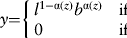
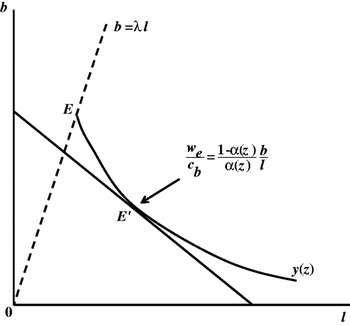
where λ>0, and the technology parameter α(z) relating to the bad varies across goods. The interpretation of (1) is that effective labor l and the bad b can be substituted for one another in production of any good z, but there are limits to these substitution possibilities, i.e. any point above the production ray b=λl is not feasible for any given labor input l. This follows from the bad b being a by-product of production. This technology is illustrated in Figure 1 where y(z) is an isoquant for good z.
Figure 1.

If production of the bad b is costless, firms will always choose a point along the production ray b=λl. This would be the case, for example, if pesticides were free and there were no government regulation of their use, i.e. firms would have no incentive to abate the public bad. However, as firms do have to pay a positive price for pesticides, and/or a public standard s is set for an allowable level of the public bad, production will occur below the ray b=λl. In setting a standard, it is assumed that the government essentially imposes additional compliance costs c b on firms that utilize the public bad in production. In the case of pesticides, this could take the form of a ban on particularly harmful pesticides which drives up the price of substitute pesticides (Zilberman et al., Reference Zilberman, Schmitz, Casterline, Lichtenberg and Siebert1991), and/or it could come from compliance costs consisting of abatement, certification, and monitoring costs for using allowable pesticides and meeting maximum pesticide residue limits. It is assumed that compliance costs c b vary positively in the level of the standard.
Given a return on a unit of effective labor w e, and the per unit compliance costs c b, cost minimization for any good in the continuum z implies that the ratio of input prices, (w e/c b), will equal the marginal technical rate of substitution:
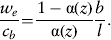
Expression (2) indicates that the share in production costs of the compliance costs c b is a constant α(z), so that goods in the continuum can be ordered in terms of their intensity in generating the public bad, α′(z)>0. Importantly, both food and non-food consumption goods are assumed to be spread along this continuum in terms of their generation of a public bad. This ensures that both North and South will produce both food and non-food consumption goods in equilibrium. The equilibrium in (2) is shown in Figure 1 as the tangency point between the isoquant and the isocost curve at E′, where input b is being appropriately priced, which compares to the equilibrium at E where firms have no incentive to abate the public bad.
Suppose the technology in (1) is available to firms in both North and South, and each has the same endowment of workers L=L *, but the supply of effective labor is greater in the North than the South, A(h)L>A(h *)L *, where h is the human capital/worker, and h>h * (*denoting the South). This assumption captures the empirical observation of Essaji (Reference Essaji2008) that developing countries are lacking in human capital. Given that the return to effective labor is higher in the North than the South, income per capita in the North exceeds that in the South, and if demand for reduction of the public bad rises with income, then the North will set a higher standard s and, therefore, higher per unit compliance costs c b will be incurred by its firms.
For given wages and compliance costs, a good z in the continuum will be produced in the North as opposed to the South if the former has lower unit costs of production, i.e. a(z)≤a*(z), from which it is possible to derive the following relationship:

where the ratio of compliance costs in the South to those in the North is given as  . If demand for reduction of the public bad is income elastic, then
 , i.e. compliance costs will be higher in the North than the South. This follows from the fact that if a government acts optimally, the Samuelson rule for supply of a public bad should hold, whereby compliance costs faced by producers should be set equal to the aggregate marginal damage generated by the public bad, i.e. c b=βDγ −1I, where β is a representative consumer's disutility associated with the public bad, and
 is their marginal willingness to pay for its reduction. Consequently, the level of compliance costs, and by implication the standard s, varies positively in income I in the North and likewise in the South,
 , the ratio of North and South compliance costs being given as
 , i.e. standards for pesticide use in the South will eventually rise as their income rises. Of course, standards are not necessarily set at the optimum level, but it is not unreasonable to argue that they will increase with income. Motivation for the latter argument draws on the empirical work of Grossman and Krueger (Reference Grossman and Krueger1995).
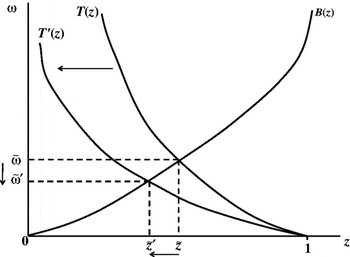
Given  , which is shown as the downward-sloping function in Figure 2, it can be stated that a good z in the continuum is produced in the North if
 and is produced in the South if
 . Given compliance costs in the North are higher than those in the South,
 , and also that goods are arranged in terms of their intensity in generating the public bad, α′(z)>0, then is decreasing in z, i.e. the North's comparative advantage in producing any good z falls as compliance costs become a larger fraction of total production costs. Therefore, for any given value of relative wages ω, there will be a critical industry
 on the function where goods are either produced in the North on the interval
 , or they are produced in the South on the interval
 , with the North (South) producing the goods that are least (most)-intensive in their production of the local public bad.
Figure 2.

In order to determine equilibrium relative wages  , and hence the critical industry , the demand side of the economy is introduced through a balance of trade function, defined as:

i.e. total imports of Southern goods by the North have to equal total exports of Northern goods to the South, where  denotes the proportion of income spent by the North (South) on Southern (Northern) goods. Rearranging (4) generates a balance of trade function:
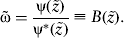
 , shown in Figure 2, slopes upwards to reflect the fact that as the range of goods produced in the North increases, its exports increase and its imports fall, so that relative wages ω have to increase to balance trade. Combining both and determines the equilibrium relative wage and critical industry − see Figure 2.
Given h>h * and s>s *, the trading equilibrium is one where the North specializes in goods that are intensive in their use of effective labor , while the South specializes in goods that are intensive in their use of the local public bad . This reflects both the North's comparative advantage in producing goods that generate less of the local public bad, as well as the fact that it sets higher standards, which follows from the fact that it has a higher level of income than the South. These results provide theoretical support for Essaji's (Reference Essaji2008) empirical finding that developing countries specialize in exporting goods with lower regulatory burdens.
The implication of the theory is that if developing countries set lower standards because of lower incomes, they become ‘havens’ for production of local public bad(s). This result necessarily comes out of the logic of a Ricardian model where in equilibrium a country (the South) totally specializes in producing a range of goods (public-bad intensive) in the continuum. The so-called ‘pollution haven hypothesis’ is a strong theoretical result, for which there is rather weak empirical support. This follows from the fact that trade specialization will be affected by other determinants of comparative advantage. However, there is more empirical support for the related ‘pollution haven effect’ whereby higher standards deter exports (encourage imports) by the North of goods that embody a public bad(s) (Taylor, Reference Taylor2004).
2. ‘Standards as barriers’ to trade
By assumption, the result in Figure 2 is based on aggregate damage D only resulting from a local public bad, standards being benign in that their level simply reflects the relative development of the North versus the South. Suppose, however, that the public bad produced in the South can have measurable effects in the North, i.e. there is potential for harmful pesticide residues to be on or contained in food consumption goods produced in and imported from the South. Cash and Zilberman (Reference Cash, Zilberman and Siebert2003) argue there are two market failures associated with pesticide residues in food: incomplete information and externalities. The former occurs because consumers are unable to detect the level of pesticide residues in the food they purchase. The latter is due to the fact that producers applying pesticides fail to take account of the potential social costs due to dietary exposure to pesticides.
These two distinct market failures can be targeted with quite different policy instruments. In the case of imperfect information, the North could adopt a system of country of origin labeling, whereby goods imported from the South are required to carry a label stating they were produced in the South. As a result, consumers in the North could choose to internalize the externality themselves by only consuming goods produced in the North. In the case of negative externalities, the North could apply the same pesticide residue standards to imports from the South as applied to producers in the North, thereby internalizing the externality. Setting high pesticide residue standards could also assure consumers in the North that everything is being done by regulators to ensure that their food is safe, be it produced in the North or the South. However, if producers meet Northern standards, the standard does the job of internalizing the negative externality. Assuming the standard set in the North meets the criteria of the SPS Agreement, and is equally restrictive on goods produced in the North and South, it will likely satisfy the principle of national treatment (GATT Article III).
As standards in the model outlined are higher in the North due to their level of income, there is a presumption that by providing an incentive to reduce production of the local public bad caused by pesticide use, Northern food products are already expected to meet strict limits on maximum pesticide residue levels, and that the necessary level of effective labor is available in the North to satisfy these standards at minimum cost. However, if the same standards concerning maximum pesticide residue levels are applied by the North to imports from the South, it might be expected that meeting such standards, which are higher than those that the South has already set due its own level of development, will result in considerably higher costs of exporting, which are much harder to minimize due the lower level of effective labor available in the South. In other words, increased costs of exporting to the North, over and above the compliance costs  already set in the South may act as a barrier to trade, especially given that its comparative advantage lies in producing goods that are intensive in their use of the public bad. Consequently, even if application of Northern standards resolves a market failure due to a negative externality, and it is not explicitly protectionist, producers in the South, due to a lack of necessary human capital, may be unable to satisfy these higher standards, and therefore face a barrier to trade. This contrasts with Marette and Beghin's (Reference Marette and Beghin2010) result that standards can be anti-protectionist if foreign producers are more efficient at complying with them than domestic producers.
Concerns about the safety of food products are captured in the increasing stringency of pesticide residue rules applied by developed countries. For example, in 2005 the EU harmonized its regulations on maximum residue levels (MRLs) of pesticides in or on food products thereby reducing its tolerance levels for pesticide residues (European Union, 2005). The MRL is the level of pesticide residue that is permitted under EU rules to remain in or on food products after use of a specific pesticide under what is called Good Agricultural Practice (GAP), and is applied to products sourced from within the EU as well as imports. In addition, an import tolerance (IT) is an MRL set for imported food products that contain a pesticide not authorized within the EU for reasons other than public health. If an IT has not been established, a default value of 0.01 mg/kg in foodstuffs is applied. Introduction of these rules on MRLs has created considerable concern among African, Caribbean, and Pacific (ACP) exporters, particularly due to the complexity of obtaining an IT (Jaud and Cadot, Reference Jaud and Cadot2012). Empirical evidence suggests that higher standards facing exporters can have a significant impact on their costs, resulting in substantial reductions in exports (Otsuki et al., Reference Otsuki, Wilson and Sewadeh2001; Essaji, Reference Essaji2008). For example, a World Bank study by Manarungsan et al. (Reference Manarungsan, Naewbanij and Rerngjakrabhet2005) found that more stringent pesticide residue rules increased the compliance costs of Thai exporters of asparagus by over 60%.
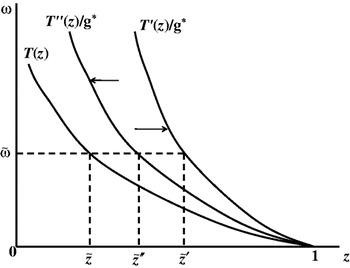
In modeling the imposition of higher standards in the North on imports from the South, it is assumed that these generate additional costs to Southern producers beyond the compliance costs already incurred in meeting the standards set in the South. Following Dornbusch et al. (Reference Dornbusch, Fischer and Samuelson1977), these additional compliance costs due to application of the higher Northern standard s on the range of goods imported by the North, but already applied to the range of goods produced in the North, are modeled as iceberg transport costs, g *. This implies that only a fraction g*(z) of any commodity z actually arrives, the relationship between unit costs in the North and South being re-written as a(z)≤[a*(z)]/g*. Graphically, introducing such costs results in a new schedule  in Figure 3, such that for a given relative wage , there will be a set of non-traded goods between
 .
Figure 3.

In other words, the North continues to produce and export goods in the range , for which it has a comparative advantage, but it also produces goods in the range as it is cheaper than importing those goods, although it cannot export these goods to the South as they can still be produced more efficiently in the South. The South also produces non-traded goods in the range , but its exports are reduced to the range  . Therefore, introducing iceberg transport costs into the model can be interpreted as broadly capturing the ‘standards as barriers’ hypothesis, illustrating the concerns developing countries have about proliferation of standards and technical regulations in developed countries.
The previous analysis presumes that due to a lack of effective labor in the South, it is very costly for the South to meet higher standards set in the North. In contrast to this, the hypothesis has been put forward that rather than barriers, higher standards in developing countries may be a ‘catalyst’ to trade. For example, Henson and Jaffee (Reference Henson and Jaffee2008) argue that being forced to comply with higher standards provides an incentive to firms and regulators in developing countries to invest in their ability to meet such standards, i.e. to increase h *. Specifically, they appeal to Porter and van de Linde's (Reference Porter and van der Linde1995) argument that there will be regulatory-induced innovation. Crudely, the ‘standards as catalysts’ hypothesis is represented in Figure 3 by a shift in the  schedule to as an increase in effective labor h * in the South offsets the costs of complying with higher standards in the North.
Anders and Caswell's (Reference Anders and Caswell2009) recent analysis of the impact of US food safety standards on imports of seafood provides some early empirical support for the hypothesis of ‘standards as catalyst’. Specifically, they find that among their sample of developing exporters to the US, standards appear to act as a catalyst for larger exporters and a barrier for smaller exporters. These results are somewhat surprising in light of Palmer et al.'s (Reference Palmer, Oates and Portney1995) critique of the hypothesis of regulatory-induced innovation – a priori, if it is unprofitable to invest in developing the human capital required to abate a public bad prior to implementation of tougher standards, there will be no incentive for firms to invest in innovation after implementation of said standards. Even assuming that a reasonable theoretical argument could be put forward for regulatory-induced innovation, the empirical inference that higher standards in the North are a catalyst to improving the quality of human capital in the South, could be observationally equivalent to the transfer of human capital from North to South through aid for trade programs or the activities of multinational firms.
3. Technological change vs. aid for trade
From the standpoint of the South, an important question arises as to what circumstances will result in a change in the composition of their exports to the North. One possibility is that over time, there will be labor-augmenting technological change in the South, due to an increase in their human capital h *, holding the level of human capital h in the North constant. Inspection of (3) shows that the schedule in Figure 2 will rotate downwards to  , the South increasing its production of goods that are intensive in their use of effective labor from to
 . Due to the fact that the South's exports will increase and its imports fall, relative wages have to fall from to
 in order that trade balances. At the same time as incomes rise in the South, their level of standards s * will also increase, and thereby their compliance costs .
In the absence of technological progress in the South, suppose that development aid from the North to the South is tied to abatement of the public bad. This possibility captures the argument noted earlier that aid should aim to improve developing countries’ ability to meet higher regulatory standards. In the context of food standards, a good example of aid for trade is the Pesticides Initiative Program (PIP) financed by the European Development Fund and implemented by the Europe-Africa-Caribbean-Pacific Liaison Committee (COLEACP). Started in 2001 with a budget of 34 million euros, a key objective of PIP has been to enable ACP exporters of fresh fruit and vegetables to comply with EU pesticide residue requirements. Jaud and Cadot (Reference Jaud and Cadot2012) present empirical evidence that PIP has had a positive impact on Senegal's exports to the EU.
In the context of the general equilibrium model, assume that tied aid to the South comes in the form of a transfer of the necessary human capital h for goods to meet higher Northern standards, and the cost of this transfer τ is reflected in a decrease in Northern income, (I–τ), i.e. tied aid improves productive capacity in the South, but has a redistributive effect in the North. Compliance costs in the North become c b=βD γ–1(I–τ), and (3) becomes:

Tied aid has two effects: first, there is a productive effect in the South due to the transfer of h – in Figure 2,  rotates down, the South increasing its production of goods that are intensive in their use of effective labor and pushing up its relative wage; second, there are negative income effects in the North resulting in lower compliance costs, c b, in the North, causing to rotate up in Figure 2, the North increasing its production of goods that are intensive in their use of the public bad, and pushing up its relative wage, but not by enough to offset the direct effect of the transfer of h. The overall impact on trade will depend on relative factor prices, which in turn depend on the strength of the income effect in the North on its level of standards s, and the elasticity of supply of the public bad in the South. This compares with the case of untied aid to the South where there is a negative income effect in the North and a positive income effect in the South, the North increasing its production of goods that are intensive in their use of the public bad, i.e. only rotates up in Figure 2. The policy implication is that tied aid in the form of transfers of human capital from North to South are required if the South is to produce a wider range of goods in equilibrium.
Summary and conclusions
Given the proliferation of standards in the past two decades, the focus of this article has been on the interaction between such standards and international trade. Specifically, this interaction was set in the context of the tension between standards as a response to market failures, and their potential to create barriers to trade. The analytical results presented reinforce an observation made by Wilson (Reference Wilson2008): standards are not like tariffs if their objective is to take care of market failures, however it is important that not only are they applied in a non-discriminatory manner, but also any agreement between countries about standards has to ensure the benefits of economic integration are realized, without undermining the resolution of market failures.
Based on production of local public bad(s), a model of international trade was presented showing that compared to developing countries (the South), if developed countries (the North) have more effective labor, and higher standards, the North specializes in producing and exporting goods intensive in their use of effective labor, while the South specializes in producing and exporting goods intensive in their use of the public bad. With an increase in effective labor in the South, their standards will converge on those of the North, reinforcing the argument that harmonization of standards as a pre-condition for trade liberalization is unnecessary.
If the public bad produced in the South has the potential to impose damage on consumers in the North, exports of goods from the South will face the higher standards already imposed in the North. Treating higher standards on Southern exports as iceberg transport costs results in a range of non-traded goods – the hypothesis of ‘standards as barriers’, one that has support in much of the empirical work on food standards and trade. In principle, the competing hypothesis of ‘standards as catalysts’ can be characterized in the model as innovations that result in an increase in effective labor in the South, allowing it to better comply with higher Northern standards. Alternatively, an increase in effective labor in the South might also come about due to the transfer of human capital from the North through tied aid.
In conclusion, the general equilibrium model outlined is pretty robust in terms of its analysis of standards, providing a theoretical basis for the extensive empirical work that supports the hypothesis of ‘standards as barriers’ to trade. However, there is a need for more rigorous modeling of an issue that has received increasing attention, and which is now being included in empirical analysis. Specifically, the rather ad hoc hypothesis of ‘standards as catalysts’, for which there is so far only limited empirical support, also requires an underlying dynamic theory of why developing countries innovate in the face of higher standards in developed countries.
Supplementary material
A supplementary appendix for this paper is available online at: http://dx.doi.org/10.1017/S1474745612000249