Introduction
Research in conversation analysis (CA) and interactional linguistics (IL) has demonstrated the importance of positionally sensitive grammars (Schegloff Reference Schegloff, Ochs, Schegloff and Thompson1996) for action formation and ascription (Schegloff Reference Schegloff2007; Levinson Reference Levinson2013). Of particular interest are resources at various levels of grammatical structure, including phonetics/prosody (e.g. Couper-Kuhlen & Selting Reference Couper-Kuhlen and Selting1996; Couper-Kuhlen & Ford Reference Couper-Kuhlen and Ford2004; Curl, Local, & Walker Reference Curl, Local; and Walker2006; Ogden & Walker Reference Ogden, Walker, Szczepek-Reed and Raymond2013), the lexicon (e.g. Clift Reference Clift2001; C. Raymond Reference Raymond2016), morphosyntax (e.g. Thompson & Couper-Kuhlen Reference Thompson and Couper-Kuhlen2005; Curl Reference Curl2006; Fox Reference Fox2007; Heritage Reference Heritage2012b,Reference Heritagec; Couper-Kuhlen Reference Couper-Kuhlen2014; C. Raymond Reference Raymond2017), as well as resources of the body (e.g. Sorjonen & Raevaara Reference Sorjonen, Raevaara, Drew and Couper-Kuhlen2014; Fox & Heinemann Reference Fox and Heinemann2017; Mondada Reference Mondada, Sorjonen, Raevaara and Couper-Kuhlen2017; Keevallik Reference Keevallik2018).
Much of this research has played out in the sequence-organizational context of questions and answers. In English and many other languages (Dryer Reference Dryer, Haspelmath, Dryer, Gil and Comrie2008), a morphosyntactic distinction exists between declarative and interrogative questions. This distinction is demonstrably relevant for participants, who routinely use interrogatives as requests for information, and declaratives as requests for confirmation (Heritage Reference Heritage2012c). Some of the most convincing evidence for this distinction is found during episodes of self-repair (Clift & Raymond Reference Clift and Raymond2018; Drew Reference Drew2018). For example, in extract (1), Leslie revises her nascent (cut-off) declarative question to Hal (“you were-”, line 3), to a more epistemically ‘cautious’ (Drew Reference Drew2013:133) interrogative format: “were you…” (line 3).
(1) (Field SO88(II):1:3:1)


Through her self-repair (line 3), Leslie modifies her stance regarding how much she claims to know about Hal's whereabouts during the previous evening (Heritage Reference Heritage2012c). Relative to her initial, declarative format, Leslie's subsequent interrogative format claims less knowledge, and thus Leslie effectively enacts an epistemic backdown. This claim is supported by the fact that Leslie immediately continues to propose an alternative timeframe to “la:st night” (line 3) with an or-prefaced self repair (Lerner & Kitzinger Reference Lerner and Kitzinger2015) that is further mitigated with perhaps: “or: was it the night before per↓haps.” (line 4; see Drew Reference Drew2013).
The present article argues that, while research on interrogative versus declarative formats has been extensive and productive, the distinction between the two has become virtually reified as a dichotomy, when in fact participants appear to rely on more granular distinctions in the formation and recognition of action. Consider the following three examples from our data.
(i) do you wanna put soles on ‘em?
(ii) you wanna do heels too?
(iii) >wanna do it?<
The first example represents a fully interrogatively designed offer, complete with an auxiliary verb do in presubject position followed by the main verb wanna. Relative to the first example, the third represents a much more minimal construction, without an auxiliary verb or subject; on strictly morphosyntactic grounds, its declarative/interrogative status is ambiguous. Relative to (i) and (iii), while the second example may initially appear to be declaratively formatted, it can also be argued to occupy an intermediate degree of morphosyntactic minimality.Footnote 1 Note that we refrain from referring to this cline of morphosyntactic minimality in terms of ‘elision’ (i.e. of auxiliary verbs and/or subjects) because such terminology intrinsically privileges fully elaborated grammatical forms as being unmarked or most normative, thereby implicitly casting other options as ‘secondary’ alternatives (Thompson, Fox, & Couper-Kuhlen Reference Thompson, Fox; and Couper-Kuhlen2015).
Following the CA assumption of ‘order at all points’ (Sacks Reference Sacks, Atkinson and Heritage1984:22), this article examines the use of these three different turn formats—that is, do you want…?, you want…?, and want…?—as possible distinct practices (Schegloff Reference Schegloff, Ochs, Schegloff and Thompson1996) in the design of questions implementing offers and requests. Drawing primarily on American data from the context of a shoe-repair shop (see below), and supplemented by data from American and British mundane and medical contexts, we posit that this cline of minimality reflects a cline of the action-initiator's stance, from relatively weak to strong (respectively), regarding their expectation that the action will be accepted or complied with.Footnote 2 We therefore argue that English-speaking participants orient to at least a three-way distinction in morphosyntactic form when building offers and requests, rather than a simple binary between interrogative and declarative. In fact, contrary to much thinking in linguistics in the last forty years, we aim to contribute to the substantial research in talk-in-interaction showing that grammatical formats are drawn on for a wide range of finely tuned social actions.
One type of evidence for our claims involves the sequential environments in which the three different turn formats that we target—that is, do you want…?, you want…?, and want…?—are regularly and differentially positioned. These environments vary based on the degree to which recipients have publicly displayed themselves to be disposed toward accepting an offer/request. We use the term disposition, meaning ‘the tendency of something to act in a certain manner under given circumstances’,Footnote 3 in order to avoid more mentalistic synonyms, such as ‘inclination’, ‘proclivity’, or ‘propensity’. There are many ways that talk and embodied conduct can project interactants’ dispositions. For example, providing a go-ahead to a pre-invitation projects one's disposition toward accepting the invitation (Schegloff Reference Schegloff2007). Or when recipients ‘fail’ to respond at the ends of stories, tellers’ facial expressions can contribute to projecting tellers’ readiness to end their stories and receive particular types of uptake (Peräkylä & Ruusuvuori Reference Peräkylä, Ruusuvuori, Peräkylä and Sorjonen2012).
Various researchers have argued that offerers and requesters tailor their turn formats based on their assessments of recipients’ dispositions toward acceptance. Wootton (Reference Wootton1997), for instance, demonstrates that English-speaking children format requests as imperatives when they have grounds for expecting that their requests will be fulfilled. Regarding low-cost, here-and-now requests, Rossi (Reference Rossi2012) argues for Italian that speakers use: (i) imperatives when making requests for objects or tasks implicated in activities that are being currently, mutually engaged in by both requester and requestee (e.g. requesting that someone cut a deck of cards during a game); and (ii) interrogatives when requests are ‘not part of an undertaking that is already shared with the requestee but, rather, that is part of something which is independently initiated by the requester’ (Reference Rossi2012:446). Rossi posits that ‘the choice of an interrogative format presents the speaker as not knowing whether the recipient will comply’ (Reference Rossi2012:454, emphasis added). Similarly, Curl & Drew (Reference Curl and Drew2008) illustrate that speakers use modal-verb requests (e.g. would/could you…) when they assess the outcome to be relatively noncontingent (i.e. more likely to be granted), and I wonder when they assess the outcome to be relatively contingent (i.e. less likely to be granted; Fox & Heinemann Reference Fox and Heinemann2017). Most relevant to the present article, Curl (Reference Curl2006) observes that offers formatted with do you want…? ‘are only found when the problem they propose to remedy or solve is educed from the prior talk—when the problem is not overtly displayed as such by the eventual offer recipient’ (Reference Curl2006:1269, emphasis added).
Our data indicate that speakers position the do you want…? format—which we argue enacts a relatively neutral or agnostic stance with regard to possible acceptance/compliance—in contexts in which there is no (or sometimes contrary) evidence (verbal, vocal, embodied, artifactual) in prior interaction that recipients are disposed toward accepting or complying with the action. In contrast, the more minimal you want…? and want…? formats—which we argue display increasingly stronger stances of expectation for acceptance/compliance—are recurrently positioned in sequential contexts in which there is evidence that recipients are disposed to accept/comply with the action. Relative to the you want…? format, the want…? format appears in contexts in which recipients have demonstrated a particularly strong or explicit disposition toward acceptance/compliance, and is regularly produced and understood as seeking (re)confirmation of acceptance/compliance.
Contextual positioning is only one type of evidence for our claims. As Curl & Drew (Reference Curl and Drew2008) illustrate in their seminal work, it is not that sociolinguistic speech settings ‘cause’ certain request formats to occur, but rather that such formats embody different stances regarding speakers’ levels of entitlement to make the requests, and that these stances are regularly fitted to the social-relational details of the contexts of their implementation. Curl & Drew demonstrate this point with cases in which speakers use, for example, request formats indexing certain stances of entitlement in contexts that might suggest otherwise, as when a patient makes a relatively high-entitlement request to a physician (but does so ‘for cause’, e.g. to communicate urgency), or when a family member makes a relatively low-entitlement request to another close, immediate family member (but does so ‘for cause’, e.g. because that family member just displayed themselves to be disposed toward rejecting the forthcoming request). We support our argument with similar evidence, such as how the stance associated with a particular format can be ‘flouted’ for a particular interactional effect.
Data and method
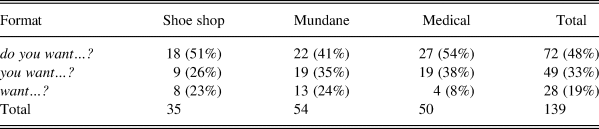
This article is based on a collection of all instances of do you want…?, you want…?, and want…? in our corpora of telephone and face-to-face interactions, both mundane and institutional. We limited the current report in terms of action (i.e. offers and requests), lexical design (i.e. the verb want), beneficiary of the offer (i.e. the second-person recipient you, excluding offers to third parties), and verbal complement (i.e. clausal). This generated a collection of 139 target cases (see Table 1).
Distribution of cases by format and context.

While the decision to look at a particular social action is common in CA and IL research, analyzing a morphosyntactic format by specifying its lexical design and complement is perhaps less familiar. This decision was motivated by work in usage-based linguistics that convincingly shows that certain classes of verbs (e.g. of cognition, of volition, etc.), as well as certain persons (i.e. first, second, third), can be far more or less likely to occur with minimal forms (e.g. Thompson & Mulac Reference Thompson and Mulac1991; Nicita Reference Nicita2002; Scheibman Reference Scheibmann2002). For example, in studies investigating subject expression in Spanish (e.g. yo creo vs. simply creo, both meaning ‘(I) think’), verbs of cognition pattern differently than other classes of verbs with regard to explicit use of the first-person singular pronoun yo ‘I’ (Nicita Reference Nicita2002; Travis & Torres Cacoullos Reference Travis and Cacoullos2012; see also Tao Reference Tao1996 on Mandarin, and Torres Cacoullos & Travis Reference Torres Cacoullos and Travis2014 on English). Similarly, in the case of the optional complementizer that in utterances such as I heard (that) you were sick, Thompson & Mulac (Reference Thompson and Mulac1991:237) write that ‘first and second person subjects, the verbs think and guess, and auxiliaries, indirect objects, and adverbs in the main clause, and pronominal complement subjects are all significant in predicting the use of that’.
Accordingly, in line with the CA method of isolating and ‘controlling for’ sequential position and features of turn design because they can be relevant practices of action formation (Schegloff Reference Schegloff, Ochs, Schegloff and Thompson1996), here we did the same with verb, person, and complement: We did not want to assume that participants used verbs of volition (e.g. want) in the same way as other verbs with regard to their options of minimality (for a similar discussion in the context of nouns and noun phrases, see C. Raymond & Fox Reference Raymond, Fox, Oni and Thompson2020).Footnote 4 We view the ways in which participants use different verbs in the service of action—particularly with regard to different degrees of minimality in their turn designs—as an altogether empirical question, rather than assuming homogeneity a priori across all classes of verbs, a point to which we return in the discussion.
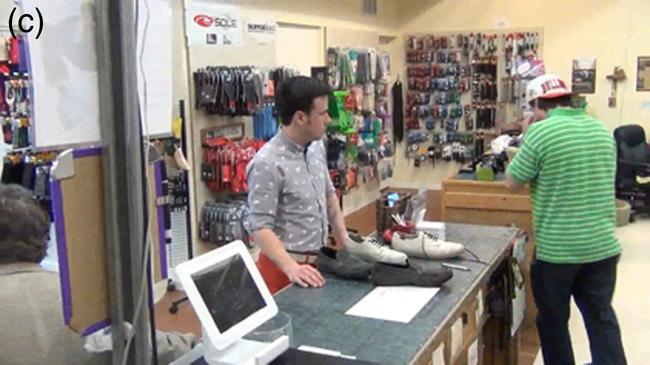
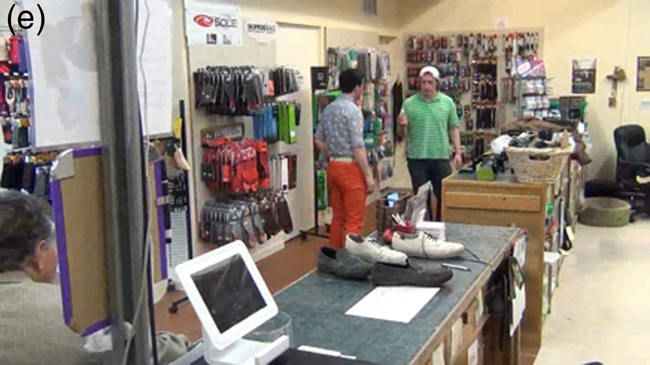
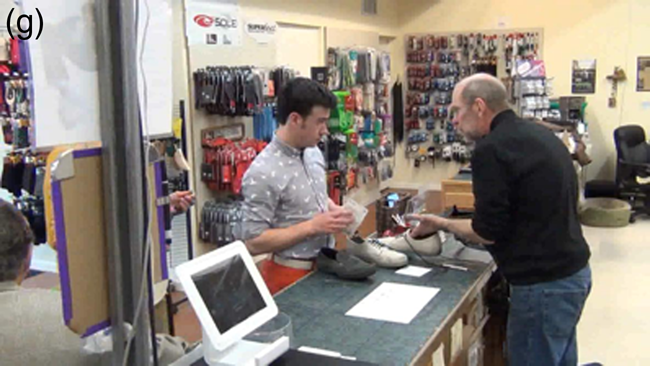
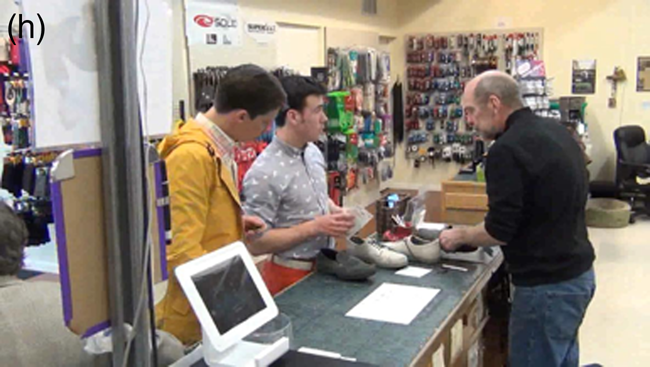
In a similar methodological vein, we begin our analysis by considering a collection of recordings made at a North American shoe-repair shop (Fox & Heinemann Reference Fox and Heinemann2015, Reference Fox and Heinemann2016, Reference Fox and Heinemann2017, Reference Fox and Heinemann2019) because, as an institution, it provides a relatively circumscribed, and thus ‘controlled’, context (in terms of participants’ identities, roles, goals, etc.) in which to begin our analysis (see Drew & Heritage Reference Drew, Heritage, Drew and Heritage1992).
The shop has been owned by a local family for roughly 100 years, and is primarily operated by the owner, his partner, and their adult daughter (along with several other staff). The shop will attempt to repair almost any leather item, most obviously shoes and boots, but also belts, jackets, baseball gloves, saddles, and so on. Customer interactions generally fall into two types: (i) dropping off of problematic items; and (ii) picking those items up, some days or weeks later. Most of the cases examined in the current study come from drop-off interactions. Because there is no suitable noun to refer to individual staff members, we use the invented term shoetender (à la ‘bartender’).
The method is conversation analysis (Sidnell & Stivers Reference Sidnell and Stivers2013), supplemented by distributional trends (Robinson Reference Robinson2007). Data were transcribed according to the standards of CA (Jefferson Reference Jefferson2004), with some additional figures and notation included to illustrate multimodal conduct (Mondada Reference Mondada, Sorjonen, Raevaara and Couper-Kuhlen2017).
Analysis
Shoe-shop corpus
Our claim is that the three want-related offer formats enact differing stances regarding speakers’ expectations that recipients will accept the offers. The fullest form, do you want…?, enacts a stance of lowest expectation, whereas the most minimal form, want…?, enacts a stance of highest expectation (for our purposes here) and is essentially a request for (re)confirmation of acceptance (vs. a solicitation of acceptance or rejection; for the distinction, see G. Raymond Reference Raymond2003). The intermediate form, you want…?, enacts a stance that the recipient is, on balance, more likely to accept the offer than not.
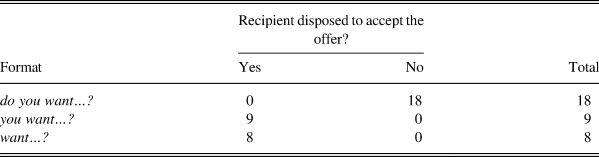
Initial quantitative evidence supports our claims (see Table 2). We categorized our thirty-five shoe-shop cases according to the contexts of their production—specifically, whether or not they are positioned in a context where there is demonstrable evidence (in prior talk and/or embodied conduct) that recipients are disposed toward accepting the offers. For instance, when shoetenders offer services that have never been mentioned, or even alluded to, by customers, and when customers’ items to be repaired are not visibly (at least to customers) in need of such services, there is no evidence that customers are specifically disposed toward or against accepting such services. Alternatively, certain customer actions, such as agreeing to the terms (e.g. the price) of services, display customers’ dispositions toward accepting offers to perform such services. As seen in Table 2, 100% of both the you want…? (9/9) and the want…? (8/8) formats are produced in contexts where there is some evidence that customers are disposed toward accepting offers. In contrast, 18/18 (100%) of the do you want…? formats are produced in contexts where there is no such evidence.
Distribution of shoe-shop cases by context of production.

The stark contrast in contexts of use between the do you want…? format, on the one hand, and the you want…? and want…? formats, on the other, offers robust preliminary evidence for our claims. We now turn to a qualitative examination of our data to further analyze the use of these three formats in context, beginning with the do you want…? format.
Do you want…?
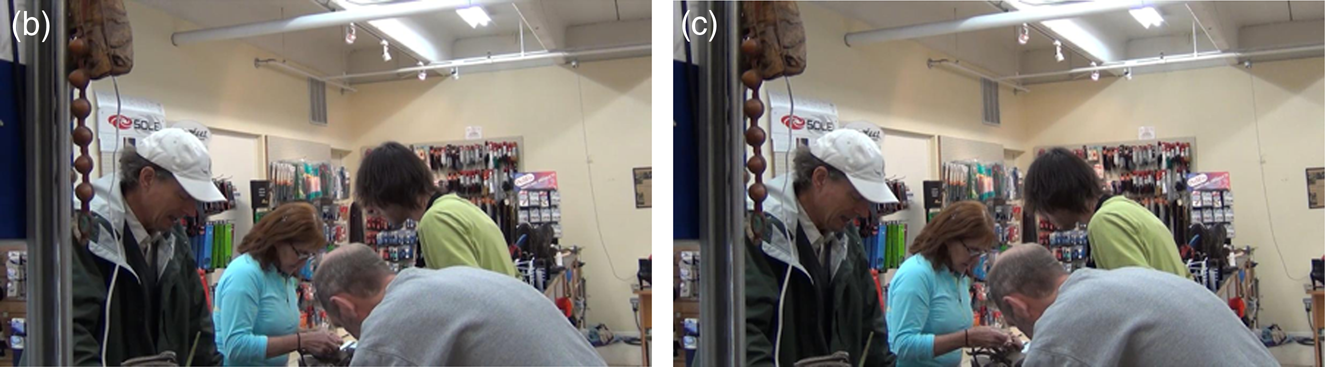
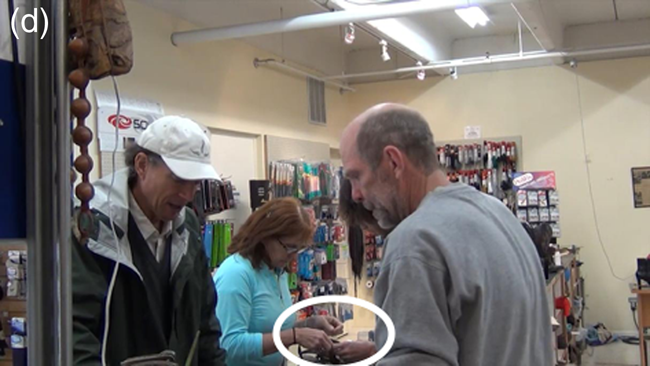
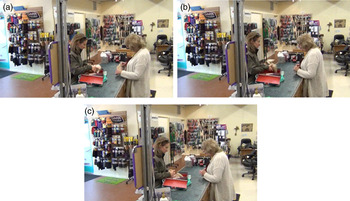
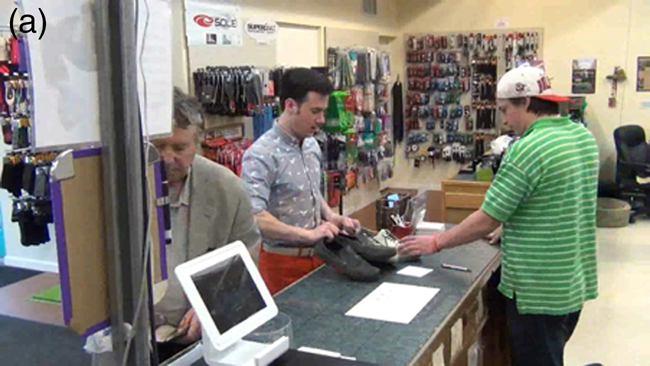
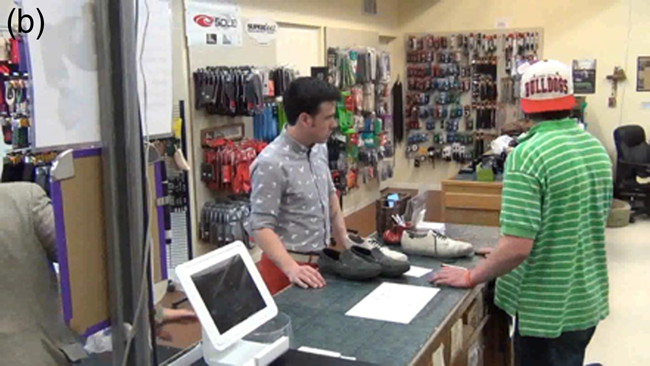
Extract (2) provides a first illustration of our claim that the do you want…? format enacts a relatively neutral stance regarding whether or not customers will accept an offer. Here, after a brief opening (lines 1–4), the customer (in the blue shirt) asks if the shop can sew back on a strap that has come off of her shoe: “I wanted to find out (1.2) if (you can) sew:- this back onto here” (lines 5–6). According to Levinson's (Reference Levinson2000) quantity heuristic (i.e. that speakers not provide statements that are informationally weaker than their knowledge of the world allows), the customer pragmatically implicates that—at least from her perspective at this point in the encounter—she only ‘wants’ or ‘needs’ the sewing service, and not additional services. However, after the shoetender (in the light green shirt) affirms, mm hm:, and visually inspects the shoe (lines 8–12; Figures 2a–2c), he offers an additional, distinct repair service that has not previously been mentioned: “do you want to replace these elastics as well?” (line 13). The shoetender's “as well” orients to ‘elastic’ services as being additional and distinct from the customer's request regarding ‘sewing’ services. In sum, while the customer might be inclined to defer to the expertise of the shoetender regarding the need for new ‘elastics’, this do you want…?-formatted offer is made in a context where the customer has previously displayed herself (lines 5–6) as being disposed only toward sewing services. Note that the occurrence of screenshot figures in transcripts is symbolized by a bold hashtag followed immediately by the figure's alphanumeric designation (e.g. #a).
(2) (Shoe Shop 10-13-2013)

Customer has placed shoe on the counter, shoetender inspects and grants request.

Participants continue to examine item.

Customer and shoetender inspect shoe, shoetender touches shoe.

In the silence at line 14, both customer and shoetender inspect the ‘elastics’: Figure 2d shows the shoetender's hand on the shoe. During this time, the customer is accountable for producing a response to the offer. When the shoetender goes on to justify the need for ‘elastics’—“they aren't really- (0.3) functioning as elastics anymore,” (line 15)—the shoetender orients to possible resistance by the customer to the offer, and thus to it as one that may not be accepted; this supports our argument that do you want…?-formatted offers embody a relatively neutral stance regarding their acceptability. Ultimately, the customer accepts the offer with “alright” (line 20).
For a second instance of the do you want…? format, consider extract (3). Here, the customer touches the heel of one of her shoes and requests: “just need one of these things.” (line 2). Similar to the customer in extract (2), the customer's request here pragmatically implicates, and thus enacts a disposition, that she needs one and only one shoe dowel (i.e. a type of heel), accentuated by the minimizer “just”. Shoetender 1 orients to this disposition when she asks shoetender 2 about the availability of a single (i.e. one) dowel: “do you have one of these dowels that you can just pop in there?” (line 12). In this context, shoetender 2's offer (which is made after inspecting the shoes’ heels, lines 23–24)—“do you wanna- (0.2) do ‘em both…” (line 25)—is misaligned with the customer's request for, and disposition toward wanting/needing, a single heel.
(3) (Shoe shop 12-6-2014, 134309) (10:03)

Customer brings one shoe out of the box, and then touches the problematic area.

S2 inspects first one shoe and then the other.

S2 holds both shoes next to each other.

Shoetender 2 orients to the customer's possible resistance to the offer in three ways. First, his turn-initial “well:,” (line 25) projects a forthcoming turn that will diverge in some way from the expectations for action established by the customer's prior conduct (Heritage Reference Heritage2015). Second, as we saw in extract (2), the shoetender accounts for his offer: “s:o they make sure they're the same height? and sound the same?” (lines 25–26). Third, the shoetender uses a turn-final or (“’r:”, line 26) to index epistemic uncertainty (Drake Reference Drake2015) and project an alternative course of action: “doesn't matter to you.” (line 28). This example again supports our argument that do you want…?-formatted offers embody a relatively neutral stance regarding their acceptability to the recipient. In this case, contrary to what we saw in extract (2), the customer ultimately refuses the offer (line 32).
To summarize, in both extracts (2) and (3), after examining—and applying their professional expertise toward—customers’ problems, shoetenders issue professionally justified offers that are in some way not aligned with customers’ displayed dispositions, implicated by their original requests for service. Both the contextual positioning of do you want…?-formatted offers, and shoetenders’ orientations to them as being possibly resisted, are evidence that these offers embody a relative neutral stance regarding their acceptability.
Want…?
In stark contrast to the do you want…? format, the maximally minimal of our three target formats, the want…? format, is used in shoe-shop contexts where customers have not merely tacitly evinced their dispositions toward accepting the offers, but have explicitly displayed their preparedness to do so. In extract (4), the customer's problem involves cleaning a pair of suede shoes, which he initially considers doing himself. After discussing appropriate cleaning products and methods with two shoetenders (data not shown here, but see extract (6) below), the customer ultimately expresses his worry that he might ruin his shoes if he cleans them himself: “is there any chance that I'm=‘na: ruin the shoes?” (line 64). The customer goes on to justify this worry with: “ca(h)use I don't trust myself much” (line 72). In doing so, the customer displays a revised disposition toward having the shoe-shop (vs. himself) do the cleaning. Both shoetenders orient to this disposition, the second one by supplying a price for the shoeshop's services: “well it's about- … eighteen to twenty two dollars a pair for us to do it.” (lines 75–80), and the first one by offering to clean the shoes: “well we- (0.7) we can do it,” (lines 76–78).
(4) (Shoe Shop 3-18-2015, 170700)

The action of supplying the price (lines 75–79) is sequentially preliminary (Tersaki Reference Tersaki and Lerner2004) to finalizing the service (i.e. of the shoe-shop cleaning the shoes) and makes relevant acceptance or rejection from the customer (Fox & Heinemann Reference Fox and Heinemann2017). The customer accepts the price, “okay,” (line 82), which sequentially constitutes a go-ahead (Schegloff Reference Schegloff2007) for the shoetender to finalize the service. It is in this context, where the customer has already virtually agreed to the service, that shoetender 2 offers: “want us to do it?” (line 84), which the customer accepts (line 86).
Extract (5) plays out in a similar way. As context, the customer is concerned about a pair of expensive shoes, which shoetender 2 diagnoses as needing to be completely re-soled (see lines 1 and 11).
(5) (Shoe Shop 1-18-2014, 123230e)

Shoetender shows the significant damage.

Shoetender announces price, extends turn, and then shows the material that would be used to resole the shoes.

Customer manually and visually inspects material.

Customer continues to inspect the shoes.

Customer leans out and appears to stop her inspection.

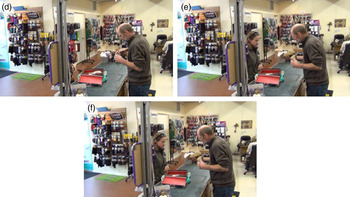
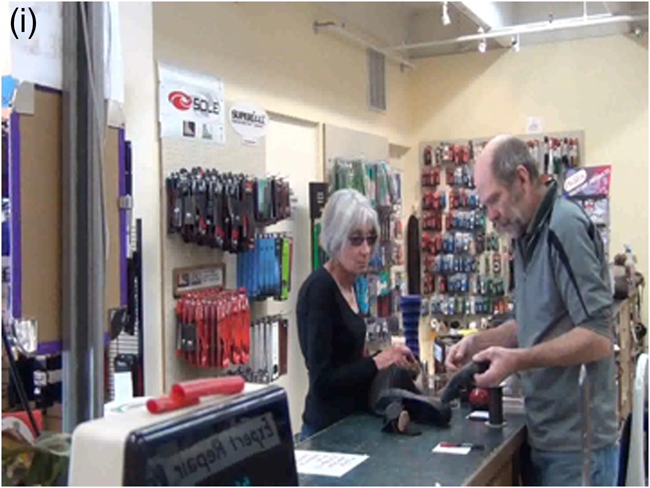
As in extract (4), here the shoetender's announcement of the price (lines 8–9)—which is completed while gazing at the customer, a practice which can mobilize recipiency (Figure 5c; Stivers & Rossano Reference Stivers and Rossano2010)—is preliminary to finalizing the service, and makes relevant acceptance or rejection from the customer (Fox & Heinemann Reference Fox and Heinemann2017). When the customer does not immediately produce a response (at line 10)—which can project possible rejection (Schegloff Reference Schegloff2007; Pomerantz & Heritage Reference Pomerantz and Heritage2013)—the shoetender pursues a response with an increment (line 11; Ford, Fox, & Thompson Reference Ford, Fox;, Thompson, Ford, Fox and Thompson2002; Schegloff Reference Schegloff2016), and then by informing the customer about the likely material to be used during the repair: “and we'd put somethin’ like this on.” (line 13). During the silence at line 14, the customer inspects the material both visually and manually (see Figure 5f), producing a low-volume: “°okay:,°” (line 15). Given that this follows the shoetender's informing (at line 13) regarding the material, and that the customer is still visually and manually inspecting the material (see Figure 5f), the customer's “okay” acknowledges and accepts the shoetender's informing (Beach Reference Beach1993). However, the customer is still accountable for accepting or rejecting the price of service (at lines 8–9), which she eventually does at line 28 when she leans back, ends her inspection of the material, and produces a prosodically heightened “↑yea:h” (see Figure 5i). As in extract (4) above, agreeing to the price serves as a go-ahead for the shoetender to finalize the service, and virtually agrees to the service. It is in this sequential environment, where the customer has very strongly indicated her disposition toward proceeding with the service, that the shoetender explicitly seeks the customer's acceptance with the maximally minimal form “>wanna do it?<” (line 30), which is enthusiastically accepted by the customer with “↓let's do it,” (line 32).
You want…?
At one end of the spectrum, extracts (2) and (3) above provide evidence that shoetenders’ offers of service can come in contexts in which there is no positive evidence (from talk or other conduct) that customers are disposed toward accepting such offers; these offers are designed with the do you want…? format. At the other end of the spectrum, extracts (4) and (5) above provide evidence that shoetenders’ offers can come in contexts in which there is clear and explicit evidence that customers are disposed toward accepting such offers; these offers are designed with the want…? format (recall Table 2). We predicted that in the shoe-shop context, the intermediate you want…? format would be used when customers have only tacitly or indirectly indicated that they are disposed toward accepting the offer, or when there is possible contradictory or conflicting evidence (e.g. alternative service options that are still under consideration). Indeed, this turns out to be the case: In such sequential environments, we argue that shoetenders infer that customers are possibly disposed toward agreeing to services, producing offers formatted with you want…?.
Consider extract (6), which is drawn from the same interaction as extract (4) above. Extract (6) provides especially powerful evidence for our claims because it involves the same shoetender implementing an alternative offer format (i.e. want in (4); you want in (6)) to the same customer as the customer's disposition toward services changes over the course of the interaction. The customer's initial service request—“I was wondering if y:ou guys had the supplies for me to just like clean them?” (lines 9–11)—explicitly indicates that he wants to clean his suede shoes himself. Although the customer shows himself to be open to the possibility of the shoe-repair shop doing the cleaning with “or if you::: guys had the:- way to do that?” (line 13)—which is oriented to by shoetender 1 with “yeah::- um (0.8) (well) we can do it, we can shampoo these, (0.4) in the back,” (lines 15–16)—both shoetenders ultimately pursue the goal of facilitating the customer's ability to clean the shoes himself. For example, shoetender 1 asks shoetender 2 if they “sell shampoo: cleaning stuff” (line 18), indicates the need for a brush (line 36), provides instructions on the cleaning method (line 40–41; see also shoetender 2's instructions at lines 56–58), and indicates the possible need for “desalter” (line 44), and shoetender 2 suggests a brand of shampoo called “foam te:x” (line 46 and 48).
(6) (Shoe Shop 3-18-2015) (00:20)

Customer places shoes on the counter.

Shoetender 1 turns to ask shoetender 2 if they sell cleaning stuff.

Shoetender 1 begins to walk to the back wall.

Shoetender 1 continues to walk to the back wall.

Shoetender 1 displays brush to customer.

Shoetender 2 inspects shoes.

Shoetender 2 suggests shampooing the shoes.

Customer acknowledges shoetender 2's suggestion.

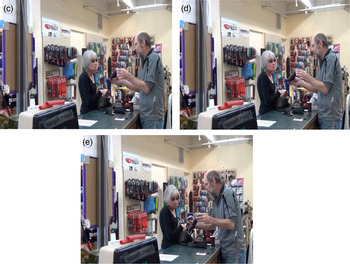
Up through line 60, the customer has displayed a disposition toward cleaning his shoes himself (vs. paying the shoeshop to clean them), and this disposition has been oriented to by the shoetenders through their assistance-so-far. However, across lines 18–60, the prospect of the customer cleaning his own shoes is arguably problematized by becoming increasingly complicated and costly given the required tools (shampoo, brush, desalter) and instructions on how to use them.Footnote 5 It is in this context that shoetender 2 asks: “you wanna do it yourself?” (line 62). In contrast to the do you want…? format, which we argue embodies the speaker's stance that they are relatively neutral or agnostic in terms of their expectation that the recipeint will accept, and in contrast to the want…? format, which we argue embodies the speaker's stance that they strongly expect that the recipient will accept, the intermediate you want…? format embodies the speaker's stance that the recipient is more likely than not to accept. This stance is fitted, or recipient-designed, to the the customer's previously displayed disposition toward cleaning his shoes himself, while acknowledging the potential shift in this disposition in light of the difficulties involved in completing the task on his own. And indeed, as we saw in extract (4) above, the customer ultimately does opt for the shop to do the cleaning for him.
We see a similar pattern in extract (7). Here the customer begins by tapping the top of the back area of a shoe and asking: “can you do anything about thi:s?” (line 1). The shoetender confirms, “yeah” (line 2), that the shop “can reline it,” (line 2)—that is, “put a new leather liner inside,” (line 4). As in extracts (2) and (3) above, the customer's request pragmatically implicates that he is disposed toward replacing the liner, and nothing more. After the shoetender briefly leaves the counter and returns, the customer inquires into the price: “how much would that go about,” (line 9).
(7) (Shoe Shop 10-13-2013)

Preliminary—and thus relevant—to providing the cost (i.e. technically as a presecond, insert-expansion sequence; Schegloff Reference Schegloff2007), the shoetender negatively assesses the shoes’ heels, “heels're kinda badly worn over,” (line 11), with which the customer softly agrees: “°yeah,°” (line 13). While this agreement might imply that he is prepared to agree to a service that would address the heels (including its cost), it does not explicitly endorse doing so. The shoetender orients to this lack of an on-record endorsement by pursuing the matter with: “can you live with that?” (line 15), to which the customer eventually responds with “.hh naw:,” (line 17). On the one hand, by disconfirming the shoetender's pursuing question, the customer's response constitutes a go-ahead, indicating his disposition to accept an offer to address the heels. On the other hand, though, the response is produced with various markers of dispreference, including a half-second delay and an audible in-breath; moreover, the disconfirmation interjection itself is produced quietly and with a relaxed articulation that lacks the rounding of a typical ‘no’. These features in the design of the response render the go-ahead in this case far more tentative than those seen in earlier examples. In sum, then, here the customer has implied (but not explicitly indicated) that he is disposed toward repairing the heels, but this disposition runs contrary to his original request (which pragmatically implicated replacing the shoe liners, and nothing more) and is indicated somewhat tentatively. It is in this context that the shoetender asks: “you wanna do heels too?” (line 18), which is precisely fitted to the customer's displayed disposition-so-far toward replacing the heels. Note also that with the addition of “too?” (line 18), the shoetender orients to ‘heels’ as being an extra or additional service that had not been originally requested.
So far, we have shown that our shoe-shop data strongly support our claim that the formatting choices involved in offers made by shoetenders are oriented towards the perceived strength of the customer's disposition to accept the offer, as shown by the customer's conduct up to that point. In the next section, we support our argument with evidence drawn from mundane and medical contexts.
Evidence from mundane and medical contexts
Do you want…?
Extract (8) is taken from a mundane phone call, during which Dina and Bea discuss an event they will be attending together with other friends. Prior to this extract, they have been discussing Margaret (referenced at lines 1–2), who is out of town for an unknown amount of time and thus will not be attending the event. At lines 4–5, Bea concludes that they will get together with Margaret “some other ti:me” (line 4), which Dina acknowledges with “ah hah::” (line 6). Our focus is on Bea's referential shift to a different, and previously unmentioned (in this call), woman named Viola who will be at the event (lines 7–9).
(8) (SBL 1:1:11R; modified orthography)

Bea's “Oh ↑SA:Y:” (line 7) serves as a disjunct marker (Jefferson Reference Jefferson and Schenkein1978:221–22), projecting a sudden remembering and a novel sequential and action trajectory (Heritage Reference Heritage, Atkinson and Heritage1984a). Bea continues to inform Dina that “Vio:la's coming.” (line 7), which orients to Dina as not having previously known this information (Thompson, Fox, & Couper-Kuhlen Reference Thompson, Fox; and Couper-Kuhlen2015:ch. 3). Similar to extracts (2) and (3) above, in a context where Dina has not evinced a disposition regarding her willingness to pick up Viola, Bea uses the do you want…? format—“do you want to pick her up?” (line 8)—which we argue embodies a neutral or agnostic stance regarding Dina's willingness to comply with the request. Bea orients to the possible delicacy (e.g. the face threat and dispreferred nature) of this request (and perhaps to Dina's possible resistance to it) by providing an account—“just to save car spa:ce?” (line 8)—just as we saw in the do you want…?-formatted examples in the shoe shop.
Want…?
In extract (9), taken from a medical consultation, as the physician begins to deliver her diagnosis—“I got good news and bad news for you.” (line 1)—the patient begins a protracted cough (lines 2, 4, 7–8, 10, 13), which is severe enough to render her temporarily unable to interact. Indeed, she coughs (lines 7–8) in lieu of responding to the physician's question from lines 5–6.
(9) (MC.18.01)

DOC gazes at sink and prepares to stand, gazes back at PAT.

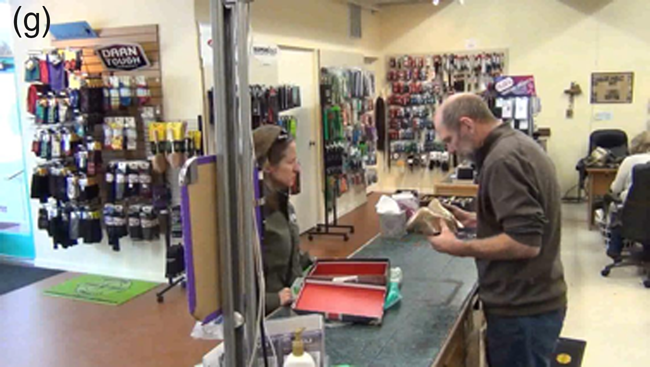
The patient's uncontrollable coughing displays a ‘need for help’ (Kendrick & Drew Reference Kendrick and Drew2016). At line 8 (Figure 9a), the physician bodily orients to the patient as needing, and as being strongly disposed toward accepting, a specific type of help: The physician shifts her gaze from the patient to the sink and prepares her body to stand up to get the patient a cup of water (e.g. by putting her hands on the seat of her chair to lift herself up). At line 9, prior to actually standing, the physician offers: “Want = me get you a cup of water?”. Although the patient declines the offer (lines 11–13), this extract demonstrates that recipients’ dispositions regarding their possible acceptance of offers are social facts (Durkheim Reference Durkheim, Lukes and Walls1982), and that the physician's want-formatted offer nonetheless embodies a stance that the patient is (and thus treats the patient as being) strongly disposed toward accepting the offer.
You want…?
In extract (10), teenaged Virginia has been lobbying her mother for a larger weekly allowance. At line 5, Mom articulates the following if-clause: “If I could see what you did with your money.”
(10) (Virginia; standardized orthography)

On the one hand, Mom's if-clause (line 5) may be a criticism of Virginia's financial squandering as opposed to a genuine solicitation of a condition under which she might be willing to entertain Virginia's request. On the other hand, taken as a genuine solicitation of a solution, Mom's if-clause is commonsensically satisfied by numerous arrangements, even though Mom does not specify any. Thus, Mom can be held accountable for evincing a disposition that she is conditionally willing to accept a delimited number of arrangements. One such arrangement is inferred and—likely sarcastically—offered by Virginia: “you want me to write you=a a- a little list, every week?” (lines 7–8). The you want…? format is tailored to a recipient (Mom) who is accountable for implying that she might (but only might) be willing to accept the offer it implements, which she indeed does in line 11.
Evidence from alternative offers
It sometimes happens that the same speaker produces one version of an offer followed by another version in immediate succession, using a different grammatical format for each. Such cases powerfully support our argument because the two different grammatical formats are normatively fitted to the recipient's displayed disposition toward accepting each action (recall also examples (4) and (6)).
In extract (11), taken from a pediatric medical consultation, the mom and the physician are discussing a chewable type of allergy medicine that the child might take. There is evidence that the mom and the child are somewhat disposed toward the child taking this medication: (i) In response to the physician's request for confirmation regarding the medication's efficacy (“and that was: very helpful,”; line 2), Mom provides confirmation, but one that is downgraded and hedged (“.hh uhm: I think it's pretty helpful:_”; line 4), and the child confirms by nodding (line 5); and (ii) In response to Mom's request for confirmation that the child has ‘some’ prior experience with the medicine (“you've taken it some huh.”; line 6), the child confirms with “mm hm,” (line 7). In line with our argument, the physician infers from this prior conduct that the recipients are somewhat disposed toward accepting an offer of a new prescription of the previously used chewable version of the medicine. He thus constructs his offer with the you want…?-format, thereby embodying a stance that the recipients are more likely than not to accept the offer: “you wanna try: an- use that again:?” (line 8).
(11) (No Affect)

Immediately following his you want…?-formatted offer (line 8), and before the mom or child respond, the physician launches an alternative offer of a different, swallowable version of the same medicine: “or do you want…the swallowable ones” (lines 9–12). As seen in prior cases, the physician displays his orientation to the novelty of this subsequent offer by accounting for it—“cuz you're eleven now” (line 9)—and doing so before he actually completes the offer (i.e. he cuts himself off to insert the account). As this medicine is wholly new to this patient, and this is the first time that this swallowable version has been mentioned in this visit, the mom and child have not yet displayed a disposition toward accepting it. In line with our argument, the physician constructs this offer with the do you want…? format, embodying a stance that he is neutral or agnostic regarding the liklihood that it will be accepted. Our analysis is supported by the fact that the physician alters the formatting of his offers as his stance changes in accordance with the participants’ displayed dispositions toward accepting what is being offered.
Evidence from flouting the practice
We have argued for a normative relationship between morphosyntactic minimality and the action-initiator's stance, from relatively weak to strong, regarding their expectation that the offer or request will be accepted or complied with. This claim does not, however, amount to a statement of invariance (see e.g. Heritage, Raymond, & Drew Reference Heritage, Raymond; and Drew2019). We conclude with an example of the most minimal want…? format that may initially appear to reject our argument, but ultimately supports it by demonstrating that this grammatical format is a social practice that can be flouted to achieve a particular interactional effect—in this case, a tease.
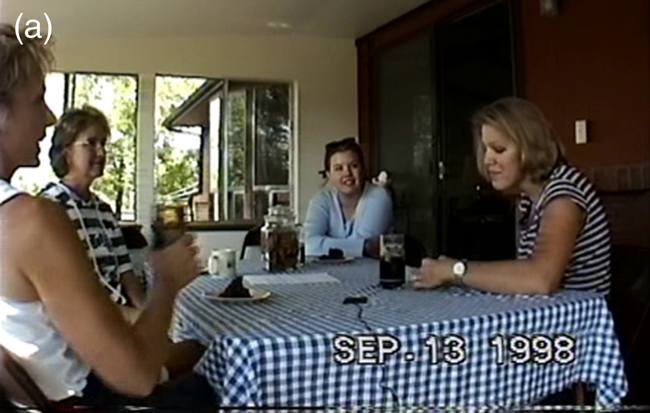
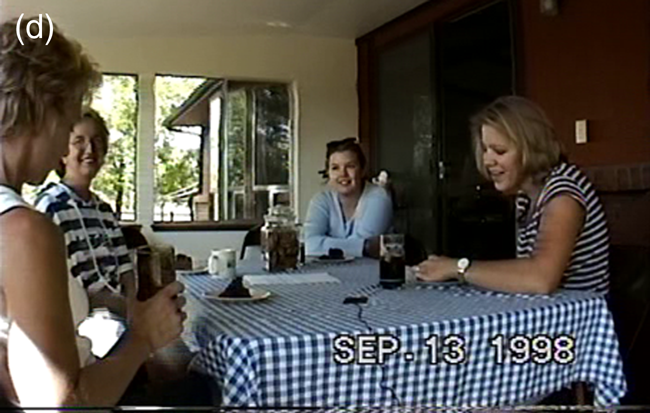
Extract (12) takes place at the home of Laura and her mom, and includes two of their friends, Donna and Michelle. Prior to this extract, Donna, who walked to this event, implies that she felt rushed doing so. At lines 1–3, she asserts: “I just don't like being rushed ‘cause I like enjo:ying (0.3) my walks and runs and stuff”. And at line 5, she asserts her intention to have a ‘relaxing’ walk home: “A:nd (ah) the way home I will,”. In doing so, Donna displays a disposition that she would not be receptive to a ride home, which is what Laura jokingly offers at line 8: “want me give you a ride home?”. Laura uses the want…? format, which we have shown is normatively deployed in contexts where addressees have explicitly displayed dispositions toward accepting offers. Here, Laura reflexively uses the want…? format to implement a tease, as opposed to a genuine offer.
(12) (Farmhouse)

Laura's slight smile.

Mom begins to smile.

Mom's teeth begin to show.

Corners of Laura's mouth turn up.

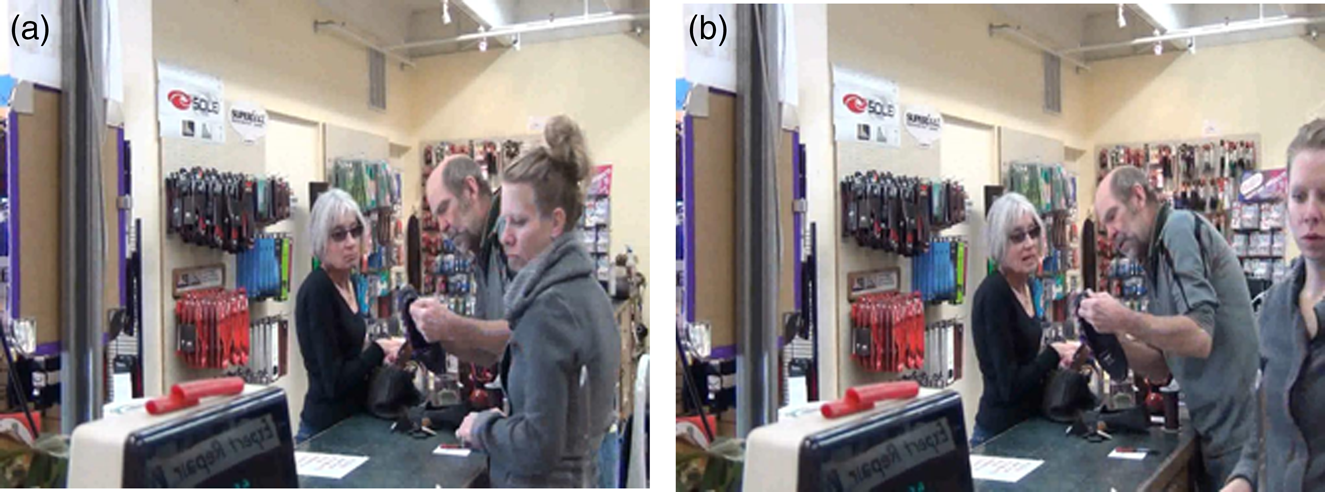
There are at least three related pieces of evidence that Laura's offer (at line 8) implements a tease. First, Laura produces her offer while gazing down at the table, as opposed to gazing at her addressee, Donna. Furthermore, just prior to Donna completing her response—“nope.” (line 11)—Laura begins to smile (i.e. at line 13, the corners of her mouth begin to turn up (Figure 12d), although she does not produce a full smile until line 15). In sum, Laura's offer is produced ‘coyly’.
Second, upon completion of Laura's offer, Mom simultaneously begins to smile and shift her gaze toward Donna; Mom's smile widens as she turns her head, with her teeth visibly showing after the “no-” of Donna's “nope” (see line 12 and Figure 12c). Thus, Mom's smile independently treats Laura's offer as being nonserious.
Third, in response to Laura's offer, Donna produces a relatively quick: “nope.” (line 11). As G. Raymond (Reference Raymond2000) has argued, in contrast with other type-conforming, dispreferred responses (e.g. no, uh-uh), nope is a designed-to-be-complete response, projecting no elaboration (i.e. no turn expansion). Along these lines, Donna's “nope.” is produced with falling intonation such that it comprises the entirety of her turn, which is followed by a 0.3-second silence. Especially as a response to an offer, nope differs from many other forms of dispreferred response, which are normally accompanied by accounts (Heritage Reference Heritage1984b:269–73; Ford Reference Ford, Bybee and Noonan2001). In sum, Donna's “nope.” treats her rejection as needing no account, treats Laura's offer as not making an account relevant, and thus treats Laura's offer as something other than a genuine offer. We argue that Laura has used a form that treats Donna as having displayed a strong disposition to accept her offer, even though it is clear that Donna has not displayed such a disposition; it is Laura's flouting of the normative use of the want…?-format that, in part, constructs this offer as being nongenuine and nonserious.
Discussion
Grammatical parasitism
In this article, we argue that: (i) there is cline of morphosyntactic minimality in question design, as opposed to a simple binary distinction between declarative and interrogative; and (ii) at least with regard to offers and requests formatted with do you want…?, you want…?, and want…?, this cline indexes or enacts the speaker's stance, from relatively weak to strong, regarding their expectation that the action will be accepted or complied with. The question remains, though, why these two clines—one relating to grammatical form and the other to an expectation regarding acceptance—should map onto each other in the first place. What is the interactional logic by which these particular grammatical practices can be deployed in the service of modulating action?
One explanation involves what we call grammatical parasitism. As research in conversation analysis has shown, the principle of adjacency holds that any next turn-at-talk in interaction is normally accountable as being addressed to (e.g. responsive to, targeting) the immediately preceding (i.e. adjacent) turn of talk and, more specifically, the immediately preceding unit of talk (Robinson Reference Robinson2014). Evidence for this accountability is found in the fact that interactants have specific practices for disrupting the principle of adjacency by projecting that what comes next will be ‘independent’ of prior talk. Schegloff & Sacks (Reference Schegloff and Sacks1973) referred to these practices as turn-initial misplacement markers (e.g. by the way, so, hey, look, first of all; Schegloff & Sacks Reference Schegloff and Sacks1973:319; for review, see Bolden Reference Bolden and Sidnell2009). Misplacement markers essentially disrupt the normal parasitism of next turns on prior turns.
Even without using misplacement markers, though, interactants have a range of grammatical practices for claiming that their next turns are less (vs. more) parasitic on prior talk. For example: (i) Relative to Speaker A's use of a locally initial reference form (e.g. Betty), a next speaker B's re-use of the same full-noun phrase Betty marks their talk as less dependent on that of Speaker A compared to the locally subsequent pronomial form she (Hopper & Thompson Reference Hopper and Thompson1984; Fox Reference Fox1987; Levinson Reference Levinson, Verschueren and Papi1987, Reference Levinson, Enfield and Stivers2007; Schegloff Reference Schegloff, Ochs, Schegloff and Thompson1996; C. Raymond, Clift, & Heritage Reference Raymond, Clift and Heritage2020); (ii) Relative to Speaker A's polar question (e.g. are you going to the movie?), Speaker B's repetitional answer (e.g. I am) marks it as less dependent on Speaker A's talk than an interjectional answer (e.g. yeah) (G. Raymond Reference Raymond2003; Heritage & G. Raymond Reference Heritage, Raymond and de Ruiter2012; Enfield et al. Reference Enfield, Stivers, Brown, Englert, Harjunpää, Hayashi, Heinemann, Hoymann, Keisanen, Rauniomaa, Raymond, Rossano, Yoon, Zwitserlood and Levinson2019); (iii) Relative to Speaker A's assessment, informing, or question-word interrogative, Speaker B's clausal response marks it as less dependent on Speaker A's talk than an interjectional response (e.g. Heritage & G. Raymond Reference Heritage and Raymond2005; G. Raymond & Heritage Reference Raymond and Heritage2006; Thompson, Fox, & Couper-Kuhlen Reference Thompson, Fox; and Couper-Kuhlen2015). Across these (and other) practices, what we find is that more minimal or parasitic grammatical forms—variously labeled in the literature as ‘less full’ or ‘noninitial’ forms—accomplish a stronger sense of dependency on prior talk. Furthermore—at least in the aforementioned research—the more parasitic grammatical forms that claim more dependency on Speaker A's prior talk also claim that Speaker A has a relatively high degree of agency over the terms and conditions set out in their talk/action, while less parasitic forms are more agentive in this respect (see Thompson, Fox, & Couper-Kuhlen Reference Thompson, Fox; and Couper-Kuhlen2015; C. Raymond, Clift, & Heritage Reference Raymond, Clift and Heritage2020).
One explanation for our findings involves the aforementioned patterns of parasitism. The grammatical form for offering or requesting that is least parasitic on prior talk, do you want…?, is used when recipients have not previously displayed a disposition (in their verbal or embodied conduct) toward accepting or complying; this form marks the offer or request as being relatively independent of the recipient's disposition toward acceptance based on their prior talk and activity. Alternatively, the slighly more parasitic form, you want…?, is used when recipients’ ‘on-balance’ dispositions toward accepting or complying can be inferred from prior talk and other conduct (but have not been made clear or explicit); this form, relative to do you want…?, marks the offer or request as being somewhat more dependent on the recipient's disposition toward acceptance based on their prior talk and activity. The maximally parasitic form that we target here, want…?, is used when recipients’ dispositions toward acceptance are explicitly and clearly available from prior talk and other conduct, and marks the offer or request as being extremely dependent on the recipient's publically displayed disposition toward acceptance based on their prior talk and activity. Thus, the grammar of the action embodies an orientation to its level of dependency on the recipient's disposition toward acceptance displayed in prior courses of action and activity. Moreover, as in the previously cited literature on other grammatical practices, the less parasitic forms are also more agentive in that they launch new trajectories of action, whereas the more parasitic forms are less agentive in that they continue a line of action to which the recipient has already shown themselves to be (somewhat) disposed to comply with.
At a more general level, prior research has shown that alterations of a turn's morphosyntactic design can transform the action being implemented, as when a request for information is transformed into a request for confirmation or vice-versa (recall example (1)) (G. Raymond Reference Raymond, Freed and Ehrlich2010; Heritage Reference Heritage2012c). Our findings suggest that morphosyntactic alterations can also operate within a single action type by modulating its stance. For example, while the action of offering or requesting is not fundamentally altered, the stance it embodies regarding speakers’ expectations of recipients’ acceptance or compliance is modulated. Our findings are a further reminder that binary distinctions—such as that between interrogative and directive—often do a disservice to the analysis of action and the more granular practices of its implementation (Heritage Reference Heritage2012a; Fox & Heinemann Reference Fox and Heinemann2017).
Implications for future research
Our findings have at least five implications for future research, especially that involving the relationship between grammar and action formation/ascription in interaction. First, our findings confirm that, as noted by Searle (Reference Searle, Cole and Morgan1975), based on intuitions, there is no close correlation between the traditional grammatical classification into three ‘sentence types’ (declarative, interrogative, and imperative; Sadock & Zwicky Reference Sadock, Zwicky and Shopen1985) and the jobs that grammatical formats in everyday interactions are used by speakers to do.
Second, our findings show that language users are keenly sensitive to the statistical behavior of specific lexical items within general constructional patterns (Bybee Reference Bybee2006, Reference Bybee2010:ch. 5). As we collected data for this study, we intended to report on the interactional uses of do you [verb]…? vs. you [verb]…? vs. [verb]…?. However, as we examined subcollections of different verbs, it became clear that the grammatical options for various verbs, as well as their interactional uses, exhibited considerable variation. We therefore elected to focus, in this article, on the specific verb want, which seemed to be the most frequent in our collection, is strongly grammaticalized in the two more minimal formats, and is used to accomplish familiar and well-studied offers and requests (Curl Reference Curl2006; Curl & Drew Reference Curl and Drew2008; Fox & Heinemann Reference Fox and Heinemann2016).
As a brief example of the sort of variation that exists among the different verbs in our broader collection, consider the verb remember, which is typically used in presequence actions (e.g. pre-announcements, pretellings), and as an evidential method to defend against challenges, objections, and other dispreferred forms of uptake (Bolden & Mandelbaum Reference Bolden and Mandelbaum2017). Compared to constructions involving the verb want, those involving remember tend to occur in different sequential contexts and get used to implement different actions. Furthermore, the grammatical options associated with each verb are distinct. For instance, the do you remember…? format rarely takes a clausal complement, and the more minimal (re)member…? format typically occurs without any complement, not even a noun phrase (Tao Reference Tao2003). This contrasts with offers and requests implemented by the verb want, where a clausal complement is by far the most common, and where unexpressed complements are, in our data at least, nonexistent. Moreover, even if turn formats with the verbs remember and want can be argued to have certain common properties, they cannot be generalized to all verbs, or even to all verbs that take complement clauses (i.e. ‘complement-taking predicates’; Thompson Reference Thompson2002). Thus, whatever the right formulation of the generalization is, it must be specific to a very small set of verbs. This finding of lexical specificity, while widely accepted in usage-based studies of language (e.g. Nicita Reference Nicita2002; Scheibmann 2002; Bybee Reference Bybee2006, Reference Bybee2010), is new to the CA/IL literature and is thus a contribution of our study.
Third, if we are correct that do you want…?, you want…?, and want…? formats convey a stance of increasing expectation for acceptance or compliance, then these formats should differentially affect preference organization. For example, a rejection of an offer formatted with want…? would disalign with its stance of expectation for acceptance more than would the same rejection of the same offer formatted with do you want…?. Preference organization (Pomerantz & Heritage Reference Pomerantz and Heritage2013) predicts that such increased disalignment would affect how the rejection is formatted, for example, by being more delayed and by being accompanied by more prebeginning behaviors (e.g. breathing, uhm), eyeball shifting (Kendrick & Holler Reference Kendrick and Holler2017), accounting, and so on. The present qualitative study cannot verify this prediction, but there is some support for it by Robinson (Reference Robinson2020) with regard to positively formatted polar interrogatives and their stance of expecatation for affirmation (see also Kendrick & Holler's Reference Kendrick and Holler2017 findings regarding interrogatives vs. declaratives).
Fourth, in examining two types of requests in the shoe-repair shop data (i.e. can you X and wonder X), Fox & Heinemann (Reference Fox and Heinemann2017:31) argued that ‘variations in the X component in these requests are associated with variations in the unfolding development of the request sequences’. Applying this thinking to the present study, we propose that whether the verb want is preceded by do you, just you, or nothing shapes the nature of the action being implemented. Moreover, our few instances of (do (you)) want + [NP] (e.g. (do (you)) want the bag?) seem to be differently organized interactionally than the cases of (do (you)) want + [clause]), on which we have focused here. While these cases deserve further investigation, what we know about them so far suggests that the X component in this case, as in Fox & Heinemann (Reference Fox and Heinemann2017), is significant to the action implemented, and the practices used to implement it; we excluded these cases from the present study for these very reasons, but their future exploration is certainly necessary.
Fifth and finally, it bears mention that the particular stance we have described here appears to be neither purely epistemic nor purely deontic in nature, at least as generally characterized. Following Heritage (Reference Heritage2012b,Reference Heritagec), we understand epistemic stance to refer to displays of being more or less knowing with regard to something like propositional knowledge (e.g. whether a grandchild is ‘rascally’ or not; G. Raymond & Heritage Reference Raymond and Heritage2006), and deontic stance to refer to claims to have more or less social-structural right (or legitimate power or authority) to determine another's actions (Stevanovic Reference Stevanovic2013). In our data, the stance displayed involves speakers’ estimations of recipients’ dispositions toward acceptance or compliance, which seems neither entirely epistemic or deontic. Future research must determine if a ‘stance of expectation for acceptance’—which has been registered in prior research (e.g. a stance of expectation for affirmation; Heritage & C. Raymond Reference Heritage and Raymond2020; Robinson Reference Robinson2020) and alluded to in prior work on offers and requests—is a distinct type of stance. In sum, we hope to have made a compelling argument for the complexity of morphosyntactic forms and their relevance for formulating stances and actions.