Introduction
Petractis, as currently understood, is a small genus of calcicolous lichens with endolithic or pseudoendolithic thalli, pale, immersed apothecia, septate to muriform ascospores, and with Trentepohlia or Scytonema as photobiont. Vězda (Reference Vězda1965) accepted five species, four of them newly transferred by him from Gyalecta. In addition to these, Clauzade & Roux (Reference Clauzade and Roux1985) also accepted P. crozalsii (B. de Lesd.) Clauz. & Cl. Roux. Owing to uncertainties in the circumscription of the genus, it is not possible to give precise morphological distinctions from other genera of gyalectoid lichens at present.
Kauff & Lutzoni (Reference Kauff and Lutzoni2002) used the SSU and LSU ribosomal RNA genes to investigate the phylogenetic relationships of Gyalectales and Ostropales. Analyses confirmed the close relationship of the Gyalectales with ostropalean and graphidalean fungi, but four monophyletic entities were distinguished: 1, a clade with Gyalecta, Petractis hypoleuca (Ach.) Vězda and P. thelotrematella (Bagl.) Vězda; 2, a Coenogonium clade (including the former Dimerella, now treated as a synonym of Coenogonium); 3, a Graphidaceae-Thelotremataceae clade (Diploschistes, Chroodiscus, Phaeographina and Graphina) and 4, a Trapeliaceae clade. Petractis hypoleuca and P. thelotrematella were united with the genus Gyalecta within the Gyalectaceae. The relationships of several taxa, including Petractis clausa (Hoffm.) Krempelh. (the type of the genus) and P. luetkemuelleri (Zahlbr.) Vězda remained unresolved. Because of the close relationships between the taxa, the authors recommended that Gyalectales and Ostropales should be combined, under the latter name.
Lumbsch et al. (Reference Lumbsch, Schmitt, Palice, Wiklund, Ekman and Wedin2004), using nuclear LSU and mitochondrial SSU ribosomal DNA sequences to investigate supraordinal phylogenetic relationships in Lecanoromycetes, distinguished a Gyalectales + Ostropales + Graphidales clade as sister to the remainder of Lecanoromycetes. The Gyalectales were paraphyletic in the analysis, but the monophyly of this order could not be rejected with the data set used. The authors suggested that more data were needed before the relationship of the orders within this group could be resolved. They noted that the results of Kauff & Lutzoni (Reference Kauff and Lutzoni2002) could support a more traditional view (the three orders remaining separate) if Petractis clausa, P. luetkmuelleri and Ocellularia (their relationships shown with low support in the trees of Kauff & Lutzoni) were treated as belonging to Gyalectales. Wedin et al. (2005) using combined nuclear LSU rDNA and mitochondrial SSU rDNA sequences, found Ostropales (s. str., represented by Absconditella, Conotrema, Neobelonia and Stictis) to be sister to a Gyalectales + Graphidales clade; Graphidales was nested within Gyalectales, but the monophyly of Gyalectales could not be rejected.
In 2006, a specimen of an unidentified Petractis species was collected on the coast of South Wales. In 2008 more abundant material was collected from a second site 7 km distant from the first; this enabled a better assessment of the morphological features of the taxon, and the extraction of DNA for sequencing. The species is described here as new.
Materials and Methods
Sections were cut by hand and examined in water, 5% KOH, and a 0·5% IKI solution (I2 0·5 g, KI 1 g, water 100 ml). Some sections were decalcified in c. 5% HCl before examination. Conidia were cleared in Lugol's Iodine. Indian Ink was used to detect gelatinous ascospore sheaths.
DNA was extracted from thallus tissue of freshly collected specimens, using the Qiagen DNeasy Plant Mini Kit; the manufacturer's instructions were followed except that warm water was used for the final elution. PCR amplification was carried out using PuReTaq Ready-To-Go PCR Beads (Amersham Biosciences). For one specimen, the nuclear small subunit ribosomal DNA (SSU), the two internal transcribed spacer regions and the 5.8S region (ITS1-5.8S-ITS2), and the 5′ end of the nuclear large subunit ribosomal DNA (LSU) were amplified, and in a second specimen only the ITS-5.8S-ITS2 region was amplified. The following primers were used: nssu97A, nssu1088R (Kauff & Lutzoni Reference Kauff and Lutzoni2002), NS24 (Gargas & Taylor Reference Gargas and Taylor1992), ITS1F (Gardes & Bruns Reference Gardes and Bruns1993), LR3, LR7 (Vilgalys & Hester Reference Vilgalys and Hester1990) and nu-LSU-155-5′ (Döring et al. Reference Döring, Clerc, Grube and Wedin2000). The PCR thermal cycling parameters were: initial denaturation for 5 min at 94°C, followed by 5 cycles of 30 s at 94°C, 30 s at 55°C, and 1 min at 72°C, then 30 cycles of 30 s at 94°C, 30 s at 52°C and 1 min at 72°C. PCR products were visualized on agarose gels stained with ethidium bromide, and purified using the Sigma GenElute PCR Clean-Up Kit. Sequencing was performed by The Sequencing Service (College of Life Sciences, University of Dundee, www.dnaseq.co.uk) using Applied Biosystems Big-Dye Ver 3.1 chemistry on an Applied Biosystems model 3730 automated capillary DNA sequencer.
Sequences were assembled and edited using DNAstar Lasergene software (http://www.dnastar.com/products/lasergene.php). Alignment was carried out using BioEdit (http://www.mbio.ncsu.edu/BioEdit/bioedit.html); ClustalW was used to create an initial alignment, which was edited manually. Insertions and ambiguously aligned regions (identified “by eye”) were excluded from the analysis.
Sequences for members of Ostropales sensu lato, Baeomycetales and two outgroup sequences, used in phylogenetic analyses by Kauff & Lutzoni (Reference Kauff and Lutzoni2002), were downloaded from GenBank (Table 1) and aligned with the newly obtained nuclear SSU rDNA and nuclear LSU rDNA sequences. The sequences were analysed in two sets: 1, taxa for which both SSU and LSU sequences were available and 2, taxa for which only the LSU was available. SSU and LSU sequences were concatenated before analysis. The ITS1-5.8S-ITS2 regions (available only for two newly prepared sequences) were excluded from the analyses. Phylogenetic relationships and support values were investigated using a Bayesian approach. Additional support values were obtained using Maximum Parsimony bootstrapping. The Bayesian analysis employed the GTR+I+G model, selected using the Akaike Information Criterion (AIC) in MrModeltest 2.2 (Nylander Reference Nylander2004). Using MrBayes 3.1.2 (Huelsenbeck & Ronquist Reference Huelsenbeck and Ronquist2005), two analyses of two parellel runs were carried out for 100 000 generations (SSU + LSU data set) or 5 000 000 generations (LSU data set), with trees sampled every 100 generations. Stationarity was considered to have been reached when the average standard deviation of split frequencies dropped to <0·01, and the values for the Potential Scale Reduction Factor were close to 1. A burnin sample of 250 and 12 500 trees were discarded from each run, respectively. Maximum Parsimony bootstrapping was carried out using MEGA version 4.0 (Tamura et al. Reference Tamura, Dudley, Nei and Kumar2007). The Maximum Parsimony tree was obtained using the Close-Neighbour-Interchange (CNI) algorithm, in which the initial trees were obtained with the random addition of sequences (10 replicates). The bootstrap consensus tree was inferred from 2000 bootstrap replicates. Gaps were treated as missing data. Support values of ≥95% posterior probabilities and ≥70% MP bootstrapping were regarded as significant.
Results and Discussion
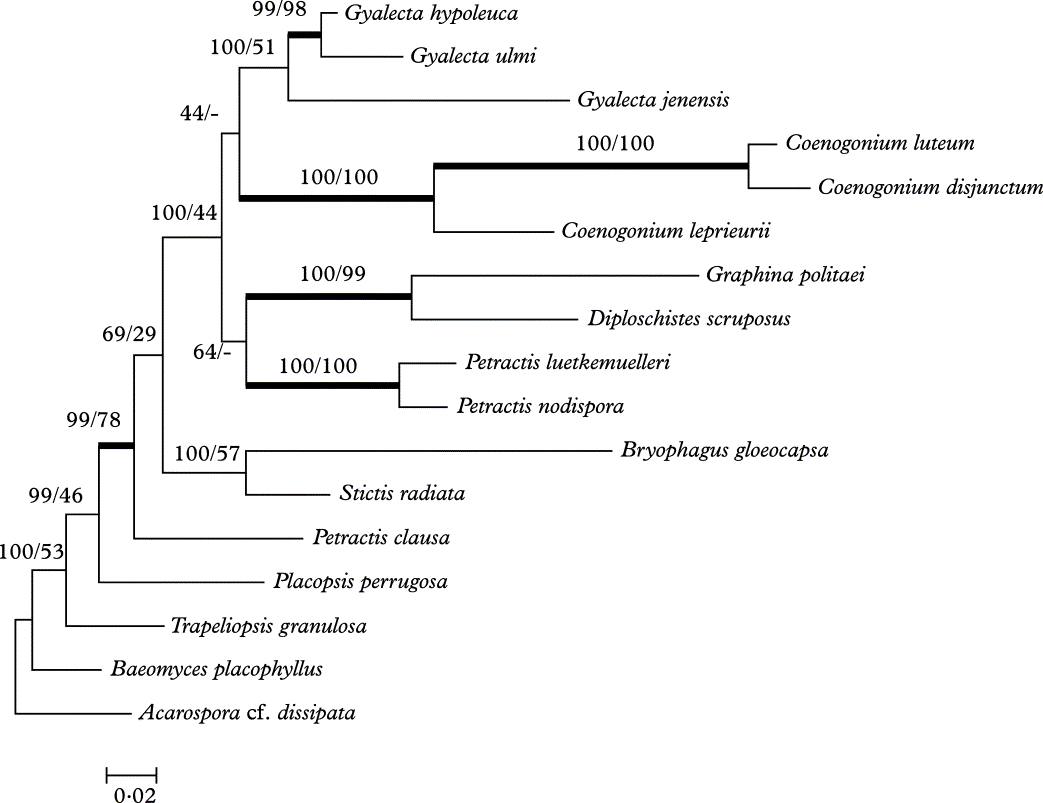
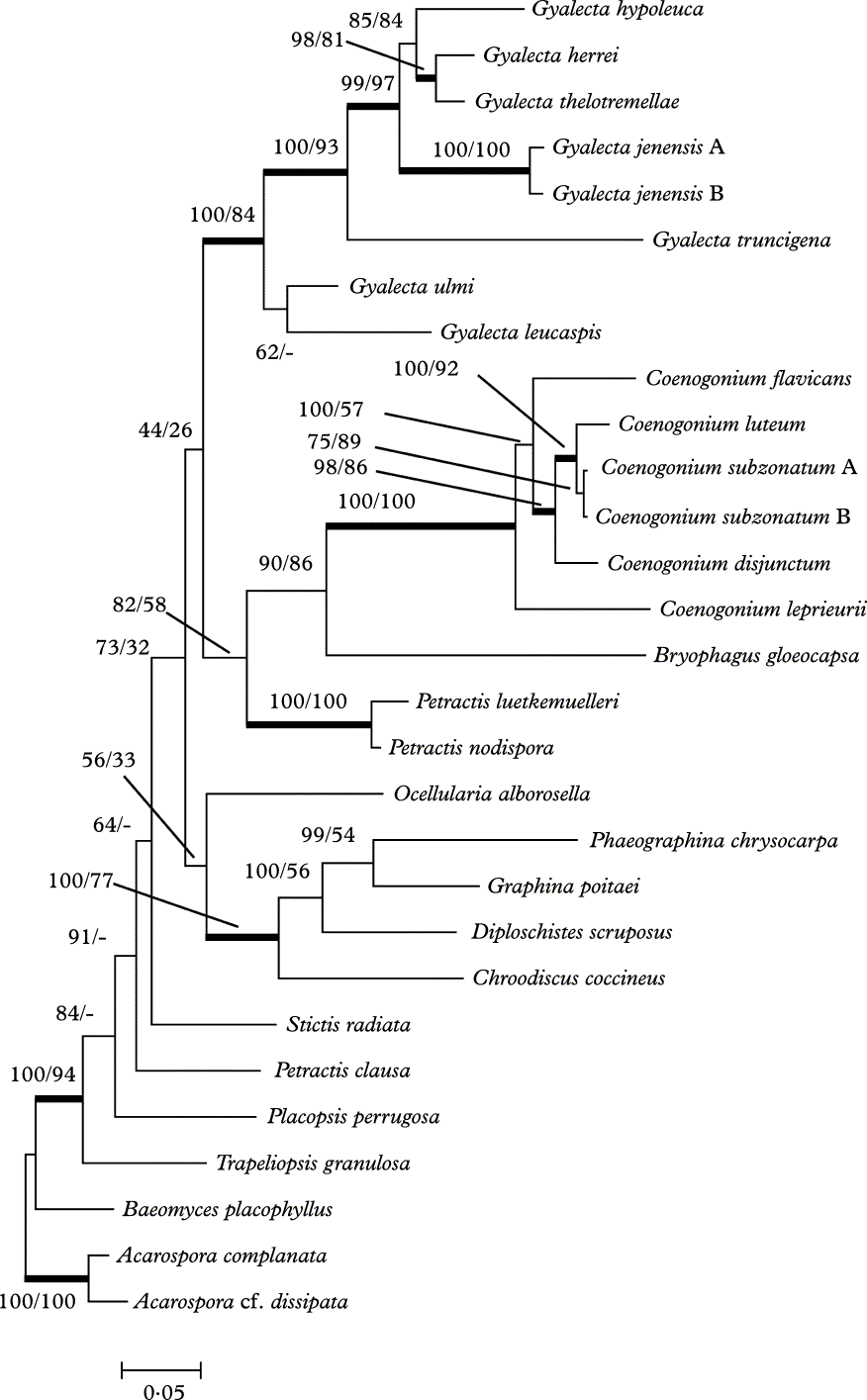
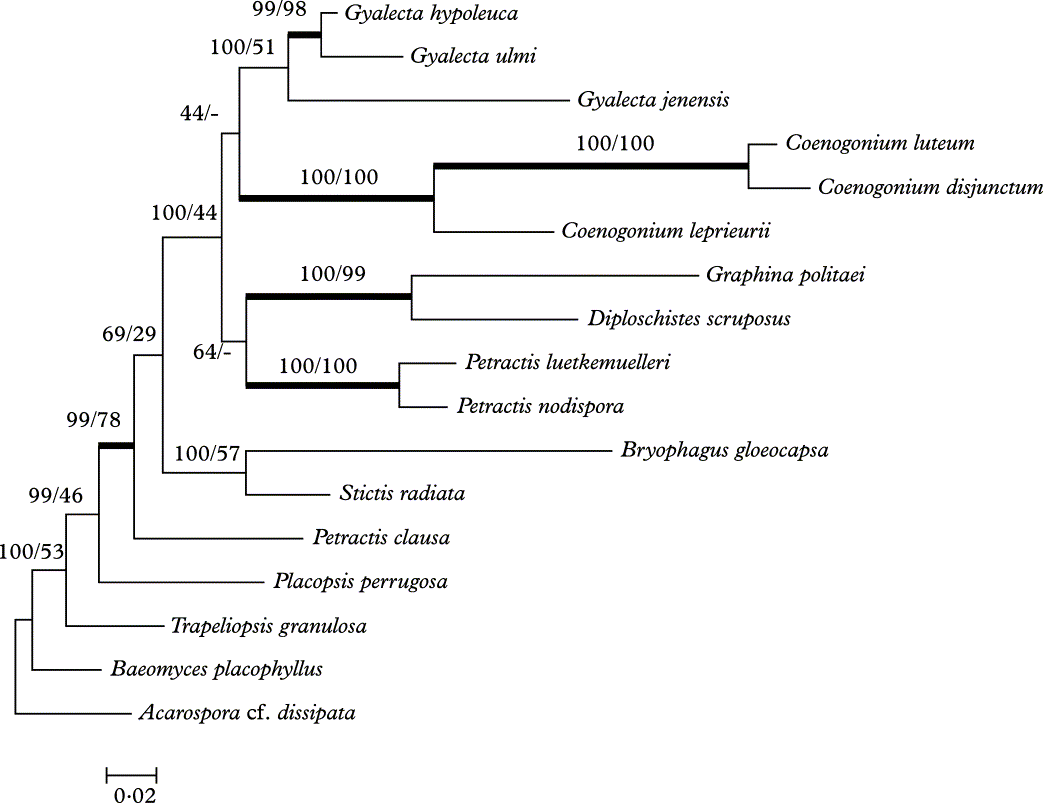
After exclusion of ambiguously aligned regions, the alignment of dataset 1 (SSU + LSU) contained 350 parsimony-informative characters. The tree resulting from the Bayesian analysis is shown in Fig. 1. After exclusion of ambiguously aligned regions and insertions, the alignment of dataset 2 (LSU only) contained 262 parsimony-informative characters. The tree resulting from the Bayesian analysis is shown in Fig. 2. In both trees, three well-supported clades were recovered: 1, a clade containing only Gyalecta species (but with only 57% MPb support in Fig. 1), including two species previously placed in Petractis by Vězda (Reference Vězda1965) (G. hypoleuca and G. thelotremella); 2, a Coenogonium clade; 3, a clade with Chroococcus, Diploschistes, Graphina and Phaeographina.
Phylogenetic relationships among 13 species of Ostropales s. lat. and 3 species of Baeomycetales, based on a Bayesian analysis of combined nuclear SSU and LSU sequences. The tree was rooted using a species of Acarospora (Acarosporomycetidae). The two support values associated with each branch are posterior probabilities and maximum parsimony bootstrap values, respectively. Branches in bold indicate a support of PP ≥95% and MPb ≥70%. If a node of the Bayesian tree was not recovered by MP bootstrapping, the MPb value is replaced by a dash.
Phylogenetic relationships among 22 species of Ostropales s. lat. (represented by 24 specimens) and 4 species of Baeomycetales, based on a Bayesian analysis of nuclear LSU sequences. The tree was rooted using two species of Acarospora (Acarosporomycetidae). The two support values associated with each branch are posterior probabilities and maximum parsimony bootstrap values, respectively. Branches in bold indicate a support of PP ≥95% and MPb ≥70%. If a node of the Bayesian tree was not recovered by MP bootstrapping, the MPb value is replaced by a dash.
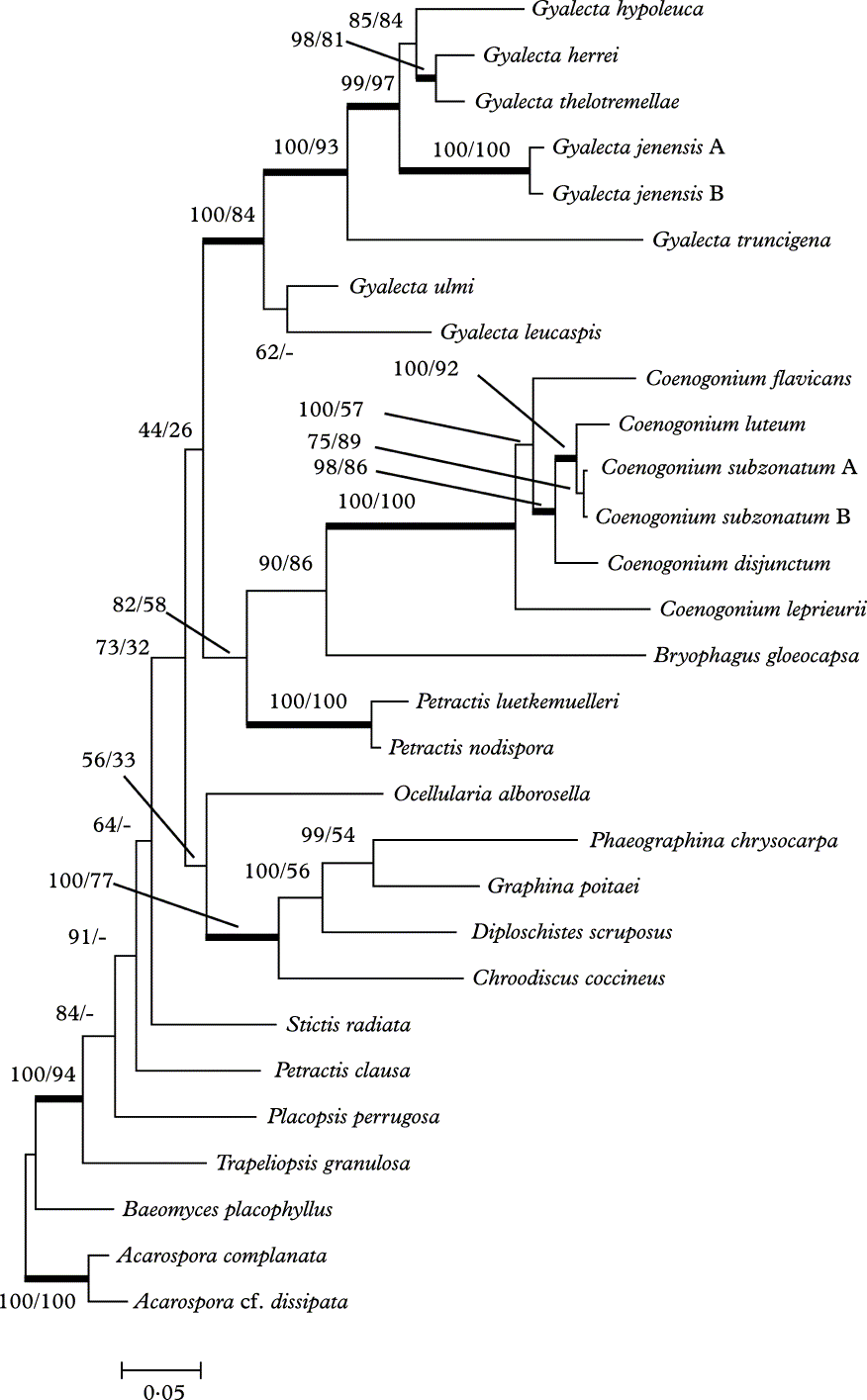
These clades were also recovered in the analysis of Kauf & Lutzoni (Reference Kauff and Lutzoni2002), where they are designated as 1, Gyalectaceae, 2, Coenogoniaceae and 3, Graphidaceae/Thelotremataceae.
In both trees, Petractis nodispora groups with P. luetkemuelleri with 100% PP and MPb support, but the relationship of these with the clades above is not well-supported. In Fig. 1, Petractis clausa, the type of the genus, is shown with good support as part of a clade containing the three clades listed above, together with P. nodispora and P. luetkemuelleri; it is shown as basal to the other taxa in the clade, but with low support. This clade corresponds to Ostropales in the broad sense of Kauff & Lutzoni; Baeomyces, Placopsis and Trapeliopsis belong to Baeomycetales (Lumbsch et al. Reference Lumbsch, Schmitt, Mangold and Wedin2007). A similar position for P. clausa is shown in Fig. 2, but with low support. The generic and familial position of P. nodispora is thus currently unresolved. It is likely that P. nodispora and P. luetkemuelleri are congeneric but do not belong to Petractis s. str. It is not proposed to erect a new genus for these species here, as this should only follow a more detailed study sampling additional gyalectoid lichens and preferably using additional gene regions.
The two new sequences obtained for P. nodispora, for morphologically indistinguishable specimens collected at the same site, but 600 m apart, showed differences at five sites within the ITS1-5.8S-ITS2 region (3 transitions and 2 insertion/deletions). Petractis nodispora differs significantly in morphology from P. luetkemuelleri (see below), and is accordingly described here as a new species. No ITS sequence was available for P. luetkemuelleri, but the SSU and LSU sequences of this species and P. nodispora show a number of differences (SSU differing by 23 transitions, 4 transversions and 3 insertion/deletions; LSU differing by 9 transitions, 7 transversions and 1 insertion/deletion).
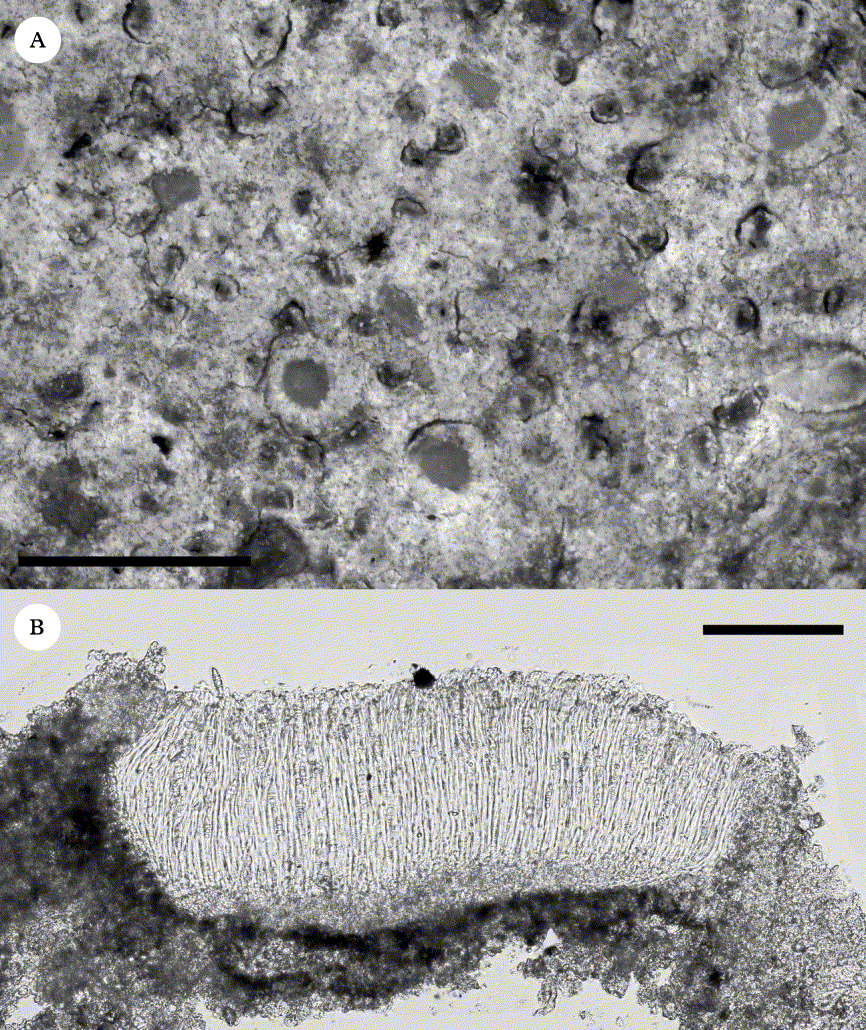
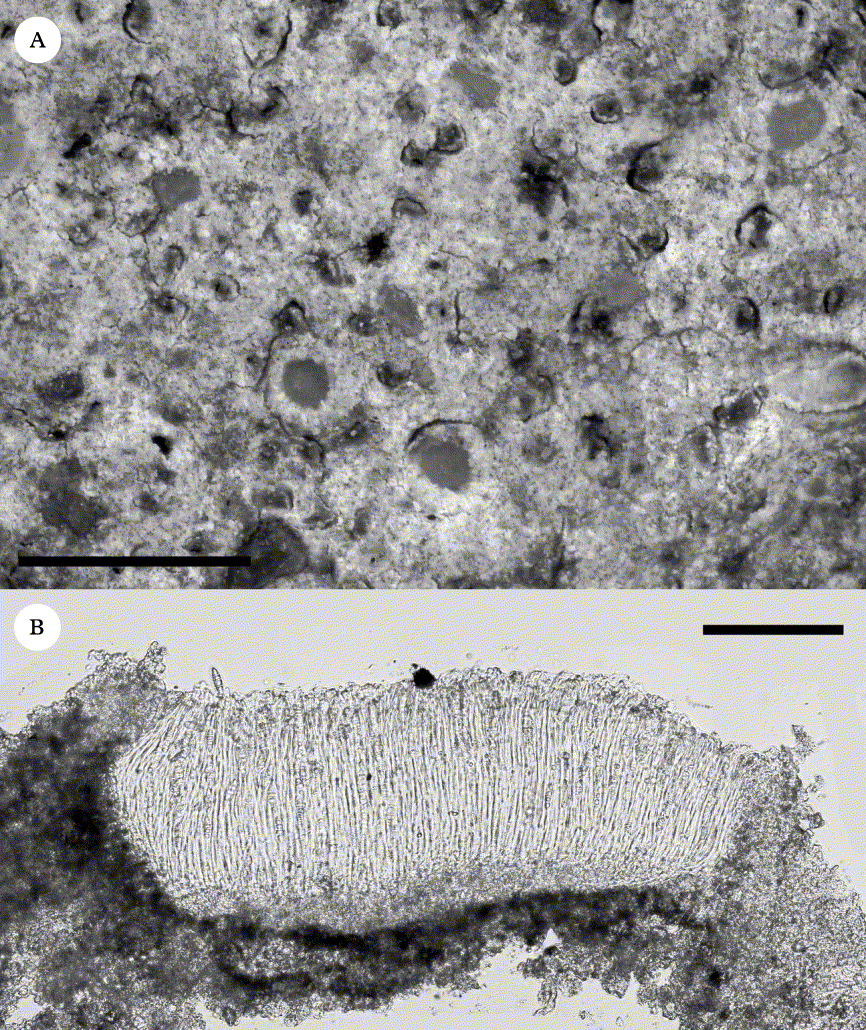
Petractis nodispora (holotype). A, thallus with three mature apothecia (below centre, and top right) and numerous pycnidia; fragment on cement-mortar; B, section of apothecium (decalcified). Scales: A = 1 mm, B = 100 μm.
The Species
Petractis nodispora Orange sp. nov
MycoBank no: MB 512785
Thallus crustosus, endolithicus, pallide roseus vel carneus. Apothecia immersa, discus concavus, pallide roseus. Ascosporae 3-septatae, hyalinae, 16.5–25 × 5.5–7.5 μm, perispora instructa. Conidia multicellulares, hyalina, 9–18.5 × 5.5–10.5 μm. Photobiont ad Trentepohlia pertinens.
Typus: Great Britain, Wales, Glamorgan, Southerndown, Dunraven Park, Pant y Slade, national grid reference 21/8872.7330, 51°26′50″N, 3°36′05″W, 30 August 2008, on vertical side of unshaded, north-west-facing limestone wall, A. Orange 17573 (NMW [C.2007.001.284]—holotypus, AIX—isotypus; GenBank accession no: FJ588710).
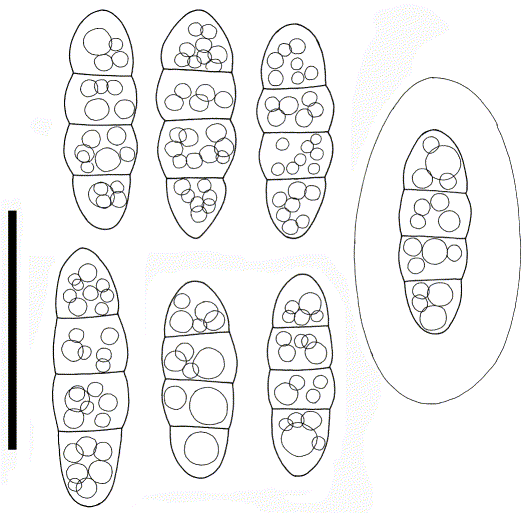
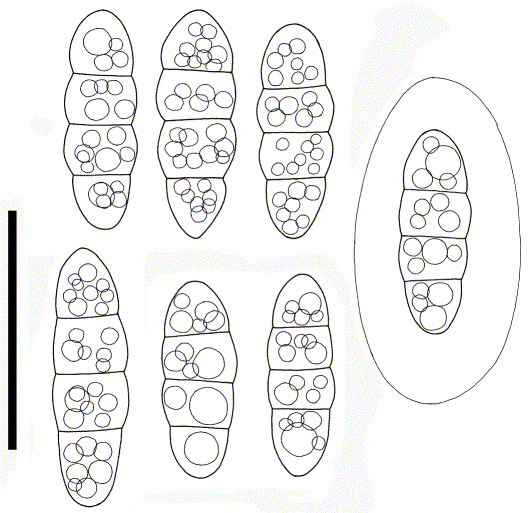
Petractis nodispora (holotype), ascospores; perispore indicated only for ascospore on right. Scale = 20 μm.
Petractis nodispora (holotype), conidia. Scale = 30 μm.
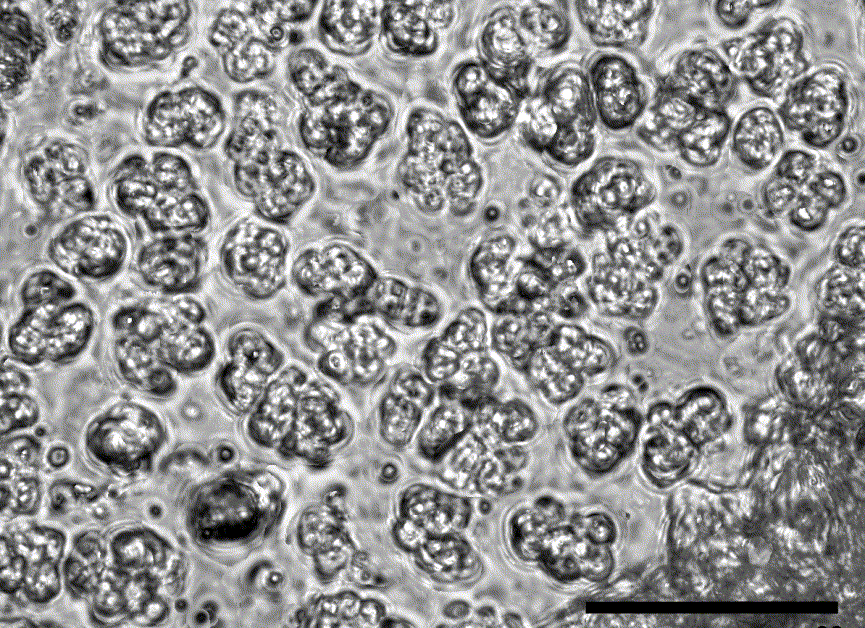
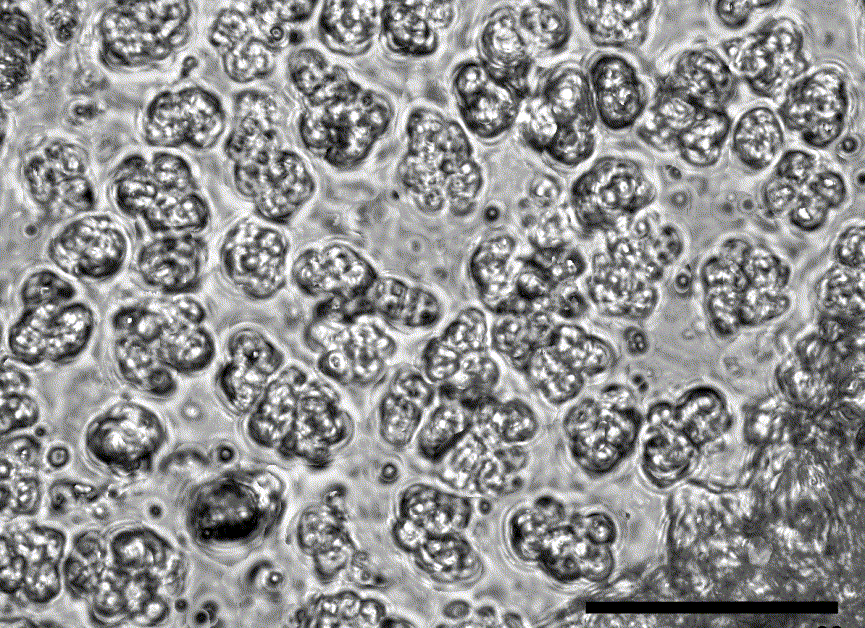
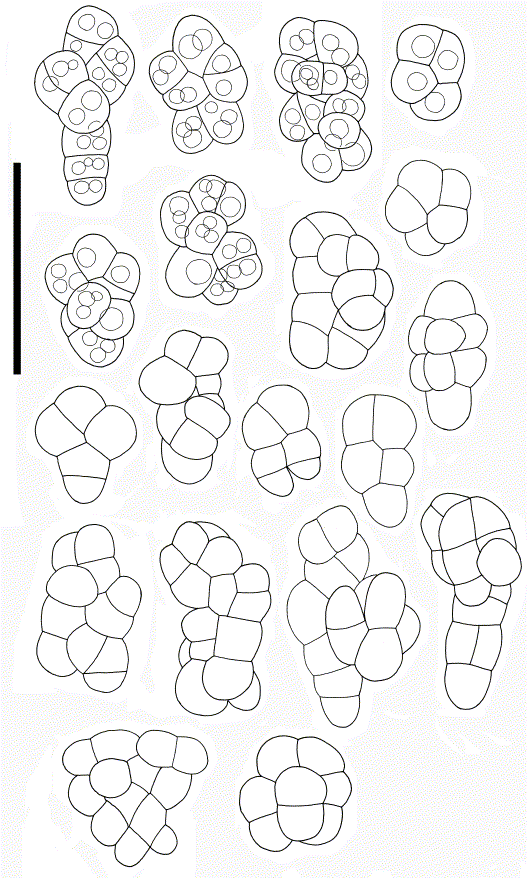
Petractis nodispora (holotype), conidia; cell contents shown only for first six conidia. Scale = 20 μm.
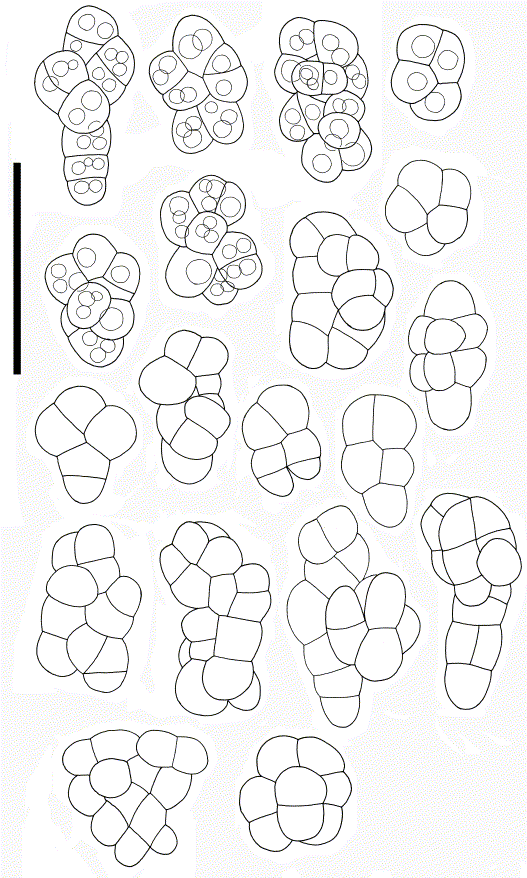
Thallus crustose, diffuse, endolithic, pale pink, matt, continuous or with a few fine cracks; c. 250–320 μm thick. Photobiont Trentepohlia. Thallus cortex absent; photobiont layer ill-defined, reaching up to c. 160 μm into thallus; fungal cells of photobiont layer isodiametric to shortly elongated, 5–10 × 3.5–6 μm; medulla of hyphae comprising chains of swollen cells, constricted at the septa, cells 8–11 × 5–9 μm, each containing a single oil droplet.
Apothecia immersed, margin not or scarcely distinguishable from surrounding thallus, at most slightly raised and then 60–100 μm wide; apothecia often surrounded by an irregular concentric crack; radial cracks absent; disc pale pink, smooth, concave, sunken below level of margin, 120–260 μm wide, not separating from margin when dry. Exciple thin, colourless, 25–50 μm wide at apex, adjacent to hymenium the cellscolourless, angular, isodiametric to oblong, 3·5–6·5 × 3·3–5 μm; below the subhymenium exciple thin, indistinct, c. 4–8 μm thick. Hymenium 90 μm thick, colourless, I − (+ faint blue at low concentration of iodine), K/I + blue. Hamathecium of paraphyses, these simple, with numerous septa; 2–3 μm thick in mid-hymenium, slightly constricted at septa, apex not or scarcely widened, 2–3·5 μm wide, without coloured oil droplets or other pigments (all observations on fresh material in water). Asci thin-walled, K/I + blue, 8-spored. Ascospores colourless, 3-septate, 16·5–25 × 5·5–7·5 μm, cells containing oil droplets; perispore present, diffuse, 2–4 μm thick, inconspicuous under normal lighting conditions, but revealed when Indian Ink is added to a preparation. Conidiomata pycnidia, immersed in the thallus, abundant and scattered over the whole thallus, ostiole easily visible as a pit or an irregular, sometimes triradiate, crack; pycnidia often surrounded by an irregular crack.
Pycnidia unilocular, but sometimes with projections on the inner surface, wall colourless, of more or less isodiametric cells 4–5·5 μm diam., conidiogenous cells similar to cells of wall, lining the pycnidial cavity up to the ostiole, holoblastic, not proliferating. Conidia not catenate, colourless, irregularly shaped but mostly oblong-ellipsoid, 9–18·5 × 5·5–10·5 μm, formed of irregular clusters of 5–15 or more cells, each cell containing one or more oil droplets.
Etymology. From Latin nodus (knot, node) and spora (spore).
Habitat and distribution. On limestone and cement-mortar on old, unshaded to lightly shaded walls; associated species include Acrocordia conoidea, Caloplaca flavescens, Opegrapha calcarea and Verrucaria nigrescens. Currently known from two sites, each within a few hundred metres of the coast of South Wales.
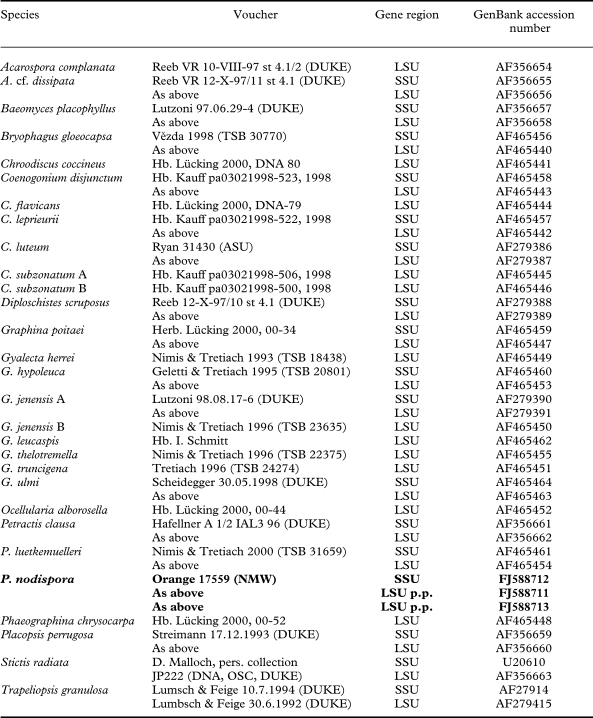
Specimens used in the phylogenetic analysis.
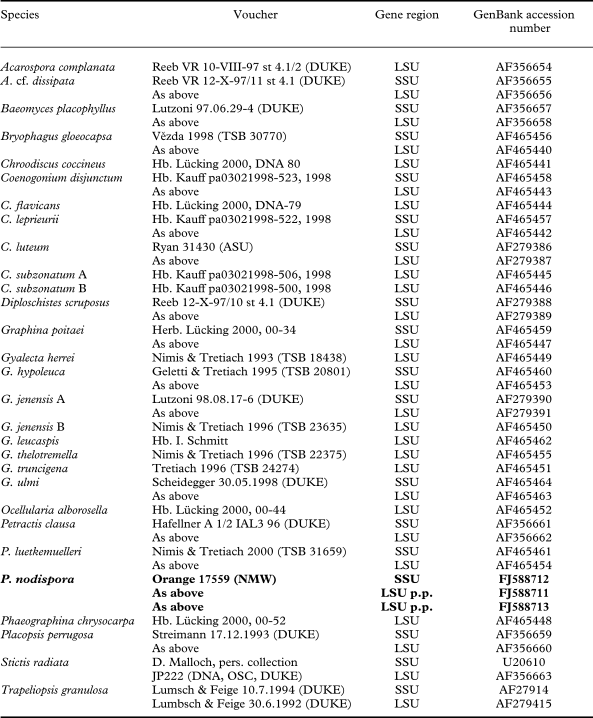
New sequences generated for this study are shown in bold.
Notes. The diffuse, pale pink thallus is conspicuous in the field; the thallus is similar in appearance to some other Trentepohlia-containing lichens including Acrocordia conoidea and Opegrapha calcarea, but apothecia are usually present in those species, and both fertile and sterile thalli of P. nodispora have numerous pycnidia, visible as small dots. According to descriptions in Vězda (Reference Vězda1965) and Clauzade & Roux (Reference Clauzade and Roux1985), P. luetkemuelleri differs in the larger apothecia (300–500 μm diam.) with fissured margin, taller hymenium (130–150 μm), and larger ascospores (18–31 × 7–18 μm) which vary from 3-septate to submuriform; the ascospores are halonate. Only small, simple conidia have been reported. Petractis crozalsii has 3-septate ascospores, but these lack a perispore; one specimen examined had numerous, rather crowded apothecia, often with a slightly raised margin, the hymenium was strongly I + blue, and no pycnidia were detected. Other lichens of similar appearance in the British Isles include Petractis clausa (apothecia with narrowly exposed disc and radially fissured margin, photobiont scytonemoid), Gyalecta biformis (Körb.) H. Olivier (ascospores mostly 5–7-septate), G. geoica (Wahlenb.) Ach. (apothecia often sessile, with raised margin and markedly concave disc), G. hypoleuca (spores 5–9-septate) and Ramonia calcicola Canals & Gómez-Bolea (exciple with periphyses on inner face, asci K/I −).
Additional specimens examined. Petractis nodispora: Great Britain: Wales: V.C. 41, Glamorgan: Llantwit Major, St Donat's Castle, 21/934.671, on unshaded limestone wall, 2006, A. Orange 16412 (NMW [C.2007.001.285]); Southerndown, Dunraven Park, 21/8937.7319, on limestone on shaded wall, 2008, A. Orange 17559 (NMW [C.2007.001.282]).
Petractis crozalsii: France: Hérault, Notre-Dame-de-Londres, 1993, O. Bricaud & C. Roux 23516 (NMW [C.2006.011.13]).
As this is my first publication using DNA sequence data, I would like to thank Mats Wedin for his generosity in providing training in molecular techniques at Umeå in 2006, and also Carin Olofsson for tuition in the laboratory there. Dr C. Roux kindly examined the first-collected specimen of P. nodispora, and generously provided a specimen of P. crozalsii. Three anonymous referees provided helpful comments.