The point on which it [Keynotes] differs from all other well-known books by women is the intensity of the awakened consciousness. It follows no pattern and is quite independent of any previous work; it is simply full of a woman's individuality.
— Laura Marholm Hansson, Six Modern Women (1896)
Every moment was delightful; we were making discoveries, finding we had had like experiences, – had both hungered, both known want, were both of an age; we were both unconventional, and were shaking hands mentally all the time.
— “Now Spring Has Come,” Keynotes (1893)
First published in 1893, George Egerton's Keynotes was immediately popular, selling six thousand copies in its first year alone.Footnote 1 Appearing three years later, Laura Marholm Hansson's review effectively singles out what made the text such a tremendous success: each story offered readers a probing representation of woman's “consciousness” or inner world of emotional and sexual passions, subjects unavailable in any “previous work.” Egerton was, of course, the penname for Mary Chavelita Dunne Bright, and many of the themes covered in Keynotes were loosely modeled after her own life. The volume was uncompromising in its portrayal of women's desires, or those “notes” from which it takes its title. “[T]here are no signs of girlish prudery in ‘Keynotes,’” Hansson continues, “it is a liberal book, indiscreet in respect of the intimacies of married life, and entirely without respect for the husband” (63). Despite this high praise, Hansson also worries whether Keynotes was not “too good a book to become famous all at once” (61). Her hesitation alludes to the mixed reception among readers and literary critics, for to say that everyone loved Egerton's fiction would be an exaggeration and, more importantly, would miss the cultural work of her appetitive characters. As signaled by the second epigraph, taken from Egerton's “Now Spring Has Come,” Keynotes was full of stories focused on “unconventional” women who “hungered” for both food and love; such libidinal desires were unthinkable – and even unspeakable – in a world where the proper Victorian lady was defined in terms of bodily sacrifice. While some readers certainly disapproved, still others like Hansson, as the first epigraph suggests, welcomed this “independent” turn in women's writing and saw in Egerton's characters a reflection of their own “woman's individuality.”
There has been, over the last two decades, a proliferation of criticism on the fin-de-siècle New Woman, and this scholarship has paved the way for innovative and often controversial analyses of Egerton's fiction. Credit for Egerton's resurgence in popularity must be given to Margaret D. Stetz, whose 1982 dissertation on ‘George Egerton’ still stands as one of the finest works on the author and fin-de-siècle gender studies, as well as Martha Vicinus's “Rediscovering the ‘New Woman’ of the 1890” (1983), which shifted our attention to the late-Victorian marketplace and popular feminism. Inspired by these touchstone studies, the majority of later scholars have tended to read Keynotes as part of a late-Victorian literary movement interested in rethinking gender and validating women's sexual desire. Some see in Egerton's writings a kind of ‘difference feminism’ that defends women's libidinal drives as closer to nature (per essentialist feminism). In Love and Eugenics in the Late Nineteenth Century (2003), for example, Angelique Richardson describes Egerton's writing as “reaching beyond the social” in search of some “primal” or “natural” self (171; emphasis original). Kate McCullough's “Mapping the ‘Terra Incognita’ of Woman” (1996) argues that “the source of ‘womanhood’ for Egerton . . . appears to be biological, an essence of woman grounded in the body, and it is that biological difference which both justifies and forms the subject matter of her writing” (206).Footnote 2 Still other critics – including Nicole M. Fluhr, Daniel Brown, Tina O'Toole, and Kate Krueger – see in Egerton's writings a frank defense of feminine desire in terms compatible with liberal individualism. Fluhr's “Figuring the New Woman” (2001) includes the author among writers who “challenged prescriptions for maternal selflessness and authorial modesty” (243), while Brown's “George Egerton's Keynotes” (2011) explains how the author's philosophical stories “introduce premises from which new social and sexual relations may be engendered and individual existential choices made” (143). Shifting attention to cultural contexts, both O'Toole (The Irish New Woman [2013]) and Krueger (British Women Writers and the Short Story [2014]) celebrate Egerton's avant-garde heroines for their active role in the “deterritorialization” of classed and gendered hierarchies limiting women's social and sexual mobility (O'Toole 144; Krueger 105).
Building upon this excellent critical conversation, this article expands the definition of feminist desires to include hunger and, specifically, the consumption of food. For while many recognize the radical implications of Egerton's sexualized heroines, there has yet to be a thorough study on her representations of appetitive women and their role in popularizing New Women's fiction. In pursuit of this latter reading, my article thus aligns itself with ongoing conversations among Victorianists on the role of food and bodily discipline in the definition of gendered identities. In their touchstone work, The Madwoman in the Attic (1979), Sandra Gilbert and Susan Gubar look at how the female body is a site of cultural contestation in the feminist struggle for social authority, and within this context, feminine self-starvation is thus redefined as a self-possessive “protest” against what “society has defined as nourishing” in terms of both ideas and material sustenance (391). Whereas Gilbert and Gubar rely upon an a-historical discussion of anorexia nervosa, Helena Michie's The Flesh Made Word (1987) looks more closely at how Victorian conventions of gender and especially expectations of feminine self-sacrifice (the “Angel in the House”) prohibit women's expression of bodily demand, including hunger and/or pleasurable consumption; rather, the respectable lady's “femininity and her social position are defined quite literally by negation,” and her “denial of hunger is an affirmation of a precarious class position” (18). Anna Krugovoy Silver, in Victorian Literature and the Anorexic Body (2002), also explains how nineteenth-century gender ideology is “built upon an anorexic logic” promoting women's bodily restraint (14). Like Gilbert and Gubar before her, Silver champions the rebellious heroine who asserts her right to appetitive expression and therein challenges dominant gender codes.Footnote 3 Inspired by such critical studies, I read Egerton's Keynotes as an explicit representation of feminine hunger meant to draw attention to – and not deny – women's bodily drives.
With its unabashed representation of appetitive heroines, Keynotes raises persistent questions about women's hunger and health within the traditional domestic plot, narratives in which women's physical wants are typically sacrificed in service to men and the family. In pursuit of this thesis, I therefore position Egerton's short fiction as playing an active role in popularizing feminist representations of appetitive women at the fin de siècle. By the time Keynotes appeared in print, readers were already clamoring for books on feminine sexuality, and so what reviewer Hansson labels as Egerton's “newness” was in fact part of a growing body of New Woman literature. Indeed, the dichotomy between women's hunger and sexuality did not have to exist and was, most likely, a remnant of Victorian dual worlds of lust and love – with the proper “lady” sacrificing the former for the latter. By linking together sex and food, Egerton's fiction represents women's bodily hunger in a way that cuts to the core of, and challenges, established models of feminine repression. This discussion of Egerton's libidinal rebellion is divided into two parts: the first part of this article reads Keynotes’s appetitive heroine as a response to domestic plots, and the second half considers these libidinal representations within the context of the literary marketplace. As readers make their way through the sequence of stories, there also emerges another subplot on the question of masculine desire and whether it is healthier for the New Woman to love a man who inspires hunger or one who nourishes her unconventional passions. Through her short stories, Egerton brings together representations of physical hunger and sexual longing at a time when, thanks to New Women writers before her, the dominant models of feminine embodiment were under revision. Keynotes’s bold literary experiment thus helped usher in, at the end of the century, a call for new narrative opportunities – including alternative romantic plots and “new men” as partners – for appetitive women unwilling to compromise their bodily pleasure.
Part 1: Hungry Women and Victorian Gender Roles
When Egerton first drew up her manuscript for Keynotes, she proposed a sequence of stories beginning with “Under Northern Sky” on a woman's escape from an abusive relationship, and ending with “A Cross Line,” a story about a “wild” (22) woman who, in following her desire, commits adultery and ends the story pregnant (most likely with her lover's child).Footnote 4 However, the Bodley Head (then managed by co-founders John Lane and Elkin MathewsFootnote 5) rearranged the manuscript and, effectively, reversed the order of stories.Footnote 6 Stetz describes the editorial choice to begin with “A Cross Line” as a deliberate act of rebellion that “flung up a red flag to John Bull [and] guaranteed attention for the whole book” (‘George Egerton’ 36). Ever the astute publishers, Lane and Mathews knew that readers would be drawn to the scandalous subject matter of “A Cross Line,” and so opening with the story quickly and effectively signaled the volume's break from ‘proper’ models of Victorian femininity (repressive norms which Stetz labels as the “John Bull” of nineteenth-century culture). This first story introduced readers to a new kind of heroine, named Gipsy, who thwarts convention in pursuit of bodily pleasure, both gastronomic and sexual.
Gipsy's penchant for masculine forms of consumption, such as drinking and smoking, is an immediate indication of her gender radicalism. First, Gipsy's husband offers her a “nip of whisky” to rid her of her “qualmish feeling” (Egerton, Keynotes 8), and later she is shown enjoying a “cigarette poised between the first and second fingers, idly pleased with its beauty of form and delicate, nervous slightness” (13). The consumption of alcohol itself was considered unfeminine, as Lady Constance Howard explains in her 1885 book on Etiquette, and the proper Victorian lady was expected to limit herself to one glass of wine served only “at dessert” (307). Yet Gipsy is instead rather liberal in her preference for stronger spirits like whiskey, which by the mid-century was widely recognized as “a gentleman's drink” for “persons of taste and distinction” (Kosar 56). That Gipsy enjoys her alcohol combined with a cigarette, taken at leisure in the evening, would have been immediate cause for concern among conservative-minded Victorian readers. Smoking was still, by the later decades of the century, considered a masculine activity. As Lady Constance Howard explains, the after-dinner drink and smoke break were both taken privately by men and in separate quarters, and thus both gendered forms of consumption precluded women's participation: “Twenty minutes now-a-days is generally the longest time gentlemen sit over their wine; and cigarettes, after the ladies have left the room, half-an-hour, at the longest, instead of an hour or more as they used to do formerly, when wine and cigarettes were good, and the stories told of as agreeable, racy description” (52). In the Social History of Smoking (1914), G. L. Apperson admits that there were Victorian women smokers, but that these women usually came from the “hardened” working classes, or that they were “gipsy women who tramp the country” (n. pag.; ch. 13). “Respectable folk in the middle and upper classes,” Apperson continues, “would have been horrified at the idea of a pipe or a cigar between feminine lips; and cigarettes had been used by men for a long time before it began to be whispered that here and there a lady – who was usually considered dreadfully ‘fast’ for her pains – was accustomed to venture upon a cigarette” (n. pag.; ch. 13).Footnote 7 Gipsy's smoking thus marks her as dangerously transgressive, both in terms of gender and class.
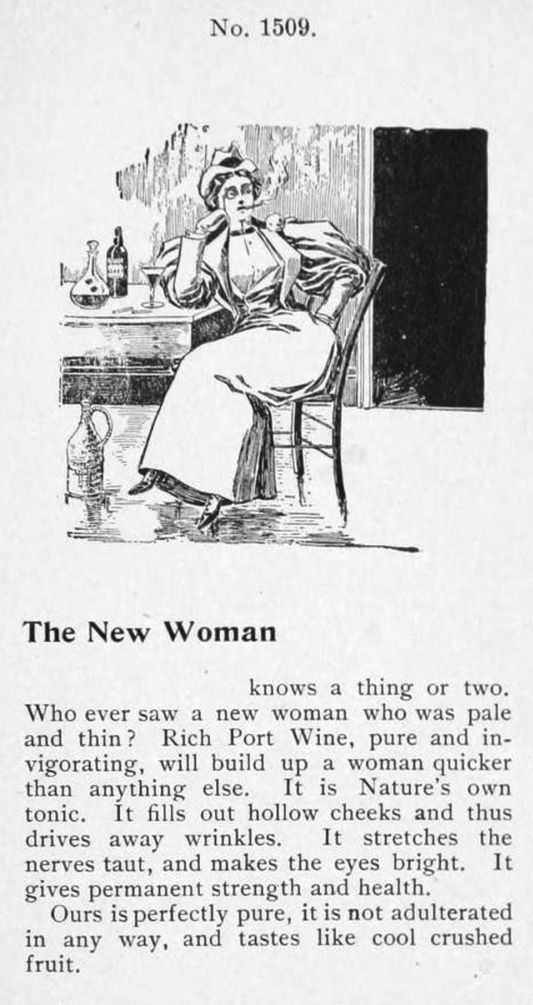
Gipsy's unconventional appetite is made all the more threatening by virtue of its association with stimulation, as opposed to disciplined utility. In The Discourses of Food in Nineteenth-Century British Fiction (2010), Annette Cozzi explains how “[t]he Germans have a word, Genussmittel, which means ‘articles of pleasure’ and includes not only intoxicants such as alcohol, tobacco, and opium, but also spices and condiments – those items that are not necessities and are meant for sensual pleasure” (114). This definition perfectly encapsulates the decadent mode of consumption implicit in Gipsy's smoking and drinking, both of which serve no useful propose. It is also through this pleasurable consumption that Egerton's heroine is aligned with the appetitive “New Woman.” Entry 1509 in The Liquor Book (1899) paints a picture of the New Woman as someone who “knows a thing or two” (67) about the link between alcohol and physiological stimulation (Figure 1). Shown surrounded by alcohol (three bottles and a full glass) as she also enjoys a cigarette, this feminist figure is the opposite of self-denial – for as the caption puts it, “Who ever saw a new woman who was pale and thin?”; rather, the New Woman's robust body is evidence of the “invigorating” effects of a “rich port wine” that “fills out hollow cheeks,” “stretches the nerves taut,” “makes the eyes bright,” and “gives permanent strength and health” (The Liquor Book 67). But not everyone was as positive in their account of the appetitive New Woman. As Cozzi explains, this late-Victorian feminist figure served as one of many “monstrous” types whose voracious desire haunted the Victorian imagination and thereby reminded readers that Victorian gender roles mandated feminine “moderation” through purposive consumption (128).
“The New Woman.” (No. 1509) Illustration from Charles Austin Bates, ed. The Liquor Book (New York: Charles Austin Bates Syndicate, 1899), 67.

Gipsy's radical sexual desire is, from the outset of “A Cross Line,” aligned with bodily consumption, and each of the two men in her life represent a different, albeit limited, opportunity for satiation. The unconventional heroine has in her “[a] thirst for excitement, for change” and a “restless craving for sun and love and motion” (Egerton, Keynotes 21), far from the “monotony” of domestic life with her husband (11). The story uses fishing as an extended metaphor linking together her dual pursuit of libidinal and gastronomic stimulation. Gipsy's brief love affair with the “grey-eyed man” (3) begins almost immediately after the two meet by the river's edge, though each are there for notably different reasons: she sees fishing as an opportunity for creative reflection (she is first pictured in deep philosophic thought), but she is also intent on catching wild food that she will eat for nourishment. Conversely, there is no mention of the grey-eyed man eating his catch, and in fact, he seems more interested in the opportunity for sexual conquest furnished by this chance encounter – fishing is, in other words, a means to “his untiring pursuit of women as an interesting problem” (3).Footnote 8 Yet it is precisely this type of sexual adventure that attracts Gipsy. Though she loves her husband, Gipsy is also unsatisfied in the marriage; she calls him the “best emotional check” at one point (14), and later refers to him as a “good man” while also crying over a ripe plum he has brought her to eat (32). Little wonder, then, that Gipsy would be drawn to a lover who travels the world on his “yacht” (26) and makes “poetic” promises of “skim[ming] through the sunshine of Southern seas on a spice-scented breeze” or “sail[ing] out through the moonlight over silver seas” (27). An affair with the grey-eyed man would seem libratory in its constant search for new stimulation and unconventional (undomesticated) game.
While “A Cross Line” certainly celebrates the positive or (re)productive potential of women's appetitive consumption, the opening story also sets in motion a counter-narrative on the physiological sacrifices demanded of women within the traditional romance.Footnote 9 Once Gipsy realizes that she is with child, she willingly gives up her sexual affair and commits to her new role as mother, as symbolized in her decision to repurpose the cambric nightgown into tiny “elfin-shirts” (36). The maternal body was, as Silver argues, at the very heart of most nineteenth-century narratives on women's gendered embodiment: founded upon notions of “disinterested love and nurture,” this domestic ideal required that Victorian women deny “every aspect of their physicality, including (but not limited to) their sexuality” so that they could better serve the family's needs and wants (9).Footnote 10 In giving up her grey-eyed lover, Gipsy complies with the domestic strictures of women's libidinal repression; by choosing her husband, she also makes the prudent appetitive choice. The latter man is, importantly, a skilled provider who grows food and delights in tending to his wife's bodily needs – from filling her whiskey glass (8), to lighting her cigarette (11), or feeding her plums (31) and fresh peas (33). Her husband also “love[s] young things” (9) and will, therefore, prove an attentive father to the child growing in her body. Ending with this safe choice (over sexual adventure), “A Cross Line” therein highlights for readers the costs implicit in the Victorian mother's domestic self-sacrifice. The subsequent stories in Keynotes delve even deeper into, and interrogate, these repressive gender norms that deny women's sexual and social fulfillment. Certain stories – like “The Spell of the White Elf” (middle) and “An Ebb Tide” (conclusion) – also highlight the possibility of an alternative romantic arrangement between the ambitious New Woman and a “New Man” who, like Gipsy's husband, nourishes her bodily desires.
Egerton's second story, “Now Spring Has Come,” builds upon the theme of domestic self-sacrifice, using appetitive language to describe women's sexual frustrations. Our narrator-protagonist is introduced as a passionate young woman (“consumed with a desire” [40]) who is not averse to travelling great distances to seek a writer to whom she is already mentally attracted. The unnamed heroine in this story recounts meeting and falling in love with her literary idol, a character based upon Egerton's real-life lover Knut Hamsun whose bodily “hunger” was famously recorded in his novel by the same name, Sult (1890; translated into English as Hunger).Footnote 11 While Egerton's story replicates many of Hamsun's impressionistic narrative techniques, its feminine point of view also recasts hunger as a product of social norms policing women's libidinal expression. Upon first meeting, the emotional attraction between both characters is immediate and intense. “[W]e had found ourselves,” the narrator recalls, adding that “[e]very moment was delightful, we were making discoveries, finding we had had like experiences, had both hungered, both known want, were both of an age. We were both unconventional, and were shaking hands mentally all the time” (47–48; emphasis added). The heroine is overtaken by physical desire, which she compares to “a beaker of exhilarating, life-giving, rich wine . . . that steals through you and witches and warms you” (59). But this romantic plot does not paint such sexual intoxication as empowering to women; rather, the narrator is deferential in her attitude toward her body, and after her lover leaves, rushes to a mirror and “trie[s] to fancy how he saw me” (48; emphasis original). The heroine thus loses all agency as well as appetite, and is instead consumed by love until she grows “wretchedly thin” (59).
The story's tendency to frame feminine desire in terms of physical nourishment also helps readers to recognize the negative effects of heterosexual romance upon women's bodily health, especially when the woman is drawn to an equally or excessively ravenous man. In Egerton's fiction the real antagonist is the domestic plot that has built into it an assumption of women's appetitive restraint as necessary to familial and social harmony. Egerton's story acknowledges how women are themselves responsible for perpetuating such gender roles by willingly subordinating themselves, “by chains of our own forging, in deference to narrow custom” (53). This act of self-denial is what Silver describes as the “anorexic continuum” that underwrites ideal femininity throughout the nineteenth century (11). While Silver is careful not to impose twenty-first-century definitions onto Victorian fiction, the connotations of illness make sense in the context of Egerton's story. In “Now Spring Has Come,” women's libidinal repression proves unhealthy to the self as well as the relationship, for the heroine's lover is appalled to find her grown thin and old with lovesickness. Still privileging her male lover's point of view, the narrator admits that “I ought to eat plenty too” and that “I looked as if I didn't eat enough, my eyes and cheeks were hollowed out” (60). Through such scenes, Egerton implies that women's appetitive expression is healthier for the female body and for love itself. As the narrator intuitively understands, women require a time of libidinal consumption – a time for “sowing wild oats” – so that they might withstand the shock of love: “we repress, and repress, and then some day we stumble on the man who just satisfies our sexual and emotional nature, and then there is shipwreck of some sort” (56–57). Only when women can live “larger and freer lives” – free to follow appetitive drives – will they be “better balanced than we are now” (57).
Egerton's third story, “The Spell of the White Elf,” explores in greater detail the tension between women's professional ambition and normative femininity as defined through maternal self-sacrifice. Set aboard a steamer bound from Christiana to Hull, the story dramatizes this tension through an extended conversation between the narrator-persona and a professional writer (a New Woman-type) who has recently found happiness in her new life as adoptive mother to the eponymous “White Elf.” It is no accident that these two women meet in the ship's restaurant, for this space is associated with both individual mobility and appetite.Footnote 12 Like her new friend, the narrator in Egerton's story is comfortable in this public dining room because she is not a conventional lady; rather, she admits early into the story that she has left her lover Hans Jörgen “waiting” in order to travel and work “alone” “for five years” (69). Yet the narrator “[has] not the same gladness in my work of late years” (70), and as such, seems almost instinctually drawn to memories of Jörgen and his stories of disciplined consumption (including “fixed menus” [71] and “weekly supply” of provisions [73]). A shared drink and conversation with the writer begin to “mak[e] clear to [the narrator] most of the things that had puzzled [her] for a long time” (77). The writer shares her own story so that our interlocutor might avoid the same mistakes of putting career before family and (or, as a result) of knowing next to nothing about homemaking – the writer's “husband stays at home, and grows good things to eat” while she “go[es] out and win[s] bread and butter” (80). The moral is stated explicitly at the end of her story when the writer claims that all are “the better” for meeting and loving the child and that, for this reason, she “wish[es] you a white elf,” too (89).
Unlike the first two stories in Keynotes, “The Spell of the White Elf” models an acute anxiety toward those feminist characters – like the New Women – who outright reject the role of self-sacrificing mother, a narrative move that (deliberately or not) implies the power of such gender models in the social regulation of women's appetitive embodiment. This story uses the first-person point of view to immerse readers in Victorian conversations on women's maternal responsibility, and through the narrator we witness the writer's reformation into an ideal (or domesticated) woman who learns to put the family's needs before her own. In referring to the writer as “manlike” (74), for example, the narrator implicitly accepts the former's account that to work for a living runs counter to dominant gender roles (“[p]ositions are reversed” [80]). The writer, in fact, knows little to nothing about feeding a family and instead relies upon her husband's gastronomic expertise, a division of labor that challenges Victorian expectations of femininity as defined in relationship to domestic management (including appetitive repression).Footnote 13 It was her husband, after all, who advised that she get “milk of one cow, an’ mind not mix it!” (87), essential advice in preventing infant mortality.Footnote 14 It took much of the nineteenth century to implement proper sanitation and safety standards to regulate the dairy industry, and even after the introduction of pasteurization in the 1890s, problems with contamination and adulteration persisted.Footnote 15 In “The Spell of the White Elf,” the husband's request for unmixed milk from a single source (or the “cow fair”) is a sign of just how far many would go to procure uncontaminated milk.Footnote 16 That the writer does not know about such safety measures is not only a strike against her femininity, but it also exacerbates the popular assumption that the self-interested New Woman posed a direct threat to the health of the family. Yet, the fact that her husband is indeed capable of managing the household's dietary needs, even after the arrival of the White Elf, hints at another and, even, subversive subplot on the “New Man” as romantic alternative; one wonders if the New Woman's appetitive sacrifice is necessary so long as she has a male partner who is willing to shoulder his half of the domestic labor. Still, the writer's lesson on compulsory motherhood is not lost on our narrator, and so the story ends with the latter “getting everything ready,” for she has “so much to buy,” so many “pretty tiny things” (90). The narrator has decided to forego her career abroad and instead writes to her lover calling him back so that they might begin a procreative life together.
The next two stories in Keynotes focus on the men for whom women sacrifice their libidinal desire, both in terms of sex and food, immersing readers in the traditional heterosexual plot as a structure of power. The progressive alternative of the New Man who nourishes is, therefore, exchanged for the archetypal male whose libidinal appetite overshadows and therein stifles women's bodily needs. As if to emphasize this reversion to dominant gender roles, the fourth story, “A Little Grey Glove,” is told from the perspective of the male lover who recounts his love affair with a recently divorced woman. In comparison, the fifth story, “An Empty Frame,” offers an intimate account of one woman's frustration with her adulterous husband. The former story, “A Little Grey Glove,” is particularly interesting insofar as it also, like “A Cross Line,” uses images of fishing and hunting as extended metaphors for men's aggressive desires.Footnote 17 In the opening paragraph, the narrator admits that his last lover “threw me over for a neighboring pork butcher” (91) and that it is only through the “hunter's lust, bent on a ‘kill’” that he can escape the “strange lack” or “strange lonely feeling” (97). In his study of Meat (1992), Nick Fiddes explains this link between masculinity and the consumption of animal protein as a question of sexual authority: “meat is almost ubiquitously put to use as a medium through which men express their ‘natural’ control, of women as well as of animals” (146).Footnote 18 Victorian medical practitioner George M. Beard, M.D. (Sexual Neurasthenia [1898]) even rationalized white men's consumption of protein as proof of their social superiority over so-called “lower animals” or “savage” classes, including women, who feed on “fruits and cereals” (250).Footnote 19 Of course Victorian women were well aware of the sexual stigma attached to meat, and many would even willingly limit themselves to a “modest” vegetarian dinner in order to secure their husband's unrivaled supply of masculine protein (Adams 51).Footnote 20 What makes Egerton's “A Little Grey Glove” so fascinating, then, is that the two lovers meet while fishing, as if to suggest that a woman might strive for a form of sexual power (what Fiddes describes as “dominion over nature” [55, 176]) on a par with her male counterpart. As in “A Cross Line” before it, this fourth story links fishing with adventure when the narrator proudly describes himself as a “wandering spirit” who has traveled the world, from Finland to Canada and Central America, in search of “gamer” fish (Egerton, Keynotes 94–95). Brought together by accident, the lovers quickly grow close and even seem rejuvenated by their shared experience of hunting: the narrator fixates on the woman's smooth and youthful skin (“soft as a child's), for example, while also admitting that their first exchange has made him feel “curiously happy” (101). Once snagged in the ear by the woman's lure, however, the narrator discovers that the tables have turned and that he is caught (“held”) by a female even more leery than he is of domestic commitment (99–100). Still scarred by her much-publicized divorce decree nisi (110), the woman insists that she is not yet ready to give her love, and requests that he wait a year while she embarks on her own personal adventure: “I must learn first to think of myself as a free woman again,” she boldly insists, while also acknowledging that such feminine desire is unconventional and that “it almost seems wrong to-day to talk like this” (113).
Despite her bold assertion of libidinal appetite, the woman in “A Little Grey Glove” is nonetheless gradually rewritten by the male narrator into the object of his romantic fantasy. She is, in this way, like so many Victorian women whose desires are suppressed in support of domestic plots. But whereas many of these women participate in their own self-erasure, our heroine is instead prescribed this repressive role by the male narrator; she enters the story a wild woman whose libidinal drive is signaled through participation in sports fishing (she literally ‘hooks’ the narrator), but then she is transformed into an “old,” “tired,” and “haggard-looking” woman as she recounts the details of her very public divorce (106–07). Her independence and vitality are gradually stripped away as she is increasingly defined by, and also diminished in proportion to, men's desires – including her ex-husband's and her new lover's (the narrator's) sexual wants. In the closing chapter, for example, the narrator recounts how he would often meet the woman for breakfast or dinner, but he makes no reference her actual consumption, and he also claims that she is “eager to fish or pick gooseberries” but then focuses on her consumption of the latter, which he claims she would “eat daintily” (106). At first glance, the narrator of “A Little Grey Glove” seems like a step up from the ex-husband who uses the popular newspapers to sex-shame his “adulterous” wife (112), but even this new lover proves himself to be the kind of man who denies women's appetitive autonomy. The story closes with his “dream of the spring to come” when the woman will return at the same time as the “trout,” as if she were a fish to be caught or possessed (114). Again, it is interesting to note that he is the one left waiting, which is itself a very unconventional twist on gender roles, while she is the one with agency who must “come with her grey eyes shining to exchange herself for her little grey glove” (114). The narrator's syntax, however, betrays his adamant refusal to see himself as passive; he instead reframes the elusive woman as an object to be “exchange[d]” in trade for another object (the glove), a sentence and sexual structure that effectively obfuscates the agency implicit in her sacrifice (of “herself”).
In transitioning from “A Little Grey Glove” to “An Empty Frame,” Keynotes highlights for readers the mental, as well as physical, toll exacted from women within heterosexual romance, as if to ask whether such feminine self-sacrifice is healthy and thus necessary. The next story, “An Empty Frame,” shows readers how men often prove unworthy of appetitive authority. There are no explicit references to food in this story, but as in the preceding tales, appetitive language is used to convey women's frustrated desires. The story is set (all one scene) in the evening, presumably after dinner, and yet our heroine does not appear satisfied or ‘nurtured’; she is instead preoccupied with memories and recalls how she once gave herself over, “tame as a hungry bird” (118), to her husband in marriage. The heroine is now utterly disappointed (she “cries quietly” [118]) to discover his affair, not because she is jealous, but because she mourns the great woman she might have been had she chosen differently: “‘And I’ (with a catch of voice) ‘with a great man might have made a great woman – and now those who know and understand me’ (bitterly) ‘think of me as a great failure’” (122). By this reference to a “great man,” the woman means her former lover whose letter she had just reviewed prior to the confrontation with her husband. This lover had asked her to “share” and “work” with him “equal as a creature,” and though he “worship[ped]” her as “queen” (even promising to “crouch at [her] feet and swear [himself] to [her],”) he had also insisted that he “must be free and unfettered” and therefore would “not bind [himself] . . . by any legal or religious tie” (118–19). As in earlier stories (“A Cross Line” and “A Little Grey Glove”), sexual passion is aligned with wild or “unfettered” appetite that is risky. Looking back, however, this female protagonist can also now appreciate that she had, “in her loneliness of spirit,” rejected passion in favor of security and “married him who seemed to need her most” (119). The safe choice has let her down, and so the woman is now forced to contemplate how she might have been a success (not “failure”) had she followed her libidinal drive.
In Egerton's “An Empty Frame,” women's domestic self-sacrifice comes at a devastating cost to creative, as well as “spiritual” (119) well-being. In order to reclaim any imaginative potential, women must stage a radical rejection of the domestic plot for there is no New Man written into this narrative who is worthy of her sacrifice, nor is there inspiration for her mental genius. The second half of “An Empty Frame” shows the husband kneeling before his wife in contrition, and though she tells him that “it's all right” (123), the balance of power has definitely shifted. She may have forgiven her husband, but the relationship is forever altered, and the woman now knows that he cannot hope to understand, let alone support, her “complex nature” (123). The story closes with a surreal dream sequence in which the woman sees herself “sitting on a fiery globe rolling away into space” and, at the same time, sees also her own head “wedged in a huge frame” and “growing larger and larger” until she is finally left “sitting inside her own head, and the inside is one vast hollow” (123). This conclusion provides one of the most powerful images of women's bodily reclamation in the whole of Keynotes. She falls asleep with feelings of domestic disappointment still fresh in her mind, and there, in her dream, works through the day's revelations and also rediscovers her own creative potential. The final reference to a picture reminds readers of the opening scene in which the woman is first shown holding a “pretty little frame” that once “stood on the middle of the bedroom mantle-board” (115). Just as that real-life frame was “empt[ied]” (115) of its former contents (most likely a picture of the once-satisfied couple), so too is this dream version unable to contain the woman whose mental and sexual appetites have been unleashed. Instead, her mind expands and reaches beyond the confines of the domestic “frame” until she is entirely of and in herself, a state of mind and body that is clearly cosmic in its plenitude. The final chapter in Keynotes, a series of three stories under the collective title “Under Northern Sky,” continue to chart the rise of this rebellious woman as she finally breaks free of masculine desire and rediscovers her independent appetite.
Part 2: Appetitive Women and the Literary Marketplace
The first two stories in the “Under Northern Sky” trilogy focus on the trials of domestic life with an alcoholic man whose disease has progressed to a terminal stage. These stories contain few references to women's consumption of food and, instead, suggest how female appetite is unhappily restricted in service to men's sometimes excessive desires. There is, at the very start of “How Marie Larsen Exorcised a Demon,” for example, a notable contrast between the surrounding landscape with its bountiful “farmland” or ocean full of “eager salmon” and the interior home in which the woman has grown “wear[y]” from tending to her abusive lover (125–26). The latter has lost control over his appetite and, as a result, often resorts to sadistic behavior in order to secure his necessary dose of whisky or brandy (“demon of drink [reigns] like a sinister god” over the house [124]). A subsequent reference to “temperance beer” (137) alludes to real-life efforts by Victorian reformers who believed that consumptive limits on alcohol were not only a moral issue but also essential to women's sexual and social equality. The promotion of beer as a moderate alternative to liquor began in the early nineteenth century with the 1830 Beerhouse Act, but became increasingly unpopular among temperance advocates and teetotalers at the fin de siècle.Footnote 21 later activists also reframed temperance as a feminist issue and would regularly invoke the ‘drunken husband’ figure as justification for married women's property rights per self-protection and domestic stability.Footnote 22 Published in 1893, however, Egerton's volume postdates the 1882 Married Women's Property Act, which guaranteed women limited rights to property after marriage, and its reference to temperance beer suggests that it is instead interested in the link between sexual equality and appetitive control, not property rights. As suggested by this final trilogy, ‘control’ for men would imply some form of self-discipline that does not infringe upon and exhaust women's bodily appetites, while for women it means the equal right to gastronomic and sexual pleasure.
The title of the first story in the trilogy – naming “Marie Larson” as the one to “exorcise the demon” of drink (124) – immediately signals to readers the class dynamics implicit within this notion of bodily rights and ‘control.’ The working-class Larson is a “Wife of Bath” type whose fleshy appetite is infamous throughout the region (she is even rumored to have worked as a prostitute);Footnote 23 she is well-known for her cooking, which “covers a multitude of frailties,” and though “her nose was red and her breath smelt of cloves, who could say they ever saw her buy a bottle of akavit” (a strong Scandinavian spirit that smells of spice) (133). Yet it is precisely her ability to handle liquor that makes Larsen an unlikely ally to the Victorian lady whose drunken husband will not be mollified. Larsen engages this man in an all-day “battle” (132), drinking “raw spirit” like a “connoisseur” (134) and recounting boring stories of charity church bazaars until he eventually passes out. That a working-class woman's drinking restores domestic peace is most certainly an interesting inversion of most temperance narratives, which sought to reform such characters.Footnote 24 As Gwen Hyman notes, in her history of the reform movement, “[t]he temperance notion of drink and intoxication was deeply inflected by class, and the drinker urged to reform was inevitably marked as a person to be condescended to” (453). By shifting its focus (and condescension) to the middle-class husband, however, Egerton's story accomplishes two astonishing points: first, it shows how the domestic ideal of appetitive restraint is maintained through class difference – the narrator even concludes that the “little mistress” must “credit” her “delicious, dreamless slumber” to “Jomfrue Marie Larsen!” (Egerton, Keynotes 139); second, and more significantly, it suggests that women's bodily self-discipline is not always met with equal commitment from, but is instead often exploited by, the husband.
In Keynotes, women's healthy expression of bodily desire within the domestic plot is impossible so long as they take male lovers with dominant appetites. As illustrated by the next two stories in the trilogy, the heroine gradually begins to reclaim her appetite as her lover fades away and, thus, demands less and less of her. In “A Shadow's Slant,” she waits upon the lover, heeding his request for more brandy (143, 146, 149, 153), and though she has grown “wan from watching” him throughout the long night, she also takes comfort in knowing that his end is drawing near and that “the shadow of the cross is lightening with the coming dawn” (154). She is equally frustrated with his womanizing and looks on with “scorn” as he openly harasses a gipsy girl (143), and later, after watching the same girl leave (150), the heroine meditates upon her own appetitive disappointment (she stares at her “small thin face” in the mirror [151]) and longs to leave behind her oppressive domestic situation. Indeed, as the sun rises, she “mutters to herself” that “[s]ix moons will rise, then you will be free!” (154), a statement which reflects both the burden of her sacrifice (her “cross” [152, 154]) as well as her anticipation of its imminent end. Her waking dream of “sweet potatoes” (169) in the next story, “An Ebb Tide,” is indication that she is already hungry for this libidinal freedom.Footnote 25 Spanish explorers were introduced to the sweet potato during their exploration of the Caribbean, and by the sixteenth century the vegetable was regularly imported to Europe and assumed by many to be an exotic aphrodisiac (Smith 21–22).Footnote 26 Once her lover dies, these desires become even more explicit as she “wonders” about a former “sweetheart, a boy officer,” and recalls how “she used to like all soldiers” (176). The story's final scene shows her riding “seaward” in the ship carrying her lover's body to its final resting place (182), but when she goes into the cabin for coffee, she discovers that, “they [had] forgotten at the house, in their care for the funeral, to provide her with food or rugs” (184). This is the last time her lover's needs will supersede her own, however, for “there is no new effort either to make unless she chooses” (184), and when the captain later hands her a cup of coffee, “she is too deliciously weary . . . to care” and “swallows it gratefully” (184). Fatigue is “delicious” because her work is finally done, and she can now focus on her own appetitive enjoyment, including her ‘grateful’ pleasure in a cup of warm coffee.
In its final affirmation of feminine consumption as an end unto itself, Egerton's Keynotes aligned itself with popular fin-de-siècle fiction interested in rebellious New Women who reject the notion of bodily repression. By the 1890s, a significant cultural shift in attitudes towards the New Woman was already underway.Footnote 27 As critics Chris Willis and Talia Schaffer help us to see, this shift was largely the result of a corresponding evolution in the literary marketplace.Footnote 28 In “Nothing But Foolscap and Ink” (2001), Schaffer points out that there was a significant difference between literary representations and real-life feminists, and that many writers reproduced the hyperbolic New Woman type in order to secure readers’ favor for more moderate gender reformers (45). Willis's “Packaging the New Woman for Mass Consumption” (2001) argues that “the high-minded heroines of the New Women novelists were scaled down and prettied up for popular consumption in a variety of novels and stories which possibly did as much for women's rights as did the more serious fiction produced by the campaigners” (54). Whereas the old New Woman was represented as an “ugly and unmarriageable” bicycling Amazon, her later and popular descendants were made palatable because of their more deliberate return to feminine desire and reproductive plots; the New Woman's supposedly radical appetite – including reading and smoking – was, in other words, “diffused by her submission to marriage in the last chapter” (64). Thanks to the proliferation of these earlier – albeit fictional – types, alternative representations of New Women's bodily drives were not only acceptable but also became the stuff of popular literary demand.
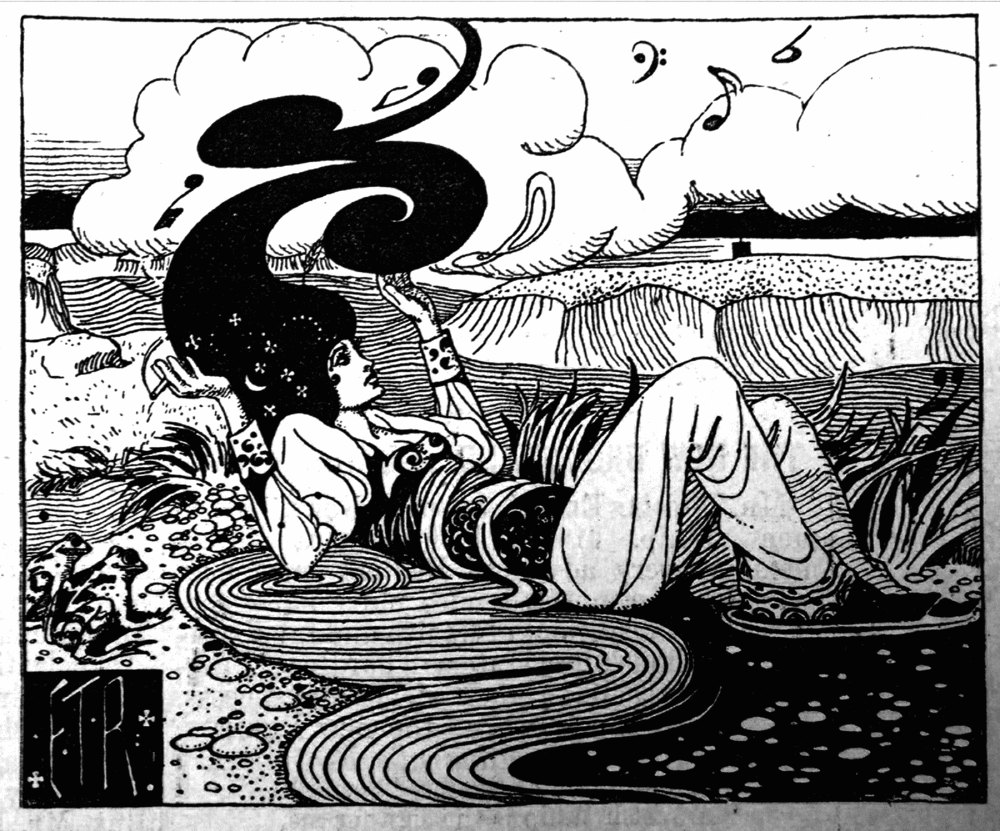
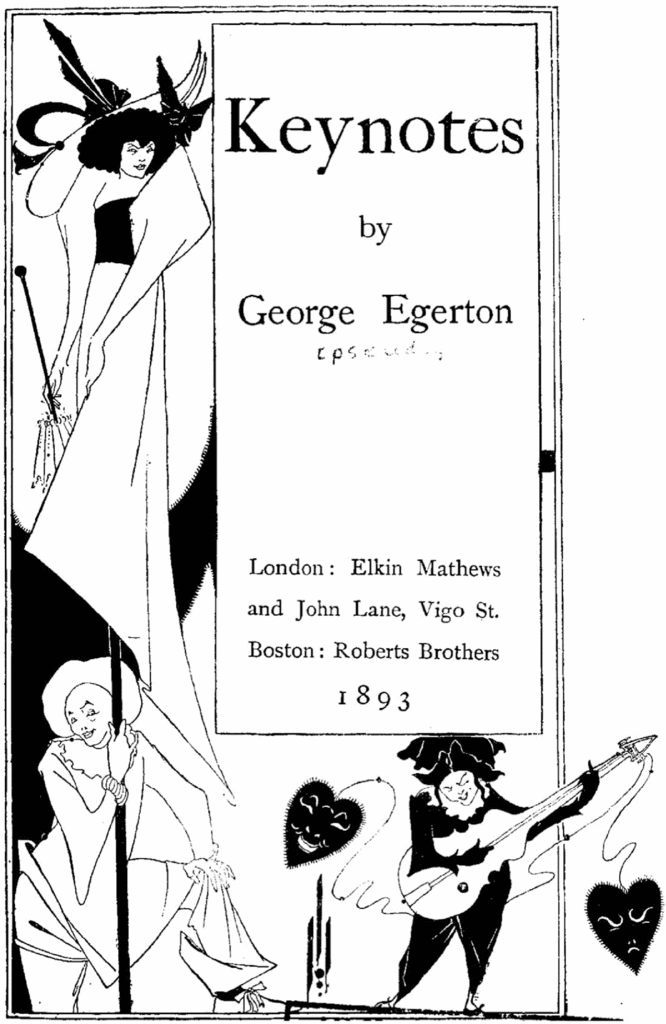
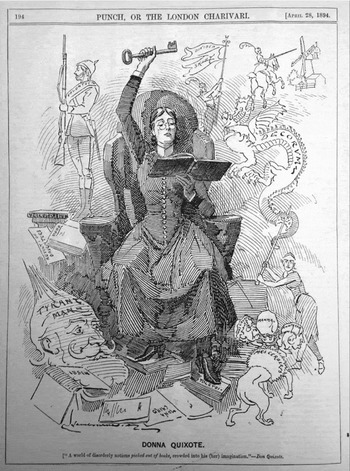
Unlike these more moderate feminist writers, however, Egerton did not endorse domesticity as an answer to women's appetitive wants. Indeed, many of her critics recognized Egerton's persistent focus on women's independent desire and thus coded her characters as perversely self-serving. In issues 10 and 17 of March 1894, for example, Punch magazine published two installments of “She-Notes” by Borgia Smudgiton, the pen name for Owen Seaman. The picture by “Whiskersly” (Edward Tennyson Reed) accompanying Seaman's satire (Figure 2) caricatures both Egerton's fiction as well as Aubrey Beardsley's original black-and-white ‘japonisme’ illustrations for Keynotes (including the cover and title-page design, as well as the “key” image for the series as a whole).Footnote 29 Egerton was, from the start, critical of Beardsley's attention-getting image of a female marionette posed atop a phallic pole and caressing her inner thigh (maybe a reference to feminine masturbation) (Figure 3), and her concern would later prove warranted when Reed's caricature seized upon the perverse and rewrote Egerton's heroine as sitting in the river and thus ‘wet,’ in a salacious reference to sexual arousal.Footnote 30 The female subject in Reed's illustration is not only absurd but also somewhat grotesque, dirty, and seated next to a frog – a mocking reference to her desire for a ‘prince’ mate. The detailing on her neckline is also suggestive of erect or aroused nipples, which are themselves nearly exposed by the low cut of her dress, and the black swirling pattern on her top complements and therein draws attention to her untamed and upswept hair, which is then mirrored by the curl of smoke from her cigarette. The combined effect is a picture of a ‘wild’ woman who is both sexual (wet with erect nipples) and untamed (the parallel between the hair and cigarette). This preoccupation with the New Woman's libidinal demand comes up again with the 28 April 1894 issue's cartoon caricature of a woman called “Donna Quixote” (Figure 4). The key in her hand immediately reminds us of “Keynotes,” and the words that surround this erudite woman evoke Egerton's central critique of gender “decorum” restricting women's social and sexual expression. Donna Quixote is surrounded by enemies such as “Tyrant man” and “Mrs. Grundy,” and as the caption reads, “a world of disorderly notions picked out of books crowded into his (her) imagination.” This New Woman is, in other words, unsexed by “his/her” undisciplined (“disorderly”) consumption of feminist ideas that only “crowd” her mind and corrupt her ability to embody normative gender roles.
Illustration by ‘Borgia Smudgiton’ [Owen Seaman] from “‘She-Notes’ with Japanese Fin de Siècle Illustrations by Mortarthurio Whiskersly.” Punch (10 Mar. 1894): 129.

Title-page for Keynotes (1893), original design by Aubrey Beardsley.

“Donna Quixote.” Illustration from Punch (28 Apr. 1894): 194.

Still other critics, such as Hugh Stutfield, recognized Egerton's fiction as part of a distinct phase in fin-de-siècle literature and, specifically, the movement away from an older generation of feminists whose works celebrated the hyper-sexualized Amazonian New Woman. Stutfield's essay “Tommyrotics” (1895) complains that too much of this feminist fiction is perversely fixated on sex, or what he calls “erotomania”:
the physiological excursion of our writers of neuropathic fiction are usually confined to one field – that of sex. Their chief delight seems to be in making their characters discuss matters which should not have been tolerated in the novels of a decade ago. Emancipated woman in particular loves to show her independence by dealing freely with the relations of the sexes. Hence all the prating of passion, animalism, “the natural workings of sex,” and so forth, with which we are nauseated. Most of the characters in these books seem to be erotomaniacs. (224)
The “emancipated woman” is, according to this history, obsessed with sex, and her “free” treatment of “matter” “not . . . tolerated in novels of a decade ago” marks her as unfeminine; she violates the rules of both literary and gender decorum by speaking openly and by rudely “prating of passion and animalism.” In his diatribe against this “neuropathic fiction,” Stutfield references works by notable authors such Henrik Ibsen and Sarah Grand, but he also singles out Egerton's second text, Discords (1895), for specific and positive attention: “the New Woman, or the ‘desexualized half-man,’ as a character in Discords unkindly calls her, is a victim of the universal passion for learning and ‘culture,’ which, when ill-digested, are apt to cause intellectual dyspepsia” (225). Stutfield sees in Egerton a like-minded critic of the perverse New Woman, and he makes this point by undermining fin-de-siècle feminists’ “ill-digested” ideas that are then reproduced in her “smattering and chattering” of conversation or writings (225). Yet, Egerton's fiction imagines a very different relationship between women's sexual and literary expression, one that is complementary rather than antagonistic.
Egerton certainly did distance herself from first-generation New Women writers (a point on which Stutfield is correct), and yet her frank account of appetitive women in Keynotes can be read as contributing to, rather than opposing, the fin-de-siècle shift in cultural attitudes toward bodily desire made popular by second-generation feminist writers. As Stetz notes, Egerton was indeed horrified to discover she was being compared to early New Women authors such as Olive Schreiner or Sarah Grand and refused participation in women's clubs on the grounds that such “advanced females” were “unsexed” by their political pursuits (‘George Egerton’ 67). “What [Egerton] wanted,” Stetz continues, “what she argued for in every book – were not civil rights but sexual rights for women” (68; emphasis original). This defense of women's libidinal appetites is something that Egerton's many readers – if not Stutfield – picked up on and exploited to popular literary ends. Most notable examples of this kind of critical engagement can be found in the aforementioned satirical images, “She Notes” and “Donna Quixote,” both of which also draw attention to the link between women's bodily desire and intellectual expression. The “She-Notes” illustration by Reed references Gipsy's daydreams about physical and sexual adventure. The opening scene in “A Cross Line” shows her reading by a river with her “busy brain” and “vivid imagination” actively “producing pictures” (Egerton, Keynotes 1), and again, mid-way through the text, Gipsy is shown “stretched on her back . . . at the side of a bog stream” (18) dreaming of Antony and Cleopatra's great romance. This latter scene, the subject of Reed's spoof, occurs while Gipsy is still deep into her affair with the grey-eyed man, and it would seem that her libidinal desire has prompted mental escape into a world where she is not restricted by appetitive regulation: “a great longing fills her soul to sail off somewhere too – away from the daily need of dinner-getting and the recurring Monday with its washing; life with its tame duties and virtuous monotony” (18–19). The “Donna Quixote” illustration makes a similar point about the reciprocal relationship between women's bodily desire and mental stimulation. The New Woman's ample frame suggests a substantial appetite (this is a woman who eats!), which is then mirrored by her hunger for information and literary expressions of feminist ideas. Of course, the image's title and caption are indication of the artist's critical attitude toward such intellectual ventures (Quixote himself is shown ‘tilting at windmills’ in the upper right corner), and yet one can also imagine how those readers looking for alternative representations of feminine embodiment would draw certain inspiration from the voracious New Woman who consumes texts by Mona Caird, Leo Tolstoy, and Ibsen in stark defiance of decorum and Mrs Grundy. Proudly holding above her head the same “key” found on the inside frontispiece to Keynotes, this feminist figure thus aligns herself with a literary movement that, thanks to writers like Egerton, helped usher in a new and imaginative representations of women's pleasure.
Conclusion: Ebb Tides and New Horizons
In giving voice to women's desire, Egerton positioned herself as part of a new generation of writers who took pleasure in, and encouraged, women's appetitive consumption. If popularity is any indication of cultural taste, Egerton's book marked a turning point in Victorian attitudes towards women's libidinal expression. Indeed, the Bodley Head, which was responsible for the volume, continued to reap substantial profits for the better part of five years after the first printing.Footnote 31 Keynotes was also translated into seven languages and enjoyed considerable success overseas, outselling all other short fiction writers (except Kipling).Footnote 32 The text enjoyed a particular popularity among women readers: “Mrs. Egerton had struck the fundamental chord in woman's nature,” Hansson writes in 1896, “and her book was received with applause by hundreds of women” (Six Modern Women 67). Sensing the opportunity, publisher John Lane issued a new “Keynotes Series” of publications on and by late-Victorian gender radicals in an attempt to exploit Egerton's popularity. The series included nineteen works of short stories and fourteen novels from prominent 1890s sexual radicals, such as Grant Allen (The Woman Who Did [1895]), Ella D'Arcy (Monochromes [1895]), Victoria Cross (The Woman Who Didn't [1895]), and E. Nesbit (In Homespun [1896]), to name but a few.Footnote 33 It is in this way that Egerton helped to usher in what Hansson refers to as a new “department” of women's fiction (71).
From start to finish, the stories in Egerton's Keynotes not only depict but also celebrate women's independent desire. Opening with “A Cross Line,” the volume stages a radical break from sexual conventions, a move which grabs readers’ attention, and the subsequent stories that fill the volume continue to surprise with their frank exploration of infidelity and raw attraction. At the same time, the sequence of stories charts the female protagonist's struggle against appetitive repression implicit in the domestic plot. The recurring picture of the unhappy and hungry woman sends a clear message: the conventions of love and gender are not worth woman's libidinal sacrifice. Instead, readers must wonder if an alternative sexual plot is not only happier but also healthier for the lovers involved. The volume's final story, “An Ebb Tide” (the last of the three-part “Under Northern Sky”), is no exception to this running theme. In the story's final scene, the widow rides aboard a tug bearing her lover's corpse “on a glorious lonely death-ride, out of the sunny fjord to the glistening sea, away to where the rainbow ends” (Egerton, Keynotes 179). While there is sadness in this scene (echoed by the ocean's “cadence of pity” [178]), there is also a feeling of comfort as the “pearl-mists” “wrap her in a chilly shroud” (183) and the breeze “soothes her troubled spirit with tender whisperings” (184). This is a picture of an embodied woman attuned to life around her and the physiological needs within her, but when the captain brings her fresh coffee and a warm jacket, she exchanges those natural comforts for material nourishments reminiscent of the domestic plot: “it [the coat] smells ‘homey’ with its mingled odour of tobacco, and brine, and man, and touches her chilled lone soul like the honest clasp of a warm human hand with a promise of rest and shelter to come” (184). We do not know if this intimate moment marks the beginning of a romance between the widow and the Captain, but even if not, we can still see a marked and positive change in her attitude toward men who nourish. Unlike other representations of love in the volume, this closing image of domesticity does not require feminine sacrifice; instead, love and “homey” comforts are expressed in sensual terms (‘smell’ and ‘touch’), while the appetitive woman takes equal pleasure in the “mingled odours” of both tobacco and man. We must wonder, therefore, if this last scene in fact marks a fresh chapter (“tide”) in the woman's life as she looks forward to the “warm hand” of love with a new man who, thinking of her bodily needs, will help rewrite the domestic plot to include feminine desire.
While “An Ebb Tide” is a story about death, it is also a story about new beginnings – a theme which therein mirrors the kind of cultural rupture the volume itself hoped to effect.Footnote 34 Certainly, the Bodley Head's revisions to the order of stories detracted from what Stetz correctly identifies as the semi-autobiographical potential of the textFootnote 35 but, at the same time, the decision to conclude with “An Ebb Tide” fits so well with Keynotes’s ongoing interest in the “promise” (184) of an alternative domestic plot that nourishes women's bodily needs. In a final twist, this last story leaves readers wanting, but not without hope, for as its last line reads: “He, to no mortal awakening; she, perchance to a brighter dawn” (184). The hesitation in ‘perchance’ is critical because it gestures toward both possibility and, with it, the reader's eager desire for more – more of the unconventional woman and her story. The final question, then, is whether there are, among such readers, New Men and sexual partners equal to the challenge of these appetitive New Women.