Implications
The current review describes the development of sustainable techniques to breed goats during the non-breeding season to avoid seasonality of milk, cheese and meat production. The use of these techniques to control goat reproduction can stabilize production all year round, reducing the wide variations in the producer incomes and allowing a continuous availability of fresh goat products to consumers.
Introduction
Goats are found in different ecological zones ranging from tropical to arctic latitudes and from humid to dry areas, and these animals have developed different reproductive strategies to reach a maximal survival of offspring. Under temperate latitudes (>40°), all breeds show marked reproductive seasonality (Mohammad et al., Reference Mohammad, Grossman and Vatthauer1984; Amoah et al., Reference Amoah, Gelaye, Guthrie and Rexroad1996). By contrast, under subtropical latitudes (23° to 40°), local or adapted breeds of goats showed different annual rhythm in their sexual activity. Some breeds display large seasonal variations in their sexual activity, while others show a weak seasonality or no seasonality at all as they display sexual activity all year round (Walkden-Brown and Restall, Reference Walkden-Brown and Restall1996). The reproductive seasonality causes a seasonal availability of the goat-derived products (such as milk, cheese or meat), which affects both producers and consumers. Indeed, prices of goat products decrease during the natural production period, reducing markedly the incomes of producers. By contrasts, fresh products are not available for consumers during the anestrous season (Chemineau et al., Reference Chemineau, Malpaux, Brillard and Fostier2007). Therefore, a good knowledge of the reproductive strategies of goats, and the identification of the main environmental factor responsible for the annual breeding season in males and females, is necessary to manipulate their reproductive activity and to have the opportunity to produce goat products all year round. In this paper, I will describe studies conducted on local goats from subtropical Mexico to determine their annual breeding season and to identify the role of the environmental cues on the development of the annual reproductive rhythm. Then, I will describe how the photoperiod was used in combination with the ‘male effect’ to develop sustainable breeding techniques for goat reproduction in a subtropical environment.
Subtropical climatic conditions and description of the goat management system in northern Mexico
Subtropical latitudes are geographical regions bounded by the Tropic of Cancer (23.5°N) and the Tropic of Capricorn (23.5°S). These subtropical latitudes are characterized by at least 8 months with a mean temperature of 10°C or above, and the rainfall patterns are highly variable ranging from hot deserts to humid forests. The studies described in this review were conducted using local goats from the semiarid Comarca Lagunera region in the State of Coahuila, Mexico (Latitude, 26°23′N and Longitude, 104°47′W). In this subtropical latitude, the photoperiod varies from 1336 h of light at the summer solstice to 1024 h of light at the winter solstice. This area is characterized by dry climate with a mean annual temperature of 21°C, ranging from 37°C between May and August to 6°C in December and January. The average annual rainfall is 266 mm (range: 163 to 504 mm) and the dry period lasts from November to May.
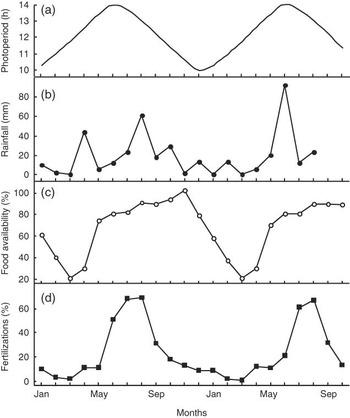
Mexico has a goat population of about 10 million spread under both subtropical and tropical (<23.5°N) latitudes. The Comarca Lagunera region is an important caprine production area with about 500 000 animals. The local goats are derived from the Spanish Granadina, Murciana and Malagueña breeds. These animals were crossed with Alpine, Saanen, Toggenbourg and Anglo-Nubian breeds during the last 60 years to improve milk and meat production. Kids are nursed by their mothers and are weaned and sold between 4 and 6 weeks of age. However, the sale of the female’s milk is the most important income source for producers. Females are usually kept with males in natural grazing conditions, eating only available natural vegetation without supplementary feed in the pen. From June to January, food availability (%) and the nutrient content of diets selected by goats decrease (June: 9.1% CP; 1.7 Mcal/kg; January: 7.4% CP; 0.9 Mcal/kg; Figure 1; Sáenz-Escárcega et al., Reference Sáenz-Escárcega, Hoyos, Salinas, Espinoza, Guerrero and Contreras1991; Ramírez et al., Reference Ramírez, Loyo, Mora, Sanchez and Chaire1991). At night, animals remain in outdoor pens (Sáenz-Escárcega et al., Reference Sáenz-Escárcega, Hoyos, Salinas, Espinoza, Guerrero and Contreras1991).
Annual changes in the photoperiod (a), rainfall (b), food availability (c) and fertilizations (d) of local female goats from subtropical Mexico maintained in contact with males under natural grazing conditions (adapted from Sáenz-Escárcega et al. (Reference Sáenz-Escárcega, Hoyos, Salinas, Espinoza, Guerrero and Contreras1991)).

Reproductive seasonality in subtropical male and female goats
Male goats
Interbreed differences in the length and the timing of the breeding season are found in subtropical male goats. For example, Angora bucks show marked seasonal variations in their libido and testicular size with a peak in autumn (Ritar, Reference Ritar1991). By contrast, Australian cashmere, Damascus and Rayini male goats display a moderate reproductive seasonality (Walkden-Brown et al., Reference Walkden-Brown, Restall, Norton, Scaramuzzi and Martin1994; Zamiri and Heidari, Reference Zamiri and Heidari2006; Ramadan et al., Reference Ramadan, Taha, Samak and Hassan2009). In cashmere goats, the breeding season, characterized by high levels of LH and testosterone, as well as the emission of a strong odor, begins in late spring and ends in late autumn (Walkden-Brown et al., Reference Walkden-Brown, Restall, Norton, Scaramuzzi and Martin1994). Finally, in native Korean bucks, sperm production did not vary between seasons (Chang-Yong et al., Reference Chang-yong, Jung-Gon, Sang-Rae, Dong-Soo, Young-Keun, Balasubramanian, Sang-Yong and Gyu-Jin2006).
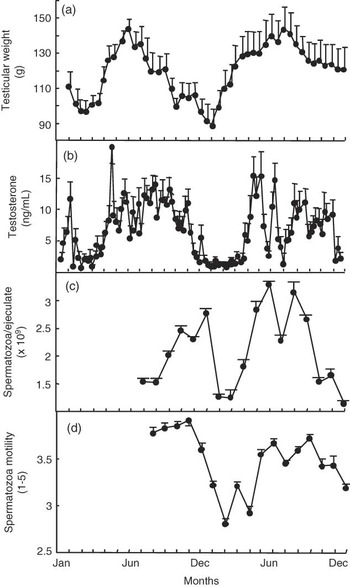
In local males from subtropical Mexico, a decrease in sexual behavior was reported in March and April. However, the annual sexual and endocrine activities (testosterone secretion, sexual behavior, quantitative and qualitative sperm production) were never evaluated in the same animals in these early studies (Sáenz-Escárcega et al., Reference Sáenz-Escárcega, Hoyos, Salinas, Espinoza, Guerrero and Contreras1991). As the rest season coincided with the dry season and consequently with a marked reduction in the quantity and quality of natural food availability in our location, it was hypothesized that undernutrition was the factor responsible for the decrease in male sexual activity during this period of the year, as reported previously in other subtropical breeds (Walkden-Brown et al., Reference Walkden-Brown, Restall, Norton, Scaramuzzi and Martin1994; Pérez-Clariget et al., Reference Pérez-Clariget, Forsberg and Rodríguez-Martínez1998). To test if undernutrition causes the seasonal decrease in sexual activity during the non-breeding season, testicular weight, testosterone secretion and sperm production were determined in male goats fed with alfalfa ad libitum and 200 g of a commercial concentrate when maintained in a shaded open pen under natural photoperiodic and temperature changes. In these males, testicular weight, plasma testosterone concentrations and quantitative as well as qualitative semen production varied seasonally and were higher during the breeding season, which lasts from late spring (May to June) to late autumn (December to January), than during the non-breeding season (Figure 2; Delgadillo et al., Reference Delgadillo, Canedo, Chemineau, Guillaume and Malpaux1999). These results showed that our male goats exhibited seasonal variation in their sexual activity even if they were housed indoors and received a nutritional level to meet their requirements, thus suggesting that the reduction in food availability observed during the rest season period is not the factor responsible for the reduction in the sexual and endocrine activities in these subtropical males. These results are in contradiction with the initial hypothesis of Sáenz-Escárcega et al. (Reference Sáenz-Escárcega, Hoyos, Salinas, Espinoza, Guerrero and Contreras1991) and suggest that male reproductive seasonality is an obligatory phenomenon controlled by other environmental factor(s) than nutrition. In addition, they indicated that Mexican bucks displayed a moderate reproductive seasonality, similar to that reported in other subtropical sheep and goat breeds (Walkden-Brown et al., Reference Walkden-Brown, Restall, Norton, Scaramuzzi and Martin1994; Pérez-Clariget et al., Reference Pérez-Clariget, Forsberg and Rodríguez-Martínez1998).
Seasonal variations (mean ± s.e.m.) in testicular weight (a), plasma testosterone concentrations (b), total number of spermatozoa per ejaculate (c) and progressive spermatozoa motility (d) in confined well-nourished local male goats from subtropical Mexico maintained in an open pen and subjected to natural photoperiodic and temperature changes (adapted from Delgadillo et al. (Reference Delgadillo, Canedo, Chemineau, Guillaume and Malpaux1999)).

Female goats
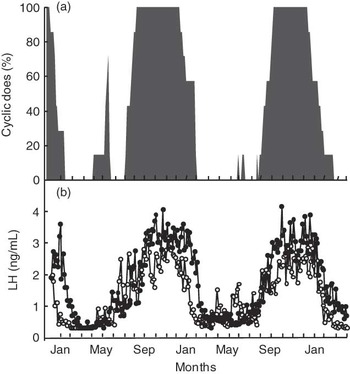
In females from subtropical latitudes, there is also an interbreed difference in the length and timing of the breeding season. In female goats from the subtropical latitudes of Australia and Argentina, estrous behavior and ovarian activity start in autumn and finish in winter (Restall, Reference Restall1992; Rivera et al., Reference Rivera, Alanis, Chaves, Ferrero and Morello2003). In contrast, local goats from Chile show only 3 months of anestrus in late spring and early summer (Santa Maria et al., Reference Santa Maria, Cox, Muñoz, Rodríguez and Caldera1990), while Boer goats in South Africa display estrous activity all year round, with the highest percentage of estrus in autumn (Greyling, Reference Greyling2000). In Mexican female goats, it was assumed that an anestrous period existed from March to May considering the marked reduction or absence of parturitions 5 months later, a duration corresponding to the gestation length in goats (Sáenz-Escárcega et al., Reference Sáenz-Escárcega, Hoyos, Salinas, Espinoza, Guerrero and Contreras1991). However, the annual sexual activity (estrous behavior and ovulatory activity) was never evaluated in the same non-pregnant females. As the anestrous period coincided with the dry season and, as a consequence, with a marked reduction in the quantity and quality of natural food availability in our location, it was hypothesized that undernutrition could be the factor responsible for the changes in their annual sexual activity, as reported previously in other subtropical breeds (Sáenz-Escárcega et al., Reference Sáenz-Escárcega, Hoyos, Salinas, Espinoza, Guerrero and Contreras1991; Walkden-Brown and Bocquier, Reference Walkden-Brown and Bocquier2000). However, in our location, the non-breeding season also coincides with an increase in day-length and a period of intense nursing of the kids (Figure 1). These environmental factors could be also involved in the expression of the anestrous period (Peters and Lamming, Reference Peters and Lamming1990; McNeilly, Reference McNeilly1994; Malpaux et al., Reference Malpaux, Migaud, Tricoire and Chemineau2001). To test if undernutrition was the factor responsible for the anestrous period, estrous behavior and ovulatory activity were determined in intact female goats fed with 2.7 kg of alfalfa and 200 g of commercial concentrate when maintained in a shaded open pen under natural photoperiodic and temperature changes. In addition, the influence of the management system (nutrition, temperature, socio-sexual relationships, etc.) on the annual breeding season was determined in ovariectomized does bearing a subcutaneous implant constantly releasing estradiol 17β (OVX + E). In these OVX + E females, LH secretion, an index of the ovulatory activity in intact females (Henniawati et al., Reference Henniawati, Restall and Scaramuzzi1995), was determined. One group of OVX + E females fed with 2.7 kg of alfalfa and 200 g of commercial concentrate was kept in a shaded open pen under natural photoperiodic and temperature changes. The other group of OVX + E females was kept in a local flock of intact females that included four males under extensive conditions eating only the spontaneously available natural vegetation. Intact does displayed large seasonal variations in their sexual activity (Figure 3). During the breeding season, which lasted from September to February, females showed regular estrous and ovulatory cycles (Duarte et al., Reference Duarte, Flores, Malpaux and Delgadillo2008). In OVX + E females, seasonal variations in LH secretion were also observed regardless of whether they were constantly fed indoors or kept under grazing conditions (Figure 3). Variations in LH secretion in OVX + E females were consistent with the ovulatory activity in intact ones with high LH levels coinciding with ovulatory activity and low levels with anovulation. The increase in LH secretion was similar in does maintained indoors or under grazing conditions and occurred in August. By contrast, the seasonal decline in LH secretion occurred earlier in females kept in grazing conditions (January) than in those kept indoors on a high level of nutrition (February; Duarte et al., Reference Duarte, Flores, Malpaux and Delgadillo2008). Taken together, these results showed that female goats exhibited seasonal variation in their sexual and endocrine activity even if they received a nutritional level to meet their requirements. Thus, the seasonal reduction in food availability does not appear as the factor responsible for the seasonal variations in the reproductive activity of females. It seems that, similar to what is observed in males of the same breed, reproductive seasonality of Mexican female goats is an obligatory phenomenon controlled by other environmental factor(s) than food availability. The difference of 1 month in the decline in LH secretion between OVX + E females maintained indoors or in extensive conditions was probably due to the drastic reduction in food availability observed at the beginning of each year in our subtropical location (Sáenz-Escárcega et al., Reference Sáenz-Escárcega, Hoyos, Salinas, Espinoza, Guerrero and Contreras1991). The delay in LH secretion observed in indoor OVX + E females suggests that nutrition could be a modulatory factor in the timing of the breeding season. Indeed, the ovulatory activity in intact highly and constantly fed goats and ewes is longer than in undernourished ones (Forcada and Abecia, Reference Forcada and Abecia2006; De Santiago-Miramontes et al., Reference De Santiago-Miramontes, Malpaux and Delgadillo2009). The pattern of the reproductive seasonality observed in this study agrees with those reported in breeds from subtropical and temperate latitudes in which the natural breeding season occurs in autumn and winter (Chemineau et al., Reference Chemineau, Daveau, Maurice and Delgadillo1992; Restall, Reference Restall1992).
Seasonal variations in the percentage of female goats showing cyclic ovulatory activity (a), or LH secretion (b; mean ± s.e.m.) in ovariectomized estradiol-treated local female goats from subtropical Mexico maintained in open pens (●) or natural grazing conditions (○) and subjected to natural variations of photoperiodic and temperature changes (adapted from Duarte et al. (Reference Duarte, Flores, Malpaux and Delgadillo2008)).

Taken together, these results demonstrate that local male and female goats in subtropical Mexico display seasonal variations in their sexual and endocrine activities. Nutrition levels do not appear to be the main factor controlling the sexual activity in this subtropical breed.
Photoperiod is the major environmental cue that triggers the annual breeding season in subtropical goats
The year-to-year repeatability of the annual reproductive cycle in highly and constantly fed does and bucks from subtropical Mexico suggests that these animals use the photoperiod to synchronize their breeding season. To test this hypothesis, female and male goats were submitted to alternations between short and long days mimicking, respectively, the winter and summer solstice day-length.
Male goats
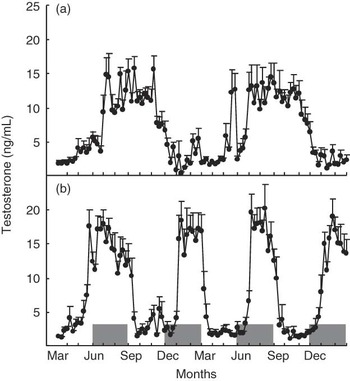
In subtropical Merino rams, it was clearly shown that the reproductive axis is driven by photoperiodic changes. Indeed, testosterone secretion increases during artificial short days and decreases during artificial long days (Poulton and Robinson, Reference Poulton and Robinson1987). In Angora bucks adapted to a subtropical latitude, rapid changes between long and short days modified the reproductive seasonality observed in natural conditions suggesting an important role of the photoperiod in the synchronization of their annual breeding season (Morello et al., Reference Morello, Alvarez, Medina, Bogado, Quintana, Venturino and Aisen2004). To test if the photoperiod was the factor responsible for the annual reproductive rhythm observed in our subtropical male goats, testosterone secretion was determined in bucks exposed, in a light-proof building, to alternations between 3 months of subtropical long days (14 h of light/day) and 3 months of subtropical short days (10 h of light/day). Control male goats remained in a shaded open pen under natural photoperiodic and temperature variations. As expected, in the control group, plasma testosterone concentrations showed large seasonal variations increasing in May to June and decreasing in November to December. By contrast, in the experimental group, testosterone secretion increased invariably during short days and decreased during long days (Figure 4; Delgadillo et al., Reference Delgadillo, Cortez, Duarte, Chemineau and Malpaux2004). These results showed that in male goats from subtropical Mexico, the photoperiod is the major environmental factor that controls the annual breeding season. In the experimental group, the photoperiodic rhythm modified the seasonality of testosterone secretion observed in control animals exposed to natural light variations as reported in Alpine bucks and Soay rams (Lincoln and Short, Reference Lincoln and Short1980; Delgadillo and Chemineau, Reference Delgadillo and Chemineau1992).
Changes (mean ± s.e.m.) in plasma testosterone concentrations in local male goats from subtropical Mexico subjected to natural photoperiodic variations (a) or to alternations between 3 months of long days (14 h of light/day) and 3 months of short days (10 h of light/day; b). Gray areas indicate the months of short days (adapted from Delgadillo et al. (Reference Delgadillo, Cortez, Duarte, Chemineau and Malpaux2004)).

Female goats
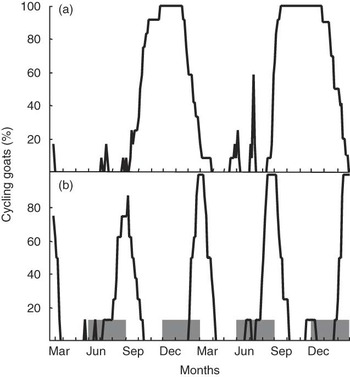
In subtropical sheep and female goats, a role of photoperiod on the annual reproductive rhythm was suggested. Indeed, on the four Merino ewes subjected to alternations between subtropical long and short days, only one responded to the treatment (Poulton and Robinson, Reference Poulton and Robinson1987). In addition, in subtropical Egyptian ewes, annual sexual activity was modified by a long-day and melatonin treatment (Aboul-Naga et al., Reference Aboul-Naga, Aboul-Ela and Hassan1992). To test whether the photoperiod was the factor responsible for the annual reproductive rhythm observed in our subtropical female goats, ovarian activity was determined in does exposed to the same experimental conditions described above in males. As expected, the control group displayed large seasonal variations in their ovulatory activity, which lasted from September to February, as in other subtropical and temperate breeds of sheep and goats (Chemineau et al., Reference Chemineau, Daveau, Maurice and Delgadillo1992; Restall, Reference Restall1992; Rivera et al., Reference Rivera, Alanis, Chaves, Ferrero and Morello2003). The experimental group also displayed changes in their ovulatory activity, but the timing of these changes was profoundly modified by photoperiodic treatment. In the experimental group, the ovulations started during short days and ended during long days (Figure 5; Duarte et al., Reference Duarte, Nava-Hernández, Malpaux and Delgadillo2010). These results showed that in female goats from subtropical Mexico, the photoperiod is a major environmental factor that controls the annual ovulatory activity. In the experimental group, the photoperiodic rhythm modified the seasonal pattern of ovulations observed in the control group exposed to natural light, a result consistent with those reported in Alpine does and Suffolk ewes (Karsch et al., Reference Karsch, Bittman, Foster, Goodman, Legan and Robinson1984; Gebbie et al., Reference Gebbie, Forsyth and Arendt1999).
Changes in cyclic ovulatory activity in local female goats from subtropical Mexico subjected to natural photoperiodic variations (a) or to alternations between 3 months of long days (14 h of light/day) and 3 months of short days (10 h of light/day; b). Gray areas indicate the months of short days (adapted from Duarte et al. (Reference Duarte, Nava-Hernández, Malpaux and Delgadillo2010)).

These results clearly showed that the local male and female goats from subtropical Mexico were sensitive to the photoperiod and suggested that this environmental factor was important in the timing of the annual reproductive rhythm. In addition, they suggested that the photoperiod could be used to induce sexual activity in both males and females during the non-breeding season as in goat breeds from temperate latitudes (Chemineau et al., Reference Chemineau, Malpaux, Brillard and Fostier2007).
Control of the sexual activity of male and female goats
In goat and sheep breeds from temperate latitudes, the sexual activity of males and females can be induced during the non-breeding season using long days followed by short days or melatonin treatment, a pineal hormone that can mimic the effects of short days (Hanif and Williams, Reference Hanif and Williams1991; Donovan et al., Reference Donovan, Boland, Roche and O’Callaghan1994; Sweeney et al., Reference Sweeney, Donovan, Roche and O’Callaghan1997). We tested different photoperiodic treatments to stimulate the sexual activity of males during the non-breeding season. We did not test the effect of these treatments in females because, in subtropical Mexico, most local goats remain in precarious open pens at night, making it difficult to expose them to photoperiodic treatment. In females, it was rather decided to stimulate their sexual activity by acute exposure to males, a technique known as the ‘male effect’ (Chemineau et al., Reference Chemineau, Pellicer-Rubio, Lassoued, Khaldi and Monniaux2006; Delgadillo et al., Reference Delgadillo, Gelez, Ungerfeld, Hawken and Martin2009; Bedos et al., Reference Bedos, Flores, Fitz-Rodríguez, Keller, Malpaux, Poindron and Delgadillo2010). Indeed, exposure of anestrous does or ewes to rams or bucks, respectively, induces the rapid activation of LH secretion leading to estrous behavior and ovulation. Several factors can modify the ovulation and estrous responses of females exposed to males, including the intensity of the sexual behavior. In fact, a major limitation of the ‘male effect’ is that the sexual response of females is weak or absent when it is performed during mid-seasonal anestrus, probably because of the low sexual behavior of males, which are also in rest season at this time (Restall, Reference Restall1992; Flores et al., Reference Flores, Véliz, Pérez-Villanueva, Martínez de la Escalera, Chemineau, Poindron, Malpaux and Delgadillo2000; Delgadillo et al., Reference Delgadillo, Flores, Véliz, Duarte, Vielma, Hernandez and Fernandez2006). Therefore, it was tested if this limitation of the ‘male effect’ could be circumvented by the use of males rendered sexually active by a previous exposure to photoperiodic treatments.
Long days, melatonin and the ‘male effect’
Males from the control group were exposed to natural day-length, while another group of males was exposed to long days (16 h of light/day) from November 1 to January 15. On January 16, males of the experimental group received two subcutaneous ear melatonin implants and were then exposed to natural photoperiodic changes. This light-treatment during the non-breeding season stimulated LH and testosterone secretion, sexual behavior and sperm production from the end of February to the end of April (Delgadillo et al., Reference Delgadillo, Carrillo, Morán, Duarte, Chemineau and Malpaux2001). Then, we tested whether these photoperiod-treated bucks could stimulate the sexual activity of anestrous goats. For this purpose, three treated and three control bucks were placed with anovulatory goats maintained in open pens. The photoperiod-treated males induced estrous behavior in all females (40/40) in the first 11 days after their introduction. By contrast, no behavioral activity was observed in females exposed to the light-untreated males during the same period (Flores et al., Reference Flores, Véliz, Pérez-Villanueva, Martínez de la Escalera, Chemineau, Poindron, Malpaux and Delgadillo2000). These were our first results showing that the photoperiod could be used indirectly to stimulate the sexual activity of anovulatory goats.
Long days and the ‘male effect’
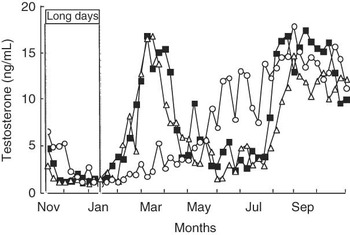
To simplify the photoperiodic treatment used in males, we first tested whether melatonin implants were necessary to stimulate the sexual activity of our local bucks. Indeed, during long-day treatments, animals are exposed to 16 h of light/day. When long-day treatment was stopped in January, males were exposed to natural photoperiodic changes, that is, about 11 h of light/day, and this day-length was shorter than the previous artificial long days. This reduction in day-length may provide a sufficient stimulatory signal (Robinson and Karsch, Reference Robinson and Karsch1987). Thus, two groups of males were kept in two shaded open pens and exposed to artificial long days (16 h of light/day) from November 1 to January 15. On January 16, the light treatment was stopped and one group of bucks received two subcutaneous ear melatonin implants while the second group did not. Control males remained in a shaded open pen under a natural photoperiod throughout the experiment. In both long-day treated groups, plasma testosterone concentrations did not differ and were higher than in controls from February to April, during the non-breeding season, indicating that the long-day treatment stimulated the endocrine testes activity, and that melatonin was not necessary for this stimulation (Figure 6; Delgadillo et al., Reference Delgadillo, Flores, Véliz, Hernández, Duarte, Vielma, Poindron, Chemineau and Malpaux2002). Then, we tested the efficiency of the only long-day treated bucks to stimulate the sexual activity of the anestrous goats. For this purpose, two light-treated and two control bucks were placed with anovulatory goats maintained in open pens. The proportion of females that displayed estrous behavior was greater in those exposed to the light-treated bucks (19/19) than in those exposed to light-untreated ones (2/20; Delgadillo et al., Reference Delgadillo, Flores, Véliz, Hernández, Duarte, Vielma, Poindron, Chemineau and Malpaux2002). Interestingly, the light-treated males could also stimulate the estrous behavior of female goats maintained under extensive conditions. In fact, the proportion (18/20) of females that displayed estrous behavior was higher when they were left permanently in pens and grasslands with sexually active males than with sexually inactive ones (9/20; Rivas-Muñoz et al., Reference Rivas-Muñoz, Fitz-Rodríguez, Poindron, Malpaux and Delgadillo2007). In addition, a high behavioral response (>90%) was also obtained when males remained in the open pen during the day while females grazed in open range (Rivas-Muñoz et al., Reference Rivas-Muñoz, Fitz-Rodríguez, Poindron, Malpaux and Delgadillo2007; De Santiago-Miramontes et al., Reference De Santiago-Miramontes, Rivas-Muñoz, Muñoz-Gutiérrez, Malpaux, Scaramuzzi and Delgadillo2008; Fitz-Rodríguez et al., Reference Fitz-Rodríguez, De Santiago-Miramontes, Scaramuzzi, Malpaux and Delgadillo2009).
Changes (mean ± s.e.m.) in plasma testosterone concentrations in local male goats from subtropical Mexico subjected to natural photoperiodic variations (○, or to 2.5 months of artificial long days (16 h of light/day) from November 1, and then treated with two s.c. melatonin implants (▵) or exposed to natural short days (▪) (adapted from Delgadillo et al. (Reference Delgadillo, Flores, Véliz, Hernández, Duarte, Vielma, Poindron, Chemineau and Malpaux2002)).

These results showed that artificial long days followed or not by melatonin implants stimulate the sexual behavior of bucks during the non-breeding season. These photoperiodic treatments can be applied in open pens, making them easy to use in semiarid subtropical conditions. In addition, and more importantly, the photoperiodically treated males can stimulate the sexual activity of anestrous goats raised in confined or extensive conditions. These data showed that in our subtropical breed, females do not need to be submitted to photoperiodic treatment to obtain a high sexual response when exposed to the light-treated males as reported in the Alpine breed raised in temperate latitudes (Chemineau et al., Reference Chemineau, Normant, Ravault and Thimonier1986; Pellicer-Rubio et al., Reference Pellicer-Rubio, Leboeuf, Bernelas, Forgerit, Pougnard, Bonné, Senty and Chemineau2007). The indirect use of a photoperiod to control the sexual activity of females by means of sexually active males is a sustainable breeding technique for goat reproduction in the subtropics. The high response induced by the light-treated males could be due to the fact that photoperiodic treatment stimulates testosterone secretion, the odor of males and their sexual behavior, improving the quality of signals provided by the males to does during the ‘male effect’ (Delgadillo et al., Reference Delgadillo, Flores, Véliz, Duarte, Vielma, Hernandez and Fernandez2006; Murata et al., Reference Murata, Wakabayashi, Kitago, Ohara, Watanabe, Tamogami, Warita, Yamagishi, Ichikawa, Takeuchi, Okamura and Mori2009). Indeed, it was recently shown that the sexual behavior displayed by the sexually active males contributes to the maintenance of high LH secretion, allowing a higher rate of ovulations in does exposed to these light-treated males (Vielma et al., Reference Vielma, Chemineau, Poindron, Malpaux and Delgadillo2009).
Conclusion
This review indicates that knowledge of the reproductive characteristics of both male and female goats and the characterization of the role of environmental cues is a useful tool to develop relevant techniques to manipulate the sexual activity of animals. In our case, the identification of the photoperiod as the main environmental cue controlling the annual breeding season in our subtropical goats allowed us to develop original techniques to control the reproductive activity of does. Indeed, the manipulation of the photoperiodic environment stimulates the sexual activity of males, which in turn was used to induce and synchronize the estrous behavior and ovulations in anovulatory goats by the phenomenon called the ‘male effect’. In addition, the sexually active males improve the sexual response of does, even in conditions in which the male effect had been previously described as poorly efficient. The manipulation of the photoperiod as well as social relationships are two strategies to ensure a sustainable control of goat reproduction in the subtropics.
Acknowledgments
I express my deepest thanks to Philippe Chemineau for giving me the opportunity to do my PhD in his laboratory and allowing me to discover the fascinating world of caprine reproduction. My warmest thanks goes also to Benoît Malpaux for his unconditional friendship during all these years of collaboration; I much appreciate the comments, advice and support that he gave me during this time. I also very much appreciate the friendship of Pascal Poindron who introduced me to the fascinating study of the maternal and sexual behavior of goats; his decision to participate in the development of our goat program of reproduction contributed to its success. I am also grateful to Dolores López for her great contribution and friendship in the development of our research program by her infallible secretarial and administrative assistance during all these years. You all will find in this review the results of the great support you provided to me to initiate this fantastic goat reproduction history and to build the Centro de Investigación en Reproducción Caprina (CIRCA). I also thank the past and present members of the CIRCA for their dedicated participation in the experiments described in this review, especially G. Duarte, J. A. Flores, H. Hernández, J. Vielma, G. Fitz-Rodríguez and I. G. Fernández. I appreciate very much the comments of M. Keller that improved this manuscript and for his kind help in the correction of the English. J. A. Delgadillo was supported by the International Foundation of Science (grant B/2071-3F) and the exchange program between Mexico (ANUIES, SEP, CONACYT) and France (ECOS; M02-A04 and M95-B05 grants) in carrying out the described experiments.