1 Introduction
1.1 Preliminaries
This article examines the calling contour (henceforth CC), also known as the ‘vocative chant’ or ‘stylised fall’, first noticed and probably most fully described for English (Pike Reference Pike1945, Abe Reference Abe, Sovijärvi and Aalto1962, Liberman Reference Liberman1975, Gibbon Reference Gibbon1976, Leben Reference Leben1976, Ladd Reference Ladd1978, Reference Ladd1980, Reference Ladd1983, Reference Ladd1996, Pierrehumbert Reference Pierrehumbert1980, Gussenhoven Reference Gussenhoven1983, Reference Gussenhoven, van der Hulst and Smith1985, Reference Gussenhoven2004, Bolinger Reference Bolinger1986, Reference Bolinger1989, Grice Reference Grice1995, Grice et al. Reference Grice, Ladd and Arvaniti2000, etc.). The CC has been reported to occur in several other languages, too, including Hungarian (Varga Reference Varga1989, Reference Varga and Lewis1995, Reference Varga2002, Ladd Reference Ladd1996), but it has been claimed that it may be associated with syllables differently in different languages (Ladd Reference Ladd1996: 139).
The general characteristic of the CC in both English and Hungarian is the presence of two ‘terraces’, i.e. two level stretches of pitch, each marked by a high tone, the second being somewhat lower than the first. The interval between the two terraces is typically a minor third. This is illustrated by (1a’ for Hungarian and (1b’ for English. The diagrams demonstrate the schematic pitch pattern of the contour, using small lines to indicate syllabic pitch heights and pitch movements, and putting a dot at the beginning of the small line if the syllable which it represents is accented. The long horizontal line at the bottom of the diagrams represents the lower limit of the speaker's pitch range.Footnote 1
(1)


The CC is said to be the stylised version of the plain fall (Ladd Reference Ladd1980: 173–179, Gussenhoven Reference Gussenhoven, van der Hulst and Smith1985: 122). The plain fall ends on the lower limit of the speaker's voice, with a considerable drop in pitch during or right after the accented syllable, as in (2’.
(2)
For the metrical aspects of the CC, I will adopt a three-degree system of phonological prominence (Varga Reference Varga2002: 127; cf. also Gussenhoven Reference Gussenhoven1991), distinguishing unstressed, stressed and accented syllables. A stressed syllable is defined as a syllable that stands out by its extra intensity (and, in English, by its non-reduced vowel quality) and/or by junctural or durational stress markers. An accented syllable is a syllable that is not merely stressed, but is also intonationally prominent, i.e. it is a stressed syllable that has become accented by being associated with a pitch accent. The other syllables are unstressed. In the examples in this article, accented syllables will be marked [ˈ], and the unaccented but stressed ones will be marked [ˌ]. This threefold division of syllabic prominence is sufficient for Hungarian. In the English examples, however, the stressed syllables will sometimes be differentiated further, because the strongest postnuclear stress may also be relevant to the issues discussed below.
Borrowing Ladd's (Reference Ladd1983, 1996) autosegmental notation, the CC in Hungarian (and in other languages when comparison is needed) will initially be represented as H* !H. In this initial notation the starred H tone is a monotonal pitch accent, i.e. a tone that lends extra prominence to an already stressed syllable with which it is associated, thus making that syllable accented. The exclamation mark indicates a downstep in the second H tone. So (1a’ and (1b’ will be represented as (3a’ and (3b’ respectively.
(3)
Illustrative pitch tracks of the Hungarian examples are provided in some cases (see Figs 1–7). These examples are recordings of my own speech; native speakers who have heard them are of the opinion that they are natural CC realisations.
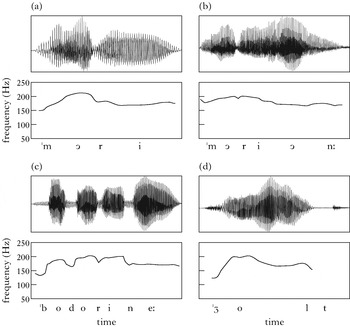
Spectrograms and pitch tracks for the examples in (4’: (a) ˈMari!; (b) ˈMariann!; (c) ˈBodoriné!; (d) ˈZsolt!.

1.2 Scope of the article
The article concentrates on the CC in Hungarian, but will also systematically compare its formal properties with those of its English counterpart and occasionally with those of the CCs of other languages. This comparison is a step towards establishing a typology of CCs. In addition, the article offers a brief critical survey of the recent literature on the phonological analysis and representation of the English CC, and then carries out a phonological analysis of the Hungarian CC, suggesting a representation based on that analysis.
The emphasis will be on the formal and representational aspects of the contour. The uses of the CC will not be discussed, because I have nothing substantial to add to the existing accounts of this aspect of the CC in English (Ladd Reference Ladd1980, Reference Ladd1996) or Hungarian (Varga Reference Varga and Lewis1995, Reference Varga2002). The Hungarian data confirm Ladd's proposal that the most important criterion of the uses of this contour is ‘routine’, which means that the CC is used in utterances referring to predictable, everyday, domestic events. A secondary criterion (which is perhaps stronger in Hungarian than in English) is that there is some real or metaphorical distance between speaker and hearer, including the lack of eye-contact between them.
§2 discusses the formal properties of the CC in three types of environment. §2.1 examines them in utterances with one accented syllable and no postaccentual stresses, and claims that in this environment the formal features of the Hungarian and English CC are practically identical: the second terrace of the CC is on the last syllable. Ladd's (Reference Ladd1996: 138) opinion that the Hungarian and French versions of the contour belong to the same formal type is refuted. §2.2 studies cases where the utterance with the CC has one accented syllable and one or more postaccentual stressed syllables. Here Hungarian is insensitive to the postaccentual stresses, so that the second terrace of the CC continues to appear on the last syllable, while English is sensitive to them, with the second terrace starting on the strongest (but in some cases on the first) postaccentual stress. §2.3 focuses on utterances with several accented syllables. The most striking feature of Hungarian in this environment is that the CC can recur on each accented syllable, which does not happen in English.
§3 is devoted to the phonological analysis and representation of the CC. §3.1 discusses Ladd's (Reference Ladd1983, 1996) general analysis of the contour (H* !H), §3.2 compares it with the more abstract and language-specific analyses of the English CC offered by Pierrehumbert (Reference Pierrehumbert1980), Grice et al. (Reference Grice, Ladd and Arvaniti2000) and Gussenhoven (Reference Gussenhoven2004), and argues in favour of the representation H* !H-L%. §3.3 starts the analysis of the Hungarian CC, and demonstrates that in Hungarian the second H in the CC is neither a trailing tone nor a boundary tone, but a phrase tone (H-). §3.4 examines the issue of boundary tones, which have to be recognised at least at the end of an utterance-final Hungarian CC. It is shown that the Hungarian boundary tone cannot be L% (the boundary tone in the English CC), because in Hungarian the L% boundary tone indicates a falling stretch after H- (cf. Grice et al. Reference Grice, Ladd and Arvaniti2000: 150). In order to avoid the ambiguity of H-L% in one and the same language, it is suggested that an utterance-final Hungarian CC should end in a zero boundary tone (0%). Thus the article provides support for the existence of a ‘tone-preserving’ boundary tone, proposed for German by Grabe (Reference Grabe1998). §3.5 examines additional support for the idea of a zero boundary tone, coming from the falling contours of Hungarian, and argues that these contours are best analysed as sequences of a bitonal pitch accent (H*+L) and a boundary tone (L%, H% or 0%), with no intervening phrase tone. §3.6 concentrates on utterance-internal Hungarian CCs, and concludes that these can be analysed as intermediate phrases (each ending in a !H- phrase tone, in the sense of Beckman & Pierrehumbert Reference Beckman and Pierrehumbert1986).
2 Remarks on formal properties
2.1 The type A environment
Utterances provide three types of environment for the CC. These depend on whether there is one or more than one accented syllable in the utterance, and, if there is only one accented syllable, whether or not there are any stressed syllables after it. The formal properties of the CC will now be discussed according to these environment types.
In the type A environment, the utterance has one accented syllable, which is followed by only unstressed syllables or no syllables at all. As described in Varga (Reference Varga and Lewis1995, Reference Varga2002: 44–47), the higher terrace here starts on the accented syllable and continues up to the last syllable, while the lower terrace is located on the last syllable. In examples (4a–c), the syllables after the accent are unstressed. When there are no further syllables after the accented one, the accented syllable alone accommodates both terraces (see (4d’). The pitch tracks of these utterances are shown in Fig. 1.
(4)
In Fig. 1, there is a slight rise in pitch at the very beginning of the first terrace in each utterance. This is a phonologically insignificant (and practically inaudible) phenomenon, which is due to the fact that it takes some time for the vocal cords to reach the target pitch height of the first terrace. What is significant (and clearly audible) is the lower pitch on the last syllable.
When the Hungarian CC is at the end of the utterance (this is not the only possibility, as we shall see in §2.3), the last syllable of the CC can be lengthened (Varga Reference Varga and Lewis1995: 279); see the examples in (5’. When the CC is spread over two syllables, lengthening may affect the penultimate syllable, too, if it has a long vowel or its coda is a sonorant consonant. This is why lengthening can occur in either the final syllable, or in both the final and penultimate syllables, as is shown in (5’. I indicate this by tripling the vowel letter of the relevant syllables. The lengthening is optional, but when it is present, it can be easily heard. However, the lengthening is phonetic in the sense that it does not change the phonological identity of the affected vowel; for example, the [ɔ] in Dalma, however long, does not acquire the quality of long [aː].
(5)
The facts of CC-final lengthening will become relevant when we discuss the representation of Hungarian CCs in §§3.4 and 3.6.
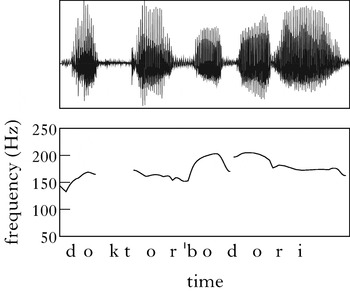
When there are unaccented syllables before the accented syllable in the utterance, these syllables form a low (L) sequence; see (6’ and Fig. 2.
(6)
In the type A environment, the formal characteristics of the Hungarian CC are practically identical to those of the English CC (for descriptions of the latter see e.g. Pike Reference Pike1945, Crystal Reference Crystal1969, Ladd Reference Ladd1980, Reference Ladd1983, Reference Ladd1996, Gussenhoven Reference Gussenhoven1983, Reference Gussenhoven, van der Hulst and Smith1985, Reference Gussenhoven2004). The various instantiations of the CC in English are illustrated in (7’, and are formally parallel with the Hungarian examples in (4’.Footnote 2
(7)
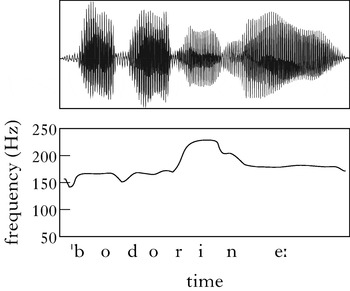
In Hungarian, in addition to its prototypical form, exemplified in (4’, the CC has a special variant in which the first, higher, terrace is replaced by a clearly audible rising stretch; see Varga (Reference Varga and Lewis1995: 282–283). This variant has a playful, soothing, confidence-building effect, as opposed to the basic form, which is emotionally neutral and can, in some situations, be pragmatically interpreted as unfriendly. The initial rise is represented as L*H, because, whenever there are more than two syllables at the contour's disposal, the accented syllable is definitely low. Examples are given in (8’; Fig. 3 contains the pitch curve of (8c’.Footnote 3
(8)
Figure 3 shows that in this variant the pitch rise is phonologically significant and replaces the entire first terrace of the CC (compare Figs 1c and 3).
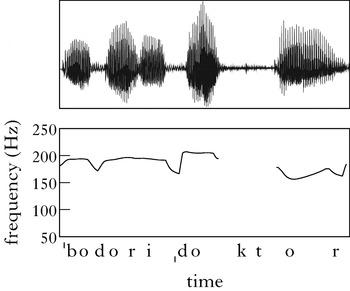
Spectrogram and pitch track for the example in (6’: Doktor ˈBodori!.

Spectrogram and pitch track for the example in (8c’: ˈBodoriné!.

Examples like those in (8’ may create the impression that in Hungarian, just as in French, the two terraces are associated with the last two syllables no matter where the accent falls. This is Ladd's (Reference Ladd1996: 138) conclusion. But this conclusion does not seem to be justified. This is what we find in French.Footnote 4
(9)
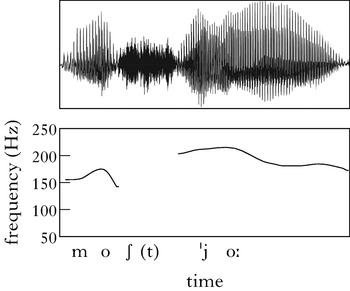
The H !H sequence in Hungarian is associated with the last two syllables in the special variant of the CC, shown in (8’, but in this variant the first H is the end-point of a rise (which starts on the accented syllable), not the starting point of a terrace. In the prototypical form of the Hungarian CC, which consists of two terraces, the initial H must be associated with a stressed syllable (which thus becomes accented, and the starting point of the first terrace). For instance, in a disyllabic Hungarian utterance which consists of an unaccented syllable followed by an accented syllable, it is impossible to deploy the H !H sequence on both syllables (see (10a’). (This would be possible in French; see (9b’ above.) In Hungarian, it is the final, accented, syllable that receives both terraces of the CC, and the unaccented syllable before it remains low (see (10b’, shouted by one cable-laying worker to another, whom he could not see). The pitch track is provided in Fig. 4.
(10)
Spectrogram and pitch track for the examples in (10b’: Most ˈjo!.

2.2 The type B environment
Let us now consider the type B environment, i.e. utterances that have one accented syllable followed by syllables of which one or more are stressed. Here there is considerable difference between English and Hungarian.
In English, where there is one postaccentual stressed syllable, the lower terrace will start on that postaccentual stressed syllable (see e.g. Gussenhoven Reference Gussenhoven2004: 57).
(11)
In this way the CC can be used as a diagnostic device for discovering postaccentual stresses in English (Liberman Reference Liberman1975, Hayes Reference Hayes1995, Gussenhoven & Bruce Reference Gussenhoven, Bruce and van der Hulst1999, Grice et al. Reference Grice, Ladd and Arvaniti2000, Gussenhoven Reference Gussenhoven2004: 314), which is important in view of the difficulties of identifying such stresses (see Burzio Reference Burzio1994: 48).
In Hungarian, the presence of stresses in the postaccentual region does not affect the realisation of the CC, and the lower terrace invariably starts on the final syllable, just as it does in the type A environment. In (12’ the syllable dok- can be stressed, but the lower terrace is still located on the last syllable, -tor. The pitch track of the example is shown in Fig. 5.
(12)
This is why Hungarian speakers of English, even those with an excellent command of the language, tend to realise (11a’ and (11b’ as the unacceptable (13a’ and (13b’.
(13)
When there is more than one stressed syllable after the accented syllable, the form of the Hungarian CC is unchanged, i.e. the lower terrace remains on the last syllable, irrespective of the places of the stresses. In (14’, the name Bodori is contrastively accented (this is indicated by the use of small capitals), and the words following it are (or can be) stressed on their first syllables. These stresses do not affect the distribution of the levels, and the lower level is restricted to the last syllable.
(14)
In English, one of the postaccentual stresses will start the lower terrace, but it is not quite clear which. Ladd (Reference Ladd1996: 215) and Grice et al. (Reference Grice, Ladd and Arvaniti2000: 176), following Leben (Reference Leben1976), propose that the downstepping H tone appears on the most prominent postaccentual stress, preferably on a word stress, as in (15a’, or, if there is no word stress, on a foot stress, as in (15b’ (from Grice et al. Reference Grice, Ladd and Arvaniti2000: 176).
(15)
However, Gussenhoven (Reference Gussenhoven, van der Hulst and Smith1985: 123) suggests that when the accent is within the first half of a compound followed by another word, as in e.g. coffee-table book, many speakers start the lower terrace on the first postaccentual stress within the compound (the one on ta-), despite the fact that the second postaccentual stress (the one on book) is higher-ranking, and presumably stronger.
(16)
Under similar circumstances, my British informant, Mark Newson, also starts the lower terrace at the first postaccentual stress.
(17)
Interestingly, in German realisations of similar cases there seems to be free variation: the lower terrace may start either on the compound or on the following word, i.e. on either of the two postaccentual stresses nearest to the accent.
(18)
It seems likely that a similar sort of free variation exists in English, too, and in examples like those in (16’ and (17’ the second terrace of the CC can, in fact, start on the second postaccentual stress as well (i.e. on book, or on the first syllable of oven or player).Footnote 5
Spectrogram and pitch track for the example in (6’: ˈBodori ˌdoktor!.

To sum up, in the type B environment the downstepped terrace of the English CC normally starts on the strongest postaccentual stress. But this tendency becomes weaker when nominal compounds are involved and either the stress within the second half of the compound (i.e. the first postaccentual stress) or the stress in the following word (i.e. the second postaccentual stress) is chosen. The Hungarian CC, however, is insensitive to postaccentual stresses, and the downstepped terrace is invariably located on the final syllable.Footnote 6
2.3 The type C environment
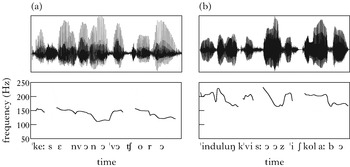
The most interesting feature of the Hungarian CC can be observed in the type C environment, i.e. in utterances with more than one accented syllable. Here the CC starts all over again on each accented syllable. This is shown in (19’, as well as in Fig. 6. (19a’ is an announcement by a mother that dinner is ready and the family are expected to come to the table. (19b’ is shouted by a teacher to her pupils in order to call them together at the end of a school trip, because she wants to take them back to school.
(19)
The possibility of having more than one CC in an utterance, and thus having utterance-internal CCs alongside utterance-final CCs, is a characteristic feature of Hungarian. In descriptions of English I have not found any reports of repeated occurrences of CCs in the same utterance. Nevertheless, it may seem that such repeated CCs do occur in a few English children's chants.Footnote 7 Consider, for example, (20’ (from Bolinger Reference Bolinger1986: 231), which I represent by schematic pitch indications in the manner of (1’ and (2’, because the notational device I am using in this section is inadequate to handle the extra high-pitched indefinite article.
(20)
In my opinion, however, it is doubtful whether we can regard (20’ as a sequence of CCs. First, the initial fragment (Susie is a) is not a real CC, because the pitch of the indefinite article is not at the same height as the pitch of is, but is extra high. Second, it seems likely that the melody of the whole utterance is fixed. (The same complex melody is found in several other utterances of a similar kind, such as Ring around the roses, a pocket full of posies.) It is therefore plausible that utterances like (20’ are simply playful little songs (often with fixed words) in children's speech, rather than instances of repeated CCs, and thus there is not much point in trying to provide an intonational analysis for this melody. To sum up, then, I assume that the CC in an English utterance starts on the last accented syllable, i.e. English CCs are always utterance-final. The preceding accented syllables can receive a H tone, as in (21’ (from Ladd Reference Ladd1980: 174).Footnote 8
(21)
Spectrograms and pitch tracks for the examples in (19’: (a) ˈKészen van a ˈvacsora!; (b) ˈIndulunk ˈvissza az ˈiskolába!.

3 Analysis and representation
3.1 H* !H as a general notational device
Up to now I have informally been representing the CC examples in Hungarian and English as (22’, originally proposed for English by Ladd (Reference Ladd1983, Reference Ladd1996: 91, 136–139).
(22) H*!H
Ladd (Reference Ladd1983, Reference Ladd1996) offers this as an alternative to (23’, first provided for the English CC by Pierrehumbert (Reference Pierrehumbert1980).Footnote 9
(23) H*+L H−L%
The H*+L sequence in (23’ corresponds to the first terrace of the CC, and the H-L% sequence to the second. The H*+L is a bitonal pitch accent, in which the trailing L tone (connected to the H* by +) does not indicate a pitch change: its sole function is to trigger downstep in the H- tone following it. H- is a phrase tone (also known as phrase accent), and L% is a boundary tone. The latter does not here indicate a lowering in pitch; on the contrary, it is upstepped to the height of the preceding H-, thus the pitch remains level.
Ladd's (Reference Ladd1983, Reference Ladd1996) alternative, (22’, has the following important features: (i) it does not specify a boundary tone; (ii) the accent of the phrase is monotonal (H*) rather than bitonal (H*+L); (iii) downstep is indicated by a special diacritic (an exclamation mark before the downstepped H tone); (iv) the downstepped H tone in the English CC can be of two kinds: either a secondary (postnuclear) accent or some kind of edge tone (Ladd Reference Ladd1996: 215–217). It is a secondary accent when it is associated with a postnuclear stressed syllable, such as the syllable turn in (24a’ below. But it is only an edge tone in the default case, i.e. when there is no postnuclear stress. In this case the downstepped H appears on the final, unstressed, syllable of the intonational phrase, as in (24b’ (from Ladd Reference Ladd1996: 215).
(24)
With the built-in indeterminacy (and different association possibilities) of the second H tone, and with the omission of a boundary tone, (22’ has become a general shorthand representation of CCs in different languages (see Ladd Reference Ladd1996: 137–138, 215).
3.2 Analyses of the English CC
However, the representations of the CCs of particular languages, when based on the phonological analysis of the intonation of those languages, are fuller and more specific.
Let us first discuss the representation of the English CC. As far as the first terrace of the English CC is concerned, it seems that Ladd's (Reference Ladd1996) analysis has prevailed. While in Pierrehumbert (Reference Pierrehumbert1980) the first terrace is a bitonal pitch accent (H*+L), which is necessary because only bitonal pitch accents are said to cause downstep in a following H- tone, in Ladd (Reference Ladd1996) downstep is an independent choice, which does not need to be triggered by a preceding bitonal pitch accent, and so the first terrace is analysed as being a monotonal pitch accent (H*). Although Beckman & Pierrehumbert (Reference Beckman and Pierrehumbert1986) criticise the idea of downstep as an independent choice (saying that it makes downstep possible not only on the second member of a series of two H tones but also on the first, where it does not occur), and Grice (Reference Grice1995) also maintains that a bitonal pitch accent is necessary to trigger downstep, Ladd's diacritic for indicating downstep as an independent choice has been widely accepted, and is used in Grice et al. (Reference Grice, Ladd and Arvaniti2000), as well as in the ToBI system, with the proviso that the downstep diacritic should never be put before the first H tone of a phrase (Beckman & Hirschberg Reference Beckman and Hirschberg1994: 5, Beckman & Elam Reference Beckman and Elam1997).
With respect to the second terrace, Grice et al. (Reference Grice, Ladd and Arvaniti2000) show convincingly that the second H within the English CC is a phrase tone (‘phrase accent’ in their terminology), and that in this respect Pierrehumbert's (Reference Pierrehumbert1980) analysis of the second terrace of the English CC, containing the H- phrase tone, is correct. Grice et al. (Reference Grice, Ladd and Arvaniti2000) further develop the idea of the secondary association of phrase tones, originally proposed in Pierrehumbert & Beckman (Reference Pierrehumbert and Beckman1988). Under this view, the phrase tone of the CC, being an edge tone, is primarily associated with the end of the phrase, and then copied and secondarily associated to the strongest postaccentually stressed syllable if there is one, or, in the absence of a postaccentual stress, the phrase tone associates to the final syllable. Grice et al. (Reference Grice, Ladd and Arvaniti2000: 180) ignore the final boundary tone because they want to remain ‘deliberately agnostic about the type of prosodic constituent with whose edge the phrase accent is primarily associated’. In principle, this prosodic constituent could be either an intermediate phrase or an intonational phrase. The distinction was introduced by Beckman & Pierrehumbert (Reference Beckman and Pierrehumbert1986), who defined the intermediate phrase as a series of accents closed by a phrase tone, and an intonational phrase as a series of accents closed by a phrase tone and a boundary tone. Thus, although both are units of intonation in a sense, the intermediate phrase is less sharply separated from what follows it than the intonational phrase.Footnote 10 However, because of the ‘considerable disagreement about the taxonomy of phrase-size units in the prosodic hierarchy’ (2000: 181), Grice et al. do not wish to commit themselves on this issue. Nevertheless, for those who identify the end of an English CC with the end of an intonational phrase, the L% boundary tone of the Pierrehumbert analysis is added to the representation of the second terrace: !H-L%. As we saw in §3.1 above, the L% does not indicate a lowering here, but a continuation of the pitch of the !H- before it.
This yields the following language-specific phonological representation for the English CC, as developed gradually by Pierrehumbert (Reference Pierrehumbert1980), Ladd (Reference Ladd1996) and Grice et al. (Reference Grice, Ladd and Arvaniti2000).Footnote 11
(25) H* !H−L%
Other analyses have also been proposed. In Gussenhoven (Reference Gussenhoven2004: 313–314) the English CC is represented as a bitonal pitch accent (H*+!H).Footnote 12 In this the starred H tone is followed by an automatically downstepped H trailing tone, which is associated with the second terrace. However, this trailing tone cannot simply be aligned with the beginning and end of some part of the carrier string by convention, as the other trailing tones in Gussenhoven's system can, but has to be directly associated with the relevant point of the carrier string by means of an association line, as if it were a starred tone. Furthermore, the domains of the other trailing tones in Gussenhoven's system begin at or right after the syllable associated with the starred tone, but this is not necessarily the case with the trailing tone in the CC. This odd behaviour of the trailing tone in the CC remains unexplained in Gussenhoven's (Reference Gussenhoven2004) analysis.
3.3 The downstepped H tone in the Hungarian CC
Let us now turn to the analysis of the Hungarian CC. We can construct three hypotheses concerning the downstepped H in the Hungarian CC: it can be (i) the trailing tone within the H*+!H pitch accent, (ii) a boundary tone after a monotonal H* or (iii) a phrase tone after a monotonal H*.
3.3.1 Hypothesis (i)
The downstepped H tone of the Hungarian CC is a trailing tone, i.e. part of a bitonal pitch accent, as was suggested for English by Gussenhoven (Reference Gussenhoven2004: 311–314). If this is the case, then – ignoring the final boundary tone for the time being – the representation of the Hungarian CC will be as in (26’.
(26) The Hungarian CC: Hypothesis (i)
H*+!H
But there are problems here. In the standard framework a trailing tone is aligned with domains starting with the accented syllable itself, or with the syllable immediately following the accented one, but in the Hungarian CC it would be associated with the last syllable, which can be a long way away from the accented syllable. Consider e.g. (14’ above (ˈBodori ˌdoktor ˌfelesége), where the final syllable is the eighth after the accented one. If we analyse this example in accordance with (26’, we must treat the entire phrase (a string of nine syllables) as the carrier of a single bitonal pitch accent. This solution is extremely counterintuitive. An anonymous reviewer suggests that the central component (H*) of the bitonal pitch accent (H*+!H) is able to spread and thus the !H can still be regarded as a trailing tone. But this suggestion is suspect in light of the literature, according to which spreading is possible for a monotonal pitch accent or for the trailing tone of a bitonal pitch accent, but not for the central tone of a bitonal pitch accent when it has a trailing tone after it (cf. Gussenhoven Reference Gussenhoven2004: 296–302). Because of these problems, I reject Hypothesis (i).
3.3.2 Hypothesis (ii)
The downstepped H tone of the Hungarian CC is a final boundary tone. It this is so, the CC can be represented as in (27’.
(27) The Hungarian CC: Hypothesis (ii)
H* !H%
This is intuitively more attractive than Hypothesis (i), because it utilises a natural resemblance between the final boundary tone and the downstepped tone of the Hungarian CC: both of them are at the right edge of the phrase. One might object – in view of Beckman & Pierrehumbert (Reference Beckman and Pierrehumbert1986) – that the boundary tone at the end of an intonational phrase is only possible if it immediately follows a phrase tone (since the end of an intonational phrase is simultaneously the end of an intermediate phrase), but there is no phrase tone here, and so (27’ has to be rejected. However, this is not enough evidence for rejection, because (a) the notion of intermediate phrase is not quite firmly established,Footnote 13 and (b), even if the intermediate phrase is accepted, one could suggest that – since the end of an intonational phrase is simultaneously the end of an intermediate phrase – a final boundary tone at the end of an intonational phrase may simultaneously signal the end of an intermediate phrase as well, thus rendering a phrase tone immediately before it superfluous.Footnote 14 The reason why I reject Hypothesis (ii) is that in the literature that I know of the downstepped H tone is regarded (a) as a H* pitch accent (Beckman & Pierrehumbert Reference Beckman and Pierrehumbert1986, Gussenhoven Reference Gussenhoven2004: 308), (b) as a H- phrase tone (Beckman & Pierrehumbert Reference Beckman and Pierrehumbert1986, Grice et al. Reference Grice, Ladd and Arvaniti2000) or (c) as a H component in a bi- or tritonal pitch accent (Gussenhoven Reference Gussenhoven2004: 311), but is never regarded as a boundary tone. Since adding this new possibility is far from inevitable, it seems better to avoid it. Therefore Hypothesis (ii) is also rejected.
3.3.3 Hypothesis (iii)
The downstepped H tone of the Hungarian CC is a phrase tone, as suggested for English by Pierrehumbert (Reference Pierrehumbert1980) and Grice et al. (Reference Grice, Ladd and Arvaniti2000). If this is correct, then – ignoring the final boundary tone – the representation of the Hungarian CC will be as in (28’.
(28) The Hungarian CC: Hypothesis (iii)
H* !H-
This has important advantages. A phrase tone indicates a pitch change somewhere in the postaccentual region, but this pitch change need not occur at or immediately after the pitch accent; rather, it can occur any number of syllables away (and in fact often at or near the right edge of the phrase). So a phrase tone would be ideal for representing the second terrace in the CC. Moreover, if, following Grice et al. (Reference Grice, Ladd and Arvaniti2000: 177–180), we look upon the phrase tone as being primarily associated with the end of the phrase, from where it is copied to certain syllables within the phrase, we can treat the Hungarian and English CC in a unified way: in Hungarian the docking site is the final syllable; in English it is the strongest (or first) postaccentual stressed syllable if there is one, otherwise it is also the final syllable. Phrase tones have been shown to exist in Hungarian, and do not have to be specially introduced here. Grice et al. (Reference Grice, Ladd and Arvaniti2000: 149–151) point out that the rising-falling (yes-or-no question) intonation of Standard Hungarian has the pattern L*H-L%, where the H- is a phrase tone which is secondarily associated with the penultimate syllable, to form the peak of the contour, as shown in (29’, where reggel is contrastively stressed (cf. Grice et al. Reference Grice, Ladd and Arvaniti2000: 148, 150).
(29)
This analysis of the Hungarian rising-falling contour is quite convincing, and accounts not only for the Standard Hungarian rise-fall but also for the rise-fall of Transylvanian Hungarian.Footnote 15 By analogy with this analysis, the downstepped !H tone of the Hungarian CC can also be regarded as a phrase tone, which is associated with the end of the phrase and then copied to the last syllable of the phrase. So, of the three hypotheses, Hypothesis (iii) is the best.
We have rejected Hypotheses (i) and (ii), and accepted Hypothesis (iii), i.e. (28’. Consequently the representations in (4’ above should be amended to indicate that the second H in each CC is a phrase tone, which is to be associated with the end of the phrase and then copied to the last syllable. The amended versions are given in (30’.
(30)
These representations ignore the fact that the pitch height of the first terrace is usually reached a little later than at the very beginning of the terrace – due to the inertia of the vocal cords (see Fig. 1). This small initial ‘rise’ may be indicated by a low initial boundary before the H* pitch accent (L%H* !H-). However, since the low initial boundary is treated as default (as opposed to the high initial boundary), it need not be shown.
As for the representation of the special variant of the Hungarian CC, in which the entire first terrace is replaced by a rise (see (8’ above), we can borrow Gussenhoven's (Reference Gussenhoven2004: 307) Delay rule, originally formulated by Gussenhoven & Rietveld (Reference Gussenhoven and Rietveld1992) as L-prefixation, shown in (31’.
(31) Delay
[L* [T…]Pitch Accent]Pitch Accent
In (31’ the T is the originally starred tone of a pitch accent, which was associated with a stressed syllable to make it accented, but the L takes over the association with the accented syllable, and the T is timed after L. In this way the H* becomes L*H, as shown in (32’.
(32) H*→L*H
The newly created L*H unit is a two-element pitch accent in which the H is not a trailing tone but a former monotonal pitch accent which has undergone ‘Delay’ or ‘L-prefixation’. So the examples in (8’ can be represented as (33’, again ignoring the final boundary tone.
(33)
But the representations in (30’ and (33’ are still not complete, because these CCs are utterance-final and consequently intonational phrase-final as well. (The end of an utterance is by definition the end of an intonational phrase.) So they should have a boundary tone. The nature of this boundary tone is the topic of the next section.
3.4 The final boundary tone in the Hungarian CC
In my view, the job of a final boundary tone is to signal a particular type of melodic transition to the pause that follows or may follow an intonational phrase. It is not merely a melodic event to signal the end of an intonational phrase, but a signal of a real or potential pause at the end of an intonational phrase. In the current autosegmental literature it is customary to distinguish two kinds of final boundary tone: H% and L%. In Pierrehumbert's (Reference Pierrehumbert1980) proposal for English, after a H tone the H% boundary tone indicates a rise, while the L% boundary tone is upstepped to maintain the pitch level of the preceding H tone. This is why the representation of the English CC in (25’ ends with a L% boundary tone.
The Hungarian CC, however, must be represented differently, because the sequence H-L% has been convincingly shown by Grice et al. (Reference Grice, Ladd and Arvaniti2000: 150) to signal the falling part of the Hungarian rising-falling (yes-or-no question) contour (see (29’ above). So whereas in English the H-L% sequence indicates a level stretch, in Hungarian the same sequence indicates a falling stretch. This is appropriate as long as the H-L% configuration covers different phonetic realities in different languages. But it cannot be allowed to cover different phonetic realities within one and the same language, and this would be the case if we allowed it to represent not only the falling part of the Hungarian rise-fall but also the lower level of the Hungarian CC. As Ladd (Reference Ladd1996: 146) puts it: ‘we should not give identical phonological analyses to markedly different contours in mutually intelligible varieties of the same language’. We therefore cannot accept the idea of the boundary tone being L% in the Hungarian CC.
If the boundary tone at the end of a Hungarian CC cannot be L%, it may seem possible that it is H%, with the proviso that when the H% follows a downstepped H- phrase tone, the H% is realised not as a rise in pitch but as a sustained mid-high pitch (this was suggested by an anonymous reviewer). The problem with this suggestion is that it is totally ad hoc, and cannot be supported by evidence from any other intonational phenomenon than the one it is meant to account for.
It seems better, therefore, to assume that in addition to H% and L%, there is a third final boundary tone, the zero or sustained boundary tone, represented as 0%.Footnote 16 This is a tone for a boundary whose tonal specification does not differ from that of the immediately preceding tone, and should not be confused with the absence of a boundary tone.Footnote 17 0% is a real boundary tone, which signals the preservation of the pitch level of the preceding tone at the end of an intonational phrase.
By introducing a third boundary tone we raise the number of tonal possibilities at the end of the intonational phrase to three and thus return to the spirit of the three terminal junctures (falling, rising, sustained) of classical American structuralist analysis (Trager & Smith Reference Trager and Smith1951), which was, in a sense, a forerunner of Pierrehumbert's theory. However, the structuralist analysis had a major shortcoming: it tried to describe intonation contours with reference to more than two (usually four) pitch levels, without properly clarifying the notion of relative height.Footnote 18 This shortcoming was eliminated by Pierrehumbert (Reference Pierrehumbert1980), who recognised only two tones, H and L. The two-tone system is satisfactory for accents, but (at least for Hungarian) it seems inadequate for boundary tones. Recognition of a third boundary tone does not burden the system with a third pitch level, since it is simply the prolongation of a preceding H or L.
Under this proposal, the examples in (4’ should be reanalysed as in (34’.
(34)
To summarise this part of the discussion, it seems that the representation of the Hungarian CC, without a final boundary tone, given in (28’, repeated here as (35a’, is unsatisfactory for CCs that are utterance-final (and thus intonational phrase-final). For such CCs, the representation should contain a 0% boundary tone, as in (35b’.
- (35)
a. H* !H-
b. H* !H-0%
3.5 Further evidence for the zero boundary tone: a digression on Hungarian falling contours
Additional support for the idea of a zero boundary tone comes from the analysis of Hungarian intonation contours other than the CC. For instance, it can justifiably be assumed that the zero boundary tone may occur at the end of the ‘half falling contour’ (i.e. a fall with a characteristic drop in pitch right after the accent, as in the plain fall, but ending higher than the bottom of the speaker's voice); see Varga (Reference Varga2002: 34). This contour sometimes stands at the end of an utterance, and consequently at the end of an intonation phrase, and in this position I assume it has a boundary tone. This boundary tone cannot be L%, because L% marks the end of a plain fall, but it cannot be H% either, because L% marks the end of a fall-rise. So it can only be 0%.
On the basis of Grice et al.'s (Reference Grice, Ladd and Arvaniti2000: 169–175) analysis of some English and German falling-rising and falling patterns, we can try to represent the Hungarian plain fall, half fall and fall-rise as in (36’. Since these representations contain a monotonal H* pitch accent, a L- phrase tone and a final boundary tone, they can be called ‘phrase tone-based’ representations (following Grice et al. Reference Grice, Ladd and Arvaniti2000, we can assume that the L- phrase tone is primarily associated with the end of the phrase and then copied and secondarily associated with the initial, accented syllable, from where it spreads to the right). There is a triple contrast between the L%, 0% and H%.
(36)
The half fall can also stand inside an utterance, with no real or potential pause after it, and in this position it should be analysed as lacking a boundary tone. In this situation the absence of a boundary tone (no %) is in contrast with the presence of a boundary tone (L%, 0%, H%). This is illustrated in (37’, where there is a half falling contour without a boundary tone (on Bodoriné), followed by a plain falling contour (on telefonja).
(37)
The last example, however, reveals a serious problem in the phrase tone-based analysis. By regarding the non-final half fall (on Bodoriné) as H*L-, and the final plain fall (on telefonja) as H*L- L%, the analysis implies that both the word Bodoriné and the word telefonja constitute intermediate phrases, belonging to the same intonational phrase (the first because it ends in a phrase tone, the second because it ends in a phrase tone and a final boundary tone; the phrase tone–boundary tone sequence signals not only the end of an intonational phrase, but automatically also the end of an intermediate phrase). In reality, however, they cannot be intermediate phrases, because there is downstep (catathesis) between them, which should not occur between intermediate phrases (see Beckman & Pierrehumbert Reference Beckman and Pierrehumbert1986: 298–299).Footnote 19 If we retain the phrase tone in these representations, we imply that a phrase tone does not necessarily signal the end of an intermediate phrase.
I therefore suggest replacing this analysis with a ‘trailing tone-based’ analysis for falling contours in Hungarian. This alternative lacks a phrase tone; it has a bitonal pitch accent containing a central H and a trailing L tone (H*+L), and a final boundary tone (L%, 0%, H%) or no boundary tone (see (38’). It should be noted that under this analysis the claim about the necessity of a 0% would still hold.
(38)
Further examples bring further confirmation for the ‘trailing tone-based’ analysis. Consider the declarative utterances in (39’.
(39)
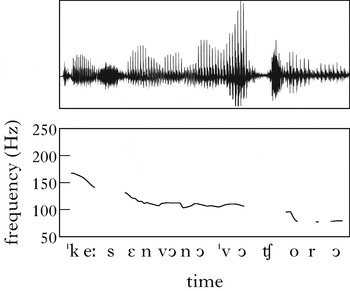
The spectrogram and pitch track of (39a’ can be seen in Fig. 7. If we submit the examples in (39’ to the ‘phrase tone-based’ analysis, each accent will mark the beginning of an intermediate phrase, but we will not be able to account for the downstep which quite clearly marks each successive accented syllable, and which should not be there if we had real intermediate phrases in the examples. Besides, the intermediate phrases posited will last from one accented syllable to the next, and so will not be able to accommodate more than one accent, whereas real intermediate phrases can have more than one accent. But no such problems arise if we accept the ‘trailing tone-based’ analysis for Hungarian falling contours.
Spectrogram and pitch track for the example in (39a’: (a) ˈKészen van a ˈvacsora!.

In (39’, just as in (38’, the final boundary tone follows a bitonal pitch accent without there being a phrase tone between them. From this it follows that the requirement that a phrase tone and a boundary tone must both be present at the end of an intonational phrase (Pierrehumbert Reference Pierrehumbert1980, Beckman & Pierrehumbert Reference Beckman and Pierrehumbert1986) should be lifted. If intermediate phrases are recognised in a language, the end of an intonational phrase is simultaneously the end of an intermediate phrase, and the final boundary tone (L%, 0% or H%) can be regarded as signalling not only the end of the intonational phrase but also the end of an intermediate phrase. Consequently, if intermediate phrases are indeed necessary in Hungarian, then (39a’ and (39b’ are utterances, each of which corresponds to one intonational phrase, and each intonational phrase corresponds to one intermediate phrase.
In this section I have shown that the falling contours of Hungarian call for a ‘trailing tone-based’ analysis rather than a ‘phrase tone-based’ analysis. However, this choice does not affect my central claim, viz. that there is a need for a 0% boundary tone. This claim remains valid under either analysis.
3.6 The issue of utterance-internal Hungarian CCs
In §3.4 we saw that utterance-final (and consequently intonational phrase-final) CCs in Hungarian should be analysed as (35b’, repeated here as (40’.
(40) H* !H-0%
Let us now examine utterance-internal CCs. The question is whether these can be analysed as (40’, i.e. as intonational phases, or whether they should be analysed differently.
The most significant cues to the end of the intonational phrase are (a) the presence of a terminal contour, and (b) a real or potential pause after the terminal contour. These cues are both necessary for the identification of the end of an intonational phrase. A terminal contour is a recurring intonation contour which is able to start on the last accented syllable of an utterance and continue till the end of the utterance.Footnote 20 Pauses can be silent (these are noticeable intervals of silence) or filled (these create the impression of a pause, e.g. by lengthening a syllable or inserting a schwa or a nasal at a particular point in speech).
It is clear that a pause (even a real pause) is insufficient in itself to signal the end of an intonational phrase. (Hesitation pauses, for instance, may occur inside intonational phrases.) A pause signals the end of an intonational phrase only when it follows a terminal contour. But a terminal contour alone, i.e. without the possibility of being followed by a pause, is also insufficient to mark the end of an intonational phrase. If it is not possible to have a normal pause after a terminal contour, then its end should not be identified with the end of an intonational phrase. This is why I believe there is a boundary tone at the end of every intonational phrase: a final boundary tone expresses the melodic transition of the end of a contour to a real or potential pause. In this I differ from my earlier account (Varga Reference Varga2002: 117–121), where I claim that the end of a terminal contour alone sufficiently signals the end of an intonational phrase, and so a (real or potential) pause is not an indispensable criterion. But this earlier account is not quite consistent: it makes an exception in connection with half falls and says that, although half falls are terminal contours since they are able to appear in utterance-final position, their ends should be identified with the ends of intonational phrases only if they are or can be followed by a pause (Varga Reference Varga2002: 54–56). I suggest that this insight should be extended to all other contours. For instance, the second half fall in a sequence of half fall+half fall+plain fall can be replaced by a high monotone, as in (41b’.Footnote 21Varga (Reference Varga2002: 117–121) claims that, since the high monotone is a terminal contour, its end automatically signals the end of an intonational phrase, and so the original single intonational phrase is split into two.
(41)
However, the high monotone in (41b’ cannot be followed by a pause. Therefore I suggest that it should be analysed differently from a high monotone which is followed (or followable) by a pause, and that its end should not be identified with the end of an intonational phrase. If the high monotone which is at the end of an intonational phrase is represented as H*0%, the high monotone in (41b’ should be analysed as H*.
On this view, a CC after which there can be no pause does not constitute an intonational phrase, despite the fact that it is a terminal contour. Since utterance-internal CCs cannot have pauses after them, they are not separate intonational phrases, and an utterance which contains them is one single intonational phrase. Consequently, the examples in (19’ will be analysed as in (42’.
(42)
The CCs in (42a’ and (b) both end with a H- phrase tone (while the last CC in the utterance also takes a 0% boundary tone). Consequently, in Beckman & Pierrehumbert (Reference Beckman and Pierrehumbert1986)'s analysis, they should be regarded as intermediate phrases. That is to say, both (42a’ and (b) are single utterances, each consisting of one single intonational phrase, with each intonational phrase consisting of more than one intermediate phrase, each coextensive with a CC. In (42a’ these are készen van a and vacsora, while in (42b’ they are indulunk, vissza az and iskolába.
This analysis is based on the fact that no pauses are possible between the consecutive CCs, and so these CCs cannot be separate intonational phrases. At present it seems that the only Hungarian utterance type in which an intonational phrase can contain more than one intermediate phrase is the utterance with multiple CCs. In other kinds of Hungarian utterances, intonational phrases and intermediate phrases coincide.
4 Conclusion
In this article I have described the facts of the Calling Contour (CC) in Hungarian and offered a phonological analysis. At each stage of the analysis there were several possibilities which seemed compatible with the facts, and in each case I chose the alternative that seemed best in the present state of our knowledge.
The analysis of the Hungarian CC assumes a monotonal pitch accent (H*) as the initial element of the representation. This pitch accent is associated with the stressed syllable on which the first (higher) terrace starts and at the same time it causes this syllable to be accented. The second, downstepped, H is best analysed neither as a trailing tone nor as a boundary tone, but as a phrase tone, !H-, also known as phrase accent, which is invariably associated with the last syllable, on which the second (lower) terrace is located. When the Hungarian CC is utterance-final (and thus intonational phrase-final), it is analysed as H* !H-0%, where the 0% is a zero boundary tone, which I introduce as a new kind of boundary tone. An utterance-internal CC, which cannot be followed by a pause, is analysed as H* !H-, where the final phrase tone indicates the end of an intermediate phrase.
The main claims of the analysis are the following: (i) Phrase tones exist in Hungarian, and occur in the rising-falling (yes-no question) contour (see Grice et al. Reference Grice, Ladd and Arvaniti2000), and also in the CC. However, phrase tones do not seem to be present in the falling contours (plain falls, half falls, fall-rises) of Hungarian. (ii) Intermediate phrases exist in Hungarian, because utterance-internal Hungarian CCs are best analysed as intermediate phrases. However, since at present we can only prove their existence for CC utterances, future research will have to find out whether they occur elsewhere, or whether there are some alternative analyses to circumvent the necessity to recognise them in Hungarian. At this point, considering that the presence of the intermediate phrase in a language implies that intonational phrases are composed of intermediate phrases, we can assume that the end of every intonational phrase is simultaneously also the end of an intermediate phrase. Consequently, a boundary tone (without a preceding phrase tone) can be regarded not only as signalling the end of an intonational phrase but also as signalling the end of an intermediate phrase, and so the requirement that a boundary tone must follow a phrase tone (cf. Pierrehumbert Reference Pierrehumbert1980, Beckman & Pierrehumbert Reference Beckman and Pierrehumbert1986) should be abandoned. (iii) A boundary tone represents a melodic transition from the end of the pitch contour of an intonational phrase to a (silent or filled) pause that follows or can follow it. Consequently, in addition to the generally recognised H% and L% in Hungarian, there is a need for a third kind of boundary tone, the zero boundary 0%. This is a boundary tone whose tonal specification is identical to that of the immediately preceding tone. By proposing a zero boundary tone we can distinguish …H-L%, which represents the falling stretch of the Hungarian rise-fall, from …H-0%, which represents the lower level terrace of the utterance-final Hungarian CC. The idea of a 0% is supported by other intonational facts of Hungarian, too.
Although the article has concentrated on Hungarian, it systematically compared the formal properties of the Hungarian CC with those of the English CC, and occasionally with those of the CCs of other languages. It was found that, while in the English CC the second terrace starts on the strongest (or sometimes on the first) postaccentual stressed syllable if there are postaccentual stresses and on the final syllable otherwise, in Hungarian the second terrace of the CC is invariably located on the final syllable. The 0% boundary tone is unnecessary for the analysis of standard English intonation, in which no final slumps occur (see Gussenhoven Reference Gussenhoven2004: 301–302). However, if dialectal English intonation is also taken into consideration, it may also be useful to recognise the 0% in English intonational analyses. The English CC then could be represented like the Hungarian CC: H* !H-0% (with different conventions for the association of the !H-), and the sequence …H-L%, which is now reserved for the representation of the lower terrace of the English CC, might then be used to represent the final slump which we find in the intonation of northern urban varieties of English (see Cruttenden Reference Cruttenden1997: 139, Gussenhoven Reference Gussenhoven2004: 301).