Gross, Carr, Reichman, Abdul-Nasiru, and Oestereich's (Reference Gloss, Carr, Reichman, Abdul-Nasiru and Oesterich2017) article argues that industrial and organizational (I-O) psychology has a limited perspective that rarely goes beyond the specific professional populations in formal economies of high-income countries—a perspective they refer to as a POSH perspective. This valuable criticism should also eschew the notion that workers in nonindustrialized countries are necessarily different.
We encountered the POSH perspective when investigating work ethic or work centrality. Work ethic is typically investigated using the lottery question commonly formulated as follows: “If you were to get enough money to live as comfortably as you would like for the rest of your life, would you continue to work or would you stop working?” (yes/no). The lottery question is often found in psychology textbooks to show that people actually like work. The relatively high overall percentages found in Western countries have been interpreted as an indicator of Western or Protestant work ethic. Data on nonindustrialized countries is, to our knowledge, limited, and we accordingly were interested in studying differences between nonindustrialized and high-income countries, and decided to do a study. Building on the earlier literature on the topic, we expected much variation between societies and were surprised to find that under- or unrepresented countries in I-O psychology contradicted the notion that work ethic is particularly high in Western society. Our study using the lottery question thus is an example that illustrates Gross et al.’s (Reference Gloss, Carr, Reichman, Abdul-Nasiru and Oesterich2017) overarching point by emphasizing that individuals in nonindustrialized countries are likely not less willing to work despite the differences between economies and cultures.
Nonindustrialized Work Ethic
We conducted surveys in nine nonindustrialized countries. These include, according to Gross et al. (Reference Gloss, Carr, Reichman, Abdul-Nasiru and Oesterich2017), four underrepresented countries (Colombia, India, Jordan, Myanmar), one unrepresented country (Rwanda), and five countries with less than 2 million inhabitants (Bhutan, Maldives, Palau, Seychelles). The nine countries selected also range on the scale of the Human Development Index (UNDP, 2014) as low human development (n = 2, HDI scores below 0.550) in the case of Rwanda and Myanmar; medium human development (n = 3, HDI between 0.700 and 0.550) for Bhutan, India, and the Maldives; and high human development (n = 4, HDI between 0.800 and 0.700) for Colombia, Jordan, Seychelles, and Palau. This assessment provides a first but coarse estimate of the economic circumstances in each area.
The participants’ jobs range from driver, guide, waiter, and porter to receptionist, duty manager, accountant, and managing director. They show backgrounds with contrasting religious preferences, including Christianity (Catholic, Protestant), Buddhism, Hinduism, and Islam.
The phrasing of the lottery question followed Highhouse, Zickar, and Yankelevich (Reference Highhouse, Zickar and Yankelevich2010) together with their four-point scale on job satisfaction (ranging from very dissatisfied to very satisfied) and a five-point scale on relative financial status (ranging from far below to far above average). One three-point scale about life (exciting, pretty routine, dull), one on overall satisfaction (very happy, pretty happy, not too happy), and questions about age and gender were also included.
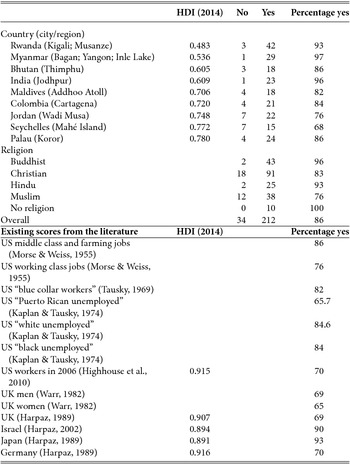
Table 1 provides an overview of differences between countries and religious groups in terms of their work ethics. The numbers in Table 1 indicate that the overall level of willingness to continue to work was relatively high, and the average level was not lower than extant findings from high-income countries. The general amount of “yes” answers to the lottery question suggests that employees in nonindustrialized countries tended to score higher.
Table 1.
Number of No Answers and Yes Answers to the Lottery Question by Country and Religion
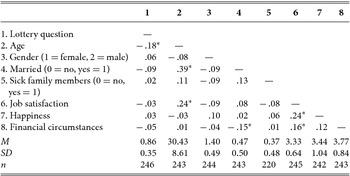
We also investigated whether individual characteristics had an influence on participants’ responses. In addition to marital stage, we asked if they were taking care of sick family members, their age at which they started school, and the age of their parents when they were starting school. In addition to participants’ job titles, we requested descriptions of the main tasks of their jobs to clarify their positions. These supplementary questions further informed the answers concerning their financial and economic situations. In contrast with earlier studies, we included a question in which each respondent identified his or her religion. Table 2 shows a correlation matrix that relates the lottery question to participants’ age, gender, marital stage, dependents, job satisfaction, happiness, and financial circumstances. Contrary to some studies, but confirming Morse and Weiss (Reference Morse and Weiss1955), age is negatively related to “yes” answers in this dataset. We also ran logistic regression analyses with country membership as dummy-coded control variables and the variables in Table 2 as predictors. Age remained a significant predictor after controlling for country membership (z = –2.231, p = 0.025), but none of the other individual predictors predicted answers to the lottery questions when country membership was controlled (z ≤ |1.55|). The overall contribution of the individual predictor variables was also not significant: ΔNagelkerke-Pseudo-R² = .06, χ² (df = 7) = 7.84, p = .35.
Table 2.
Correlations Between Answers to the Lottery Question and Individual Circumstances
Our study has limitations that are characteristic for studies that attempt to mitigate the biases summarized as POSH. Most of all, only part of the POSH bias has been addressed. The respondents to our survey were versed in English, and they had jobs that may not be representative for the workforce in the respective countries. The results are comparable across countries and religious backgrounds in this sample, but they may not be directly comparable with extant samples. On the other hand, extant research does not suggest that the lottery question varies much between different occupational groups (e.g., Tausky, Reference Tausky1969). Morse and Weiss (Reference Morse and Weiss1955) and Kaplan and Tausky (Reference Kaplan and Tausky1974) showed that specific groups of workers can have different scores, but these differences were commonly not very pronounced. For several of the countries that we included, a systematic sampling scheme would be frustrated by the limited information on the characteristics of the population. This problem is common in cross-cultural research, and many large comparative studies across countries in psychology use convenience samples, such as college students (e.g., Terracino et al., Reference Terracino, Abdel-Khalek, Adám, Adamovová, Ahn, Ahn and McCrae2005). A restriction to a specific set of jobs, like in our study, potentially enhances comparability across countries. Our results confirm the suggestion that individual predictors, such as education, gender, job satisfaction, or financial situation, are not good predictors of the lottery question. These findings are in line with earlier findings in the literature (Snir & Harpaz, Reference Snir and Harpaz2002; Highhouse et al., Reference Highhouse, Zickar and Yankelevich2010), and thus are similar in POSH data and our non-POSH context.
Conclusion
Our research suggests that the work ethic that underlies a high nonfinancial employment commitment is not particularly American, Western, Protestant, or Judeo-Protestant, as the literature has suggested. The data imply that in the nonindustrialized world, the value of work also goes beyond that of the accumulation of wealth.
Responses to the lottery question are not related to the amount of school education people received or socio-economic status as measured by parents’ level of education. Only age is negatively related to “yes” answers in this dataset. These measures did not deviate from those found in high-income countries.
Inclusion of our data in future comparisons across countries counters the assumption of a “Western work ethic.” An awareness of the POSH perspective and the inclusion of such data are a first practical measure that should shift the basic assumptions of cross-country research in I-O. They show that the exclusion of a POSH perspective is not just limiting to results that are thought to be similar across un(der)represented populations, but also to outcomes that are assumed to be different and superior in Western society.




 You have
Access
Gross, Carr, Reichman, Abdul-Nasiru, and Oestereich's (Reference Gloss, Carr, Reichman, Abdul-Nasiru and Oesterich2017) article argues that industrial and organizational (I-O) psychology has a limited perspective that rarely goes beyond the specific professional populations in formal economies of high-income countries—a perspective they refer to as a POSH perspective. This valuable criticism should also eschew the notion that workers in nonindustrialized countries are necessarily different.
We encountered the POSH perspective when investigating work ethic or work centrality. Work ethic is typically investigated using the lottery question commonly formulated as follows: “If you were to get enough money to live as comfortably as you would like for the rest of your life, would you continue to work or would you stop working?” (yes/no). The lottery question is often found in psychology textbooks to show that people actually like work. The relatively high overall percentages found in Western countries have been interpreted as an indicator of Western or Protestant work ethic. Data on nonindustrialized countries is, to our knowledge, limited, and we accordingly were interested in studying differences between nonindustrialized and high-income countries, and decided to do a study. Building on the earlier literature on the topic, we expected much variation between societies and were surprised to find that under- or unrepresented countries in I-O psychology contradicted the notion that work ethic is particularly high in Western society. Our study using the lottery question thus is an example that illustrates Gross et al.’s (Reference Gloss, Carr, Reichman, Abdul-Nasiru and Oesterich2017) overarching point by emphasizing that individuals in nonindustrialized countries are likely not less willing to work despite the differences between economies and cultures.
Nonindustrialized Work Ethic
We conducted surveys in nine nonindustrialized countries. These include, according to Gross et al. (Reference Gloss, Carr, Reichman, Abdul-Nasiru and Oesterich2017), four underrepresented countries (Colombia, India, Jordan, Myanmar), one unrepresented country (Rwanda), and five countries with less than 2 million inhabitants (Bhutan, Maldives, Palau, Seychelles). The nine countries selected also range on the scale of the Human Development Index (UNDP, 2014) as low human development (n = 2, HDI scores below 0.550) in the case of Rwanda and Myanmar; medium human development (n = 3, HDI between 0.700 and 0.550) for Bhutan, India, and the Maldives; and high human development (n = 4, HDI between 0.800 and 0.700) for Colombia, Jordan, Seychelles, and Palau. This assessment provides a first but coarse estimate of the economic circumstances in each area.
The participants’ jobs range from driver, guide, waiter, and porter to receptionist, duty manager, accountant, and managing director. They show backgrounds with contrasting religious preferences, including Christianity (Catholic, Protestant), Buddhism, Hinduism, and Islam.
The phrasing of the lottery question followed Highhouse, Zickar, and Yankelevich (Reference Highhouse, Zickar and Yankelevich2010) together with their four-point scale on job satisfaction (ranging from very dissatisfied to very satisfied) and a five-point scale on relative financial status (ranging from far below to far above average). One three-point scale about life (exciting, pretty routine, dull), one on overall satisfaction (very happy, pretty happy, not too happy), and questions about age and gender were also included.
Table 1 provides an overview of differences between countries and religious groups in terms of their work ethics. The numbers in Table 1 indicate that the overall level of willingness to continue to work was relatively high, and the average level was not lower than extant findings from high-income countries. The general amount of “yes” answers to the lottery question suggests that employees in nonindustrialized countries tended to score higher.
Number of No Answers and Yes Answers to the Lottery Question by Country and Religion
We also investigated whether individual characteristics had an influence on participants’ responses. In addition to marital stage, we asked if they were taking care of sick family members, their age at which they started school, and the age of their parents when they were starting school. In addition to participants’ job titles, we requested descriptions of the main tasks of their jobs to clarify their positions. These supplementary questions further informed the answers concerning their financial and economic situations. In contrast with earlier studies, we included a question in which each respondent identified his or her religion. Table 2 shows a correlation matrix that relates the lottery question to participants’ age, gender, marital stage, dependents, job satisfaction, happiness, and financial circumstances. Contrary to some studies, but confirming Morse and Weiss (Reference Morse and Weiss1955), age is negatively related to “yes” answers in this dataset. We also ran logistic regression analyses with country membership as dummy-coded control variables and the variables in Table 2 as predictors. Age remained a significant predictor after controlling for country membership (z = –2.231, p = 0.025), but none of the other individual predictors predicted answers to the lottery questions when country membership was controlled (z ≤ |1.55|). The overall contribution of the individual predictor variables was also not significant: ΔNagelkerke-Pseudo-R² = .06, χ² (df = 7) = 7.84, p = .35.
Correlations Between Answers to the Lottery Question and Individual Circumstances
*p < .05.
Our study has limitations that are characteristic for studies that attempt to mitigate the biases summarized as POSH. Most of all, only part of the POSH bias has been addressed. The respondents to our survey were versed in English, and they had jobs that may not be representative for the workforce in the respective countries. The results are comparable across countries and religious backgrounds in this sample, but they may not be directly comparable with extant samples. On the other hand, extant research does not suggest that the lottery question varies much between different occupational groups (e.g., Tausky, Reference Tausky1969). Morse and Weiss (Reference Morse and Weiss1955) and Kaplan and Tausky (Reference Kaplan and Tausky1974) showed that specific groups of workers can have different scores, but these differences were commonly not very pronounced. For several of the countries that we included, a systematic sampling scheme would be frustrated by the limited information on the characteristics of the population. This problem is common in cross-cultural research, and many large comparative studies across countries in psychology use convenience samples, such as college students (e.g., Terracino et al., Reference Terracino, Abdel-Khalek, Adám, Adamovová, Ahn, Ahn and McCrae2005). A restriction to a specific set of jobs, like in our study, potentially enhances comparability across countries. Our results confirm the suggestion that individual predictors, such as education, gender, job satisfaction, or financial situation, are not good predictors of the lottery question. These findings are in line with earlier findings in the literature (Snir & Harpaz, Reference Snir and Harpaz2002; Highhouse et al., Reference Highhouse, Zickar and Yankelevich2010), and thus are similar in POSH data and our non-POSH context.
Conclusion
Our research suggests that the work ethic that underlies a high nonfinancial employment commitment is not particularly American, Western, Protestant, or Judeo-Protestant, as the literature has suggested. The data imply that in the nonindustrialized world, the value of work also goes beyond that of the accumulation of wealth.
Responses to the lottery question are not related to the amount of school education people received or socio-economic status as measured by parents’ level of education. Only age is negatively related to “yes” answers in this dataset. These measures did not deviate from those found in high-income countries.
Inclusion of our data in future comparisons across countries counters the assumption of a “Western work ethic.” An awareness of the POSH perspective and the inclusion of such data are a first practical measure that should shift the basic assumptions of cross-country research in I-O. They show that the exclusion of a POSH perspective is not just limiting to results that are thought to be similar across un(der)represented populations, but also to outcomes that are assumed to be different and superior in Western society.